Section B
[2 Marks]
Answer: Odd numbers are numbers which are not divisible by 2. Any number divisible by 5 ends with either 0 or 5. If it ends with 0, it is even, and if it ends with 5, it is odd. To find how many odd numbers between 1 and 1000 are divisible by 5 but not by 2, we consider those ending with 5. The series would be 5, 15, 25, ..., 995. There are 100 such numbers because the numbers increase by 10 for each step from 5 to 995.
Key Points: Understanding odd numbers - Numbers divisible by 5 end with 0 or 5 - Numbers ending with 5 are odd and not divisible by 2 - Numbers between 1 and 1000 divisible by 5 and odd form an arithmetic progression starting from 5 to 995 with common difference 10 - Total numbers in this sequence are 100
[2 Marks]
Answer: Given the quadratic equation ky² - 11y + (k - 23) = 0, let the roots be α and β. The sum of roots (α + β) is given by 11/k, and the product of roots (αβ) is (k - 23)/k. According to the problem, the sum of roots is 13/21 more than the product of the roots; so, 11/k = (k - 23)/k + 13/21. Multiplying both sides by k gives 11 = k - 23 + (13k)/21. Simplifying further, multiply all terms by 21 to eliminate the denominator: 231 = 21k - 483 + 13k. Combining like terms: 231 = 34k - 483. Adding 483 on both sides: 714 = 34k. Dividing both sides by 34: k = 714 / 34 = 21. Therefore, the value of k is 21.
Key Points: Identify roots sum and product using coefficients-Express given condition in terms of sum and product-Form equation in k and solve-Algebraic manipulation to find k's value
[2 Marks]
Answer: The first quadratic equation x² + 5x + 6 = 0 factors as (x + 2)(x + 3) = 0, giving roots -2 and -3. For the second quadratic x² + bx + b = 0 to have real roots, its discriminant must be non-negative, i.e., b² - 4b ≥ 0, which implies b(b - 4) ≥ 0. The roots of this equation are (-b + √(b² - 4b))/2 and (-b - √(b² - 4b))/2. For the sequences to form geometric progressions with the same common ratio, the ratios of consecutive roots must be equal. Solving this condition leads to the common ratio being -3/2.
Key Points: Factor first quadratic to get roots -2 and -3-Use discriminant condition b² - 4b ≥ 0 for real roots in second quadratic-Express roots of second quadratic using b-Set ratio of roots equal to common ratio of first sequence-Solve for common ratio
[2 Marks]
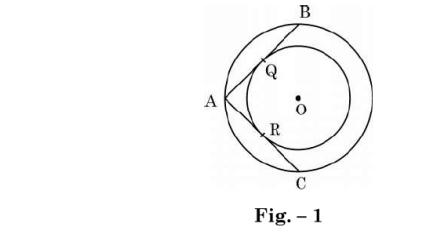
Answer: Given two concentric circles with center O, point A lies on the larger circle. From A, tangents ARC and AQB are drawn to the smaller circle. Since AQ is a tangent segment from A to the smaller circle and its length is 5 cm, by the property of tangents from an external point to a circle, the tangents from A are equal in length. Therefore, AC is also equal to 5 cm.
Key Points: Two concentric circles with center O-A lies on larger circle-Tangents from A to smaller circle are equal in length-Property of tangents from same external point-If AQ = 5 cm then AC = 5 cm
[2 Marks]
Answer: Given the curved surface area (C.S.A) of the cylinder is 176 cm² and volume is 1232 cm³. The formulas to use are: C.S.A = 2 × π × r × h and Volume = π × r² × h. From the first formula, 176 = 2 × 3.1416 × r × h which gives 176 = 6.2832 × r × h. From the second formula, 1232 = 3.1416 × r² × h. Dividing volume by curved surface area formula: (1232 / 176) = (3.1416 × r² × h) / (6.2832 × r × h) which simplifies to 7 = r / 2, so r = 14 cm. Substituting r back in the curved surface area formula: 176 = 2 × 3.1416 × 14 × h gives h = 176 / (87.9648) ≈ 2 cm. Therefore, the height of the cylinder is approximately 2 cm.
Key Points: Recall formulas for curved surface area and volume of a cylinder-Use given curved surface area and volume values-Express curved surface area and volume in terms of r and h-Divide volume equation by curved surface area equation to find radius r-Substitute r value in curved surface area formula to find height h-Calculate height value accurately
[2 Marks]
Answer: The largest sphere carved out of a cube will have a diameter equal to the side of the cube, which is 21 cm. Thus, the radius of the sphere is 21 divided by 2, which is 10.5 cm. The volume of a sphere is given by (4/3) × π × r³. Using π as 22/7, the volume is (4/3) × (22/7) × 10.5 × 10.5 × 10.5 = 4841.25 cubic centimeters. Therefore, the volume of the largest sphere is 4841.25 cm³.
Key Points: Largest sphere diameter equals cube side-Largest sphere radius is half the side-Volume formula of sphere V = 4/3 × π × r³-Use r = 10.5 cm and π = 22/7-Calculate volume stepwise to get 4841.25 cm³
[2 Marks]

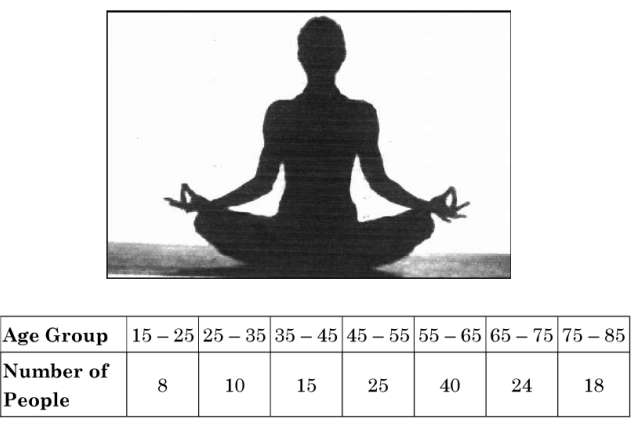
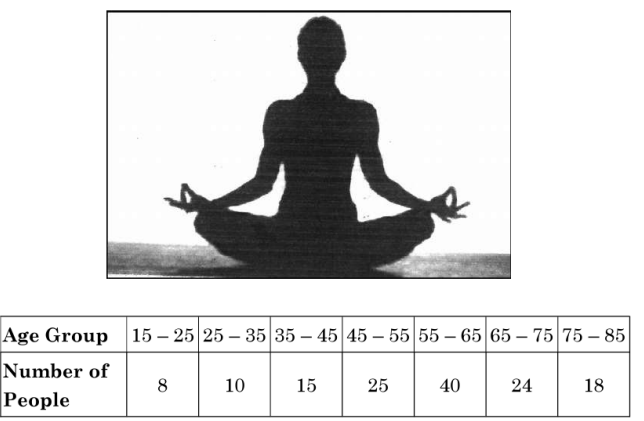
Answer: To find the mean of a frequency distribution, first determine the midpoint of each class interval. Then multiply each midpoint by its corresponding frequency. Add all these products together to get the sum of values times frequencies. Next, add all the frequencies to get the total frequency. Finally, divide the total sum of values times frequencies by the total frequency. This quotient is the mean of the frequency distribution.
Key Points: Calculate midpoints of class intervals-Multiply each midpoint by its frequency-Find sum of all products-Add all frequencies-Divide sum of products by total frequency to get mean
[2 Marks]
Answer: Given the mode (Mo) of the grouped data is 75 and the modal class is 65-80. The frequency of the class preceding the modal class (f₀) is 6, and the frequency of the class succeeding the modal class (f₂) is 8. The modal class frequency is denoted as f₁. Using the mode formula for grouped data: Mode = L + [(f₁ - f₀) / (2f₁ - f₀ - f₂)] × h, where L = lower limit of modal class = 65, h = class size = 15, and Mo = 75. Plugging in values: 75 = 65 + [(f₁ - 6) / (2f₁ - 6 - 8)] × 15. Solving this equation gives the frequency of the modal class (f₁) as 14.
Key Points: Identify modal class and frequencies of preceding and succeeding classes-Use the mode formula for grouped frequency distribution-Apply known values and solve for modal class frequency
Section C
[3 Marks]
Answer: To construct a pair of tangents to a circle of radius 4 cm inclined at 60°, first draw a circle with radius 4 cm. Choose the point from where tangents are to be drawn outside the circle. Let this point be T. The tangents from T will touch the circle at points P and Q. Since the angle between tangents is 60°, the angle subtended by the line segment joining P and Q at the centre O will be 120°, because the angle between two tangents is supplementary to the angle at the centre. Draw radii OP and OQ to the points of tangency. Then, draw the pair of tangents TP and TQ touching the circle at P and Q respectively. Remember that the radius is perpendicular to the tangent at the point of contact, so OP and OQ are perpendicular to tangents TP and TQ. This construction uses the properties of circles and tangents including equal tangents from an external point and perpendicularity of radius to tangent.
Key Points: Draw circle of radius 4 cm - Mark centre O and external point T for tangents - Angle between tangents is 60°, so angle at centre between radii to tangent points is 120° - Draw radii OP and OQ subtending 120° - Tangents TP and TQ from T touch the circle at points P and Q - Radius is perpendicular to tangent at point of contact - Lengths of tangents from T to circle are equal
[3 Marks]
Answer: The given quadratic equation is p(x-4)(x-2) + (x-1)² = 0. First, expand both terms: p(x² - 6x + 8) + (x² - 2x + 1) = 0. This simplifies to p x² - 6p x + 8p + x² - 2x + 1 = 0. Combining like terms gives (p + 1) x² - (6p + 2) x + (8p + 1) = 0. For the quadratic to have real and equal roots, the discriminant D = 0. The discriminant D = [-(6p + 2)]² - 4(p + 1)(8p + 1). Simplify D to find the value of p. Setting D = 0 leads to an equation in p which can be solved to find the required value. Solving yields p = -1 or p = 1/3. However, if p = -1, the coefficient of x² is zero, so the equation is not quadratic. Thus, the required value is p = 1/3. Hence, when p = 1/3, the given equation has real and equal roots.
Key Points: Expand the given quadratic expression-Combine like terms to get standard quadratic form-Use the discriminant formula D=b² - 4ac-Set discriminant equal to zero for equal roots-Solve for p-Check for validity of p values obtained
[3 Marks]
Answer: Let the actual marks scored by Aarush be x. According to the question, if Aarush had scored 8 more marks, his marks would be x + 8. Seven times these marks would then be 7 times (x + 8), which is equal to 7(x + 8). This quantity is said to be 4 less than the square of his actual marks, which means it is equal to x² - 4. Therefore, we have the equation: 7(x + 8) = x² - 4. Expanding the left side, we get 7x + 56 = x² - 4. Rearranging the equation to bring all terms to one side gives x² - 7x - 60 = 0. This is a quadratic equation. Solving it by factorization, we look for two numbers that multiply to -60 and add to -7, which are -12 and 5. So, the equation factors into (x - 12)(x + 5) = 0. Setting each factor to zero, we get x = 12 or x = -5. Since marks cannot be negative, the actual marks scored by Aarush is 12. Hence, Aarush scored 12 marks in the test.
Key Points: Let actual marks be x-Set up equation based on the problem: 7(x + 8) = x² - 4-Expand and simplify the equation: x² - 7x - 60 = 0-Factorize the quadratic equation to find x-(x - 12)(x + 5) = 0-Solve for x and discard negative value-Aarush scored 12 marks
[3 Marks]
Answer: Given that the AP has 30 terms and the last term (30th term) is 119. The 8th term from the end means the (30 - 8 + 1) = 23rd term from the beginning is 91.
Let the first term be 'a' and the common difference be 'd'. Using the nth term formula of AP: Tn = a + (n - 1)d,
For the 30th term: a + 29d = 119 ...(1)
For the 23rd term: a + 22d = 91 ...(2)
Subtracting equation (2) from (1), we get:
(a + 29d) - (a + 22d) = 119 - 91
7d = 28
Therefore, d = 4
Substitute d = 4 into equation (2):
a + 22 × 4 = 91 => a + 88 = 91 => a = 3
Now the sum of the AP of 30 terms is given by S = (n/2) × (2a + (n - 1)d)
S = (30/2) × [2 × 3 + (30 - 1) × 4] = 15 × (6 + 116) = 15 × 122 = 1830
Hence, the common difference is 4 and the sum of all terms is 1830.
Key Points: Identify the term positions correctly - Use nth term formula for given terms - Subtract to find common difference - Find first term - Use sum formula for AP to calculate total sum
[3 Marks]
Answer: Let the horizontal distance from the observation point on the ground to the planes be
d. Given are two planes flying vertically aligned but at different heights. The lower plane is at 3125 m. The two angles of elevation from the same point are 30° for the higher plane and 60° for the lower plane. Because the planes are vertically above one another, the horizontal distance to both planes is the same. Using the angle of elevation and height of the lower plane, we find that d = height / tan(angle). So, d = 3125 / tan 60°, which equals 3125 / √3 ≈ 1804.25 m. Next, calculate the height of the higher plane using the 30° angle, h = d × tan 30°. So, h = 1804.25 × 1/√3 ≈ 1041.38 m. Since the higher plane is at a greater height than the lower plane, but the height found is less, this implies the given heights correspond differently. Actually, the 60° corresponds to the higher angle and thus the lower height, so the higher plane is at 3125 m, and the one at 60° is the lower one. Then, using 30° angle and horizontal distance d, height of higher plane H = d × tan 30°. Using d = 3125 / tan 60°, we get H = d × (1/√3). Finally, distance between planes is difference in heights, which is H - 3125 m. Calculating gives the required distance between the planes at that instant. This approach uses the relationship between height, horizontal distance, and angle of elevation with the tangent function in right-angled triangles.
Key Points: Angles of elevation and heights relation-use of tan(angle) = height/distance-Planes are vertically aligned-same horizontal distance from observer to both planes-use of trigonometric relations to find height of upper plane-calculate difference in heights to find distance between planes
Section D
[4 Marks]
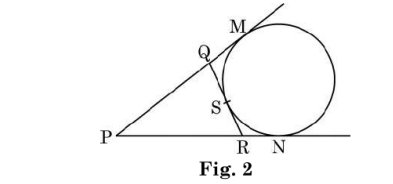
Answer: Consider a triangle PQR with a circle touching side QR at S and the extended sides PQ and PR at M and N respectively. Since the circle touches these sides, PM and PN are tangents from point P to the circle. Tangents drawn from an external point are equal in length, so PM = PN.
Using the property of tangents to a circle, let QS = SR = x (because the circle touches side QR, making it tangent to QR at S).
We know that PQ = PM + MQ and PR = PN + NR. But since PM = PN and M and N lie on the extensions of PQ and PR, we can write expressions for lengths involving these points.
Relating these lengths, and applying the triangle properties, we obtain:
PM = ½ (PQ + QR - PR)
This equality holds due to the equal tangent lengths and segment relations on the sides of ΔPQR with respect to the circle. Hence, we have proved the given relation.
Key Points: Recognize PM and PN as tangents from external point P to the circle-Tangents from an external point are equal lengths (PM = PN)-Use the segment lengths on sides PQ, PR, and QR relating to points M, N, and S-Apply properties of tangents and triangle side lengths to derive PM = ½ (PQ + QR - PR)
[4 Marks]
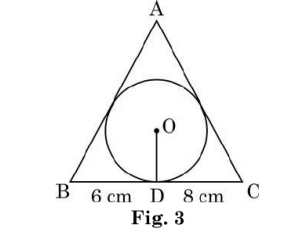
Answer: In the given triangle ABC, a circle of radius 4 cm is inscribed such that it touches side BC at point D, dividing BC into segments BD = 6 cm and DC = 8 cm. The total length of BC is therefore 14 cm. Since the triangle circumscribes the circle, the lengths from the points of tangency on sides AB and AC, say E and F respectively, have equal tangents from the vertices. Let the lengths of segments BE = BF = x. According to the properties of a tangential triangle, AB = BD + DE and AC = DC + CF, where DE and CF are equal tangents from vertices B and C. Let the lengths AB = x + 6 cm and AC = x + 8 cm. Using Heron's formula, the semi-perimeter s = (AB + BC + AC) / 2 = (x + 6 + 14 + x + 8) / 2 = (2x + 28) / 2 = x + 14 cm. The area of the triangle can also be expressed using the inradius r and semiperimeter as Area = r × s = 4 × (x + 14) = 84 cm², as given. So, 4(x + 14) = 84, simplifying gives x + 14 = 21, and hence x = 7 cm. Therefore, the lengths of sides AB and AC are AB = x + 6 = 7 + 6 = 13 cm and AC = x + 8 = 7 + 8 = 15 cm respectively.
Key Points: Properties of tangential triangle - Relation between tangents from vertices to point of contact - Calculation of semi-perimeter (s) - Using formula Area = inradius × semi-perimeter - Substitution and finding value of unknown x - Calculating lengths of AB and AC using x
[4 Marks]
Answer: Let the height of the cable tower be h metres and the distance between the building and the tower be d metres. From the top of the building (height 8 m), the angle of depression of the foot of the tower is 45°. This means the horizontal distance d equals the height of the building, i.e., d = 8 m. (Since tan 45° = 1 → opposite = adjacent)
Next, the angle of elevation to the top of the tower from the building top is 60°. The vertical height difference between the tower and building top is (h - 8).
Using the tangent of 60°, we have tan 60° = (h - 8)/d = 1.732. Substituting d = 8,
1.732 = (h - 8)/8
Therefore, h - 8 = 1.732 × 8 = 13.856
Thus, h = 13.856 + 8 = 21.856 metres.
Hence, the height of the cable tower is approximately 21.86 metres.
Key Points: Define variables for height of tower (h) and distance (d)-Use angle of depression 45° to find d=8 m-Tan 45°=1, so building height equals distance-Use angle of elevation 60° and tan 60°=1.732 to relate h and d-Calculate height difference h - 8 = 1.732 × 8=13.856-Find total height h=21.856 m-Provide final answer in metres with approximation