Class 11 PCB . English . Hornbill . We Re Not Afraid to Die If We Can All Be Together
Chapter 2: “We’ re Not Afraid To Die...If We Can All Be Together”
Ch 2
English
Class 11 PCB
In The Face Of Storm.
The Voyage Begins
- In July 1976, the narrator, his wife Mary, and their children, Jonathan and Suzanne, set sail from Plymouth to repeat Captain James Cook’s round-the-world voyage.
- After 16 years of improving their sailing skills, they began a planned three-year, 105,000-kilometre journey in Wavewalker, a 23-metre, 30-ton wooden boat.
- The boat had been professionally built, fitted out, and tested in rough weather. The family sailed down Africa’s west coast to Cape Town, where American Larry Vigil and Swiss Herb Seigler joined them for the southern Indian Ocean crossing.
The Storm Grows
- Soon after leaving Cape Town, the boat faced weeks of strong gales and waves reaching 15 metres, as high as the main mast.
- On Christmas Day, despite terrible weather, the family celebrated aboard Wavewalker. The weather did not improve on New Year’s Day and soon worsened.
- On January 2, enormous waves and fierce wind forced the crew to slow the boat, secure equipment, practise the liferaft drill, attach lifelines, and put on oilskins and life jackets.
The Wave Hits Wavewalker
- At about 6 p.m., an ominous silence and dark sky were followed by a huge, steep wave with a breaking crest.
- The wave crashed over the stern, knocking the narrator overboard and nearly capsizing the boat. His lifeline pulled him back to Wavewalker.
- Badly injured, with cracked ribs and a mouth full of blood and broken teeth, he returned to the wheel and steered the stern towards the next waves.
The Family Fights to Stay Afloat
- Mary alerted the narrator that the decks were smashed and the boat was filling with water. Larry and Herb worked the pumps while the narrator checked on the children.
- Jonathan and Suzanne were safe in an upper bunk, though Suzanne had a bump on her head.
- The narrator covered the holes in the damaged starboard side with canvas and hatch covers, reducing the water entering the boat.
- The hand pumps clogged and the electric pump short-circuited. He found a spare electric pump under the chartroom floor and got it working.
- Through the freezing night, the crew pumped, steered, and sent Mayday calls, but no reply came from the remote ocean.
The narrator
- Experienced and prepared: he and Mary had spent years developing their sailing skills.
- Courageous and resourceful: despite serious injuries, he steered the boat, repaired the damage, and found a working pump.
Mary
- Committed to the voyage: she shared the long preparation and dangerous journey with her family.
- Alert in the emergency: she came on deck and urgently told the narrator that the boat was badly damaged and filling with water.
Larry Vigil and Herb Seigler
- Dependable crewmen: they worked frantically at the pumps during the emergency.
Courage and Resourcefulness in Crisis
The storm tests the family’s preparation and courage. Their teamwork, quick decisions, and determination help them confront danger together.
- Honing our seafaring skills
- Improving and refining our ability to sail.
- Ominous silence
- An unsettling quiet that suggests danger is near.
- Mayday calls
- Urgent radio messages asking for help in an emergency.
- Pinpricks in the vast ocean
- Tiny, distant points against the immense sea.
- A tousled head
- A head with untidy or dishevelled hair.
What preparations did the crew make as the storm worsened?
How did the narrator respond after Wavewalker was badly damaged?
Quick recap
- The family set out from Plymouth in Wavewalker to repeat Captain James Cook’s voyage.
- Weeks of gales and towering waves battered the boat in the southern Indian Ocean.
- A huge wave struck Wavewalker on January 2, injuring the narrator and flooding the vessel.
- The narrator, Mary, and the crew worked together to steer, pump, and patch the boat.
- A spare electric pump helped them manage the flooding, but their Mayday calls received no reply.
A Journey Of Courage.
Damage and the search for land
- Sue’s injuries: She had a swollen head, black eyes and a deep cut on her arm. She had hidden them so she would not worry her parents while they were trying to save everyone.
- January 3: The pumps brought the water level under control enough for the family to take turns resting. The narrator discovered that nearly all the boat’s main rib frames were smashed; cupboard partitions alone supported part of the starboard hull.
- A new destination: Wavewalker could not hold together long enough to reach Australia. The narrator identified two small islands to the east, including Ile Amsterdam, but the disabled auxiliary engine and rough seas made reaching them difficult.
- January 4: After 36 hours of pumping, they could keep pace with the water still entering. Since the main sail could pull the damaged hull apart, they raised the storm jib and headed towards the islands.
- A brief meal: Mary found corned beef and cracker biscuits—their first meal in almost two days.
The storm returns
- January 4–5: Black clouds gathered, the wind rose to 40 knots and the seas grew higher. By dawn on January 5, their situation was desperate again.
- Jon’s courage: When he asked whether they would die, Jon said he was not afraid if the family could all be together. His words strengthened the narrator’s resolve.
- The narrator’s plan: To protect the weakened starboard side, he turned the undamaged port hull towards the waves and used a makeshift sea anchor: heavy nylon rope and two 22-litre paraffin barrels.
- That evening: Mary and the narrator held hands as water entered through the broken planks, fearing the end was near.
The island is sighted
- January 6: With the wind easing, the narrator used a sextant and estimated their position from wind speed, course, drift and current.
- A difficult estimate: They had lost the main compass; the spare was not corrected for magnetic variation. The narrator also allowed for the westerly currents and estimated they were somewhere in 150,000 kilometres of ocean, searching for an island only 65 kilometres wide.
- Sue’s card: Despite her injuries, Sue gave her parents a loving, hopeful card. Her head was badly swollen; a recurring blood clot between skin and skull later required six minor operations to remove.
- The final approach: The narrator set a course of 185 degrees and expected to see land at about 5 p.m. After waking at 6 p.m., he feared they had missed the island, but Sue and Jon pointed it out ahead.
- Landfall: Ile Amsterdam was a bleak volcanic rock with little vegetation, yet it seemed beautiful to the exhausted family. They anchored offshore; the next morning all 28 inhabitants cheered and helped them ashore.
The narrator
- Resourceful and determined: He managed the pumping, protected the damaged hull and navigated despite the storm and unreliable compass.
- Responsible leader: He tried to reassure his children and continued fighting to bring the family to safety.
Sue
- Selfless and brave: She concealed her injuries to avoid worrying her parents.
- Loving and hopeful: She made them a card of thanks and encouragement despite her serious head injury.
Jonathan (Jon)
- Courageous and affectionate: Though only six, he said he was not afraid to die if the family could stay together.
- Encouraging: He called his father the best captain and, with Sue, helped him see the island.
Mary
- Steadfast and supportive: She stayed at the wheel during crucial hours and shared the family’s ordeal with courage.
Larry and Herbie
- Cheerful and optimistic: The narrator remembered their good spirits under extreme pressure.
Courage and family unity
Love and togetherness help the family endure danger and despair. Courage appears in the narrator’s leadership, Mary’s steadiness and the children’s selflessness and hope.
““we aren’t afraid of dying if we can all be together — you and Mummy, Sue and I.””
Jonathan
Quick recap
- On January 3, the narrator found severe structural damage and turned towards Ile Amsterdam for refuge.
- After pumping out water, the family used a storm jib; a renewed storm made their situation critical.
- The narrator protected the weakened hull by turning the stronger port side towards the waves and using a makeshift sea anchor.
- The narrator’s position estimate left them searching across 150,000 kilometres of ocean for an island only 65 kilometres wide.
- Despite injuries and navigational uncertainty, the family stayed hopeful and worked together.
- On January 6, Sue and Jon spotted Ile Amsterdam, and its 28 inhabitants helped the family ashore.
Exercise
Comprehension Review
What should an answer about the captain’s actions cover?
What should be covered when discussing the voyagers and the narration?
Vessel and Island Reference
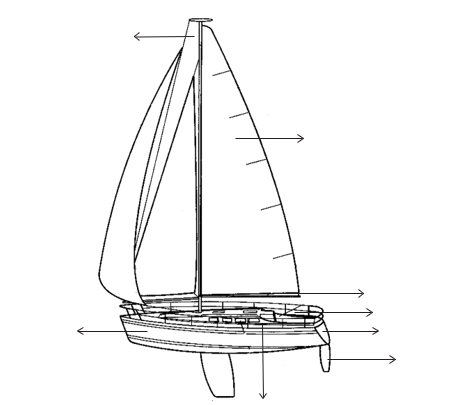
Yacht Parts to Label
- Parts: Bow, cabin, rudder, cockpit, stern, boom, mainsail and mast.
| Feature | Information |
|---|---|
| Location | South Indian Ocean, between the southernmost parts of Australia and South Africa |
| Latitude and longitude | 37 92 S, 77 67 E |
| Sovereignty and status | France; part of the French Southern and Antarctic Lands |
| Population | 35; meteorological station staff |
| Land area | 86 square kilometres |
What information does the exercise give about Ile Amsterdam?
Quick recap
- Use the account to answer what the captain did to protect the ship and control flooding.
- Describe the voyagers’ mental condition separately for 4 and 5 January using the narrative.
- Trace the three sections’ changes in narration and give each a suitable subtitle.
- The yacht-label terms are bow, cabin, rudder, cockpit, stern, boom, mainsail and mast.
- Ile Amsterdam is French territory in the South Indian Ocean; the exercise gives its coordinates as 37 92 S, 77 67 E.
- The exercise lists a population of 35 meteorological station staff and an area of 86 square kilometres.
English — ALL CHAPTERS
1
The Portrait of a Lady
2
“We’ re Not Afraid To Die...If We Can All Be Together”
3
Discovering Tut: The Saga Continues
4
The Ailing Planet: The Green Movement’s Role
5
The Adventure
6
Silk Road
7
Note-making
8
Summarising
9
Sub-titling
10
Essay-writing
11
Letter-writing
12
Creative Writing
1
The Summer of the Beautiful White Horse
2
The Address
3
Mother’s Day
4
Birth
5
The Tale of Melon City