SOLUTIONS

2022 BOARD EXAM

CBSE Class 12 PCM English Board Paper 2022 — Set 3 Solutions

2022

English

Class 12 PCM

CBSE EXAMINATION PAPER-2022

ENGLISH

(Solved)

Time allowed : 3 hours

Maximum Marks : 42

General Instructions :

Read the following instructions carefully and follow them :

  1. This question paper contains 16 questions. All questions are compulsory.
  2. This question paper is divided into 6 sections.
  3. Section A – questions number 1 to 2 are case based questions
  4. Section B – questions number 3 to 9 are short answer
  5. Section C – questions number 10 to 11 are grammar short
  6. Section D – questions number 12 to 14 are long answer
  7. Section E – questions number 15 to 15 are letter
  8. Section F – questions number 16 to 16 are paragraph
  9. There is no overall choice given in the question paper. However, an internal choice has been provided in few questions.
  10. Use of calculator is NOT allowed.

Section A

Question 1. Read the passage given below : Sifting through the sands of time 1 When you’re on the beach, you’re stepping on ancient mountains, skeletons of marine animals, even tiny diamonds. Sand provides a mineral treasure-trove, a record of geology’s earth-changing processes. 2 Sand : as children we play on it and as adults we relax on it. It is something we complain about when it gets in our food, and praise when it’s moulded into castles. But we don’t often look at it. If we did, we would discover an account of a geological past and a history of marine life that goes back thousands and, in some cases, millions of years. 3 Sand covers not just sea-shores, but also ocean beds, deserts and mountains. It is one of the most common substances on Earth. And it is a major element in man-made items too — concrete is largely sand, while glass is made of little else. 4 What exactly is sand ? Well, it is larger than fine dust and smaller than shingle. Depending on its age and origin, a particular sand can consist of tiny pebbles or porous granules. Its grain may have the shape of stars or spirals, their edges jagged or smooth. They have come from the erosion of rocks, or from the skeletons of marine organisms which accumulate on the bottom of the oceans, or even from volcanic eruptions. 5 Colour is another clue to sand’s origins. If it is a dazzling white, its grains may be derived from nearby coral outcrops, from crystalline quartz rocks or from gypsum. On Pacific islands jet black sands form from volcanic minerals. 6 Usually, the older the granules, the finer they are and the smoother the edges. The fine, white beaches, for instance, are recycled from sandstone several hundred million years old. Perhaps they will be stone once more, in another few hundred million. 7 Sand is an irreplaceable industrial ingredient whose uses are legion : but it has one vital function you might never even notice. Sand cushions our land from the sea’s impact, and geologists say it often does a better job of protecting our shores than the most advanced coastal technology.

(1) How is sand a ‘treasure-trove’ ?

[1 Mark]
Answer: Sand is called a 'treasure-trove' because it holds many valuable things like minerals, tiny diamonds, and skeletons of marine animals. It records important geological changes and shows us the history of the Earth and marine life. Thus, sand contains a hidden wealth of natural information and resources, as mentioned in the passage.
Key Points: Contains minerals and tiny diamonds - Holds skeletons of marine animals - Records Earth's geological past and marine life history

(2) What is the origin of white sand ?

[1 Mark]
Answer: White sand originates from nearby coral outcrops, crystalline quartz rocks, or gypsum as explained in the passage. These sources give white sand its dazzling colour and fine texture, often found on beaches formed from very old sandstone deposited over millions of years.
This shows how the colour and composition of sand depend on its origin.
Key Points: White sand comes from coral outcrops - crystalline quartz rocks - gypsum sources - fine texture and dazzling white colour

(3) In what ways are older granules different from recent granules ?

[1 Mark]
Answer: Answer: Older sand granules are generally finer and have smoother edges compared to recent granules. This is because over time, the granules are worn down and polished by natural processes like erosion. The passage states that the fine, white beaches are made of very old sandstone, showing how older granules become smoother and smaller.
Key Points: Older granules are finer - Older granules have smoother edges - Recent granules are coarser with jagged edges

(4) List the different shapes of sand.

[1 Mark]
Answer: Sand grains have different shapes like stars and spirals, with edges that can be jagged or smooth, as mentioned in the passage. These shapes come from the erosion of rocks or skeletons of marine organisms.
Reference: Paragraph 4 describes the shapes of sand grains.
Key Points: Sand grains can be star-shaped - Sand grains can be spiral-shaped - Edges can be jagged or smooth

(5) How is sand both a pain and a pleasure ?

[1 Mark]
Answer: Sand is a pain when it gets into our food or clothes and is annoying. But it is a pleasure because children play on it and adults relax on it. Sand can also be molded into castles, making it fun and useful, as the passage explains.
Key Points: Sand can be annoying when it gets in food or clothes - Children play and adults relax on sand - Sand can be molded into castles making it enjoyable

(6) Name two man-made materials that contain sand.

[1 Mark]
Answer: Answer: Concrete and glass are two man-made materials that contain sand. According to the passage, concrete is largely made of sand and glass contains very little else besides sand.
This shows the importance of sand in making common construction and everyday materials.
Key Points: Concrete contains sand - Glass is made mostly of sand - Sand is an important industrial ingredient
Question 2. Read the passage given below : Extraction And Purification Of Drinking Water 1 Some consumers choose to purchase bottled drinking water, rather than relying on city tap water supplies. Bottled water has typically been extracted from underground sources. If water exists underground, but has no natural exit points, bottling companies may construct a water table well by drilling down to extract water from an unconfined aquifer. This is done when the Earth’s natural water level — known as a water table — is much lower than the Earth’s surface. In some cases, as with a valley or gully on a mountain, the level of the water table may be higher than the Earth’s surface, and a natural spring can emerge. Bottling companies are permitted to extract this water from a hole drilled into the underground spring, but the composition of the water must be identical to that of the naturally surfacing variety nearby. 2 Artesian water is drawn from a confined aquifer, a deep underground cavity of porous rock that holds water and bears pressure from a confining layer above it. This water can be accessed if companies drill a vertical channel down into the confined aquifer. Due to the pressurised nature of this aquifer, water will often rise up from within it and form a flowing artesian well, which appears as an explosive fountain at the Earth’s surface. However, this only occurs when the surface is lower than the natural water table. If the surface is not lower than the natural water table, it is still possible to draw artesian water by using an extraction pump. 3 Some bottled water is advertised as ‘purified’, which means it has been subjected to a variety of cleansing processes. A common filtering procedure, known as reverse osmosis, involves the water being pressed through microscopic membranes that prevent larger contaminants from passing through. The microscopic size of these holes is such that they can even obstruct germs, but they are most effective against undesirable materials such as salt, nitrates and lime scale. One disadvantage of reverse osmosis is that a lot of unusable water is generated as a by-product of the procedure; this must be thrown away. 4 For treating pathogens, an impressive newer option is ultraviolet (UV) light. Powerful UV light has natural antibacterial qualities, so this process simply requires water to be subjected to a sufficient strength of UV light as it passes through a treatment chamber. The light neutralises many harmful germs by removing their DNA, thereby impeding their ability to replicate. A particularly impressive quality of UV light is its ability to neutralise highly resistant viral agents such as hepatitis. 5 The overall effects of UV light treatment are variable, however, which leaves many municipal water treatment processes relying on chlorination. Its powerful and comprehensive antimicrobial effect notwithstanding, chlorination is also extremely inexpensive and remains the only antimicrobial treatment capable of ensuring water remains contaminant-free all the way through the pipes and to the taps of domestic homes. Many members of the public remain suspicious of water that has been treated with such a harsh chemical. Its ease of use and affordability has meant that chlorine often plays an important role in making tainted water supplies safe for consumption immediately after natural disasters have occurred.

(1) Under what conditions does a natural spring emerge?

[1 Mark]
Answer: Answer: A natural spring emerges when the water table is higher than the Earth’s surface, such as in a valley or gully on a mountain. This causes water to flow out naturally to the surface as stated in the passage.
Key Points: Water table higher than Earth’s surface - Natural spring occurs in valleys or gullies - Water flows out naturally to surface

(2) How are pathogens treated?

[1 Mark]
Answer: Pathogens in water are treated using ultraviolet (UV) light and chlorination. UV light kills bacteria and viruses by destroying their DNA, stopping them from multiplying. Chlorination is a cheap method that keeps water safe from germs till it reaches our homes, as explained in paragraphs 4 and 5.
Key Points: UV light removes DNA of pathogens - Chlorination keeps water germ-free in pipes - Both methods ensure water safety for consumption

(3) What forms a flowing artesian well?

[1 Mark]
Answer: Answer: A flowing artesian well is formed when water from a confined aquifer rises up under pressure and flows out naturally at the Earth’s surface, appearing like an explosive fountain. This happens only if the surface is lower than the natural water table, as explained in the passage.
Key Points: Artesian well - Confined aquifer - Pressurised water rises naturally

(4) Why is municipal water treated by chlorination?

[1 Mark]
Answer: Municipal water is treated by chlorination because it is a powerful and inexpensive antimicrobial method that keeps water free from harmful germs throughout the pipes and up to the tap, as explained in the passage. Chlorine ensures safe drinking water even after natural disasters, making it very effective for public health.
Key Points: Chlorination is powerful antimicrobial treatment - It is inexpensive and easy to use - Ensures water remains contaminant-free through pipes to taps

(5) What is a confined aquifer?

[1 Mark]
Answer: Answer: A confined aquifer is a deep underground cavity of porous rock that holds water and is covered by a pressure-bearing layer above. It contains artesian water, which can rise on its own due to this pressure when accessed by drilling, as explained in the passage.
Key Points: Deep underground cavity - Porous rock holding water - Covered by a confining pressure layer

(6) Explain the term ‘purified’ water.

[1 Mark]
Answer: Purified water is water that has been cleaned by processes like reverse osmosis to remove harmful contaminants such as salt, nitrates, lime scale, and germs. This makes the water safe and healthy to drink by removing impurities as explained in the passage.
Key Points: Water cleaned by removing harmful substances - Uses processes like reverse osmosis - Safe and clean for drinking

Section B

Question 3. Grief is often seen as a measure of love. Justify your response to Buddha’s sermon.
[2 Marks]
Answer: The story of Kisa Gotami, as narrated by Buddha, reflects profound wisdom about grief and love. When she lost her only son, her immense grief showed the depth of her love. Buddha explained that grief arises from attachment and love, making it a natural, personal response to loss. He advised Kisa Gotami to seek mustard seeds from homes untouched by death, symbolizing the universality of suffering. This taught her that grief, though deeply personal, is a common human experience. Thus, grief can be seen as a measure of love because it shows how deeply we care for those we lose. Buddha’s teachings remain relevant today, helping us understand grief not as weakness but as an expression of love and attachment, while guiding us to accept impermanence and find peace.
Key Points: Kisa Gotami’s story - grief as sign of deep love - Buddha’s teaching on universality of suffering - grief arises from attachment - grief is personal and natural - grief as measure of love - relevance of Buddha’s sermon today - acceptance of impermanence - finding peace through understanding grief
Question 4. How did the baker become synonymous with celebrations and occasions in Goa? (Glimpses of India)
[2 Marks]
Answer: In Goa, the baker, also known as 'pader', has been an essential figure in village life, especially during celebrations and special occasions. Traditionally, Goan bakers prepared important items like cakes and bolinhas that were indispensable during Christmas and other festivals. On significant family events such as a daughter's engagement, the lady of the house prepared sandwiches using the bread and cakes provided by the baker. The presence of the baker’s furnace was vital in the village to meet these festive needs. Even after Goa’s liberation and the decline of Portuguese-style bread, the paders survived by adapting to new methods like door-to-door bread delivery, maintaining their important role in society. Hence, the baker became synonymous with celebrations as they supplied festive delicacies that brought families and villages together during joyous moments and cultural festivals.
Key Points: Bakery items like cakes and bolinhas essential for Christmas and festivals-Traditional bread and cakes used in celebrations-The role of baker’s furnace in the village-Baker’s importance during family occasions like engagements-Survival of paders through adaptation after Goa’s liberation-Connection between baker and villagers in festive contexts
Question 5. How would you describe Custard the Dragon?
[2 Marks]
Answer: Custard the Dragon is a unique and interesting character from the poem 'The Tale of Custard the Dragon' by Ogden Nash. Custard has big sharp teeth, spikes on top, and scales underneath, making him look fierce and strong. Despite his appearance, he is called a cowardly dragon because he is afraid and likes to stay in a safe cage. His friends tease him because of this. However, when danger arrives, Custard bravely defends his friends, showing he is actually courageous and protective underneath his shy personality.
Key Points: Custard has big sharp teeth and spikes-Called a coward because he fears and wants a safe cage-Teased by friends for being scared-Actually brave and protective in danger
Question 6.

‘Amanda is alone but not lonely in the world she envisions.” Give instances from the poem to justify.

[2 Marks]
Answer: In the poem, Amanda is physically alone, but she is not lonely because she escapes into a world of imagination where she feels happy and content. For instance, she imagines herself as a mermaid with silvery hair in a green sea, enjoying the freedom of the waves. She also dreams of being Rapunzel, letting her hair down from a tower, suggesting a wish to be playful and carefree. These images show how Amanda's imagination gives her company and joy, keeping her from feeling lonely. Even though she might feel lonely in reality, her dreams provide her a comforting and lively world.
Key Points: Amanda is physically alone but happy in her imagination-Amanda imagines herself as a mermaid in the green sea-Amanda dreams of being Rapunzel, carefree and playful-These imaginative dreams show Amanda’s companionship and joy despite solitude
Question 7.

‘A parent should try to be a companion to a child.’” Explain with reference to Richard’s mother. (The Making of a Scientist)

[2 Marks]
Answer: Richard’s mother exemplified how a parent can be a true companion to their child. She supported and encouraged Richard’s curiosity by taking him on educational trips and providing him with scientific equipment like telescopes, microscopes, and cameras. She actively participated in his learning process and understood his motivations. Richard’s mother said that she was his only companion until he started school, showing the closeness they shared. Her companionship helped Richard develop a genuine interest in science, aiming to do his best for the right reasons. This shows that when parents become companions by sharing interests and encouraging learning, they create a nurturing environment that helps the child grow intellectually and emotionally.
Key Points: Richard’s mother encouraged his interest in learning - She provided scientific tools and accompanied him on trips - She was his companion before he started school - Richard’s motivation was to do his best, supported by his mother - Being a companion means sharing interests and nurturing growth - Parental companionship fosters intellectual and emotional development
Question 8.

How did the necklace change the life of Loisel ?

[2 Marks]
Answer: The necklace profoundly changed the life of Loisel and his wife, Matilda. Initially, Matilda desired a wealthy and luxurious life, but she was born into a modest family. When she borrowed a beautiful diamond necklace to attend a prestigious ball, she lost it. To replace the necklace, the Loisels had to borrow a huge amount of money and spent the next ten years repaying their debts. This forced them into a life of extreme poverty and hard work, drastically lowering their social status and happiness. The necklace, which appeared valuable, turned out to be fake, making their sacrifice pointless. This incident changed their future forever, teaching a hard lesson about vanity, pride, and honesty.
Key Points: Matilda's desire for luxury leads to borrowing the necklace-The necklace is lost and must be replaced-Loisels borrow money to replace the necklace-They live in poverty for 10 years to repay debts-The necklace was fake, implying their sacrifice was unnecessary-Life of Loisels changed from moderate comfort to hardship
Question 9.

Do you agree with the poet Walt Whitman’s perception of animal life. Justify. (Animals)

[2 Marks]
Answer: Yes, I agree with Walt Whitman’s perception of animal life as he views animals with deep respect and admiration. Whitman celebrates the natural instincts and freedom of animals, portraying them as beings with dignity and a strong connection to nature. Unlike negative perspectives that see animals as mere creatures subject to human control, Whitman appreciates their simplicity and purity. Through his poems, he emphasizes harmony between humans and animals, encouraging us to recognize their intrinsic value and the peaceful coexistence they symbolize. This perspective contrasts with the conflict shown in poems like "A Tiger in the Zoo," where animals suffer from human interference. Whitman's views inspire us to treat animals kindly and understand their role in nature rather than dominate or destroy them.
Key Points: Whitman respects and admires animals-Animals symbolize freedom and natural dignity-Poem highlights harmony between humans and animals-Contrasts with conflict in "A Tiger in the Zoo"-Encourages kindness and coexistence-Animals have intrinsic value and purity

Section C

Question 10.

The following paragraph has not been edited. There is one error in each line. Identify the error and write its correction against the correct blank number. Remember to underline the correction. The first one has been done for you. Error Correction. The first one has been done for you.

Discipline at public life ensures (e.g.) at in

peace and harmony, who in turn (a) ________ ________

offer the required impetous (b) ________ ________

from the progress. (c) ________ ________

[3 Marks]
Answer:

Errors and corrections:

Example: at → in

(a) who → which
Correction: peace and harmony, which in turn

(b) impetous → impetus
Correction: offer the required impetus

(c) from → for
Correction: from the progress.     for the progress.

Corrected paragraph:
Discipline in public life ensures peace and harmony, which in turn offer the required impetus for the progress.

Key Points: Identify error in each line-Correct 'at' to 'in' in first line-Replace 'who' with 'which' after 'peace and harmony'-Correct spelling 'impetous' to 'impetus'-Replace preposition 'from' with 'for' in last line-Write corrections clearly opposite to each blank-Underline the corrections-Rewrite the paragraph correctly after corrections
Question 11.

Read the conversation below and complete the passage that follows:

Doctor: You must exercise daily to keep your heart fit.

Patient: Is it enough if I go for a daily morning walk and do some breathing exercises?

The doctor advised the patient that he (a) _________ to keep his heart fit.

The patient questioned whether it was enough if he (b) _________ and did some breathing exercises.

[3 Marks]
Answer: The doctor advised the patient that he (a) must exercise daily to keep his heart fit. The patient questioned whether it was enough if he (b) went for a daily morning walk and did some breathing exercises. The conversation highlights the importance of regular exercise, including activities like walking and breathing exercises, which help maintain heart fitness and overall health.
Key Points: Doctor's advice about daily exercise-The patient mentioning daily morning walk and breathing exercises-Importance of exercise for heart health

Section D

Question 12.

After reading the story ‘Bholi’ you find her to be ‘a role-model’ for village girls. Discuss.

[4 Marks]
Answer:

Bholi is a true role-model for the village girls because she overcame the social barriers and hardships that many girls in villages face. Initially, Bholi was neglected due to her speech problem and was considered a less important child in her family. But her teacher saw her potential and encouraged her to gain confidence and face the challenges boldly. Bholi’s transformation from a timid, neglected girl to a confident young woman who stood up against injustice, especially in refusing to marry a man she did not like, is inspiring.

Her story teaches village girls to believe in themselves and to fight against discrimination and social evils like child marriage and neglect of girl children. Bholi’s success was possible because of education and support from her teacher which motivates girls to pursue education and help change society’s attitude towards girls. This story encourages girls to be brave, speak up for their rights, and not be afraid of societal pressures.

In conclusion, Bholi’s journey from a neglected girl to a confident individual makes her an ideal role model for village girls, showing them the importance of education, self-respect, and courage.

Key Points: Bholi faced social neglect and had a speech problem - Teacher encouraged and motivated her - Education helped Bholi gain confidence - Bholi stood against child marriage - Her transformation is inspiring for village girls - Encourages education and self-respect among girls - Role in changing social attitudes - Importance of courage and self-belief in girls
Question 13. Valli was sensitive, but at the same time she was fearless and quite determined. Explain with reference to the text.
[4 Marks]
Answer: Valli, the young girl in the story, shows sensitivity as well as fearlessness and determination. She is sensitive because she notices and understands things around her deeply, as seen when she agrees that things happen without our knowledge, showing awareness of the world. Despite her sensitivity, Valli is fearless. She bravely plans a bus ride on her own, a significant act for an eight-year-old, to satisfy her desire to explore and see new places. She is determined because she saves money by collecting and selling paper to pay for the bus fare. She also fearlessly stands on the bus seat to see a broader view, showing her courage and eagerness to learn. Her act of calling out loudly to stop the bus reflects her boldness. Valli’s determination and fearlessness drive her actions, whereas her sensitivity makes her thoughtful and observant. Together, these qualities make her a brave and keen child who wants to experience and understand life beyond her known world.
Key Points: Valli is sensitive because she notices things carefully and agrees thoughtfully - Valli's fearlessness is shown by her planning and riding the bus alone - She is determined as she saves money by collecting paper to pay the fare - She boldly stands up on the bus seat and calls out to stop the bus - These traits together show her courage and strong will
Question 14.

Russian society emerges as an important character in the play, ‘The Proposal’. Support your answer giving instances.

[4 Marks]
Answer:

Anton Chekhov's one-act play 'The Proposal' brilliantly portrays Russian society, making it almost a character in itself. The social customs, dialogues, and interactions between the characters reflect the values and attitudes prevalent in Russia during the time. For instance, the play revolves around the act of proposing marriage, a significant social ritual, showcasing how seriously and formally it was treated in Russian culture. The language used, such as addressing men with terms like 'my darling' or 'my treasure,' highlights the Russian style of expression which may seem unusual in English but is typical in the Russian context.

Moreover, the negotiations and disputes over land and property between Lomov and Chubukov mirror the importance of landowning in Russian society, indicating social status and wealth. The constant quarrels between the characters also humorously reflect the rigid and prideful nature of people in that era. The simplicity of the wedding preparations mentioned suggests a contrast between social expectations and the straightforward lifestyle of Russian people.

Thus, through the characters' behavior, speech patterns, and the thematic focus on marriage and property, Chekhov effectively encapsulates the peculiarities and nuances of Russian society, making it an essential element that drives the play’s humor and message.

Key Points: The play reflects Russian customs and social rituals-The language and expressions are distinctively Russian-The significance of land and property in social status-Quarrels reveal pride and social attitudes-Simplicity in wedding preparations reflects Russian lifestyle

Section E

Question 15. You are Sujata/Sudhir, Secretary of the Student Council, Nav Vihar Public School, Mumbai. You are planning an excursion to Jim Corbett National Park for students. Write a letter to the Director, Tourism Department, Jim Corbett National Park, enquiring about a package for 100 students which would include transportation, sightseeing, boarding and lodging for 4 nights.
[5 Marks]
Answer:

Nav Vihar Public School
Mumbai

15 April 2024

The Director
Tourism Department
Jim Corbett National Park
Ramnagar, Uttarakhand

Subject: Enquiry about Excursion Package for 100 Students

Dear Sir/Madam,

I am Sudhir, Secretary of the Student Council of Nav Vihar Public School, Mumbai. We are planning an educational excursion to Jim Corbett National Park for 100 students. We would like to enquire about the available packages that include transportation, sightseeing, boarding, and lodging for a duration of four nights.

Please provide details on the cost per student, types of accommodation available, transport facilities from Mumbai or nearest railway station, and the sightseeing options included in the package. Additionally, information on meals, safety measures, and any terms and conditions would be appreciated.

We look forward to receiving the information at the earliest so that we can finalize the trip planning.

Thank you for your assistance.

Yours faithfully,
Sudhir
Secretary, Student Council
Nav Vihar Public School, Mumbai

Key Points: Sender's address and date-Recipient's address-Subject of the letter-Introduction mentioning the purpose-Enquiry about package details including transportation, lodging, boarding and sightseeing-Request for cost and facilities information-Closing with anticipation for prompt reply and signature

Section F

Question 16.

School authorities and parents have realized the benefits of encouraging their children to play and participate in sports. The age-old myth that academics is the only foundation for a successful career has been replaced. Write a paragraph in not more than 120 words analyzing the given information :
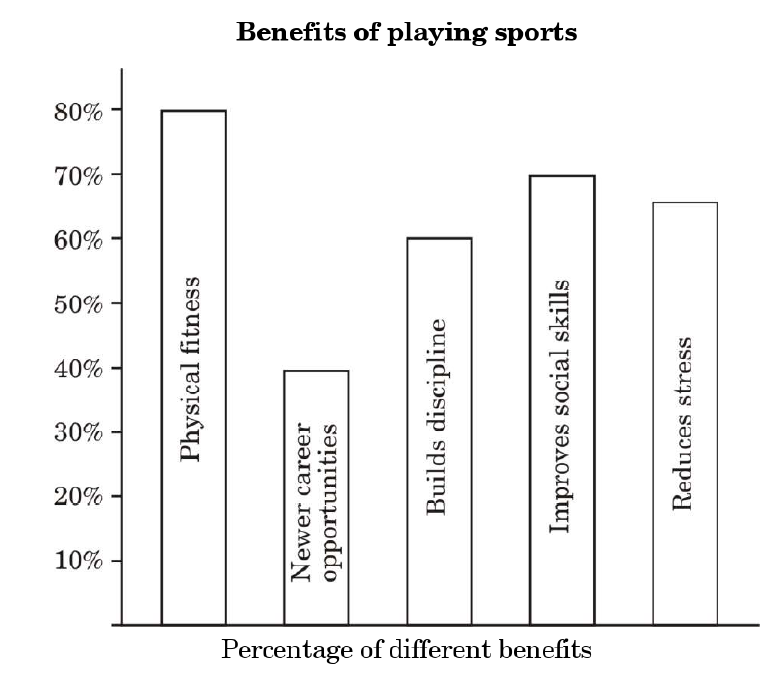
[5 Marks] Diagram 1 – CBSE Class 12 PCM English 2022 Set 3 Solutions
Answer: In today’s world, both parents and school authorities have rightly understood the importance of sports alongside academics. Encouraging children to play and engage in sports not only improves their physical health but also boosts their mental and emotional well-being. Sports teach important life skills such as teamwork, discipline, patience, and the ability to handle both winning and losing gracefully. The old belief that academic success alone guarantees a successful career no longer stands true because participation in sports develops a balanced personality and essential social skills. Therefore, integrating sports with studies creates a holistic environment for children to grow, preparing them better for future challenges in life.
Key Points: Importance of sports alongside academics-Benefits of sports on physical and mental health-Life skills learned from sports like teamwork and discipline-Sports develop a balanced personality and social skills-Replacement of old myth that only academics ensure career success-Holistic development through sports and education

Paper Details

CBSE Board Exam 2022

Class

Class 12 PCM

Subject

English

Year

2022

Set

Set 3

Other Years — English

2022 Set-1

2022 Set-2

2022 Set-3

2022 Set-4

2023 Set-1

2023 Set-2

2023 Set-3

2023 Set-4

2024 Set-1

2024 Set-2

2024 Set-3

2025 Set-1

2025 Set-2

2025 Set-3

CBSE Class 12 English 2022 Set 3 Solutions | Prepzy