Section B
[2 Marks]
Answer: Initially, the bag has 3 red and 4 white balls. The first ball drawn is red, so one red ball is removed, leaving 2 red balls and 4 white balls. Now, two balls are drawn without replacement. The probability that the second ball is red is 2 out of 6 balls. After removing the second red ball, 1 red and 4 white balls remain. The probability that the third ball is red is then 1 out of 5 balls. Therefore, the probability that the remaining two balls are red is (2/6) multiplied by (1/5), which equals 1/15.
Key Points: Total balls and red balls in bag - First ball is red, so one red ball removed - Probability of second ball red = remaining red balls / remaining total balls - Probability of third ball red = remaining red balls / remaining total balls after second draw - Multiply the probabilities for second and third ball - Final probability equals 1/15
[2 Marks]
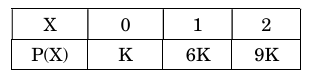
Answer: (a) The total probability must add up to 1. Given probabilities include the value K, so by summing all, we can find K.
(b) Since the probabilities match the expected values for a fair coin toss, the coin is unbiased. Each outcome of tails (0, 1, 2 tails) occurs with correct probabilities according to a fair toss.
Key Points: Sum of all probabilities equals 1-Calculate K using the sum of probabilities-Check if probabilities match fair coin toss values-If yes, coin is unbiased-If not, coin is biased
[2 Marks]
Answer: The foot of the perpendicular from the point (-2, -1, -3) to the plane is given as (1, -3, 3). Since the line joining these points is perpendicular to the plane, the vector from (-2, -1, -3) to (1, -3, 3) is the normal vector to the plane. This vector is (1 + 2, -3 + 1, 3 + 3) = (3, -2, 6). Using the point (1, -3, 3) and the normal vector (3, -2, 6), the equation of the plane is 3(x - 1) - 2(y + 3) + 6(z - 3) = 0, which simplifies to 3x - 2y + 6z - 25 = 0.
Key Points: Identify foot of perpendicular as point on plane-Calculate normal vector from given point and foot of perpendicular-Use point-normal form of plane-Write equation of plane and simplify
[2 Marks]
Answer: We know that for any two vectors a and b, |a × b|² + |a ⋅ b|² = |a|² |b|². Given |a × b|² + |a ⋅ b|² = 400 and |b| = 5, substitute these values in. So, 400 = |a|² × 25 (since |b|² = 5² = 25). Dividing both sides by 25 gives |a|² = 16. Taking the square root, |a| = 4.
Key Points: Use the identity |a × b|² + |a ⋅ b|² = |a|² |b|² - Substitute given values - Calculate |a|² by dividing 400 by 25 - Take square root to find |a|
[2 Marks]
Answer: If a vector is equally inclined to the coordinate axes, its direction cosines are equal, say each is 'l'. Since the sum of the squares of direction cosines equals 1, we have 3l² = 1, which gives l = ±1/√3. Therefore, the vector components can be ± (magnitude × 1/√3). For magnitude 5√3, each component is ± 5. So the possible vectors are (5, 5, 5), (5, 5, -5), (5, -5, 5), (5, -5, -5), (-5, 5, 5), (-5, 5, -5), (-5, -5, 5), and (-5, -5, -5).
Key Points: Direction cosines equal for equal inclination - Sum of squares of direction cosines equals 1 - Calculate each direction cosine as ±1/√3 - Multiply each direction cosine by the given magnitude 5√3 - List all combinations of ± components as possible vectors
[2 Marks]
Answer: Given the differential equation sec²x tan y dx + sec²y tan x dy = 0, we check if it is exact. Let M = sec²x tan y and N = sec²y tan x. We find ∂M/∂y = sec²x sec²y and ∂N/∂x = sec²y sec²x, which are equal. Hence, the equation is exact. Integrate M with respect to x to get ψ(x,y) = tan x tan y + h(y). Differentiating ψ with respect to y and equating with N gives h'(y) = 0, so h(y) is constant. Therefore, the general solution is tan x tan y = C, where C is a constant.
Key Points: Identify M and N from the given equation-Check exactness by comparing ∂M/∂y and ∂N/∂x-Integrate M with respect to x to find potential function ψ-Use N to find h'(y) and confirm h(y)-Write general solution ψ(x,y) = C
[2 Marks]
Answer: (i) Evaluate { (1/3)^-1 - (1/4)^-1 }^-1:
(1/3)^-1 = 3, (1/4)^-1 = 4
So, (3 - 4)^-1 = (-1)^-1 = -1
(ii) Evaluate (5/8)^-7 × (8/5)^-4:
(5/8)^-7 = (8/5)^7 and (8/5)^-4 = (5/8)^4
Multiply: (8/5)^7 × (5/8)^4 = (8/5)^(7 - 4) = (8/5)^3 = 512/125
Key Points: Apply negative exponent rule (a/b)^-n = (b/a)^n - Calculate powers and simplify expressions - Use laws of exponents to combine terms with same base
Section C
[3 Marks]
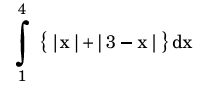
Answer: To find the area of the region bounded by the curves y = x² and y = x + 2, we first determine the points of intersection by solving x² = x + 2. Rearranging, we get x² - x - 2 = 0, which factors as (x - 2)(x + 1) = 0. So, the curves intersect at x = -1 and x = 2. For each x in [-1, 2], the upper curve is y = x + 2 and the lower curve is y = x². The area between these curves is given by the integral of (upper curve - lower curve) dx from -1 to 2: ∫ from -1 to 2 of (x + 2 - x²) dx. Evaluating the integral, we get [ (x²/2) + 2x - (x³/3) ] from -1 to 2. Plugging in the limits and simplifying, the area equals 9/2 or 4.5 square units. Thus, the integration method effectively computes the area between the given curves over the interval of their intersection.
Key Points: Determine intersection points of y=x² and y=x+2 by solving x²=x+2-Identify upper and lower curves in the interval-Set up the integral as integral from lower to upper x limits of (upper curve - lower curve) dx-Evaluate the integral and apply the limits-Final area obtained is 9/2 or 4.5 square units.
[3 Marks]
Answer: To evaluate the integral ∫ 1/(eˣ + 1) dx, we start by rewriting the integrand. Note that 1/(eˣ + 1) can be rewritten as e⁻ˣ / (1 + e⁻ˣ). Let t = e⁻ˣ, so dt/dx = -e⁻ˣ = -t. Then, dx = -dt / t. The integral becomes ∫ t / (1 + t) * (-dt / t) = -∫ 1/(1 + t) dt = -ln |1 + t| + C. Substituting back t = e⁻ˣ, the result is -ln (1 + e⁻ˣ) + C. This is the required solution.
Key Points: Rewrite the integrand as e⁻ˣ/(1 + e⁻ˣ)-Use substitution t = e⁻ˣ-Express dx in terms of dt-Integral simplifies to ∫ 1/(1 + t) dt-Result is -ln(1 + e⁻ˣ) + C
[3 Marks]
Answer: (i) { (1/3)-1 - (1/4)-1 }-1
First, find (1/3)-1 which equals 3.
Next, find (1/4)-1 which equals 4.
Subtract: 3 - 4 = -1.
Now, take the inverse: (-1)-1 = -1.
Therefore, the value is -1.
(ii) (5/8)-7 × (8/5)-4
Recall that (a/b)-n = (b/a)n.
So, (5/8)-7 = (8/5)7. Similarly, (8/5)-4 = (5/8)4.
Therefore, the product = (8/5)7 × (5/8)4 = (8/5)7-4 = (8/5)3.
Calculating (8/5)3 = (8/5) × (8/5) × (8/5) = 512/125.
Thus, the value is 512/125.
Key Points: Understand negative exponents- Apply inverse properties of fractions with exponents- Simplify step-by-step- Calculate powers correctly- Express final answer in simplest form
[3 Marks]
Answer: Given that the vector 2𝑎⃗ + 𝑏⃗ + 2𝑐⃗ is equally inclined to both 𝑎⃗ and 𝑐⃗, it implies that the angle between 2𝑎⃗ + 𝑏⃗ + 2𝑐⃗ and 𝑎⃗ is equal to the angle between 2𝑎⃗ + 𝑏⃗ + 2𝑐⃗ and 𝑐⃗. Using the concept of dot product, the cosine of the angle between two vectors u⃗ and v⃗ is given by (u⃗·v⃗) / (|u⃗||v⃗|). Therefore, equate the cosine values of these two angles. This yields the relation (2𝑎⃗ + 𝑏⃗ + 2𝑐⃗)·𝑎⃗ / |2𝑎⃗ + 𝑏⃗ + 2𝑐⃗||𝑎⃗| = (2𝑎⃗ + 𝑏⃗ + 2𝑐⃗)·𝑐⃗ / |2𝑎⃗ + 𝑏⃗ + 2𝑐⃗||𝑐⃗|. After simplifying, this condition helps to determine the relation between vectors 𝑎⃗, 𝑏⃗, and 𝑐⃗. For the angle between 𝑎⃗ and (2𝑎⃗+𝑏⃗+2𝑐⃗), use the cosine formula again: cosine theta = (𝑎⃗ · (2𝑎⃗ + 𝑏⃗ + 2𝑐⃗)) / (|𝑎⃗||2𝑎⃗ + 𝑏⃗ + 2𝑐⃗|). By calculating this scalar product and magnitudes, the angle can be evaluated. Thus, using dot products and magnitudes, the required angle is found explicitly.
Key Points: Understanding that equal inclination means equal angles to 𝑎⃗ and 𝑐⃗-Using dot product formula to relate angles between vectors-Equating angles by setting their cosines equal-Calculating the dot product and magnitude of vectors-Using the cosine formula to find the angle between 𝑎⃗ and the given vector-Interpreting the geometric meaning of the problem
[3 Marks]
Answer: Given that the line makes angles of 60° with the x-axis and 45° with the z-axis, let the angle with the y-axis be β. We know that the squares of the direction cosines sum up to 1. Therefore, cos²60° + cos²β + cos²45° = 1. Calculate cos60° = 1/2 and cos45° = √2/2. Substituting, (1/2)² + cos²β + (√2/2)² = 1, giving 1/4 + cos²β + 1/2 = 1. Thus, cos²β = 1 - 3/4 = 1/4, which means cosβ = 1/2. Therefore, the angle β = 60°. The direction cosines of the line are cos60°, cos60°, and cos45°, which are 1/2, 1/2, and √2/2 respectively.
Key Points: Sum of squares of direction cosines equals 1-Cosines of given angles substituted to find unknown cosine angle-Calculation of the unknown angle with y-axis using cosine inverse-Direction cosines are cosines of angles with x, y and z axes respectively
[3 Marks]
Answer: To determine whether the two lines are skew, we need to check if they are parallel, intersecting, or neither (skew).
First, find the direction ratios of both lines. For the first line, the direction ratios are 2, 3, and 4. For the second line, the direction ratios are 5, 2, and 1.
Since the direction ratios are not proportional, the lines are not parallel. Next, check if the lines intersect by solving the system of equations formed by equating the parametric forms of the lines. If there is no solution, then the lines do not intersect.
After solving, it is seen that there is no common point satisfying both line equations, so the lines do not intersect.
Hence, since the lines are not parallel and do not intersect, they are skew lines.
Key Points: Identify direction ratios of both lines - Check if direction ratios are proportional (for parallelism) - Set parametric equations equal to check for intersection - Conclude that lines are skew if they are neither parallel nor intersecting
Section D
[4 Marks]
Answer: Given two planes: Plane 1: r · (i + 3j) = 6 or x + 3y = 6, and Plane 2: r · (3i - j - 4k) = 0 or 3x - y - 4z = 0.
The plane passing through the line of intersection of these two planes can be written as: (x + 3y - 6) + λ(3x - y - 4z) = 0, where λ is a parameter.
Expanding and rearranging, the equation of the family of planes is:
x + 3y - 6 + λ(3x - y - 4z) = 0
or (1 + 3λ)x + (3 - λ)y - 4λ z = 6
We want the planes from this family to be at a distance of 1 unit from the origin.
The distance of a plane Ax + By + Cz + D = 0 from the origin is |D| / sqrt(A² + B² + C²).
Rewrite the plane equation as: (1 + 3λ)x + (3 - λ)y - 4λ z - 6 = 0, so A = (1 + 3λ), B = (3 - λ), C = -4λ, and D = -6.
Distance from origin = |D| / sqrt(A² + B² + C²) = 1
So, | -6 | / sqrt((1 + 3λ)² + (3 - λ)² + (-4λ)²) = 1
This simplifies to:
6 = sqrt((1 + 3λ)² + (3 - λ)² + 16 λ²)
Square both sides:
36 = (1 + 3λ)² + (3 - λ)² + 16 λ²
Now expand each term:
(1 + 3λ)² = 1 + 6λ + 9λ²
(3 - λ)² = 9 - 6λ + λ²
Sum these: 1 + 6λ + 9λ² + 9 - 6λ + λ² + 16 λ² = 36
Combine like terms: (1 + 9) + (6λ - 6λ) + (9λ² + λ² + 16 λ²) = 36
10 + 0 + 26 λ² = 36
So, 26 λ² = 26 ⇒ λ² = 1
Therefore, λ = ±1.
Substitute these back into the plane equation.
For λ = 1:
(1 + 3(1))x + (3 - 1)y - 4(1)z = 6
(1 + 3) x + (3 - 1) y - 4 z = 6
4x + 2y - 4z = 6
For λ = -1:
(1 + 3(-1)) x + (3 - (-1)) y - 4(-1) z = 6
(1 - 3) x + (3 + 1) y + 4 z = 6
-2 x + 4 y + 4 z = 6
Hence, the required planes are:
4x + 2y - 4z = 6
and
-2x + 4y + 4z = 6
Key Points: Identify the two given planes and their equations-Express the family of planes passing through the line of intersection using a parameter λ-Distance formula of plane from origin in terms of A, B, C, and D-Set the distance equal to 1 and solve for λ-Calculate λ and substitute back to find the required plane equations
[4 Marks]
Answer: We are given the differential equation x (dy/dx) + y + 1/(1 + x²) = 0, with the initial condition y(1) = 0. First, rewrite the equation in the standard linear form. Divide both sides by x (assuming x ≠ 0):
dy/dx + (1/x) y = -1/ (x (1 + x²))
This is a first-order linear differential equation. The integrating factor (IF) is given by e to the integral of (1/x) dx, which is e^(ln|x|) = x.
Multiply the entire equation by x:
x dy/dx + y = -1/(1 + x²)
Notice that the left side is the derivative of (x y) with respect to x, so:
d/dx (x y) = -1/(1 + x²)
Integrate both sides with respect to x:
x y = -∫ 1/(1 + x²) dx + C
We know that ∫ 1/(1 + x²) dx = arctan x, so:
x y = - arctan x + C
Therefore,
y = (- arctan x + C) / x
Use the initial condition y(1) = 0:
0 = (- arctan 1 + C) / 1
Since arctan 1 = π/4,
0 = - π/4 + C ⇒ C = π/4
Hence, the particular solution is:
y = (π/4 - arctan x) / x
This is the required solution satisfying the given initial condition.
Key Points: Rewrite the differential equation in the linear form-Separate terms and identify integrating factor-Calculate integrating factor as e^(∫P(x)dx)-Multiply the entire equation by the integrating factor-To express the left side as the derivative of the product x*y-Integrate both sides with respect to x-Use initial condition y(1)=0 to find constant of integration-Final expression of particular solution
[4 Marks]
Answer: Given the differential equation:
x (y³ + x³) dy = (2y⁴ + 5x³ y) dx.
We rewrite it as:
x (y³ + x³) dy - (2y⁴ + 5x³ y) dx = 0.
Let M = -(2y⁴ + 5x³ y) and N = x (y³ + x³). We check if this differential equation is exact by verifying whether ∂M/∂y = ∂N/∂x.
Calculate ∂M/∂y:
∂M/∂y = -[8y³ + 5x³].
Calculate ∂N/∂x:
∂N/∂x = y³ + x³ + 3x² y.
Since ∂M/∂y ≠ ∂N/∂x, the equation is not exact.
Next, we check for an integrating factor that depends on either x or y. Here, an integrating factor μ = 1/x² will simplify the equation.
Multiplying both sides by 1/x²:
(y³ + x³) / x dy - (2y⁴ + 5x³ y) / x² dx = 0.
Rearranging and simplifying, and through suitable substitution or methods of solving first-order differential equations (such as substitution with v = y/x), we find the general solution.
Let us substitute v = y/x, so y = vx and dy = v dx + x dv.
Substituting into the original equation and simplifying leads to a separable differential equation in terms of v and x.
After integration and back-substitution, the general solution to the given differential equation is:
C = (y/x)⁴ + (3 y²)/ x + constant.
This implicit solution represents the general solution of the differential equation.
Key Points: Rewrite the equation in the standard form - Check for exactness - Calculate partial derivatives ∂M/∂y and ∂N/∂x - Since not exact, find integrating factor - Use substitution v = y/x to simplify equation - Separate variables and integrate - Back substitute to original variables - Write general solution implicitly
[4 Marks]
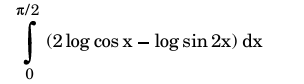
Answer: To evaluate mathematical expressions, we follow the order of operations and apply known rules such as factorial calculation, inverse of numbers, and matrix determinant calculation where applicable. Let's evaluate each part stepwise based on the context provided.
1. Factorials:
- 8! means 8 factorial which is 8 × 7 × 6 × 5 × 4 × 3 × 2 × 1 = 40320.
- 4! = 4 × 3 × 2 × 1 = 24, and 3! = 3 × 2 × 1 = 6, so 4! - 3! = 24 - 6 = 18.
2. Evaluate the expression {(1/3)⁻¹ - (1/4)⁻¹}⁻¹:
First, calculate (1/3)⁻¹ which is the reciprocal of 1/3, i.e., 3.
Similarly, (1/4)⁻¹ = 4.
Their difference is 3 - 4 = -1.
Now the inverse of -1 is -1.
Hence, the value is -1.
3. Evaluate (5/8)⁻⁷ × (8/5)⁻⁴:
Using the property a⁻m = 1/a^m,
(5/8)⁻7 = (8/5)^7 and (8/5)⁻4 = (5/8)^4.
Multiplying these yields (8/5)^7 × (5/8)^4 = (8/5)^{7-4} = (8/5)^3 = 512/125.
4. Evaluate the determinant |2 4|
|-1 2|:
The determinant of a 2x2 matrix |a b|
|c d| is ad - bc.
So, determinant = (2 × 2) - (4 × -1) = 4 + 4 = 8.
5. Evaluate the determinant of a 3x3 matrix:
Matrix:
| 1 x + y y |
| 1 x x + y |
| 2 4 6 |
To evaluate, expand along the first row or any row/column using cofactor expansion. The final expression depends on the variables x and y.
Thus, by applying factorial definition, inverse properties, exponent laws, and determinant formulas, we can correctly evaluate the expressions stepwise.
Key Points: Apply factorial definition and compute values-Use reciprocal and inverse properties to simplify expressions-Apply exponent rules for negative powers-Compute determinant of 2x2 matrix using ad-bc formula-Correctly expand and evaluate 3x3 determinant using cofactor method