Class 6 . English . Poorvi . Friendship the Unlikely Best Friends
Chapter 2: Friendship (The Unlikely Best Friends)
Ch 2
English
Class 6
The Unlikely Best Friends (Part I)
Writer
- Subba Rao wrote “The Unlikely Best Friends.”
Gajaraj’s loneliness
- Gajaraj, an elephant, lived comfortably in the royal stables and was cared for by the mahout.
- Although the mahout was kind, Gajaraj felt lonely because he had no friend to play with.
A new companion
- One evening, a tired and hungry stray dog entered the stable. Gajaraj shared his food with him.
- The next morning, the mahout allowed the dog to stay and gave him some crumbs.
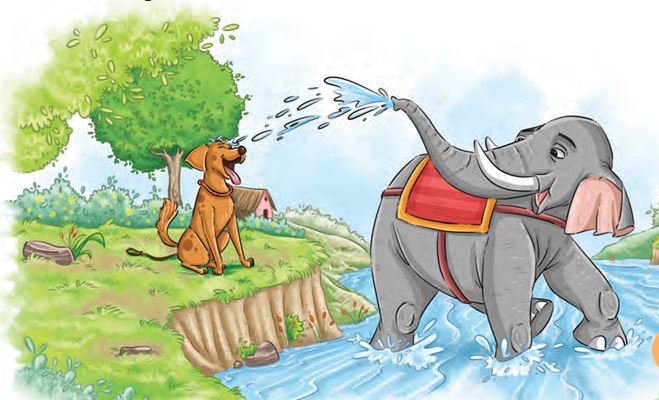
- The dog accompanied Gajaraj to the pond. Gajaraj splashed water playfully, but the dog yelped because he disliked showers.
- On the way back, Gajaraj lifted the dog onto his back and gave him a ride.
Buntee is found
- A farmer recognised the dog as Buntee, his missing pet, and hugged him happily.
- The farmer asked to take Buntee home. The mahout did not object, and the farmer put a rope around Buntee’s neck to lead him away.
- The passage ends without revealing whether Buntee will leave Gajaraj and return home with the farmer.
Gajaraj
- Lonely: he wishes for a friend to play with.
- Kind and generous: he shares his food with the hungry dog.
- Playful and caring: he splashes water playfully and carries the dog on his back.
Buntee
- A stray dog who is hungry and tired when he first enters the stable.
- Friendly and trusting: he accepts Gajaraj’s food and stays near him.
- He enjoys the ride on Gajaraj’s back but dislikes being splashed with water.
Unexpected friendship
Friendship can grow between very different animals through kindness, sharing and companionship.
- booth
- A rectangular space.
- stables
- Buildings or spaces where animals are kept.
- mahout
- An elephant trainer.
- interacted
- Communicated or spent time with someone.
- strayed
- Wandered somewhere by mistake.
- munching
- Chewing food.
- wagged
- Moved from side to side.
- convey
- Communicate or express.
- crumbs
- Small pieces of food.
- accompanied
- Went somewhere with someone.
- plunging
- Jumping or moving suddenly into water.
- yelped
- Gave a short, sharp cry.
Quick recap
- Subba Rao’s story introduces Gajaraj, a lonely elephant in the royal stables.
- Gajaraj shares food with a hungry stray dog, who later turns out to be Buntee.
- The dog and elephant share playful moments at the pond and on the way home.
- A farmer finds Buntee and begins taking him home; what Buntee will do is left unanswered.
- The story shows how kindness can create friendship between unlikely companions.
The Unlikely Best Friends (Part II )
The Story’s Ending
- Separation: When the farmer took Buntee away, he and Gajaraj were both upset. Neither the farmer nor the mahout noticed their tears.
- Missing a friend: Gajaraj refused his food. The mahout realised he might be missing Buntee; Buntee also would not eat at the farmer’s house.
- Reunion: The farmer understood that Buntee missed Gajaraj, untied him and let him go. Buntee ran to the stable, where Gajaraj joyfully lifted him with his trunk.
- New friendship: The mahout brought food, and both friends ate. The mahout and farmer were pleased—and the mahout said he had found a friend too.
Gajaraj
- Sensitive: He becomes sad when Buntee is taken away and stops eating.
- Affectionate: He joyfully picks Buntee up with his trunk when they reunite.
Buntee
- Loyal: He misses Gajaraj and refuses to eat after they are separated.
- Affectionate: He licks the farmer’s hand before running back to Gajaraj.
The farmer and the mahout
- The farmer: Notices Buntee’s sadness, understands he misses Gajaraj and sets him free.
- The mahout: Cares for Gajaraj and realises that his friend’s absence may be why he will not eat.
Friendship and Compassion
Gajaraj and Buntee’s deep affection crosses differences in size and species. The farmer’s kindness helps reunite them, while the ending shows friendship growing between the humans too.
Important Questions
Why did Gajaraj stop eating?
Give two examples that show Gajaraj was happy to see Buntee.
What was unlikely about Gajaraj and Buntee’s friendship?
Word Meanings
- Vocabulary: The story’s word meanings clarify descriptions, actions, and feelings.
- Purpose: Knowing these words helps readers understand how the characters behave and how the friendship develops.
Opposites and Word Formation
Opposites
- Opposites: Words with contrasting meanings include kind—unkind, awake—asleep, relieved—worried, missing—found, and sad—happy.
- Prefixes: Adding a prefix can make a word negative or change its meaning: un- (unhappy), in- (incorrect), dis- (disconnect), mis- (misuse).
Past Tenses
| Tense | Use | Form | Example |
|---|---|---|---|
| Simple past | An action happened and finished in the past. | Regular verb + -ed; irregular verbs use their past form. | The farmer untied Buntee. |
| Past progressive | An action was continuing at a particular time in the past. | I/he/she/it + was + verb-ing; we/you/they + were + verb-ing. | Buntee was missing his friend. |
| Past perfect | An action was completed before another past event. | had + past participle (third form) | The farmer had tied Buntee with a rope. |
Do not confuse: Past progressive describes an action continuing in the past; past perfect marks an action completed before another past event.
Neither…Nor and Either…Or
| Point | Neither…nor | Either…or |
|---|---|---|
| Meaning | Links two choices that are both negative or not true. | Presents a choice between two alternatives. |
| Example | Neither the farmer nor the mahout noticed the tears. | Rohit wants to play either cricket or kho-kho. |
Story Background and Related Example
Connections
- Jataka tales: “The Elephant and the Dog” is a Jataka tale. Jataka stories are ancient Buddhist tales about values and wisdom, passed from one generation to another for over two thousand years.
- Real-life example: Tarra the elephant and Bella the dog became friends at an elephant sanctuary in the United States. When Bella was injured and kept indoors for three weeks, Tarra waited outside; their reunion made them very happy.
Quick recap
- Gajaraj and Buntee stop eating when they are separated because they miss each other.
- The farmer understands Buntee’s sadness, frees him and enables the friends to reunite.
- Gajaraj welcomes Buntee joyfully, and both animals eat together again.
- The farmer and mahout also discover friendship through their care for the animals.
- Use simple past for completed past events, past progressive for ongoing past actions, and past perfect for earlier completed actions.
- Neither…nor links two negative choices; either…or presents a choice between alternatives.
- The story presents an unlikely friendship and comes from the Jataka tradition.
A Friend’s Prayer
Poet
- Jill Wolf is the poet of “A Friend’s Prayer.”
A Friend’s Prayer
- The speaker prays that friendship will always be important in her life.
- She feels grateful for her special friends and wants to be the best friend she can be.
- The speaker wants to do more than simply share her friends’ hopes and plans.
- She will make an effort to help her friends achieve their wishes.
- The speaker wants to understand friendship with care and feeling, not make distant judgements.
- She prays to accept and love her friends as they are.
| Device | Example | Effect |
|---|---|---|
| End rhyme | “be / me”; “share / care” | Gives the poem a musical, memorable rhythm. |
| Metaphor | “use my heart to see” | Suggests understanding friends through care and feeling. |
| Prayer-like expression | “May my friendships always be” | Shows the speaker’s sincere wish and prayer for friendship. |
Key Ideas
Friendship and Acceptance
True friendship means being caring and supportive, trying to help friends fulfil their wishes, and accepting them as they are.
The Speaker’s Wishes
- Friendship: She wants it to remain one of the most important parts of her life.
- Effort: She wants to do her best and do more than merely share her friends’ plans.
- Understanding: She wants to realise what friends can be and help make their wishes come true.
- Acceptance: She will not judge her friends from a distance; she will love them as they are.
- blessed
- feeling grateful and fortunate
- realise
- understand or become aware of
- judgements
- opinions or conclusions about someone
- afar
- from a distance
- wishes
- things someone hopes will happen
Why is this poem a prayer?
Why does the speaker want to do more for her friends?
What does the speaker mean by “use my heart to see”?
Quick recap
- Jill Wolf’s poem presents friendship as a sincere prayer.
- The speaker feels grateful for her special friends.
- She wants friendship to remain important throughout her life.
- A good friend supports friends and tries to help their wishes come true.
- The speaker wants to understand friendship with care and love friends as they are.
The Chair
Part I: The Bet and the Invisible Chair
- Mario often boasted about having many friends. His grandfather doubted that all of them were true friends.
- His grandfather bet Mario a fruit chaat that Mario did not have as many friends as he thought; many might only be companions or partners.
- His grandfather gave him a special invisible chair and said that its magic would reveal his true friends if Mario managed to sit on it at school.
Part II: The Test Reveals True Friends
- At school, Mario repeatedly missed the invisible chair and fell. His classmates laughed, but he kept trying.
- When Mario finally seemed to sit in mid-air, he saw that Guneet, Asma and Deepa were holding him up.
- Many others only laughed at Mario’s falls. He understood that real friends care for us and do not enjoy our misfortune.
- Mario and his three friends visited his grandfather, who had won the bet. The children later used the chair test to identify friends for life.
Mario
- Initially boastful: he frequently talked about having many friends.
- Brave and determined: he kept trying to sit on the chair despite falling and being laughed at.
- Thoughtful: he understood the difference between casual companions and caring friends.
Mario’s grandfather
- Wise and caring: he helped Mario recognise who truly cared for him.
- Clever: he used the invisible chair as a way to reveal how Mario’s classmates behaved.
| Classmates | Their response | What it reveals |
|---|---|---|
| Guneet, Asma and Deepa | Held Mario up so he would not fall. | They were caring and supportive friends. |
| Many others | Laughed at Mario’s repeated falls. | They did not show the care of true friends. |
True Friendship
A true friend supports us in difficult moments and does not take pleasure in our troubles. Care, loyalty and kindness matter more than having many acquaintances.
Friendship Words
- Companion: someone who spends time or does activities with another person.
- Partner: someone who shares an activity or task.
- Buddy: an informal word for a friend.
- Classmate: a student in the same class.
- showed off
- boasted or tried to impress others
- readily
- easily; without hesitation
- attic
- a space just below a house’s roof, often used for storage
- invisible
- impossible to see
- tricky
- difficult to do
- determined
- firmly decided and unwilling to give up
- amazing
- very surprising
- experienced
- felt or went through
- technical problem
- a difficulty with how something works
- misfortune
- bad luck or an unfortunate event
Word Building: Roots and Suffixes
Suffix — A suffix is a group of letters added to the end of a root word to form a new word or change its meaning or word class.
| Root word | Suffix | New word |
|---|---|---|
| friend | -ly | friendly |
| talk | -ing | talking |
| call | -ed | called |
| magic | -al | magical |
| care | -ful | careful |
| celebrate | -ion | celebration |
| wonder | -ful | wonderful |
| friend | -ship | friendship |
| courage | -ous | courageous |
Adjectives with Nouns
- Adjective: a word that describes a noun.
- Examples: brave soldier, clever plan, tasty peanuts, heavy rain, slight cold, true friend.
Other Friendship Examples in the Lesson
- A listening passage describes a cow and a leopard that developed a friendship; the leopard returned to sit quietly beside the cow.
- Another passage describes Monika helping a new student adjust to school by guiding her, introducing her to others and sharing notes.
- Ajay and Dhiraj enjoy outdoor activities and spending time together, showing friendship through shared interests.
What was the bet between Mario and his grandfather?
Why was the invisible chair tricky to sit on?
How did Mario identify his real friends?
Quick recap
- Mario boasted about having many friends, so his grandfather bet a fruit chaat that he did not have as many true friends as he thought.
- The invisible chair made Mario’s classmates’ reactions visible through their actions.
- Guneet, Asma and Deepa supported Mario when he kept falling.
- True friends care for us in difficult moments rather than laughing at our troubles.
- A suffix is added to the end of a root word to form another word.
- Adjectives describe nouns, as in brave soldier and true friend.