Class 11 PCM . Chemistry . Chemistry Part I . Equilibrium
Chapter 6: Equilibrium
Ch 6
Chemistry
Class 11 PCM
Introduction
Meaning and Importance of Equilibrium
Why equilibrium matters
- Biological example: Oxygen–haemoglobin equilibrium helps transport oxygen from the lungs to muscles.
- Toxicity: Carbon monoxide–haemoglobin equilibrium is associated with carbon monoxide toxicity.
- Applications: Industrial and laboratory conditions are adjusted to favour equilibrium in the direction of the desired product.
Equilibrium by Extent of Reaction
- Extent: Reactions at equilibrium may proceed nearly to completion, form only small amounts of products, or contain comparable amounts of reactants and products.
- Conditions: The extent of a reaction depends on conditions such as concentration and temperature.
Equilibrium in Physical Processes
- Physical equilibrium: Equilibrium can occur between different phases of a substance, such as solid and liquid, liquid and vapour, or solid and vapour.
- Dynamic state: Opposing physical processes continue at equal rates, so measurable properties remain constant.
Solid–Liquid Equilibrium
Liquid–Vapour Equilibrium
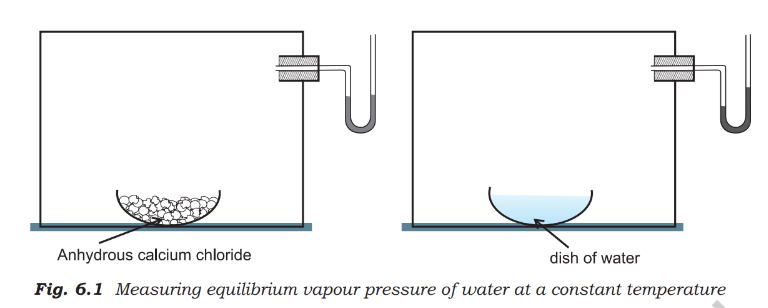
Open Systems and Boiling Point
- Open system: Vapour disperses into the surroundings, so condensation back into the liquid is much slower than evaporation; equilibrium is not reached.
- Evaporation time: It depends on the liquid’s nature, the amount of liquid and the temperature.
- Normal boiling point: For a pure liquid, the temperature at which liquid and vapour are in equilibrium at .
- Pressure effect: Boiling point depends on atmospheric pressure; at high altitude, lower pressure gives a lower boiling point.
- Water: Liquid water and water vapour are in equilibrium at and .
Solid–Vapour Equilibrium
Why is chemical equilibrium called dynamic?
What is equilibrium vapour pressure?
How does high altitude affect water’s boiling point?
Quick recap
- Equilibrium is dynamic: opposing processes continue at equal rates while concentrations remain constant.
- Reactions at equilibrium can leave negligible reactant, mostly reactant, or comparable amounts of reactants and products.
- Physical equilibria include solid–liquid, liquid–vapour and solid–vapour changes.
- Equilibrium vapour pressure rises with temperature; higher vapour pressure indicates greater volatility and a lower boiling point.
- Open systems generally do not reach evaporation–condensation equilibrium because vapour disperses.
- At high altitude, lower atmospheric pressure lowers a liquid’s boiling point.
Equilibrium Involving Dissolution of Solid or Gases in Liquids
Dissolution of Solids in Liquids
Evidence of dynamic exchange
- Radioactive sugar: When added to a saturated solution of ordinary sugar, radioactivity eventually appears in both the solution and solid sugar.
- Meaning: Sugar molecules continue to move between the solid and dissolved phases, even though their overall amounts remain constant at equilibrium.
Dissolution of Gases in Liquids
Henry’s law — At a given temperature, the mass of gas dissolved in a given mass of solvent is proportional to the gas pressure above the solvent.
At constant temperature, dissolved-gas concentration increases with the gas pressure above the liquid.
Pressure and temperature effects
- Pressure: Higher gas pressure above a liquid allows more gas to dissolve.
- Temperature: The amount of gas dissolved decreases as temperature increases.
- Soda water: Bottles are sealed under high pressure, keeping more carbon dioxide dissolved.
- Opening the bottle: Pressure falls, so dissolved carbon dioxide escapes until a new equilibrium is reached; the drink becomes flat if left open.
Features of Physical Equilibria
| Process | Characteristic at a given temperature |
|---|---|
| Solid ⇌ liquid | At 1 atm (1.013 bar), the two phases coexist at the melting point; without heat exchange, their masses remain constant. |
| Liquid ⇌ vapour | The vapour pressure remains constant. |
| Solid solute ⇌ dissolved solute | The solubility, or dissolved-solute concentration in a saturated solution, remains constant. |
| Gas ⇌ dissolved gas | The dissolved-gas concentration is proportional to the gas pressure above the liquid. |
General Characteristics of Physical Equilibria
- Closed system: Physical equilibrium is possible only in a closed system at a fixed temperature.
- Dynamic balance: Opposing processes continue at equal rates, producing a stable overall state.
- Constant properties: Measurable properties of the system remain constant at equilibrium.
- Equilibrium parameter: Each physical equilibrium is characterised by a quantity with a constant value at a given temperature, such as vapour pressure or solubility.
- Extent of process: The value of that quantity indicates how far the physical process has proceeded before equilibrium is reached.
Why is equilibrium in a saturated sugar solution called dynamic?
Why does an opened soda-water bottle gradually become flat?
Quick recap
- A saturated solution contains the maximum solute that can dissolve at a given temperature.
- Dissolution and crystallisation continue at equal rates in a saturated solution.
- Henry’s law states that dissolved-gas concentration is proportional to gas pressure at constant temperature.
- Gas solubility in liquids decreases as temperature rises.
- Physical equilibria require a closed system; opposing processes continue at equal rates and measurable properties stay constant.
Equilibrium In Chemical Processes – Dynamic Equilibrium
Chemical Equilibrium
Chemical equilibrium — The state in a reversible reaction where forward and reverse reaction rates are equal, so reactant and product concentrations remain constant.
How equilibrium is reached
- Reversible reaction: Proceeds in both forward and reverse directions, represented by .
- As time passes: Reactants are used up and products accumulate; the forward rate decreases while the reverse rate increases.
- At equilibrium: The two rates become equal. Both reactions continue, but there is no net change in composition.
- Concentrations: They become constant at equilibrium, but are not necessarily equal to one another.
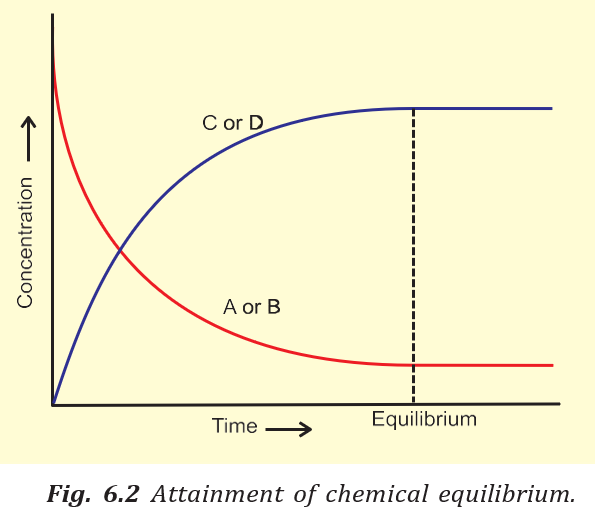
Dynamic nature of equilibrium
- Dynamic, not static: Forward and reverse reactions continue even when observable concentrations no longer change.
- Analogy: In a two-container transfer, liquid can keep moving in both directions while the levels stay constant; constant levels do not mean transfer has stopped.
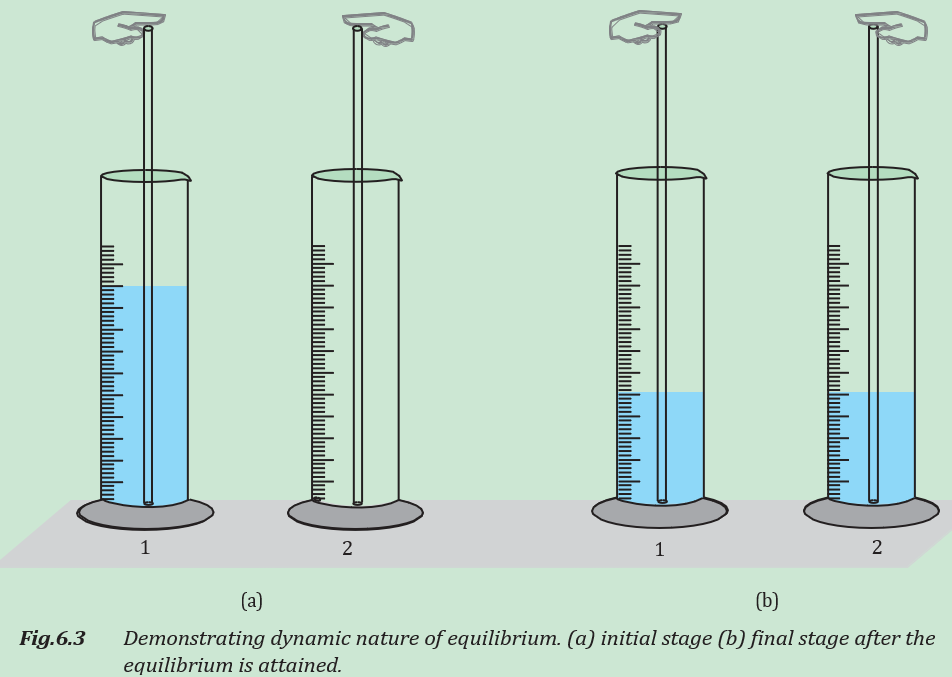
Evidence from Ammonia Synthesis
Haber process and isotope evidence
- Haber process: At high temperature and pressure, nitrogen and hydrogen form ammonia. The mixture's composition eventually becomes constant, although reactants remain.
- Isotope test: Replacing hydrogen with deuterium () under the same starting conditions gives the same equilibrium composition, with deuterium-containing species.
- Scrambling: Analysis detects , , , and , as well as , , and .
- Conclusion: Hydrogen and deuterium atoms exchange among molecules because forward and reverse reactions continue at equilibrium. If the reaction had stopped, this mixing would not occur.
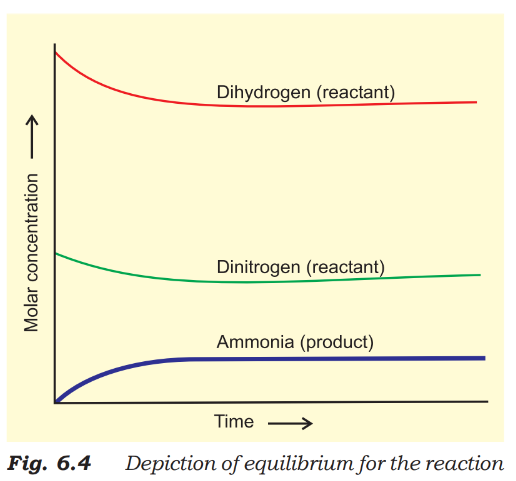
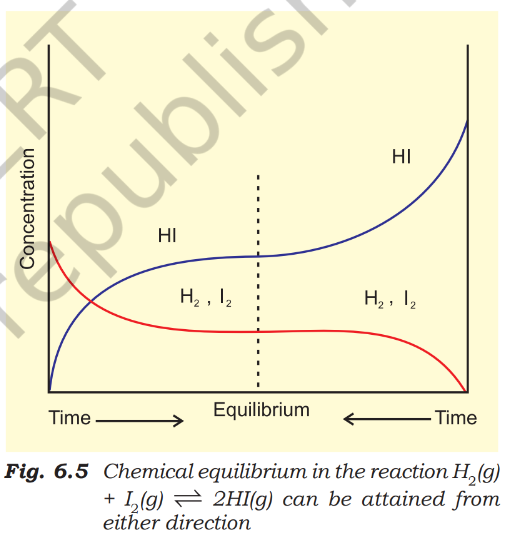
Equilibrium from either direction
- Starting with reactants: and react to form until equilibrium is reached.
- Starting with product: decomposes to form and until equilibrium is reached.
- Key condition: With the same conditions and conserved amounts of atoms, equilibrium can be approached from either side.
Equilibrium in Hydrogen–Iodine Reaction
Approaching equilibrium from both sides
- Starting with and : Their concentrations decrease as forms; all concentrations eventually become constant.
- Starting with alone: decreases while and form; all concentrations eventually become constant.
- Same equilibrium mixture: If the total numbers of hydrogen and iodine atoms in a given volume are the same, the same equilibrium mixture results from either starting point.
Do not assume equilibrium means the reaction has stopped or that reactant and product concentrations are equal. Both reactions continue at equal rates; concentrations are constant, not necessarily equal.
Why is chemical equilibrium called dynamic?
What does isotope scrambling in the ammonia system show?
Quick recap
- Chemical equilibrium occurs when forward and reverse reaction rates are equal.
- Reactant and product concentrations stay constant at equilibrium, but need not be equal.
- Equilibrium is dynamic: both reaction directions continue with no net composition change.
- Isotope scrambling in ammonia synthesis provides evidence of ongoing reactions at equilibrium.
- A reversible reaction can reach equilibrium from either the reactant side or the product side.
Law Of Chemical Equilibrium And Equilibrium Constant
Equilibrium mixture — A mixture of reactants and products present when a reversible reaction has reached equilibrium.
Equilibrium law and its experimental basis
Law of mass action
- Proposed: Norwegian chemists Cato Maximilian Guldberg and Peter Waage proposed the law in 1864.
- Name: It is also called the law of mass action; concentration was historically called active mass.
- At a fixed temperature: The ratio of product concentrations to reactant concentrations, each raised to its stoichiometric coefficient, is constant at equilibrium.
- Concentrations: Square brackets denote molar concentrations; equilibrium values are implied in an equilibrium-constant expression.
The subscripts in the exponents are the stoichiometric coefficients of the balanced equation. The subscript indicates that the constant is expressed using concentrations in .
The measured value was approximately – for the equilibrium datasets; a ratio without the squared product concentration was not constant.
Writing equilibrium-constant expressions
Rules for writing the expression
- Products over reactants: Put product concentrations in the numerator and reactant concentrations in the denominator.
- Powers: Raise each concentration to the coefficient of that species in the balanced equation.
- Phases: Phase symbols such as , and are generally omitted from the expression.
- Temperature: The equilibrium constant has a definite value at a specified temperature.
How the reaction equation affects the constant
| Change to the reaction | New equilibrium constant |
|---|---|
| Reverse the reaction | |
| Multiply every coefficient by | |
| Divide every coefficient by |
Examples of coefficient changes
- Reverse: For , the constant is the reciprocal of that for the forward reaction.
- Halve coefficients: For , the constant is relative to the original equation.
- Specify the equation: Always state the balanced reaction when giving an equilibrium constant, because changing its direction or coefficients changes the value.
At , , and . Find for .
At equilibrium, , and . Find for .
Quick recap
- At a fixed temperature, equilibrium concentrations follow the law of mass action.
- Write as products over reactants, using balanced-equation coefficients as powers.
- The subscript identifies an equilibrium constant expressed using concentrations in .
- Equilibrium concentrations are implied in the expression; phase symbols are generally omitted.
- Reversing a reaction makes its constant .
- Multiplying every coefficient by makes the new constant .
- State the balanced reaction whenever quoting an equilibrium constant.
Homogeneous Equilibria
Homogeneous Systems
Homogeneous equilibrium — An equilibrium in which all reactants and products are in the same phase.
Examples
- Gas phase: Ammonia formation has all reactants and products in the gaseous phase.
- Solution phase: Ester hydrolysis and formation of the thiocyanatoiron(III) complex occur entirely in solution.
Equilibrium Constants for Gaseous Systems
Concentration and Partial Pressure
- : Equilibrium constant expressed using equilibrium molar concentrations.
- : For gaseous equilibria, the equilibrium constant is often expressed using equilibrium partial pressures.
- Ideal-gas relation: At constant temperature, a gas's partial pressure is proportional to its concentration.
Use concentration in mol L⁻¹ and pressure in bar with the stated gas constant.
Gas Constant and Pressure Standard
- Gas constant: when pressure is in bar and concentration in mol L⁻¹.
- Pressure conversion: ; use bar when applying the pressure standard state of 1 bar.
For a balanced gaseous reaction, each partial pressure is raised to its stoichiometric coefficient.
For a balanced gaseous reaction, is gaseous product moles minus gaseous reactant moles, counting stoichiometric coefficients.
When the Constants Are Equal
- Equal constants: If , then .
- Hydrogen iodide formation: For , , so .
- Ammonia formation: For , , so .
| Reaction | Temperature (K) | |
|---|---|---|
| 298 | ||
| 400 | ||
| 500 | ||
| 298 | ||
| 500 | ||
| 700 | ||
| 298 | ||
| 400 | ||
| 500 |
For at equilibrium, and .
Finding Equilibrium Concentrations with an ICE Setup
- For the water-gas shift reaction, express initial and equilibrium concentrations using the reaction stoichiometry.
- Substitute the equilibrium concentrations into the given equilibrium-constant expression.
- Solve the resulting quadratic and reject any root that gives an impossible concentration.
For , . At , gives using in bar units.
Heterogeneous Equilibria
Heterogeneous equilibrium — An equilibrium in a system containing substances in more than one phase.
Pure Solids and Liquids in Equilibrium Expressions
- Constant concentration: The molar concentration of a pure solid or liquid is constant, regardless of the amount present.
- Omit pure phases: Pure solids and liquids do not appear in the equilibrium-constant expression.
- Phase requirement: A pure solid or liquid involved must remain present at equilibrium, even in a small amount.
The pure solid terms are omitted, leaving only gaseous carbon dioxide.
Pressure Example for Calcium Carbonate
- Calculation: If and the standard pressure is , then .
Other Examples
- Nickel carbonyl formation: In nickel purification, solid nickel is omitted: for , .
- Silver oxide reaction: For , ; omit the pure solid and liquid.
For , graphite is omitted. Given at , initial bar, and no CO initially, the equilibrium pressures are bar and bar.
Units of Equilibrium Constants
- Conventional units: Substituting concentrations in mol L⁻¹ or pressures in a pressure unit can give units for or , unless numerator and denominator powers cancel.
- Examples: For , both constants have no units by cancellation. For , conventional units are mol L⁻¹ for and bar for .
- Dimensionless form: Divide each quantity by its standard-state value. The standard state is 1 bar for a pure gas and 1 mol L⁻¹ for a solute.
- Standard states: Dimensionless and can have different numerical values because their standard states differ.
Features and Applications of Equilibrium Constants
Key Features
- At equilibrium: The equilibrium-constant expression applies when reactant and product concentrations have become constant.
- Initial amounts: The equilibrium constant is independent of the initial concentrations.
- Temperature: For a given balanced reaction, the constant has one value at a particular temperature; it changes with temperature.
- Reverse reaction: The reverse reaction's equilibrium constant is the reciprocal of the forward reaction's constant.
- Changing coefficients: Multiplying the reaction equation by changes the constant to ; dividing the equation by changes it to .
Applications
- Extent: Use the magnitude of the equilibrium constant to assess the extent of a reaction.
- Direction: Use equilibrium-constant information to predict the direction in which a reaction proceeds.
- Equilibrium composition: Use the constant with initial quantities to calculate equilibrium concentrations.
Quick recap
- Homogeneous equilibria contain species in one phase; heterogeneous equilibria contain species in more than one phase.
- For gaseous equilibria, uses partial pressures; the general expression raises each pressure term to its stoichiometric coefficient.
- For gases, , where is gaseous product moles minus gaseous reactant moles.
- Pure solids and liquids are omitted from equilibrium expressions but must be present at equilibrium.
- Equilibrium constants depend on temperature, not initial concentrations; reversing a reaction reciprocates its constant.
- Equilibrium constants help assess reaction extent and direction, and calculate equilibrium composition.
Predicting the Extent of a Reaction
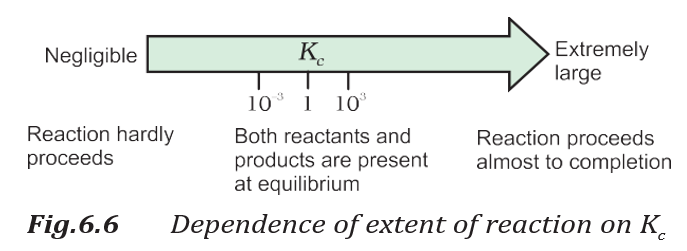
Using the Equilibrium Constant to Predict Reaction Extent
| Equilibrium constant | Composition at equilibrium | Interpretation |
|---|---|---|
| Products predominate | Reaction proceeds nearly to completion | |
| Reactants predominate | Reaction proceeds to a small extent | |
| to | Appreciable amounts of both | Neither side overwhelmingly predominates |
Examples of equilibrium constants
- Large : For at , .
- Large : For at , .
- Very small : Water decomposition at has ; reactants strongly predominate.
- Very small : For at , .
- Intermediate : For hydrogen and iodine forming hydrogen iodide at , .
- Intermediate : For at , ; both species are present appreciably.
Predicting the Direction of a Reaction
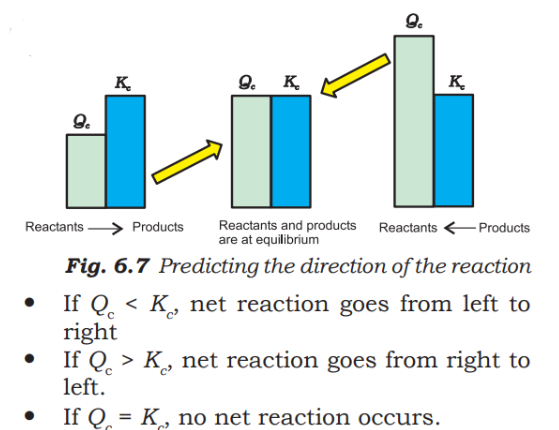
For , use the current concentrations in the expression.
| Comparison | Direction of net reaction | Meaning |
|---|---|---|
| Forward, toward products | The mixture has too few products relative to equilibrium | |
| Reverse, toward reactants | The mixture has too many products relative to equilibrium | |
| No net change | The mixture is at equilibrium |
Example: hydrogen and iodine
- Reaction: has at .
- Current concentrations: , and give .
- Direction: Since , more and react to form until .
For , and . Which way will the reaction proceed?
Calculating Equilibrium Concentrations
Finding equilibrium concentrations from initial concentrations
- Write the balanced chemical equation.
- Tabulate initial, change, and equilibrium concentrations; express the changes using stoichiometric coefficients and an unknown .
- Substitute equilibrium concentrations into the equilibrium expression and solve for .
- Choose the solution that is chemically meaningful, calculate all equilibrium concentrations, and check them in the equilibrium expression.
Example: equilibrium composition of phosphorus pentachloride
- Reaction and initial mixture: ; in a vessel, the initial concentrations are .
- ICE setup: If mol/L of dissociates, equilibrium concentrations are , , and .
- Solve using : , giving the chemically valid root .
- Equilibrium mixture: and .
For gaseous reactions, is gaseous product moles minus gaseous reactant moles, using stoichiometric coefficients.
Example: equilibrium pressures for nitrogen tetroxide
- Initial pressure: of in at is . From , the initial pressure is .
- Equilibrium setup: For , pressures change from to bar.
- Use the total pressure: , so ; hence and .
- Equilibrium constants: . Here , so .
Equilibrium Constant, Reaction Quotient and Gibbs Energy
is the standard Gibbs energy change; is the reaction quotient.
At equilibrium, and .
Interpreting the sign of
- Negative : ; products are favoured at equilibrium.
- Positive : ; reactants are favoured at equilibrium.
- Zero : .
Examples using
- Glucose phosphorylation: With at , and .
- Sucrose hydrolysis: For at , .
Quick recap
- The magnitude of predicts equilibrium composition, but not the speed of reaching equilibrium.
- Large favours products; small favours reactants; intermediate values allow appreciable amounts of both.
- Calculate from current concentrations or pressures, then compare it with to predict reaction direction.
- Use an initial–change–equilibrium table and stoichiometry to solve for unknown equilibrium concentrations.
- For gases, , where counts gaseous product moles minus reactant moles.
- The relations and connect reaction direction and equilibrium to Gibbs energy.
Factors Affecting Equilibria
Why Equilibrium Conditions Matter
Le Chatelier’s Principle
- Principle: A system at equilibrium shifts in a direction that reduces or counteracts an imposed change.
- Factors: Changes in concentration, pressure, volume or temperature can alter the equilibrium position; a catalyst changes the rate but not the equilibrium composition.
Effect of Concentration Change
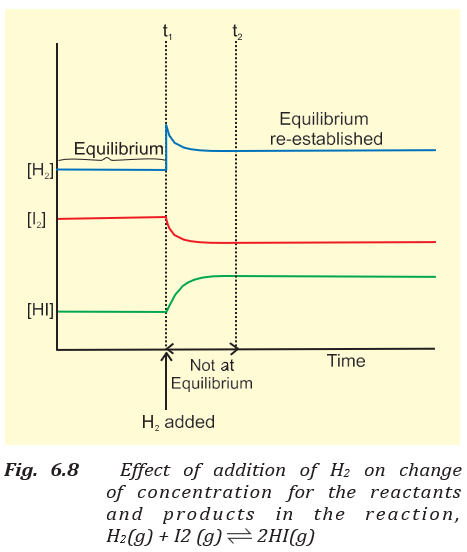
Adding increases the denominator, so ; the reaction moves forward until .
Using Product Removal to Increase Yield
- Remove a product: The reaction shifts forward to replace some of the product removed; continuous removal keeps and sustains the forward reaction.
- Ammonia manufacture: Ammonia is liquefied and removed from the reaction mixture, favouring further ammonia formation.
- Lime production: Removing carbon dioxide from the kiln drives the decomposition of calcium carbonate forward.
Concentration Changes in the Iron(III)–Thiocyanate System
At equilibrium, the product of ion concentrations is related to the complex-ion concentration by .
State Le Chatelier’s principle.
How does continuous removal of a product affect an equilibrium reaction?
Quick recap
- Le Chatelier’s principle predicts how an equilibrium responds to a change in conditions.
- Adding a substance favours the direction that consumes it; removing one favours the direction that replenishes it.
- At equilibrium, ; after a concentration change, the reaction shifts until this equality is restored.
- Removing a product can drive a reaction forward and increase product yield.
- In the iron(III)–thiocyanate system, more intensifies the red colour, while removing either reactant fades it.
Effect of Pressure Change
Effect of Pressure Change
- When pressure matters: A pressure change affects gaseous equilibria if reactant and product sides have different total moles of gas.
- Compression: Increasing pressure shifts equilibrium toward the side with fewer moles of gas; decreasing pressure favours the side with more.
- Heterogeneous equilibria: Ignore pressure effects on solids and liquids because their volumes and concentrations change negligibly.
- No mole difference: If both sides have equal gaseous mole totals, a pressure change does not shift equilibrium.
Compression and the reaction quotient
- Example: Halving the volume at constant temperature doubles the pressure and the concentrations of all gases.
- Quotient: Doubling each concentration makes the numerator scale by and the denominator by ; therefore the new is one-quarter of its equilibrium value.
- Direction: Since the starting mixture was at equilibrium, the new ; the reaction proceeds forward until equilibrium is restored.
Effect of Inert Gas Addition
Inert gas at constant volume — Adding a gas that does not react, while keeping volume constant, does not disturb the equilibrium.
- Reason: The partial pressures and concentrations of the reacting gases stay unchanged, so the reaction quotient is unchanged.
- Exception: The quotient can change if the added gas is itself a reactant or product in the equilibrium.
Effect of Temperature Change
- Unlike pressure or concentration changes: A temperature change alters the equilibrium constant .
- Other disturbances: Concentration, pressure or volume changes alter the reaction quotient ; the system shifts until again.
| Reaction type | Sign of | As temperature increases |
|---|---|---|
| Exothermic | Negative | decreases; equilibrium shifts toward reactants. |
| Endothermic | Positive | increases; equilibrium shifts toward products. |
Ammonia yield
- Temperature: Raising the temperature shifts this exothermic equilibrium left and lowers the equilibrium concentration of ammonia; lower temperature favours its yield.
- Practical balance: Very low temperature makes the reaction too slow, so a catalyst is used to achieve a satisfactory rate.
- Pressure: The product side has fewer gas moles, so increasing pressure favours ammonia formation.
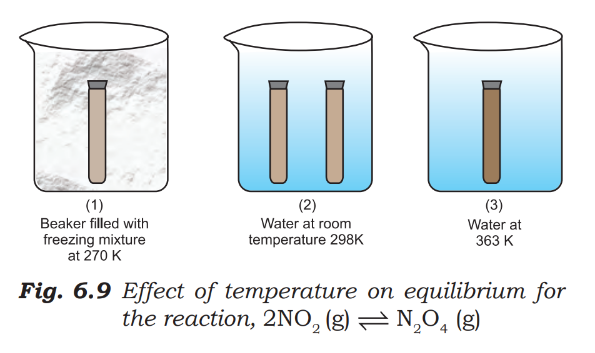
- Cooling: Favours the exothermic forward reaction, producing more colourless and fading the brown colour.
- Heating: Favours the reverse reaction, producing more brown and intensifying the colour.
- At room temperature: The mixture is blue, indicating the presence of .
- On cooling: The equilibrium shifts in reverse and the mixture turns pink, indicating more .
Effect of a Catalyst
Catalyst — A substance that increases reaction rate by providing a pathway with lower activation energy.
- Forward and reverse rates: A catalyst lowers the activation energies of both reactions by the same amount, increasing both rates.
- Equilibrium: It does not change equilibrium composition or the equilibrium constant; it only helps equilibrium to be reached faster.
- Equation: A catalyst is not included in the balanced chemical equation or in the equilibrium-constant expression.
- Limitation: A catalyst is of little help when the equilibrium constant is exceedingly small.
Catalysts in industrial processes
- Ammonia synthesis: Fritz Haber found that iron catalyses the reaction at a practical rate under conditions that still give a reasonably favourable ammonia concentration.
- Operating conditions: The stated optimum conditions are about and , with a catalyst.
- Sulphuric acid manufacture: Oxidation of sulfur dioxide is very slow in practice, despite the large equilibrium constant; platinum or vanadium pentoxide () increases its rate.
What is the effect of increasing pressure on a gaseous equilibrium?
Does a catalyst change the equilibrium position?
Quick recap
- Increasing pressure favours the side with fewer gaseous moles; solids and liquids have negligible pressure effects.
- Adding inert gas at constant volume leaves reacting-gas partial pressures and equilibrium unchanged.
- Temperature changes alter : heating lowers it for exothermic reactions and raises it for endothermic reactions.
- Cooling favours exothermic directions; heating favours endothermic directions.
- Catalysts speed up both directions equally and do not change equilibrium composition.
- Ammonia synthesis uses iron at about and ; sulfur dioxide oxidation uses platinum or .
Ionic Equilibrium In Solution
Ionic Equilibrium and Electrolytes
Ionic equilibrium — An equilibrium involving ions in an aqueous solution, including equilibria between ions and unionised molecules.
Electrolytes
- Electrolytes: Substances whose aqueous solutions conduct electricity; non-electrolytes do not.
- Conductivity: Common salt solution conducts electricity, unlike sugar solution; increasing salt concentration increases conductivity.
- Strong electrolytes: Ionise almost completely in water. Sodium chloride solution contains sodium and chloride ions.
- Weak electrolytes: Dissociate only partially; an equilibrium forms between ions and unionised molecules.
- Example: Acetic acid is less than ionised in water, so most remains as molecules.
| Type | Extent of ionisation | Example | Solution composition |
|---|---|---|---|
| Strong electrolyte | Almost complete | Sodium chloride | Nearly all ions |
| Weak electrolyte | Partial | Acetic acid | Mostly molecules, with some ions |
Acids, Bases and Salts
| Class | Key properties | Examples |
|---|---|---|
| Acids | Usually sour; turn blue litmus red; some react with metals to release dihydrogen | Hydrochloric acid in gastric juice; acetic acid in vinegar; citric and ascorbic acids in citrus juices; tartaric acid in tamarind |
| Bases | Bitter and soapy; turn red litmus blue | Washing soda |
| Salts | Form when acids and bases react in suitable proportions | Sodium chloride, barium sulphate, sodium nitrate |
Dissolving Ionic Solids in Water
Sodium Chloride in Water
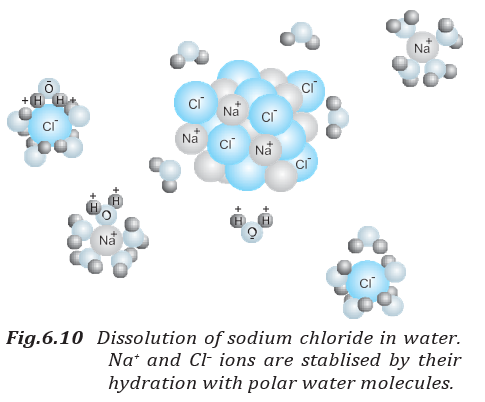
- Solid sodium chloride: A crystal contains positive sodium ions and negative chloride ions held together by electrostatic attraction.
- Water’s effect: Water has a high dielectric constant of , reducing electrostatic forces between ions by a factor of and helping them move freely.
- Hydration: Water molecules surround the separated ions, keeping them apart in solution.
- Ionisation extent: Hydrochloric acid ionises completely in water, whereas acetic acid ionises only partially ().
- What affects ionisation: The extent depends on bond strength and the degree of solvation of the ions formed.
| Point | Dissociation | Ionisation |
|---|---|---|
| Meaning | Separation of ions that already existed in the solid solute | Formation of charged ions when a neutral molecule splits in solution |
| Example | Sodium chloride separates into sodium and chloride ions in water | A neutral acid molecule forms ions in water |
- Usage here: “Dissociation” and “ionisation” are used interchangeably, despite their distinct meanings.
- Electrolyte strength: Strong means nearly complete ionisation; weak means partial ionisation.
Quick recap
- Ionic equilibrium includes equilibria involving ions in aqueous solution.
- Electrolytes conduct in solution; strong electrolytes ionise almost completely and weak electrolytes only partially.
- Acids turn blue litmus red; bases turn red litmus blue; acids and bases form salts in suitable proportions.
- Water’s dielectric constant of weakens ionic attractions and helps hydrated ions separate.
- Dissociation separates ions already present in a solid; ionisation forms ions from neutral molecules.
Arrhenius Concept of Acids and Bases
Arrhenius Acids and Bases
Arrhenius acid — A substance that dissociates in water to produce H⁺(aq), which exists in solution as hydrated protons.
Arrhenius base — A substance that dissociates in water to produce hydroxide ions, OH⁻.
Hydrated ions
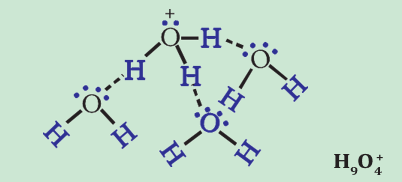
- Hydrogen ion: A bare H⁺ is a proton and does not exist freely in water; it bonds to a water molecule to form H₃O⁺.
- Hydronium: H₃O⁺ is trigonal pyramidal; in this chapter, H⁺(aq) and H₃O⁺(aq) both represent a hydrated proton.
- Further hydration: Hydronium may form ions such as H₅O₂⁺, H₇O₃⁺ and H₉O₄⁺; hydroxide also forms hydrated species such as H₃O₂⁻ and H₅O₃⁻.
- Hydroxide: OH⁻ is hydrated in aqueous solution as well.
Arrhenius theory applies only to aqueous solutions and does not explain bases such as NH₃, which have no OH⁻ group in their formula.
Brønsted–Lowry Acids and Bases
Brønsted–Lowry acid — A proton (H⁺) donor.
Brønsted–Lowry base — A proton (H⁺) acceptor.
| Species | Role | Conjugate partner |
|---|---|---|
| H₂O | Acid | OH⁻ (conjugate base) |
| NH₃ | Base | NH₄⁺ (conjugate acid) |
| NH₄⁺ | Acid in the reverse reaction | NH₃ (conjugate base) |
| OH⁻ | Base in the reverse reaction | H₂O (conjugate acid) |
Conjugate acid–base pair — Two species that differ by exactly one proton; the acid has one more proton than its conjugate base.
Conjugate pairs and water’s dual role
- Conjugate base: Formed when an acid loses one proton; for example, Cl⁻ is the conjugate base of HCl.
- Conjugate acid: Formed when a base gains one proton; for example, H₃O⁺ is the conjugate acid of H₂O.
- Water as a base: It accepts H⁺ from HCl.
- Water as an acid: It donates H⁺ to NH₃.
- Strength relationship: A strong acid has a weak conjugate base, and a strong base has a weak conjugate acid.
| Species | Conjugate acid (add H⁺) | Conjugate base (remove H⁺) |
|---|---|---|
| H₂O | H₃O⁺ | OH⁻ |
| HCO₃⁻ | H₂CO₃ | CO₃²⁻ |
| HSO₄⁻ | H₂SO₄ | SO₄²⁻ |
| NH₃ | NH₄⁺ | NH₂⁻ |
| Original species | Type | Conjugate species |
|---|---|---|
| HF | Acid | F⁻ |
| H₂SO₄ | Acid | HSO₄⁻ |
| HCO₃⁻ | Acid | CO₃²⁻ |
| NH₂⁻ | Base | NH₃ |
| NH₃ | Base | NH₄⁺ |
| HCOO⁻ | Base | HCOOH |
Lewis Acids and Bases
Lewis acid — A species that accepts an electron pair.
Lewis base — A species that donates an electron pair.
Lewis acid–base behaviour
- Greater scope: A Lewis acid need not contain a proton; this makes the Lewis concept broader than the Brønsted–Lowry concept.
- Bases: Lewis and Brønsted–Lowry bases both use an electron pair in their reactions.
- Lewis acids: Electron-deficient species such as BF₃ and AlCl₃, and cations such as Co³⁺ and Mg²⁺, can accept an electron pair.
- Lewis bases: H₂O, NH₃, OH⁻, F⁻ and HO⁻ can donate a lone pair.
| Species | Classification | Reason |
|---|---|---|
| HO⁻ | Lewis base | Donates a lone pair |
| F⁻ | Lewis base | Donates a lone pair |
| H⁺ | Lewis acid | Accepts an electron pair |
| BCl₃ | Lewis acid | Accepts an electron pair |
Ionization of Acids and Bases
| Point | Strong | Weak |
|---|---|---|
| Acid ionization | Almost completely dissociated in water; good proton donor | Partially dissociated; most acid remains as molecules |
| Base ionization | Almost completely dissociated in water and produces OH⁻ | Does not ionize completely in water |
| Conjugate strength | Strong acid → very weak conjugate base; strong base → very weak conjugate acid | Weak acid → relatively strong conjugate base |
| Class | Examples |
|---|---|
| Strong acids | HClO₄, HCl, HBr, HI, HNO₃, H₂SO₄ |
| Weak acids | HNO₂, HF, CH₃COOH |
| Strong bases | LiOH, NaOH, KOH, CsOH, Ba(OH)₂ |
Direction of acid–base equilibrium
- Compare the proton-donating strengths of the two acids and proton-accepting strengths of the two bases.
- The stronger acid donates a proton to the stronger base.
- The equilibrium favours the side containing the weaker acid and weaker base.
Conjugate strength and examples
- Strong acids: Their conjugate bases are much weaker than H₂O; examples include ClO₄⁻, Cl⁻, Br⁻, I⁻, NO₃⁻ and HSO₄⁻.
- Weak acids: They ionize only partly, so the solution contains mainly undissociated acid molecules; their conjugate bases are relatively stronger.
- Very strong bases: NH₂⁻, O²⁻ and H⁻ readily accept protons and are stronger bases than H₂O.
State the Brønsted–Lowry definitions of an acid and a base.
Why is BF₃ a Lewis acid in its reaction with NH₃?
In which direction does an acid–base equilibrium tend to shift?
Quick recap
- Arrhenius acids produce H⁺(aq), while Arrhenius bases produce OH⁻(aq) in water.
- In aqueous solution, H⁺ is hydrated as H₃O⁺; hydroxide ions are hydrated too.
- Brønsted–Lowry acids donate protons and bases accept them; conjugates differ by one proton.
- Water can act as either a Brønsted–Lowry acid or base, depending on its reaction partner.
- Lewis acids accept electron pairs; Lewis bases donate them.
- Strong acids and bases ionize almost completely; equilibria favour the weaker acid–base pair.
- Acid and conjugate-base forms of indicators have different colours.
The Ionization Constant of Water and its Ionic Product
Ionization of Water and Ionic Product
Ionic product of water
- Equilibrium expression: The concentration of pure liquid water is constant, so it is incorporated into the equilibrium constant.
- Ionic product: , also written as .
- At : Pure water has , giving .
- Temperature: varies with temperature because it is an equilibrium constant.
Extent of water ionization
- Molarity of water: From density and molar mass , pure water is about .
- Dissociated fraction: The ratio is , or about molecules in .
- Conclusion: The equilibrium lies overwhelmingly toward undissociated water.
| Solution | Ion concentrations |
|---|---|
| Acidic | |
| Neutral at | |
| Basic |
The pH Scale
pH — The negative base-10 logarithm of hydrogen-ion activity: .
Calculating and interpreting pH
- Activity: Hydrogen-ion activity is dimensionless and given by .
- Dilute solutions: Below about , activity is approximately equal in magnitude to concentration; hence use when concentration is in molarity.
- Examples: HCl has pH ; a solution with has pOH and pH at .
- Logarithmic scale: A one-unit pH change means a tenfold change in ; a hundredfold change means a two-unit pH change.
- Temperature: Although varies with temperature, the resulting pH variation is often small enough to ignore in routine calculations.
At , .
| Solution | pH | Hydrogen-ion concentration |
|---|---|---|
| Acidic | ||
| Neutral | ||
| Basic |
Measuring pH
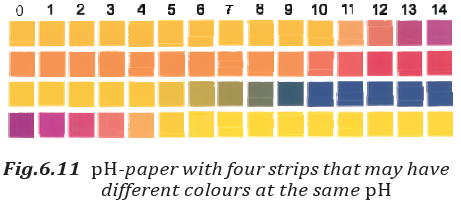
- pH paper: Estimates pH across the range –, with accuracy of about pH unit.
- pH meter: Measures the pH-dependent electrical potential; precision can be about pH unit.
- Soft-drink example: For , , so the drink is acidic.
| Substance | pH |
|---|---|
| Saturated NaOH solution | About 15 |
| NaOH solution | 13 |
| Lime water | 10.5 |
| Milk of magnesia | 10 |
| Egg white; seawater | 7.8 |
| Human blood | 7.4 |
| Milk | 6.8 |
| Human saliva | 6.4 |
| Black coffee | 5.0 |
| Tomato juice | About 4.2 |
| Soft drinks; vinegar | About 3.0 |
| Lemon juice | About 2.2 |
| Gastric juice | About 1.2 |
| HCl | About 0 |
| Concentrated HCl | About |
Extremely dilute strong acid
- Key point: In HCl, water ionization contributes significantly to and must be included.
- Setup: Let be the formed by water; then and .
- Result: , so pOH and pH .
Do not ignore water ionization for an extremely dilute strong acid; the water contribution can exceed the acid's contribution to hydrogen-ion concentration.
Ionization Constants of Weak Acids
Acid-ionization constant — The equilibrium constant describing the partial ionization of a weak acid in water.
| Stage | |||
|---|---|---|---|
| Initial | |||
| Change | |||
| Equilibrium |
At a fixed temperature, larger indicates a stronger acid. is dimensionless when standard-state concentrations are taken as .
| Acid | |
|---|---|
| Hydrofluoric acid, | |
| Nitrous acid, | |
| Formic acid, | |
| Niacin, | |
| Acetic acid, | |
| Benzoic acid, | |
| Hypochlorous acid, | |
| Hydrocyanic acid, | |
| Phenol, |
Lower corresponds to larger and greater acid strength.
Finding pH from a weak acid
- Identify the Brønsted–Lowry acids and bases initially present.
- Write balanced equations for all possible proton-transfer reactions.
- Select the reaction with the larger equilibrium constant as the primary reaction.
- Tabulate initial, change, and equilibrium concentrations using the degree of ionization.
- Substitute equilibrium concentrations into the primary reaction's equilibrium expression and solve for .
- Calculate the equilibrium concentrations of the species in the primary reaction.
- Calculate for a dilute solution.
Weak-acid calculation examples
- HF example: For and , solving gives .
- HF equilibrium: , , and pH .
- Back-calculation: A monobasic acid with pH has , , and .
The fraction of the initial acid concentration that has ionized, expressed as a percentage.
Small-ionization approximation and HOCl example
- Approximation: If , then , so and .
- HOCl example: For HOCl with , .
- Results: The solution has pH and percent dissociation .
What is in pure water at ?
How does indicate the strength of a weak acid?
Quick recap
- Water is amphoteric and self-ionizes to form and .
- At , ; neutral pure water has pH .
- At , ; each pH unit represents a tenfold change in hydrogen-ion concentration.
- For extremely dilute strong acids, include the hydrogen ions produced by water ionization.
- Weak-acid strength increases with and decreases with .
- Use equilibrium concentrations and to calculate ionization, species concentrations, pH, and percent dissociation.
Ionization Constants of Weak Acids
Ionization of Weak Bases
Weak-base ionization — A weak base ionizes only partially in water, establishing an equilibrium between the un-ionized base and its ions.
Key points
- Partial ionization: Only a fraction of weak-base molecules form ions.
- Base ionization constant: The equilibrium constant for base ionization is denoted by .
- Strength: A larger means greater ionization and a stronger base.
Use the equilibrium concentrations of the species.
For initial concentration and degree of ionization , each ion has concentration and un-ionized base has concentration at equilibrium.
| Base | |
|---|---|
| Dimethylamine, | |
| Triethylamine, | |
| Ammonia, (also written ) | |
| Quinine | |
| Pyridine, | |
| Aniline, | |
| Urea, |
Examples and ammonia in water
- Very weak bases: Methylamine, codeine, quinine and nicotine are described as very weak bases because their values are very small.
- Ammonia: It accepts a proton from water, forming ammonium and hydroxide ions.
The pKb Scale
A lower corresponds to a higher and greater base ionization.
A 0.004 M hydrazine solution has pH 9.7. Find its and .
Finding pH in an Ammonia–Ammonium Mixture
Small-ionization approximation
- Equilibrium: Ammonia ionizes to form ammonium and hydroxide ions; ammonium is also present initially from .
- Approximation: If is small, the change may be neglected relative to the initial concentrations of ammonia and ammonium.
| Stage | |||
|---|---|---|---|
| Initial (M) | |||
| Change (M) | |||
| Equilibrium (M) |
For M and M , let formed. When is small, use .
Calculate the pH when 0.2 M and 0.1 M are present; .
Quick recap
- Weak bases ionize partially in water and are characterized by .
- Equilibrium expression: .
- Degree of ionization: .
- pKb: ; lower means a stronger base.
- Small-ionization approximation: Neglect concentration changes when they are tiny compared with initial concentrations.
- Mixture example: M and M at give .
Relation between Ka and Kb
Relation Between Ka and Kb
Conjugate acid–base pair — A conjugate acid and base differ by one proton; their ionisation constants are linked by the water ionisation constant, Kw.
Adding the conjugate-pair reactions
- Net reaction: Adding the two equilibria cancels NH₄⁺ and NH₃, leaving water ionisation.
- Equilibrium constants: When reactions are added, their equilibrium constants are multiplied.
- Consequence: The product of Ka and Kb for a conjugate pair equals Kw.
- Strength: A strong acid has a weak conjugate base, and a weak acid has a strong conjugate base.
Use this relation to calculate either constant when the other is known.
For reactions added together, the net equilibrium constant is the product of the individual constants.
Taking negative logarithms gives the corresponding relation between pK values.
Ammonium–ammonia example
- For NH₄⁺/NH₃: and .
- Product: .
- Equilibrium expressions: ; .
- Cancellation: Multiplying these expressions cancels and , leaving .
Ammonia Ionisation, pH and Conjugate-Acid Ka
Worked example: 0.05 M NH₃
- Given: and .
- Small-ionisation approximation: If the degree of ionisation is small, , so .
- Degree of ionisation: .
- Hydroxide concentration: .
- pH: ; therefore .
- Conjugate acid: For NH₄⁺, .
Dibasic and Polybasic Acids
Polybasic (polyprotic) acid — An acid with more than one ionisable proton per molecule; examples include oxalic, sulphuric and phosphoric acids.
Each ionisation step has its own equilibrium constant; a tribasic acid has , and .
| Acid | |||
|---|---|---|---|
| Oxalic acid | — | ||
| Ascorbic acid | — | ||
| Sulphurous acid | — | ||
| Sulphuric acid | Very large | — | |
| Carbonic acid | — | ||
| Citric acid | |||
| Phosphoric acid |
Why successive ionisations weaken
- Trend: Usually ; each later proton is harder to remove.
- Reason: Removing a positively charged proton from an increasingly negative ion requires overcoming stronger electrostatic attraction.
- Example: Removing a proton from is harder than from neutral ; removing one from is harder than from .
- Solution composition: A diprotic-acid solution can contain , and ; hydronium comes mainly from the first dissociation.
Factors Affecting Acid Strength
Acid strength — Acid strength depends broadly on how readily the H–A bond breaks and the acid dissociates.
Bond strength and polarity
- Bond strength: A weaker H–A bond needs less energy to break, so HA is generally a stronger acid.
- Bond polarity: Greater electronegativity difference between H and A creates greater charge separation and generally makes bond cleavage easier.
- Same periodic group: H–A bond strength is the more important factor; as A gets larger down the group, the bond weakens and acidity increases.
- Same periodic row: Bond polarity is the deciding factor; increasing electronegativity of A increases acid strength.
| Comparison | Trend in acid strength | Main factor |
|---|---|---|
| Group 17 hydrides | Bond strength decreases down the group | |
| Second-period hydrides | Electronegativity of A increases across the row | |
| Group 16 hydrides | is a stronger acid than | Weaker H–A bond down the group |
Do not use bond polarity alone to compare acids across a group: the decrease in H–A bond strength is more influential there.
How are Ka and Kb related for a conjugate acid–base pair?
Why does the acidity of a polyprotic acid generally decrease at successive ionisation steps?
Quick recap
- For a conjugate acid–base pair, ; at 298 K, .
- When reactions are added, multiply their equilibrium constants to obtain the net constant.
- Use for a weak base when its degree of ionisation is small.
- Polybasic acids ionise stepwise, and later ionisation constants are generally smaller.
- Acid strength rises as the H–A bond weakens or, in same-row comparisons, as bond polarity increases.
- Down a group, bond strength is the key acidity factor; across a row, electronegativity is the key factor.
Common Ion Effect in the Ionization of Acids and Bases
Common Ion Effect in Acid–Base Ionization
Common ion effect — The shift in an ionization equilibrium caused by adding a substance that supplies an ion already present in that equilibrium.
How the effect works
- Acetate added: Increasing shifts acetic acid ionization to the left, lowering .
- Hydrogen ions added: Adding also shifts the equilibrium left, towards undissociated acetic acid.
- Principle: The shift follows Le Chatelier’s principle and suppresses further ionization of a weak acid or base.
For acetic acid, .
Example: acetic acid with acetate ions
- Given: Mix acetic acid with acetate ion.
- Equilibrium: If ionization is , then , , and .
- Approximation: Since is small, ; both the acetate and acid concentrations are approximately .
- Result: , so and .
For ammonia, .
Example: ammonia before and after adding acid
- Initial ammonia: For ammonia, let ; then and .
- Initial hydroxide: , giving .
- Initial pH: , so .
- Neutralization: of ammonia contains ; of HCl supplies .
- After mixing: The HCl converts ammonia to ammonium, leaving each of and in ; each is about .
- Common-ion calculation: Added suppresses ammonia ionization. Since and are equal, .
- Final pH: , so .
Hydrolysis of Salts and the pH of Their Solutions
Salt hydrolysis — The interaction of salt ions with water to form the corresponding acid or base; this interaction can change the solution’s pH.
General rule
- Strong acid–strong base salts: Their ions are hydrated but do not hydrolyse, so the solution is neutral with .
- Hydrolysing ions: Ions derived from weak acids or weak bases react with water; the resulting or determines the solution’s acidity or basicity.
| Salt type | Example | Hydrolysis and pH |
|---|---|---|
| Strong acid + strong base | No hydrolysis; neutral, . | |
| Weak acid + strong base | The anion hydrolyses and forms ; basic, . | |
| Strong acid + weak base | The cation hydrolyses and forms ; acidic, . | |
| Weak acid + weak base | Both ions hydrolyse; pH depends on and . |
Why sodium acetate is basic
- Weak acid formed: Acetic acid has and remains mainly unionized.
- pH effect: Hydrolysis increases , making the solution alkaline with .
Why ammonium chloride is acidic
- Weak base formed: Ammonium hydroxide has and remains almost unionized.
- pH effect: Hydrolysis increases , making the solution acidic with .
Weak acid–weak base salt
- Both ions hydrolyse: In ammonium acetate, acetate and ammonium ions form acetic acid and ammonium hydroxide.
- Concentration: The degree of hydrolysis is independent of the salt-solution concentration.
- pH control: The relative strengths of the weak acid and weak base determine whether the solution is acidic, neutral, or basic.
A positive gives ; a negative difference gives .
Example: ammonium acetate
- Given: Acetic acid has and ammonium hydroxide has .
- Calculation: ; the solution is very slightly basic.
Do not assume every salt solution is neutral: salts containing ions from weak acids or weak bases can hydrolyse and alter pH.
What is the common ion effect?
Why is aqueous sodium acetate basic?
State the pH relation for a salt of a weak acid and a weak base.
Quick recap
- Adding a common ion shifts weak-electrolyte ionization toward the undissociated form.
- Acetate added to acetic acid lowers ; ammonium added to ammonia lowers its ionization.
- For ammonia, ; equal ammonia and ammonium concentrations give .
- Strong acid–strong base salts do not hydrolyse appreciably and give neutral solutions.
- Weak acid–strong base salts are basic; strong acid–weak base salts are acidic.
- Both ions of a weak acid–weak base salt hydrolyse, and its pH follows .
- For ammonium acetate with and , .
Buffer Solutions
Buffer Solutions and Their Importance
Buffer solution — A solution that resists a change in pH on dilution or when small amounts of acid or alkali are added.
Why buffers matter
- Body fluids: Blood and urine normally maintain a definite pH; deviation can indicate malfunction.
- Applications: Buffers maintain pH in chemical and biochemical processes and in medical and cosmetic formulations.
- Examples: Acetic acid/sodium acetate buffers near pH ; ammonium chloride/ammonium hydroxide buffers near pH .
Designing an Acidic Buffer
Acidic buffer — A mixture of a weak acid and its conjugate-base salt, commonly formed by reacting the acid with a strong base.
Most conjugate base comes from the salt, while the weak acid ionises only slightly; concentrations can therefore be approximated by the amounts of salt and acid used.
Using the acidic-buffer equation
- Equal concentrations: If , then because .
- Choosing an acid: Select a weak acid whose is close to the required pH.
- Example: Equal molar concentrations of acetic acid and sodium acetate give a buffer near pH .
- Ratio effect: A higher salt-to-acid ratio raises pH; a lower ratio reduces it.
Designing a Basic Buffer
Basic buffer — A mixture of a weak base and its conjugate-acid salt.
For the pH equation below, is for the conjugate acid. The relations and connect the two forms.
Using the basic-buffer equation
- Equal concentrations: If , then for the conjugate acid.
- Example: Equal molar concentrations of ammonia and ammonium chloride give a buffer near pH , the stated value for ammonia/conjugate-acid buffering.
- Dilution: Both concentrations change by the same factor, so their ratio—and therefore buffer pH—remains unchanged.
How is the pH of an acidic buffer calculated?
Why does dilution not significantly change a buffer’s pH?
Solubility of Ionic Salts
Factors affecting solubility
- Solubility range: Ionic solids vary widely in water solubility; calcium chloride is highly soluble and hygroscopic, whereas lithium fluoride has so little solubility that it is commonly termed insoluble.
- Lattice enthalpy: The attractions between ions in the solid must be overcome for the salt to dissolve.
- Solvation: Ion–solvent interactions release energy; solvation enthalpy is negative, and its magnitude depends on the solvent.
- Solvent effect: Non-polar solvents provide weak solvation, often insufficient to overcome lattice enthalpy, so ionic salts generally do not dissolve in them.
- General condition: For a salt to dissolve, the solvation enthalpy must be sufficient to overcome lattice enthalpy. Solubility also depends on temperature.
| Category | Description | Solubility |
|---|---|---|
| I | Soluble | |
| II | Slightly soluble | |
| III | Sparingly soluble |
Solubility equilibrium
- Focus: Sparingly soluble salts establish an equilibrium between the undissolved ionic solid and its saturated aqueous solution.
Quick recap
- Buffer: Resists pH change on dilution or on adding small amounts of acid or alkali.
- Acidic buffer: Weak acid plus conjugate-base salt; .
- Basic buffer: Weak base plus conjugate-acid salt; as stated in the source, .
- Equal concentrations: Give for the relevant acid/conjugate-acid pair.
- Solubility: Salt dissolution depends on overcoming lattice attractions through ion–solvent interactions; solvent and temperature matter.
- Categories: Soluble salts have ; slightly soluble salts have ; sparingly soluble salts have .
Solubility Product Constant
Dissolution Equilibrium and the Solubility Product
Solubility product constant, — The equilibrium product of dissolved-ion concentrations for a sparingly soluble ionic solid in a saturated solution; each concentration is raised to its stoichiometric power.
For barium sulphate, at , .
Relating to Molar Solubility
Molar solubility, — The number of moles of a salt that dissolve per litre of saturated solution.
General salt stoichiometry
- Ion concentrations: If each formula unit produces cations and anions, their equilibrium concentrations are and .
- General dissolution: For , the salt is electrically neutral overall.
- General expression: .
Use after substituting ion concentrations from the dissolution stoichiometry.
Examples of solubility calculations
- Barium sulphate: Its ions form in a ratio, so . With , .
- Zirconium phosphate: One formula unit gives zirconium ions and phosphate ions; therefore, and .
- Zirconium phosphate result: , so .
- : . For , .
Reaction Quotient and Comparing Solubilities
— The ion-concentration product calculated like , using the concentrations present at that moment.
| Comparison | Outcome |
|---|---|
| Precipitation occurs until equilibrium is restored. | |
| The solution is at saturated equilibrium. | |
| More solid dissolves until equilibrium is restored. |
Comparing molar solubilities
- Do not compare values alone when salts have different dissolution stoichiometries; calculate for each salt.
- Silver cyanide: For , , giving .
- Nickel hydroxide: For , , giving .
- Conclusion: is more soluble than .
| Salt | |
|---|---|
Common-Ion Effect on Solubility
Common-ion effect — The decrease in solubility of an ionic salt when another electrolyte adds one of the ions already present in its dissolution equilibrium.
Applications and effects
- Adding an ion: The equilibrium shifts towards the solid, often causing precipitation, until again.
- Removing an ion: More solid dissolves to replace the removed ion and restore equilibrium.
- Sodium chloride example: Passing gas through saturated solution adds and precipitates . This can yield high-purity salt, removing impurities such as sodium and magnesium sulphates.
- Gravimetric analysis: The effect enables near-complete precipitation of silver as , ferric ion as (or hydrated ferric oxide), and barium as .
- Concentrated solutions: For soluble salts such as , activities rather than molarities are used in at high concentrations.
Effect of pH on Salts of Weak Acids
Why lower pH increases solubility
- Phosphate example: Phosphate salts become more soluble at lower pH because phosphate anions are protonated, reducing the free anion concentration.
- Equilibria: Both salt dissolution, , and weak-acid dissociation, , must be considered.
- Anion fraction: The unprotonated fraction is ; it decreases as increases.
- Solubility response: As free anion is consumed by protonation, more salt dissolves to restore the solubility-product condition.
For a salt with a weak-acid anion, and .
How does predict precipitation or dissolution?
Why does lowering pH increase the solubility of salts containing weak-acid anions?
Quick recap
- is the equilibrium product of ion concentrations in a saturated solution; pure solids are omitted.
- Calculate solubility: Use dissolution stoichiometry to express ion concentrations in terms of .
- Compare and : A greater quotient favours precipitation; a smaller one favours dissolution.
- Common ion added: Solubility usually decreases, and precipitation can result.
- Lower pH: Protonates weak-acid anions and increases the solubility of their salts, including phosphate salts.
- Compare salts correctly: Calculate each salt’s molar solubility rather than comparing values alone.
Summary
Dynamic Equilibrium and Equilibrium Constants
is written using equilibrium concentrations.
Reaction Quotient and Gaseous Equilibria
- : For a gaseous reaction, replace concentration terms in the expression with the corresponding partial pressures.
- Reaction quotient : Uses the same expression as , but with current concentrations; at equilibrium, .
- Direction: If , the forward reaction proceeds; if , the reverse reaction proceeds; if equal, the system is at equilibrium.
Le Chatelier’s Principle
- Principle: When an equilibrium system is disturbed, it shifts in a direction that counteracts the disturbance and establishes a new equilibrium.
- Applications: Changes in concentration, pressure or temperature can be used to control the equilibrium composition and product yield.
Electrolytes and Acid–Base Theories
| Theory | Acid | Base |
|---|---|---|
| Arrhenius | Produces in aqueous solution. | Produces in aqueous solution. |
| Brønsted–Lowry | Proton donor. | Proton acceptor. |
| Lewis | Electron-pair acceptor. | Electron-pair donor. |
Conjugate Acid–Base Pairs
- Brønsted–Lowry reaction: An acid donates a proton to a base, producing the acid’s conjugate base and the base’s conjugate acid.
- Conjugate pair: The two members differ by one proton, .
Weak Electrolytes, Ionisation and pH
For a weak acid and weak base , the constants are written using equilibrium concentrations.
These logarithmic quantities express ion concentrations and equilibrium constants.
The relationship holds for aqueous solutions at a given temperature.
Salt Hydrolysis and Buffer Solutions
Buffer solution — A solution that resists significant change in pH when small amounts of acid or base are added.
Solubility Equilibrium
How does predict the direction of reaction?
What is the difference between strong and weak electrolytes?
When does a sparingly soluble salt precipitate?
Quick recap
- Dynamic equilibrium: Forward and reverse rates are equal while microscopic processes continue.
- Equilibrium constants: uses concentrations, uses partial pressures, and predicts reaction direction.
- Equilibrium shifts: Disturbances cause shifts that counteract them; catalysts speed reactions without changing equilibrium composition.
- Acids and bases: Arrhenius, Brønsted–Lowry and Lewis theories define acids and bases by ions, proton transfer and electron-pair transfer.
- Solution equilibria: Electrolyte strength, ionisation, pH, hydrolysis and buffers describe aqueous behaviour.
- Solubility: relates to solubility; compare with to assess precipitation or further dissolution.
Chemistry — ALL CHAPTERS
1
Some Basic Concepts Of Chemistry
2
Structure Of Atom
3
Classification Of Elements And Periodicity In Properties
4
Chemical Bonding And Molecular Structure
5
Thermodynamics
6
Equilibrium
7
Redox Reactions
8
Organic Chemistry – Some Basic Principles And Techniques
9
Hydrocarbons