Class 11 PCM . Chemistry . Chemistry Part II . Organic Chemistry Some Basic Principles and Techniques
Chapter 8: Organic Chemistry – Some Basic Principles And Techniques
Ch 8
Chemistry
Class 11 PCM
General Introduction & Tetravalence Of Carbon: Shapes Of Organic Compounds
Organic Chemistry: Scope and Background
Organic chemistry — The branch of chemistry that studies organic compounds, which are largely covalent compounds of carbon.
Carbon Compounds and Their Importance
- Catenation Carbon forms covalent bonds with other carbon atoms, creating chains and other structures.
- Other elements Carbon also bonds covalently with hydrogen, oxygen, nitrogen, sulphur, phosphorus and halogens.
- Applications Organic compounds occur in DNA, proteins, clothing, fuels, polymers, dyes and medicines.
Key Milestones
- Around 1780Chemists began distinguishing organic compounds from plants and animals from inorganic compounds obtained from minerals.
- 1828F. Wöhler synthesised urea from inorganic ammonium cyanate, challenging the vital-force theory proposed by Berzelius.
- 1845Kolbe synthesised acetic acid from inorganic sources.
- 1856Berthelot synthesised methane from inorganic sources.
Development of Modern Organic Chemistry
- Vital-force theory Berzelius proposed that a special force was needed to form organic compounds; Wöhler’s synthesis challenged this idea.
- Modern development The electronic theory of covalent bonding helped establish the modern approach to organic chemistry.
Tetravalence and Shapes of Carbon Compounds
Tetravalence of carbon — Carbon has valency four and can form four covalent bonds; its bonding and molecular shapes are explained by its electronic configuration and hybridisation.
| Hybridisation | s character | Typical shape | Example |
|---|---|---|---|
| Linear | \ce{HC#CH} (ethyne) | ||
| Intermediate | Trigonal planar | (ethene) | |
| Least of these three | Tetrahedral | (methane) |
How Hybridisation Affects Bonds
- Bond length and strength More character brings the hybrid orbital closer to the nucleus, producing shorter and stronger bonds.
- Trend Bond length increases in the order ; bond strength follows the reverse order.
- Electronegativity Carbon’s electronegativity increases with character: .
| Compound | Carbon hybridisation | Molecular shape |
|---|---|---|
| Trigonal planar | ||
| Tetrahedral | ||
| \ce{HC#N} | Linear |
| Compound | Carbon hybridisation, in order |
|---|---|
Characteristic Features of Pi Bonds
Pi bond — A bond forms by sideways overlap of parallel orbitals on adjacent atoms.
Pi-Bond Properties
- Planarity In , all atoms lie in one plane; the parallel orbitals are perpendicular to this plane.
- Restricted rotation Rotating one fragment disrupts -orbital overlap, so rotation about a bond is restricted.
- Electron cloud The -bond electron cloud lies above and below the plane of the bonding atoms.
- Reactivity electrons are readily available to attacking reagents, making bonds reactive centres in molecules with multiple bonds.
| Molecule | |||
|---|---|---|---|
| \ce{HC#C-CH=CH2} | |||
Why is rotation restricted about a carbon–carbon double bond?
How does increasing character affect carbon’s electronegativity and bond strength?
Quick recap
- Catenation and tetravalence let carbon form many covalent compounds with itself and other elements.
- Wöhler synthesised urea from ammonium cyanate in 1828, challenging the vital-force theory.
- Carbon hybridisation commonly corresponds to linear , trigonal planar and tetrahedral shapes.
- Greater character means greater electronegativity and shorter, stronger bonds.
- A bond forms by sideways overlap of parallel orbitals, restricting rotation around a double bond.
- The -bond electron cloud lies above and below the bonding plane and is readily attacked by reagents.
Structural Representations Of Organic Compounds
Complete, Condensed and Bond-Line Structural Formulas
Ways to represent organic compounds
- Types: Organic structures may be shown as Lewis (dot) structures, dash structures, condensed structural formulas or bond-line formulas.
- Lewis structure: Shows covalent bonds as shared electron pairs; a dash structure simplifies each shared pair to a line.
- Bond marks: One dash represents a single bond, two a double bond and three a triple bond.
- Lone pairs: Lone pairs on heteroatoms such as oxygen, nitrogen, sulphur and halogens may be shown or omitted.
Complete structural formula — A representation that shows the atoms and the bonds between them explicitly.
- Examples: Complete structures show the individual bonds in ethane, ethene, ethyne, methanol and ethanol.
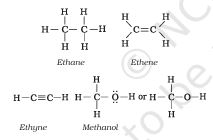
Condensed structural formula — A shortened structural formula that omits some or all bond dashes and groups repeated identical units using subscripts.
Condensed formula examples
- Simple molecules: Ethane is ce{CH3CH3}, ethene is ce{H2C=CH2}, ethyne is ce{HC#CH} and methanol is ce{CH3OH}.
- Repeated units: ce{CH3CH2CH2CH2CH2CH2CH2CH3} can be shortened to ce{CH3(CH2)6CH3}.
- Nitrile example: ce{N#C-CH(OH)-C#N} can be condensed to ce{HOCH(CN)2}.
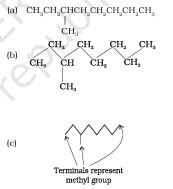
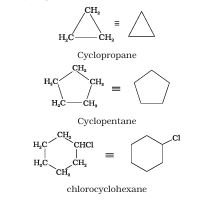
Bond-line structural formula — A skeletal representation that uses lines for carbon–carbon bonds and leaves carbon and carbon-bound hydrogen symbols unwritten.
Reading bond-line formulas
- Carbon atoms: Each line junction and line end represents a carbon atom.
- Hydrogens: Each carbon has the number of implied hydrogens needed to complete its valency of four.
- Heteroatoms: Atoms such as oxygen, nitrogen and chlorine are written explicitly.
- Terminals: A line terminal usually represents a methyl group, ce{-CH3}, unless another group is shown there.
- Shape: Carbon chains are drawn in a zigzag pattern; cyclic compounds are shown as skeletal polygons.
Converting between representations
- Expansion: ce{CH3CH2COCH2CH3} becomes ce{CH3-CH2-C(=O)-CH2-CH3} when bonds and the carbonyl group are shown explicitly.
- Condensation: ce{HOCH2CH2CH(CH3)CH(CH3)2} can be written as ce{HO(CH2)2CH(CH3)CH(CH3)2}.
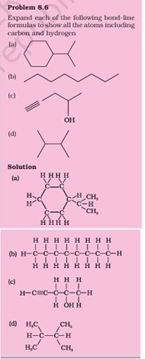
- Reading a skeleton: Add the implied carbon atoms at every endpoint and junction, then add enough hydrogens to give each carbon four bonds.
Three-Dimensional Representation of Organic Molecules
Wedge-and-dash formula — A drawing convention that shows the direction of bonds in three-dimensional space.
- Solid wedge: The bond projects out of the paper towards the observer; its broad end points towards the observer.
- Dashed wedge: The bond projects behind the plane of the paper, away from the observer.
- Normal line: The bond lies in the plane of the paper.
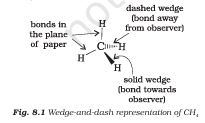
Molecular Models
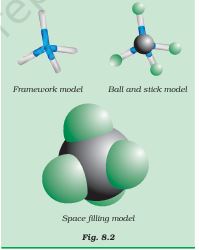
Molecular models — Physical or computer-based representations used to visualise the three-dimensional shapes of molecules.
- Materials: Physical models may be made from wood, plastic or metal.
- Framework model: Shows only the bonds connecting atoms, emphasising the bonding pattern rather than atom sizes.
- Ball-and-stick model: Shows atoms as balls and bonds as sticks; springs may replace sticks to represent double bonds such as ce{C=C} in ethene.
- Space-filling model: Shows relative atom sizes based on van der Waals radii; bonds are not displayed, so the model conveys the volume occupied by the molecule.
- Computer modelling: Computer graphics can also be used to model molecules.
| Model | What it shows | Emphasis |
|---|---|---|
| Framework | Bonds only | Bonding pattern |
| Ball-and-stick | Atoms as balls; bonds as sticks or springs | Atoms and their connections |
| Space-filling | Atoms sized by van der Waals radii; bonds omitted | Relative atomic size and molecular volume |
What do endpoints and junctions represent in a bond-line formula?
How do solid and dashed wedges differ?
Quick recap
- Common structural representations include Lewis dot, dash, condensed and bond-line formulas.
- Complete formulas show atoms and bonds explicitly; condensed formulas abbreviate bonds and repeated groups.
- Bond-line formulas omit carbon symbols and carbon-bound hydrogens; endpoints and junctions represent carbon atoms.
- Solid wedges point towards the observer, dashed wedges away, and normal lines lie in the page.
- Framework, ball-and-stick and space-filling models emphasise different aspects of molecular structure.
Classification Of Organic Compound
Classification by Structure
Main structural classes
- Acyclic (open-chain) compounds: Aliphatic compounds with straight or branched carbon chains.
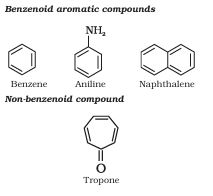
- Cyclic (closed-chain) compounds: Compounds whose atoms form one or more rings; these include alicyclic and aromatic compounds.
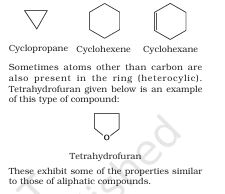
- Ring atoms: A ring may contain only carbon atoms (homocyclic) or carbon plus heteroatoms (heterocyclic).
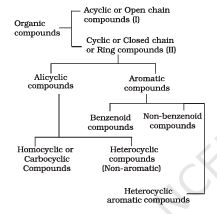
| Class | Key feature | Examples |
|---|---|---|
| Acyclic / aliphatic | Straight or branched open chain | Ethane ; isobutane ; acetaldehyde ; acetic acid |
| Alicyclic | Aliphatic ring compounds; carbon atoms form a homocyclic ring | Cyclic hydrocarbons |
| Aromatic | Special ring compounds; may be benzenoid or non-benzenoid | Benzene and related compounds; tropone is non-benzenoid |
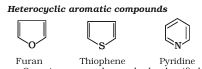
| Heterocyclic aromatic | Aromatic ring containing a heteroatom | Furan, thiophene and pyridine |
Functional Groups
Functional group — An atom or group of atoms attached to a carbon chain that gives an organic compound its characteristic chemical properties.
| Functional group | Representation |
|---|---|
| Hydroxyl | |
| Aldehyde | |
| Carboxylic acid |
Homologous Series
Homologous series — A family of organic compounds that share a characteristic functional group and have successive members differing by one unit in molecular formula.
Key features
- Members: Each member is called a homologue.
- Representation: Members can be represented by a general molecular formula.
- Difference: Molecular formula changes by between successive members.
- Examples of series: Alkanes, alkenes, alkynes, haloalkanes, alkanols, alkanals, alkanones, alkanoic acids and amines.
Polyfunctional Compounds
Polyfunctional compound — An organic compound containing two or more functional groups, which may be identical or different.
What is a homologous series? State the difference between successive members.
Distinguish alicyclic compounds from heterocyclic aromatic compounds.
Quick recap
- Organic compounds are classified structurally as open-chain or cyclic.
- Open-chain compounds may be straight or branched and are also called aliphatic.
- Cyclic compounds include alicyclic and aromatic types; aromatic compounds may be benzenoid or non-benzenoid.
- A functional group gives an organic compound its characteristic chemical properties.
- Successive members of a homologous series differ by .
- Compounds with two or more functional groups are polyfunctional.
Nomenclature Of Organic Compound
IUPAC nomenclature — A systematic method of naming organic compounds, developed by the International Union of Pure and Applied Chemistry (IUPAC), that links names to structures.
| Point | IUPAC name | Common or trivial name |
|---|---|---|
| Basis | Derived systematically from the compound’s structure. | Often based on the compound’s origin or a property. |
| Use | Allows a structure to be deduced from the name. | Still useful, especially when a systematic name is long or complex. |
| Examples | Follows established naming rules. | Citric acid is associated with citrus fruits; formic acid is named from the Latin word for ant, formica. |
| Formula | Common name |
|---|---|
| Methane | |
| -Butane | |
| Isobutane | |
| Neopentane | |
| -Propyl alcohol | |
| Formaldehyde | |
| Acetone | |
| Chloroform | |
| Acetic acid | |
| Benzene | |
| Anisole | |
| Aniline | |
| Acetophenone | |
| Ethyl methyl ether |
The IUPAC System
How an IUPAC Name Is Built
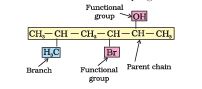
- Identify the parent hydrocarbon and the functional group or groups attached to it.
- Modify the parent name with prefixes and suffixes to show substituents and functional groups.
Hydrocarbon — An organic compound containing only carbon and hydrogen.
| Type | Bonding | Name or note |
|---|---|---|
| Saturated | Contains only carbon–carbon single bonds. | The alkane homologous series; formerly called paraffins. |
| Unsaturated | Contains at least one carbon–carbon double or triple bond. | Contains a multiple carbon–carbon bond. |
IUPAC Nomenclature of Alkanes
Alkane — A saturated hydrocarbon in a homologous series whose names end in “-ane.”
| Number of carbon atoms | Name | Molecular formula |
|---|---|---|
| 1 | Methane | |
| 2 | Ethane | |
| 3 | Propane | |
| 4 | Butane | |
| 5 | Pentane | |
| 6 | Hexane | |
| 7 | Heptane | |
| 8 | Octane | |
| 9 | Nonane | |
| 10 | Decane | |
| 20 | Icosane | |
| 30 | Triacontane |
Straight-Chain Alkanes and Homologues
- Naming: Names end in “-ane” and use a prefix indicating the carbon count; for through , these prefixes come from the traditional names methane, ethane, propane and butane.
- Homologues: Successive alkanes differ by one group.
Branched-Chain Alkanes and Alkyl Groups
Alkyl group — A group formed by removing one hydrogen atom from an alkane; its name changes from “-ane” to “-yl.”
| Alkane | Alkyl structure | Alkyl name | Abbreviation |
|---|---|---|---|
| Methane | Methyl | Me | |
| Ethane | Ethyl | Et | |
| Propane | Propyl | Pr | |
| Butane | Butyl | Bu | |
| Decane | Decyl | — |
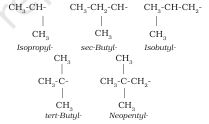
| Common name | Structure |
|---|---|
| Isopropyl | |
| sec-Butyl | |
| Isobutyl | |
| tert-Butyl | |
| Neopentyl |
Branched Alkyl-Group Naming
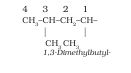
- Common names: Propyl groups may be -propyl or isopropyl; branched butyl groups include sec-butyl, isobutyl and tert-butyl.
- Neopentyl: The group is called neopentyl.
- Attachment point: In a branched substituent, number from the carbon attached to the parent chain; this is carbon 1.
- Parentheses: Enclose the name of a branched alkyl substituent in parentheses within the compound name.
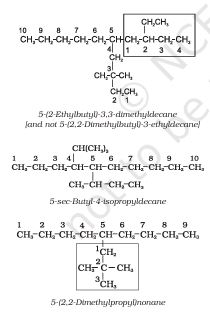
- Alphabetical order: Count iso- and neo- as part of the substituent name; do not count sec- and tert-.
- Use of common prefixes: Iso- and related common prefixes may be used when the alkyl group is not further substituted.
Rules for Naming Branched-Chain Alkanes
Naming a Branched-Chain Alkane
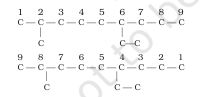
- Choose the longest continuous carbon chain as the parent chain; if equal-length chains are possible, choose the one with more side chains.
- Number the parent chain from the end that gives substituents the lowest possible set of locants.
- If numbering choices give equivalent locants, assign the lower number to the substituent whose name comes first alphabetically.
- Identify each alkyl substituent and record its position number.
- List different substituents alphabetically; ignore di-, tri-, tetra- and similar multiplicative prefixes when alphabetising.
- For repeated identical substituents, use di-, tri-, tetra-, penta- or hexa-; separate locants with commas.
- Join locants and names with hyphens; write the substituent directly before the parent name, with no space.
| Structure | IUPAC name |
|---|---|
| 2,4-Dimethylpentane | |
| 2,2,4-Trimethylpentane | |
| 3-Ethyl-4,4-dimethylheptane | |
| 3-Ethyl-6-methyloctane |
Locants and Alphabetical Order
- Lowest locants: Choose the numbering with the lowest set of substituent positions, such as 2,5,6 rather than 3,4,7.
- Alphabetical tie-break: If substituents have equivalent positions, give the lower number to the substituent that comes first alphabetically.
- Example: The correct name is 3-ethyl-6-methyloctane, not 6-ethyl-3-methyloctane.
- Punctuation: Separate locants with commas and locants from words with hyphens; do not insert spaces within the name.
Cyclic Compounds
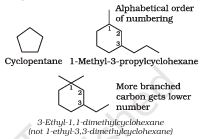
Saturated monocyclic compound — A saturated compound containing one ring; name it by adding “cyclo-” to the corresponding straight-chain alkane name.
Substituted Cycloalkanes
- Side chains: Apply the same substituent and alphabetical-order rules used for branched-chain alkanes.
- Numbering: Number the ring to give substituents the lowest possible locants; use alphabetical order to resolve equivalent choices.
How are repeated identical substituents shown in an IUPAC name?
How is a numbering tie between different substituents resolved?
Quick recap
- IUPAC naming links compound names to structures; common names may reflect origin or properties and can remain useful.
- Alkanes are saturated hydrocarbons; their names end in “-ane,” and successive homologues differ by .
- For through , the carbon-count roots come from the traditional names methane, ethane, propane and butane.
- An alkyl group forms when one hydrogen is removed from an alkane; change “-ane” to “-yl.”
- Choose the longest parent chain; for equal-length choices, select the chain with more side chains.
- Number for the lowest substituent locants; use alphabetical order to break equivalent-position ties.
- A saturated monocyclic compound is named by adding “cyclo-” to the corresponding alkane name.
Nomenclature Of Organic Compounds Having Functional Group(s)
Functional Groups and Basic Naming Rules
Functional group — An atom or group of atoms bonded in a characteristic way, usually the site of chemical reactivity in an organic molecule.
Naming a Compound
- Similar reactions: Compounds with the same functional group often undergo similar reactions; for example, alcohols react with sodium to liberate hydrogen.
- Identify: Find the functional group; it determines the appropriate suffix and, in polyfunctional compounds, helps select the principal group.
- Select and number: Choose the longest carbon chain containing the principal group and number it to give that group the lowest possible locant.
- Name: Use the principal group’s suffix and add the locants and prefixes needed for other substituents.
Common Functional Groups and Naming Forms
| Class | Functional group | Prefix | Suffix | Example |
|---|---|---|---|---|
| Alkanes | — | — | -ane | Butane, |
| Alkenes | — | -ene | But-1-ene, | |
| Alkynes | \ce{C#C} | — | -yne | But-1-yne, \ce{CH#CCH2CH3} |
| Arenes | Benzene ring | — | — | Benzene, |
| Halides | () | halo- | — | 1-Bromobutane, |
| Alcohols | hydroxy- | -ol | Butan-2-ol, | |
| Aldehydes | formyl- or oxo- | -al | Butanal, | |
| Ketones | oxo- | -one | Butan-2-one, | |
| Nitriles | \ce{-C#N} | cyano- | nitrile | Pentanenitrile, |
| Ethers | alkoxy- | — | Ethoxyethane, | |
| Carboxylic acids | carboxy- | -oic acid | Butanoic acid, | |
| Carboxylate ions | — | -oate | Sodium butanoate, | |
| Esters | alkoxycarbonyl- | -oate | Methyl propanoate, | |
| Acyl halides | () | halocarbonyl- | -oyl halide | Butanoyl chloride, |
| Amines | , , | amino- | -amine | Butan-2-amine, |
| Amides | , , | carbamoyl- | -amide | Butanamide, |
| Nitro compounds | nitro- | — | 1-Nitrobutane, | |
| Sulphonic acids | sulpho- | -sulphonic acid | Methylsulphonic acid, |
Priority in Compounds with Multiple Functional Groups
Choosing and Naming the Principal Group
- Principal group: In a polyfunctional compound, the highest-priority functional group determines the suffix.
- Subordinate groups: Name the other functional groups as substituents using their appropriate prefixes.
- Always prefixes: Alkyl, phenyl, halogen, nitro and alkoxy groups are named as prefixes.
| Priority | Functional group |
|---|---|
| 1 (highest) | |
| 2 | |
| 3 | |
| 4 | |
| 5 | |
| 6 | |
| 7 | |
| 8 | |
| 9 | |
| 10 | |
| 11 | |
| 12 (lowest) | \ce{C#C} |
Priority and Numbering Examples
- Alcohol and ketone: Ketone has higher priority, so the alcohol is named with the prefix hydroxy-.
- Example: is 7-hydroxyheptan-2-one, not 2-oxoheptan-7-ol.
- Bromo-substituted alkene: In , number from the end nearest the double bond; the name is 3-bromoprop-1-ene.
Worked Naming Examples
- Alcohol: An eight-carbon chain with the hydroxyl group on carbon 3 is octan-3-ol.
- Aldehyde: An eight-carbon chain ending in is octanal; the aldehyde carbon is carbon 1.
- Ketone: A seven-carbon chain with the carbonyl group on carbon 4 is heptan-4-one.
- Carboxylic acid: A six-carbon chain containing is hexanoic acid.
Repeated Functional Groups and Multiple Bonds
- Repeated groups: Use di-, tri- and similar prefixes, with locants for each group.
- Multiple suffix groups: Write the full parent alkane name before the class suffix; for example, is ethane-1,2-diol.
- Multiple double or triple bonds: Drop the final e of the parent alkane before the unsaturation ending; is buta-1,3-diene.
Nomenclature of Substituted Benzene Compounds
One or Two Substituents
- One substituent: Place its name as a prefix before “benzene”; many substituted benzenes also have common names.
- Two substituents: Number the ring to give the substituents the lowest possible locants; for example, use 1,3-dibromobenzene, not 1,5-dibromobenzene.
| Relative position | Locants | Prefix |
|---|---|---|
| Adjacent | 1,2 | ortho- (o-) |
| Separated by one carbon | 1,3 | meta- (m-) |
| Opposite positions | 1,4 | para- (p-) |
Three or More Substituents
- Locants: Do not use ortho-, meta- or para-; identify each substituent position using the lowest-locant rule.
- Base compound: If a common benzene derivative is used as the base, assign its substituent position 1.
- Numbering direction: Choose the direction that gives the next substituent the lowest number.
- Name order: List substituent prefixes in alphabetical order.
Phenyl group — When a benzene ring is a substituent attached to an alkane containing the principal functional group, it is called phenyl, , abbreviated Ph.
Do not give a lower-priority group the suffix: the highest-priority group determines the suffix, while other functional groups are named as prefixes.
How is the principal functional group selected when a compound contains several functional groups?
What do ortho, meta and para indicate in disubstituted benzene?
Quick recap
- Functional groups identify characteristic reactive sites and help classify organic compounds.
- Choose the longest chain containing the principal group and number it to give that group the lowest locant.
- The highest-priority functional group determines the suffix; subordinate groups are named as prefixes.
- Use di-, tri- and similar prefixes with locants for repeated functional groups.
- For disubstituted benzene, use the lowest locants; ortho, meta and para indicate 1,2; 1,3; and 1,4.
- For three or more benzene substituents, use lowest locants and list prefixes alphabetically.
- A benzene ring treated as a substituent is phenyl, , or Ph.
Isomerism
Isomerism
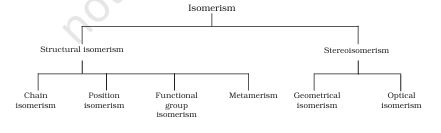
Structural Isomerism
Structural isomers — Compounds with the same molecular formula but different ways of linking their atoms.
| Type | How structures differ | Example |
|---|---|---|
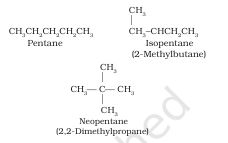
| Chain isomerism | Different carbon skeletons or branching patterns. | The formula has pentane, isopentane and neopentane; branching affects properties such as boiling point and stability. |
| Position isomerism | The position of a substituent or functional group differs on the same carbon skeleton. | Propan-1-ol and propan-2-ol, both . |
| Functional group isomerism | The compounds have different functional groups. | Propanal (aldehyde) and propanone (ketone), both . |
| Metamerism | Different alkyl chains occur on either side of the same functional group. | Methoxypropane and ethoxyethane, both . |
Position Isomer Examples
- Propan-1-ol: The group is on carbon 1; it is a primary alcohol.
- Propan-2-ol: The group is on carbon 2; it is a secondary alcohol.
- Key difference: Both have formula ; the position of the hydroxyl group changes.
Functional Group Isomer Examples
- Propanone: Its carbonyl group is within the carbon chain, so it is a ketone.
- Propanal: Its terminal group identifies it as an aldehyde.
- Key difference: Both have formula , but their functional groups differ.
Stereoisomerism
Stereoisomers — Compounds with the same constitution and sequence of covalent bonds but different spatial arrangements of atoms or groups.
Types of Stereoisomerism
- Main types: Geometrical isomerism and optical isomerism.
Fundamental Concepts in Organic Reaction Mechanism
Reaction mechanism — A step-by-step account of electron movement, bond breaking and formation, energetics, and the rates of reactant-to-product transformation.
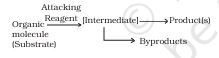
General Reaction Pathway
- Substrate (organic starting molecule) + attacking reagent
- Temporary intermediate(s) form
- Intermediate(s) transform into product(s); byproducts may also form
Substrate and Reagent
- Organic reactions: Ions are generally not the reacting starting materials; molecules usually participate as such.
- Substrate: The reactant whose carbon supplies carbon to a new bond; the other reactant is called the reagent.
- If both reactants supply carbon: The choice of substrate is arbitrary and depends on which molecule is being considered.
- Why mechanisms matter: They help explain organic reactivity and plan synthesis.
Fission of a Covalent Bond
| Point | Heterolytic cleavage | Homolytic cleavage |
|---|---|---|
| Electron distribution | Both shared electrons go to one bonded atom or group. | One shared electron goes to each bonded atom or group. |
| Products | Ions: a cation and an anion. | Neutral radicals, each with an unpaired electron. |
| Arrow notation | A full-headed curved arrow shows movement of an electron pair. | A half-headed fishhook arrow shows movement of one electron. |
| Reaction type | Ionic, heteropolar or polar reaction. | Free-radical, homopolar or nonpolar reaction. |
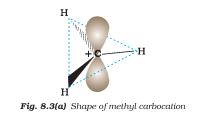
Carbocation — A positively charged carbon species in which the carbon has a sextet of electrons.

Carbocation Structure and Stability
- Classification: Primary, secondary and tertiary carbocations have one, two or three carbon groups attached to the positively charged carbon.
- Shape: The charged carbon is hybridised and trigonal planar, with a vacant orbital perpendicular to the plane.
- Stability: Alkyl groups stabilise carbocations through inductive and hyperconjugation effects; stability increases from methyl to tertiary.
Carbanion — A carbon species carrying a negative charge on carbon, usually with an unshared electron pair.
Carbanion Structure
- Geometry: Carbon is generally hybridised; the lone pair gives a trigonal-pyramidal, distorted tetrahedral structure.
- Reactivity: Carbanions are unstable and reactive intermediates.
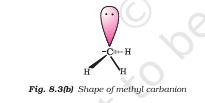
Free radical — A neutral atom or group containing an unpaired electron, formed by homolytic bond cleavage.
Radical Stability
- Classification: Alkyl radicals are primary, secondary or tertiary according to the number of carbon groups attached to the radical carbon.
- Stability: Radical stability increases from methyl/primary through secondary to tertiary.
Substrate and Reagent
Identifying Substrate and Reagent
- Substrate: In general, the molecule whose carbon is involved in forming a new bond.
- Reagent: The other reactant that attacks or interacts with the substrate.
- Carbon–carbon bond formation: If both reactants supply carbon to the new bond, assigning substrate and reagent is arbitrary and depends on the molecule being considered.
Nucleophiles and Electrophiles
| Point | Nucleophile | Electrophile |
|---|---|---|
| Electron behaviour | Donates an electron pair to form a bond; seeks a positive nucleus. | Accepts an electron pair to form a bond; seeks electrons. |
| Character | Electron-rich; often has a negative charge or lone pair. | Electron-deficient; may have a positive charge or incomplete valence shell. |
| Examples | , , carbanions, and amines. | Carbocations, , and ; neutral electrophilic groups include carbonyl groups and alkyl halides. |
Reactive Centres and Examples
- Electrophilic centre: An electron-deficient part of a substrate that accepts an electron pair from a nucleophile.
- Nucleophilic centre: An electron-rich part of a substrate that supplies an electron pair to an electrophile.
- Attack: Nucleophiles attack electrophilic centres; electrophiles attack nucleophilic centres.
- Nucleophiles: , , , and have available electron pairs to donate.
- Electrophiles: , and can accept an electron pair; the listed electron-deficient centres have incomplete valence shells.
- Partial positive carbon: In , and , the electrophilic centre is the carbon made partially positive by bond polarity: the carbon attached to oxygen, the carbon adjacent to the cyano group, and the carbon attached to iodine, respectively.
Electron Movement in Organic Reactions
Curved-Arrow Notation
- Electron-pair movement: A full-headed curved arrow starts at the electron pair and points to where the pair moves.
- Single-electron movement: A half-headed fishhook arrow shows the movement of one electron.
- Common shifts: Electron pairs may move from a bond to a bond position, from a bond to an adjacent atom, or from an atom to an adjacent bond.
How do structural isomers differ from stereoisomers?
What is the difference between heterolytic and homolytic cleavage?
Define a nucleophile and an electrophile.
Quick recap
- Isomers share a molecular formula but differ in properties; they may be structural isomers or stereoisomers.
- Structural isomerism includes chain, position, functional group and metamerism; stereoisomerism includes geometrical and optical isomerism.
- Reaction mechanisms trace electron movement, bond changes, energetics and reaction rates from substrate and reagent to products.
- Heterolytic cleavage forms ions; homolytic cleavage forms neutral radicals.
- Carbocations and alkyl radicals become more stable from methyl/primary to tertiary; carbocations are planar with a vacant p orbital.
- Nucleophiles donate electron pairs and electrophiles accept them; full-headed arrows show pair movement and fishhooks show single-electron movement.
Electron Displacement Effects in Covalent Bonds
Electron Displacement: Overview
- Permanent effects: Substituent groups can cause lasting electron displacement in a molecule.
- Temporary effect: An attacking reagent can induce electron displacement during a reaction.
Inductive Effect

Inductive Effect: Examples
- More polar bonds: Among the given pairs, C–Br is more polar than C–H; C–O is more polar than C–N; and C–O is more polar than C–S.
- Farthest bond: In , the inductive effect is least at the carbon-3–hydrogen bond, farthest from bromine.
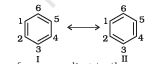
Resonance Structures

| Check | Rule or stability preference |
|---|---|
| What remains unchanged | Nuclei positions and number of unpaired electrons stay the same; only electrons move. |
| Bonds and shells | More covalent bonds and complete octets are preferred; hydrogen has a duplet. |
| Charges | Less separation of opposite charges and greater charge dispersal are preferred. |
| Charge placement | A negative charge is favoured on a more electronegative atom; a positive charge on a more electropositive atom. |
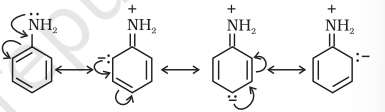
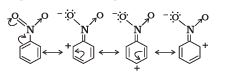
Resonance Effect
Electromeric Effect
Hyperconjugation
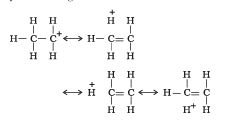
Increasing alkyl substitution generally increases hyperconjugative stabilisation.
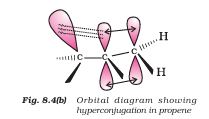
Hyperconjugation: Stability Example
- Tert-butyl cation: has nine adjacent C–H bonds available for hyperconjugation, making it more stable than .
- Methyl cation: lacks hyperconjugative stabilisation: its vacant p orbital is perpendicular to the plane of its C–H bonds and cannot overlap with them.
Types of Organic Reactions
What remains unchanged between resonance structures?
How do +R and −R effects differ?
Why is the tert-butyl cation more stable than the ethyl cation?
Quick recap
- Inductive effect: Permanent sigma-bond polarisation that weakens rapidly with distance.
- Resonance hybrid: The actual structure is represented by contributing forms; the hybrid is lower in energy than any canonical form.
- Resonance effects: +R donates electron density into a conjugated system; −R withdraws it towards the substituent.
- Electromeric effect: A temporary, complete shift of pi electrons caused by an approaching reagent.
- Hyperconjugation: Adjacent C–H sigma electrons delocalise and stabilise unsaturated systems and carbocations.
- Reaction categories: Substitution, addition, elimination and rearrangement.
Methods of Purification of Organic Compounds
Purification: purpose and methods
Purification — Purification separates an organic compound from impurities after extraction or synthesis.
Choosing a method and checking purity
- Method choice: Depends on the physical properties of the compound and the impurities present.
- Common methods: Sublimation, crystallisation, distillation, differential extraction and chromatography.
- Melting/boiling points: Pure compounds generally have sharp melting or boiling points.
- Modern checks: Chromatographic and spectroscopic techniques are also used to assess purity.
Sublimation
Sublimation — Sublimation is the change of a solid directly into vapour without passing through the liquid state.
Principle and use
- Separation: Heating vaporises the sublimable solid; the nonsublimable impurities remain behind.
- Use: Purifies a sublimable compound from solid impurities that do not sublime.
Crystallisation
Crystallisation — Crystallisation purifies a solid using differences in the solubility of the compound and its impurities in a suitable solvent.
Principle and key points
- Suitable solvent: The compound is sparingly soluble at room temperature but appreciably soluble when hot.
- Crystals form: Concentrate the hot solution to near saturation, then cool it; the purified compound crystallises and is filtered off.
- Mother liquor: The filtrate retains impurities and a small amount of the compound.
- Solvent mixture: Can be used when the compound is highly soluble in one solvent but only slightly soluble in another.
- Colour removal: Activated charcoal adsorbs coloured impurities.
- Repeated crystallisation: Needed when impurities have solubilities similar to that of the compound.
Distillation
Distillation — Distillation separates liquids by vaporising them and condensing their vapours, using differences in volatility and boiling points.
Simple distillation
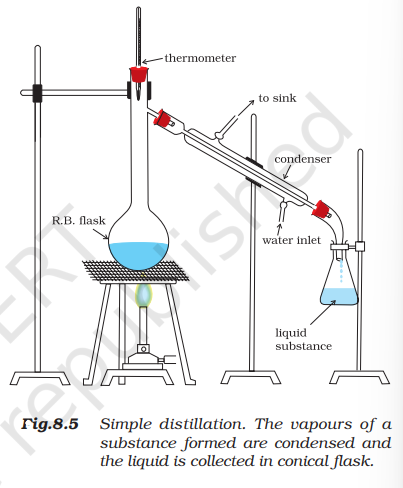
- Uses: Separates a volatile liquid from nonvolatile impurities, or liquids with sufficiently different boiling points.
- Separation: The lower-boiling component vaporises first; its vapour is cooled in a condenser and collected as liquid.
- Example: Chloroform (b.p. ) and aniline (b.p. ) can be separated by distillation.
- Apparatus: The mixture is heated in a round-bottom flask; a condenser cools vapour and a receiver collects the distillate.
Fractional distillation
- Use: Separates liquids whose boiling points are close, so simple distillation cannot separate their vapours effectively.
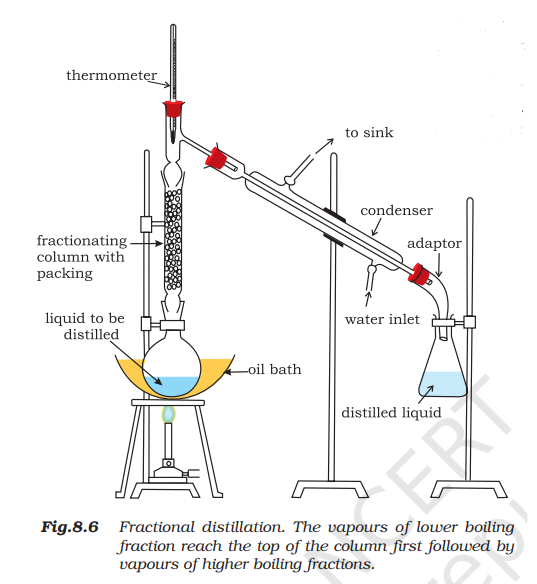
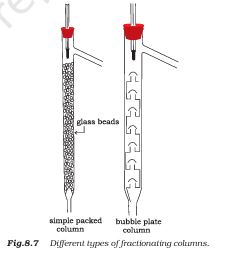
- Fractionating column: Fitted above the flask; it provides surfaces for repeated heat exchange, condensation and vaporisation.
- Vapour enrichment: Higher-boiling vapour condenses lower in the column; rising vapour becomes richer in the more volatile, lower-boiling component.
- Products: The lower-boiling component reaches the top, passes to the condenser and is collected; the flask liquid becomes richer in the higher-boiling component.
- Theoretical plate: Each successive condensation–vaporisation unit in the column is called a theoretical plate; commercial columns may have hundreds.
- Application: Used in the petroleum industry to separate crude oil into fractions.
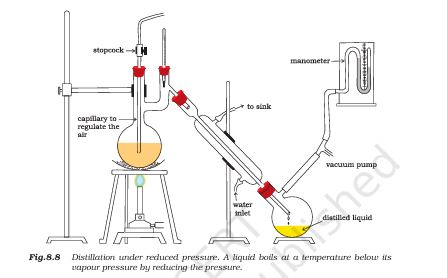
Distillation under reduced pressure
- Use: Purifies liquids with very high boiling points or liquids that decompose at or below their boiling points.
- Principle: Reducing external pressure lowers the temperature at which a liquid boils.
- Boiling condition: A liquid boils when its vapour pressure equals the external pressure.
- Equipment/example: A water pump or vacuum pump reduces pressure; glycerol can be separated from spent-lye in the soap industry this way.
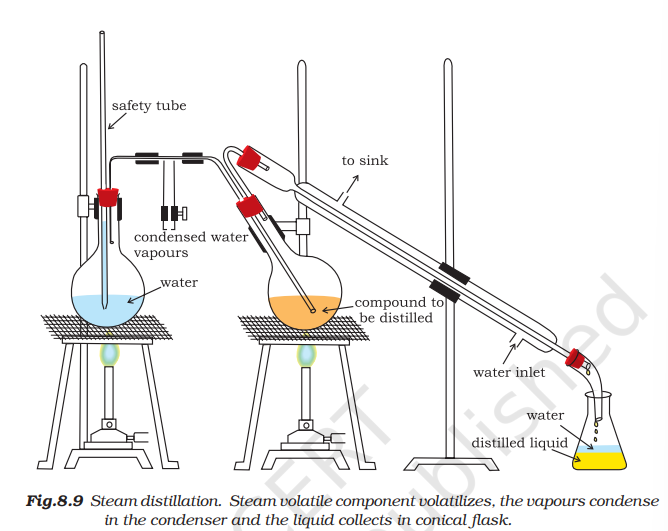
Steam distillation
- Use: Separates steam-volatile substances that are immiscible with water.
- Principle: The mixture boils when the combined vapour pressures of water and the organic compound equal atmospheric pressure.
- Lower boiling temperature: Since the organic compound contributes to the total vapour pressure, it can vaporise below its normal boiling point.
- Separation: Condense the steam–organic vapour mixture, then separate the organic layer from water using a separating funnel.
- Example: Aniline can be separated from an aniline–water mixture; immiscible water mixtures generally boil close to, but below, .
The total vapour pressure equals atmospheric pressure.
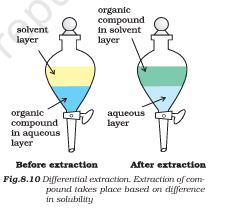
Differential extraction
Differential extraction — Differential extraction transfers an organic compound from an aqueous solution into an immiscible organic solvent in which it is more soluble.
Key points
- Layer formation: The organic solvent and water must be immiscible so they form separate layers in a separating funnel.
- Recovery: Remove the organic solvent by evaporation or distillation to obtain the compound.
- Continuous extraction: Useful when the compound is only slightly soluble in the organic solvent; the same solvent is repeatedly used to extract it.
Chromatography
Chromatography — Chromatography separates mixture components through their different interactions with a stationary phase and a moving mobile phase.
Principle and classification
- Stationary phase: A solid or liquid phase that remains in place.
- Mobile phase: A solvent, solvent mixture or gas that moves over the stationary phase.
- Separation: Components move differently because their interactions with the two phases differ.
- Main types: Adsorption chromatography and partition chromatography.
| Type | Principle | Examples |
|---|---|---|
| Adsorption chromatography | Components are adsorbed to different extents on a solid adsorbent. | Column chromatography; thin-layer chromatography (TLC) |
| Partition chromatography | Components distribute differently between stationary and mobile phases. | Paper chromatography |
Adsorption chromatography
Column chromatography
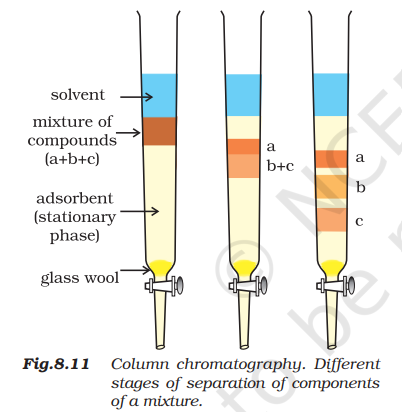
- Stationary phase: An adsorbent, commonly silica gel or alumina, packed into a glass column.
- Eluant: A suitable liquid or liquid mixture flows slowly down the column as the mobile phase.
- Separation: Components travel different distances according to how strongly they are adsorbed.
- Position: The most strongly adsorbed components are retained nearer the top; less strongly adsorbed components move farther down.
Thin-layer chromatography (TLC)
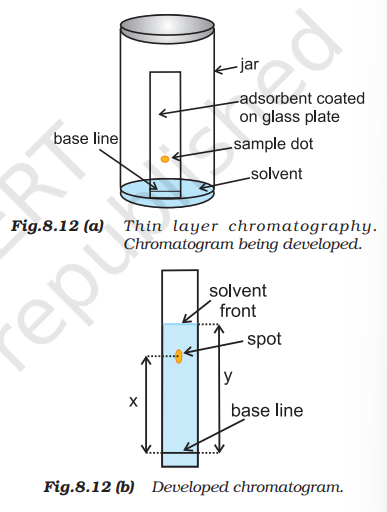
- Stationary phase: A thin layer (about ) of silica gel or alumina coated on a glass plate, called a TLC plate or chromaplate.
- Starting spot: Apply the mixture as a small spot about above one end of the plate.
- Development: Place the plate in a closed jar with eluant; the solvent rises and carries components different distances according to their adsorption.
- Retardation factor: The relative movement of a component is measured by its value.
- Spot detection: Coloured spots are visible; colourless compounds may be detected under ultraviolet light, with iodine vapour, or using a suitable spray reagent.
- Example: Ninhydrin spray is used to detect amino acids.
Compare the distance travelled by the component with the distance travelled by the solvent front, both measured from the starting line.
Partition chromatography
Paper chromatography
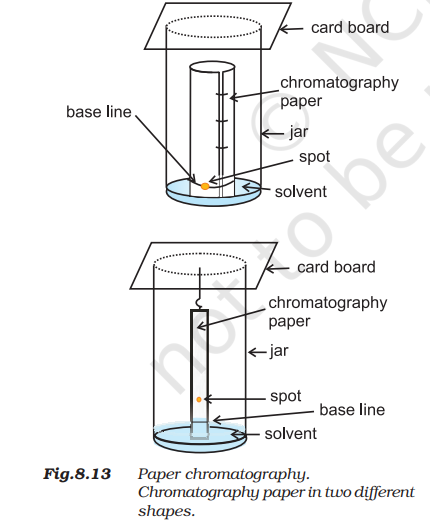
- Principle: Components partition continuously and differently between the stationary and mobile phases.
- Stationary phase: Water trapped in the chromatography paper.
- Mobile phase: A suitable solvent or solvent mixture that rises through the paper by capillary action.
- Separation: Components partition differently between the two phases and appear as spots at different heights on the developed paper, called a chromatogram.
- Spot detection: Coloured spots are visible; colourless compounds can be detected under ultraviolet light or with an appropriate spray reagent.
When is fractional distillation preferred over simple distillation?
State the principle of steam distillation.
What is the difference between adsorption and partition chromatography?
Quick recap
- Choose a purification method according to the compound's properties and the impurities present.
- Crystallisation relies on solubility differences; sublimation separates sublimable solids from nonsublimable impurities.
- Simple, fractional, reduced-pressure and steam distillation suit different boiling-point and volatility conditions.
- Differential extraction transfers a compound into an immiscible solvent where it is more soluble.
- Chromatography separates components through differing adsorption or partition between stationary and mobile phases.
- TLC uses an value; paper chromatography uses water in the paper as its stationary phase.
Qualitative Analysis of Organic Compounds
Qualitative Analysis
Qualitative analysis — Identifies which elements are present in an organic compound.
Elements in organic compounds
- Common elements: Carbon and hydrogen are present; compounds may also contain oxygen, nitrogen, sulphur, halogens or phosphorus.
Detection of Carbon and Hydrogen
Oxidation and confirmation
- Method principle: Heat the compound with copper(II) oxide; carbon is oxidised to carbon dioxide and hydrogen to water.
- Carbon dioxide: Turns lime-water milky by forming calcium carbonate.
- Water: Turns anhydrous copper sulphate from white to blue as it forms the hydrated salt.
Detection of Nitrogen, Sulphur and Halogens
Lassaigne’s test — A test in which sodium fusion converts covalently bonded nitrogen, sulphur and halogens into water-soluble ionic sodium salts for detection.
Preparation of sodium fusion extract
- Fuse the organic compound with sodium: covalent elements form ionic salts such as NaCN, Na₂S and NaX.
- Boil the fused mass with distilled water to dissolve the salts.
- The aqueous solution is the sodium fusion extract.
| Element | Test | Positive result |
|---|---|---|
| Nitrogen | Boil extract with iron(II) sulphate, then acidify with concentrated sulphuric acid. | Prussian blue colour from ferriferrocyanide. |
| Sulphur | Acidify with acetic acid and add lead acetate. | Black lead sulphide precipitate. |
| Sulphur | Add sodium nitroprusside to the extract. | Violet colour. |
| Chlorine | Acidify with nitric acid, then add silver nitrate. | White AgCl precipitate; soluble in ammonium hydroxide. |
| Bromine | Acidify with nitric acid, then add silver nitrate. | Cream/yellowish AgBr precipitate; sparingly soluble in ammonium hydroxide. |
| Iodine | Acidify with nitric acid, then add silver nitrate. | Yellow AgI precipitate; insoluble in ammonium hydroxide. |
Important interferences
- Nitrogen and sulphur together: Sodium fusion may form NaSCN; with Fe³⁺ it gives a blood-red complex. Free cyanide is absent, so the usual Prussian blue test does not occur.
- Excess sodium: Further fusion decomposes thiocyanate into cyanide and sulphide, which then give their usual tests.
- Halogen test interference: If nitrogen or sulphur is present, boil the extract with concentrated nitric acid before adding AgNO₃; this decomposes interfering cyanide and sulphide ions.
Detection of Phosphorus
Phosphorus test
- Oxidise the compound with sodium peroxide; phosphorus becomes phosphate.
- Boil the solution with nitric acid and add ammonium molybdate.
- A yellow colour or precipitate of ammonium phosphomolybdate confirms phosphorus.
Quantitative Analysis
Quantitative analysis — Measures the mass percentage of each element in a compound; these percentages help determine empirical and molecular formulae.
Estimation of Carbon and Hydrogen
Combustion analysis
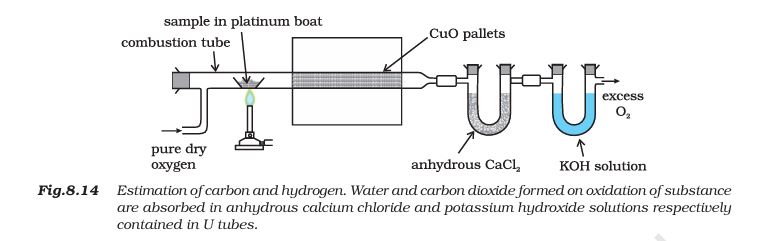
- Principle: Burn a known mass of the compound in excess oxygen with copper(II) oxide; carbon and hydrogen form CO₂ and H₂O.
- Absorption: Weighed anhydrous CaCl₂ absorbs water; a second tube containing concentrated KOH absorbs CO₂.
- Measurement: The mass increases of the tubes give the amounts of H₂O and CO₂, from which hydrogen and carbon percentages are calculated.
Here, is the sample mass, the water mass, and the carbon dioxide mass.
Estimation of Nitrogen
| Method | Principle | Measurement |
|---|---|---|
| Dumas method | Heat the nitrogen-containing compound with CuO in a CO₂ atmosphere; nitrogen is released as N₂ along with CO₂ and water. | Measure the N₂ volume and convert it to STP; calculate its mass. |
| Kjeldahl’s method | Digest with concentrated H₂SO₄ to convert nitrogen into ammonium sulphate; add excess NaOH to release NH₃. | Absorb NH₃ in a known excess of standard H₂SO₄; titrate the unused acid with standard NaOH. |
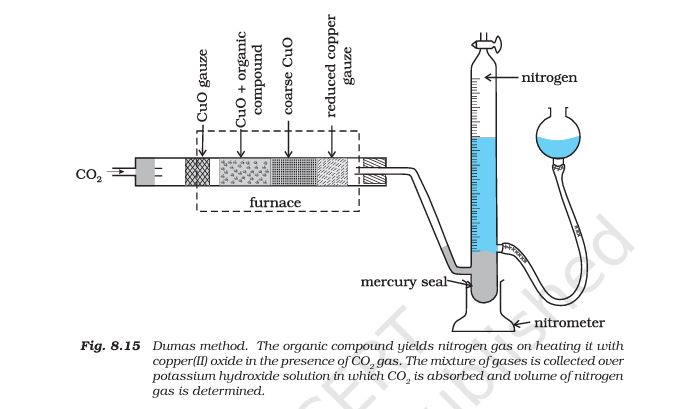
At STP, mL of N₂ has a mass of g. Correct gas pressure for aqueous tension: .
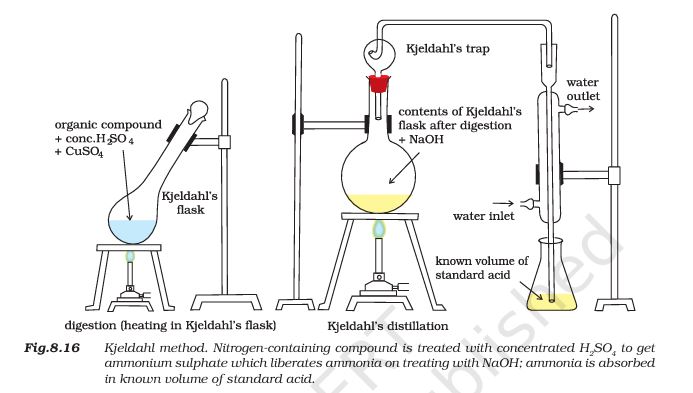
A sample of mass g is treated with mL of -molar H₂SO₄; mL of the same-molar NaOH titrates the excess acid.
Estimation of Halogens
Carius method — A method that oxidises an organic sample with fuming nitric acid in a sealed hard-glass Carius tube, forming a weighable silver halide.
Carius halogen estimation
- Process: Heat a known sample with fuming HNO₃ and AgNO₃ in a Carius tube; carbon and hydrogen oxidise, while halogen forms AgX.
- Measurement: Filter, wash, dry and weigh the AgX precipitate.
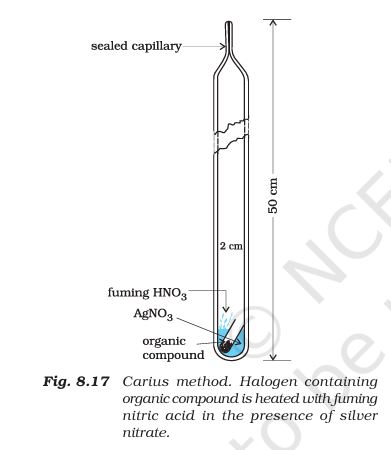
If g of compound forms g of AgX, each mole of AgX contains one mole of halogen .
Estimation of Sulphur
Sulphur estimation
- Conversion: Heat a known sample in a Carius tube with sodium peroxide or fuming nitric acid; sulphur is oxidised to sulphuric acid.
- Measurement: Precipitate sulphate as BaSO₄ with excess BaCl₂, then filter, wash, dry and weigh it.
One mole of BaSO₄ ( g) contains g of sulphur; is the BaSO₄ mass and is the sample mass.
Estimation of Phosphorus
Phosphorus estimation
- Conversion: Heat the sample with fuming nitric acid to oxidise phosphorus to phosphoric acid.
- Precipitation options: Form ammonium phosphomolybdate using ammonia and ammonium molybdate, or precipitate MgNH₄PO₄ and ignite it to Mg₂P₂O₇.
For ammonium phosphomolybdate, g mol⁻¹; for Mg₂P₂O₇, g mol⁻¹. In the latter, the precipitate contains g phosphorus per mole.
Estimation of Oxygen
| Point | By difference | Direct method |
|---|---|---|
| Principle | Subtract the percentages of all other elements from 100%. | Convert the sample’s oxygen to CO, then oxidise CO using warm I₂O₅ to produce CO₂. |
| Calculation | Use when all other element percentages are known. | Each mole of oxygen gives two moles of CO₂; therefore, 32 g O gives 88 g CO₂. |
If g of compound produces g of CO₂, the corresponding oxygen mass follows from the mass ratio.
Modern elemental analysis
- CHN analyser: Automatically measures carbon, hydrogen and nitrogen from only about – mg of sample and displays the results quickly.
How are nitrogen, sulphur and halogens detected in an organic compound?
State the principle of Dumas and Kjeldahl methods for nitrogen estimation.
How is oxygen percentage commonly determined?
Quick recap
- Carbon and hydrogen are detected by oxidation with CuO; CO₂ turns lime-water milky and water turns anhydrous CuSO₄ blue.
- Lassaigne’s test converts covalent N, S and halogens to ionic sodium salts for testing.
- Nitrogen is estimated by Dumas or Kjeldahl’s method; halogens by the Carius method.
- Sulphur is weighed as BaSO₄; phosphorus as ammonium phosphomolybdate or Mg₂P₂O₇.
- Carbon and hydrogen percentages come from measured CO₂ and H₂O after combustion.
- Oxygen is generally calculated by difference, or directly from the CO₂ produced in its estimation.
Chemistry — ALL CHAPTERS
1
Some Basic Concepts Of Chemistry
2
Structure Of Atom
3
Classification Of Elements And Periodicity In Properties
4
Chemical Bonding And Molecular Structure
5
Thermodynamics
6
Equilibrium
7
Redox Reactions
8
Organic Chemistry – Some Basic Principles And Techniques
9
Hydrocarbons