Class 12 Commerce . English . Vistas . Journey to the End of the Earth
Chapter 3: Journey to the end of the Earth
Ch 3
English
Class 12 Commerce
A Window into Earth's Ancient Past
The Journey to Antarctica
The Journey to Antarctica
- Writer Tishani Doshi travels from Madras aboard the Russian research vessel *Akademik Shokalskiy* to Antarctica, the coldest, driest and windiest continent.
- The journey begins at 13.09° north of the Equator and crosses nine time zones, six checkpoints and three bodies of water.
- After more than 100 hours by car, aeroplane and ship, the narrator feels relief, followed by wonder at Antarctica’s vastness, isolation and ancient connection with India.
Gondwana and Earth's Geological Past
Gondwana and Earth's Geological Past
- About 650 million years ago, Gondwana was a vast southern supercontinent centred roughly around present-day Antarctica.
- Gondwana had a warmer climate and diverse plant and animal life; it thrived for about 500 million years.
- As dinosaurs became extinct and the age of mammals began, Gondwana broke apart into landmasses that gradually formed the continents we know today.
- Geological clues—including Cordilleran folds, pre-Cambrian granite shields, ozone and carbon, and evidence of evolution and extinction—help us understand Earth’s changing past.
- Visiting Antarctica connects the present with this deep history and prompts reflection on where life and the planet may be heading.
Continental Movement and Its Effects
- India moved north → collided with Asia → its crust buckled and formed the Himalayas.
- South America drifted towards North America → the Drake Passage opened → a cold circumpolar current formed, helping keep Antarctica frigid and isolated.
Antarctica's Scale and Human Perspective
Antarctica's Scale and Human Perspective
- Antarctica stores about 90 per cent of Earth’s total ice volume. Its empty landscape lacks familiar human markers, making it difficult to judge time and scale.
- Life ranges from tiny midges and mites to blue whales; icebergs can be immense—the largest recorded was the size of Belgium.
- During the austral summer, daylight lasts around the clock. Deep silence is occasionally interrupted by avalanches or calving ice sheets.
- The experience places human life within Earth’s immense geological history and leaves the narrator with a bleak prognosis for humanity.
The Narrator
- Curious: wonders how India and Antarctica could once have belonged to the same landmass.
- Reflective: connects Antarctica’s geological features with Earth’s past and future.
- Humbled: the continent’s vastness and isolation make human beings seem small and vulnerable.
Earth's Deep History and Human Vulnerability
Antarctica reveals how geological change has shaped continents and life over immense spans of time. Its isolation and scale encourage people to see themselves as a small part of Earth's history.
How do geological phenomena help us understand the history of humankind?
Quick recap
- Tishani Doshi travels from Madras to Antarctica aboard the *Akademik Shokalskiy*.
- Gondwana existed about 650 million years ago near present-day Antarctica and supported diverse life in a warmer climate.
- Geological evidence helps trace Earth’s changing continents, climate and life.
- India’s collision with Asia formed the Himalayas; opening of the Drake Passage helped create a cold current around Antarctica.
- Antarctica’s ice, isolation and vastness make the narrator reflect on Earth’s history and humanity’s vulnerability.
The Last Pristine Frontier of Our Planet
Human Impact and Antarctica
Human Impact and Antarctica
- Human impact: In about 12,000 years, human populations and settlements have transformed the planet and increased competition with other species for limited resources.
- Global warming: Unchecked fossil-fuel burning releases carbon dioxide, contributing to a gradual rise in average global temperature.
- Climate debate: Possible consequences include the melting of the West Antarctic ice sheet and disruption of the Gulf Stream.
- Antarctica’s value: It has never sustained a human population and remains relatively pristine in this respect.
- Climate evidence: Its ice cores preserve carbon records from about 500,000 years ago, helping scientists study Earth’s past, present and future.
Students on Ice
Learning Through Experience
- Purpose: The programme takes high-school students to the ends of the world to build understanding and respect for the planet.
- Leadership: Canadian Geoff Green headed Students on Ice, which had been operating for six years.
- Why it began: Green had grown tired of taking celebrities and wealthy, retired curiosity-seekers who could give back only in limited ways.
- Young participants: The programme offers future policy-makers a powerful experience while they are ready to absorb, learn and act.
- Direct evidence: Seeing retreating glaciers and collapsing ice shelves makes the threat of global warming real and immediate.
Phytoplankton and the Antarctic Ecosystem
Small Changes, Wide Effects
- Simple ecosystem: Antarctica’s limited biodiversity makes it useful for studying how small environmental changes can have major repercussions.
- Phytoplankton: These microscopic, single-celled plants use sunlight to photosynthesise, absorb carbon and produce organic compounds.
- Food-chain role: Phytoplankton nourish the Southern Ocean food chain and sustain marine animals and birds.
- Wider impact: Further ozone-layer depletion could affect phytoplankton, regional wildlife and the global carbon cycle.
- Central lesson: Caring for small parts of an ecosystem helps protect the larger system.
Walking on the Ocean
The Antarctic Ice Pack
- Location: Near the Antarctic Circle at south, the Shokalskiy was blocked by thick ice between the peninsula and Tadpole Island and had to turn back.
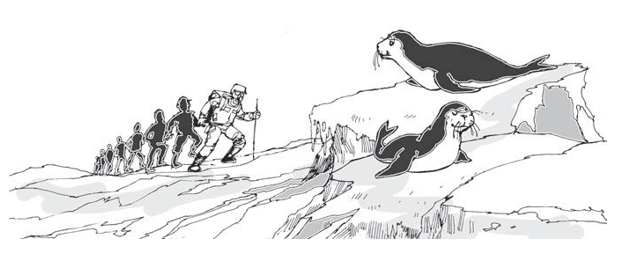
- Walking on the sea: All 52 travellers stepped onto an ice pack about one metre thick, with roughly 180 metres of seawater below.
- Wildlife: Crabeater seals stretched and rested on nearby ice floes.
- Realisation: The experience made the narrator understand that everything in nature is connected.
Balance and the Future
A Planet in Balance
- Reflection: The narrator wonders whether Antarctica could become warm again and whether humanity might disappear like dinosaurs, mammoths and woolly rhinoceroses.
- Hope: Time with idealistic teenagers renews the possibility that people can help save the world.
- Closing thought: Earth can change greatly over a million years, yet a single day can also make a difference.
Environmental Interconnectedness
Even small changes in a fragile ecosystem can affect food chains, wildlife and global processes. Protecting the planet means recognising these connections.
Learning and Responsibility
Direct experience of environmental change can inspire young people to value nature and take responsibility for the planet’s future.
Why is Antarctica important for understanding climate change?
How can changes to phytoplankton affect the wider environment?
What did the narrator realise while walking on the Antarctic ice?
Quick recap
- Human activity and fossil-fuel use contribute to rising global temperatures.
- Antarctic ice cores preserve climate records reaching back about 500,000 years.
- Students on Ice gives young people direct experience intended to encourage understanding and action.
- Phytoplankton support the ocean food chain and help regulate carbon.
- Even small environmental changes can have wide-reaching effects.
- The Antarctic journey highlights nature’s interconnectedness and the importance of acting for the future.
Exercise
Reading with Insight
Questions explored
- Geological history: Consider how studying Antarctica can help us understand Earth’s history.
- Students on Ice: Examine Geoff Green’s reasons for including high school students in the expedition.
- Environmental care: Consider the relevance of caring for small things in the Antarctic environment.
- Earth’s timescales: Explain why Antarctica is presented as a place to understand Earth’s present, past and future.
Quick recap
- The exercise asks how Antarctica’s study relates to Earth’s geological history.
- It asks why Geoff Green included high school students in Students on Ice.
- It asks about the relevance of caring for small things in Antarctica.
- It asks why Antarctica can help us understand Earth’s present, past and future.
English — ALL CHAPTERS
1
The Last Lesson
2
Lost Spring (Stories of Stolen Childhood)
3
Deep Water
4
The Rattrap
5
Indigo
6
Poets and Pancakes
7
The Interview (From the Introduction to The Penguin Book of Interviews edited by Christopher Silvester).
8
Going Places
9
My Mother at Sixty-six
10
Keeping Quiet
11
A Thing of Beauty
12
A Roadside Stand
13
Aunt Jennifer’s Tigers
1
I Sell My Dreams
2
Eveline
3
A Wedding In Brownsville
4
Tomorrow
5
One Centimetre
6
A Lecture Upon The Shadow
7
Poems By Milton
8
Poems By Blake
9
Kubla Khan OR A Vision In A Dream: A Fragment
10
Trees
11
The Wild Swans At Coole
12
Time And Time Again
13
Blood
14
Freedom
15
The Mark On The Wall
16
Film-making
17
Why The Novel Matters
18
The Argumentative Indian
19
On Science Fiction
20
Chandalika
21
Broken Images
1
The Third Level
2
The Tiger King
3
Journey to the end of the Earth
4
The Enemy
5
On The Face Of It
6
Memories of Childhood