Class 7 . English . Poorvi . A Homage to Our Brave Soldiers
Chapter 13: A Homage to Our Brave Soldiers
Ch 13
English
Class 7
A Letter to Ananda
The Letter and the National War Memorial
Part I: The visit to the memorial
- The letter: On 14 April 20XX, a student writes to Ananda after a school trip to New Delhi, sharing thoughts about soldiers who gave their lives for India’s peace and security.
- Memorial: The National War Memorial was built near India Gate on 40 acres. Its construction began in April 2018 and was completed in February 2019; Prime Minister Narendra Modi envisioned and inaugurated it in February 2019.
- Purpose: The memorial honours soldiers and reminds people of the human cost of freedom and the horrors of war.
- Names of the fallen: Its 29,000 tablets carry more than 26,000 names of soldiers who made the supreme sacrifice in conflicts from 1947 onwards.
- Conflicts remembered: The memorial includes soldiers from the 1962 Indo-China conflict, the Indo-Pak wars of 1965 and 1971, and the Kargil War of 1999.
Gallantry Awards
Recognition of soldiers’ courage
- Awards: The Param Vir Chakra (PVC) is India’s highest wartime gallantry medal. The other awards mentioned are the Maha Vir Chakra (MVC), Kirti Chakra (KC), Vir Chakra (VrC) and Shaurya Chakra (SC).
- PVC recipients: The letter notes that 21 brave soldiers received the PVC for service to the nation.
- First PVC: Major Somnath Sharma received India’s first PVC posthumously for the Battle of Badgam in 1947.
- Other service: PVCs were later awarded for exceptional gallantry in the 1962 India-China conflict and 1965 India-Pakistan War, as well as for service during UN peacekeeping operations in Congo.
- 1971 war: Posthumous PVC recipients included Lance Naik Albert Ekka, Flying Officer Nirmal Jit Singh Sekhon, Second Lieutenant Arun Khetarpal and Major Hoshiar Singh.
- Navy: Captain Mahendra Nath Mulla and other Navy personnel received the MVC for courage and leadership.
Lance Naik Albert Ekka’s Citation
Bravery at Gangasagar
- Situation: Lance Naik Albert Ekka of 14 Guards took part in an attack on a strongly defended enemy position at Gangasagar on the eastern front.
- First machine gun: When an enemy Light Machine Gun caused heavy casualties, Ekka charged its bunker, bayoneted two soldiers and silenced it, despite being wounded.
- Second machine gun: As a Medium Machine Gun continued firing from a building, he crawled forward and threw a grenade through its loophole.
- Final action: When the gun kept firing, Ekka scaled a side wall, entered the bunker and bayoneted the enemy soldier operating it.
- Outcome: His actions saved further casualties and helped secure the attack. He later died of his serious injuries after the objective was captured.
- Citation’s tribute: Ekka showed conspicuous valour and determination, making the supreme sacrifice in the finest traditions of the Army.
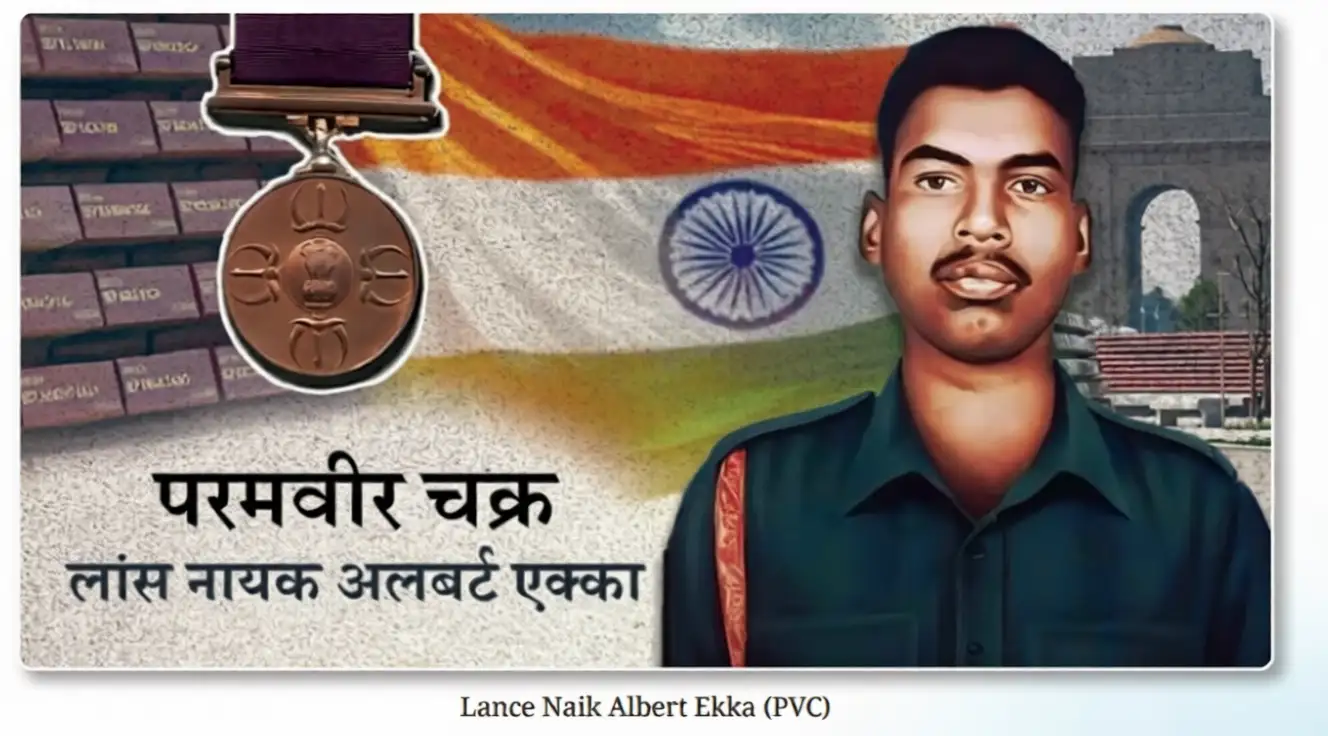
Lance Naik Albert Ekka
- Fearless: Attacked enemy positions despite intense fire and serious injury.
- Selfless: Put his personal safety aside to silence the machine guns and protect his company.
- Determined: Continued fighting until the enemy guns were silenced and the objective secured.
Patriotism and sacrifice
The letter honours soldiers whose courage and sacrifice protect the country and preserve the freedom and security people enjoy.
Remembering the cost of war
The National War Memorial keeps the names and sacrifices of fallen soldiers alive in public memory, reminding visitors that freedom comes at a great cost.
- Homage
- A public expression of respect or honour.
- Territorial integrity
- Protection of a nation’s borders and territory.
- Envisioned
- Imagined or planned as a future possibility.
- Iconic
- Widely recognised and celebrated.
- Tribute
- An act or statement showing respect and gratitude.
- Tablet
- A memorial slab bearing a name or inscription.
- Etched
- Engraved or cut into a surface.
- Gallantry
- Exceptional courage, especially in battle.
- Posthumously
- After a person’s death.
- Citation
- An official account recognising meritorious service.
- Awestruck
- Filled with amazement and admiration.
Why is the National War Memorial important?
How did Albert Ekka help secure the attack at Gangasagar?
What is the Param Vir Chakra, and who received the first one?
Quick recap
- The National War Memorial near India Gate honours soldiers who died defending India.
- Its 29,000 tablets bear more than 26,000 names of fallen soldiers.
- The Param Vir Chakra is India’s highest wartime gallantry medal.
- Major Somnath Sharma received the first PVC posthumously for the 1947 Battle of Badgam.
- Albert Ekka’s actions at Gangasagar showed courage, determination and self-sacrifice.
- The memorial reminds people to honour soldiers and remember the cost of freedom.
The Eternal Flame
The Amar Jawan Jyoti
- Meaning: Amar Jawan Jyoti means an immortal flame, kept burning day and night to honour soldiers’ sacrifices.
- Earlier memorial: The flame, with a rifle and helmet, was lit beneath India Gate in January 1972 to mark India’s victory in the 1971 India-Pakistan War.
- At the National War Memorial: A new flame was lit in the central obelisk; later, the old India Gate flame was merged with it.
- Effect: Wreaths honour the fallen, while changing light from dawn to dusk makes the memorial’s landscape majestic.
- commemorates
- officially remembers and honours
- obelisk
- a tall, tapering stone pillar
- wreaths
- circular flower arrangements placed in remembrance
- interminable
- everlasting
- murals
- large paintings on a wall
- discourses
- serious discussions
The Four Chakras
Layout and Symbols
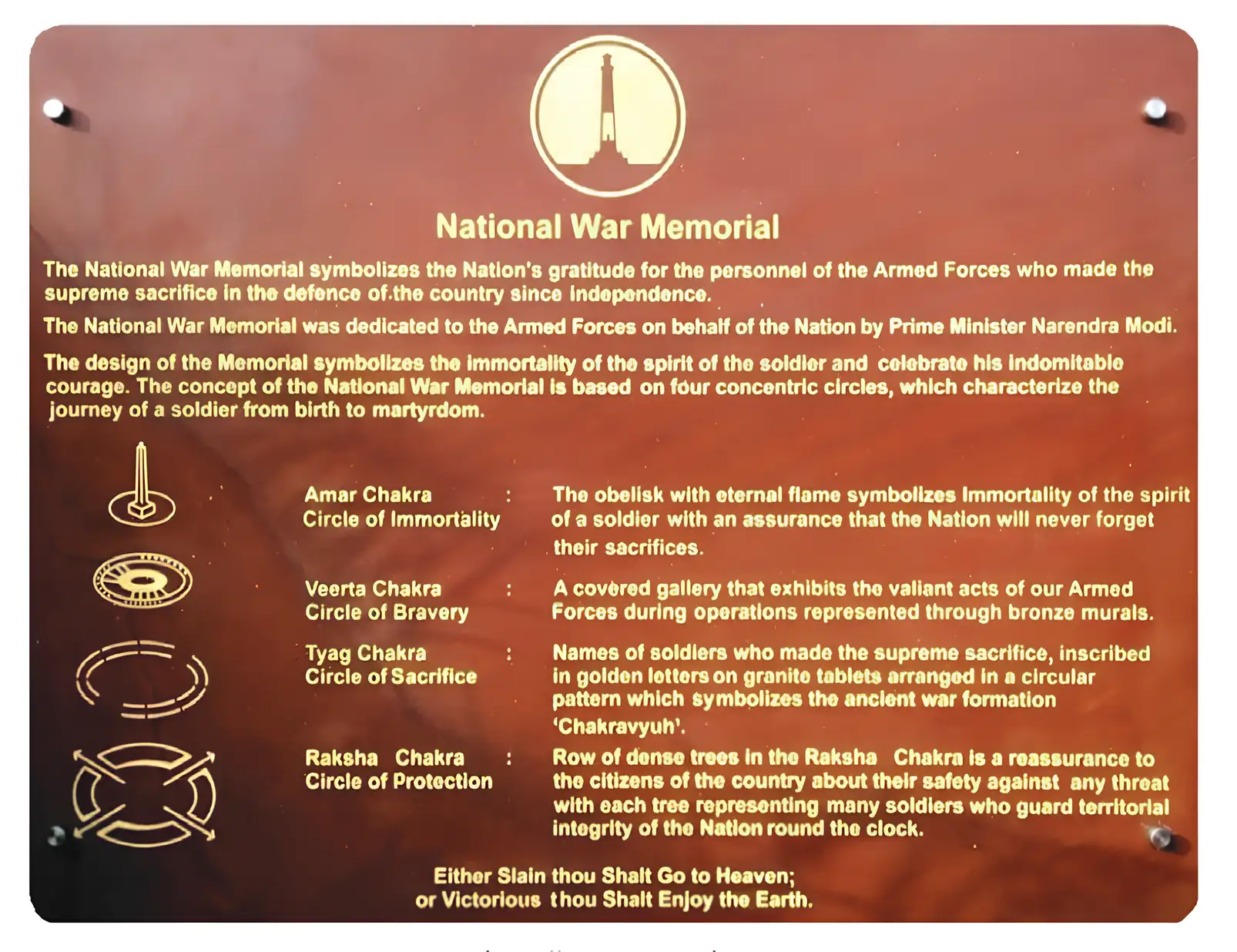
- Structure: Four concentric circles surround a central obelisk, which is 15 metres tall and holds the Amar Jawan Jyoti.
- Other features: The memorial includes bronze and stone murals, graphic panels, and honour walls.
| Chakra | Meaning and features |
|---|---|
| Amar Chakra | Circle of Immortality; the innermost circle has the obelisk and eternal flame, symbolising the undying spirit of fallen soldiers and the nation’s remembrance. |
| Veerta Chakra | Circle of Bravery; its covered gallery displays six bronze murals depicting courageous actions by the Armed Forces. |
| Tyag Chakra | Circle of Sacrifice; concentric honour walls represent the ancient Chakravyuh formation. Granite tablets bear the names of post-Independence fallen heroes in gold letters. |
| Raksha Chakra | Circle of Protection; its outer row of trees represents soldiers who protect citizens and preserve the nation’s territorial integrity. |
Soumya’s Visit and Reflection
- Soumya describes the memorial and Kartavyapath as solemn, visually inspiring places that filled her with pride and helped her feel connected to the site.
- The discussions about war also made her sad about its destruction and loss of life, while motivating her to live in a way worthy of the soldiers’ sacrifices.
- The class formed five groups to present stories of soldiers’ courage; students were also encouraged to share their learning at the school assembly.
Major Padmapani Acharya’s Valour
The Kargil Mission
- Major Padmapani Acharya of 2 Rajputana Rifles was a Company Commander during Operation Vijay in the 1999 Kargil War.
- On 28 June 1999, he was tasked with capturing a heavily fortified enemy position protected by mines, machine-gun fire and artillery.
- When enemy fire caused heavy casualties and the attack faltered, he led the reserve platoon forward through artillery fire and encouraged his men.
- He crawled towards the enemy position and threw grenades. Though severely wounded, he urged his soldiers to continue the attack and kept firing.
- The position was captured, but Acharya later died of his injuries. His citation honours his exceptional courage, leadership and self-sacrifice.
Award and Message
- Award: He was awarded the Maha Vir Chakra posthumously; the citation gives the date of award as 15 August 1999.
- Letter to his father: Before battle, he wrote that he was not afraid to lose his life protecting the motherland.
- Gita reference: He quoted a verse saying that a fighter who dies in battle attains heaven, while a victor enjoys the earth; it urges Arjuna to rise and fight with resolve.
“Hato va prapsyasi svargam jitva va bhoksyase mahim Tasmaduttistha kaunteya yuddhaya krtaniscayah”
Shrimad Bhagavad Gita, Chapter 2, Verse 37
Remembrance, Courage and Sacrifice
The memorial honours soldiers whose courage protects the nation. Its eternal flame and the stories of heroes encourage people to remember their sacrifices.
What is the significance of the Amar Jawan Jyoti?
Which Chakra represents protection, and what does it symbolise?
What is India’s highest gallantry award?
Quick recap
- Amar Jawan Jyoti is an everlasting tribute to the sacrifices of Indian soldiers.
- The former flame at India Gate was lit in January 1972 to mark the 1971 India-Pakistan War victory; it was later merged with the memorial’s new flame.
- The memorial’s four Chakras represent immortality, bravery, sacrifice and protection.
- Soumya’s visit brings together pride in the nation, sadness about war and motivation to honour the fallen.
- Major Padmapani Acharya showed courage and leadership in the 1999 Kargil War and received the Maha Vir Chakra posthumously.
A Reply to the Letter
Reply to Soumya
- Letter details: Written from Chandigarh on 24 April 20XX, the letter responds to Soumya’s visit to the National War Memorial in Delhi.
- Soumya’s account: The writer praises her careful observations and understanding of the emotions connected with the memorial.
- Meaning of a war memorial: It commemorates those killed or injured in war and expresses gratitude for soldiers’ sacrifices in protecting the country.
- Duty and inspiration: The writer believes people should visit memorials to honour soldiers and is considering joining the Armed Forces.
A Memorial in Chandigarh
- School presentation: The writer supports Soumya’s class presentation, hoping it will help others learn about India’s heroes and inspire students to serve.
- Personal memory: During a visit to Chandigarh’s Bougainvillea Garden in Sector 3, the writer saw people offering flowers and prayers at the War Memorial.
- Shared respect: The visitors had gathered to honour soldiers who had sacrificed their lives for the country.
The Poem and Soldiers’ Sacrifice
- Poem recalled: “Pushp ki Abhilasha” by Makhanlal Chaturvedi expresses a flower’s wish not to be used for beauty or honour.
- Central wish: The flower asks to be placed on the path taken by brave people going to sacrifice themselves for the motherland.
- Peace and courage: Soldiers’ vigilance and hard work allow people to live peacefully and enjoy ordinary freedoms.
Captain Anuj Nayyar
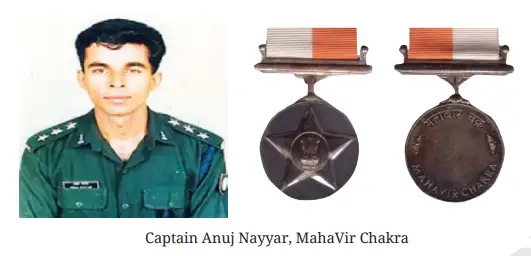
- Service: Captain Anuj Nayyar was an Indian Army officer in the 17 Jat Regiment.
- Award: He was posthumously awarded the Maha Vir Chakra for exemplary bravery during the Kargil War in 1999; it is India’s second-highest gallantry award.
- Memoir: His mother, Meena Nayyar, wrote *Tiger of Drass – Capt. Anuj Nayyar – 23 – Kargil Hero* about his life and sacrifice.
- Interview excerpt: Meena Nayyar describes how writing about her son’s life helped her ensure that people would know of his sacrifice.
Gratitude and Remembrance
The letter highlights the need to honour soldiers’ courage and sacrifice, and to remember that their service helps protect the country and sustain peace.
- Edifice
- An impressive, large building.
- Valiant
- Very brave.
- Memoir
- An account of personal life and experiences.
What does the flower wish for in “Pushp ki Abhilasha”?
Why was Captain Anuj Nayyar awarded the Maha Vir Chakra?
Quick recap
- The writer thanks Soumya for sharing her visit to the National War Memorial.
- War memorials honour soldiers and remind people of their sacrifices.
- The writer recalls people paying tribute at Chandigarh’s War Memorial.
- “Pushp ki Abhilasha” expresses a wish to honour those who sacrifice for the motherland.
- Captain Anuj Nayyar of the 17 Jat Regiment received the Maha Vir Chakra posthumously for courage in the Kargil War.
Collecting Stamps
Ananda’s Letter
- National War Memorial: Ananda and her friends wish to visit the memorial in Delhi. She has found the interactive app National War Memorial and Museum, which answers questions in 21 languages, and admires the murals.
- New idea: Ananda plans to share an idea with her classmates and teacher and create a collage about the lives and stories of inspiring people.
- Stamp collecting: Ananda enjoys the beautiful stamps on Soumya’s letters. She explains that collecting stamps is called philately.
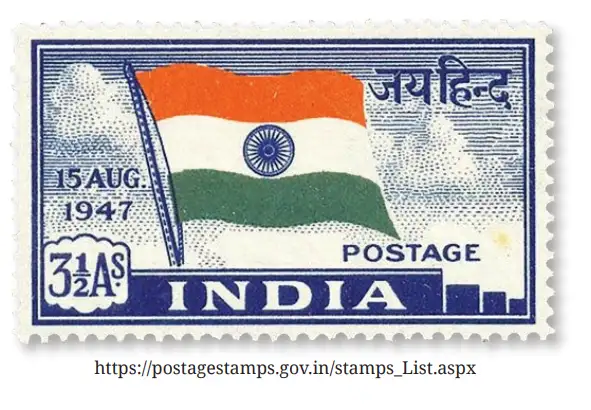
- Independence stamp: Ananda receives a stamp celebrating India’s independence, connecting with the theme of Soumya’s letter.
Philately — The hobby or study of collecting postage stamps.
Remembering Soldiers
- Flag and sacrifice: The letter connects the national flag with the sacrifice of soldiers who died protecting it.
- Stamp detail: The stamp shows the Indian national flag and the date 15 August 1947, marking India’s Independence Day.
Ananda
- Curious: She learns about the National War Memorial and Museum app and the term philately.
- Inspired: She plans to share an idea and make a collage with her classmates.
- Warm and appreciative: She values Soumya’s letters and the stamps they carry.
Inspiration and Remembrance
Letters can inspire people to learn about brave soldiers, share meaningful ideas and remember important moments in India’s history.
Why was Ananda reminded of the poem ‘Pushp ki Abhilasha’?
How does Soumya’s letter help Ananda pursue her hobby?
What actions does Ananda plan to take after reading Soumya’s letter?
Quick recap
- Ananda and her friends wish to visit the National War Memorial in Delhi.
- The National War Memorial and Museum app answers questions in 21 languages.
- Ananda plans to share an idea and create a collage about inspiring people.
- Collecting stamps is called philately.
- Soumya’s letters and stamps encourage Ananda’s interest in her hobby.
- The independence stamp shows the national flag and 15 August 1947.
English — ALL CHAPTERS
1
The Day The River Spoke
2
Poem-Try Again
3
Three Days to See
4
Animals, Birds, and Dr. Dolittle
5
Poem - A Funny Man
6
Say the Right Thing
7
My Brother’s Great Invention
8
Poem-Paper Boat
9
North, South, East, West
10
The Tunnel
11
Poem- Travel
12
Conquering the Summit
13
A Homage to Our Brave Soldiers
14
Poem- My Dear Soldiers
15
Poem - Rani Abbakka