QUESTION PAPER

2023 BOARD EXAM

CBSE Class 10 Social Science Board Paper 2023 — Set 4

2023

Social Science

Class 10

CBSE EXAMINATION PAPER-2023

SOCIAL SCIENCE

(Solved)

Time allowed : 3 hours

Maximum Marks : 88

General Instructions :

Read the following instructions carefully and follow them :

  1. This question paper contains 43 questions. All questions are compulsory.
  2. This question paper is divided into 5 sections.
  3. Section A – questions number 1 to 4 are case based questions
  4. Section B – questions number 5 to 24 are multiple choice questions
  5. Section C – questions number 25 to 29 are very short answer
  6. Section D – questions number 30 to 35 are short answer
  7. Section E – questions number 36 to 43 are long answer
  8. There is no overall choice given in the question paper. However, an internal choice has been provided in few questions.
  9. Use of calculator is NOT allowed.

Section A

Question 1. The first cotton mill in Bombay came up in 1854 and it went into production two years later. By 1862, four mills were at work with 94,000 spindles and 2,150 looms. Around the same time, jute mills came up in Bengal, the first being set up in 1855 and another one seven years later, in 1862. In north India, the Elgin Mill was started in Kanpur in the 1860s, and a year later the first cotton mill of Ahmedabad was set up. By 1874, the first spinning and weaving mill of Madras began production.

(1) When was the first cotton mill set up in India?

[1 Mark]

(2) Name any two early industrialists of India.

[1 Mark]

(3) How did many Indian entrepreneurs survive despite tight economic controls imposed by the British Government? Explain.

[2 Marks]
Question 2. In ancient India, along with the sophisticated hydraulic structures, there existed an extraordinary tradition of water-harvesting system. People had an in-depth knowledge of rainfall regimes and soil types and developed wide ranging techniques to harvest groundwater, rainwater, river water and flood water in keeping with the local ecological conditions and their water needs. In hilly and mountainous regions, people built diversion channels like the kuls and guls of Western Himalayas for agriculture. Rooftop rainwater harvesting was very commonly practised to store drinking water, particularly in Rajasthan.

(1) Mention any two methods of traditional water-harvesting used in India.

[1 Mark]

(2) How do people of Rajasthan utilise rainwater?

[1 Mark]

(3) Explain any two benefits of rainwater harvesting.

[2 Marks]
Question 3. Belgium is a small country in Europe, smaller in area than the state of Haryana. It has borders with France, the Netherlands, Germany and Luxembourg. It has a population of a little over one crore, about half the population of Haryana. The ethnic composition of this small country is: Five per cent lives in the Flemish region and speaks Dutch language. Another 40 per cent people live in the Wallonia region and speak French. Remaining one per cent of the Belgians speak German. In the capital city Brussels, 80 per cent of the people speak French while 20 per cent are Dutch-speaking.

(1) Explain the ethnic composition of Belgium.

[1 Mark]

(2)

Explain the term 'ethnic'.

[1 Mark]

(3) How did the Belgian Government solve their ethnic problem? Explain.

[2 Marks]
Question 4. Two places A and B have been marked on the given political outline map of India (on page 23). Identify them with the help of the following information and write their correct names on the lines drawn near them :

(1) The place where Gandhiji broke the salt law.

[1 Mark]

(2)

The place where the session of the Indian National Congress was held in September, 1920.

[1 Mark]

(3)

On the same political outline map of India, locate and label any three of the following with suitable symbols :

(i) Tehri Dam

(ii) Bokaro Coal mines

(iii) Pune Software Technology Park

(iv) Tuticorin Sea port

[3 Marks]

(4)

The following questions are for the Visually Impaired Candidates only:

Answer any five questions

(1) Name the place where Gandhiji broke the salt law.

(2) Name the place where the Indian National Congress session was held in September, 1920.

(3) Name the state where Tehri dam is located.

(4) Name the state where Bokaro coal mines are located.

(5) In which state is the Pune Software Technology Park located ?

(6) Name the state where Tuticorin sea port is located.

[6 Marks]

Section B

Question 5. Which one of the following aspects was the base of the Bretton Woods system?
[1 Mark]
  • (A) Cultural system
  • (B) Military system
  • (C) Economic system
  • (D) Historical system
Question 6. Which one of the following books was printed first by Gutenberg?
[1 Mark]
  • (A) Chapbooks
  • (B) Amar Jivan
  • (C) Bible
  • (D) Almanac
Question 7. Who among the following led the peasant movement in Bardoli in 1928?
[1 Mark]
  • (A) Baba Ramchandra
  • (B) Jawaharlal Nehru
  • (C) Vallabhbhai Patel
  • (D) Subhash Chandra Bose
Question 8.

Which one of the following is not true about the female allegory of France?

[1 Mark]
  • (A) She was named Marianne.
  • (B) Her images were marked on coins and stamps.
  • (C) She was a symbol of national unity.
  • (D) She took part in the French Revolution.
Question 9. Choose the correctly matched pair.
[1 Mark]
  • (A) Intensive subsistence farming single crop production farming
  • (B) Primitive subsistence farming practised on large patches of land
  • (C) Plantation farming practised on small patches of land
  • (D) Commercial farming use of higher doses of modern inputs
Question 10. When was the Wildlife Protection Act implemented?
[1 Mark]
  • (A) 1972
  • (B) 1978
  • (C) 1980
  • (D) 1985
Question 11. Mention the main reason for land degradation in states like Jharkhand, Chhattisgarh and Odisha.
[1 Mark]
  • (A) Mining
  • (B) Over-grazing
  • (C) Over irrigation
  • (D) Mineral processing
Question 12. Which one of the following languages was declared as the official language of Sri Lanka by an Act passed in 1956?
[1 Mark]
  • (A) Sinhala
  • (B) Tamil
  • (C) English
  • (D) Hindi
Question 13.

Which one of the following options prove that India is a quasi-federal state?
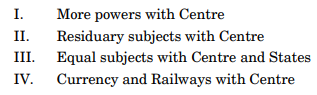
[1 Mark] Diagram 1 – CBSE Class 10 Social Science 2023 Set 4
  • (A) I, III and IV
  • (B) I, II and IV
  • (C) II, III and IV
  • (D) I, II and III
Question 14. Which one of the following statements is not true?
[1 Mark]
  • (A) The Constitution prohibits discrimination on the grounds of religion.
  • (B) The Constitution allows us to practice, profess and propagate any religion or not to follow any.
  • (C) As per the Constitution, religion can never be separated from politics.
  • (D) The Constitution of India allows the state to intervene in the matters of religion in order to ensure equality within religious communities.
Question 15.

There are two statements marked as Assertion (A) and Reason (R). Read both the statements and choose the correct option as your answer:

Assertion (A): India has a multiparty system.

Reason (R): It is because of the social and geographical diversities in India. Options:

[1 Mark]
  • (A) Both Assertion (A) and Reason (R) are true and Reason (R) is the correct explanation of the Assertion (A).
  • (B) Assertion (A) is true, but Reason (R) is false.
  • (C) Both Assertion (A) and Reason (R) are true, but Reason (R) is not the correct explanation of the Assertion (A).
  • (D) Assertion (A) is false, but Reason (R) is true.
Question 16.

Which one of the following is not true about a democratic government?

[1 Mark]
  • (A) Democratic government is the people's government
  • (B) It does not allow room to correct mistakes.
  • (C) Democratic government is a legitimate government.
  • (D) Democratic government is a responsive government.
Question 17.

Read the given data in the table and find out the average monthly income of Country A. Choose the correct option.
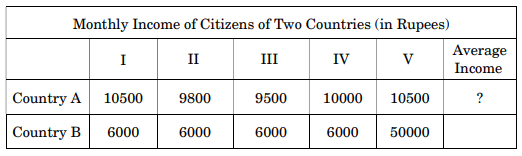
[1 Mark] Diagram 2 – CBSE Class 10 Social Science 2023 Set 4
  • (A) 9500
  • (B) 10000
  • (C) 10060
  • (D) 10500
Question 18. What percentage of the population of Belgium lives in the Flemish region?
[1 Mark]
  • (A) 40%
  • (B) 80%
  • (C) 59%
  • (D) 70%
Question 19.

Select which among the following cannot be purchased through money. Choose the correct option:

I. Full protection from infectious diseases

II. A pollution-free atmosphere

III. High quality education

IV. A luxury home

[1 Mark]
  • (A) I and III
  • (B) III and IV
  • (C) I and IV
  • (D) I and II
Question 20.

Study the data given in the table and answer the question by selecting the correct option. Which is the most important sector that provides maximum jobs to the people?
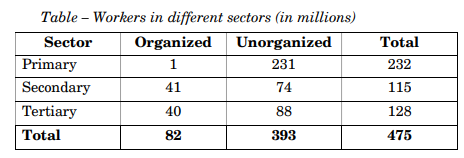
[1 Mark] Diagram 3 – CBSE Class 10 Social Science 2023 Set 4
  • (A) Secondary sector, especially organized sector
  • (B) Primary sector, especially organized sector
  • (C) Tertiary sector, especially organized sector
  • (D) Primary sector, especially unorganized sector
Question 21.

'A' is a worker in a garment export industry of jaipur. He gets facilities like health insurance, provident fund, medical leave, etc.

In which sector are benefits like health insurance, provident fund, medical leave, etc. available?

[1 Mark]
  • (A) Non-Governmental sector
  • (B) Unorganized sector
  • (C) Primary sector
  • (D) Organized sector
Question 22. Which among the following organisations issues the currency notes in India?
[1 Mark]
  • (A) The NITI Aayog
  • (B) The Central Government of India
  • (C) The Finance Ministry
  • (D) The Reserve Bank of India
Question 23. Cargill Foods, a very large MNC, is the largest producer of edible oil in India. Which one of these countries does it belong to?
[1 Mark]
  • (A) France
  • (B) India
  • (C) Great Britain
  • (D) United States of America
Question 24. In which one of the following ways has information and communication technology stimulated the globalisation process the most?
[1 Mark]
  • (A) Access foods across countries
  • (B) Access raw material across countries
  • (C) Access information instantly across countries
  • (D) Access services across countries

Section C

Question 25. Why did Europeans flee to America in the 19th century? Explain.
[2 Marks]
Question 26.

'Communalism in harmful for the nation.' Explain

[2 Marks]
Question 27.

'Energy saved is energy produced.' Support the statement.

[2 Marks]
Question 28. Why is there a pressing need to use non-conventional energy resources? Explain.
[2 Marks]
Question 29. Suggest any two ways to create more employment in the rural sector.
[2 Marks]

Section D

Question 30. Explain any three effects of Non-Co-operation Movement on the Indian economy.
[3 Marks]
Question 31. How was the Rowlatt Act opposed by the people of India? Explain with three examples.
[3 Marks]
Question 32. Explain the importance of pipelines as a means of transportation in India.
[3 Marks]
Question 33. Describe the impact of flexibility in the labour laws on the workers in India.
[3 Marks]
Question 34.

' Transparency is the most important feature of a democracy.' Support the statement.

[3 Marks]
Question 35. Which are the two sectors based on the ownership of resources? Explain each of them.
[3 Marks]

Section E

Question 36. Explain the process of unification of Italy.
[5 Marks]
Question 37.

How did the French Revolution play an important role in creating the idea of the 'Nation' in Europe ? Explain.

[5 Marks]
Question 38. Explain the importance of manufacturing industries.
[5 Marks]
Question 39. Explain any five ways to reduce industrial pollution.
[5 Marks]
Question 40. Explain any five challenges faced by political parties in India.
[5 Marks]
Question 41. Explain any five major functions of the political parties.
[5 Marks]
Question 42. How does credit play a positive and a negative role? Explain with examples.
[5 Marks]
Question 43. What is a collateral? Why is it a main reason to prevent the poor getting a loan from banks? Explain.
[5 Marks]

Paper Details

CBSE Board Exam 2023

Class

Class 10

Subject

Social Science

Year

2023

Set

Set 4

Other Years — Social Science

2022 Set-1

2022 Set-2

2022 Set-3

2022 Set-4

2023 Set-1

2023 Set-2

2023 Set-3

2023 Set-4

2023 Set-5

2024 Set-1

2024 Set-2

2024 Set-3

2024 Set-4

2024 Set-5

2025 Set-1

2025 Set-2

2025 Set-3

2025 Set-4

2025 Set-5

2025 Set-6