QUESTION PAPER
2024 BOARD EXAM
CBSE Class 10 Social Science Board Paper 2024 — Set 5
2024
Social Science
Class 10
CBSE EXAMINATION PAPER-2024
SOCIAL SCIENCE
(Solved)
General Instructions :
Read the following instructions carefully and follow them :
- This question paper contains 45 questions. All questions are compulsory.
- This question paper is divided into 5 sections.
- Section A – questions number 1 to 5 are case based questions
- Section B – questions number 6 to 26 are multiple choice questions
- Section C – questions number 27 to 31 are very short answer
- Section D – questions number 32 to 37 are short answer
- Section E – questions number 38 to 45 are long answer
- There is no overall choice given in the question paper. However, an internal choice has been provided in few questions.
- Use of calculator is NOT allowed.
Section A
Read the given source and answer the questions that follow :
Print Comes to India
From 1780, James Augustus Hickey began to edit the Bengal Gazette, a weekly magazine that described itself as ‘a commercial paper open to all, but influenced by none’. So it was private English enterprise, proud of its independence from colonial influence, that began English printing in India. Hickey published a lot of advertisements, including those that related to the import and sale of slaves. But he also published a lot of gossip about the Company’s senior officials in India. Enraged by this, Governor-General Warren Hastings persecuted Hickey, and encouraged the publication of officially sanctioned newspapers that could counter the flow of information that damaged the image of the colonial government. By the close of the eighteenth century, a number of newspapers and journals appeared in print. There were Indians, too, who began to publish Indian newspapers. The first to appear was the weekly Bengal Gazette, brought out by Gangadhar Bhattacharya, who was close to Raja Rammohan Roy.
(1) In which language was ‘Bengal Gazette’ edited by James Augustus Hickey published?
[1 Mark](2) Why was James Augustus Hickey persecuted?
[1 Mark](3) Which newspapers were encouraged during the 1780s? Why were they encouraged?
[2 Marks]Read the given source and answer the questions that follow :
Conservation of Resources
At the international level, the Club of Rome advocated resource conservation for the first time in a more systematic way in 1968. Subsequently, in 1974, Gandhian philosophy was once again presented by Schumacher in his book Small is Beautiful. The seminal contribution with respect to resource conservation at the global level was made by the Brundtland Commission Report, 1987. This report introduced the concept of ‘Sustainable Development’ and advocated it as a means for resource conservation, which was subsequently published in a book entitled Our Common Future. Another significant contribution was made at the Earth Summit at Rio de Janeiro, Brazil in 1992.
(1) Explain the meaning of sustainable development.
[1 Mark](2) In which international conference was ‘Agenda-21’ accepted?
[1 Mark](3) Explain any two outcomes of the Summit.
[2 Marks]Read the given source and answer the questions that follow :
Loans from Cooperatives
Besides banks, the other major source of cheap credit in rural areas are the cooperative societies (or cooperatives). Members of a cooperative pool their resources for cooperation in certain areas. There are several types of cooperatives possible such as farmers cooperatives, weavers cooperatives, industrial workers cooperatives, etc.
Krishak Cooperative functions in a village not very far away from Sonpur. It has 2300 farmers as members. It accepts deposits from its members. With these deposits as collateral, the Cooperative has obtained a large loan from the bank. These funds are used to provide loans to members. Once these loans are repaid, another round of lending can take place. Krishak Cooperative provides loans for the purchase of agricultural implements, loans for cultivation and agricultural trade, fishery loans, loans for construction of houses and for a variety of other expenses.
(1) What are the different types of loans that ‘Krishak Cooperatives’ offer to their members?
[1 Mark](2) Why are such cooperatives desirable in the rural areas?
[2 Marks](3) How do ‘Krishak Cooperatives’ secure funds for providing loans to their members?
[1 Mark]Two places ‘A’ and ‘B’ have been marked on the given political outline map of India (on page 27). Identify them with the help of the following information and write their correct names on the lines drawn near them :
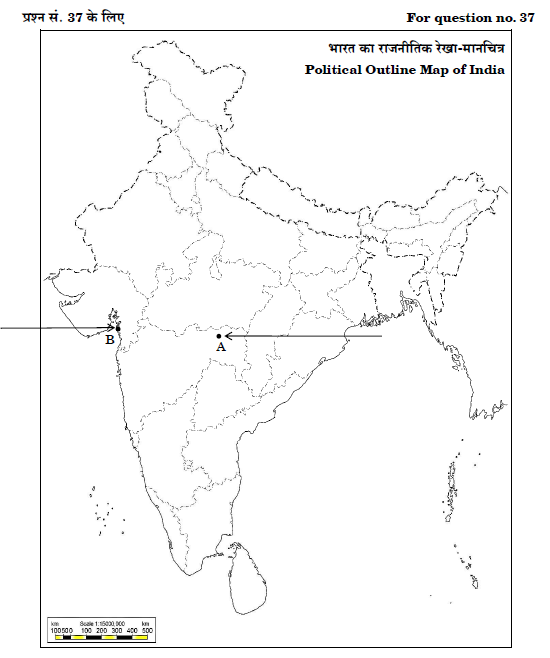
(1) The place where the session of Indian National Congress was held in 1920.
(2) On the same political outline map of India, locate and label any three of the following with suitable symbols : (i) Bailadila – Iron ore Mines (ii) Namrup – Thermal Power Plant (iii) Kandla – Major Sea Port (iv) Meenam Bakkam – International Airport
(3) The place where Gandhiji broke the salt law.
Note : The following questions are for the Visually Impaired Candidates
Attempt any five questions.
(1) Name the state where the session of Indian National Congress was held in 1927.
(2) Name the place where Gandhiji broke the salt law.
(3) Name the state where Bailadila iron ore mines are located.
(4) Name the state where Kandla sea port is located.
(5) In which state is Namrup Thermal Power Plant located ?
(6) Name the state where Meenam Bakkam international airport is located.
Section B
Arrange the following events in chronological order and choose the correct option.
I Formation of Khilafat Committee in Bombay
II Jallianwala Bagh Massacre
III Bardoli Satyagraha
IV Withdrawal of Non-Cooperation Movement
Choose the correct option to fill in the blank.
In the beginning of the 19th century, _________ a girl married in a very orthodox household wrote an autobiography called ‘Amar Jiban’.
Match Column I with Column II and choose the correct option.
Column I Column II
(National Park) (State)
i. Kaziranga a. Madhya Pradesh
ii. Jim Corbett b. Assam
iii. Sunderbans c. Sunderbans
iv. Bandhavgarh d. West Bengal
Two statements, I and II are given below. Read both the statements and choose the correct option.
Statement I : Division of power is good for democratic systems.
Statement II : It helps to reduce the possibility of conflict between social groups.
Choose the most appropriate option regarding the division of legislative rights in India.
Subject list in Indian Constitution Subjects
(A) Union List - Defence and Commerce
(B) State List - Police and Agriculture
(C) Concurrent List - Forest and Communication
(D) Residuary Subjects – Computer Software and Trade
Read the following provisions regarding Secularism in the Indian Constitution and choose the correct option.
I. The Indian State has not adopted any religion as its official religion.
II. The Constitution gives freedom to all the citizens to practice and propagate any religion.
III. The Constitution declares any kind of discrimination done on the basis of religion to be legal.
IV. It gives the government the right to intervene in religious matters for ensuring equality within religious communities.
Which one of the following steps has been taken by the Election Commission of India to reform political parties?
Two statements are given below. They are Assertion (A) and Reason (R). Read both the statements and choose the correct option.
Assertion (A) : Multi-party system has been adopted in India.
Reason (R) : It is capable of accommodating all the social and geographical differences in India.
Two statements, I and II are given below. Read both the statements and choose the correct option.
Statement I : Women are now actively contributing to various professions including roles as doctors, engineers, lawyers, managers and university teachers.
Statement II : Political expression of gender division and political mobilization helped to improve women’s role in public life.
In one of the small villages, a farmer borrows money from the village moneylender at a high monthly interest rate but is not able to repay it back. Next, he borrows it from a bank at a lower interest rate. Gradually he earns and pays back the loan to the moneylender and the bank.
Which of the following best describes the role of the bank in this credit situation?
Look at the given picture. The work being done in the picture comes under which one of the following economic sectors?

Two statements are given below. They are Assertion (A) and Reason (R). Read both the statements and choose the correct option.
Assertion (A) : Rural poor families are still dependent on informal sources of credit.
Reason (R) : For obtaining loan from banks, collateral and special documents are required.
Select the formal sources of credit from the given sources and choose the correct option.
I. Bank
II Moneylender
III Cooperatives
IV Businessman
Section C
‘Minerals occur in igneous and metamorphic rocks.’’ Explain the statement with example.
‘‘The ocean waters contain vast quantities of minerals.’’ Explain the statement with example.
Section D
How did the Indian folklore and symbols strengthen the idea of nationalism during the twentieth century ? Explain with examples.
Section E
Paper Details
CBSE Board Exam 2024
Class
Class 10
Subject
Social Science
Year
2024
Set
Set 5
Other Years — Social Science