Section B
[1 Mark]
-
(A) Rashsundari Debi
-
(B) Tarabai Shinde
-
(C) Raja Rammohan Roy
-
(D) Ram Chaddha
Explanation: The correct answer is Raja Rammohan Roy. He published 'Sambad Kaumudi' in 1821 as part of his effort to spread knowledge and challenge traditional practices in society. This context highlights his role as a reformer and his contributions to journalism in the early 19th century in India.
[1 Mark]
-
(A) c d b a
-
(B) d c b a
-
(C) b d c a
-
(D) a b d c
Explanation: The correct matches are: I - d (Cobalt is a ferrous metal), II - c (Bauxite is a non-ferrous mineral), III - b (Granite is a non-metallic mineral), IV - a (Coal is an energy mineral). Therefore, the correct option is 'd c b a'.
[1 Mark]
-
(A) Both(A) and (R) are correct and (R) is the correct explanation of (A).
-
(B) (A) is true, but (R) is wrong.
-
(C) Both(A) and (R) are correct, but (R) is not the correct explanation of (A).
-
(D) (A) is wrong, but (R) is true.
Explanation: Both (A) and (R) are correct and (R) is the correct explanation of (A). The 'Zollverein', or Customs Union, was indeed formed on Prussian initiative to create a unified economic area by abolishing tariffs and facilitating the free movement of goods, people, and capital, which aligns with the objectives described in the reason.
[1 Mark]
-
(A) Establishing a unitary form of government.
-
(B) Establishing cultural and educational matters of Dutch.
-
(C) Accommodating linguistic and regional interest.
-
(D) Centralized political control of government.
Explanation: The correct option is 'Accommodating linguistic and regional interest.' This is because the Belgian power-sharing model is designed to respect and recognize the cultural and linguistic diversity of its population. The arrangement aims to ensure that both Dutch-speaking and French-speaking communities are represented equally in the government, as highlighted in the context provided.
[1 Mark]
-
(A) Primary Production
-
(B) Secondary Production
-
(C) Gross Domestic Product
-
(D) Net Domestic Product
Explanation: The correct answer is 'Gross Domestic Product'. GDP represents the total monetary value of all final goods and services produced within a country during a specific year, signifying the size and health of its economy. As outlined in the context, GDP is a crucial metric for measuring a country's development.
[1 Mark]
-
(A) Only II, III and IV are correct.
-
(B) Only I, II and III are correct.
-
(C) Only I, II and IV are correct.
-
(D) Only I, III and IV are correct.
Explanation: The correct option is 'Only I, II and III are correct.' Buddhism spread due to cultural exchange along the Silk Routes (II), which were vital for trade and interaction among different cultures (III). The context does not indicate that European efforts contributed to the spread of Buddhism, making IV incorrect.
[1 Mark]
-
(A) II, III, I and IV
-
(B) I, III, II and IV
-
(C) I, II, IV and III
-
(D) IV, III, II and I
Explanation: The correct chronological order of the events is: II (Lahore Session of the Indian National Congress in December 1929), I (Formation of Swaraj Party in 1923), IV (Formation of Depressed Class Association in 1930), III (Gandhi-Irwin Pact in March 1931). Therefore, the correct option is I, II, IV and III.
[1 Mark]
-
(A) Wheat
-
(B) Bajra
-
(C) Ragi
-
(D) Rice
Explanation: The correct answer is Rice. According to the provided context, rice is identified as the staple food crop for the majority of the population in India, it is the second largest produced crop worldwide after China, it is classified as a Kharif crop, and it thrives in conditions of high humidity along with an annual rainfall of over 100 cm.
[1 Mark]
-
(A) d a c b
-
(B) a b d c
-
(C) b c a d
-
(D) c d b a
Explanation: The correct matches are: I (Union List) - b (Banking), II (State List) - c (Police), III (Concurrent List) - a (Trade Union), IV (Residuary List) - d (Internet). The Union List includes subjects of national importance such as banking, while the State List includes local matters like police. The Concurrent List contains subjects of common interest, like trade unions, where both levels of government can legislate.
[1 Mark]
-
(A) Encouraging men to take leadership roles.
-
(B) Promoting superiority of women over men.
-
(C) Limiting the rights of men in all spheres.
-
(D) Ensuring equal opportunities and rights for women.
Explanation: Ensuring equal opportunities and rights for women is the correct answer because women empowerment fundamentally aims to provide women with the same rights, opportunities, and treatment as men, enabling them to reach their full potential in all aspects of life. The context emphasizes the importance of equal political rights, education, and legal reform, illustrating that true empowerment involves addressing inequalities and ensuring that women can participate on equal footing with men.
[1 Mark]
-
(A) Through Press Conferences
-
(B) Through Social Media Campaigns
-
(C) Through Elections and Voter Support
-
(D) Through encouraging Partisanship
Explanation: The correct option is 'Through Elections and Voter Support'. Political parties ensure accountability by contesting elections and needing voter support to maintain their positions and power. As highlighted in the context, parties must reflect public opinion and address the needs of citizens to avoid losing support during elections, which encourages them to be responsive to the public.
[1 Mark]
-
(A) I, III and IV
-
(B) I, II and IV
-
(C) II, III and IV
-
(D) I, II and III
Explanation: The correct option is I, III and IV. Statement I is true because democracy promotes equality among citizens, ensuring that everyone has an equal voice in electing their representatives. Statement III is correct as democracies protect human rights and ensure individual freedoms. Statement IV is also true, as a democratic government operates within limits set by law and includes checks and balances to prevent abuse of power. Statement II is inaccurate because it describes an oligarchy rather than a democracy, which involves governance by the people.
[1 Mark]
-
(A) Finance Commission of India
-
(B) Supreme Court of India
-
(C) Prime Minister of India
-
(D) President of India
Explanation: The correct answer is 'Supreme Court of India'. The Supreme Court acts as the highest judicial authority and is specifically mentioned in the provided context as the body that resolves disputes between the Centre and State governments. Its decisions are binding and it is responsible for overseeing the implementation of constitutional provisions, including the division of powers.
[1 Mark]
-
(A) Uniform Culture
-
(B) Environmental Support
-
(C) Access to New Markets
-
(D) Support to Domestic Market
Explanation: Access to New Markets is a significant aspect of globalisation as it allows goods and services to be traded across borders, increasing consumer choice and competition. The context highlights that globalisation has led to greater integration of markets and improved access for consumers, which supports this answer.
[1 Mark]
-
(A) The literate population at the global level
-
(B) The proportion of literate population in the seven years and above
-
(C) The average number of schools in a region
-
(D) The total number of children attending school in a region
Explanation: The correct option is 'The proportion of literate population in the seven years and above.' This is accurate as the provided context explicitly states that Literacy Rate measures the proportion of literate population in the 7-and-above age group.
[1 Mark]
-
(A) Country ‘E’
-
(B) Country ‘D’
-
(C) Country ‘C’
-
(D) Country ‘A’
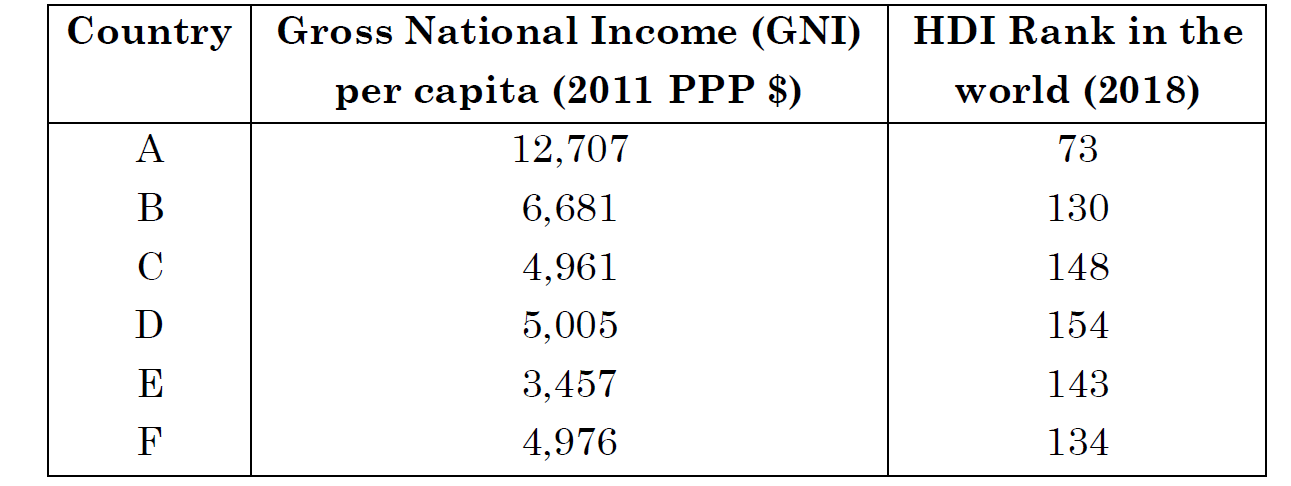
Explanation: Based on the context provided, Sri Lanka is mentioned as being much ahead of India in every respect in terms of Human Development Index (HDI) rankings. Therefore, among the options given, 'Country C' likely refers to Sri Lanka, which would have a higher HDI rank compared to India and potentially the other countries listed.
[1 Mark]
-
(A) 362255
-
(B) 000313
-
(C) 110002078
-
(D) 16137926023
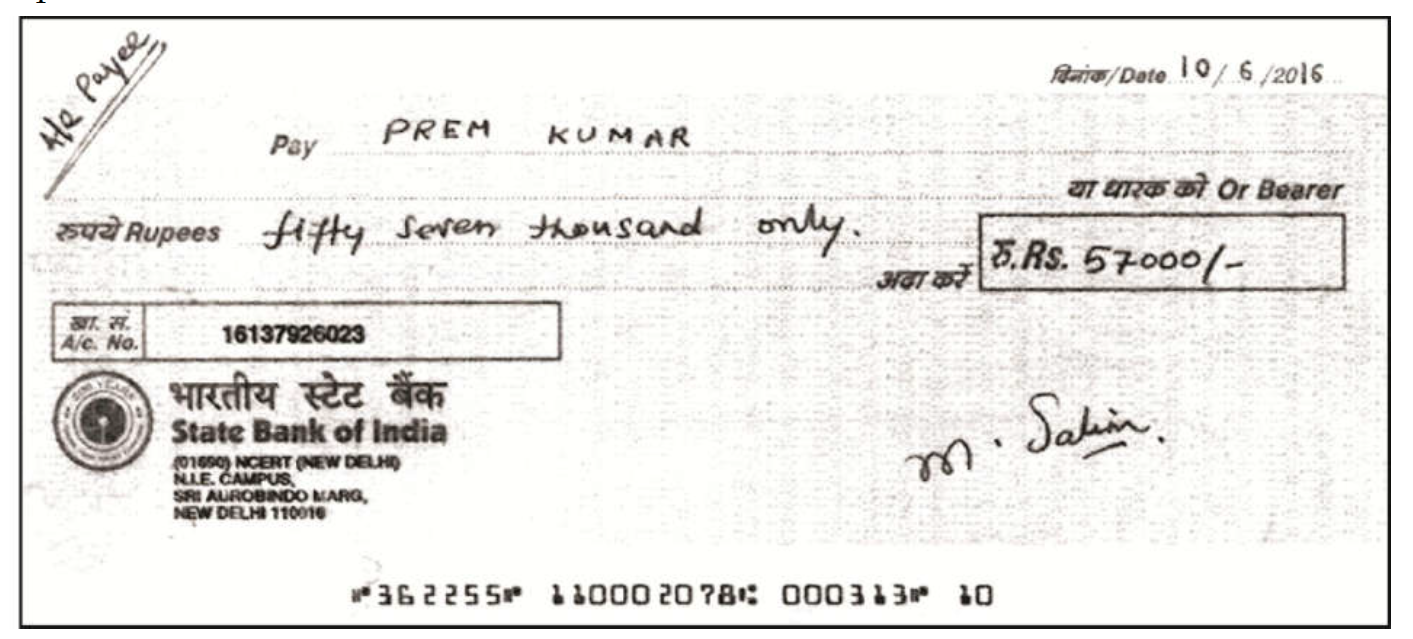
Explanation: The correct cheque number can typically be found in a designated area on the cheque. It is usually a sequence of digits that stands out from other numbers such as the account number or the amount. Given the options provided, you will have to refer to the specific cheque image to determine which option matches the cheque number format.
[1 Mark]
-
(A) Nature of employment
-
(B) Nature of ownership
-
(C) Nature of activities
-
(D) Nature of income
Explanation: The correct option is 'Nature of activities'. The classification of economic activities into primary, secondary, and tertiary sectors is based on the nature of the activities involved. Primary activities depend directly on natural resources, secondary activities involve the processing of these resources, and tertiary activities provide support services to the other sectors.
[1 Mark]
-
(A) Indian Bank
-
(B) Punjab National Bank
-
(C) State Bank of India
-
(D) Reserve Bank of India
Explanation: The correct answer is 'Reserve Bank of India' because it is the sole authority in India authorized to issue currency notes on behalf of the central government and regulates the credit system. The context clearly states that no other organization is allowed to issue currency, and the RBI supervises the functioning of banks to ensure proper credit management.
[1 Mark]
-
(A) Banks
-
(B) Relatives
-
(C) Money-lenders
-
(D) Friends
Explanation: The correct answer is 'Banks'. According to the relevant context provided, formal sector loans in India include loans from banks and cooperatives, while informal loans come from moneylenders, relatives, and friends. Thus, banks are classified as formal sources of loans.
Section C
[2 Marks]
Answer: The Indian subcontinent played a pivotal role in the trade network of the sixteenth century. Land and maritime routes connected it to Central Asia, Southeast Asia, and Europe. Indian goods such as spices, textiles, and other manufactured products were highly sought after in West Asia and beyond. The subcontinent served as a crucial link in inter-Asian trade, facilitating cultural and commercial exchanges that expanded significantly with European exploration, enhancing global trade dynamics.
Key Points: central trade hub-overland and maritime routes-Indian goods in demand-European exploration impact
[2 Marks]
Answer: Two effective ways to address land degradation are afforestation and proper management of grazing. Afforestation involves planting trees and vegetation in degraded areas, which helps restore soil health and improve biodiversity. Proper management of grazing prevents overgrazing, allowing the land to recover and maintain its productivity. Together, these methods can significantly mitigate the impact of human activities on land and contribute to sustainable land conservation.
Key Points: Afforestation-proper management of grazing
[2 Marks]
Answer: Two effective ways to conserve resources are recycling and reducing consumption. Recycling involves processing used materials to create new products, thus minimizing waste and the demand for new raw materials. Reducing consumption, on the other hand, means being mindful of how much we use resources in our daily lives, such as electricity and water. Both practices contribute to sustainable development and help ensure that resources remain available for future generations.
Key Points: recycling-reducing consumption-sustainable development
[2 Marks]
Answer: The UNDP focuses on human development, emphasizing citizen well-being, health, and empowerment through a multi-dimensional approach. In contrast, the World Bank primarily evaluates development through economic metrics, such as per capita income and uniform poverty lines, like $1.90/day. While the UNDP aims for sustainable and inclusive progress tailored to local needs, the World Bank's approach is driven by financial indicators, often neglecting the qualitative aspects of development, such as the social context and individual aspirations.
Key Points: UNDP emphasizes human development; World Bank focuses on economic metrics; UNDP uses multi-dimensional approach; World Bank maintains a uniform poverty line; UNDP aims for sustainable progress; World Bank driven by financial indicators
[2 Marks]
Answer: The role of women in Indian politics has significantly evolved, though challenges remain. Historical movements and recent activism have pushed for greater political representation. Women's participation in governance is crucial for addressing gender issues. However, they still constitute a small percentage of elected officials. Initiatives like reserving one-third of seats for women can further enhance their role. Overall, while progress has been made, true equality in political representation is still a work in progress.
Key Points: Increased political activism-Need for legal reforms-Underrepresentation in governance
Section D
[3 Marks]
Answer: The process of German Unification was primarily driven by the rise of nationalism and the leadership of Prussia under Otto von Bismarck. Initially, nationalist sentiments stirred the middle class in 1848, advocating for a unified German nation-state. The establishment of the Zollverein in 1834 fostered economic integration by eliminating tariff barriers, facilitating the movement of goods and people. Bismarck strategically orchestrated three wars against Denmark, Austria, and France from 1864 to 1871, where Prussia's military might secured victories that consolidated German territories. The culmination of this process was the proclamation of the German Empire in 1871 at Versailles, establishing Prussian dominance and standardizing banking, legal, and economic systems across Germany. This unification not only formed a new state but also symbolized a shift towards centralized governance, overriding regional identities and creating a cohesive German nation-state.
Key Points: Rise of nationalism among middle-class Germans- Establishment of Zollverein for economic integration- Bismarck's leadership and military strategy in three wars- Proclamation of the German Empire in 1871- Standardization of banking, legal, and economic systems
[3 Marks]
Answer: The transformation of India's development process can largely be attributed to the Information Technology (I.T.) and Electronic Industry. The I.T. sector has created millions of jobs, contributing significantly to employment generation. For example, companies like Infosys and TCS have become global players, employing thousands of skilled professionals. Additionally, the Green Revolution showcased how technology enhances productivity; similarly, I.T. has improved efficiency across various sectors, underscoring the value of human capital over traditional resources. India's robust IT infrastructure has also spurred advancements in e-governance, further improving service delivery and transparency. Overall, the synergy between I.T. and other industries demonstrates a profound impact on India's economic evolution.
Key Points: Employment generation; Examples of Infosys and TCS; Green Revolution as a technological influence; Importance of human capital; Advancements in e-governance; Impact on economic evolution
[3 Marks]
Answer: Political parties serve several crucial functions in a democratic society. First, they contest elections, selecting candidates who represent their ideologies and policies. This ensures that citizens have a choice among various alternatives during elections. Second, parties form and run governments, executing policies that reflect their platforms and garnering public support. Third, they shape public opinion, raising and highlighting critical societal issues, often leading movements to address the problems faced by citizens. Through these functions, political parties play an essential role in ensuring democratic governance.
Key Points: Contest elections - select candidates and offer choices; Form and run governments - implement policies and reflect party ideologies; Shape public opinion - raise issues, mobilize support, and lead movements.
[3 Marks]
Answer: To make formal sector loans beneficial for poor farmers and workers, it is crucial to first increase the accessibility of these loans. Financial institutions like banks and cooperatives should extend their services to rural areas and simplify the application processes, reducing the need for complex documentation and collateral. Additionally, banks should offer lower interest rates compared to informal lenders to encourage repayments and reduce debt cycles. Training programs could also help educate farmers about effective loan usage, budgeting, and sustainable agricultural practices. Furthermore, promoting self-help groups can empower communities by pooling resources and providing mutual support for borrowing and entrepreneurship, ultimately decreasing their reliance on informal credit. Overall, equal and fair distribution of funds would enable the poor to invest in productive assets, enhancing their income stability and improving their livelihoods.
Key Points: Increase accessibility of loans; Simplify loan application processes; Provide lower interest rates; Educate farmers on loan usage; Promote self-help groups; Equal distribution of funds
[3 Marks]
Answer: The public sector plays a crucial role in a country's development and well-being by providing essential services that meet the basic needs of citizens. It encompasses a range of activities such as education, healthcare, and infrastructure development, which the private sector may not provide adequately or affordably. Governments utilize taxes and revenues to fund these services, ensuring that everyone has access to necessary facilities. Notably, the Indian Constitution recognizes the right to water, health, and education as fundamental rights. However, the effectiveness of public services often faces challenges such as resource shortages and inequalities in access, highlighting the ongoing need for improvement and investment in the public sector. This focus not only supports the primary and secondary sectors of the economy but also furthers sustainable development goals by promoting social equity and enhancing the overall quality of life for citizens.
Key Points: Public sector provides essential services - Education and healthcare as basic rights - Funded through taxes and revenues - Addresses market failures in private sector - Challenges include resource shortages and inequalities - Supports sustainable development and social equity
[3 Marks]
Answer: The Italian Unification, or Risorgimento, was a complex process initiated in the early 19th century. Key leaders like Giuseppe Mazzini, Count Camillo di Cavour, and Giuseppe Garibaldi played pivotal roles. Mazzini’s advocacy for a unified republic laid the ideological foundation, while Cavour, as prime minister of Sardinia-Piedmont, tactically maneuvered through diplomacy and alliances, particularly with France. The unification progressed rapidly between 1859 and 1870, with key regions joining, culminating in 1861 when Victor Emmanuel II was proclaimed king. The last territory to join was Rome in 1870. While many Italians were unaware of liberal nationalism, the unification ultimately fostered economic growth and political dominance for the new Italian state.
Key Points: Role of Mazzini, Cavour, and Garibaldi- Significant dates (1859-1870)- Formation of a unified Italy in 1861- Last region to join (Rome in 1870)- Impact of unification on economic and political development
Section E
[5 Marks]
Answer: Cultural processes played a vital role in shaping Indian nationalism and capturing the imagination of the people. One of the key methods was the revival of Indian folklore during the late 19th century. Nationalists recorded folk tales and songs, creating a sense of pride and unity among ordinary people. Additionally, artists sought to portray India as a mother figure, invoking devotion to this image as a symbol of nationalism. The reinterpretation of history allowed Indians to reclaim their narrative, fostering a belief in their capabilities contrary to British views. The growth of Romanticism also inspired nationalistic sentiments through art and literature. Moreover, the symbolism of the tricolor flag during the Swadeshi movement helped unify diverse groups under a common identity. Thus, art, folklore, reinterpretation of history, and the creation of symbols collectively forged a national consciousness that transcended individual differences and mobilized people toward the struggle for independence.
Key Points: Revival of folklore; Devotion to mother figure; Reinterpretation of history; Symbolism of the tricolor flag; Role of Romanticism in art and literature; Unity of diverse groups; National consciousness and struggle for independence
[5 Marks]
Answer: The Civil Disobedience Movement saw widespread participation from various social groups in India who were united in their struggle against British colonial rule. One prominent group was the middle class, who were motivated by the desire for self-rule and economic independence. For example, urban professionals and businesspeople participated in boycotts and strikes. Another significant contributor to the movement was the peasantry, particularly in regions like the Deccan, where farmers protested against oppressive land revenue policies. Women also played a pivotal role, as many joined marches, such as the famous Dandi March led by Gandhi, and participated in salt-making activities. The involvement of these diverse groups highlighted the movement's national character and illustrated the widespread discontent with British rule, promoting unity across various sections of society. Furthermore, students, workers, and tribal groups joined in support, showcasing the movement's comprehensive appeal throughout India, emphasizing the collective aspiration for freedom and social justice.
Key Points: Involvement of middle class; participation of peasants and farmers; role of women; Dandi March; involvement of students, workers, and tribal groups; national character of the movement; collective aspiration for freedom.
[5 Marks]
Answer: Agriculture forms the backbone of the Indian economy, employing nearly two-thirds of the population and significantly contributing to the Gross Domestic Product (GDP). It not only provides food for the populace but also serves as the source of raw materials for several industries, including textiles, which is crucial for industrial production and employment. Major crops like rice, wheat, and pulses play vital roles in ensuring food security. The sector also supports agro-based industries, enhancing agricultural productivity. Furthermore, agriculture promotes rural development and provides employment opportunities, thereby reducing poverty. Its significance extends to exports, where products like tea and cotton contribute to foreign exchange earnings. Moreover, diverse cropping patterns across the country reflect India's agricultural richness. Hence, agriculture is instrumental in sustaining livelihoods, driving economic growth, and maintaining food security in India.
Key Points: Significant contributor to GDP-Employs two-thirds of the population-Supplies raw materials for industries-Food security and livelihoods-Drives rural development-Exports generate foreign exchange-Diverse cropping patterns reflect agricultural richness
[5 Marks]
Answer: The Indian government has implemented several technological and institutional reforms since the 1960s to address the challenges faced by farmers. The Green Revolution, introduced in the late 1960s and 1970s, focused on the use of high-yield variety (HYV) seeds, fertilizers, and irrigation to enhance agricultural productivity. This was complemented by the White Revolution (Operation Flood) which transformed milk production. Institutional reforms included land reforms aimed at consolidation of land holdings, the abolition of zamindari, and the establishment of cooperative societies for better access to credit and resources. Policies such as the Kissan Credit Card, crop insurance schemes, and guaranteed minimum support prices (MSP) were introduced to ensure financial security for farmers, protect them from market fluctuations, and enhance their income stability. Furthermore, initiatives like Grameen banks provided loans at lower interest rates, while government programs like the Pradhan Mantri Krishi Sinchaee Yojana ensured efficient irrigation access. These reforms have aimed to create a more equitable agricultural landscape, ensuring farmers are not exploited while increasing food production to meet the demands of a growing population.
Key Points: Green Revolution; White Revolution; consolidation of land holdings; abolishment of zamindari; Kissan Credit Card scheme; minimum support prices (MSP); crop insurance; Pradhan Mantri Krishi Sinchaee Yojana; Grameen banks providing loans; enhancement of agricultural productivity.
[5 Marks]
Answer: Assessing the outcomes of democracy involves evaluating several key aspects that reflect its effectiveness in serving citizen needs. Democracy aims to promote equality among citizens, ensuring fair representation and participation in governance. A primary outcome we expect is accountability, where governments respond to the needs of the populace. Furthermore, an effective democracy encourages transparency and provides mechanisms for citizens to participate in decision-making. It is also important to assess how democracies manage social differences and conflicts, promote economic well-being, and reduce inequalities. While many people value democracy in principle, they often express dissatisfaction with its implementation. Therefore, evaluating actual outcomes against these expected ideals is essential. We must consider political participation before and after elections while also understanding that citizens should be able to express grievances and expectations openly. Continuous assessment allows for a distinction between minimal and quality democracies. It's pivotal for citizens to engage in the Democratic process proactively to attain the aspirational outcomes hidden within democratic frameworks.
Key Points: Expectations from democracy; Accountability to citizens; Mechanisms for participation; Role of transparency; Evaluation of social conflicts and economic inequalities; Comparison of theoretical vs. practical democracy; Importance of citizen engagement
[5 Marks]
Answer: The statement highlights three fundamental characteristics of democracy: accountability, responsiveness, and legitimacy. An accountable government is one that is answerable to its citizens; it must explain its decisions and actions, ensuring transparency and trust. Responsiveness implies that the government must act in accordance with the needs and expectations of the people, prioritizing their welfare. Lastly, legitimacy means that a democracy derives its authority from the consent of the governed; citizens recognize it as their representative body, which enhances their involvement in decision-making processes. Therefore, a democratic government not only respects the rights of its citizens but also actively encourages their participation, fostering an environment of inclusivity and civic engagement, which differentiates it from non-democratic forms of governance.
Key Points: Accountability ensures government is answerable to citizens; Responsiveness means acting in accordance with citizen needs; Legitimacy comes from the consent of the governed; Active citizen participation promotes inclusivity; Differentiates democracy from non-democratic governance.
[5 Marks]
Answer: Liberalisation plays a crucial role in the process of globalisation by removing government-imposed restrictions on foreign trade and investment. This transformation allows businesses to engage in cross-border trade more freely, thus facilitating the flow of goods, services, and capital between countries. The establishment of the World Trade Organisation (WTO) emphasized the need for open markets and fair trade rules, promoting a more integrated global economy. For example, when India liberalised its trade policies, it opened doors for multinational corporations (MNCs), leading to increased foreign investment and the establishment of manufacturing units in the country. This not only boosted economic growth but also enhanced consumer choice and lowered prices. However, this rapid integration also created challenges, such as rising inequalities among different social groups, as not all segments of the population benefited equally from globalisation. While educated and skilled individuals thrived due to new opportunities, others struggled to compete in the global market. Therefore, while liberalisation is vital for promoting globalisation and its economic benefits, it must be complemented by policies that address inequalities, ensuring fair distribution of its advantages. In conclusion, liberalisation is both a catalyst for and a consequence of globalisation, making it essential for countries to adopt policies that foster equitable growth.
Key Points: Definition of liberalisation; Role in removing trade barriers; Impact on foreign investment; Example of India and MNCs; Economic benefits and inequalities; Importance of fair policies.
[5 Marks]
Answer: Globalisation has been shaped by various factors that facilitate its process. Firstly, advancements in technology, especially in transportation and communication, have dramatically decreased costs and improved connectivity, enhancing trade efficiency. Secondly, the liberalisation of trade policies, supported by institutions like the WTO, has reduced barriers to foreign investments, promoting economic integration. Thirdly, multinational corporations (MNCs) play a crucial role by establishing operations in different countries, thereby connecting global markets. Fourthly, the rise of global supply chains allows countries to specialize in certain goods, fostering interdependence. Finally, cultural exchange, bolstered by media and travel, fosters a global consumer culture, facilitating the acceptance of foreign products and ideas. Each of these factors creates a framework that contributes towards greater global interaction and interconnectivity.
Key Points: Advancements in technology, liberalisation of trade policies, role of multinational corporations, rise of global supply chains, cultural exchange