Class 11 PCB . Physics . Physics Part I . Gravitation
Chapter 7: GRAVITATION
Ch 7
Physics
Class 11 PCB
Introduction
Gravity and Planetary Motion
Acceleration due to gravity — The acceleration of objects towards Earth is called acceleration due to gravity.
Earth’s Attraction and Early Planetary Models
- Everyday evidence: Objects thrown upwards and raindrops fall towards Earth.
- Galileo (1564–1642): Recognised that bodies of different masses have the same constant acceleration towards Earth; inclined-plane experiments gave a value close to the more accurate value found later.
| Model | Main idea | Key names and points |
|---|---|---|
| Geocentric | Earth is at the centre; celestial objects were thought to move around it in circles. | Ptolemy proposed this model about 2,000 years ago, using combinations of circles to describe planetary motions. |
| Heliocentric | Planets revolve around the Sun. | Aryabhata mentioned this model in the 5th century AD. Copernicus (1473–1543) later proposed planets moving in circles around a fixed Sun; Galileo supported the theory and faced prosecution. |
How Kepler’s Laws Were Established
- Tycho Brahe (1546–1601): Recorded planetary positions over many years.
- Johannes Kepler (1571–1640): Analysed Brahe’s observations and derived three laws of planetary motion.
- Importance: Kepler’s laws helped Newton formulate the universal law of gravitation.
Kepler’s Laws
Law of orbits — Every planet moves in an elliptical orbit with the Sun at one focus.
Ellipses and Orbital Geometry
- Ellipse: A closed curve for which the sum of distances from any point on it to the two foci is constant.
- Semi-major axis: Half the longest diameter of an ellipse; it extends from the centre to an endpoint of the major axis.
- Circle: A special ellipse whose two foci coincide; its semi-major axis is its radius.
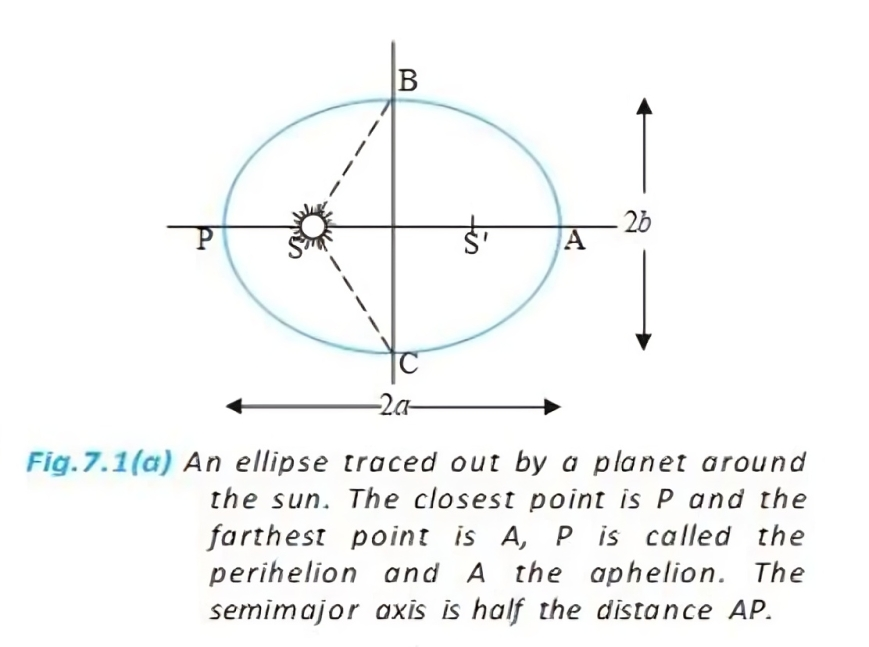
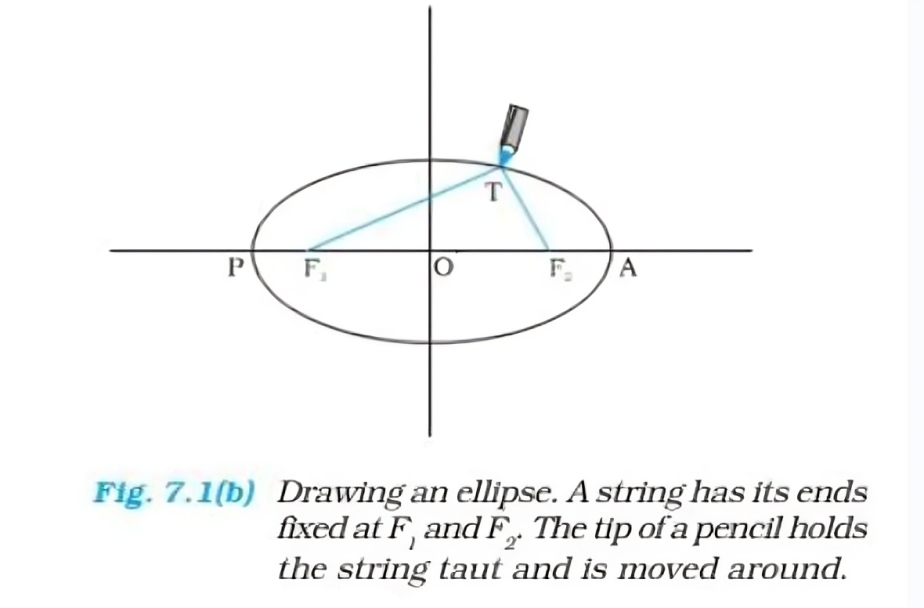
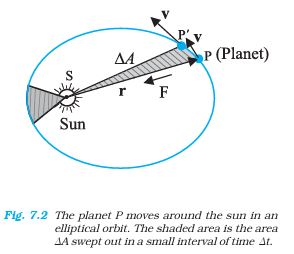
Law of areas — The line joining a planet to the Sun sweeps out equal areas in equal time intervals.
Planetary Speed and Swept Area
- Speed variation: Planets move more slowly when farther from the Sun and faster when nearer it.
- Meaning: Equal areas swept by the Sun–planet line correspond to equal time intervals, despite changes in speed.
Law of periods — The square of a planet’s orbital period is proportional to the cube of the semi-major axis of its orbit.
is the orbital period and is the semi-major axis.
| Planet | () | (years) | () |
|---|---|---|---|
| Mercury | 5.79 | 0.24 | 2.95 |
| Venus | 10.8 | 0.615 | 3.00 |
| Earth | 15.0 | 1 | 2.96 |
| Mars | 22.8 | 1.88 | 2.98 |
| Jupiter | 77.8 | 11.9 | 3.01 |
| Saturn | 143 | 29.5 | 2.98 |
| Uranus | 287 | 84 | 2.98 |
| Neptune | 450 | 165 | 2.99 |
Why the Law of Areas Holds
Central force — A force is central when it acts along the line joining the object to a fixed centre.
Central Force and Angular Momentum
- Gravitational force: The Sun’s force on a planet is directed along the Sun–planet line, so it is a central force.
- Angular momentum: A central force produces zero torque about the centre, so angular momentum remains constant.
- Area rate: The area swept per unit time is proportional to angular momentum; its constancy gives Kepler’s law of areas.
For a planet of mass , position vector , velocity and momentum , angular momentum is .
At perihelion and aphelion, the radius vector and velocity are perpendicular. Conservation of angular momentum gives the speed relation.
Orbit Segment Times
- Speed conclusion: Since , the planet’s speed at perihelion is greater than at aphelion: .
- Time conclusion: The larger swept area takes longer to traverse than the smaller area , because equal areas—not unequal areas—are swept in equal times.
State Kepler’s three laws of planetary motion.
Why does a planet obey Kepler’s law of areas?
Quick recap
- Galileo recognised that bodies of different masses accelerate equally towards Earth.
- Aryabhata mentioned a heliocentric model; Copernicus later proposed planets revolving around a fixed Sun.
- Kepler’s first law: planets move in ellipses with the Sun at one focus.
- Kepler’s second law: the Sun–planet line sweeps equal areas in equal times.
- Kepler’s third law: .
- A central gravitational force conserves angular momentum and explains the law of areas.
- A planet moves faster at perihelion than at aphelion.
Universal Law Of Gravitation
The Moon’s Acceleration and the Inverse-Square Dependence
Using the Moon’s motion
- Centripetal acceleration: The Moon’s circular motion around Earth requires an acceleration directed toward Earth’s centre.
- Comparison: The Moon’s acceleration is much smaller than surface gravity, showing that Earth’s gravitational effect weakens with distance.
- Inverse-square check: If gravitational acceleration varies as the inverse square of distance from Earth’s centre, the predicted comparison agrees with the observed values.
Here is the Moon’s orbital speed, its orbital radius, and its orbital period.
Using days, , and Earth’s surface gravity gives a ratio of about .
Newton’s Universal Law of Gravitation
Universal law of gravitation — Every body in the universe attracts every other body with a force proportional to the product of their masses and inversely proportional to the square of the distance between them.
is the universal gravitational constant; is the separation between the masses.
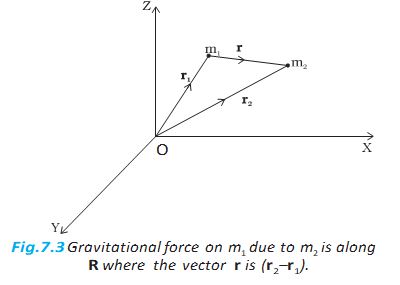
Vector form and direction
- Relative position: The vector from to is , with magnitude and unit vector .
- Attraction: The force on due to points opposite to , toward .
- Newton’s third law: The two bodies exert equal and opposite forces: .
The negative sign shows that the force is attractive.
Gravitational Forces on Collections and Extended Bodies
Superposition of forces
- Point-mass collection: Find the force on a mass by adding the forces from every other mass as vectors.
- Direction matters: Individual gravitational forces may point in different directions, so their magnitudes alone cannot simply be added.
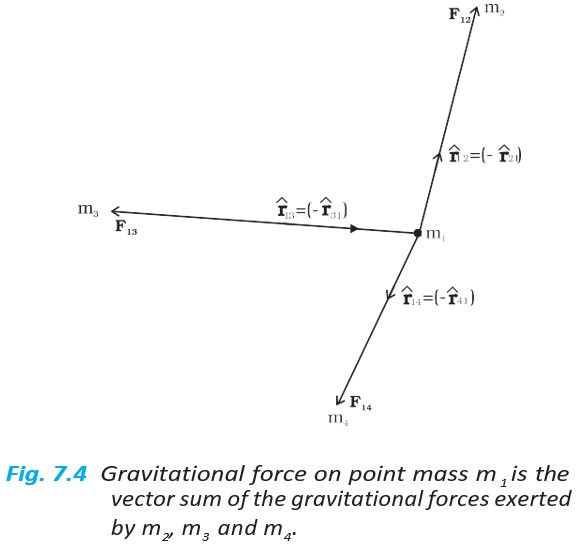
Forces due to the other point masses are added vectorially.
Extended objects
- Why direct use is limited: The point-mass law cannot be applied to an extended object as though all its parts were in one place.
- Total force: Treat the object as many point masses and add their gravitational forces vectorially; calculus can be used for a continuous mass distribution.
Gravitational Force Due to a Uniform Spherical Shell
| Point-mass location | Result |
|---|---|
| Outside the shell | The shell attracts the point mass as if all the shell’s mass were concentrated at its centre. |
| Inside the shell | The net gravitational force on the point mass is zero; attractions from all regions cancel. |
Why the shell results occur
- Outside: Components perpendicular to the line joining the point mass and shell centre cancel; the resultant lies along that line.
- Inside: Attractions from different regions of the shell cancel completely.
State Newton’s universal law of gravitation and write its mathematical form.
What is the gravitational force due to a uniform hollow spherical shell at an interior point and at an exterior point?
Quick recap
- The Moon’s orbital acceleration supports the inverse-square decrease of gravity with distance.
- Gravitational force between point masses is proportional to and inversely proportional to .
- Gravity is attractive, and the forces between two bodies are equal and opposite.
- For several masses, the net gravitational force is the vector sum of the individual forces.
- A uniform hollow spherical shell acts like a point mass at its centre for an exterior point and exerts zero net force on an interior point.
The Gravitational Constant
The Gravitational Constant
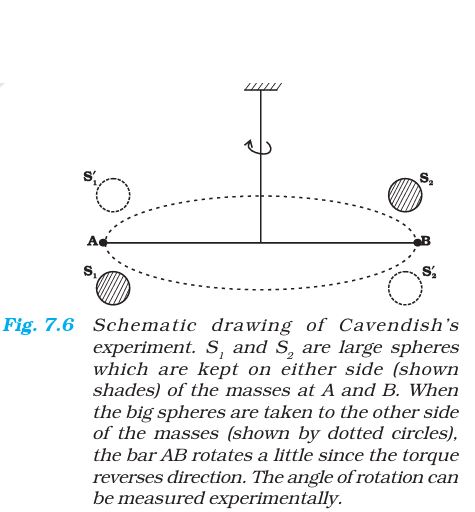
The twist angle at equilibrium allows to be determined.
Acceleration Due to Gravity of Earth
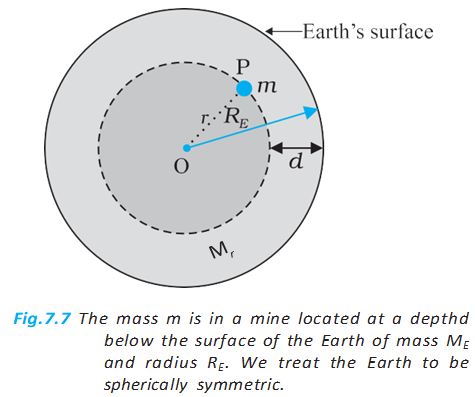
For uniform density, the mass enclosed within radius determines the gravitational force on a mass there.
At distance from Earth’s centre, the force is proportional to under the uniform-density assumption.
At Earth’s Surface
- Surface force: Set in the force expression; this gives the gravitational force on a mass at Earth’s surface.
- Acceleration due to gravity: From Newton’s second law, , so surface acceleration is found by dividing the force by .
Use this relation for the acceleration due to gravity at Earth’s surface.
Since and can be measured and is known, Earth’s mass can be estimated.
How does Cavendish’s experiment determine ?
Why is the gravitational force inside Earth determined only by the mass within radius ?
Why is Cavendish said to have “weighed the Earth”?
Quick recap
- Cavendish first measured experimentally in 1798 using a torsion balance.
- At equilibrium, the gravitational torque equals the wire’s restoring torque.
- Outside Earth, its gravitational effect is as if its total mass were concentrated at the centre.
- Inside a uniform-density Earth, only enclosed mass acts; force increases in proportion to distance from the centre.
- At the surface, .
- Earth’s mass can be calculated using .
Acceleration Due To Gravity Below And Above The Surface Of Earth
Gravity above Earth's surface
Acceleration due to gravity at height — The gravitational acceleration at height above Earth depends on the distance from Earth's centre, .
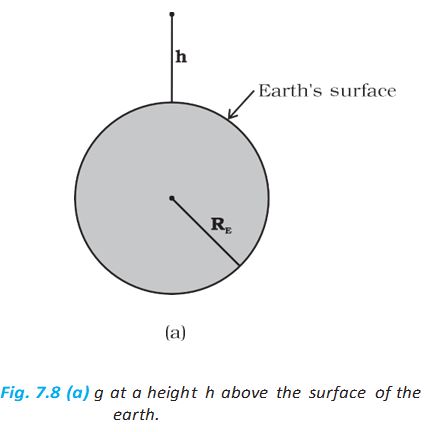
- Distance from Earth's centre: At height , the distance is .
- Gravitational force: For a mass , the force magnitude follows the inverse-square law.
- Height effect: Gravity is weaker above the surface because the distance from Earth's centre increases.
Force on a mass at height .
Divide the gravitational force by the mass being acted upon.
Here, is the acceleration due to gravity at Earth's surface.
When , use the binomial approximation. The decrease in gravity is approximately proportional to height.
Gravity below Earth's surface
Acceleration due to gravity at depth — At depth below Earth's surface, gravity is produced by the smaller sphere enclosed within radius .
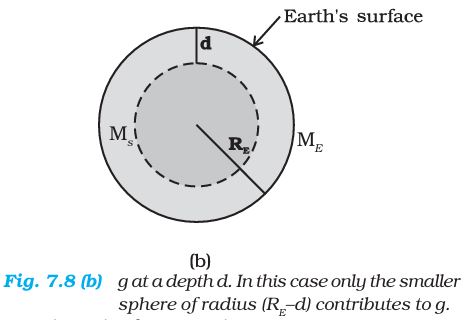
- Outer shell: The spherical shell above the point produces zero net gravitational force there.
- Contributing mass: Only the inner sphere of radius contributes; its mass is proportional to its radius cubed.
- Mass ratio: , where is the inner sphere's mass.
The force is due to the mass of the inner sphere, at distance from its centre.
Using the mass ratio gives the force in terms of Earth's total mass .
Substituting the inner sphere's mass gives a linear decrease in gravity with depth.
| Point | Above the surface | Below the surface |
|---|---|---|
| Distance/depth | Height | Depth |
| Gravity | ; for small , | |
| Variation | Follows an inverse-square relation with distance from Earth's centre. | Decreases linearly with depth under the stated spherical-Earth model. |
- Gravity is maximum at Earth's surface and decreases whether you move upward or downward.
- At Earth's centre, , so the depth formula gives .
How does acceleration due to gravity vary with depth inside Earth?
Quick recap
- At height , the distance from Earth's centre is and .
- For , gravity is approximately .
- At depth , the outer spherical shell has zero net gravitational effect.
- The inner sphere has mass ratio and produces force .
- Gravity at depth is and falls linearly with depth.
- Gravity is greatest at Earth's surface and reaches zero at the centre.
Gravitational Potential Energy
Gravitational Potential Energy Near Earth's Surface
The constant is the potential energy at Earth's surface; its value depends on the chosen reference.
Only potential-energy differences are physically definite: changing the reference constant changes , but not .
Potential Energy at Any Distance from Earth
For , work done against gravity equals the change in potential energy.
The additive constant is the potential energy at infinity. Conventionally, set .
Gravitational Potential and Systems of Particles
For a system with many particles, include each distinct pair once, using its separation .
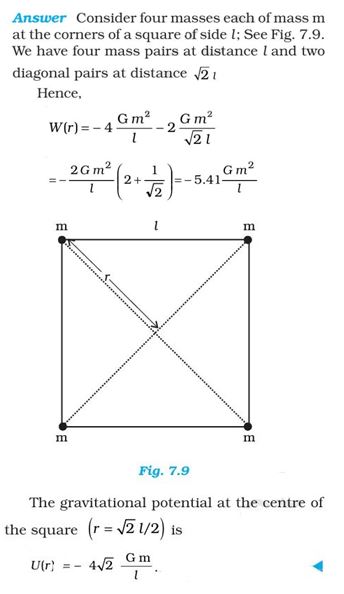
For four equal masses at the corners of a square of side , there are four edge pairs and two diagonal pairs. The potential at the centre is due to all four masses.
State the work required to move a mass from to in Earth's gravitational field.
What is the gravitational potential energy of two masses when zero is chosen at infinity?
Quick recap
- Near Earth's surface: and lifting work is .
- At arbitrary distance: With zero potential energy at infinity, .
- Work: .
- Potential: Gravitational potential is potential energy per unit mass; for Earth, .
- Two masses: Their potential energy is when the reference is infinity.
- Many particles: Add the potential energies of all distinct pairs.
- Square arrangement: For four equal corner masses, and the centre potential is .
Escape Speed
Energy Condition for Escape
Using Conservation of Energy
- Initial energy: At height above Earth’s surface, the object is at distance from Earth’s centre.
- At infinity: The object’s total energy is its kinetic energy plus gravitational potential energy. The reference potential-energy constant cancels when the two energies are equated.
- Escape condition: For the object to reach infinity, its initial kinetic energy must be at least the magnitude of its gravitational potential energy.
- Minimum case: At the minimum escape speed, the object reaches infinity with final speed zero.
Escape Speed at a Planet’s Surface
Earth’s Escape Speed
- At the surface: Put in the general result to obtain Earth’s escape speed.
- Using surface gravity: Since , the result can also be written using and Earth’s radius.
- Independence from mass: The escaping object’s mass cancels, so escape speed does not depend on the object’s mass.
Both expressions give the same escape speed.
Earth and Moon
- Earth: Its surface escape speed is approximately .
- Moon: Use the same formula with the Moon’s surface gravity and radius; its escape speed is approximately .
- Atmosphere: The Moon’s lower escape speed means gas molecules can escape its gravity, which is why the Moon has no atmosphere.
| Point | Earth | Moon |
|---|---|---|
| Escape speed at surface | Approximately | Approximately |
| Reason for difference | Greater surface gravity and radius | Smaller surface gravity and radius |
| Atmosphere | Can retain gas molecules more effectively | Gas molecules can escape more readily |
Escape speed is a minimum speed, not a required direction of motion. It is sometimes loosely called escape velocity, but velocity also specifies direction.
Derive the expression for escape speed from Earth’s surface.
Quick recap
- Escape is possible when the initial kinetic energy is at least the magnitude of the gravitational potential energy.
- At minimum escape speed, the object reaches infinity with zero final speed.
- At height , the minimum speed is .
- At Earth’s surface, .
- Escape speed is independent of the mass of the escaping object.
- The Moon’s escape speed is about , allowing gas molecules to escape.
Earth Satellites
Satellite Motion and Uses
Earth satellite — An object that revolves around Earth under its gravitational attraction.
Natural and artificial satellites
- Orbits: Satellites may follow circular or elliptical paths; Kepler’s laws apply to their motion.
- Moon: Earth’s only natural satellite has a near-circular orbit and revolves around Earth in about days. Its rotation period is approximately the same.
- Artificial satellites: Since 1957, many countries, including India, have launched them for telecommunications, geophysics and meteorology.
Circular Orbits: Speed and Time Period
Forces on a satellite
- Orbital radius: For a satellite at height above Earth’s surface, its distance from Earth’s centre is , where is Earth’s radius.
- Centripetal force: A satellite of mass moving at speed needs an inward force .
- Gravity: Earth provides this force with magnitude , where is Earth’s mass.
- Equating forces: The satellite mass cancels, so orbital speed does not depend on the satellite’s own mass.
Use for a satellite at orbital radius .
How height affects speed
- Trend: As orbital height increases, orbital speed decreases.
- At Earth’s surface: Setting gives , using .
A circular orbit has circumference ; dividing by orbital speed gives the period.
Satellite close to Earth
- Approximation: For a satellite very close to Earth, is negligible compared with .
- Period: With and , the period is about minutes.
Set the orbital radius approximately equal to Earth’s radius.
Applications of Kepler’s Third Law
Finding a planet’s mass and orbital period
- Satellite around a planet: From its orbital radius and period , the planet’s mass is .
- Mars’s mass: Phobos has an orbital radius of and a period of ; these give Mars’s mass as approximately .
- Martian year: If Mars’s orbital radius around the Sun is times Earth’s, then ; taking Earth’s year as days gives about days.
Use a satellite’s period and orbital radius around the planet.
Finding Earth’s mass in two ways
- From surface gravity: . For and , .
- From the Moon’s orbit: . Using and days gives .
- Result: Both methods give nearly the same Earth mass; their difference is less than .
Use measured surface gravity and Earth’s radius.
Using consistent units
- Constant: In , must use units consistent with the chosen units for and .
- Conversion: .
- Moon: With , this gives days.
Elliptical Orbits
- Kepler’s third law: The period relation also applies to an elliptical orbit when its semi-major axis replaces the circular orbital radius.
- Position of Earth: In an elliptical satellite orbit, Earth lies at one focus of the ellipse.
- Planetary orbits: All planets except Mercury and Mars have orbits very close to circular.
- Nearly circular example: Earth’s orbit has , where and are the semi-major and semi-minor axes.
Use the ellipse’s semi-major axis as the orbital-size measure.
Why is a satellite’s orbital speed independent of its mass?
How does the orbital period depend on the orbital radius?
Quick recap
- A satellite’s circular orbital radius is ; gravity supplies the required centripetal force.
- Orbital speed is and decreases as orbital height increases.
- Kepler’s third law for a circular orbit is .
- A satellite very close to Earth has a period of approximately minutes.
- Orbital data can determine a planet’s mass; surface gravity and the Moon’s orbit both give Earth’s mass.
- For elliptical orbits, use the semi-major axis; all planets except Mercury and Mars have nearly circular orbits.
Energy Of An Orbiting Satellite
Energy in a Circular Orbit
Total energy of a satellite — The total mechanical energy is the sum of its kinetic energy and gravitational potential energy.
- Orbital radius: For a satellite at height above Earth, its distance from Earth’s centre is .
- Kinetic energy: ; it is positive.
- Potential energy: Taking potential energy to be zero at infinity, .
- Total energy: ; therefore, .
Use these relations for a satellite of mass in a circular orbit of radius .
Energy in an Elliptical Orbit
- Changing energies: In an elliptical orbit, a satellite’s kinetic and gravitational potential energies vary with its distance from Earth.
- Total energy: The satellite’s total mechanical energy remains constant and is negative for a bound orbit.
Changing a Satellite’s Orbit
Example: Transfer from to
- Given: A satellite moves from circular radius to .
- Total-energy change: ; this is the energy to be supplied.
- Kinetic-energy change: ; the satellite’s kinetic energy decreases.
- Potential-energy change: ; its potential energy increases (becomes less negative).
The source example prints , but this sign conflicts with its initial and final energies. Since , the physically consistent change is positive: .
Why is the total energy of a bound satellite negative?
Quick recap
- For a circular orbit of radius , and .
- The total energy in a circular orbit is .
- For a bound elliptical orbit, kinetic and potential energies vary, but total energy stays constant and negative.
- A satellite transferred to a higher circular orbit needs energy; its total energy rises.
- For circular-orbit changes, and .
Summary And Points To Ponder
Universal Gravitation and Superposition
For masses and separated by , with forces from source masses:
Kepler’s Laws of Planetary Motion
For a circular orbit of radius around a body of mass ; for an elliptical orbit, replace by semi-major axis .
Kepler’s third law: useful consequences
- Same central body: The proportionality constant is the same for all planets orbiting the Sun; the law also applies to satellites orbiting Earth.
- Circular orbits: For planets orbiting the Sun, , where is common to all such planetary orbits.
Acceleration Due to Gravity with Height and Depth
Here and are Earth’s mass and radius; the approximation for height applies when .
Gravitational Potential Energy
For masses and , with zero potential energy at infinity:
Near-Earth approximation
- Approximation: The familiar expression gives the change in gravitational potential energy for a small height change near Earth’s surface, where is nearly constant.
- Reference level: Potential energy relative to infinity is negative; its value depends on the chosen zero.
Mechanical Energy and Circular Orbits
For a particle of mass , speed , at distance from a body of mass ; circular-orbit results assume .
Escape Speed
Here is the acceleration due to gravity at Earth’s surface.
Gravity of Spherical Bodies and Finite Bodies
- Spherical shell: Outside a uniform spherical shell, its gravitational attraction is the same as if its mass were concentrated at its centre.
- Inside a shell: The net gravitational force due to a uniform spherical shell is zero.
- Extended bodies: For finite bodies, gravitational forces from their parts combine by vector addition; spherical symmetry gives the simple centre-of-mass result outside the body.
Conservation and Weightlessness
- Conservation: In gravitational motion under a central force, angular momentum and total mechanical energy are conserved.
- Weightlessness: An astronaut in an orbiting satellite feels weightless because both are in free fall, not because gravity is absent.
Dimensions and Units
Why does an astronaut in a satellite experience weightlessness?
State the conservation laws for an object moving under gravitational influence.
What is the gravitational force inside a uniform spherical shell, and does the shell shield outside gravitational forces?
Quick recap
- Newton’s law gives an attractive inverse-square force; forces from multiple sources add vectorially.
- Kepler’s laws describe elliptical orbits, equal-area sweeps, and the period–orbit-size relation.
- Gravity decreases with height and, inside a homogeneous Earth, with depth.
- Gravitational potential energy is negative when zero is set at infinity; mechanical energy is conserved.
- A circular orbit has , and Earth’s escape speed is about .
- Spherical shells exert zero net force on interior particles but do not provide gravitational shielding; finite rigid bodies need not exert force along the line between their centres of mass.
- Orbital weightlessness is free fall; angular momentum and mechanical energy are conserved.
Physics — ALL CHAPTERS
1
Units And Measurement
2
MOTION IN A STRAIGHT LINE
3
MOTION IN A PLANE
4
LAWS OF MOTION
5
WORK, ENERGY AND POWER
6
SYSTEMS OF PARTICLES AND ROTATIONAL MOTION
7
GRAVITATION
8
Mechanical Properties Of Solids
9
Mechanical Properties Of Fluids
10
Thermal Properties Of Matter
11
Thermodynamics
12
Kinetic Theory
13
Oscillations
14
Waves