Class 11 PCB . Physics . Physics Part I . Units and Measurement
Chapter 1: Units And Measurement
Ch 1
Physics
Class 11 PCB
Introduction
Physical Quantities, Units and Systems
Unit — A unit is an internationally accepted reference standard chosen for comparing and measuring a physical quantity.
How measurement is expressed
- Measurement result = numerical measure × unit; both the number and its unit are needed to state a physical quantity.
- Base quantities are independent quantities whose units are called base (or fundamental) units.
- Derived quantities are formed from base quantities; their units are combinations of base units.
- System of units is a complete set of base units and derived units.
The International System of Units
| System | Length unit | Mass unit | Time unit |
|---|---|---|---|
| CGS | centimetre (cm) | gram (g) | second (s) |
| FPS (British) | foot (ft) | pound (lb) | second (s) |
| MKS | metre (m) | kilogram (kg) | second (s) |
SI system
- Name: Système International d’Unités, abbreviated SI; it is the internationally accepted system of units.
- Development: The scheme was developed by the International Bureau of Weights and Measures (BIPM) in 1971 and revised by the General Conference on Weights and Measures in November 2018.
- Use: SI is used internationally in scientific, technical, industrial and commercial work.
- Convenience: SI is decimal, so conversions within the system are straightforward.
- Unit definitions are revised as measurement technology improves, allowing greater precision.
| Base quantity | SI unit | Symbol | Definition based on fixed constant |
|---|---|---|---|
| Length | metre | Speed of light in vacuum . | |
| Mass | kilogram | Planck constant . | |
| Time | second | Caesium-133 frequency . | |
| Electric current | ampere | Elementary charge . | |
| Thermodynamic temperature | kelvin | Boltzmann constant . | |
| Amount of substance | mole | Exactly specified elementary entities per mole; this is the Avogadro number. | |
| Luminous intensity | candela | Luminous efficacy for monochromatic radiation of frequency . |
Using SI base units
- Mole: Always specify the entities being counted, such as atoms, molecules, ions, electrons or a stated group of particles.
- Definitions: The defining constants and their numerical values establish the base units; the exact values listed above are not required to be memorised for a test.
- Derived units: Other physical quantities use combinations of the seven base units; some derived SI units have special names.
Plane Angle and Solid Angle
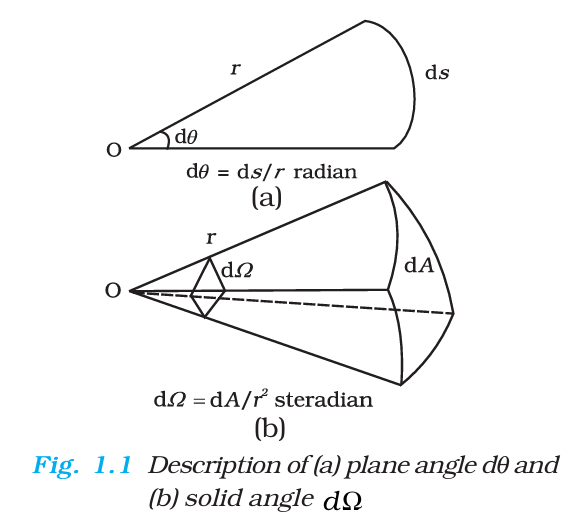
Angle units
- Plane angle is the ratio of an arc length to the radius of the circle.
- Solid angle is the ratio of the area intercepted on a sphere to the square of its radius.
- Units: Plane angle is measured in radians (rad); solid angle is measured in steradians (sr). Both are dimensionless ratios.
Arc length divided by radius.
Area on a spherical surface divided by the square of its radius.
Other Units Retained for General Use
| Name | Symbol | Equivalent in SI units |
|---|---|---|
| minute | ||
| hour | ||
| day | ||
| year | ||
| degree | ||
| litre | ||
| tonne | ||
| carat | ||
| bar | ||
| curie | ||
| roentgen | ||
| quintal | ||
| barn | ||
| are | ||
| hectare | ||
| standard atmosphere |
Derived units and notation
- Derived units may be written directly using SI base units or by using derived units with special names.
- Prefixes and symbols represent decimal multiples and submultiples of units; use the standard SI prefixes and symbol conventions.
What is the difference between a base unit and a derived unit?
Name the seven SI base quantities and their units.
Define plane angle and solid angle, and state their units.
Quick recap
- A measurement is a numerical value expressed with a unit.
- Base units describe independent quantities; derived units combine base units.
- SI is the international decimal system, with seven base quantities and units.
- CGS, FPS and MKS differ in their units for length and mass.
- The radian and steradian are dimensionless units for plane and solid angles.
- Several non-SI units remain in general use; convert them using their SI equivalents.
Significant Figures
Meaning and precision
- Significant figures: The reliable digits in a measurement plus its first uncertain digit.
- Precision: Significant figures show how precisely a quantity has been measured; extra digits can mislead.
Rules for counting significant figures
Changing units does not change significant figures
- Invariant: Changing units shifts the decimal point but does not change the number of significant figures.
- Example: ; each form has four significant figures.
- Caution: The written form of a number can make trailing zeros ambiguous, even though the measured precision is unchanged.
Scientific notation and order of magnitude
Order of magnitude — The power of ten that gives an approximate scale of a physical quantity is its order of magnitude.
| Quantity | Approximate scale | Order of magnitude |
|---|---|---|
| Earth’s diameter: | ||
| Hydrogen atom’s diameter: |
Exact numbers and significant figures
- Exact factors: Defined numbers and exact counting numbers have infinitely many significant figures; they do not limit the precision of a measurement.
- Examples: The factors in radius or circumference formulas, and the count in , are exact when they represent definitions or counts.
- Writing exact factors: An exact may be written as , or without changing its exactness.
The numerical factors shown are exact.
Why should measurements be reported with the correct number of significant figures?
How many significant figures are in ?
What is the order of magnitude of Earth’s diameter, and how does it compare with a hydrogen atom’s diameter?
Quick recap
- Significant figures are all reliable digits plus the first uncertain digit.
- Non-zero digits and zeros between non-zero digits are significant.
- Leading zeros do not count; trailing-zero significance depends on how the number is written.
- Changing units does not change a measurement’s significant-figure count.
- Scientific notation makes trailing-zero precision clear; its exponent does not affect the count.
- Order of magnitude gives an approximate scale as a power of ten.
- Exact factors and exact counts have infinitely many significant figures.
Rules for Arithmetic Operations with Significant Figures
Why Significant-Figure Rules Matter
- Purpose: Calculations with measured values must reflect the precision of the original measurements.
- Precision limit: A calculated result cannot be more precise than the data used to obtain it.
Multiplication and Division
- Multiplication and division: Retain in the result as many significant figures as are present in the input value with the fewest significant figures.
- Example: 4.237 ÷ 2.51 = 1.69, reported to three significant figures.
Addition and Subtraction
Do not apply the significant-figure rule for multiplication and division to addition or subtraction. For example, report the sum as , not ; report the difference as , not .
State the precision rule for multiplication and division.
State the precision rule for addition and subtraction.
Quick recap
- Calculated results must reflect the precision of their measured inputs.
- For multiplication and division, use the fewest significant figures among the inputs.
- For addition and subtraction, use the fewest decimal places among the inputs.
- Do not use significant-figure counting to set precision in sums or differences.
- Keep only the precision justified by the measurements.
Rounding off the Uncertain Digits
Rounding off — Rounding off adjusts a calculated value to the number of significant figures justified by the measurements.
Rounding Rules
- Dropped digit below 5: Drop it and leave the preceding digit unchanged; for example, to significant figures becomes .
- Dropped digit above 5: Drop it and increase the preceding digit by ; for example, to significant figures becomes .
- Dropped digit exactly 5: If the preceding digit is even, leave it unchanged; if it is odd, increase it by .
- Tie-rule examples: becomes because is even; becomes because is odd.
Rounding During Calculations
- Multi-step calculations: Keep one digit more than the required significant figures in intermediate steps; round to the appropriate significant figures at the end.
- Approximate constants: The speed of light in vacuum, , is often approximated as for calculations.
- Exact numbers: Exact factors in formulas, such as and , have effectively infinite significant figures and do not limit the result. Use a suitable approximation for , such as or .
The exact numerical factors do not restrict the precision of the result.
Applying Significant Figures
For cube side length , round calculated results to the number of significant figures supported by the measurement.
Cube Example
- Given: The measured side length is , which has significant figures.
- Surface area: , which rounds to to significant figures.
- Volume: , which rounds to to significant figures.
Density is mass divided by volume.
Density Example
- Given: A mass of has significant figures, and a volume of has .
- Result: The density is ; report to significant figures.
Do not repeatedly round intermediate values in a multi-step calculation; retain one extra digit and round the final result appropriately.
How do you round when the first dropped digit is exactly ?
To how many significant figures should the density of occupying be reported?
Quick recap
- For a dropped digit below , leave the preceding digit unchanged; above , increase it by .
- For an exact , leave an even preceding digit unchanged and increase an odd preceding digit by .
- Keep one extra digit in intermediate steps and round the final result.
- Exact factors such as and do not limit significant figures.
- Round calculated results to the significant-figure precision supported by the measurements.
Rules for Determining the Uncertainty in the Results of Arithmetic Calculations
Uncertainty in Products
Product uncertainty — When measured values are multiplied, their percentage (relative) uncertainties add.
Rectangular sheet example
- Measurements: and .
- Percentage uncertainties: For , the uncertainty is about ; for , it is about .
- Area: ; the percentage uncertainty is .
- Absolute area uncertainty: of is about .
- Reported result: Rounded suitably, the area is .
Significant Figures in Arithmetic Results
- Combining measured data: If data are specified to significant figures, a result from combining them is generally valid to significant figures.
- Addition and subtraction: The result is limited by the least precise number of decimal places, rather than by the number of significant figures.
- Example: is reported as , not , because is given only to one decimal place.
Relative Error Depends on the Measured Value
Relative error — Relative error is the absolute error divided by the measured value; its percentage depends on the value as well as the measurement precision.
Use this to compare the error with the size of the measured quantity.
Same absolute error, different relative errors
- For : An absolute error of gives a relative error of about .
- For : The same absolute error, , gives a relative error of about .
- Key idea: The same absolute uncertainty is proportionally larger for a smaller measured value.
Rounding in Multi-Step Calculations
- Intermediate values: Keep one more significant figure in intermediate results than the least precise measurement supports; round the final answer appropriately.
- Why: Rounding too early can build up error across multiple operations.
- Example: Rounding to three significant figures gives ; taking its reciprocal gives , not the original .
- Better precision: Keeping during the calculation and then taking the reciprocal to three significant figures gives .
Quick recap
- For products, add the percentage uncertainties of the measured factors.
- In the sheet example, the area is reported as .
- For addition and subtraction, round the result to the least precise decimal place.
- Equal significant figures do not necessarily mean equal relative errors.
- Keep one extra significant figure in intermediate calculations to reduce rounding error.
Dimensions of Physical Quantities
Dimensions and Base Quantities
- Dimensions: They describe the nature of a physical quantity using powers of base quantities.
- Base dimensions: Length [L], mass [M], time [T], electric current [A], temperature [K], amount of substance [mol] and luminous intensity [cd].
Dimensional Formulas of Common Quantities
- Derived quantities: Their dimensions are combinations of base dimensions; for example, volume has dimensions [L³].
- Examples: Speed has dimensions [LT⁻¹], acceleration [LT⁻²], force [MLT⁻²] and density [ML⁻³].
Dimensional Formula and Dimensional Equation
- Dimensional formula: Shows the powers of the base quantities that represent a physical quantity, such as [MLT⁻²] for force.
- Dimensional equation: Equates a quantity to its dimensional formula, for example [F] = [MLT⁻²].
Dimensional Analysis
- Meaning: Dimensional analysis uses the dimensions of physical quantities to examine their relationships.
- Applications: It checks dimensional consistency and can help deduce relations among quantities.
- Limitation: It cannot determine dimensionless constants or distinguish quantities with the same dimensions.
Quick recap
- Dimensions represent a physical quantity using powers of base quantities.
- The seven base dimensions are , , , , , , and .
- Mechanical quantities use , , and ; for example, force has dimensions .
- A dimensional formula gives the base dimensions and powers; a dimensional equation equates a quantity’s dimensions to that formula.
- Only quantities with the same dimensions can be added or subtracted; units and dimensions in products and quotients cancel algebraically.
- A dimensionally consistent equation has the same dimensions on both sides.
Checking the Dimensional Consistency of Equations
Principle of Homogeneity of Dimensions
Passing the dimensional test does not prove an equation is correct; failing it proves the equation is wrong. Dimensions cannot determine dimensionless numerical factors.
Dimensionless Quantities and Functions
- Dimensionless quantities: Ratios of like quantities have no dimensions, such as angle (length/length) and refractive index (speed/speed).
- Functions: The arguments of trigonometric, logarithmic and exponential functions must be dimensionless.
Checking a Position Equation
Here, is the initial position, the initial velocity, and the acceleration.
Dimensional check
- Left side: .
- Initial position: .
- Velocity term: .
- Acceleration term: ; the factor is dimensionless.
- Conclusion: Every term has dimension , so the equation is dimensionally consistent.
Checking Energy Equations
Both sides have dimensions of energy.
Dimensional check
- Left side: .
- Right side: .
- Conclusion: The sides have equal dimensions, so the equation is dimensionally consistent.
| Option | Dimensions or issue | Result |
|---|---|---|
| Rule out: dimensions differ from energy. | ||
| Dimensionally consistent; this is the correct formula. | ||
| Rule out: dimensions differ from energy. | ||
| Dimensionally consistent, but dimensional analysis cannot verify its numerical factor. | ||
| Adds energy and force, which have different dimensions. | Rule out: the sum is dimensionally invalid. |
What can and cannot be concluded when an equation passes the dimensional consistency test?
Quick recap
- Only quantities with the same dimensions can be added or subtracted.
- All terms in a valid equation must have the same dimensions on both sides.
- Arguments of trigonometric, logarithmic and exponential functions must be dimensionless.
- A failed dimensional test proves an equation wrong; a passed test does not prove it correct.
- For the position equation, each term has dimension .
- Dimensional analysis can rule out incorrect energy formulae but cannot determine their dimensionless constants.
Deducing Relation among the Physical Quantities
Method of dimensions — A method for deducing a possible relation between physical quantities by assuming a product of powers and comparing dimensions.
How the method works
- Start with known dependence: The quantity must depend on a known set of up to three linearly independent physical quantities.
- Assume a product: Write the unknown quantity as a dimensionless constant times powers of those quantities.
- Compare dimensions: Equate the powers of each fundamental dimension on both sides to find the unknown exponents.
Example: Period of a Simple Pendulum
Set up the dependence
- Assumption: Let the period depend on pendulum length , bob mass , and gravitational acceleration .
- Product form: , where is dimensionless and , , and are unknown exponents.
Deduce the pendulum period by dimensions
- Substitute the dimensions of the quantities into the assumed relation.
- Match the powers of , , and on both sides.
- Solve for the exponents and substitute them into the product form.
Dimensional analysis gives the proportional relation; the dimensionless numerical constant is supplied by the exact result.
Result and limits
- Dimensional result: The method gives ; for a simple pendulum, the exact constant is , so .
- Cannot determine constants: Dimensional analysis cannot find dimensionless numerical factors such as .
- Cannot prove an exact law: It tests dimensional consistency but cannot establish the exact relationship between quantities.
- Same dimensions: It cannot distinguish between different physical quantities that have identical dimensions.
What relation for the period of a simple pendulum is obtained by dimensional analysis?
Quick recap
- Assume an unknown quantity is a product of powers of known quantities.
- Compare the dimensions on both sides and match powers of fundamental dimensions.
- For a pendulum, dimensional analysis gives .
- The method cannot determine the dimensionless constant; the exact pendulum constant is .
- Dimensional analysis tests dimensional validity but does not prove an exact physical law.
Summary
Physical Quantities and Base Units
Physical quantity — A physical quantity is a measurable property expressed by a numerical value and a unit.
- Physics is a quantitative science based on measuring physical quantities.
- Base quantities are chosen independently; they include length, mass, time, electric current, thermodynamic temperature, amount of substance and luminous intensity.
- Unit is a standardised reference used to measure a physical quantity.
| Base quantity | SI base unit | Symbol |
|---|---|---|
| Length | metre | |
| Mass | kilogram | |
| Time | second | |
| Electric current | ampere | |
| Thermodynamic temperature | kelvin | |
| Amount of substance | mole | |
| Luminous intensity | candela |
Derived Units and the SI System
Derived unit — A derived unit is formed by combining base units according to the relationship defining a derived quantity.
- Base units are the units of fundamental quantities; derived units are combinations of base units.
- System of units is a complete set of base and derived units.
- SI is the internationally accepted system of units, based on seven base units and widely used for physical measurements.
- Special names are used for some derived SI units, such as newton, joule and watt.
| Derived quantity | SI unit | Symbol |
|---|---|---|
| Force | newton | |
| Energy | joule | |
| Power | watt |
Scientific Notation, Prefixes and Unit Notation
Scientific notation — Scientific notation expresses very large or very small measurements compactly using powers of ten.
Write a number as a coefficient multiplied by a power of ten.
- Purpose: powers of ten and SI prefixes simplify notation and numerical calculations for very large or small quantities.
- Precision: notation and prefixes should communicate the precision of a measurement.
- Notation rules: follow standard conventions for writing physical quantities, SI and other unit symbols, and SI prefixes.
- Unit symbols: use the well-defined, internationally accepted symbols, such as , , and .
Unit Calculations and Significant Figures
- Unit calculations: treat units in relationships algebraically until the desired unit is obtained.
- Significant figures are the meaningful digits retained to represent the precision of a measured or computed quantity.
- Arithmetic and rounding: follow the rules for significant figures in calculations and round off uncertain digits appropriately.
Dimensions and Dimensional Analysis
Dimensions — Dimensions describe the nature of physical quantities using base quantities and combinations of them.
- Dimensional analysis can check the dimensional consistency of equations and help deduce relations among physical quantities.
- Consistency test: the two sides of a dimensionally consistent equation must have matching dimensions.
Dimensional consistency does not prove an equation is exact or correct; dimensional inconsistency shows that it must be wrong.
What is the SI system, and what is it based on?
What can dimensional analysis establish about an equation?
Quick recap
- Physics is a quantitative science that describes measurable quantities using values and units.
- The seven SI base quantities have standard units; derived units combine base units.
- Scientific notation and SI prefixes simplify expressing very large and small measurements.
- Use standard notation for physical quantities, unit symbols and prefixes.
- Treat units algebraically in calculations and retain proper significant figures.
- Dimensional analysis checks consistency and helps deduce relations, but does not prove an equation correct.
Physics — ALL CHAPTERS
1
Units And Measurement
2
MOTION IN A STRAIGHT LINE
3
MOTION IN A PLANE
4
LAWS OF MOTION
5
WORK, ENERGY AND POWER
6
SYSTEMS OF PARTICLES AND ROTATIONAL MOTION
7
GRAVITATION
8
Mechanical Properties Of Solids
9
Mechanical Properties Of Fluids
10
Thermal Properties Of Matter
11
Thermodynamics
12
Kinetic Theory
13
Oscillations
14
Waves