Class 11 PCB . Physics . Physics Part II . Thermal Properties of Matter
Chapter 10: Thermal Properties Of Matter
Ch 10
Physics
Class 11 PCB
Introduction
Temperature and Heat
Heat — Energy transferred between systems, or between a system and its surroundings, because of a temperature difference.
| Quantity | SI unit |
|---|---|
| Heat transferred | joule () |
| Temperature | kelvin (); degree Celsius () is also commonly used |
Measurement of Temperature
Thermometers and fixed points
- Thermometer: Measures temperature using a physical property that changes with temperature; liquid volume is commonly used.
- Liquid-in-glass thermometers: Mercury or alcohol expands with temperature; its volume varies nearly linearly over a wide range.
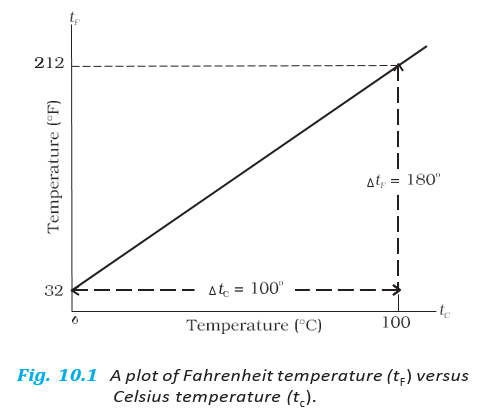
- Calibration: A temperature scale assigns numerical values using two fixed reference points.
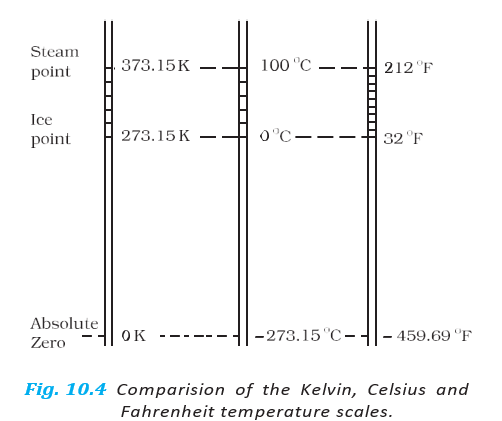
- Fixed points: The ice point and steam point are the freezing and boiling points of pure water at standard pressure.
| Reference point | Celsius scale | Fahrenheit scale |
|---|---|---|
| Ice point | ||
| Steam point | ||
| Equal intervals between points |
Use this relation to convert a temperature between the two scales.
Ideal-Gas Equation and Absolute Temperature
Gas laws
- Low-density gases: Show similar expansion behaviour, making gas thermometers more consistent than liquid-in-glass thermometers.
- Boyle's law: For a fixed quantity of gas at constant temperature, pressure times volume is constant.
- Charles' law: For a fixed quantity of gas at constant pressure, volume divided by absolute temperature is constant.
- Temperature in gas laws: Absolute temperature is measured in kelvins; .
For a fixed quantity of gas at constant temperature.
For a fixed quantity of gas at constant pressure.
Ideal-gas equation and gas thermometry
- Symbols: is pressure, is volume, is absolute temperature, and is the number of moles.
- Universal gas constant: .
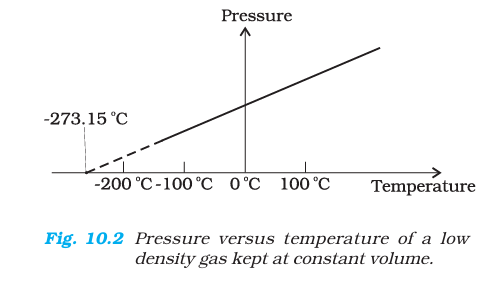
- Constant-volume thermometer: With fixed, the ideal-gas equation gives ; temperature can therefore be read from gas pressure.
Absolute zero and the Kelvin scale
- Real gases: Deviate from ideal-gas predictions at low temperatures, but pressure–temperature graphs are linear over a broad range.
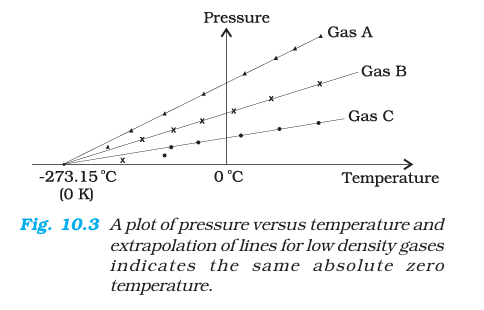
- Absolute zero: Extrapolating the straight-line pressure–temperature graph to zero pressure gives , the ideal gas's minimum temperature.
- Kelvin scale: Takes absolute zero as ; it is also called the absolute temperature scale.
- Scale size: One kelvin and one Celsius degree have the same size; their zero points differ.
Convert Celsius temperature to absolute temperature for gas-law calculations.
Define heat and state its direction of transfer.
What is absolute zero, and what is its value on the Kelvin scale?
Quick recap
- Temperature indicates hotness or coldness; heat is energy transferred due to a temperature difference.
- Heat flows from higher to lower temperature, and its SI unit is the joule.
- Thermometers use temperature-dependent physical properties and are calibrated with fixed points.
- The ice and steam points are and .
- Boyle's and Charles' laws combine to give the ideal-gas equation .
- Absolute zero is , with .
Thermal Expansion
Thermal Expansion and Its Types
Thermal expansion — The increase in a body's dimensions when its temperature rises; most substances contract when cooled.
| Type | Change in dimension | Example |
|---|---|---|
| Linear | Length | A rod becomes longer |
| Area | Surface area | A sheet expands in length and breadth |
| Volume | Volume | A liquid's level rises when heated |
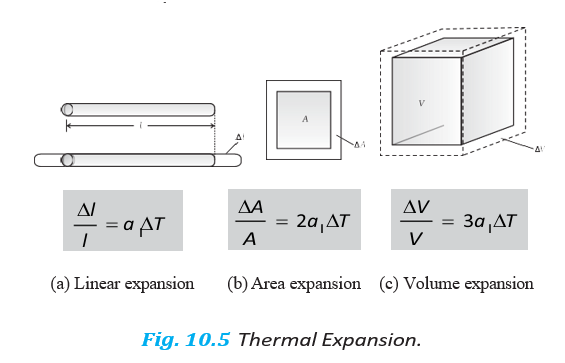
Linear Expansion
Coefficient of linear expansion — The fractional increase in length per unit rise in temperature; it is characteristic of the material.
For a small temperature change, the fractional change in length is proportional to the temperature change.
Typical linear expansion coefficients
- Units: The coefficient is measured in ; temperature differences in kelvins and degrees Celsius have the same numerical value.
- Comparison: Copper expands about five times more than Pyrex glass for the same temperature rise; metals generally have relatively high .
| Material | () |
|---|---|
| Aluminium | 2.5 |
| Brass | 1.8 |
| Iron | 1.2 |
| Copper | 1.7 |
| Silver | 1.9 |
| Gold | 1.4 |
| Pyrex glass | 0.32 |
| Lead | 0.29 |
Volume Expansion
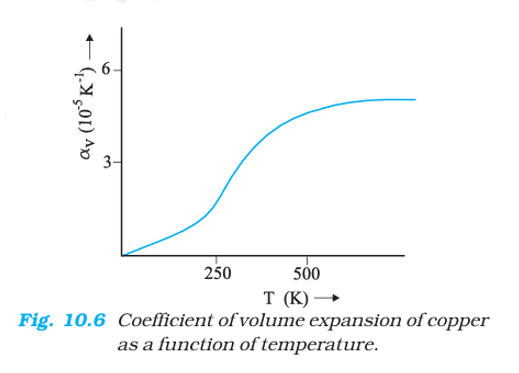
Coefficient of volume expansion — The fractional increase in volume per unit rise in temperature; it can vary with temperature.
The coefficient of volume expansion is defined by the fractional volume change.
How volume expansion varies
- Temperature dependence: is not strictly constant; for copper, it approaches a constant value only at high temperatures.
- Material comparison: Expansion is generally small in solids and liquids. Pyrex glass and Invar have particularly low volume expansion.
- Liquids: Ethanol expands more than mercury for the same temperature rise.
| Material | () |
|---|---|
| Aluminium | |
| Brass | |
| Iron | |
| Paraffin | |
| Ordinary glass | |
| Pyrex glass | |
| Hard rubber | |
| Invar | |
| Mercury | |
| Water | |
| Ethanol |
Anomalous Expansion of Water
Anomalous expansion of water — Water contracts when heated from to , unlike the usual expansion of substances on heating.
Water's density and volume
- Above : As water cools toward , its volume decreases and its density increases.
- Below : Further cooling makes water expand, so its density decreases.
- Maximum density: Water is densest at .
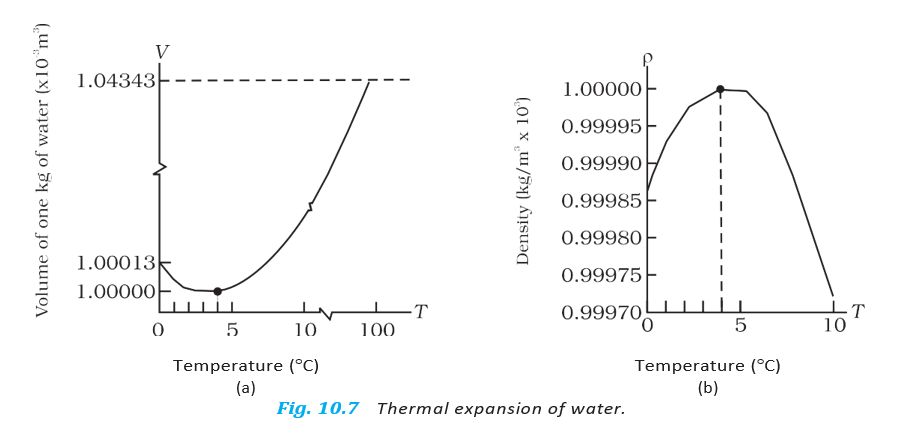
Why lakes freeze at the surface first
- Surface water cools toward and becomes denser.
- The denser water sinks while warmer, less dense water rises.
- Water cooled below becomes less dense and stays near the surface.
- The surface layer freezes first, helping protect aquatic life below.
Thermal Expansion of Gases
- Relative expansion: At ordinary temperatures, gases expand more than solids and liquids.
- Temperature dependence: For gases, depends on temperature; for liquids, it is relatively independent of temperature.
From the ideal gas law, at constant pressure the volume expansion coefficient is inversely proportional to absolute temperature.
Gas expansion values
- At : .
- At room temperature: At constant pressure, is about , much larger than the value for typical liquids.
- Trend: Since , it decreases as absolute temperature increases.
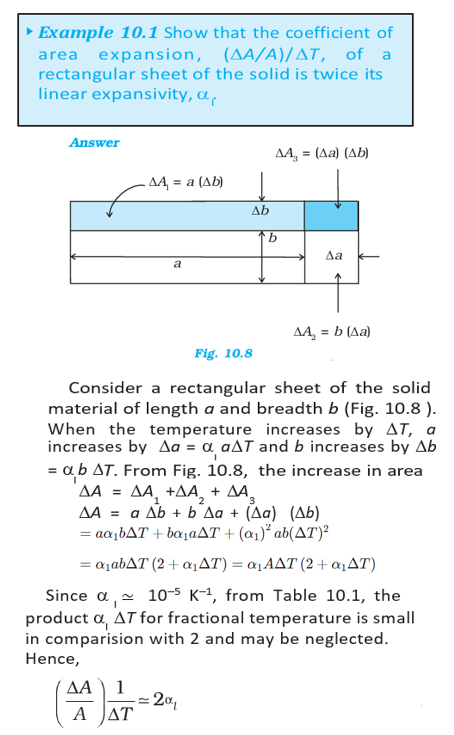
Relation Between Volume and Linear Expansion
- Assumption: A solid expands equally in all three directions, and the expansion is small.
- Small-change approximation: For a cube with side , terms involving and can be neglected when calculating its volume change.
For small expansion, the volume coefficient is three times the linear coefficient.
Thermal Stress
Thermal stress — Stress produced when a body's thermal expansion or contraction is prevented by external constraints.
For heating with expansion completely prevented, the stress is compressive; its magnitude follows from Young's modulus times the prevented thermal strain.
Steel rail example
- Given: , , , , and .
- Prevented strain: .
- Thermal stress: .
- Force: . Such a force can bend rails if their expansion is blocked.
Application: Heating an Iron Ring
Finding the temperature needed to fit a wheel rim
- Given: At , the ring diameter is and the rim diameter is ; for iron, use .
- Expansion relation: .
- Result: Setting the expanded ring diameter equal to the rim diameter gives .
Why do lakes and ponds freeze at the surface first?
State the relation between and for a solid.
Quick recap
- Thermal expansion is an increase in dimensions with temperature; it may be linear, area or volume expansion.
- For small temperature changes, and .
- Water has maximum density at , so lakes freeze at the surface first.
- For an ideal gas at constant pressure, ; gases expand far more than typical solids and liquids.
- For small, equal expansion in all directions, .
- If expansion is constrained, thermal stress develops; its magnitude is .
Specific Heat Capacity
Heat Capacity and Specific Heat Capacity
What affects heat required?
- Temperature rise: For the same mass and substance, doubling the temperature change requires twice as much heat.
- Mass: For the same substance and temperature rise, doubling the mass requires twice as much heat.
- Nature of substance: Equal masses of different substances need different amounts of heat for the same temperature change.
Heat capacity — Heat capacity is the heat needed to change the temperature of a whole body by one unit.
Here, is heat supplied or released for a temperature change ; SI unit: .
Specific heat capacity — Specific heat capacity is the heat absorbed or released per unit mass to change a substance’s temperature by one unit, with no phase change.
It depends on the substance and its temperature. SI unit: .
Use this relation when a mass changes temperature by and its specific heat capacity is .
Molar specific heat capacity — Molar specific heat capacity is the heat absorbed or released per mole to change temperature by one unit.
Here, is the amount of substance in moles. SI unit: . Like specific heat capacity, it depends on the substance and temperature.
| Gas | () | () |
|---|---|---|
| 20.8 | 12.5 | |
| 28.8 | 20.4 | |
| 29.1 | 20.8 | |
| 29.4 | 21.1 | |
| 37.0 | 28.5 |
| Condition | Constant pressure | Constant volume |
|---|---|---|
| What is kept fixed? | Pressure | Volume |
| Molar specific heat |
| Substance | Specific heat capacity () | Substance | Specific heat capacity () |
|---|---|---|---|
| Aluminium | 900.0 | Ice | 2060 |
| Carbon | 506.5 | Glass | 840 |
| Copper | 386.4 | Iron | 450 |
| Lead | 127.7 | Kerosene | 2118 |
| Silver | 236.1 | Edible oil | 1965 |
| Tungsten | 134.4 | Mercury | 140 |
| Water | 4186.0 |
Why water’s high specific heat matters
- Slow temperature change: Water warms and cools slowly because a large amount of heat causes only a modest temperature change.
- Uses: Water acts as a coolant in automobile radiators and as a heat reservoir in hot-water bags.
- Sea breeze: Land warms faster than the sea during the day; cooler air from over the sea moves toward land.
- Deserts: The surface heats quickly during the day and cools quickly at night.
Calorimetry
Calorimetry — Calorimetry is the measurement of heat transferred between bodies.
Principle and calorimeter
- Isolated system: No heat is exchanged with the surroundings.
- Thermal transfer: Heat flows from the hotter part to the colder part until thermal equilibrium is reached.
- Conservation of heat: If no heat escapes, heat lost by hotter bodies equals heat gained by colder bodies.
- Calorimeter: A metallic vessel and stirrer, commonly copper or aluminium, are placed inside an insulating jacket; a thermometer measures temperature.
For an isolated system, sum the heat changes of all bodies to zero; equivalently, total heat lost equals total heat gained.
Finding an unknown specific heat using calorimetry
- Write the heat lost by the hot body and the heat gained by each colder body.
- Set heat lost equal to total heat gained, assuming no heat escapes.
- For the aluminium sphere example, use the sphere’s cooling from to and the water and copper calorimeter’s warming from to .
- Substitute the given masses and specific heats, then solve for the unknown.
Do not count heat gained by the calorimeter as negligible unless the problem says to ignore it; include its mass and specific heat in the heat balance.
Define specific heat capacity and state its SI unit.
Quick recap
- Heat required depends on the mass, temperature change and nature of the substance.
- Heat capacity is ; specific heat capacity is .
- Molar specific heat capacity is ; gases may be described by or .
- Water’s high specific heat capacity makes it useful in cooling and heating and moderates temperature changes near seas.
- In calorimetry, when heat does not escape, heat lost equals heat gained; include the calorimeter in the balance.
Change of State
Change of state — A transition of matter from one physical state—solid, liquid or gas—to another.
Heating and phase change
- Heat exchange: Changes of state occur when heat is exchanged between a substance and its surroundings.
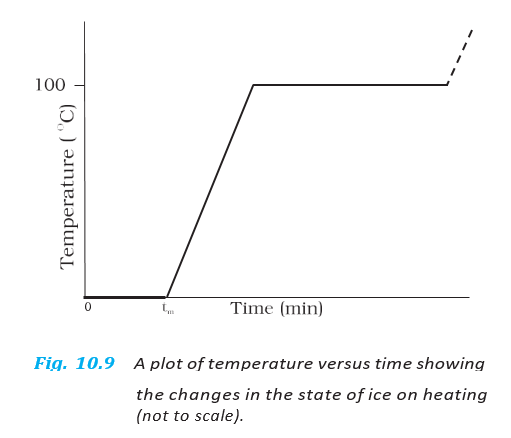
- Temperature plateau: During a phase change, temperature remains constant even while heat is supplied; the heat changes the state.
- Coexistence: The two states involved coexist in thermal equilibrium until the change is complete.
Melting, Freezing and Regelation
Melting (fusion) — The change of state from solid to liquid.
Freezing — The change of state from liquid to solid.
Melting point — The temperature at which a substance’s solid and liquid states coexist in thermal equilibrium.
Melting point
- Constant temperature: It remains unchanged until all the solid has melted.
- Characteristic value: The melting point depends on the substance and also on pressure.
- Normal melting point: The melting point measured at standard atmospheric pressure.
Regelation — The melting of ice under increased pressure followed by refreezing when the pressure is removed.
Regelation and skating
- Pressure effect: Increased pressure lowers the melting temperature of ice beneath a pressure point; water refreezes after the pressure passes.
- Skating: Pressure under a skate forms a thin layer of water that acts as a lubricant.
Vaporisation and Boiling
Vaporisation — The change of state from liquid to vapour (gas).
Boiling point — The temperature at which liquid and vapour coexist in thermal equilibrium during boiling.
Phase Diagram and Triple Point
Phase diagram — A pressure–temperature graph showing the phase regions and the conditions at which different phases coexist.
| Curve | Coexisting phases |
|---|---|
| Sublimation curve | Solid and vapour |
| Fusion curve | Solid and liquid |
| Vaporisation curve | Liquid and vapour |
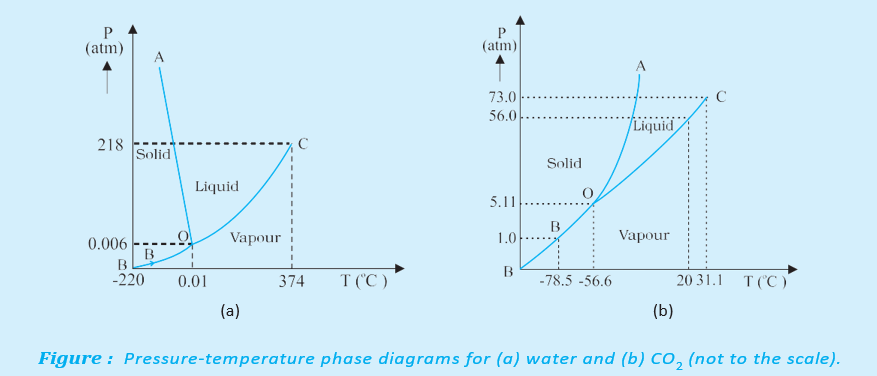
Triple point — The temperature and pressure at which solid, liquid and vapour phases coexist.
Triple point of water
- Values: and .
- Diagram: It is the meeting point of the sublimation, fusion and vaporisation curves.
Boiling
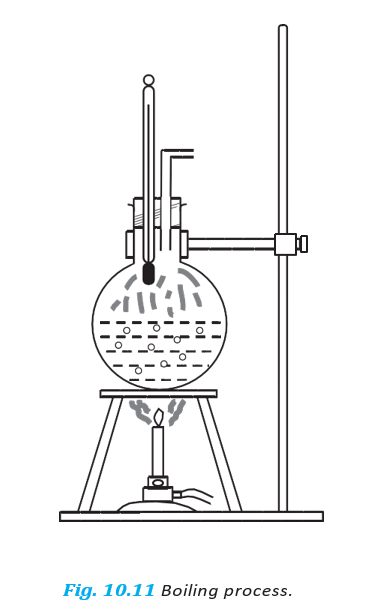
- Constant temperature: During boiling, temperature stays constant until the entire liquid becomes vapour.
- Bubbles: Early bubbles may be dissolved air; later, steam bubbles rise and condense in cooler water. Boiling begins when steam bubbles reach the surface.
- Steam: Water vapour is invisible; the fog seen above a vessel is made of tiny condensed water droplets.
- Normal boiling point: The boiling point measured at standard atmospheric pressure.
Effect of Pressure on Boiling Point
| Point | Increased pressure | Decreased pressure |
|---|---|---|
| Boiling point | Increases | Decreases |
| Example | A pressure cooker increases pressure and raises the boiling point, so food cooks faster. | At high altitudes, lower atmospheric pressure lowers water’s boiling point, making cooking difficult and slower. |
Sublimation
Sublimation — The direct change from solid to vapour without passing through the liquid state; the reverse change is also possible.
Examples
- Substances: Dry ice (solid carbon dioxide) and iodine sublime.
- Coexistence: During sublimation, solid and vapour phases coexist in thermal equilibrium.
What happens to temperature while a substance changes state?
Define the triple point.
Why does a pressure cooker cook food faster?
Quick recap
- During a phase change, temperature stays constant until the transformation is complete.
- Melting is solid to liquid; freezing is liquid to solid.
- Regelation is pressure-induced melting and subsequent refreezing of ice.
- Vaporisation is liquid to vapour; the boiling point rises with pressure.
- A phase diagram shows phase regions and the curves where two phases coexist.
- At the triple point, solid, liquid and vapour coexist; sublimation changes solid directly to vapour.
Latent Heat
Meaning and Behaviour of Latent Heat
Use this relation when mass changes state and latent heat is known.
The latent heat is the heat transferred per unit mass during a phase change.
Melting and Boiling Data at 1 atm
- Water at 1 atm: Ice melts at about 0 °C and water boils at about 100 °C.
- Latent heats: Water’s latent heat of fusion is , and its latent heat of vaporisation is .
Heating Curve for Water
- Temperature changes: On a heating curve, temperature rises as ice warms to its melting point, water warms to its boiling point, and steam warms thereafter.
- Phase changes: Temperature stays constant during melting and boiling as supplied heat changes the state of the substance.
Water’s Latent Heats and Steam Burns
- Latent heats of water: Fusion requires , while vaporisation requires .
- Steam burns: Steam at 100 °C releases its latent heat of vaporisation as it condenses on the skin, so it can cause more serious burns than boiling water at the same temperature.
Heating Without a Phase Change
Calculate heat for several stages
- Warm the ice from to : .
- Melt the ice at : .
- Warm the water from to : .
- Vaporise the water at : . Add all stages to obtain for .
Calorimetry Example: Finding Heat of Fusion
Do not use for heat absorbed during a phase change; use . For a multi-stage process, calculate each temperature-change and phase-change stage separately.
State the relation between heat, mass and latent heat, and give the SI unit of latent heat.
Why are steam burns often more serious than burns from boiling water?
Quick recap
- Latent heat is heat transferred per unit mass during a change of state: .
- The heat for a phase change is ; temperature remains constant during the change.
- Fusion refers to solid–liquid change; vaporisation refers to liquid–gas change.
- For water, and .
- For temperature changes without a phase change, use .
- For multistage heating, find the heat for each stage and add the results.
Heat Transfer
Heat transfer — Heat transfer is energy transfer caused by a temperature difference, either between systems or between parts of one system.
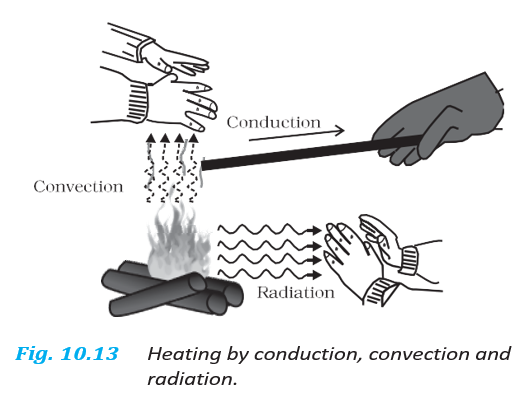
Three modes of heat transfer
- Conduction: One of the three distinct modes of heat transfer.
- Convection: One of the three distinct modes of heat transfer.
- Radiation: One of the three distinct modes of heat transfer.
Conduction
Conduction — Transfer of heat between adjacent parts of a body due to a temperature difference, without bulk movement of the material.
How conduction works
- Example: Heating one end of a metal rod transfers heat through the rod, making its other end hot.
- Conductivity: Metals generally conduct heat well; gases are poor conductors, while liquids have conductivities intermediate between solids and gases.
- Steady state: With the bar ends held at fixed temperatures and its sides insulated, temperature falls uniformly from the hot end to the cold end.
- Heat current: At steady state, the heat supplied at the hot end per unit time equals the heat leaving at the cold end.
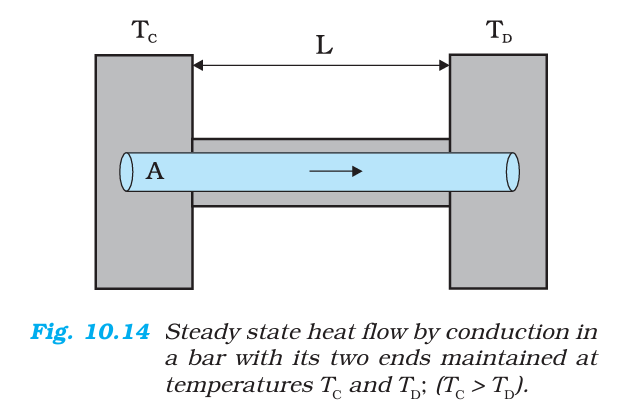
For a bar of length and cross-sectional area , with end temperatures , the steady heat current depends on conductivity and temperature difference.
Thermal conductivity — The proportionality constant describing how readily a material conducts heat.
Conductivity and applications
- Greater : Heat is conducted more rapidly through the material.
- SI unit: (equivalently ).
- Temperature dependence: Conductivity varies slightly with temperature but is treated as constant over a normal temperature range.
- Cooking pots: Copper bases spread heat evenly because copper is a good conductor.
- Insulation: Air pockets make plastic foams good insulators; earth or foam layers on concrete roofs reduce heat entering rooms.
- Nuclear reactors: Heat must be removed rapidly to prevent the core from overheating.
| Material | Thermal conductivity () |
|---|---|
| Silver | 406 |
| Copper | 385 |
| Aluminium | 205 |
| Brass | 109 |
| Steel | 50.2 |
| Lead | 34.7 |
| Mercury | 8.3 |
| Insulating brick | 0.15 |
| Concrete | 0.8 |
| Body fat | 0.20 |
| Felt | 0.04 |
| Glass | 0.8 |
| Ice | 1.6 |
| Glass wool | 0.04 |
| Wood | 0.12 |
| Water | 0.8 |
| Air | 0.024 |
| Argon | 0.016 |
| Hydrogen | 0.14 |
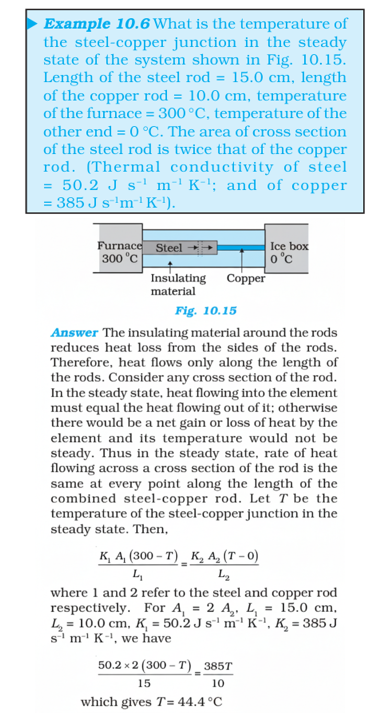
Bars Joined in Series
Steady heat flow through two joined bars
- Series condition: At steady state, the same heat current passes through each bar: .
- Junction: The junction temperature is fixed by equal heat currents into and out of it.
- Equivalent bar: The joined bars can be replaced by one bar with total length and equivalent conductivity.
For bars with conductivities , endpoint temperatures , and equal lengths and areas:
For bars of equal length and cross-sectional area joined end to end:
For total length , area , and end temperatures :
Worked values: iron and brass bars
- Given: , , , , , and .
- Junction temperature: Substitution into the junction formula gives .
- Equivalent conductivity: .
- Heat current: Using the compound-bar formula gives .
Do not assign different steady heat currents to bars joined in series: with no heat stored at the junction, the current through each bar is equal.
State the law of steady heat conduction through a uniform bar.
Why are plastic foams effective thermal insulators?
Quick recap
- Heat transfer occurs by conduction, convection or radiation.
- Conduction transfers heat between adjacent parts because of a temperature difference.
- For a uniform bar, ; larger means faster heat conduction.
- Metals are generally good conductors; gases and materials containing trapped air are poor conductors.
- In bars joined in series, the steady heat current is the same through each bar.
- For two equal-length, equal-area bars, use the weighted junction-temperature formula and .
Convection
Convection
Convection — Heat transfer by the actual bulk motion of matter; it occurs only in fluids.
Natural and forced convection
- Natural convection: A temperature difference causes fluid motion; gravity and buoyancy help drive the circulation.
- Heating from below: The heated fluid expands, becomes less dense, and rises; cooler, denser fluid moves down to replace it.
- Cycle: The cooler fluid is heated in turn, producing a continuous convection current and transporting heat in bulk.
- Forced convection: A pump or other physical means drives the fluid’s motion.
| Point | Natural convection | Forced convection |
|---|---|---|
| Cause of motion | Heating, density differences and buoyancy | Pump or other external physical means |
| Examples | Sea and land breezes; trade winds | Forced-air heating, automobile engine cooling, blood circulation |
Forced convection in the body
- Heart: Acts as a pump, circulating blood through the body.
- Heat transfer: Moving blood carries heat by forced convection and helps maintain a uniform body temperature.
Sea and Land Breezes
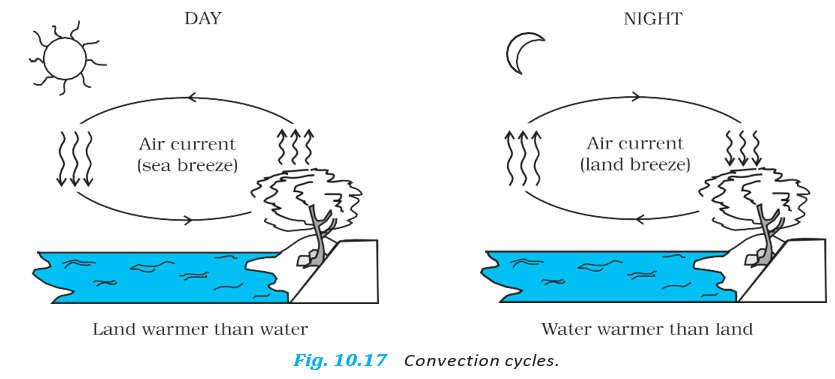
Daytime sea breeze
- Unequal heating: Land warms faster than water because water has a greater specific heat capacity; currents also spread absorbed heat through a large volume of water.
- Convection cycle: Air touching the warm land heats by conduction, expands and rises; cooler air from over the water moves toward land to replace it.
- Sea breeze: The surface wind from water to land, accompanied by rising warm air over land and descending cooler air elsewhere, transfers heat away from the land.
Nighttime land breeze
- Reversal: Land loses heat faster than water, so the water surface becomes warmer than the land.
- Land breeze: The convection cycle reverses; surface air moves from land toward the water.
Trade Winds
Trade-wind circulation
- Unequal solar heating makes equatorial surface air warm and polar upper-atmosphere air cool.
- Warm equatorial air rises and, in a simplified circulation, moves poleward; cooler air descends and flows back toward the equator.
- Earth’s rotation modifies this circulation: equatorial air has an eastward speed of about , while it is approximately zero near the poles.
- The air descends around rather than at the poles and returns toward the equator as the north-east trade wind.
Radiation
Radiation — Heat transfer by electromagnetic waves; unlike conduction and convection, it needs no material medium and can occur through a vacuum.
Radiant and thermal energy
- Radiant energy: Energy carried by electromagnetic waves, whose electric and magnetic fields oscillate in space and time.
- Speed: Electromagnetic waves travel through a vacuum at the speed of light, .
- Thermal radiation: Electromagnetic radiation emitted by a body because of its temperature; all solids, liquids and gases emit it.
- Examples: The Sun heats Earth across space; a nearby fire can be felt radiating heat before convection develops.
Absorption and reflection
- When radiation falls on a body: Some is reflected and some is absorbed.
- Colour effect: Black surfaces are better absorbers and emitters than lighter-coloured surfaces.
- Applications: Light clothes absorb less solar heat in summer; dark clothes absorb more in winter. Blackened utensil bottoms absorb more heat from a flame.
Dewar flask (thermos)
- Construction: A double-walled glass vessel has silvered inner and outer surfaces, an evacuated gap, and insulating supports such as cork.
- Radiation control: Silvered walls reflect radiation, reducing exchange with the surroundings.
- Conduction and convection control: The vacuum between the walls limits both processes; the supports reduce heat transfer through the base.
- Use: Helps keep hot contents hot or cold contents cold.
Blackbody Radiation
Spectrum and temperature
- Continuous spectrum: Thermal radiation contains a continuous range of wavelengths; the energy emitted varies with wavelength.
- Peak wavelength: The wavelength at which emitted energy is greatest decreases as absolute temperature increases.
- Wien’s displacement law: The product of peak wavelength and absolute temperature is constant: .
- Temperature and colour: As iron gets hotter, its glow changes from dull red to reddish yellow and then white hot.
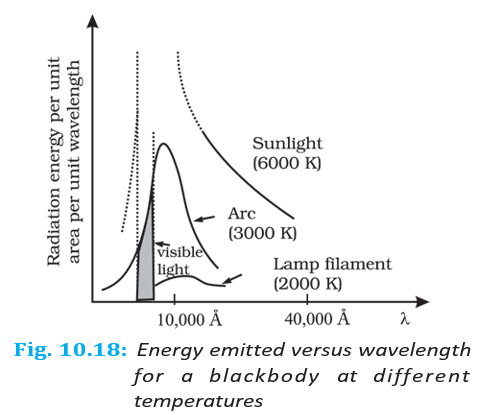
Using Wien’s law
- Use: The law helps estimate the surface temperatures of the Moon, Sun and stars from their radiation peak.
- Moon: A peak near gives an estimated surface temperature of about .
- Sun: A peak at corresponds to about —the Sun’s surface temperature, not its interior.
Universality of blackbody curves
- Universal feature: Blackbody radiation curves depend only on temperature, not on the blackbody’s size, shape or material.
Stefan–Boltzmann Law
Stefan–Boltzmann law — The radiant energy emitted per unit time depends on surface area and the fourth power of absolute temperature.
Here is energy emitted per unit time, is surface area, is absolute temperature and is the Stefan–Boltzmann constant.
Emissivity
- Emissivity : A dimensionless fraction describing how effectively a body radiates compared with a perfect radiator.
- Perfect radiator: Has ; lamp black comes close. A tungsten lamp has emissivity about .
- Stefan–Boltzmann constant: .
Use for the energy emitted per unit time by a body with emissivity .
Example: tungsten lamp
- Given: , and .
- Radiated power: Substituting into gives .
For a body at absolute temperature in surroundings at absolute temperature , this gives the net rate of energy loss; it is negative if the body gains net energy.
Example: heat loss from the body
- Values: Body area , skin temperature , room temperature , and skin emissivity .
- Result: Using the net-radiation formula gives a heat-loss rate of about .
- Comparison: This exceeds half the body’s resting energy-production rate of about .
- Heat-loss reduction: Arctic clothing may include a thin shiny metallic layer next to the skin to reflect body radiation.
How does natural convection transfer heat in a fluid?
State Wien’s displacement law and one use.
Write the Stefan–Boltzmann law for net radiation from a body.
Quick recap
- Convection transfers heat by bulk fluid motion; natural convection relies on buoyancy, while forced convection uses an external driver.
- Sea and land breezes reverse direction between day and night because land heats and cools faster than water.
- Trade winds result from unequal solar heating, with Earth’s rotation modifying the convection circulation.
- Radiation transfers heat by electromagnetic waves and needs no medium; black surfaces absorb and emit effectively.
- Wien’s law: ; hotter blackbodies have shorter peak wavelengths.
- Stefan–Boltzmann law: Emitted power varies as ; net exchange depends on .
Newton’s Law Of Cooling
Cooling and Newton’s Law
Conditions and Factors
- Validity: The law is an approximation that holds for small temperature differences between the body and surroundings.
- Surface effects: The constant depends on the body’s exposed area and the nature of its surface.
Cooling Equation
Here is a positive constant; .
For constant surroundings temperature, the excess temperature decreases exponentially with time. is set by the body’s initial temperature.
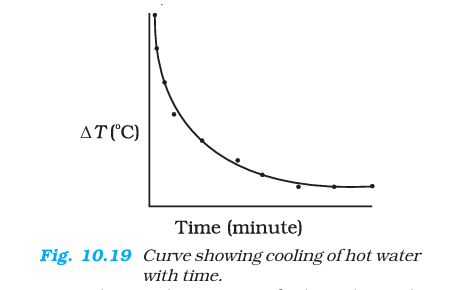
Verification and Applications
- Verification: Hot water in a copper calorimeter is placed inside a double-walled vessel containing hot water; thermometers track the temperatures of the calorimeter water and surroundings.
- Result: A graph of against time is a straight line with negative slope, supporting Newton’s law of cooling.
Example: Cooling Time
State Newton’s law of cooling and its condition of validity.
Quick recap
- A hot body cools faster when its temperature excess over the surroundings is larger.
- For small temperature differences, the rate of heat loss is proportional to the temperature difference.
- The cooling equation is , with .
- The temperature excess decreases exponentially: .
- A graph of against time is a straight line with slope .
- The pan in the example takes s to cool from to .
Summary
Heat, Temperature and Thermometers
Heat — Energy transferred between a body and its surroundings because of a temperature difference.
Temperature and thermometers
- Temperature quantitatively represents how hot or cold a body is.
- Thermometric property is a measurable property that changes with temperature and is used by a thermometer.
- Temperature scale is made by assigning values to two fixed points; these set the scale’s origin and unit size.
- Heat transfer requires a temperature difference between systems or parts of a system. Energy transfer without one is not heat.
Temperature Scales and the Ideal Gas Equation
Use this relation to convert Celsius temperature to Fahrenheit temperature .
is pressure, is volume, is absolute temperature, is the number of moles, and is the universal gas constant.
Kelvin and Celsius scales
- Absolute zero is the temperature at which substances have the least possible molecular activity.
- Kelvin and Celsius have equal-sized units but different zero points.
- Triple point of water: is assigned by choice as the fixed point; this temperature is unique.
- Current Celsius scale: melting and boiling points of water at are close to, but not exactly, and . In the original Celsius scale, these were fixed at those values.
The unit size is the same on both scales; their zero points differ.
Thermal Expansion
Coefficient of linear expansion — The fractional change in length per unit change in temperature.
Coefficient of volume expansion — The fractional change in volume per unit change in temperature.
and are changes in length and volume for a temperature change .
Specific Heat Capacity and Latent Heat
Specific heat capacity — Heat required per unit mass to raise a substance’s temperature by one unit.
is mass, is the amount in moles, and is the heat supplied for a temperature change .
| Type | Change of state | Key condition |
|---|---|---|
| Latent heat of fusion, | Solid to liquid | Heat per unit mass; temperature and pressure remain unchanged. |
| Latent heat of vaporisation, | Liquid to vapour | Heat per unit mass; temperature and pressure remain unchanged. |
Modes of Heat Transfer
| Mode | How heat is transferred | Key point |
|---|---|---|
| Conduction | Through molecular collisions between neighbouring parts. | No matter flows overall. |
| Convection | By flow of matter within a fluid due to unequal temperatures. | Requires fluid motion. |
| Radiation | A third mode of heat transfer. | Listed as a mode; no further detail is specified here. |
Conduction and convection distinction
- Running-water example: a hot bar under a running tap loses heat by conduction between its surface and the water, not by convection within the water.
Conduction and Thermal Conductivity
Thermal conductivity — A material property, denoted by , that measures its ability to conduct heat.
For a bar of length and uniform cross-sectional area , whose ends are at temperatures and , this gives the heat-flow rate.
The minus sign indicates heat flows down the temperature gradient.
Newton’s Law of Cooling
Newton’s law of cooling — The rate of cooling of a body is proportional to its excess temperature above the surroundings.
is the surrounding temperature, is the body temperature, and is a proportionality constant; the rate of cooling magnitude depends on .
Key Quantities, Dimensions and Units
| Quantity | Symbol | Dimensions | SI unit / note |
|---|---|---|---|
| Amount of substance | |||
| Celsius temperature | |||
| Kelvin temperature | ; | ||
| Linear expansion coefficient | |||
| Volume expansion coefficient | ; | ||
| Heat supplied | ; heat is not a state variable | ||
| Specific heat capacity | |||
| Thermal conductivity |
Phase equilibrium
- Equilibrium phases have the same pressure and temperature throughout the system, but differ in molar volume (and therefore density).
- General rule: the same condition applies when any number of phases coexist in equilibrium.
State the difference between conduction and convection.
Give the relation between the coefficients of volume and linear expansion.
Quick recap
- Heat is energy transferred because of a temperature difference; temperature measures hotness.
- Thermometers use temperature-dependent properties, and two fixed points establish a scale.
- Convert scales using and ; the ideal gas equation is .
- Thermal expansion obeys ; specific and molar heat capacities are heat supplied per mass or mole per temperature change.
- Fusion and vaporisation involve latent heat while temperature remains unchanged during the phase change.
- Heat transfers by conduction, convection or radiation; conduction through a bar depends on conductivity, area, temperature difference and length.
- Newton’s law relates cooling rate to the body’s excess temperature over its surroundings.
Physics — ALL CHAPTERS
1
Units And Measurement
2
MOTION IN A STRAIGHT LINE
3
MOTION IN A PLANE
4
LAWS OF MOTION
5
WORK, ENERGY AND POWER
6
SYSTEMS OF PARTICLES AND ROTATIONAL MOTION
7
GRAVITATION
8
Mechanical Properties Of Solids
9
Mechanical Properties Of Fluids
10
Thermal Properties Of Matter
11
Thermodynamics
12
Kinetic Theory
13
Oscillations
14
Waves