Class 11 PCB . Physics . Physics Part II . Mechanical Properties of Solids
Chapter 8: Mechanical Properties Of Solids
Ch 8
Physics
Class 11 PCB
Introduction
Solids, Elasticity and Plasticity
Why Elastic Behaviour Matters
- Engineering design: Elastic properties help engineers choose materials and dimensions for buildings, bridges, automobiles and ropeways.
- Design questions: Strength and weight, railway-track shape, and why glass is brittle while brass is not are considered through how forces deform solids.
Stress and Strain
For a force normal to cross-sectional area :
| Type | Force direction / condition | Resulting deformation |
|---|---|---|
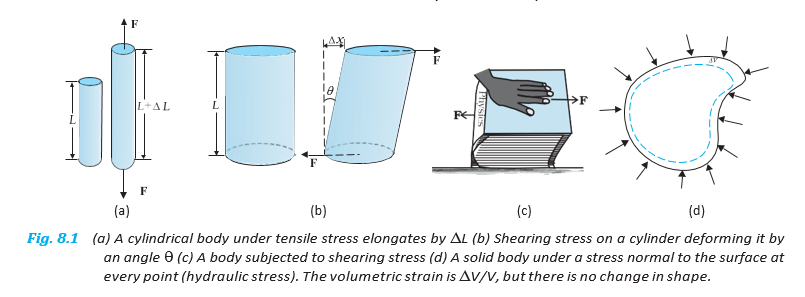
| Tensile (longitudinal) | Equal forces pull outward, normal to the cross-section. | Length increases. |
| Compressive (longitudinal) | Equal forces push inward, normal to the cross-section. | Length decreases. |
| Tangential or shearing | Equal and opposite forces act parallel to the cross-section. | Opposite faces shift relative to one another. |
| Hydraulic | Fluid pressure acts perpendicularly over the body's surface, compressing it uniformly. | Volume decreases without a change in geometrical shape. |
Strain
The change in length divided by the original length:
For relative sideways displacement between faces separated by length , with angular displacement :
Shearing Strain Notes
- Small angles: For small , measured in radians, .
- Example: At , the difference between and is about .
Under hydraulic pressure, volume changes while the shape remains unchanged:
Hydraulic Stress
- Uniform compression: High fluid pressure applies inward force perpendicular to every point on a body's surface.
- Magnitude: Hydraulic stress equals the applied hydraulic pressure; the body develops an opposing internal restoring force.
- Recovery: When removed from the fluid, an elastic body tends to regain its original shape and size.
Define stress and state its SI unit and dimensional formula.
Distinguish longitudinal, shearing and volume strain.
Quick recap
- Real solids deform under force; elastic bodies recover, while plastic bodies retain permanent deformation.
- Stress is internal restoring force per unit area; its SI unit is pascal and dimensions are .
- Tensile and compressive stresses change length; shearing stress shifts faces; hydraulic stress compresses uniformly.
- Longitudinal strain is .
- Shearing strain is for small angles.
- Volume strain is ; every strain is dimensionless.
Hooke’s Law
Proportionality of Stress and Strain
Hooke’s law — For small deformations, stress is directly proportional to strain.
The proportionality constant is the modulus of elasticity.
- Validity: Hooke’s law is an empirical law that applies to most materials within a small-deformation range.
- Limitation: Some materials do not show a linear stress–strain relationship.
Stress–Strain Curve
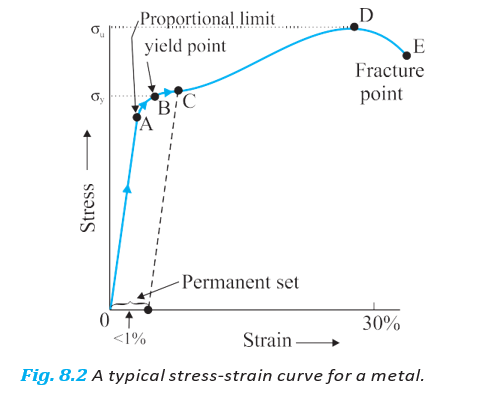
Stress–strain curve — A graph showing how a material’s stress varies with the strain produced by loading.
- Tensile test: A cylinder or wire is stretched, and the applied force and resulting change in length are recorded as the load increases.
- Plotted quantities: Stress is the applied force per unit area; tensile strain is the fractional change in length.
- Use: Curves show how materials deform as load increases; analogous curves can be obtained for compression and shear.
| Region / point | Behaviour | Response when load is removed |
|---|---|---|
| to | Stress and strain are proportional; Hooke’s law holds and the body behaves elastically. | The body returns to its original dimensions. |
| to | Stress and strain are not proportional, but the body remains elastic. | The body still returns to its original dimensions. |
| Yield point (elastic limit); the corresponding stress is yield strength, . | Beyond this point, increased loading can cause permanent deformation. | |
| to | Strain rises rapidly for a small increase in stress; plastic deformation occurs. | Unloading can leave non-zero strain, called a permanent set. |
| Ultimate tensile strength, ; this is the maximum stress on the curve. | Beyond , additional strain occurs even with a reduced applied force. | |
| Fracture point: the material breaks. | Fracture has occurred. |
Loading beyond the yield point
- Stress exceeds the yield strength at
- Strain increases rapidly; plastic deformation begins
- Unloading leaves a permanent set
- At , the material reaches its ultimate tensile strength
- Beyond , additional strain occurs even as applied force decreases
- The material fractures at
| Brittle | Ductile | |
|---|---|---|
| Curve feature | Ultimate-strength point and fracture point are close. | Points and are far apart. |
| Implication | Fracture follows soon after reaching ultimate strength. | More deformation occurs before fracture. |
Elastomers
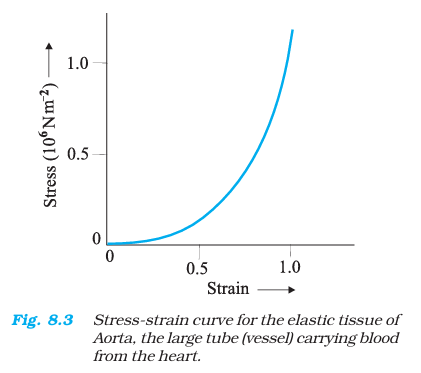
Elastomers — Materials such as rubber and aortic tissue that can undergo large strains when stretched.
- Rubber: It can be stretched to several times its original length and still return to its original shape.
- Aortic tissue: Its elastic region is very large, but it does not obey Hooke’s law over most of that region.
- Aortic-tissue curve: It has no well-defined plastic region.
State Hooke’s law and identify its proportionality constant.
How do elastic and plastic deformation differ?
Quick recap
- For small deformations, stress is proportional to strain; the proportionality constant is the modulus of elasticity.
- From to , a metal obeys Hooke’s law and deforms elastically.
- Point is the yield point (elastic limit), and its corresponding stress is yield strength, .
- Plastic deformation can leave a permanent set: strain remains when stress returns to zero.
- Point is ultimate tensile strength, ; beyond , further strain occurs even under reduced applied force, before fracture at .
- Brittle materials have nearby ultimate-strength and fracture points; ductile materials have these points farther apart.
- Elastomers such as rubber and aortic tissue can undergo large strains; aortic tissue has a large elastic region but is mostly non-Hookean.
Elastic Moduli
Elastic Modulus
Modulus of elasticity — The ratio of stress to strain within the proportional region of a material’s elastic limit; it is characteristic of the material.
- Proportional region: Stress is proportional to strain in this part of the stress–strain curve.
- Engineering relevance: This region guides the design of structures and manufactured components.
Young’s Modulus
Young’s modulus — The ratio of tensile or compressive stress to the corresponding longitudinal strain; it is denoted by .
- Tensile or compressive loading: For a given material, the magnitude of longitudinal strain is the same for equal tensile and compressive stress.
- Units: Strain is dimensionless, so Young’s modulus has the same unit as stress: or pascal (Pa).
For a rod of original length and cross-sectional area , stretched by force with extension .
| Material | Density () | Young’s modulus | Ultimate strength | Yield strength |
|---|---|---|---|---|
| Aluminium | 2710 | 70 | 110 | 95 |
| Copper | 8890 | 110 | 400 | 200 |
| Wrought iron | 7800–7900 | 190 | 330 | 170 |
| Steel | 7860 | 200 | 400 | 250 |
| Glass | 2190 | 65 | 50 | — |
| Concrete | 2320 | 30 | 40 | — |
| Wood | 525 | 13 | 50 | — |
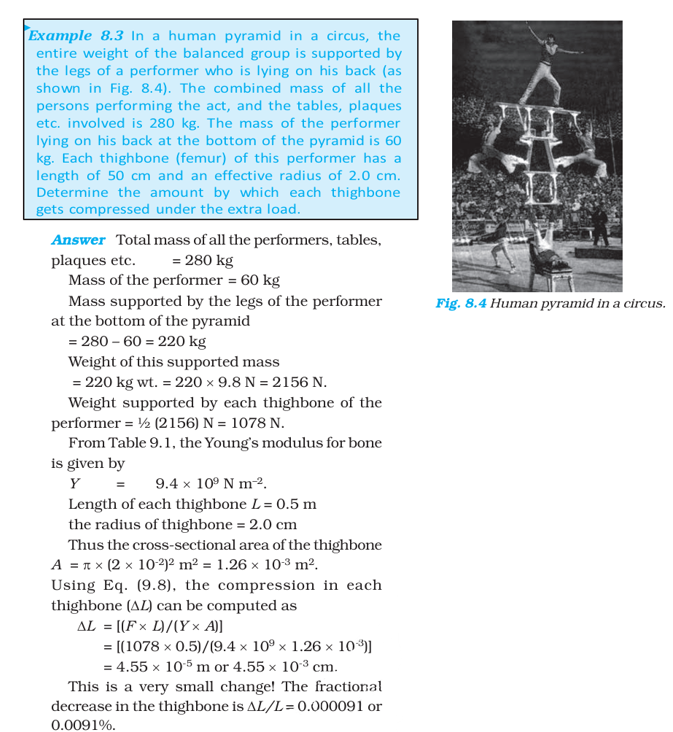
| Bone | 1900 | 9.4 | 170 | — |
| Polystyrene | 1050 | 3 | 48 | — |
Comparing material stiffness
- Metals: Generally have large Young’s moduli, so a large force is needed to produce a small change in length.
- Steel example: A steel wire with area needs a force of for a strain of .
- Same strain and area: The required forces for aluminium, brass and copper wires are , and , respectively.
- Applications: Steel’s high Young’s modulus makes it suitable for heavy-duty machines and structural designs; wood, bone, concrete and glass have comparatively smaller values.
A larger Young’s modulus means greater stiffness: more stress is required to produce the same strain. Do not interpret it as a material stretching more easily.
Applications to Rods and Joined Wires
Use within the elastic limit when a rod is loaded along its length.
Steel rod example
- Given: Radius , length , force , and .
- Area and stress: ; therefore .
- Elongation: .
- Strain: , or approximately .
Copper and steel wires joined end to end
- Shared load: Joined wires carry the same tension. If they have equal cross-sectional area, their stresses are equal.
- Strain relation: For each wire, stress equals Young’s modulus times strain: .
- Elongation ratio: For copper and steel, .
- Example values: With , , , and , the ratio is .
- Total extension: If , then and .
- Load: Using and wire radius gives .
Define Young’s modulus and state its SI unit.
Why is steel preferred for many structural applications?
Quick recap
- Elastic modulus is stress divided by strain in the proportional elastic region.
- Young’s modulus is and is measured in Pa.
- A higher Young’s modulus indicates a stiffer material.
- For a uniform rod, extension is .
- Joined wires in series carry the same tension; their extensions add to give the total extension.
- Steel’s high modulus helps explain its use in structures and heavy-duty machines.
Shear Modulus
Shear Modulus
Shear modulus — The ratio of shearing stress to the corresponding shearing strain; also called the modulus of rigidity.
- Shearing stress is force per unit area, ; shearing strain is the angular deformation, represented by .
- Effect: pure shear changes shape but not volume.
- SI unit is , or pascal (Pa).
- Typical relation: for most materials, ; shear modulus is generally less than Young’s modulus.
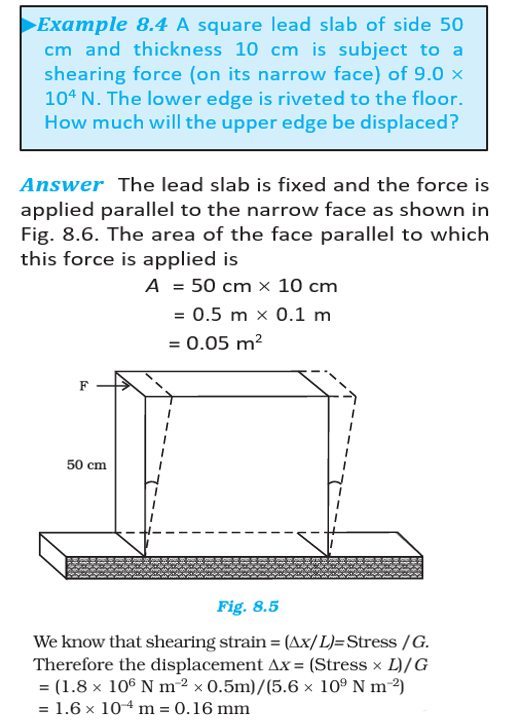
For a slab of thickness whose upper face shifts by :
When angular strain is :
| Material | (GPa) |
|---|---|
| Aluminium | 25 |
| Brass | 36 |
| Copper | 42 |
| Glass | 23 |
| Iron | 70 |
| Lead | 5.6 |
| Nickel | 77 |
| Steel | 84 |
| Tungsten | 150 |
| Wood | 10 |
Bulk Modulus and Compressibility
Bulk modulus — The ratio of hydraulic pressure (hydraulic stress) to the resulting fractional volume change, with a minus sign so the modulus is positive.
- Hydraulic stress is pressure acting perpendicular to the body’s surface; it produces a volume change.
- Sign convention: increasing pressure gives , so the minus sign in the definition makes .
- SI unit is the same as pressure: or Pa.
Here is the hydraulic pressure (equal in magnitude to the hydraulic stress); is the volume strain.
Compressibility — The fractional change in volume per unit increase in pressure; it is the reciprocal of bulk modulus.
For a pressure change :
| Category | Material | (GPa) |
|---|---|---|
| Solid | Aluminium | 72 |
| Solid | Brass | 61 |
| Solid | Copper | 140 |
| Solid | Glass | 37 |
| Solid | Iron | 100 |
| Solid | Nickel | 260 |
| Solid | Steel | 160 |
| Liquid | Water | 2.2 |
| Liquid | Ethanol | 0.9 |
| Liquid | Carbon disulphide | 1.56 |
| Liquid | Glycerine | 4.76 |
| Liquid | Mercury | 25 |
| Gas | Air at STP |
| Point | Tensile/compressive | Shearing | Hydraulic |
|---|---|---|---|
| Applied force | Equal and opposite forces perpendicular to opposite faces | Equal and opposite forces parallel to opposite surfaces; net force and torque vanish | Pressure acts perpendicular to the surface and is the same throughout |
| Strain | Longitudinal: | Angular: | Volume: |
| Effect | Changes shape; no volume change | Changes shape; no volume change | Changes volume; no shape change |
| Modulus | Young’s modulus: | Shear modulus: | Bulk modulus: |
| Applicable state | Solid | Solid | Solid, liquid and gas |
Compressibility across states of matter
- Order: solids are least compressible, followed by liquids; gases are most compressible.
- Magnitude: gases are about a million times more compressible than solids; gas compressibility varies with pressure and temperature.
- Reason: solid atoms are tightly coupled; liquid molecules are less strongly coupled, while gas molecules interact weakly.
Estimate compression at ocean depth
- Find the pressure at depth using and .
- Use water’s bulk modulus, , to find the magnitude of fractional compression.
- The signed volume change is negative because the water is compressed.
Why does the bulk-modulus formula contain a minus sign?
Define compressibility and state its relation to bulk modulus.
Do not report compression as a positive signed : its magnitude is positive, but the actual volume change is negative.
Quick recap
- Shear modulus is shearing stress divided by shearing strain: .
- Shearing deformation changes shape but not volume; is measured in Pa.
- Bulk modulus is , where is hydraulic pressure; its minus sign accounts for volume decrease under pressure.
- Compressibility is the reciprocal of bulk modulus: ; its formula uses the pressure change .
- Compressibility increases from solids to liquids to gases; gases are about a million times more compressible than solids.
- At a depth of , water’s fractional compression is in magnitude, with signed volume strain .
Poisson’s Ratio
Lateral strain — Strain perpendicular to the applied force; in a stretched wire, it is the fractional contraction of its diameter.
Longitudinal strain and Poisson’s ratio
- Longitudinal strain is the fractional change in length along the applied force.
- Elastic limit Within this limit, lateral strain is directly proportional to longitudinal strain.
- Poisson’s ratio is the ratio of lateral strain to longitudinal strain for a stretched wire.
- Nature of the ratio It is dimensionless and has no units; its value depends on the material.
For original diameter , diameter contraction , original length and elongation :
| Material | Poisson’s ratio |
|---|---|
| Steel | – |
| Aluminium alloys | About |
Elastic Potential Energy in a Stretched Wire
- Origin of the energy Tensile stretching requires work against interatomic forces; this work is stored as elastic potential energy.
- Wire variables For length , cross-sectional area , Young’s modulus and extension , the tensile force is .
- Incremental work An additional extension requires work .
- Energy density The stored energy per unit volume is proportional to stress times strain.
The work done stretching the wire from zero extension to equals its stored elastic potential energy .
Here is stress and is strain.
Applications of Elastic Behaviour
Why elastic properties matter
- Engineering design Buildings, bridges and other structures require knowledge of material strength and elastic behaviour.
- Structural elements Columns, beams and supports must withstand loads without excessive deformation or failure.
- Design questions Elasticity helps explain the use of I-shaped beams and the pyramidal forms of heaps of sand and hills.
Designing a Crane Rope
- Safety condition The rope’s stress must not exceed the material’s yield strength, so it does not deform permanently.
- Minimum area For a load of mass and yield strength , the rope must have cross-sectional area .
- Example For a -tonne load () and mild steel with , the minimum area is about .
- Radius and safety margin This area gives a circular-rope radius of about . A safety factor of about ten in load leads to a recommended radius of roughly .
- Construction A rope is made from many thin braided wires for flexibility and ease of manufacture; one thick wire would behave almost like a rigid rod.
Use the yield strength as the maximum permitted stress.
Bending of Beams
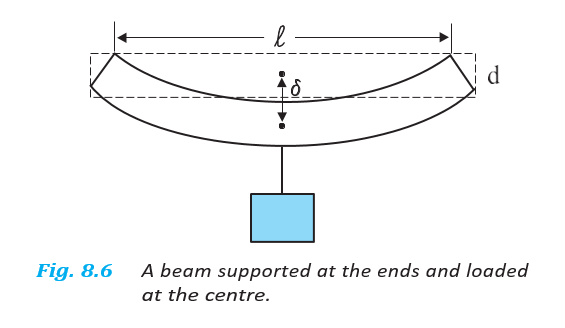
- Beam deflection A beam of length , breadth and depth , supported near both ends and loaded at its centre by , sags by .
- Reducing bending For a given load, use a material with larger Young’s modulus and keep the span as short as possible.
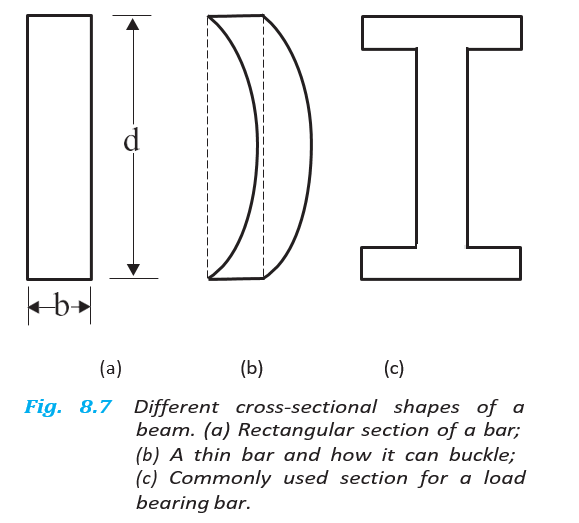
- Cross-section effect Since but only , increasing depth reduces bending much more effectively than increasing breadth.
- Buckling A deep, thin bar may buckle if the load is not applied in the proper position.
- I-section An I-shaped cross-section combines a large load-bearing surface with sufficient depth, reduces weight and cost, and retains strength.
For a beam supported near both ends and loaded at its centre:
Pillars and Columns
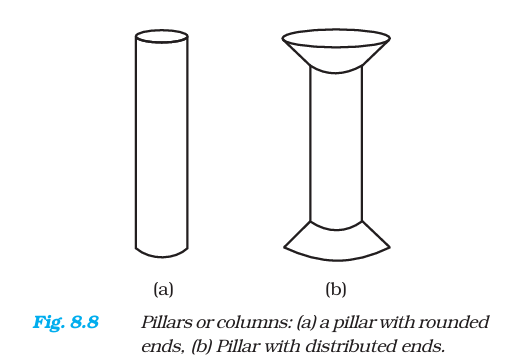
- End shape A pillar with rounded ends supports less load than one with load distributed over shaped ends.
- Design considerations Buildings and bridges must be designed for operating conditions, cost, and long-term reliability of the materials.
Maximum Height of Mountains
- Stress at the base For mountain height , density and gravitational acceleration , the weight of overlying material produces stress of order at the base.
- Why it is shear The mountain’s base is not under uniform compression; its sides are free, so the base rocks also experience shear stress.
- Height limit When this shear stress reaches the rock’s critical elastic-limit stress, the rocks begin to flow and limit further mountain growth.
- Estimate Taking rock stress as , and gives a maximum height of about , greater than Mount Everest’s height.
Set the base shear stress approximately equal to the critical stress of the rock.
Define Poisson’s ratio and state whether it has units.
How can beam bending be reduced?
Why is there an approximate upper limit to mountain height?
Quick recap
- Poisson’s ratio is lateral strain divided by longitudinal strain and is dimensionless.
- Typical values are – for steel and about for aluminium alloys.
- Stretching stores work as elastic potential energy: per unit volume.
- A crane rope’s area must keep its stress below the material’s yield strength, with a safety margin.
- Beam deflection varies as ; increasing depth is especially effective.
- Rock shear stress at a mountain’s base limits its height to an estimate of about .
Summary
Stress and Strain
- Stress: Restoring force per unit area developed in a body under deformation.
- Strain: Fractional change in a body’s dimension; it is dimensionless.
- Types: Deformation may result from tensile or compressive, shearing, or hydraulic stress.
Hooke’s Law and Elastic Moduli
- Hooke’s law: For small deformations, stress is proportional to strain in many materials.
- Elastic modulus: The proportionality constant relating stress to strain; its value depends on the material.
- Moduli: Young’s, shear, and bulk moduli describe material response to different kinds of deformation.
Longitudinal Deformation
is Young’s modulus; is the stress and is the longitudinal strain.
Shear Deformation
is the shear modulus; is the displacement in the direction of the applied force.
Hydraulic Compression
is the bulk modulus.
Elasticity and Lateral Strain
- Elasticity: The property by which a body regains its original shape and size when the deforming force is removed.
- Elastic limit: Beyond this limit, a material may retain a permanent deformation after the load is removed.
- Lateral strain: The strain perpendicular to the applied force; in a stretched wire, its diameter decreases.
- Poisson’s ratio: The ratio of lateral strain to longitudinal strain; it is dimensionless and depends on the material.
- Elastomers: Materials such as rubber can undergo large elastic strains but generally do not obey Hooke’s law over most of that range.
Quick recap
- Stress is restoring force per unit area; strain is fractional change in dimension.
- Hooke’s law applies to many materials only for small deformations in the linear part of the stress–strain curve.
- Young’s modulus describes longitudinal deformation; shear modulus describes shape change in solids.
- Bulk modulus describes volume change under uniform stress and applies to solids, liquids and gases.
- A larger Young’s modulus means less extension for a given load; elastomers do not obey Hooke’s law.
- Longitudinal strain may cause lateral strain, described by Poisson ratio; stress is not a vector quantity.
Physics — ALL CHAPTERS
1
Units And Measurement
2
MOTION IN A STRAIGHT LINE
3
MOTION IN A PLANE
4
LAWS OF MOTION
5
WORK, ENERGY AND POWER
6
SYSTEMS OF PARTICLES AND ROTATIONAL MOTION
7
GRAVITATION
8
Mechanical Properties Of Solids
9
Mechanical Properties Of Fluids
10
Thermal Properties Of Matter
11
Thermodynamics
12
Kinetic Theory
13
Oscillations
14
Waves