Class 12 PCM . Chemistry . Chemistry Part II . Alcohols Phenols and Ethers
Chapter 7: Alcohols, Phenols And Ethers
Ch 7
Chemistry
Class 12 PCM
Compounds For The Formation Of Detergents, Antiseptics And Fragrances
Basic Structures and Definitions
Phenol — A phenol has one or more groups directly attached to carbon atoms of an aromatic system; is phenol.
Ether — An ether has an oxygen atom linking two alkyl and/or aryl groups, represented as or .
Classification
- Basis: Alcohols and phenols are classified by the number of hydroxyl groups and by the hybridisation of the carbon bonded to –OH.
- Ethers: They are classified as symmetrical or unsymmetrical according to whether the two groups attached to oxygen are the same or different.
Alcohols: Types Based on the Carbon Bonded to OH
Allylic alcohol — An allylic alcohol has attached to an carbon next to a carbon–carbon double bond.
Benzylic alcohol — A benzylic alcohol has attached to an carbon next to an aromatic ring.
compounds — These have bonded directly to a double-bonded () carbon; when the carbon is part of a carbon–carbon double bond, the compound is a vinylic alcohol.
| Structure | Alcohol type | Allylic or benzylic? |
|---|---|---|
| Primary | Neither | |
| Primary | Allylic | |
| Primary | Neither | |
| Secondary | Benzylic | |
| Secondary | Neither | |
| Tertiary | Allylic |
Phenols and Ethers: Classification
| Type | Groups attached to oxygen | Example |
|---|---|---|
| Simple / symmetrical | Same groups | Diethyl ether, |
| Mixed / unsymmetrical | Different groups | or |
Nomenclature
| Compound | Common name | IUPAC name |
|---|---|---|
| Methyl alcohol | Methanol | |
| -Propyl alcohol | Propan-1-ol | |
| Isopropyl alcohol | Propan-2-ol | |
| -Butyl alcohol | Butan-1-ol | |
| -Butyl alcohol | Butan-2-ol | |
| Isobutyl alcohol | 2-Methylpropan-1-ol | |
| -Butyl alcohol | 2-Methylpropan-2-ol | |
| Ethylene glycol | Ethane-1,2-diol | |
| Glycerol | Propane-1,2,3-triol |
IUPAC Naming of Alcohols
- Parent chain: Choose the longest chain containing the carbon bonded to ; number from the end nearest the hydroxyl group.
- Suffix: Replace the alkane ending “e” with “ol”; show the hydroxyl position and substituent positions with locants.
- Multiple hydroxyl groups: Retain the final “e” and add “diol”, “triol”, etc., with locants; for example, ethane-1,2-diol.
- Common name: Name the alkyl group, then add “alcohol”; for example, is methyl alcohol.
Phenol Naming
- Parent name: Phenol is both the common name and an accepted IUPAC name for the simplest hydroxybenzene.
- Ring positions: Ortho means 1,2-substitution; meta means 1,3-substitution; para means 1,4-substitution.
- Example: A phenol ring with methyl groups at positions 2 and 6 is 2,6-dimethylphenol.
Ether Naming
- Common names: Name the two alkyl/aryl groups alphabetically, followed by “ether”; use “di” when the groups are identical. Example: is ethyl methyl ether.
- IUPAC approach: Treat an ether as a hydrocarbon with an or substituent; choose the larger group as the parent and name the other group as an alkoxy substituent.
- Example: is methoxymethane; is ethoxyethane; is methoxybenzene (anisole).
| Compound | Common name | IUPAC name |
|---|---|---|
| Methyl -propyl ether | 1-Methoxypropane | |
| Ethyl phenyl ether (phenetole) | Ethoxybenzene | |
| Heptyl phenyl ether | 1-Phenoxyheptane | |
| Methyl isopropyl ether | 2-Methoxypropane | |
| Phenyl isopentyl ether | 3-Methylbutoxybenzene | |
| — | 1,2-Dimethoxyethane | |
| Cyclohexane with ethoxy and two methyl groups | — | 2-Ethoxy-1,1-dimethylcyclohexane |
| Structure or description | IUPAC name |
|---|---|
| 4-Chloro-2,3-dimethylpentan-1-ol | |
| 2-Ethoxypropane | |
| Phenol with methyl groups at positions 2 and 6 | 2,6-Dimethylphenol |
| Cyclohexane with adjacent ethoxy and nitro groups | 1-Ethoxy-2-nitrocyclohexane |
Do not classify an alcohol by the whole molecule’s shape: primary, secondary or tertiary depends only on how many carbon atoms are bonded to the carbon bearing .
How do primary, secondary and tertiary alcohols differ?
How is an ether named by the IUPAC system?
Quick recap
- Alcohols, phenols and ethers are associated, respectively, with the formation of detergents, antiseptics and fragrances.
- Alcohols have hydroxyl groups in aliphatic systems; phenols have hydroxyl groups directly attached to aromatic carbons.
- Alcohols and phenols are mono-, di-, tri- or polyhydric according to their number of hydroxyl groups.
- Primary, secondary and tertiary alcohols depend on the number of carbon neighbours of the hydroxyl-bearing carbon.
- Allylic and benzylic alcohols have the hydroxyl-bearing carbon next to a double bond or aromatic ring, respectively.
- For alcohol IUPAC names, number to give the hydroxyl group the lowest locant; name ethers using an alkoxy substituent.
Structures Of Functional Group
Structures of Alcohols, Phenols and Ethers
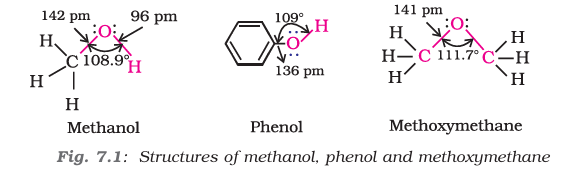
Phenols and ethers
- Phenol: The –OH group is attached to an aromatic-ring carbon that is hybridised.
- Phenol C–O bond: Its length is about , slightly shorter than in methanol because oxygen’s lone pair conjugates with the ring and the attached carbon is hybridised.
- Ether oxygen: The two bond pairs and two lone pairs are arranged approximately tetrahedrally.
- Ether bond angle: It is slightly greater than because repulsion between the bulky –R groups increases the angle.
- Ether C–O bond: Its length is about , nearly the same as in alcohols.
Preparation of Alcohols
- Methods: Alcohols can be prepared from alkenes, carbonyl compounds and Grignard reagents.
- Products: Reduction of aldehydes gives primary alcohols, while reduction of ketones gives secondary alcohols; Grignard reactions can yield primary, secondary or tertiary alcohols.
From Alkenes
Acid-catalysed hydration — Addition of water to an alkene in the presence of an acid catalyst to form an alcohol.
- Regioselectivity: With an unsymmetrical alkene, addition follows Markovnikov’s rule.
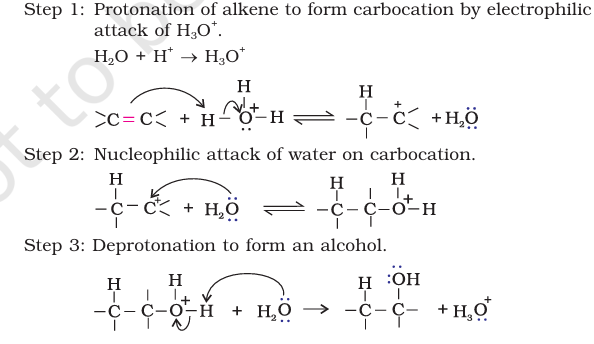
Hydroboration–oxidation — A two-stage conversion of an alkene to an alcohol using borane followed by oxidation with hydrogen peroxide in alkaline conditions.
- Orientation: Boron attaches to the carbon bearing more hydrogen atoms; oxidation replaces the boron-containing group with –OH.
- Product: The alcohol appears to result from water addition opposite to Markovnikov’s rule; the reaction gives an excellent yield.
| Point | Acid-catalysed hydration | Hydroboration–oxidation |
|---|---|---|
| Orientation for propene | Markovnikov; gives propan-2-ol | Opposite to Markovnikov; gives propan-1-ol |
| Reagents | Water and acid catalyst | Borane, then hydrogen peroxide and |
From Carbonyl Compounds
Reduction of aldehydes and ketones — Adding hydrogen to an aldehyde or ketone reduces its carbonyl group to an alcohol.
- Reagents: Catalytic hydrogenation uses finely divided platinum, palladium or nickel; alternatively, use or .
- Product class: Aldehydes give primary alcohols; ketones give secondary alcohols.
Reduction of carboxylic acids
- Laboratory reduction: converts carboxylic acids to primary alcohols, but its high cost limits it mainly to special chemicals.
- Commercial route: Convert the acid to an ester, then reduce the ester by catalytic hydrogenation.
From Grignard Reagents
Grignard addition — A Grignard reagent adds to a carbonyl group to form an alkoxide adduct, which gives an alcohol on hydrolysis.
Reaction sequence
- Grignard reagent adds nucleophilically to the carbonyl carbon.
- An alkoxide–magnesium adduct forms.
- Hydrolysis converts the adduct to an alcohol.
| Carbonyl compound | Alcohol formed after hydrolysis |
|---|---|
| Methanal | Primary alcohol |
| Other aldehydes | Secondary alcohol |
| Ketones | Tertiary alcohol |
Key Product Examples
| Reaction | Product | IUPAC name |
|---|---|---|
| Catalytic reduction of butanal | Butan-1-ol | |
| Hydration of propene in dilute sulfuric acid | Propan-2-ol | |
| Propanone + methylmagnesium bromide, then hydrolysis | 2-Methylpropan-2-ol |
Do not confuse the two propene hydration routes: acid-catalysed hydration gives propan-2-ol, while hydroboration–oxidation gives propan-1-ol.
What alcohols are formed by reduction of aldehydes and ketones?
What alcohol class results when a Grignard reagent reacts with methanal, another aldehyde, or a ketone?
Quick recap
- Alcohol oxygen is hybridised; phenol’s –OH-bearing ring carbon is hybridised.
- Phenol has a shorter C–O bond than methanol; ether has an approximately tetrahedral arrangement around oxygen.
- Acid-catalysed hydration of an unsymmetrical alkene follows Markovnikov’s rule.
- Hydroboration–oxidation gives the opposite orientation, such as propan-1-ol from propene.
- Aldehyde reduction gives primary alcohols; ketone reduction gives secondary alcohols.
- Grignard addition followed by hydrolysis gives primary, secondary or tertiary alcohols from methanal, other aldehydes or ketones, respectively.
Preparation of Phenols
Phenol — Phenol is an aromatic compound with a hydroxyl group directly attached to a benzene ring; it is also called carbolic acid.
Preparation methods
- Laboratory preparation: Phenols can be prepared from different benzene derivatives.
- Main routes: Haloarenes, benzenesulphonic acid, diazonium salts and cumene.
From Haloarenes
- Process: Fuse chlorobenzene with sodium hydroxide under high temperature and pressure to form sodium phenoxide; acidification gives phenol.
- Conditions: The reaction is carried out at and about .
From Benzenesulphonic Acid
- Step 1: Sulphonate benzene with oleum to form benzenesulphonic acid.
- Step 2: Heat it with molten sodium hydroxide to obtain sodium phenoxide; acidification yields phenol.
From Diazonium Salts
- Diazotisation: Treat an aromatic primary amine with nitrous acid, generated from sodium nitrite and hydrochloric acid, at –.
- Hydrolysis: Warm the diazonium salt with water, or treat it with dilute acid, to form phenol and nitrogen gas.
From Cumene
- Industrial route: Cumene (isopropylbenzene) is oxidised by air to cumene hydroperoxide.
- Products: Treatment with dilute acid converts the hydroperoxide into phenol and acetone; acetone is a useful by-product.
Name the four main methods for preparing phenol.
What are the products of the cumene process?
Quick recap
- Chlorobenzene fused with sodium hydroxide gives sodium phenoxide, which yields phenol on acidification.
- Benzenesulphonic acid forms sodium phenoxide on heating with molten sodium hydroxide.
- Aromatic diazonium salts hydrolyse on warming to give phenol and nitrogen gas.
- Cumene oxidation followed by dilute-acid treatment gives phenol and acetone.
Strong Oxidising
Oxidation of Alcohols
Oxidation products
- Strong oxidation: Acidified potassium permanganate can oxidise primary alcohols directly to carboxylic acids.
- Aldehydes: Anhydrous chromium trioxide, , is used to obtain aldehydes from primary alcohols.
- Unsaturated alcohols: PCC oxidises the alcohol group to an aldehyde while retaining the carbon–carbon double bond.
- Secondary alcohols: Oxidation gives ketones.
Alcohol vapours over heated copper
- Primary alcohol: Forms an aldehyde and hydrogen.
- Secondary alcohol: Forms a ketone and hydrogen.
- Tertiary alcohol: Forms an alkene by loss of water.
Reactions of Phenols
Electrophilic aromatic substitution — A reaction in which an electrophile replaces a hydrogen atom on an aromatic ring.
Phenol ring activation and direction
- Activation: The group donates electron density to the aromatic ring by resonance, making it more reactive towards electrophilic substitution.
- Direction: Increased electron density at the ortho and para positions directs incoming groups mainly to those positions.
- Common reactions: Nitration and halogenation are electrophilic aromatic substitutions.
Nitration of Phenol
Dilute nitric acid
- Separation: The isomers can be separated by steam distillation.
- Ortho isomer: Intramolecular hydrogen bonding makes -nitrophenol steam volatile.
- Para isomer: Intermolecular hydrogen bonding associates molecules, so -nitrophenol is less volatile.
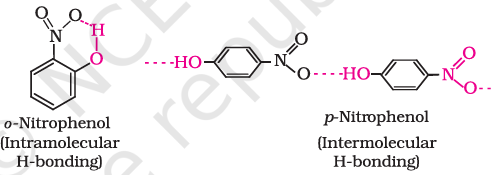
Concentrated nitric acid
- Acidity: Picric acid is strongly acidic because its three electron-withdrawing groups facilitate release of .
- Improved preparation: First form phenol-2,4-disulphonic acid with concentrated sulphuric acid, then nitrate it with concentrated nitric acid.
Halogenation of Phenol
| Conditions | Products | Note |
|---|---|---|
| Low temperature; low-polarity solvent such as or | Monobromophenols | -Bromophenol is major; -bromophenol is minor. |
| Bromine water | 2,4,6-Tribromophenol | Forms a white precipitate. |
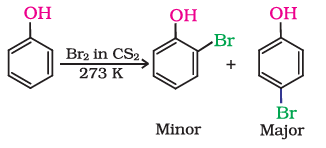
Nitration of substituted phenols
- 3-Methylphenol, mononitration: Gives 2-nitro-3-methylphenol and 4-nitro-3-methylphenol.
- 3-Methylphenol, dinitration: Gives 4,6-dinitro-3-methylphenol.
- Phenyl ester shown in the example: The diagram depicts para-nitration of a phenyl group bearing , giving para-nitrophenyl acetate. The prompt says “phenyl methanoate,” but that name does not match the depicted acetate group.
Kolbe’s Reaction
Phenoxide ion and carbon dioxide
- Reactivity: Phenoxide ion is more reactive than phenol towards electrophilic aromatic substitution.
- Electrophile: The activated phenoxide ring can react with the weak electrophile .
- Position and product: Substitution occurs mainly at the ortho position, forming salicylic acid.
Reimer–Tiemann Reaction
Formylation of phenol
- Intermediate: An ortho-substituted benzal chloride forms and is hydrolysed in alkali.
- Product: Acidification gives 2-hydroxybenzaldehyde, also called salicylaldehyde.
Other Reactions of Phenol
Reduction and oxidation
- Zinc dust: Heating phenol with zinc dust removes oxygen and forms benzene.
- Chromic acid oxidation: Phenol is oxidised to benzoquinone, a conjugated diketone.
- Air oxidation: Phenols slowly oxidise in air to dark-coloured mixtures containing quinones.
How do bromination products of phenol depend on the reaction conditions?
What are the products of Kolbe’s and Reimer–Tiemann reactions of phenol?
How is picric acid prepared from phenol?
Quick recap
- Acidified potassium permanganate can oxidise primary alcohols to carboxylic acids; anhydrous is used to isolate aldehydes.
- At over copper, primary alcohols form aldehydes, secondary alcohols form ketones, and tertiary alcohols dehydrate to alkenes.
- Phenol’s group activates the aromatic ring and directs electrophilic substitution mainly to ortho and para positions.
- Dilute nitric acid gives ortho- and para-nitrophenol; concentrated nitric acid gives picric acid.
- Bromine water gives white 2,4,6-tribromophenol, while low-temperature bromination in a low-polarity solvent gives monobromophenols.
- Kolbe’s reaction gives salicylic acid; Reimer–Tiemann reaction gives salicylaldehyde.
- Zinc dust converts phenol to benzene; oxidation gives benzoquinone, and air slowly forms dark mixtures containing quinones.
Some Commercially Important Alcohols
Methanol
- Methanol: , also called wood spirit, was formerly obtained by destructive distillation of wood.
- Commercial preparation: It is mainly made by catalytic hydrogenation of carbon monoxide at high pressure and temperature using a catalyst.
Ethanol
Preparation of Ethers
- Methods: Ethers are prepared by dehydration of alcohols or by Williamson synthesis.
- Williamson synthesis: An alkyl halide reacts with a sodium alkoxide to form an ether; it is useful for preparing symmetrical and unsymmetrical ethers.
Dehydration of Alcohols
Ether formation mechanism
- Reaction type: Ether formation is a nucleophilic bimolecular substitution ().
- Activation: An alcohol is protonated, making water a good leaving group.
- Bond formation: A second alcohol molecule attacks the ethyl carbon; the carbon–oxygen bond electrons shift onto oxygen.
- Final step: Loss of a proton gives the ether and regenerates the acid catalyst.
Williamson Synthesis
Preparation of aryl alkyl ethers
- Route: Phenol reacts with sodium hydroxide to form sodium phenoxide; reaction with an alkyl halide then gives an aryl alkyl ether.
Physical Properties of Ethers
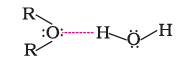
Miscibility with water
- Ethoxyethane: About g dissolves per mL of water.
- Butan-1-ol: About g dissolves per mL of water.
- Pentane: Essentially immiscible with water because it cannot form hydrogen bonds with water.
Chemical Reactions of Ethers
- Reactivity: Ethers are among the least reactive functional groups, but aromatic ethers undergo electrophilic substitution.
- Aromatic substitution: The –OR group activates the aromatic ring and directs incoming groups to the ortho and para positions.
Cleavage of the C–O Bond
Quick recap
- Methanol: Mainly made by catalytic hydrogenation of carbon monoxide using a ZnO–Cr₂O₃ catalyst.
- Ethanol: Made by fermentation: invertase produces glucose and fructose; yeast zymase converts them to ethanol and carbon dioxide.
- Alcohol dehydration: Ethanol gives ethene at 443 K and mainly ethoxyethane at 413 K with sulfuric acid.
- Williamson synthesis: Alkoxides displace halides to form ethers; tertiary halides favour elimination.
- Ether properties: Ether boiling points are near those of comparable alkanes and far below alcohols; ether oxygen can hydrogen-bond with water.
- Ether cleavage: Excess concentrated HI or HBr at high temperature breaks ethers; alkyl aryl ethers yield phenol and an alkyl halide.
Mechanism
Cleavage of Ethers by Concentrated HI
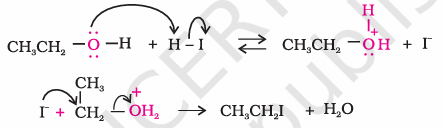
Ether cleavage — Concentrated first protonates an ether; iodide then breaks a carbon–oxygen bond to form an alkyl iodide and an alcohol.
Primary and Secondary Alkyl Groups:
- Attack: attacks the less substituted carbon of the protonated ether.
- Bond breaking: The carbon–oxygen bond breaks as the alcohol leaves; the reaction is concerted and follows the mechanism.
- Mixed ethers: With primary or secondary alkyl groups, the lower alkyl group usually forms the alkyl iodide.
Tertiary Alkyl Group:
- First step: The protonated ether loses the alcohol, forming a stable tertiary carbocation; this slow step leads to the pathway.
- Second step: rapidly attacks the carbocation to form the tertiary alkyl iodide.
- Product rule: If one alkyl group is tertiary, the tertiary group forms the halide, even when the other group is smaller.
Anisole Cleavage
- Bond preference: In protonated anisole, the bond is cleaved rather than the bond.
- Reason: The phenyl carbon is -hybridised, giving the bond partial double-bond character and making it harder to break.
- Products: Iodide attacks the methyl group, forming and phenol.
- No aryl halide: Phenol does not convert further to an aryl halide because its -bonded aromatic carbon does not undergo the required nucleophilic substitution.
Representative Ether-Cleavage Products
| Ether | Major products | Cleavage rule |
|---|---|---|
| (2-methylbutan-1-ol) + | Primary groups: the lower alkyl group forms the iodide. | |
| (propan-1-ol) + (2-iodo-2-methylbutane) | Tertiary group: cleavage proceeds by . | |
| (benzyl iodide) + (phenol) | The aryl–oxygen bond remains intact. |
Electrophilic Substitution in Aromatic Ethers
Effect of the Alkoxy Group
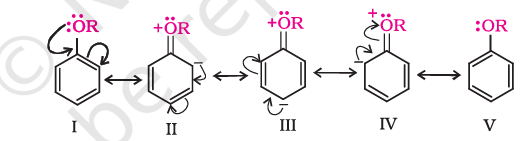
- Activation: The alkoxy group, , donates electron density into the aromatic ring by resonance, activating it toward electrophilic substitution.
- Direction: It directs incoming groups to the ortho and para positions, as the hydroxyl group does in phenol.
Halogenation
- Conditions: Anisole brominates with in ethanoic acid even without the catalyst, because the methoxy group activates the ring.
- Products: A mixture of ortho- and para-bromoanisole forms; the para isomer is the major product, obtained in about yield.
Friedel–Crafts Reactions
- Alkylation: Anisole reacts with an alkyl halide in the presence of anhydrous ; ortho and para products form, with the para product major.
- Acylation: Anisole reacts with an acyl halide using anhydrous ; the acyl group enters mainly at the para position, with some ortho product.
Nitration
- Conditions: Concentrated and concentrated nitrate anisole.
- Products: Ortho- and para-nitroanisole form; the para isomer is the major product.
Why does a tertiary ether give a tertiary alkyl halide on cleavage with HI?
State the directing effect of the group in aromatic ethers.
Quick recap
- Ether cleavage by concentrated begins with protonation of the ether oxygen.
- Primary and secondary groups generally cleave by attack at the less substituted carbon; the lower alkyl group forms the iodide.
- A tertiary group forms a stable carbocation, so cleavage follows and gives a tertiary halide.
- Anisole cleavage occurs at the methyl–oxygen bond, producing methyl iodide and phenol; phenol does not become an aryl halide by this route.
- The group activates aromatic rings and directs electrophilic substitution to ortho and para positions.
- Anisole undergoes halogenation, Friedel–Crafts reactions and nitration; para products are generally major.