Class 12 PCM . Chemistry . Chemistry Part II . Haloalkanes and Haloarenes
Chapter 6: Haloalkanes And Haloarenes
Ch 6
Chemistry
Class 12 PCM
Introduction and Classification Of Haloalkanes and haloarenes
Introduction and importance
Haloalkanes and haloarenes — Organic compounds formed when hydrogen atom(s) in an aliphatic or aromatic hydrocarbon are replaced by halogen atom(s), respectively.
Structure and uses
- Bonding: Haloalkanes have halogen bonded to an alkyl-group carbon; haloarenes have halogen bonded directly to an aryl-group carbon.
- Persistence: Many halogenated compounds resist breakdown by soil bacteria and persist in the environment.
- Uses: They are used as solvents for relatively non-polar compounds, in industry and daily life, and as starting materials for organic synthesis.
- Examples: Chloramphenicol is an antibiotic used to treat typhoid; thyroxine is an iodine-containing hormone, and its deficiency can cause goitre.
- Medical applications: Chloroquine is used to treat malaria; halothane is an anaesthetic used during surgery; fully fluorinated compounds are potential blood substitutes.
Classification
| Class | Number of halogen atoms |
|---|---|
| Monohalo | One |
| Dihalo | Two |
| Polyhalo | More than two, e.g. tri- or tetrahalo |
| Type | Bond and position | Example / identification |
|---|---|---|
| Alkyl halide (haloalkane), | Halogen bonded to an alkyl-group carbon | Homologous series: |
| Primary, secondary or tertiary haloalkane | Classified by the number of other carbon atoms attached to the carbon bonded to | One, two or three carbon neighbours, respectively |
| Allylic halide | bonded to an carbon adjacent to a bond | Halogen is not directly on the double-bond carbon |
| Benzylic halide | bonded to an carbon attached to an aromatic ring | Halogen is on a side-chain carbon |
| Vinylic halide | bonded directly to an carbon of a bond | |
| Haloarene (aryl halide) | bonded directly to an carbon of an aromatic ring | Bromobenzene |
Do not confuse allylic or benzylic halides with vinylic halides or haloarenes: the first two have halogen on a side-chain carbon; the latter two have it directly on an carbon.
Nomenclature
| Point | Common name | IUPAC name |
|---|---|---|
| Haloalkanes | Name the alkyl group followed by the halide, e.g. isopropyl chloride | Name as a halo-substituted hydrocarbon, e.g. 2-chloropropane |
| One halogen on benzene | Common and IUPAC names are the same, e.g. bromobenzene | Bromobenzene |
| Two halogens on benzene | Use -, - or - for 1,2-, 1,3- or 1,4- positions | Use locants, e.g. 1,3-dibromobenzene |
| Structure | Common name | IUPAC name |
|---|---|---|
| n-Propyl bromide | 1-Bromopropane | |
| Isopropyl chloride | 2-Chloropropane | |
| Isobutyl chloride | 1-Chloro-2-methylpropane | |
| sec-Butyl chloride | 2-Chlorobutane | |
| neo-Pentyl bromide | 1-Bromo-2,2-dimethylpropane | |
| tert-Butyl bromide | 2-Bromo-2-methylpropane | |
| Vinyl chloride | Chloroethene | |
| Allyl bromide | 3-Bromopropene | |
| - | -Chlorotoluene | 1-Chloro-2-methylbenzene or 2-chlorotoluene |
| Benzyl chloride | Chlorophenylmethane | |
| Methylene chloride | Dichloromethane | |
| Chloroform | Trichloromethane | |
| Bromoform | Tribromomethane | |
| Carbon tetrachloride | Tetrachloromethane | |
| -Propyl fluoride | 1-Fluoropropane |
| Type | Position of halogens | Common naming | Example and IUPAC name |
|---|---|---|---|
| Geminal (gem-) dihalide | Both halogens are on the same carbon atom | For dihaloalkanes with the same type of halogen atoms, the common name is alkylidene halide | : ethylidene chloride; 1,1-dichloroethane |
| Vicinal (vic-) dihalide | Halogens are on adjacent carbon atoms | For dihaloalkanes with the same type of halogen atoms, the common name is alkylene dihalide | : ethylene dichloride; 1,2-dichloroethane |
| Dihaloalkanes in IUPAC naming | Specify each halogen and its position | Named as dihaloalkanes | The same-halogen restriction applies to the common terms alkylidene halide and alkylene dihalide |
| Condensed structure | IUPAC name | Class |
|---|---|---|
| 1-Bromopentane | Primary | |
| 2-Bromopentane | Secondary | |
| 3-Bromopentane | Secondary | |
| 1-Bromo-3-methylbutane | Primary | |
| 2-Bromo-3-methylbutane | Secondary | |
| 2-Bromo-2-methylbutane | Tertiary | |
| 1-Bromo-2-methylbutane | Primary | |
| 1-Bromo-2,2-dimethylpropane | Primary |
- Classify the carbon bonded to halogen: one, two or three carbon neighbours means primary, secondary or tertiary, respectively.
- Aromatic positions: common notation corresponds to IUPAC positions .
Quick recap
- Haloalkanes and haloarenes form when hydrocarbon hydrogen is replaced by halogen; their halogen-bearing carbons are and , respectively.
- Compounds are mono-, di- or polyhalogenated depending on the number of halogen atoms.
- Allylic and benzylic halides have halogen on a side-chain carbon; vinylic halides and haloarenes have it directly on an carbon.
- Primary, secondary and tertiary haloalkanes depend on the number of carbon atoms attached to the carbon bonded to halogen.
- Common haloalkane names use alkyl + halide; IUPAC names use halo prefixes and numbered parent hydrocarbons.
- For dihaloalkanes containing the same type of halogen, geminal compounds are commonly called alkylidene halides and vicinal compounds alkylene dihalides.
- Geminal halogens share one carbon; vicinal halogens are on adjacent carbons.
Nature of E-X Bond
Nature of the Carbon–Halogen Bond (E–X Bond)
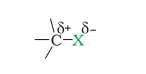
Polar carbon–halogen bond — Halogens are more electronegative than carbon, so the carbon–halogen bond is polar: carbon carries a partial positive charge and halogen a partial negative charge.
Bond trends
- Halogen size: Increases down the group from fluorine (smallest) to iodine (largest).
- Bond length: Increases from to as halogen size increases.
- Bond enthalpy: Decreases from to ; the bond has the greatest bond enthalpy.
- Dipole moment: Does not change steadily down the group; among the listed methyl halides, has the largest value.
| Bond | Bond length (pm) | Bond enthalpy () | Dipole moment (D) |
|---|---|---|---|
| 139 | 452 | 1.847 | |
| 178 | 351 | 1.860 | |
| 193 | 293 | 1.830 | |
| 214 | 234 | 1.636 |
Preparation of Haloalkanes from Alcohols
Alcohol-to-haloalkane conversion — An alcohol forms a haloalkane when its hydroxyl group, , is replaced by a halogen atom.
Reagents and conditions
- Hydrogen chloride: Primary and secondary alcohols require as catalyst; tertiary alcohols react with concentrated at room temperature.
- Hydrogen bromide: Constant-boiling is used, usually by heating the alcohol with the acid.
- Hydrogen iodide: Good yields of alkyl iodides are obtained by heating alcohols with or in orthophosphoric acid.
- Alcohol reactivity: With the same haloacid, the order is .
- Phosphorus halides: and are commonly generated in situ from red phosphorus and bromine or iodine.
- Alkyl chlorides: Prepare by passing dry gas through an alcohol solution or heating alcohol with concentrated aqueous hydrochloric acid.
- Thionyl chloride: Preferred because and escape as gases, helping leave pure alkyl chloride.
Do not apply alcohol-to-haloalkane methods directly to phenols: the aryl bond has partial double-bond character and is stronger than a single bond.
Preparation of Haloalkanes from Hydrocarbons
Free-radical halogenation — Alkanes react with chlorine or bromine under heat or ultraviolet light, replacing hydrogen atoms with halogen atoms.
Halogenation of alkanes
- Product mixture: Chlorination or bromination can form different positional isomers as well as polyhalogenated products.
- Yield: The mixture is difficult to separate, so the yield of any one product is often low.
- Example: Monochlorination of butane gives 1-chlorobutane and 2-chlorobutane.
Counting monochloro structural isomers
- Method: Identify chemically different types of hydrogen atoms; replacing each type in turn gives the possible monochloro structural isomers.
- Example: For , the four products are , , and .
- Count structural isomers only: This count does not separately count stereoisomers.
Addition of hydrogen halides to alkenes — An alkene adds , or across its double bond to form an alkyl halide.
Addition and orientation
- Markovnikov addition: When an unsymmetrical alkene reacts, one regioisomer generally predominates; propene gives 2-iodopropane as the major product with .
- Peroxide example: In the cited reaction, adds to allylbenzene in the presence of peroxide to form the terminal bromo product.
Addition of halogens to alkenes — A halogen adds across an alkene double bond to form a vicinal dihalide, with one halogen on each of two neighbouring carbons.
Bromine test for a double bond
- Observation and meaning: Bromine in loses its reddish-brown colour as colourless vic-dibromide forms; this is used to detect a carbon–carbon double bond.
Halogen Exchange in Haloalkanes
| Reaction | Conversion and conditions | Key point |
|---|---|---|
| Finkelstein reaction | Alkyl chloride or bromide reacts with in dry acetone to form alkyl iodide. | or precipitates, shifting the reaction forward according to Le Chatelier’s principle. |
| Swarts reaction | Heat an alkyl chloride or bromide with a metallic fluoride to form an alkyl fluoride. | Fluorides used include , , and . |
Preparation of Haloarenes
Electrophilic substitution of arenes — Aryl chlorides and bromides can be prepared by replacing an arene hydrogen with chlorine or bromine using a Lewis acid catalyst such as iron or iron(III) chloride.
Iodination and fluorination of arenes
- Iodination: Reversible; an oxidising agent such as or is needed to oxidise the formed.
- Fluorination: Fluoroarenes are not prepared by this method because fluorine is highly reactive.
Sandmeyer reaction — A diazonium group on an aromatic ring is replaced by chlorine or bromine using cuprous chloride or cuprous bromide.
From aromatic amine to aryl halide
- Treat a primary aromatic amine with sodium nitrite and cold aqueous mineral acid at – to form an aromatic diazonium salt.
- Use the freshly prepared diazonium salt with cuprous chloride or cuprous bromide.
- The diazonium group is replaced by or , releasing .
Preparing aryl iodides from diazonium salts
- Iodine substitution: Cuprous halide is not needed; shaking the diazonium salt with potassium iodide replaces the diazonium group by iodine.
Why is thionyl chloride preferred for converting alcohols to alkyl chlorides?
Why is sulfuric acid not used with iodide salts to prepare alkyl iodides from alcohols?
How do the Finkelstein and Swarts reactions differ?
Quick recap
- The carbon–halogen bond is polar; its length increases and bond enthalpy decreases from to .
- Alcohols form haloalkanes using hydrogen halides, phosphorus halides or thionyl chloride; alcohol reactivity with a given haloacid follows .
- Alkane free-radical halogenation gives mixtures; alkenes add hydrogen halides or halogens across the double bond.
- Finkelstein reaction prepares alkyl iodides; Swarts reaction prepares alkyl fluorides.
- Haloarenes can be made by electrophilic substitution of arenes or by converting aromatic diazonium salts to aryl halides.
Physical Properties
General appearance
- Pure alkyl halides are colourless; bromides and iodides may develop colour on exposure to light.
- Smell: Many volatile halogen compounds have a sweet smell.
Melting and boiling points
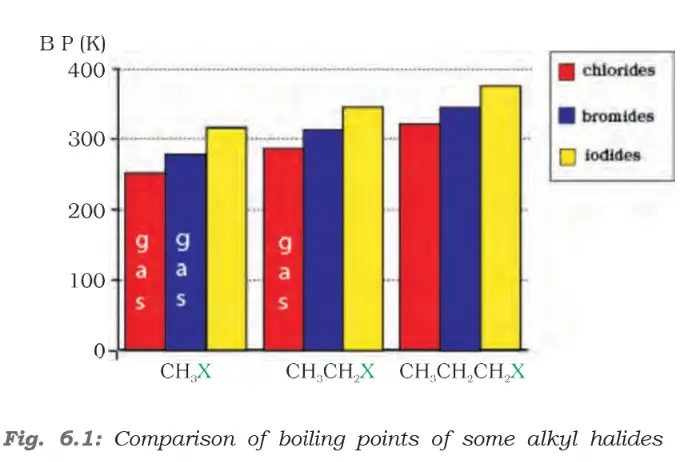
- Physical state: Methyl chloride, methyl bromide, ethyl chloride and some chlorofluoromethanes are gases at room temperature; higher members are liquids or solids.
- Compared with hydrocarbons: Haloalkanes generally have higher boiling points than hydrocarbons of comparable molecular mass because they are more polar and have stronger intermolecular attractions.
- Intermolecular forces: Dipole–dipole and van der Waals attractions occur between haloalkane molecules; these attractions strengthen as molecular size and electron count increase.
- Same alkyl group: Boiling points decrease in the order , as halogen size and mass decrease.
- Branching: Boiling points of isomeric haloalkanes decrease as branching increases; 2-bromo-2-methylpropane has the lowest boiling point among the three bromobutane isomers.
| Compound | Boiling point () |
|---|---|
- Dihalobenzenes: Isomers have very similar boiling points.
- Melting points: The para-isomer has a much higher melting point than the ortho- and meta-isomers because its symmetry allows better packing in the crystal lattice.
| Isomer | Boiling point () | Melting point () |
|---|---|---|
| Ortho (-) | ||
| Meta (-) | ||
| Para (-) |
Density
- Heavier than water: Bromo, iodo and polychloro derivatives of hydrocarbons are denser than water.
- Density trend: Density generally increases with the number of carbon atoms, the number of halogen atoms and the atomic mass of the halogen.
| Compound | Density () | Compound | Density () |
|---|---|---|---|
Solubility
- In water: Haloalkanes are very slightly soluble.
- Reason: Dissolving them requires energy to separate haloalkane molecules and break hydrogen bonds between water molecules.
- Energy balance: New haloalkane–water attractions release less energy than is needed to disrupt the original attractions, so little haloalkane dissolves.
- In organic solvents: Haloalkanes generally dissolve because the new attractions formed are similar in strength to those disrupted in the separate substances.
Arrange in increasing boiling point: (i) bromomethane, bromoform, chloromethane and dibromomethane; (ii) 1-chloropropane, isopropyl chloride and 1-chlorobutane.
Reactions of haloalkanes
Main reaction categories
- Haloalkane reactions are grouped into nucleophilic substitution, elimination and reactions with metals.
- Nucleophilic substitution is especially useful for alkyl halides where the halogen is bonded to an -hybridised carbon.
Nucleophile — An electron-rich species that donates an electron pair to an electron-deficient site.
Nucleophilic substitution — A nucleophile replaces the halogen (leaving group) in a haloalkane; the carbon bonded to halogen is partially positive and is attacked by the nucleophile.
| Reagent | Nucleophile | Product | Main product class |
|---|---|---|---|
| or | Alcohol | ||
| Alcohol | |||
| Ether | |||
| Alkyl iodide | |||
| Primary amine | |||
| Secondary amine | |||
| Tertiary amine | |||
| \ce{C#N^-} | Nitrile (alkyl cyanide) | ||
| Isocyanide (isonitrile) | |||
| Alkyl nitrite | |||
| Nitroalkane | |||
| Ester | |||
| Hydrocarbon | |||
| Alkane |
Ambident nucleophiles
- Ambident nucleophiles have two possible atoms through which they can bond; cyanide and nitrite ions are examples.
- Cyanide: Attack through carbon forms an alkyl cyanide, while attack through nitrogen forms an isocyanide.
- KCN versus AgCN: Ionic supplies free cyanide ions and mainly forms ; covalent favours nitrogen linkage and mainly forms .
- Nitrite: Linkage through oxygen gives an alkyl nitrite with ; linkage through nitrogen gives a nitroalkane with .
- Reason for cyanide products: Carbon linkage from gives a more stable C–C bond; in largely covalent , nitrogen is available for linkage.

SN2 mechanism
| Point | ||
|---|---|---|
| Rate law and order | ; second order | ; first order |
| Steps | One concerted step; no intermediate | Two steps; carbocation intermediate |
| Favoured substrate | Less steric hindrance: methyl/primary > secondary > tertiary | More stable carbocation: tertiary generally reacts fastest |
| Stereochemical result | Inversion of configuration | Carbocation intermediate; not a single concerted inversion |
How SN2 proceeds
- Concerted reaction: The incoming nucleophile bonds to carbon as the carbon–halogen bond breaks, all in one step; no intermediate forms.
- Transition state: The carbon is transiently attached to both the incoming nucleophile and leaving group, giving an unstable five-coordinate arrangement.
- Inversion: The three other bonds move away from the approaching nucleophile, inverting the configuration at the attacked carbon.
- Kinetics: The reaction between and is second order; its rate depends on both reactant concentrations.
- Steric effect: Bulky groups hinder nucleophile approach, so methyl and primary halides react faster than secondary; tertiary halides are least reactive.

Configuration — The spatial arrangement of functional groups around a carbon atom.
SN1 mechanism
How SN1 proceeds
- Solvent: SN1 reactions commonly occur in polar protic solvents such as water, alcohols and acetic acid.
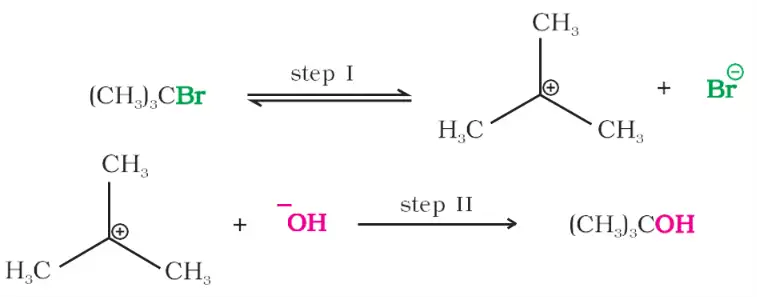
- Step 1 (slow and reversible): The polarised carbon–halogen bond breaks to form a carbocation and halide ion; solvation helps stabilise the departing ion.
- Step 2: The nucleophile attacks the carbocation to complete substitution.
- Kinetics: The slow first step controls the rate, so the reaction is first order and depends only on haloalkane concentration, not nucleophile concentration.
- Carbocation stability: More stable carbocations form more readily, increasing the SN1 rate; tertiary halides react rapidly.
- Resonance stabilisation: Allylic and benzylic halides are also highly reactive in SN1 reactions because their carbocations are resonance-stabilised.
Reactivity trends
- SN2 order: Methyl > primary > secondary > tertiary; increasing crowding around the carbon bonded to halogen slows nucleophile attack.
- SN1 order: Tertiary generally > secondary > primary, as carbocation stability increases; allylic and benzylic halides are also strongly favoured by resonance stabilisation.
- Leaving-group order: For the same alkyl group, both mechanisms follow .
| Mechanism | Increasing reactivity |
|---|---|
| Mechanism | Increasing reactivity |
|---|---|
Applying the reactivity trends
- SN1 comparison: Between the two primary bromobutanes, is more reactive than because its carbocation is better stabilised by the electron-donating alkyl group.
- Benzylic SN1: Of the two secondary benzylic bromides, reacts faster than because two phenyl groups stabilise its carbocation by resonance.
- Benzylic SN2: The phenyl group is bulkier than methyl, so is less reactive than in SN2.
- Leaving-group comparison: 1-Iodobutane undergoes SN2 faster than 1-chlorobutane because iodide is a better leaving group.
Why does mainly form alkyl cyanide, while mainly forms isocyanide?
Quick recap
- Boiling points: Haloalkanes generally boil higher than comparable hydrocarbons; same-group order is and branching lowers boiling point.
- Isomers: Dihalobenzenes have similar boiling points, but para-dichlorobenzene has a higher melting point because of crystal packing.
- Density and solubility: Density rises with carbon and halogen content and halogen mass; haloalkanes are slightly water-soluble but dissolve in organic solvents.
- Substitution: Electron-rich nucleophiles replace halide; cyanide and nitrite can link through two atoms, producing different products with potassium and silver salts.
- Mechanisms: SN2 is one-step, second order and gives inversion; SN1 is two-step, first order, and its slow carbocation-forming step is reversible.
- Reactivity: SN2 favours less hindered substrates; SN1 favours more stable carbocations; leaving-group order is .
Basic Stereochemical Principles And Notations
Optical Rotation
- Optical activity: Some compounds rotate the plane of plane-polarised light.
- Measurement: A polarimeter measures the angle of rotation; clockwise rotation is positive (+), and anticlockwise rotation is negative (−).
Chirality, Asymmetric Carbon and Enantiomers
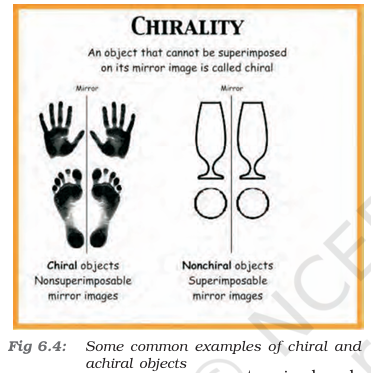
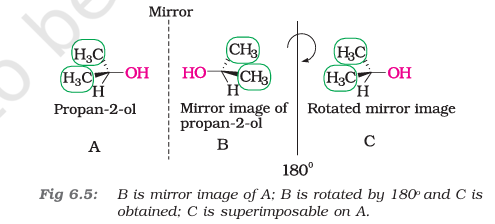
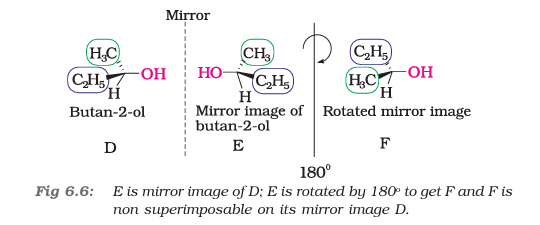
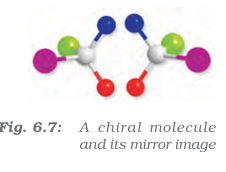
Enantiomers — Stereoisomers that are non-superimposable mirror images of each other are enantiomers.
Properties of Enantiomers
- Physical properties: Enantiomers have the same melting point, boiling point and refractive index.
- Optical rotation: They rotate plane-polarised light by equal amounts in opposite directions.
- Configuration and sign: The or sign does not by itself indicate a molecule’s absolute configuration.
Racemic mixture — An equal mixture of two enantiomers has zero net optical rotation because their rotations cancel.
Racemisation
- Notation: A racemic mixture is written with the prefix or , e.g. -butan-2-ol.
- Racemisation: Conversion of an enantiomer into a racemic mixture.
Retention of Configuration
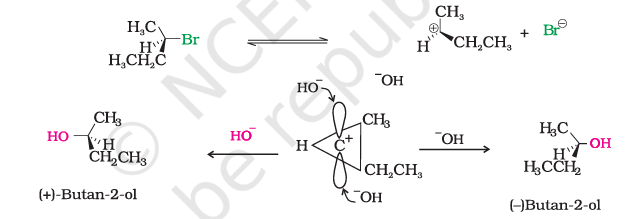
Inversion and Racemisation in Substitution
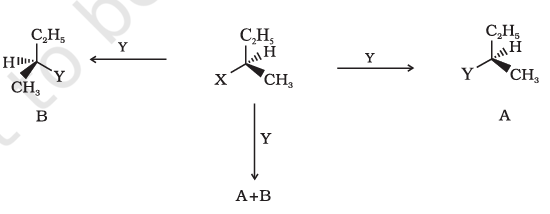
| Point | ||
|---|---|---|
| Intermediate / attack | Nucleophile attacks from the side opposite the leaving group. | A planar, achiral carbocation forms; the nucleophile can attack from either side. |
| Stereochemical result | Inversion of configuration. | Both configurations form, usually producing racemisation. |
| Example | -2-bromooctane gives -octan-2-ol with inversion. | Hydrolysis of an optically active alkyl halide can form both enantiomers. |
Elimination Reactions
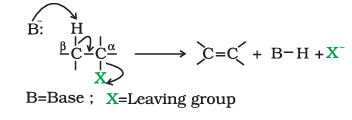
Zaitsev (Saytzeff) rule — In dehydrohalogenation, the major product is usually the alkene with more alkyl groups attached to its double-bonded carbon atoms.
Dehydrohalogenation of 2-bromopentane
- Major product: Pent-2-ene is the more substituted alkene and forms in yield.
- Minor product: Pent-1-ene forms in yield.
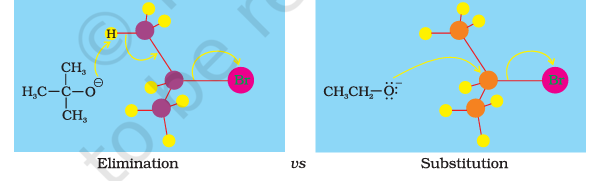
Competition Between Substitution and Elimination
Reactions with Metals
Wurtz Reaction
Quick recap
- Optically active compounds rotate plane-polarised light: is right rotation and is left rotation.
- A chiral molecule has a non-superimposable mirror image; an asymmetric carbon is commonly attached to four different groups.
- Enantiomers have identical ordinary physical properties but opposite optical rotations; a mixture is racemic.
- In substitution at a stereocentre, gives inversion, while commonly gives racemisation.
- β-Elimination forms an alkene; Zaitsev’s rule usually favours the more substituted alkene.
- Grignard reagents are prepared in dry ether and are destroyed by water; the Wurtz reaction couples alkyl groups.
Reaction Of Haloarenes
Nucleophilic Substitution


Replacement of Halogen by Hydroxyl
Hydrolysis of Chlorobenzene
- Conditions: Chlorobenzene reacts with aqueous sodium hydroxide at and ; acidification of the product gives phenol.
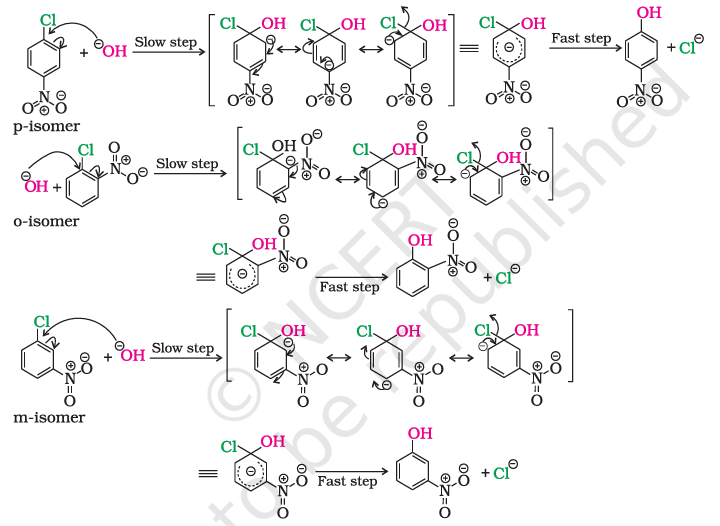
- Electron-withdrawing groups: A group at the ortho or para position increases the reactivity of a haloarene towards nucleophilic substitution.
- Activated examples: p-Chloronitrobenzene gives p-nitrophenol with NaOH at ; 1-chloro-2,4-dinitrobenzene gives 2,4-dinitrophenol with NaOH at . Both are followed by acidification.
Electrophilic Substitution Reactions
Orientation and Reactivity
- Reaction types: Haloarenes undergo halogenation, nitration, sulphonation and Friedel–Crafts reactions on the ring.
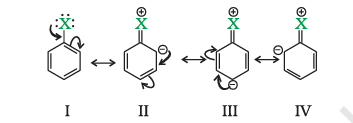
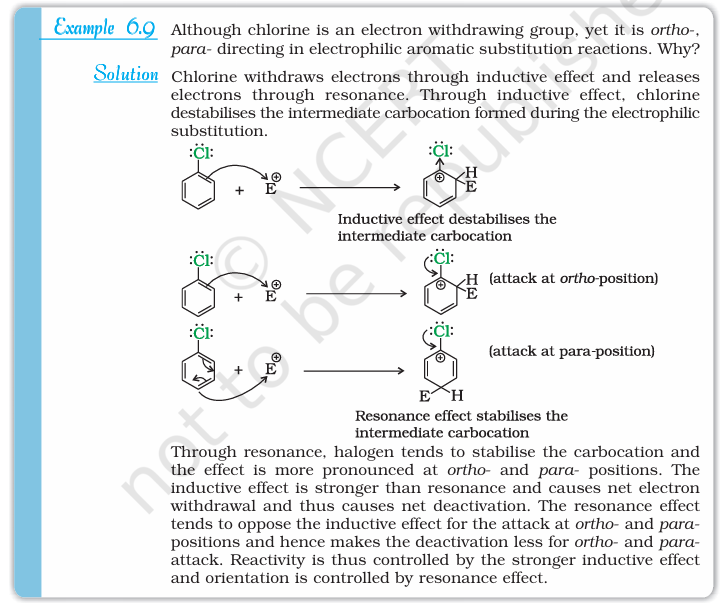
- Halogen effect: Halogens deactivate the ring overall by their electron-withdrawing inductive effect, but direct incoming electrophiles to the ortho and para positions through lone-pair resonance donation.
- Product ratio: Both ortho and para products form; the para product is generally major because it experiences less steric crowding.
| Reaction | Reagents/conditions | Products |
|---|---|---|
| Halogenation | Cl2; catalyst | 1,2-dichlorobenzene (minor) and 1,4-dichlorobenzene (major) |
| Nitration | Nitrating mixture | Ortho- and para-nitrochlorobenzene; para is major |
| Sulphonation | Concentrated H2SO4, heat | 2-chlorobenzenesulphonic acid (minor) and 4-chlorobenzenesulphonic acid (major) |
| Friedel–Crafts alkylation | CH3Cl, anhydrous AlCl3 | 1-chloro-2-methylbenzene (minor) and 1-chloro-4-methylbenzene (major) |
| Friedel–Crafts acylation | CH3COCl, anhydrous AlCl3 | 2-chloroacetophenone (minor) and 4-chloroacetophenone (major) |
Reactions with Metals
Wurtz–Fittig reaction — Coupling of an alkyl halide and an aryl halide with sodium in dry ether to form an alkylarene.
Fittig reaction — Coupling of two aryl halide molecules with sodium in dry ether to form a biaryl.
- Wurtz–Fittig: One aryl group + one alkyl group gives an alkylarene.
- Fittig: Two aryl groups couple to form a biaryl.
Quick recap
- Haloarenes resist nucleophilic substitution because of resonance, a stronger C–X bond, phenyl-cation instability and nucleophile–ring repulsion.
- Chlorobenzene gives phenol with aqueous NaOH at and , followed by acidification.
- Ortho/para groups activate haloarenes for hydroxyl substitution under milder conditions.
- Halogens deactivate the benzene ring but direct electrophilic substitution to ortho and para positions; para is generally the major product.
- Wurtz–Fittig couples an aryl and alkyl halide; Fittig couples two aryl halides, both using Na in dry ether.
Polyhalogen Compounds
Polyhalogen compounds — Carbon compounds containing more than one halogen atom are called polyhalogen compounds.
| Class | Number of halogen atoms | Example |
|---|---|---|
| Monohalogen | One | Chloromethane |
| Dihalogen | Two | Dichloromethane |
| Polyhalogen | Three or more | Chloroform, carbon tetrachloride |
Dichloromethane (Methylene Chloride)
- Formula and uses: is used as a solvent for paint removal, aerosol propellants, drug manufacture, and metal cleaning and finishing.
- Health effects: It can harm the central nervous system; low-level exposure in air may slightly impair hearing and vision.
- High exposure: It may cause dizziness, nausea, tingling, or numbness in fingers and toes. Skin contact can cause intense burning and mild redness; eye contact can burn the cornea.
Trichloromethane (Chloroform)
- Formula and uses: dissolves fats, alkaloids, iodine, and other substances; its major current use is in manufacturing refrigerant R-22.
- Earlier use: It was used as a general anaesthetic but has been replaced by safer, less toxic anaesthetics such as ether.
- Health effects: Chloroform vapour depresses the central nervous system. Brief exposure to about 900 parts per million in air may cause dizziness, fatigue, and headache.
- Chronic exposure: It may damage the liver and kidneys. Chloroform is metabolised in the liver to phosgene; skin immersion can cause sores.
- Storage hazard: Light and air slowly oxidise chloroform to poisonous phosgene (carbonyl chloride). Store it in closed, dark-coloured bottles filled completely to exclude air.
Iodoform
- Antiseptic use: Iodoform was formerly used as an antiseptic, but its antiseptic action comes from liberated free iodine, not from iodoform itself.
- Limitation: Its objectionable smell led to its replacement by other iodine-containing formulations.
Tetrachloromethane (Carbon Tetrachloride)
- Formula and uses: is used to manufacture refrigerants, aerosol propellants, chlorofluorocarbons, and other chemicals; it also has pharmaceutical and general solvent uses.
- Earlier uses: Until the mid-1960s, it was widely used as an industrial degreaser, household spot remover, and fire extinguisher.
- Health effects: Exposure may cause dizziness, light-headedness, nausea, and vomiting, with possible permanent nerve-cell damage. Severe exposure can lead to stupor, coma, unconsciousness, or death.
- Other risks: Exposure can cause an irregular heartbeat or cardiac arrest and may irritate the eyes. There is some evidence it may cause liver cancer in humans.
- Environmental effect: Atmospheric depletes ozone, increasing ultraviolet exposure and the risks of skin cancer, eye diseases and disorders, and possible immune-system disruption.
Freons
Freons — Chlorofluorocarbon compounds derived from methane and ethane are collectively called freons.
- Properties: Freons are very stable, unreactive, non-toxic, non-corrosive, and easily liquefied gases.
- Example and preparation: Freon-12, , is manufactured from carbon tetrachloride by the Swarts reaction.
- Uses: Freons are used as aerosol propellants and in refrigeration and air conditioning.
- Ozone impact: Freons diffuse into the stratosphere largely unchanged, where they can initiate radical chain reactions that disturb the natural ozone balance.
Freon production
- By 1974Annual world freon production was about 2 billion pounds.
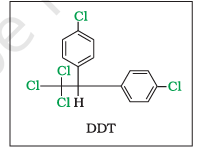
DDT (p,p′-Dichlorodiphenyltrichloroethane)
- Insecticide: DDT was the first chlorinated organic insecticide. Its use expanded after World War II, especially against malaria-carrying mosquitoes and typhus-carrying lice.
- Resistance and toxicity: Extensive use led to insect resistance; DDT is also highly toxic to fish.
- Persistence and buildup: DDT is chemically stable, fat-soluble, and not rapidly metabolised. Continued ingestion causes it to accumulate in animal fatty tissues.
Important dates for DDT
- 1873DDT was first prepared.
- 1939Paul Müller discovered DDT’s effectiveness as an insecticide.
- 1948Müller received the Nobel Prize in Medicine and Physiology for the discovery.
- After World War IIDDT use expanded worldwide, particularly to control disease-carrying insects.
- Late 1940sProblems from extensive use, including insect resistance and toxicity to fish, began to appear.
- 1973DDT use was banned in the United States, although it continued to be used in some other parts of the world.
Key Links to Haloalkanes and Haloarenes
| Halide | Preparation methods |
|---|---|
| Alkyl halides | Free-radical halogenation of alkanes; addition of hydrogen halides to alkenes; replacement of alcohol –OH groups using phosphorus halides, thionyl chloride, or hydrogen halides. |
| Aryl halides | Electrophilic substitution of arenes. |
| Fluorides and iodides | Best prepared by halogen-exchange methods. |
Carbon–halogen bond and properties
- Bond polarity: Halogens are more electronegative than carbon, so the carbon–halogen bond is polar: carbon bears a partial positive charge and halogen a partial negative charge.
- Physical properties: Organohalogen compounds generally boil at higher temperatures than corresponding hydrocarbons because of stronger dipole–dipole and van der Waals attractions. They are slightly soluble in water and soluble in organic solvents.
- Reactivity: The polar carbon–halogen bond supports nucleophilic substitution, elimination, and reactions with metals to form organometallic compounds.
| Point | SN1 | SN2 |
|---|---|---|
| Classification | Categorised by its kinetic properties. | Categorised by its kinetic properties. |
| Stereochemical outcome with chiral alkyl halides | Racemisation. | Inversion of configuration. |
Why is chloroform stored in completely filled, dark-coloured bottles?
Why does DDT accumulate in animal tissues?
Quick recap
- Polyhalogen compounds contain more than one halogen atom; compounds with three or more halogens are often grouped as polyhalogen compounds.
- Dichloromethane is a useful industrial solvent but can harm the nervous system, skin, and eyes.
- Light and air oxidise chloroform to poisonous phosgene; it must be stored in sealed, dark, full bottles.
- Carbon tetrachloride has industrial uses but presents serious health risks and depletes atmospheric ozone.
- Freons are stable chlorofluorocarbons used in refrigeration and aerosols; in the stratosphere they can disturb ozone balance.
- DDT is persistent and fat-soluble, accumulates in animal fatty tissues, is toxic to fish, and can select for resistant insects.
- The carbon–halogen bond is polar and underlies characteristic reactions; SN2 gives inversion while SN1 gives racemisation for chiral substrates.