Class 11 Humanities . Sociology . Introducing Sociology . Sociology and Society
Chapter 1: Sociology And Society
Ch 1
Sociology
Class 11 Humanities
Introduction
Individual Choices and Social Factors
How Social Conditions Shape Opportunities
- Government economic and political policies shape the needs of the economy.
- The economy influences the job market and demand for particular skills.
- The job market, family and social background, and gender affect an individual's opportunities and choices.
Personal Problems and Public Issues
- Sociological imagination: Connects an individual’s biography with the wider history and structure of society.
- Personal troubles and public issues: Personal difficulties can reflect broader social conditions and therefore affect groups, not just individuals.
Individuals, Societies and Inequality
- Multiple societies: People may belong to several communities, such as linguistic, religious, caste, tribal or national societies.
- Diversity and inequality: Societies differ in their ways of life, while people within them have unequal resources, opportunities, power and social respect.
Sociology as a Systematic Study
- Systematic inquiry: Sociology studies society through evidence and procedures that other researchers can check or repeat.
- Distinct approach: It examines how social norms and values function in actual societies rather than judging only how people ought to live.
Sociology's Development and Scope
- Historical origins: Sociology developed amid major intellectual and material changes, especially in Europe during the rise of modern society.
- Global connections: Western ideas and capitalism spread across the world, shaping societies and the development of sociology in India.
- Indian sociology: Its development reflects colonial history and India’s diversity, and it has drawn on both sociology and social anthropology.
- Scope: Sociology studies interactions, institutions and social processes at local, national and global levels.
- Related disciplines: It shares interests and methods with subjects such as economics, political science, history, psychology and anthropology.
Quick recap
- Individual effort matters, but social conditions also shape outcomes.
- Government policies and economic needs influence the job market and opportunities.
- Culture affects how societies judge the value and esteem of different jobs.
- Sociology connects personal problems with wider public issues.
- Modern individuals may belong to several societies, and societies are unequal.
- Sociology systematically studies society, distinct from philosophical, religious and common-sense reflections.
- The chapter covers sociology's history, global reach, emergence in India, scope and links to other disciplines.
The Sociological Imagination: The Personal Problem And The Public Issue
The Sociological Imagination: Personal Troubles and Public Issues.
Sociological imagination — The ability to connect individual lives and experiences with wider social structures and historical change.
Personal troubles and public issues
- Personal troubles Occur within a person’s character and immediate relationships; they affect areas of life the person directly experiences.
- Public issues Arise from social structures and extend beyond one person’s immediate surroundings or private life.
- Connection An individual’s difficulty may reflect wider social conditions, so it should be understood in both personal and social contexts.
- Homelessness Can be examined through individual circumstances and broader factors such as employment opportunities and rural-to-urban migration.
- State response The Pradhan Mantri Awas Yojana–Gramin, operationalised in 2016 by the Ministry of Rural Development, supports houseless families and families in dilapidated kutcha houses with financial and labour assistance to build pucca houses.
| Point | Personal troubles | Public issues |
|---|---|---|
| Scope | Individual and immediate relationships | Wider social structures and conditions |
| Experience | Directly experienced in a person’s local environment | Affect groups and extend beyond one person’s immediate life |
| Example | An individual is unemployed | Unemployment linked to broader economic or social change |
How social change shapes individual lives
- Industrialisation changes work and social roles → a peasant may become a worker and a feudal lord may become a businessman or lose status.
- Classes rise or fall → individuals may gain or lose employment.
- Investment rates change → people may gain confidence or face financial failure.
- War changes occupations and family life → people may take on military roles, live apart, or grow up without a parent.
Biography and history — An individual’s life and a society’s history can be understood fully only by examining how each is connected to the other.
Key references
- 1959C. Wright Mills described the sociological imagination as linking biography, history and society.
- 1978Freeman’s account of Muli depicts caste-based exclusion in a village tea shop.
- 2005Amartya Sen highlighted the many dimensions of inequality in Indian society.
- 2016The Pradhan Mantri Awas Yojana–Gramin was operationalised.
Pluralities and Inequalities among Societies
Plurality of society — People may belong to, or refer to, different societies depending on the context and the group being discussed.
Different meanings of “our society”
- National level In a conversation with foreigners, “our society” may mean Indian society.
- Community level Among Indians, it may refer to a linguistic, ethnic, religious, caste or tribal community.
- Sociological focus Deciding which society to study—and what to include—is a central question for sociology.
| Point | Romanticised village view | Sociological account |
|---|---|---|
| Focus | May emphasise peaceful scenery and an idealised rural life. | Examines lived realities, including hierarchy and exclusion. |
| Example | Satyajit Ray considered whether to portray village life, the epics or the crowded modern city. | Freeman’s account describes Muli, a Dalit man, sitting by a village tea shop with his glass and saucer conspicuously placed beside him as a signal to the shopkeeper that he wished to buy tea. |
| Insight | A selective picture can leave social differences out. | Sociological observation makes inequalities within everyday life visible. |
Many dimensions of inequality
- Economic Some people are wealthy while many have limited resources; some live comfortably while others work hard for little reward.
- Education Access and achievement differ: some are highly educated while others are illiterate.
- Political power and opportunity Some can influence decisions and advance in life; others have little influence or opportunity.
- Treatment and respect People may receive unequal treatment from institutions such as the police.
- Social conditions Hunger, obesity, labour conditions and access to healthcare reveal differences in people’s lives and resources.
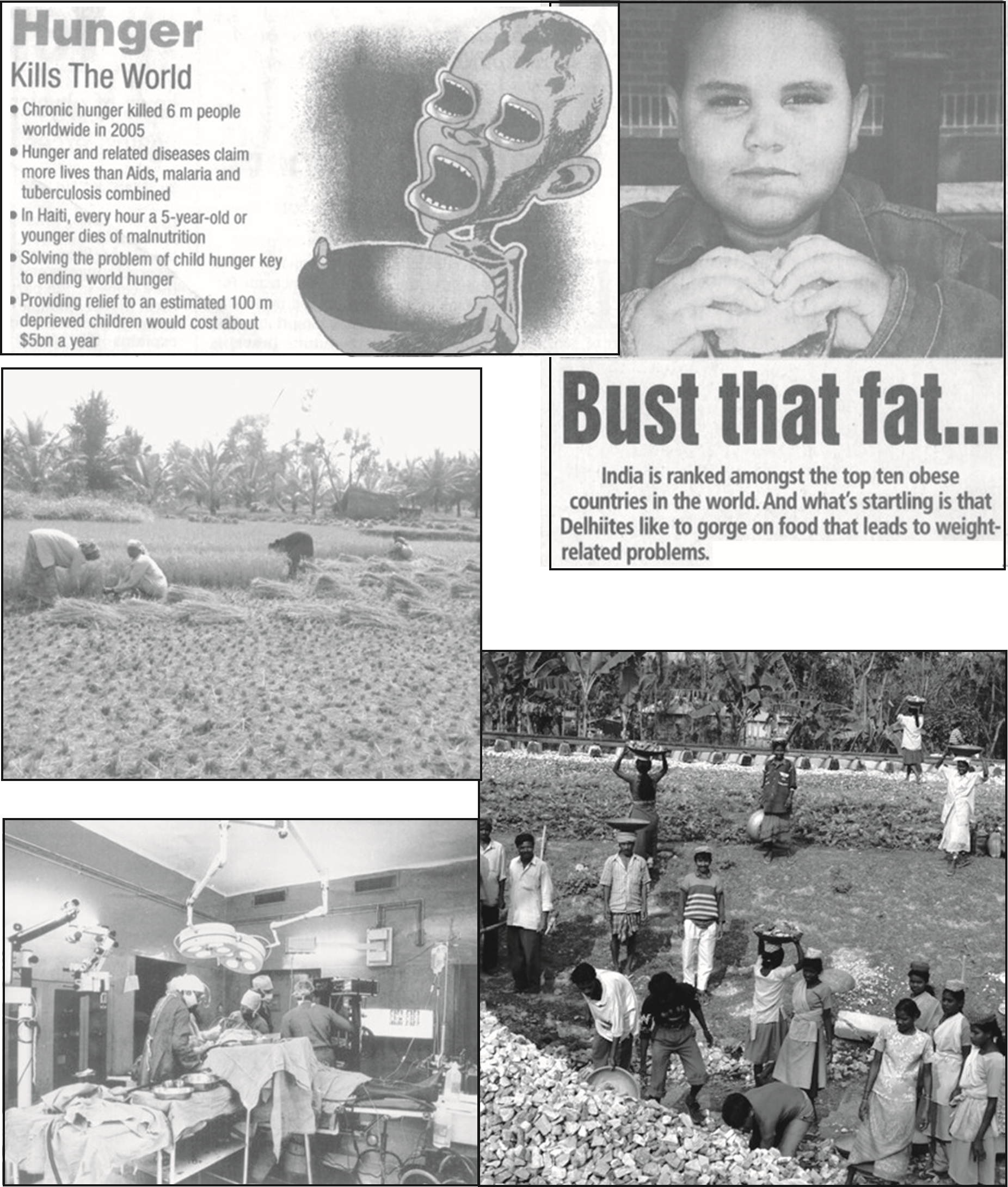
Indicators of social inequality
- Examples Education, health, employment, sanitation, income, political influence and access to opportunities can be used to examine inequality.
- Sanitation The lecture cites National Family Health Survey data indicating that access to sanitation facilities is above 60 per cent.
- Comparison Differences between groups—not just conditions overall—help reveal how resources and opportunities are distributed.
- Sociological imagination
- Connecting personal experience with social structure and history.
- Personal trouble
- A difficulty experienced within an individual’s immediate life and relationships.
- Public issue
- A concern rooted in wider social structures and affecting society beyond one individual.
- Plurality
- The presence of different communities or social identities within society.
- Social inequality
- Unequal distribution of resources, opportunities, power or social respect.
How does the sociological imagination connect personal troubles with public issues?
Name four dimensions through which social inequality can be examined.
Quick recap
- The sociological imagination links biography, history and social structure.
- Personal troubles occur in immediate individual life; public issues are rooted in wider social structures.
- Social change—such as industrialisation, class shifts and war—affects individual opportunities and experiences.
- The meaning of “society” changes with context and may refer to a nation or a specific community.
- A sociological view looks beyond idealised images to lived inequalities and exclusions.
- Inequality can be examined through education, health, employment, sanitation, wealth, power and opportunity.
Introducing Sociology
Sociology and Its Subject Matter
Sociology — The study of human social life, groups and societies, focusing on human behaviour as social beings.
Society as an interconnected whole
- Interconnection: Economic, political, family, cultural and educational institutions influence one another.
- Individual and society: Social structures constrain individual choices, but people can also change them to some extent.
- Focus: Sociology examines people, groups and social institutions in relation to one another.
Sociological Knowledge and Other Ways of Thinking
Everyday and philosophical ideas
- Everyday notions: People form common-sense ideas about their own lives, other people and different societies.
- Earlier reflection: Philosophers, religious teachers and legislators have long reflected on society and human behaviour.
- Distinct approach: Sociology differs from both everyday common sense and philosophical or theological reflection.
| Point | Sociology | Philosophical or religious reflection |
|---|---|---|
| Main concern | How norms and values function in actual societies | What is moral or immoral and how people ought to live |
| Approach | Empirical observation and analysis of society | Reflection on desirable conduct and the good society |
Empirical study and values
- Empirical study: Sociologists observe societies and gather evidence about how social life actually works.
- Values: Sociology studies norms and values as they operate in society; it does not prescribe them as ideals.
- Objectivity: Researchers must report findings even when those findings conflict with their personal preferences.
- Berger's comparison: Peter Berger likened the sociologist to a spy who must provide accurate, unbiased information about a social terrain.
Social responsibility and research
- Responsibility: Sociologists, like other citizens, should consider how their research may be used.
- Separate questions: Judging the purpose or use of findings is a social and ethical responsibility, not itself a sociological finding.
- Analogy: Biological knowledge can be used to heal or kill; deciding which use to serve is not a biological question.
Sociology as a Science
Scientific procedures
- Evidence rules: Sociological claims must be based on observations made according to procedures that others can check.
- Verification: Other researchers should be able to examine, repeat or extend the findings.
- Research debates: Sociology discusses differences between natural and human sciences, and between quantitative and qualitative research.
- Key principle: However the research is conducted, sociological observation and analysis must follow procedures open to scrutiny.
Sociology and Common-Sense Knowledge
Different ways of explaining behaviour
- Common sense: Everyday explanations are often unexamined and may rely on naturalistic or individualistic assumptions.
- Naturalistic explanation: Attributes behaviour to supposed natural causes.
- Individualistic explanation: Explains social outcomes mainly through personal qualities or choices.
- Sociological approach: Looks for broader social structures and connections rather than accepting familiar explanations at face value.
| Point | Naturalistic explanation | Sociological explanation |
|---|---|---|
| Cause attributed | Laziness, fear of work, poor budgeting, low intelligence or a ‘problem family’ | Class inequality, irregular employment and low wages |
| Level of explanation | Individual or family shortcomings | Structure of society and unequal economic conditions |
What makes sociological knowledge distinct?
- Systematic inquiry: Sociology uses concepts, methods and data; common sense cannot replace this organised body of knowledge.
- Questioning assumptions: Common sense often does not ask why a belief is held; sociology asks whether accepted beliefs are actually true.
- Cumulative progress: Sociological knowledge usually advances gradually through careful study, rather than only through dramatic breakthroughs.
- Unexpected connections: Systematic analysis can reveal consequences and relationships that were not anticipated.
Unintended Consequences of Compensation after the Kargil War
- In many communities, patrilineal descent and inheritance pass through the male line, while women often lack property rights.
- The Government of India directed compensation for soldiers killed in the Kargil War to their widows, to provide for them.
- Some families sought to keep the compensation within the deceased man's patrilineal family.
- Some widows were consequently forced to marry their brothers-in-law; in some cases, the brother-in-law was a child.
- The policy produced an unintended social consequence that its designers had not anticipated.
- Empirical study
- Study based on observation and evidence about actual social life.
- Common sense
- Everyday beliefs and explanations that are often accepted without questioning their origins.
- Naturalistic explanation
- An explanation that attributes behaviour to supposed natural causes.
- Patrilineal system
- A system in which descent and inheritance pass through the father's line.
How does sociological knowledge differ from common-sense knowledge?
How does a sociological explanation of poverty differ from a naturalistic one?
Why must sociological findings follow checkable procedures?
Quick recap
- Sociology studies social life, groups and societies, including how social institutions connect.
- Sociological inquiry examines how norms and values function in real societies rather than prescribing ideals.
- Objectivity and responsibility are distinct: research should report evidence accurately, while researchers also consider how findings may be used.
- Scientific sociology relies on evidence and procedures that others can check, repeat or extend.
- Common sense is often unreflective; sociology questions assumptions and looks for wider social causes.
- Unintended consequences show how social structures can shape the results of policies and actions.
The Intellectual Ideas That Went Into The Making Of Sociology
Evolutionary Ideas and the Classification of Societies
- Early sociology: Nineteenth-century thinkers sought ways to describe and compare different kinds of societies.
- Influence: These efforts shaped sociology’s early ideas, while often ranking Western societies as more advanced than non-Western societies.
Evolution, Society and Scientific Thinking
Enlightenment, Poverty and Progress
- Enlightenment: A European intellectual movement of the late 17th and 18th centuries that stressed reason and individualism.
- Scientific study: Growing confidence in science encouraged the belief that natural-science methods could be extended to human affairs.
- Changing explanation of poverty: Poverty, once treated as a natural condition, came to be understood as a social problem caused by human ignorance or exploitation.
- Possibility of action: If poverty had social causes, it could be studied and addressed; social surveys relied on classifying and measuring human phenomena.
- Progress and welfare: Early modern thinkers believed progress in knowledge could solve social ills. Auguste Comte (1789–1857), regarded as sociology’s founder, believed sociology could promote humanity’s welfare.
Material Changes: Industrialisation and Capitalism
Changing Labour and Urban Life
- Pre-industrial occupations: British village life included peasants and landlords, blacksmiths, leather workers, weavers, potters, shepherds and brewers.
- Degradation of labour: Industrial work pulled labour away from the support of guild, village and family life; radical and conservative thinkers were concerned by the declining status of ordinary labourers and skilled craftspeople.
- Industrial cities: Unlike earlier cities, industrial centres were marked by factories, soot and grime, overcrowded working-class slums, poor sanitation and general squalor.
- Health impact: Factory emissions, including particulate matter, sulfur dioxide () and nitrogen oxides (), can pollute air; high exposure can harm respiratory health.
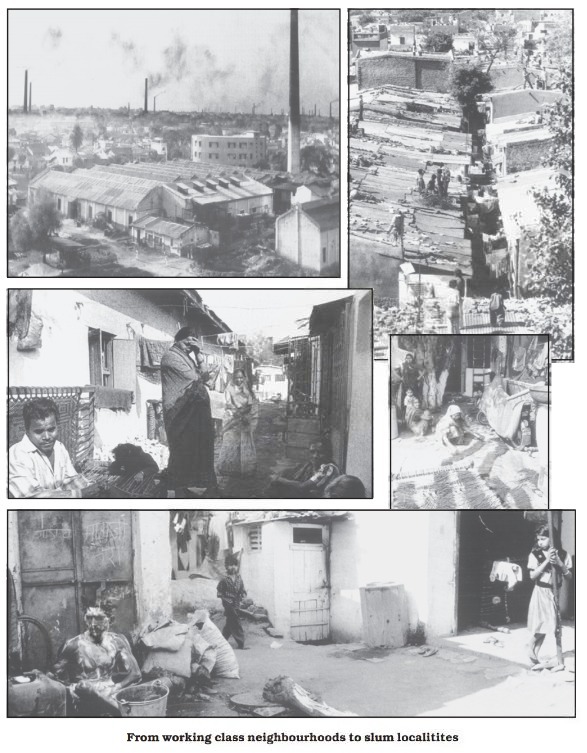
Industrialisation in Britain and India
Dates and Urbanisation
- Late 17th and 18th centuriesThe Enlightenment emphasised reason and individualism and strengthened confidence in scientific study.
- 18th and 19th centuriesWork rhythms in agriculture and manufacturing increasingly came to be regulated by clock and calendar time.
- 1810The lecture gives 20% as the share of the population living in towns and cities.
- 1910The lecture gives 80% as the share of the population living in towns and cities, illustrating rapid urbanisation in Britain.
The Factory: Oppression and Collective Action
- Factory work: Industrial capitalism moved labour away from village, family and guild settings into factory production.
- Contrasting effects: Factories could oppress workers, yet Marx saw their shared work as a potential basis for collective action to improve conditions.
Clock-Time and the Organisation of Work
- Social survey
- A way to study human phenomena by classifying and measuring them.
- Commodity
- A good, service or labour treated as something exchanged or used according to economic calculation.
- Mechanical division of labour
- The organisation of production into divided, coordinated tasks, especially in factories.
- Social stratification
- The structured ranking of groups or positions in society.
How did Enlightenment thinking influence the development of sociology?
Why did industrialisation affect Britain and India differently?
Quick recap
- Early sociology classified societies by types and stages, often using evolutionary ideas.
- The evolutionary ranking of societies treated the West as advanced and non-Western societies as less developed.
- Enlightenment ideas encouraged scientific study of society and the treatment of poverty as a social problem.
- Capitalism and industrialisation reshaped labour, communities, cities and social interactions.
- British imports damaged Indian handicrafts; many displaced craftspeople turned to agriculture even as urban centres grew.
- Factories could oppress workers but also foster collective action; clock-time reorganised work into fixed schedules.
Why Should We Study The Beginning And Growth Of Sociology In Europe?
Why Sociology’s European Beginnings Matter
European Change and Indian Relevance
- Origins: Many sociological questions emerged as European society changed rapidly during the 18th and 19th centuries with capitalism and industrialisation.
- Continuing relevance: Issues such as urbanisation and factory production still matter in modern societies, though their specific forms vary.
- India’s distinct experience: India’s colonial past and social diversity shaped a different experience of modern change.
- Connection: British capitalism and colonialism linked India to European history, making European sociology relevant to understanding social change in India.
- Capitalism
- An economic system involving private ownership and production for markets.
- Industrialisation
- The growth of machine-based production and factory industry.
- Colonialism
- Control of one country by another, often to serve economic interests.
- Indentured labour
- Labour performed under a contract that bound workers to work for a specified period.
Capitalism’s Global and Uneven Effects
Coerced Migration and Colonial Connections
- Enslavement: Between the 17th and 19th centuries, an estimated 24 million Africans were enslaved; 11 million survived the journey to the Americas.
- Impact: Enslaved people were forcibly removed from their homes and cultures and made to work for capitalist production.
- Decline: The institution of slavery declined during the 1800s.
- Indentured labour: In the 1800s, Britain transported Indian workers by ship to cotton and sugar plantations overseas, including Suriname, the West Indies and Fiji.
- Example: V.S. Naipaul, the Nobel Prize-winning writer, descended from an Indian indentured labourer taken overseas.
- Mauritius: R.K. Laxman’s account describes a population with African, Chinese, Bihari, Dutch, Persian, Tamil, Arab, French and English roots, reflecting colonial and global migrations.
- Cultural change: Laxman describes a person of Tamil origin who had lost knowledge of Tamil and spoke English with a strong French accent.
Key Periods
- 17th–19th centuriesAn estimated 24 million Africans were enslaved; 11 million survived the journey to the Americas.
- 1800sSlavery declined, while Indian indentured labourers were transported by Britain to plantations overseas.
Colonialism and Social Change in India
Colonial Economic Change
- Western sociology: Colonialism was integral to modern capitalism and industrialisation, so Western analyses help explain social change in India.
- Uneven impact: Industrialisation did not affect India in the same way as the West because colonial rule shaped India’s economy.
- Karl Marx’s observation: Indian cotton goods faced exclusion or harsh trade conditions in England, while British cotton manufactures entered India at nominal duties.
- Consequence: Cheap British imports undermined India’s celebrated cotton textile production, once a major source of world supply.
Colonial Trade and Indian Cotton Textiles
- Indian cotton goods faced exclusion or severe trade barriers in England.
- British manufactured cotton goods entered India with very low duties.
- British goods flooded the Indian market.
- India’s established cotton textile production was damaged.
Colonial Ideas About Indian Society
- Western accounts: Colonial officials and Western scholars sometimes described Indian society through inaccurate ideas shaped by colonial assumptions.
- Indian village: Victorian evolutionary writers portrayed the village as an unchanging survival from what they called the “infancy of society.”
- Imposed comparison: They treated 19th-century India as representing Europe’s own past, overlooking India’s distinct social history.
Sociology and Social Anthropology
| Point | Western distinction | Indian development |
|---|---|---|
| Sociology | Often defined as the study of human groups and societies, with particular emphasis on the industrialised world. | Its subject matter overlaps with social anthropology. |
| Social anthropology | Often defined as the study of simple, non-Western societies and “other” cultures. | Expanded from the study of so-called “primitive people” to peasants, ethnic groups, social classes, ancient civilisations and modern industrial societies. |
| Relationship between the fields | A rigid separation existed in many Western countries. | There is no rigid divide; India’s mix of village and metropolitan, traditional and modern life helps explain the overlap. |
Key Scholars
- Anthony Giddens: His standard definition of sociology emphasises the analysis of the industrialised world.
- M.N. Srinivas: Described how Indian social anthropology broadened its focus and came to overlap with sociology.
Why is the European beginning of sociology relevant to India?
How did colonial trade affect Indian cotton textiles?
How did social anthropology develop differently in India?
Quick recap
- European origins: Sociology grew from social changes linked to capitalism and industrialisation in the 18th and 19th centuries.
- Indian connection: British capitalism and colonialism linked India to Europe, but the effects were not identical.
- Coerced migration: Enslavement and indentured labour show how global capitalism moved people by force or coercion; slavery declined in the 1800s.
- Colonial economy: Unequal trade damaged India’s established cotton textile production.
- Colonial ideas: Some Western writers depicted Indian villages as primitive and unchanging.
- Indian disciplines: Social anthropology broadened its focus in India, and no rigid divide separates it from sociology.
The Scope Of Sociology And Its Relationship To Other Social Science Disciplines
The Scope of Sociology
Scope of sociology — Sociology studies meaningful social interactions and processes at individual, national and global levels.
Levels and examples
- Individual interactions: Shopkeepers and customers, teachers and students, friends, and family members.
- National issues: Unemployment, caste conflict, tribal forest rights affected by state policy, and rural indebtedness.
- Global processes: Flexible labour regulations, electronic media's impact on young people, and foreign universities' effects on education.
- Defining feature: Sociology is identified not only by what it studies, but also by how it studies a chosen subject.
Sociology and the Other Social Sciences
Shared concerns and interdisciplinary study
- Social sciences: Sociology belongs to a group that also includes anthropology, economics, political science and history.
- Overlap: These disciplines share interests, concepts and methods; their boundaries are not completely clear-cut.
- Avoid rigid divisions: Treating disciplines as wholly separate exaggerates differences and hides similarities.
- Interdisciplinary need: Feminist theories highlight that gender roles and their effects on politics or the economy require sociological understanding of family and gendered divisions of labour.
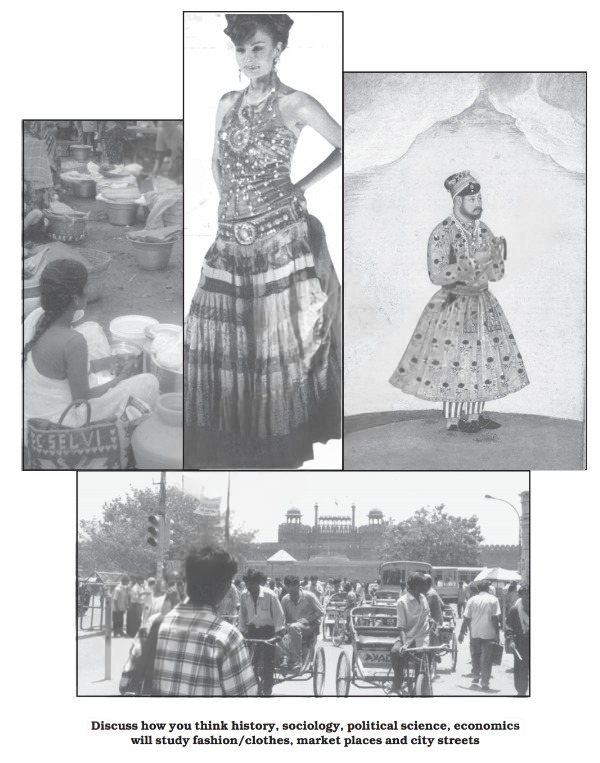
Economics and Sociology
Economics — The study of the production and distribution of goods and services.
Economic approaches
- Classical approach: Focuses on economic variables such as price, demand, supply, money flows, and input-output ratios.
- Traditional focus: Studies how scarce goods and services are allocated within society.
- Political economy: Places economic activity in a wider framework of ownership and relationships to the means of production.
- Dominant aim: Formulate precise laws of economic behaviour.
| Point | Economics | Sociology |
|---|---|---|
| Main focus | Production, distribution and allocation of scarce goods and services | Economic behaviour within social norms, values, practices and interests |
| Typical emphasis | Precise measures and laws of economic behaviour | How social relations and institutions shape behaviour |
| Approach to outcomes | Often seeks practical policy suggestions and predictions | Questions assumptions and examines the social desirability of goals |
Sociological perspectives on economic life
- Consumption: Advertising investment reflects efforts to reshape lifestyles and consumption patterns.
- Feminist economics: Treats gender as a central organising principle and examines how unpaid work at home connects with productivity outside it.
- Economic sociology: Applies sociology's wider, critical perspective to economic activity.
Strengths and limits of economic analysis
- Strengths: Economics is a focused discipline with precise terminology and measurement, and its theories can inform public policy.
- Limit: Predictions may be weakened when individual behaviour, cultural norms and institutional resistance are neglected.
A broader account of economic costs and benefits
- Pierre Bourdieu's argument: A fuller economic analysis should count costs beyond those faced by corporations, including crime and suicide.
- Economic well-being: It should include material and symbolic gains, individual and collective, as well as costs linked to inactivity or insecure employment.
- Examples: Security can be a benefit; precarious employment may carry costs such as increased medicine use.
Reference in the lecture
- 1998Pierre Bourdieu argued for assessing the wider social costs and benefits of economic activity.
What Sociology Contributes
Critical understanding
- Not mainly technical: Sociology usually does not offer technical solutions to problems.
- Critical perspective: It questions basic assumptions and examines both how to reach a goal and whether that goal is socially desirable.
- Resurgence: Economic sociology has grown again, in part because sociology offers a broader and more critical view of economic life.
- Improved understanding: Sociology can provide new factual knowledge or a stronger theoretical explanation of why a social situation occurs.
- Political economy
- An approach linking economic activity to ownership and relations to the means of production.
- Feminist economics
- An approach that examines gender as a key organiser of economic and social life.
- Economic sociology
- The sociological study of economic activity in its wider social context.
- Interdisciplinary approach
- Using insights from multiple disciplines to understand an issue that crosses their boundaries.
How does sociology's scope differ from a definition based only on its subject matter?
Why can economic predictions be limited?
What does sociology add to the study of economic activity?
Quick recap
- Sociology studies meaningful interactions and social processes from everyday life to global change.
- Its identity depends on how it studies a subject, not only on the subject itself.
- Social sciences overlap, so rigid disciplinary boundaries can hide shared concerns.
- Economics focuses on production, distribution and allocation; sociology examines their wider social setting.
- Social norms, gender relations and institutions affect economic activity and its outcomes.
- Sociology offers factual and theoretical understanding while questioning assumptions and social goals.
Sociology and Political Science
Sociology and Political Science
Political sociology — The study of political behaviour and its social causes, linking sociological approaches with the study of politics.
Sociology and History
- Time focus: Historians have traditionally studied the past, while sociologists have often focused on contemporary society and the recent past.
- Approach: History often establishes concrete events; sociology tends to seek causal relationships, categories and general patterns. Today, the fields increasingly share methods and interests.
Sociology and Psychology
Durkheim’s Study of Suicide
- Methodological focus Durkheim set aside individuals’ intentions and examined statistics related to their social characteristics.
- Significance The example shows sociology explaining behaviour through social patterns rather than only individual motives.
- Political sociology
- Sociological study of political behaviour and its social causes.
- Social history
- History that examines social patterns, relationships, customs and institutions.
- Social psychology
- Study of individual behaviour in social groups, bridging psychology and sociology.
- Social characteristics
- Social features of individuals that can be analysed to identify broader patterns.
How do sociology and conventional political science differ in their study of government?
What distinguishes social history from traditional history focused on rulers and wars?
How did Durkheim’s study of suicide show a sociological approach?
Quick recap
- Conventional political science traditionally focused on political theory, administration and formal government structures.
- Political sociology studies political behaviour, including voting, political organisations, decision-making and gender in politics.
- History often reconstructs past events; sociology seeks causal patterns and generalisations about society.
- Social history brings social relations, customs and institutions into the study of the past.
- Psychology focuses primarily on individual behaviour; social psychology examines individuals in groups.
- Sociology explains behaviour through social organisation and influences such as culture, family, norms and institutions.
Sociology and Social Anthropology
Anthropology and Its Branches
- Broad scope: Anthropology includes archaeology, physical anthropology, cultural history, branches of linguistics and the study of all aspects of life in simple societies.
- Focus here: Social and cultural anthropology are especially relevant because they are close to sociology.
Social anthropology — Traditionally, the study of all aspects of life in simple, often non-literate societies.
Sociology — Traditionally, the study of modern, complex societies.
| Point | Sociology | Social Anthropology |
|---|---|---|
| Typical society studied | Modern, complex societies | Simple, often non-literate societies |
| Typical focus | Parts of society or social processes | Society as a whole |
| Specialisation | Topics such as bureaucracy, religion, caste or social mobility | Often by area or community, such as the Andaman Islands, the Nuers or Melanesia |
Historical Background and Changing Perspectives
The History of Social Anthropology
- Origins: Social anthropology developed in the West, where Western-trained researchers often studied non-European peoples labelled as exotic, barbaric or uncivilised.
- Unequal relationship: Researchers traditionally held power to describe the societies being studied; this inequality was often left unexamined.
- Western benchmark: Accounts could appear neutral, but researchers often compared studied societies with Western modern society as the standard.
- Changing voices: People once described as ‘natives’, including Indians and Sudanese, Nagas and Santhals, increasingly speak and write about their own societies.
Modernity, Global Connections and Society
Globalisation — The increasing reach of global processes into local communities, making societies more interconnected and less bounded.
Colonialism Reshaped a Village
- British colonial rule reached even remote Indian villages.
- Colonial administration changed land laws and local administration.
- Revenue extraction changed, and manufacturing industries collapsed.
- Local communities were affected by wider political and economic forces.
Why the Idea of a Bounded ‘Simple Society’ Is Challenged
- Earlier assumption: A simple society was often treated as a self-contained, bounded unit.
- Today: Global processes connect even remote communities to events and systems beyond their locality.
- Implication: Societies cannot always be understood as isolated units.
Methods and Scope of Study
| Point | Social Anthropology | Sociology |
|---|---|---|
| Typical approach | Long-term fieldwork and living in the community studied | Often surveys and quantitative data |
| Common research methods | Ethnographic methods | Statistics and questionnaires |
| Scope | Often studied a society holistically | Often focused on a part of society or a social process |
Rethinking the Distinction and the Indian Context
Why ‘Simple’ and ‘Complex’ Are Not Fixed Categories
- Mixed realities: India combines tradition and modernity, village and city, caste and tribe, class and community.
- Urban-rural overlap: Villages exist within Delhi, while call centres in Indian towns serve clients in Europe and America.
- Conclusion: The simple–complex distinction needs rethinking; societies may combine features traditionally assigned to both categories.
Indian Sociology and Disciplinary Exchange
- Eclectic approach: Indian sociology draws on both sociological and anthropological traditions.
- Range of study: Researchers may study urban, differentiated society as well as tribes holistically; a society may be both familiar and culturally different to the researcher.
- Interchange: Social anthropology has studied newer subjects such as the state and globalisation, while sociology uses qualitative and quantitative techniques and both macro and micro approaches.
- Relationship: Rather than simply merging, the disciplines exchange methods and approaches; their relationship is particularly close in India.
- Capitalism
- An economic system based on market exchange and private ownership of assets and the means of production. Capital means assets such as money, property or machines that can produce commodities for sale or be invested in a market in the hope of profit.
- Dialectic
- The existence or interaction of opposing social forces, such as social constraint and individual will.
- Empirical investigation
- A factual enquiry carried out in a specific area of sociological study.
- Feminist theories
- Perspectives that make gender central to analysing society, explaining gender inequalities and seeking to overcome them.
- Social constraint
- The conditioning influence that groups and societies exert on people's behaviour.
- Values
- Ideas about what is desirable, proper, good or bad; differences in values are an important part of cultural variation.
How did the traditional subject matter and methods of social anthropology differ from those of sociology?
Why is the idea of a self-contained ‘simple society’ difficult to sustain today?
How are sociology and social anthropology related in India today?
Quick recap
- Anthropology covers several branches; social and cultural anthropology are especially close to sociology.
- Sociology traditionally studied modern, complex societies; social anthropology studied simple societies, often holistically.
- Social anthropology developed in a colonial context, with Western researchers often using Western modernity as the benchmark.
- Colonialism and globalisation show that local communities are connected to wider forces, not fully bounded.
- Anthropology traditionally emphasised long fieldwork and ethnography; sociology often used surveys and quantitative data.
- India combines features conventionally called simple and complex, while Indian sociology draws on both traditions.
Sociology — ALL CHAPTERS
1
Sociology And Society
2
Terms, Concepts And Their Use In Sociology
3
Understanding Social Institutions
4
Culture And Socialisation
5
Doing Sociology : Research Methods
1
Social Structure, Stratification And Social Processes In Society
2
Social Change And Social Order In Rural And Urban Society
3
Environment And Society
4
Introducing Western Sociologists
5
Indian Sociologists