Class 11 PCB . Chemistry . Chemistry Part I . Chemical Bonding and Molecular Structure
Chapter 4: Chemical Bonding And Molecular Structure
Ch 4
Chemistry
Class 11 PCB
Kössel-Lewis Approach To Chemical Bonding
Molecules, Bonds, and Stability
- Chemical bond: An attractive force that holds atoms or ions together in a chemical species.
- Stability: Bond formation generally lowers a system’s energy, making it more stable.
Kössel–Lewis Approach
- Key idea: Kössel and Lewis independently explained chemical bonding in 1916, relating valence to the stable electronic arrangements of noble gases.
- Bond formation: Atoms can gain stability by transferring or sharing valence electrons.
Lewis Symbols and Group Valence
- Lewis symbols: Dots around an element’s symbol represent its valence electrons.
- Group valence: It is generally equal to the number of valence-electron dots or to eight minus that number.
Ionic Bonding: Kössel’s Explanation
Formation of Sodium Chloride
- Sodium: loses one electron and attains the neon configuration.
- Chlorine: gains one electron and attains the argon configuration, .
Formation of Calcium Fluoride
- Calcium: loses two electrons and attains the argon configuration.
- Fluorine: Each atom, , gains one electron and attains the neon configuration.
- Ratio: One calcium atom transfers its two electrons to two fluorine atoms, forming .
Significance and Limitation
- Importance: Kössel’s ideas underpin modern explanations of ion formation by electron transfer and ionic crystalline compounds.
- Limitation: Kössel recognised that many compounds could not be explained by this ionic model alone.
Octet Rule
- Octet rule: Atoms combine by transferring or sharing valence electrons to attain eight electrons in their valence shells.
- Stable configuration: This arrangement resembles the outer-shell configuration of a noble gas; helium is stable with a duplet.
Covalent Bond
Covalent Bonding Examples
- Chlorine molecule: Each chlorine atom contributes one electron to a shared pair; both atoms attain an octet.
- Other molecules: Lewis structures can represent covalent bonding in and ; hydrogen attains a duplet in water.
- Bond partners: Covalent bonds can form between identical atoms or different elements.
Single, Double, and Triple Bonds
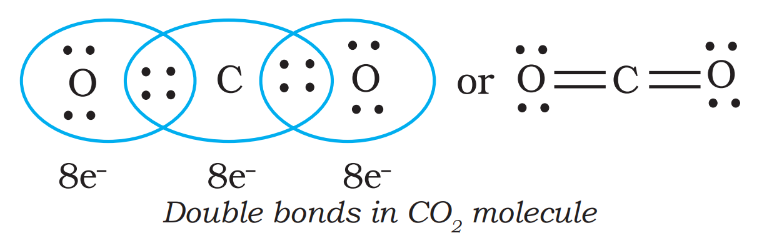
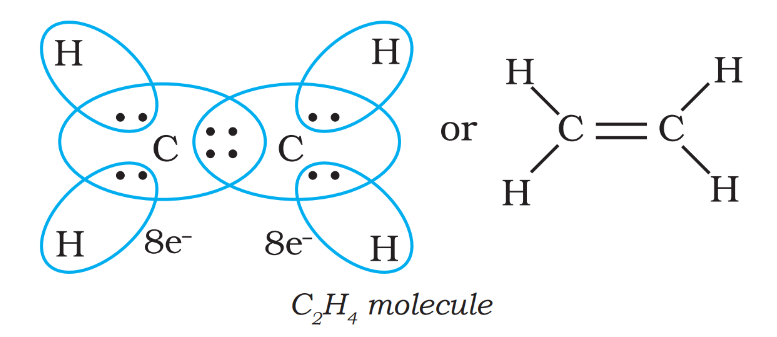
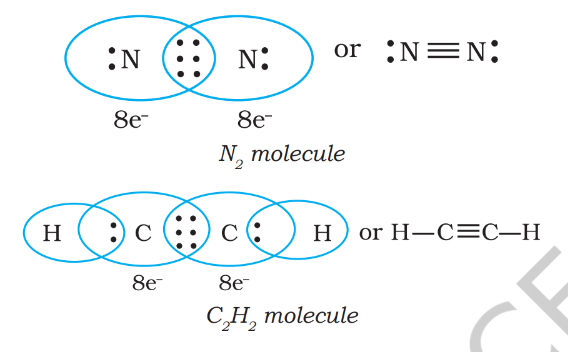
State the octet rule.
How does an electrovalent bond form?
How do single, double, and triple covalent bonds differ?
Quick recap
- Noble gases are normally independent atoms; atoms of other elements generally occur in molecules.
- Chemical bonds hold atoms or ions together, and bond formation generally lowers system energy.
- Lewis symbols show valence electrons as dots; the dot count helps predict group valence.
- Ionic bonding involves electron transfer and electrostatic attraction between oppositely charged ions.
- The octet rule describes electron transfer or sharing to reach stable outer shells; hydrogen can attain a duplet.
- Covalent bonds share one, two, or three electron pairs in single, double, or triple bonds.
Lewis Representation of Simple Molecules (the Lewis Structures)
Lewis Structures: Purpose and Method
Steps for Writing a Lewis Structure
- Count the valence electrons from all atoms; add one electron for each negative charge and subtract one for each positive charge.
- Choose a skeletal arrangement, usually placing the least electronegative atom in the centre; hydrogen is terminal.
- Connect atoms with single bonds, each representing one shared pair of electrons.
- Place remaining electrons as lone pairs, giving bonded atoms an octet where possible; hydrogen needs a duplet.
- If an atom lacks an octet, use lone pairs to form multiple bonds where possible; check the electron count and overall charge.
Electron Counting and Structure Choices
- Neutral species: Total available electrons equal the sum of the valence electrons of the atoms; for , this is .
- Ions: A negative charge adds electrons; a positive charge removes electrons. For example, has two extra electrons and has one fewer.
- Central atom: Usually the least electronegative atom; for example, N is central in and C in .
- Bonding: First account for shared pairs in bonds; remaining pairs become lone pairs or form multiple bonds.
- Hydrogen: Achieves a duplet rather than an octet.
| Species | Structure and key electron details |
|---|---|
| ; one shared pair gives each H a duplet. | |
| ; each O has two lone pairs. | |
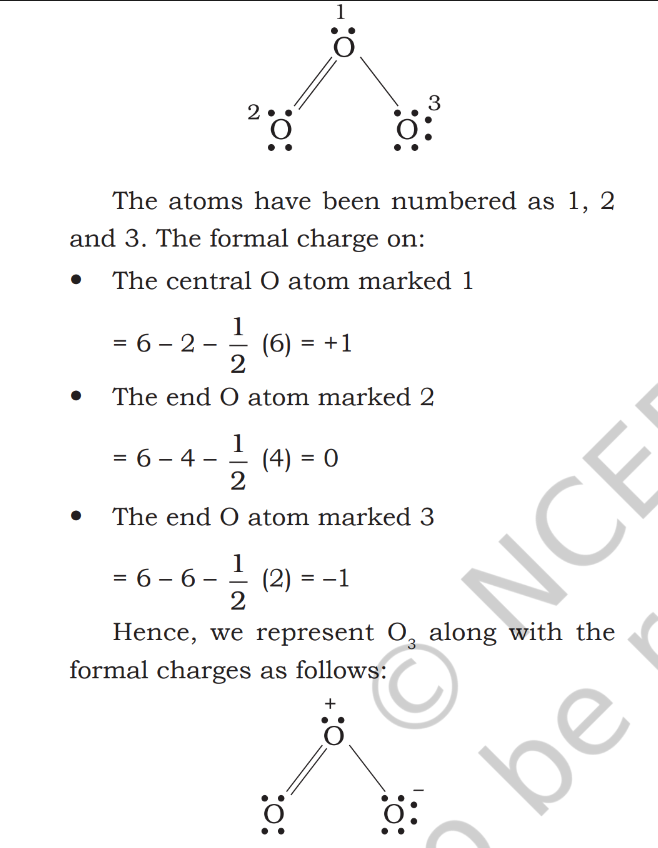
| in one representation; central O has one lone pair, double-bonded O has two, and single-bonded O⁻ has three. Equivalent resonance forms are possible. | |
| N has three single bonds to F and one lone pair; each F has three lone pairs. | |
| One form has one and two bonds; the double-bonded O has two lone pairs and each has three. Equivalent forms can place the double bond on any O. | |
| One form is ; has three lone pairs, while the double-bonded O and the OH oxygen each have two. |
Worked Applications
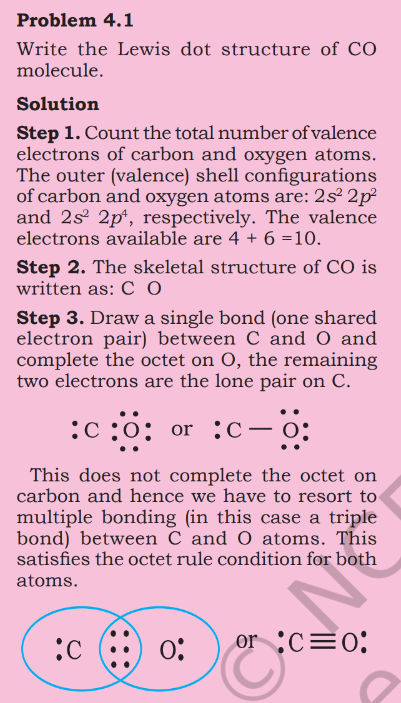
Carbon Monoxide,
- Count: Carbon contributes valence electrons and oxygen , giving total.
- Skeletal structure: Connect the two atoms as and distribute the electrons.
- Octet check: A single bond with lone pairs does not give carbon an octet; sharing additional pairs forms a triple bond.
- Final structure: has a triple bond and one lone pair on each atom; both atoms have octets.
Nitrite Ion,
- Count: valence electrons, including the extra electron from the negative charge.
- Skeleton: Arrange the atoms as .
- Bonding: Single bonds and lone pairs alone leave N without an octet, so one double bond is needed.
- Structures: and are equivalent resonance forms; N has one lone pair.
Formal Charge
Formal charge — The difference between an atom’s valence-electron count in isolation and the electrons assigned to it in a Lewis structure.
Assign both electrons of each lone pair to its atom and one electron from each bonding pair to each bonded atom.
Interpreting Formal Charge
- Symbols: is the free atom’s valence-electron count, the non-bonding electrons, and the bonding electrons around that atom.
- Meaning: Formal charges are bookkeeping values; they do not show real charge separation in the molecule.
- Use: Compare possible Lewis structures; the preferred structure generally has the smallest formal charges on its atoms.
- Basis: The calculation treats shared bonding electrons as divided equally between the bonded atoms.
| Oxygen position | Formal charge | |||
|---|---|---|---|---|
| Double-bonded terminal O | ||||
| Central O | ||||
| Single-bonded terminal O |
Limitations and Exceptions to the Octet Rule
Scope and Exceptions
- Scope: The octet rule is useful for many organic compounds and applies mainly to second-period elements, but it is not universal.
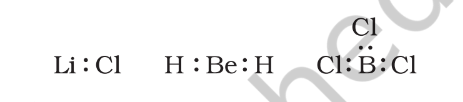
- Incomplete octet: Some central atoms have fewer than eight electrons, commonly when they have fewer than four valence electrons.
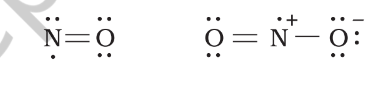
- Odd-electron species: Molecules with an odd total number of electrons cannot give every atom an octet.
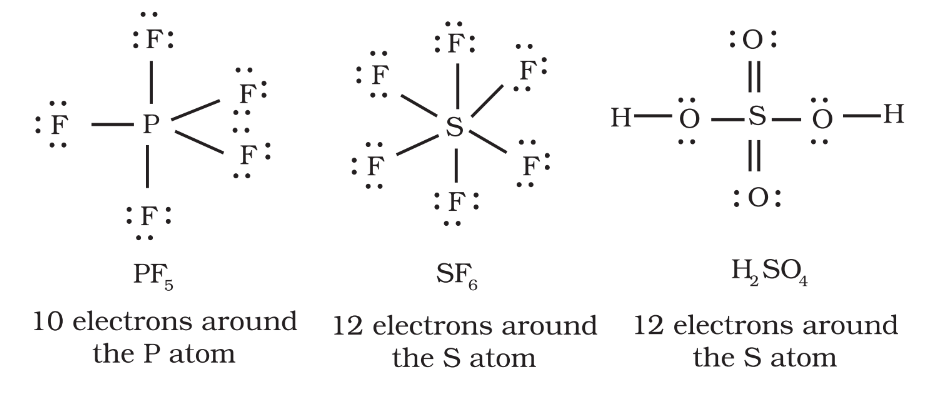
- Expanded octet: Some central atoms in or beyond period 3 can have more than eight electrons around them.
- Other limitations: The rule does not predict molecular shape or explain relative molecular stability and energy.
| Exception | What happens | Examples |
|---|---|---|
| Incomplete octet | The central atom has fewer than eight electrons. | , , , , |
| Odd-electron molecule | An odd total electron count prevents all atoms from reaching octets. | , |
| Expanded octet | The central atom has more than eight electrons around it. | , , ; some coordination compounds |
Additional Octet-Rule Notes
- Sulfur: Not every sulfur compound has an expanded octet; sulfur has an octet in .
- Noble gases: Despite their usual inertness, xenon and krypton form compounds such as , , and .

How is the total number of valence electrons adjusted for an ion?
What does formal charge show, and how is it calculated?
Name the three main types of octet-rule exceptions and give an example of each.
Quick recap
- Count valence electrons, adjusting the total for the ion’s charge.
- Build a skeleton, place single bonds and lone pairs, then use multiple bonds if octets are incomplete.
- Lewis structures show shared pairs, lone pairs, and formal-charge bookkeeping.
- Formal charge is ; smaller formal charges generally favour a structure.
- Octet-rule exceptions are incomplete octets, odd-electron molecules, and expanded octets.
- The octet rule does not explain molecular shape or relative stability.
Ionic Or Electrovalent Bond
Formation of Ionic Compounds
Ionic (electrovalent) bond — The electrostatic attraction between oppositely charged ions formed by electron transfer.
What favours ionic compound formation?
- Ion formation: Formation depends on how readily positive and negative ions form from their neutral atoms.
- Lattice arrangement: The ions must form a stable, orderly crystal lattice.
- Common sources: Cations usually come from metals and anions from non-metals; ammonium, , is an important cation made only of non-metals.
Energy changes in ion formation
- Ionization enthalpy: Energy absorbed when a gaseous atom loses electron(s) to form a cation; ionization is always endothermic.
- Electron-gain enthalpy: is the enthalpy change when a ground-state gaseous atom gains an electron. The process may be exothermic or endothermic.
- Electron affinity: The negative of the energy change accompanying electron gain.
- Favourable pairing: Ionic formation is generally easier with low ionization enthalpy and highly negative electron-gain enthalpy.
Ionic crystal structure and stability
- Crystal lattice: Ionic solids contain an orderly, three-dimensional arrangement of cations and anions held by Coulombic interactions.
- Structure depends on: Ion sizes, packing arrangements and other factors determine the crystal structure.
- Stability: Lattice formation can release enough energy to compensate for energy absorbed while making gaseous ions; achieving an octet alone does not guarantee stability.
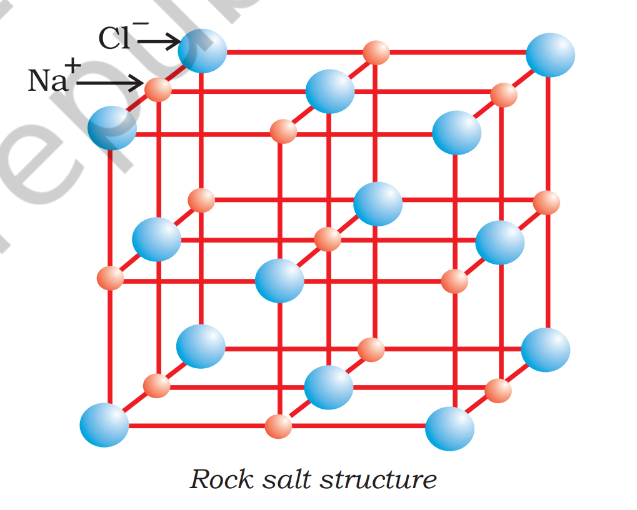
Example: Energetics of sodium chloride formation
- Ion formation: Making absorbs ; making releases .
- Net for gaseous ions: The combined enthalpy change is , so this stage absorbs energy.
- Lattice formation: Forming solid releases , more than compensating for the energy absorbed.
- Stability measure: Ionic stability depends on lattice formation enthalpy, not simply on attaining an octet in the gaseous ions.
Lattice Enthalpy
Lattice enthalpy — The energy required to completely separate one mole of an ionic solid into its gaseous constituent ions at infinite distance.
Meaning and factors
- Sodium chloride: Its lattice enthalpy is for separation into gaseous ions; lattice formation is the reverse process and releases the same amount of energy.
- Forces involved: The crystal has attractions between oppositely charged ions and repulsions between like-charged ions.
- Calculation: Since an ionic crystal is three-dimensional, lattice enthalpy cannot be calculated from attractive and repulsive forces alone; crystal geometry must also be included.
Why can an ionic compound form even when making its gaseous ions requires energy?
Quick recap
- Ionic bonding is the electrostatic attraction between oppositely charged ions.
- Ion formation is favoured by low ionization enthalpy and highly negative electron-gain enthalpy.
- Ionic solids are orderly three-dimensional lattices; their structures depend partly on ion size and packing.
- Lattice formation can offset the energy required to create gaseous ions and is central to ionic-solid stability.
- Lattice enthalpy is the energy needed to separate one mole of ionic solid into gaseous ions at infinite distance.
- Lattice enthalpy calculations must consider both attractive and repulsive forces as well as crystal geometry.
Bond Parameter
Bond Length
Bond length — The equilibrium distance between the nuclei of two bonded atoms in a molecule.
- Measurement: Bond lengths are determined by spectroscopic, X-ray diffraction and electron-diffraction techniques.
- Covalent radius: Each bonded atom contributes to the bond length; this contribution is called its covalent radius.
- Like atoms: The covalent radius is half the distance between the nuclei of two identical atoms joined by a covalent bond.
- Unlike atoms: Bond length is approximately the sum of the two covalent radii.
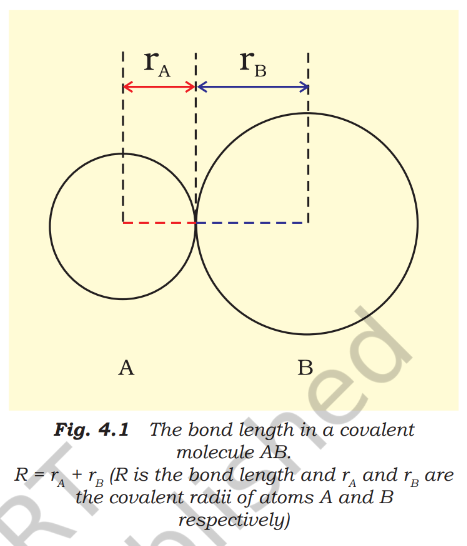
For atoms A and B joined by a covalent bond.
| Point | Covalent radius | Van der Waals radius |
|---|---|---|
| Situation | Atom in a covalent bond | Atoms in separate molecules, not covalently bonded |
| Meaning | Approximate radius of an atom’s core in a bonded situation | Overall atomic size, including its valence shell, in a nonbonded situation |
| Obtained from | Half the distance between two identical bonded atoms | Half the distance between two identical atoms in separate molecules in a solid |
| Chlorine example | ; the bond length is | ; the nonbonded distance is |
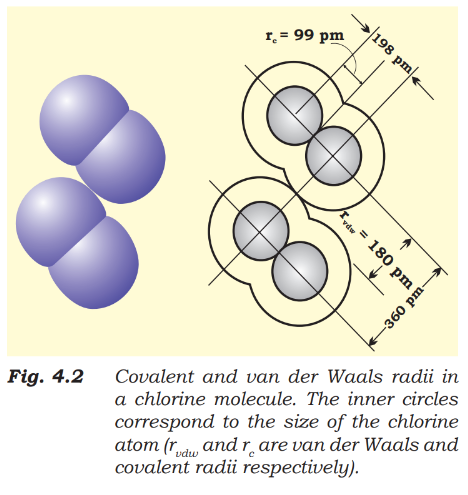
| Bond | Length (pm) |
|---|---|
| 96 | |
| 107 | |
| 136 | |
| 143 | |
| 143 | |
| 154 | |
| 121 | |
| 122 | |
| 133 | |
| 138 | |
| \ce{C#N} | 116 |
| \ce{C#C} | 120 |
| Molecule | Bond length (pm) |
|---|---|
| 74 | |
| 144 | |
| 199 | |
| 228 | |
| 267 | |
| 109 | |
| 121 | |
| 92 | |
| 127 | |
| 141 | |
| 160 |
| Element | Covalent radius (pm) |
|---|---|
| 37 | |
| 77 (1), 67 (2), 60 (3) | |
| 74 (1), 65 (2), 55 (3) | |
| 66 (1), 57 (2) | |
| 64 | |
| 99 | |
| 110 | |
| 104 (1), 95 (2) | |
| 114 | |
| 121 | |
| 104 | |
| 133 | |
| 141 | |
| 137 |
Bond Angle
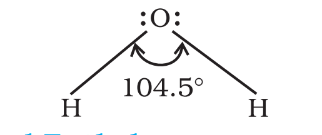
Bond angle — The angle between orbitals containing bonding electron pairs around the central atom in a molecule or complex ion.
- Unit and measurement: Bond angles are expressed in degrees and can be determined by spectroscopic methods.
- Significance: Bond angles show the distribution of bonding orbitals and help determine molecular shape.
- Water: Its angle is ; lone-pair repulsion at oxygen contributes to its bent shape.
Bond Enthalpy
Bond enthalpy — The energy required to break one mole of a particular type of bond between two atoms in the gaseous state.
- Unit: .
- Bond strength: A larger bond dissociation enthalpy indicates a stronger bond.
- Polyatomic molecules: Successive bonds of the same type may need different energies because the chemical environment changes after each bond is broken.
- Mean bond enthalpy: For polyatomic molecules, average the enthalpies for the specified bond dissociations by dividing their total by the number of bonds broken.
Successive O–H Bond Dissociations in Water
- First O–H bond: Breaking water into and requires .
- Second O–H bond: Breaking into and requires .
- Why they differ: After the first bond breaks, the remaining O–H bond is in a different chemical environment.
- Different molecules: The O–H bond enthalpy also varies with chemical environment—for example, the O–H bonds in ethanol () and water need not have identical values.
Mean bond enthalpy is the total dissociation enthalpy divided by the number of bonds broken.
Bond Order
Bond order — In the Lewis description of a covalent bond, bond order is the number of bonds between two atoms in a molecule.
- Examples: has bond order , has bond order , and has bond order .
- Carbon monoxide: has three shared electron pairs, so its bond order is .
- Isoelectronic species: Isoelectronic molecules and ions have identical bond orders: and have bond order ; , and have bond order .
- General trend: As bond order increases, bond enthalpy increases and bond length decreases.
How are bond order, bond enthalpy and bond length generally related?
Why is mean bond enthalpy used for bonds in polyatomic molecules?
Quick recap
- Bond length is the equilibrium distance between bonded nuclei; it is approximately the sum of the atoms’ covalent radii.
- Covalent radius describes an atom in a bond; van der Waals radius describes its larger nonbonded size.
- Bond angle helps determine molecular shape; water’s angle is .
- Bond enthalpy is the energy needed to break one mole of gaseous bonds; higher values indicate stronger bonds.
- Mean bond enthalpy is used because successive bonds, or bonds in different molecules, can have different energies due to their chemical environments.
- Bond order counts the bonds between two atoms; increasing bond order generally raises bond enthalpy and lowers bond length.
Resonance Structures
Resonance Structures
Resonance — Resonance describes a molecule more accurately using multiple canonical Lewis structures when no single Lewis structure matches its observed properties.
Canonical Structures and the Resonance Hybrid
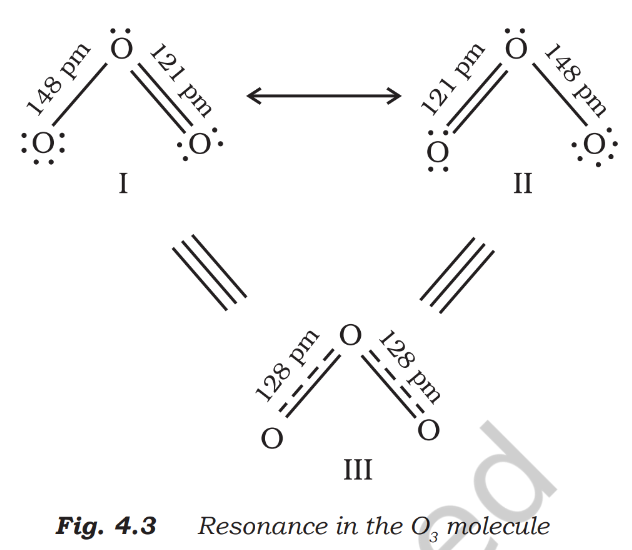
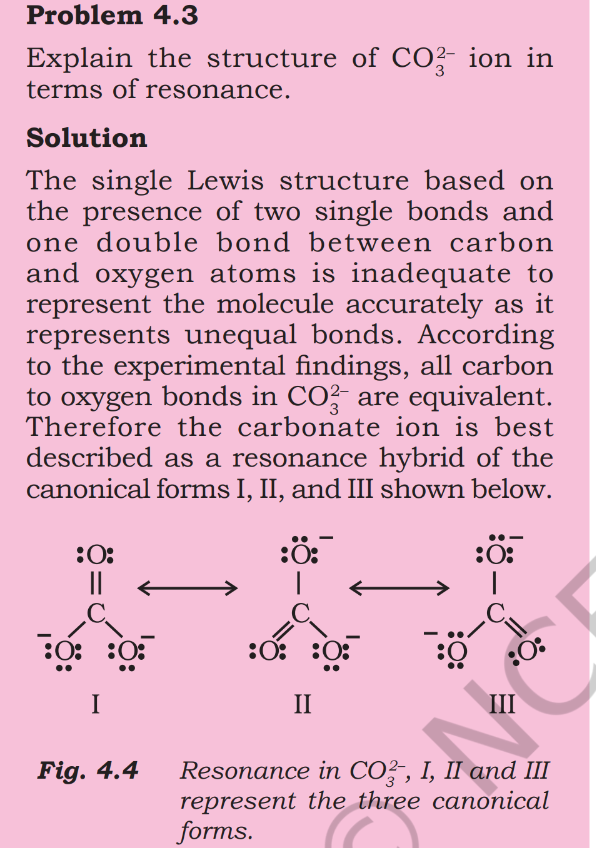
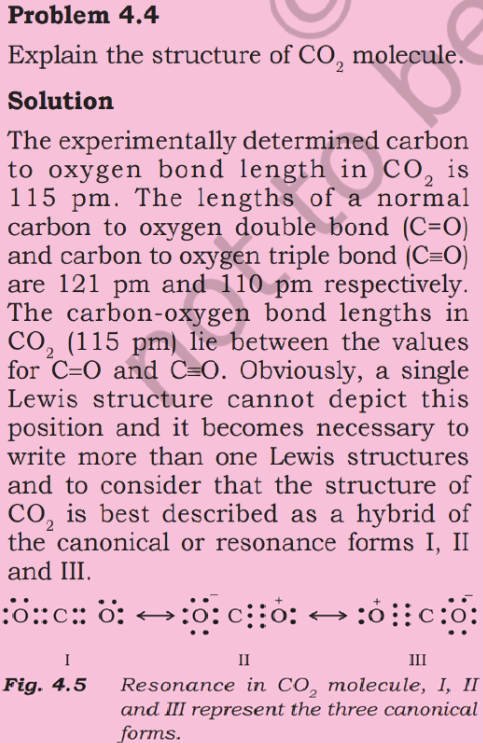
- Canonical structures have similar energies and the same positions of nuclei; they differ in the arrangement of bonding and non-bonding electrons.
- Resonance hybrid is the actual structure, represented by the combination of canonical structures; resonance is shown with a double-headed arrow.
- Ozone: its two canonical structures each show one single and one double bond, but experiments find two equal bonds of .
- Bond lengths: normal single and double bonds are and ; ozone’s bonds are intermediate.
- Other examples: the carbonate ion, , and the molecule also have resonance structures.
Effects and Meaning of Resonance
- Stabilisation: the resonance hybrid has lower energy than any individual canonical structure.
- Bond averaging: resonance makes bond characteristics intermediate across the molecule, as in ozone.
- Actual structure: the molecule exists as one resonance hybrid, not as separate canonical forms.
Canonical forms are not real structures that a molecule alternates between; unlike keto–enol tautomerism, they are not in equilibrium. The molecule has one structure: the resonance hybrid.
Polarity of Bonds
Non-polar and Polar Covalent Bonds
- Bond character: real bonds are not perfectly ionic or perfectly covalent; covalent bonds also have some ionic character.
- Non-polar covalent bond: identical atoms attract the shared electron pair equally, as in , , , and .
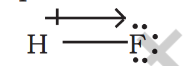
- Polar covalent bond: different electronegativities shift the shared electrons toward the more electronegative atom; in , electron density shifts toward fluorine.
- Bond dipole: the unequal charge distribution produces separated centres of positive and negative charge.
Dipole moment — The dipole moment, , is the product of the magnitude of charge and the distance between the centres of positive and negative charge.
Usually measured in Debye (); it is a vector quantity.
Here is coulomb and is metre.
Dipole Moment Direction and Molecular Polarity
- Vector convention: the dipole-moment vector points from the negative centre toward the positive centre.
- Chemistry symbol: the crossed-arrow bond symbol has its cross at the positive end and arrowhead at the negative end, so it points opposite to the conventional dipole-moment vector.
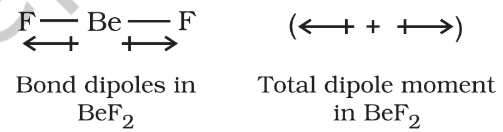
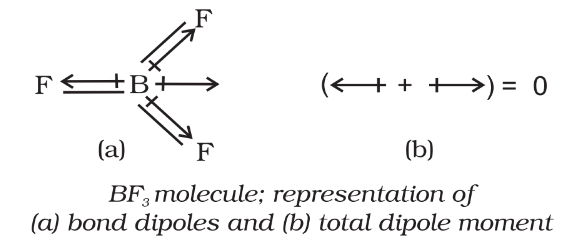
- Molecular dipole: in polyatomic molecules, the net dipole is the vector sum of all bond dipoles; its value depends on molecular shape and bond directions.
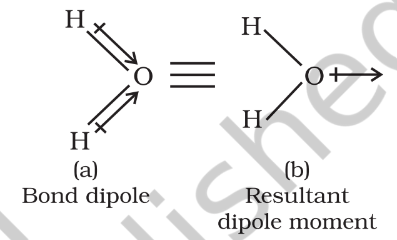
| Molecule | Geometry and bond dipoles | Net dipole |
|---|---|---|
| Bent; bonds meet at | ||
| Linear; two equal, opposite bond dipoles | Zero | |
| Trigonal planar; bond dipoles at | Zero |
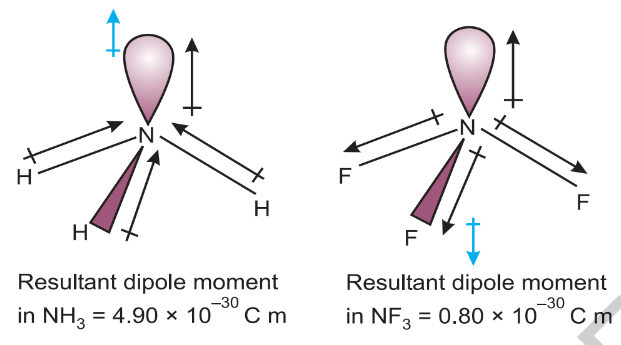
| Point | ||
|---|---|---|
| Shape | Trigonal pyramidal | Trigonal pyramidal |
| Relative direction | Lone-pair orbital dipole reinforces the resultant bond dipoles | Lone-pair orbital dipole opposes the resultant bond dipoles |
| Dipole moment |
| Molecule | Dipole moment () | Geometry |
|---|---|---|
| 1.78 | Linear | |
| 1.07 | Linear | |
| 0.79 | Linear | |
| 0.38 | Linear | |
| 0 | Linear | |
| 1.85 | Bent | |
| 0.95 | Bent | |
| 0 | Linear | |
| 1.47 | Trigonal pyramidal | |
| 0.23 | Trigonal pyramidal | |
| 0 | Trigonal planar | |
| 0 | Tetrahedral | |
| 1.04 | Tetrahedral | |
| 0 | Tetrahedral |
Covalent Character in Ionic Bonds: Fajans’ Rules
Fajans’ Rules
- Small cation, large anion: increases covalent character because the cation can distort the anion’s electron cloud more strongly.
- Higher cation charge: increases covalent character by increasing the cation’s polarising power.
- Electronic configuration: for cations with the same size and charge, a transition-metal configuration, , is more polarising than a noble-gas configuration, .
- Polarisation: the cation pulls anion electron density toward itself, increasing electron density between the nuclei and giving the bond covalent character.
- Overall factors: covalent character depends on cation polarising power, anion polarisability and the extent of anion distortion.
Why does ozone require resonance structures?
State Fajans’ rules for increasing covalent character in an ionic bond.
Quick recap
- Resonance uses canonical Lewis structures to represent a single, more accurate resonance hybrid.
- The resonance hybrid is lower in energy than its canonical forms and has averaged bond characteristics.
- Dipole moment is ; molecular dipoles are vector sums of bond dipoles.
- Molecular shape determines whether bond dipoles cancel, as in and , or produce a net dipole, as in .
- Lone-pair dipole direction helps explain why has a larger dipole moment than .
- Fajans’ rules link greater ionic-bond covalent character to stronger polarisation of the anion.
The Valence Shell Electron Pair Repulsion (Vsepr) Theory
Principle and Postulates of VSEPR Theory
- Purpose: VSEPR theory predicts the geometrical shapes of covalent molecules from the electron pairs around the central atom.
- Shape: The arrangement of these pairs determines the positions of atoms and the molecule’s geometry.
Electron-Pair Repulsions
The order of decreasing repulsion is:
Molecules Without Lone Pairs on the Central Atom
| Electron pairs | Arrangement and ideal bond angle | Molecular geometry | Example |
|---|---|---|---|
| 2 | Linear () | Linear | , |
| 3 | Trigonal planar () | Trigonal planar | |
| 4 | Tetrahedral () | Tetrahedral | , |
| 5 | Trigonal bipyramidal ( and ) | Trigonal bipyramidal | |
| 6 | Octahedral () | Octahedral |
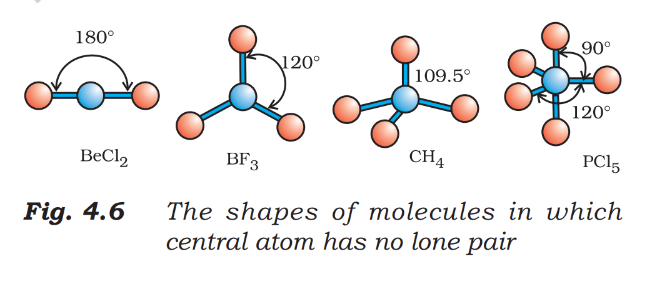
Molecules with Lone Pair(s) on the Central Atom
| Type | Bonding pairs | Lone pairs | Electron-pair arrangement | Molecular shape | Example |
|---|---|---|---|---|---|
| 2 | 1 | Trigonal planar | Bent | ||
| 3 | 1 | Tetrahedral | Trigonal pyramidal | ||
| 2 | 2 | Tetrahedral | Bent | ||
| 4 | 1 | Trigonal bipyramidal | Seesaw | ||
| 3 | 2 | Trigonal bipyramidal | T-shaped | ||
| 5 | 1 | Octahedral | Square pyramidal | ||
| 4 | 2 | Octahedral | Square planar |
Usefulness and Limitation
State the order of electron-pair repulsions and explain why lone pairs repel more strongly.
What are the electron-pair arrangement and molecular shape of ?
Quick recap
- Molecular shape depends on all valence-shell electron pairs around the central atom.
- Electron pairs maximise separation; the valence shell is treated as a sphere.
- Repulsion decreases in the order .
- A multiple bond counts as one super pair, and VSEPR applies to possible resonance structures.
- Without lone pairs, 2–6 electron pairs give linear, trigonal planar, tetrahedral, trigonal-bipyramidal and octahedral geometries.
- Lone pairs change molecular shapes, as in bent and trigonal-pyramidal .
- VSEPR predicts many geometries effectively, though its theoretical basis remains debated.
Valence Bond Theory
Why Valence Bond Theory?
Limits of Earlier Models
- Lewis approach: Does not explain how bonds form, molecular shapes, or why single bonds differ in bond enthalpy and length.
- Example: has bond enthalpy and bond length ; has and .
- VSEPR theory: Predicts geometry for simple molecules but does not theoretically explain it and has limited applications.
- Quantum-mechanical theories: Valence bond (VB) theory and molecular orbital (MO) theory provide approaches to explain chemical bonding.
Valence Bond Theory: Basis
- Development: Heitler and London introduced VB theory in 1927; Pauling and others developed it further.
- Basis: Its treatment involves atomic orbitals, electronic configurations, orbital overlap, hybridisation, and the principles of variation and superposition.
- Scope here: VB theory is presented qualitatively, without a rigorous mathematical treatment.
Formation of the Hydrogen Molecule
How Two Hydrogen Atoms Form a Bond
- Far apart: Two hydrogen atoms have negligible interaction.
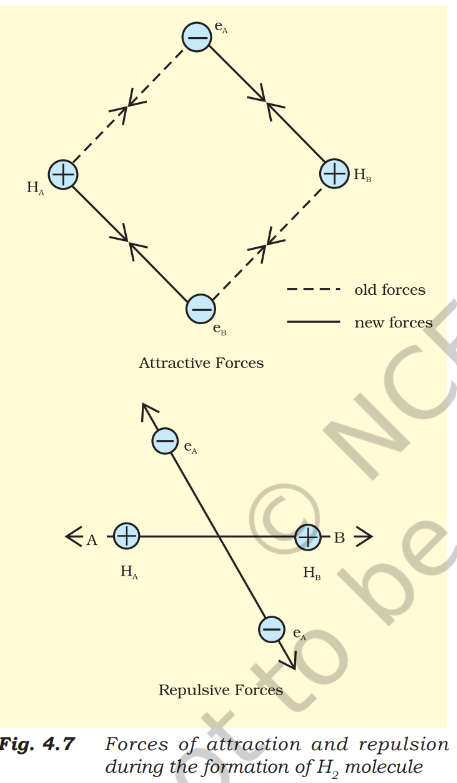
- As they approach: Attractions act between each nucleus and both electrons; repulsions act between the two electrons and between the two nuclei.
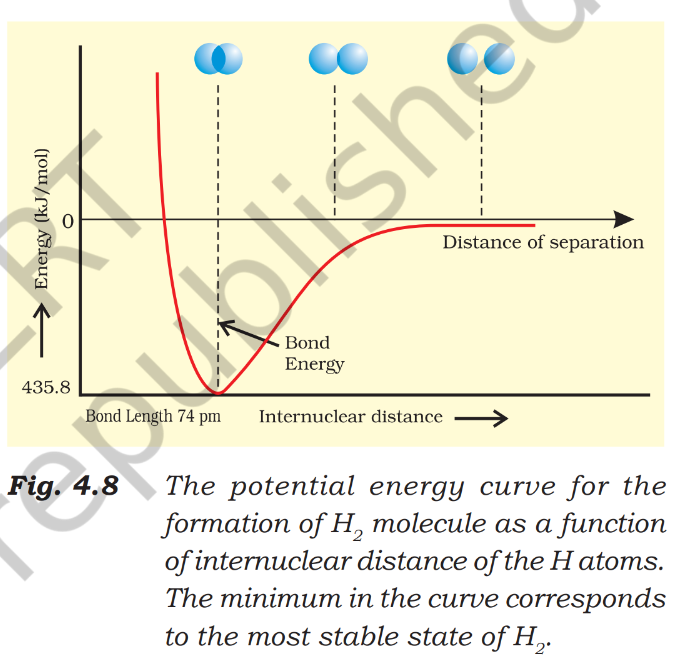
- Energy change: The new attractive forces outweigh the new repulsive forces, so the atoms approach and the system's potential energy decreases.
- Stable bond: At the balance of attraction and repulsion, the system reaches minimum energy and forms stable with a bond length of .
Bond Energy
- Bond formation: Energy is released when two hydrogen atoms form the more stable molecule.
- Dissociation: Breaking one mole of requires ; this is the energy required to dissociate the molecule.
Orbital Overlap Concept
Orbital overlap — The partial interpenetration of atomic orbitals as atoms approach one another.
- Covalent bond: Overlap enables pairing of valence electrons with opposite spins.
- Bond strength: Greater orbital overlap generally produces a stronger covalent bond.
- Hydrogen molecule: forms by overlap of the orbitals of its two hydrogen atoms.
Directional Properties of Bonds
- Polyatomic molecules: Their geometry depends on how atomic orbitals overlap, as well as on bond formation.
- VB explanation: Overlap and hybridisation explain the formation, shape, and directional properties of bonds in molecules such as , , and .
- Examples: is tetrahedral, with an bond angle of ; is pyramidal.
How does VB theory explain the formation of a stable molecule?
Quick recap
- Heitler and London introduced VB theory in 1927; Pauling and others developed it further.
- A stable bond forms when attraction and repulsion balance at minimum potential energy.
- Dissociating one mole of requires .
- Orbital overlap is partial interpenetration of atomic orbitals; greater overlap generally means a stronger bond.
- Covalent bonds form when opposite-spin valence electrons pair in overlapping orbitals.
- Overlap and hybridisation help explain bond direction and shapes such as tetrahedral and pyramidal ; VB theory also addresses geometry.
Overlapping of Atomic Orbitals
Orbital Overlap and Bond Direction
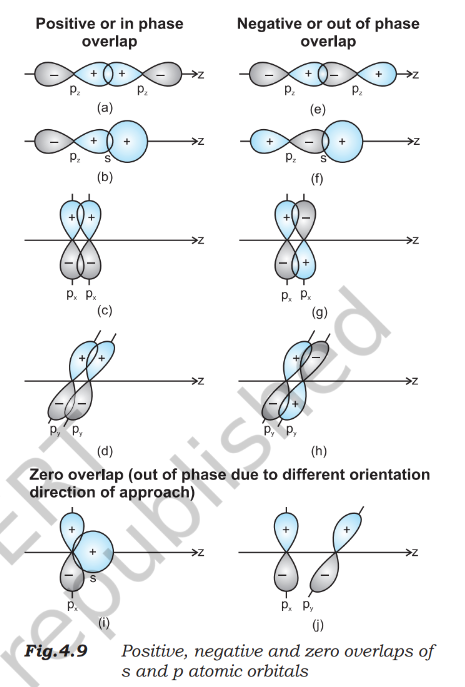
Limits of Simple Orbital Overlap
- Limitation: Unhybridised atomic-orbital overlap alone predicts bond angles of about 90° for CH₄, NH₃ and H₂O, contrary to their observed angles.
- Consequence: Simple overlap therefore cannot explain the directional bonding and actual geometries of these molecules.
Types of Covalent Bonds by Overlap
Pi bond — A bond forms by sideways overlap of parallel orbitals whose axes are perpendicular to the internuclear axis.
| Point | bond | bond |
|---|---|---|
| Overlap | Head-on, along the internuclear axis | Sideways, with orbital axes parallel and perpendicular to the internuclear axis |
| Extent of overlap | Greater | Smaller |
| Relative strength | Stronger | Weaker |
Strength of Sigma and Pi Bonds
Do not confuse orbital phase signs with charge: and show wavefunction phase. Also, a bond is formed by sideways—not head-on—overlap.
Quick recap
- Orbital overlap can be positive, negative or zero; phase signs are not charges.
- Carbon’s simple orbital-overlap model fails to explain the observed bond angles in , and .
- A bond forms by head-on overlap; possible combinations include , and head-on .
- A bond forms by sideways overlap, with electron clouds above and below the atomic plane.
- Greater overlap makes bonds stronger than bonds.
- A multiple bond has one bond and one or more additional bonds.
Hybridisation
Meaning and Features of Hybridisation
- Hybridisation: Mixing atomic orbitals of slightly different energies produces a new set of equivalent hybrid orbitals.
- Role: These directional orbitals form stable bonds and help explain molecular geometry.
Conditions for Hybridisation
- Orbitals involved: Orbitals in the valence shell with nearly equal energies can undergo hybridisation.
- Number and occupancy: The number of hybrid orbitals equals the number of orbitals mixed; promotion is not essential, and filled orbitals may participate.
Types of Hybridisation
- Hybridisation schemes: The type is named for the atomic orbitals mixed, such as s and p orbitals or, in some elements, d orbitals.
- Geometry: The number and spatial arrangement of the resulting hybrid orbitals help determine molecular geometry.
Hybridisation
Hybridisation
- Formation: One s orbital and two p orbitals mix to form three equivalent hybrid orbitals.
- Geometry: The orbitals lie in a plane, 120° apart; in , they form three B–Cl sigma bonds and give a trigonal planar shape.
Hybridisation
- Formation: One s orbital and three p orbitals mix to form four equivalent hybrid orbitals, each with 25% s-character.
- Methane: In , the orbitals point toward the corners of a tetrahedron and overlap with hydrogen 1s orbitals to form four sigma bonds; the angle is 109.5°.
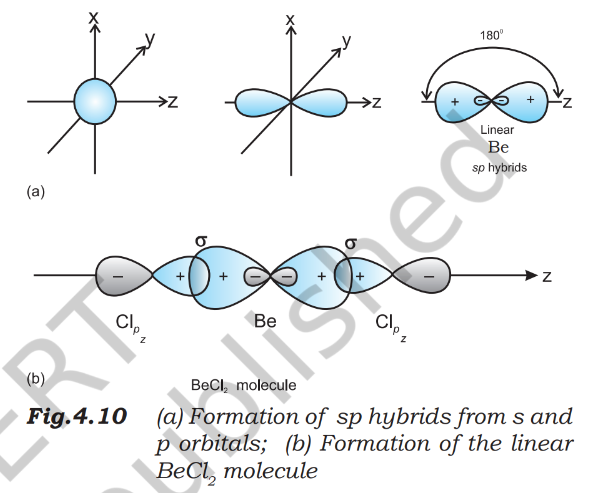
Hybridisation in and
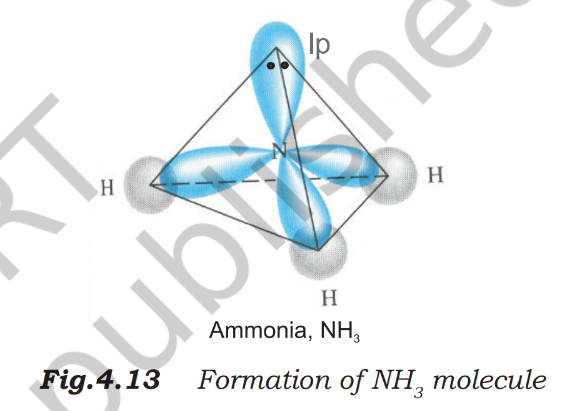
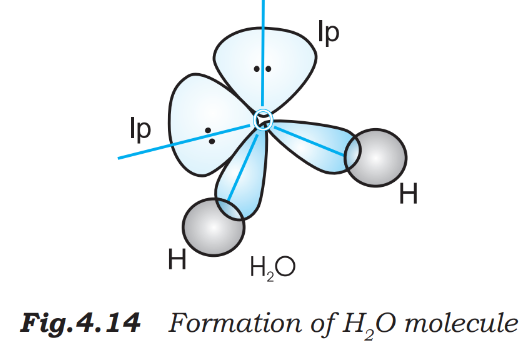
Hybridisation in , and
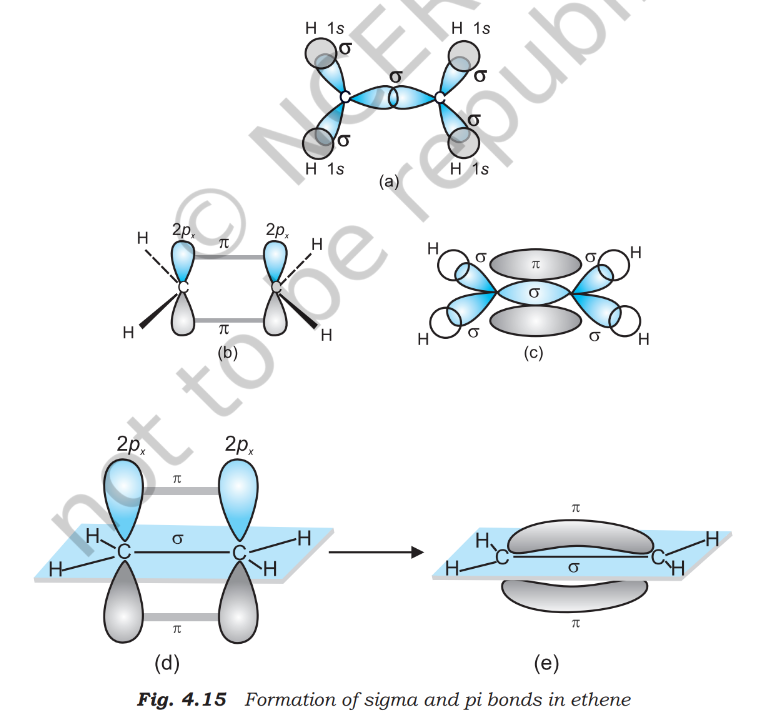
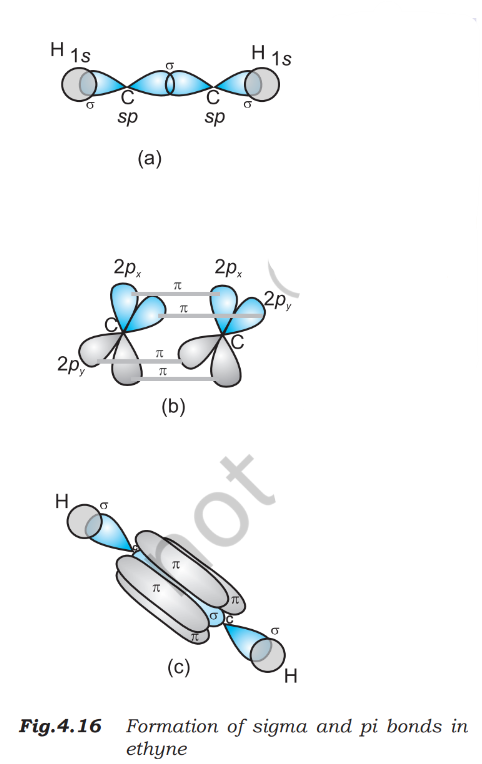
How do the bonds in the C–C multiple bonds of ethene and ethyne differ?
Quick recap
- Hybridisation mixes nearly equal-energy valence orbitals into equivalent, directional orbitals.
- , and form 2, 3 and 4 hybrids, respectively.
- , and correspond to linear, trigonal-planar and tetrahedral arrangements.
- Lone pairs distort ideal tetrahedral bond angles: is and is .
- A double bond contains one and one bond; a triple bond contains one and two bonds.
Hybridisation of Elements involving d Orbitals
Hybridisation Involving d Orbitals
d-orbital hybridisation — Mixing suitable s, p and d orbitals to form hybrid orbitals directed in particular molecular geometries.
Conditions and common schemes
- Energy: Hybridising orbitals must have comparable energies; third-period d orbitals have energies comparable to 3s and 3p, and also to 4s and 4p.
- Limitation: 3p, 3d and 4s orbitals do not hybridise together because the energy difference between 3p and 4s is significant.
| Geometry | Hybridisation | Orbitals mixed | Examples |
|---|---|---|---|
| Square planar | , | ||
| Trigonal bipyramidal | , | ||
| Square pyramidal | |||
| Octahedral | or | or | , ; |
Formation and Shape of PCl₅
sp³d hybridisation — One s, three p and one d orbital mix to form five hybrid orbitals.
PCl₅ bonding and geometry
- Ground state: Phosphorus has outer configuration , with three unpaired electrons.
- Excited state: One electron is promoted from 3s to 3d, giving and five unpaired electrons.
- Hybrid orbitals: One s, three p and one d orbital form five orbitals directed to the vertices of a trigonal bipyramid.
- Bonding: Each phosphorus hybrid orbital overlaps with a singly occupied chlorine orbital to form a sigma bond.
- Geometry: Three equatorial bonds lie in one plane at to one another; two axial bonds lie above and below that plane, at to it.
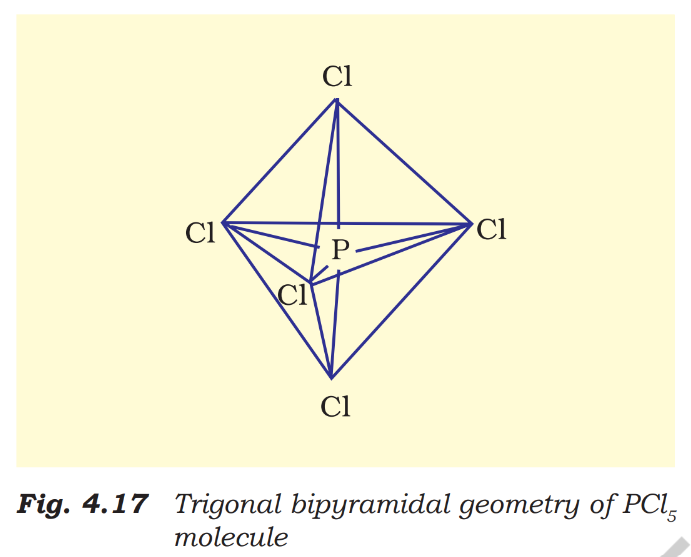
| Bond position | Arrangement | Bond angles | Relative length and strength |
|---|---|---|---|
| Equatorial | Three bonds in the same plane | between equatorial bonds | Shorter and stronger |
| Axial | One above and one below the equatorial plane | to the equatorial plane | Longer and weaker |
Why PCl₅ axial bonds differ
- Repulsion: Axial bond pairs experience more repulsion from equatorial bond pairs.
- Effect: Axial bonds are slightly longer and weaker than equatorial bonds, making more reactive.
Formation and Shape of SF₆
sp³d² hybridisation — One s, three p and two d orbitals mix to form six hybrid orbitals.
SF₆ bonding and geometry
- Ground state: Sulfur has outer configuration .
- Excited state: The six available orbitals are singly occupied, with configuration .
- Hybrid orbitals: One s, three p and two d orbitals form six orbitals directed towards the corners of a regular octahedron.
- Bonding and shape: Each hybrid orbital forms an sigma bond; is octahedral, with adjacent bond angles of .
Molecular Orbital Theory
Molecular orbital — A molecular orbital is a region of electron probability associated with a molecule, where electrons are influenced by two or more nuclei.
Core features of MO theory
- Electron location: Just as atomic electrons occupy atomic orbitals, electrons in molecules occupy molecular orbitals.
- Formation: Atomic orbitals of comparable energy and suitable symmetry combine to form molecular orbitals.
- Nature: An atomic orbital is monocentric, influenced by one nucleus; a molecular orbital is polycentric, influenced by two or more nuclei.
- Orbital count: The number of molecular orbitals formed equals the number of atomic orbitals combined; two atomic orbitals produce two molecular orbitals.
- Filling: Molecular orbitals follow the aufbau principle, Pauli exclusion principle and Hund’s rule.
- Development: F. Hund and R. S. Mulliken developed molecular orbital theory in 1932.
LCAO: Formation of Molecular Orbitals
Linear combination of atomic orbitals (LCAO) — An approximate method for constructing molecular orbitals by adding or subtracting atomic-orbital wave functions.
Bonding and antibonding molecular orbitals
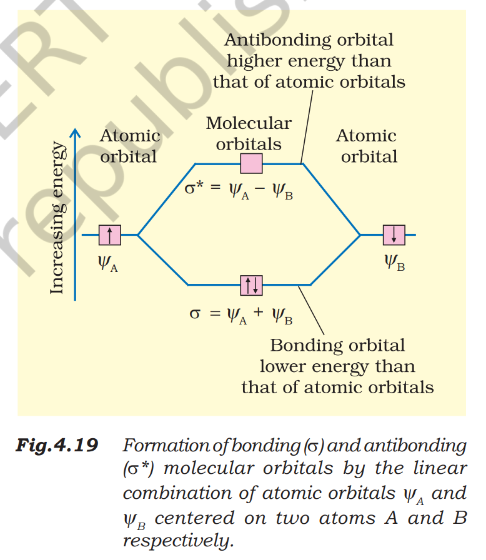
- Wave functions: Atomic orbitals are represented by wave functions such as and ; LCAO is used because the Schrödinger equation is difficult to solve directly for multi-electron systems.
- Bonding orbital: Addition of wave functions gives constructive interference, concentrating electron density between nuclei and lowering energy below the parent atomic orbitals.
- Antibonding orbital: Subtraction gives destructive interference, a nodal plane between nuclei and reduced electron density there; its energy is raised above the parent orbitals.
- Stability: Bonding-orbital electrons help hold nuclei together; antibonding-orbital electrons destabilise the molecule.
- Energy balance: The total energy of the bonding and antibonding molecular orbitals together equals that of the two original atomic orbitals.
| Point | Bonding molecular orbital | Antibonding molecular orbital |
|---|---|---|
| Wave combination | Addition; constructive interference | Subtraction; destructive interference |
| Electron distribution | High density between nuclei | Nodal plane between nuclei; low density there |
| Energy and effect | Lower energy; stabilises the molecule | Higher energy; destabilises the molecule |
Why are the axial bonds in longer and weaker than the equatorial bonds?
State the difference between bonding and antibonding molecular orbitals.
Quick recap
- Comparable-energy s, p and d orbitals can hybridise; 3p, 3d and 4s do not hybridise together.
- has hybridisation and trigonal bipyramidal geometry; axial bonds are longer and weaker.
- has hybridisation and octahedral geometry.
- Molecular electrons occupy molecular orbitals, formed from atomic orbitals of comparable energy and suitable symmetry.
- The number of molecular orbitals formed equals the number of combining atomic orbitals; two form bonding and antibonding orbitals.
- LCAO combines wave functions by addition or subtraction; bonding orbitals are lower in energy and antibonding orbitals are higher.
Conditions for the Combination of Atomic Orbitals
Conditions for Combining Atomic Orbitals
Linear combination of atomic orbitals — Atomic orbitals combine to form molecular orbitals only when they satisfy energy, symmetry and overlap requirements.
Requirements for combination
- Energy match: Combining orbitals must have the same or nearly the same energy. For example, two orbitals can combine, but and generally cannot because their energies differ greatly.
- Similar atoms: Similar-energy matching may not apply when the atoms are very different.
- Same symmetry: Orbitals must have the same symmetry about the molecular axis, conventionally the -axis.
- Maximum overlap: Greater overlap creates greater electron density between the nuclei.
Symmetry examples
- Allowed: A orbital can combine with another orbital.
- Not allowed by symmetry: A orbital does not combine with or about the molecular axis, even if their energies are similar.
Types of Molecular Orbitals
Bonding, antibonding, sigma and pi orbitals
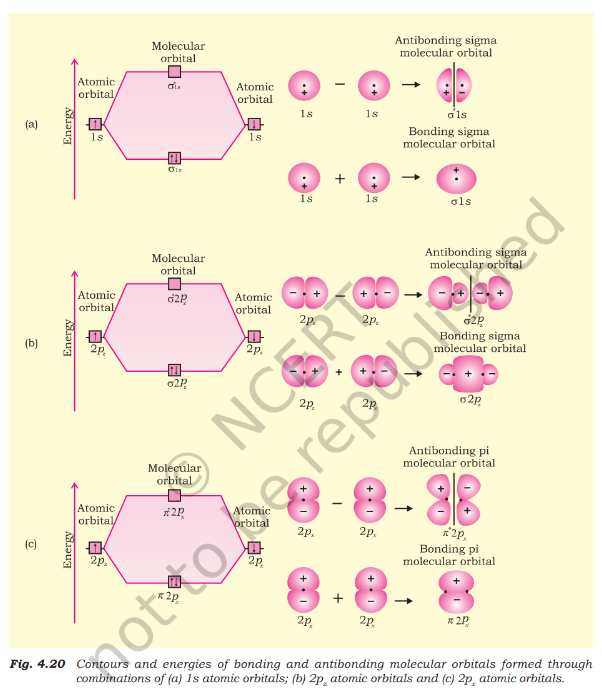
- Bonding MO: In-phase overlap forms a lower-energy orbital with electron density between the nuclei, stabilising the molecule.
- Antibonding MO: Out-of-phase overlap forms a higher-energy orbital; its electrons oppose bonding and destabilise the molecule.
- Sigma (): Symmetrical around the bond axis; formed by head-on overlap, such as – or –.
- Pi (): Not symmetrical around the bond axis; formed by side-by-side overlap of or orbitals.
- Pi bonding MO: Has greater electron density above and below the internuclear axis.
- Pi antibonding MO: Has a node between the nuclei.
- Other designation: Diatomic molecular orbitals may also be designated delta ().
| Atomic orbital overlap | Bonding MO | Antibonding MO |
|---|---|---|
| with | ||
| with | ||
| or side-by-side | or | or |
Molecular Orbital Energy Levels
Molecular orbitals from the and atomic orbitals
- Formation: The eight and atomic orbitals on two atoms form eight MOs: four bonding and four antibonding.
- Degeneracy: The and orbitals have equal energy; their antibonding counterparts also have equal energy.
| Type | Molecular orbitals |
|---|---|
| Bonding MOs | , , , |
| Antibonding MOs | , , , |
| Ordering | Increasing energy |
|---|---|
| First listed | |
| Characteristic ordering stated |
Electronic Configuration and Molecular Behaviour
Electronic configuration — The distribution of a molecule’s electrons among its molecular orbitals.
Stability and Bond Order
- Bonding electrons (): Electrons occupying bonding molecular orbitals.
- Antibonding electrons (): Electrons occupying antibonding molecular orbitals.
- Stability: A molecule is stable if ; it is unstable if or .
- Bond order: Half the difference between the numbers of bonding and antibonding electrons.
Use the electron counts in bonding and antibonding orbitals to assess stability.
| Bond order | Interpretation |
|---|---|
| Positive | Stable molecule |
| Zero or negative | Unstable molecule |
| 1, 2 or 3 | Corresponds respectively to a single, double or triple bond |
| Higher bond order | Generally shorter bond length |
| Point | Diamagnetic | Paramagnetic |
|---|---|---|
| Orbital occupancy | All molecular orbitals are doubly occupied | One or more molecular orbitals are singly occupied |
| Response to magnetic field | Repelled | Attracted |
| Example | — |
State the three conditions required for atomic orbitals to combine.
Define bond order and state how it relates to stability and bond length.
How do diamagnetic and paramagnetic molecules differ?
Quick recap
- AO combination: Requires similar energies, matching symmetry and substantial overlap.
- MO types: Diatomic molecular orbitals are designated , , , etc.; orbitals are symmetrical around the bond axis, while orbitals are not.
- Bonding vs antibonding: Bonding orbitals are lower in energy and stabilising; antibonding orbitals are higher and destabilising.
- Bond order: ; positive values indicate stability.
- Bond properties: Bond orders of 1, 2 and 3 represent single, double and triple bonds; higher bond order generally means shorter bonds.
- Magnetism: All orbitals doubly occupied means diamagnetic; one or more singly occupied means paramagnetic.
Bonding In Some Homonuclear Diatomic Molecules
Molecular Orbital Bonding in Homonuclear Diatomic Molecules
Key ideas
- Bonding molecular orbital: Electrons in this orbital favour bonding between the atoms; antibonding orbitals are marked with an asterisk, such as or .
- Orbital types: orbitals form by head-on overlap, while orbitals form by sideways overlap.
- Bond order: It is half the difference between the number of electrons in bonding and antibonding molecular orbitals.
- Magnetism: Unpaired electrons make a molecule paramagnetic; all paired electrons make it diamagnetic.
is the number of bonding electrons and is the number of antibonding electrons.
| Molecule | Molecular-orbital configuration | Bond order and properties |
|---|---|---|
| Bond order ; one covalent bond; diamagnetic. Bond dissociation energy ; bond length . | ||
| Bond order ; unstable and does not exist. | ||
| Bond order ; stable and diamagnetic. denotes the closed K-shell configuration . | ||
| Bond order ; does not exist. | ||
| Bond order ; diamagnetic. |
Second-row molecules: orbital ordering
- For , and : The orbitals lie below the orbital because of – mixing.
- For , and : The orbital lies below the orbitals; – mixing is not significant.
- Filling: Electrons occupy orbitals in increasing energy order, following the Pauli exclusion principle and Hund’s rule.
| Molecule | Valence molecular-orbital configuration | Bond order | Magnetic property / stability |
|---|---|---|---|
| Paramagnetic; two unpaired electrons. | |||
| Diamagnetic. | |||
| Diamagnetic; strong bond and short bond length. | |||
| Paramagnetic; two unpaired electrons in orbitals. | |||
| Diamagnetic. | |||
| Diamagnetic; unstable. |
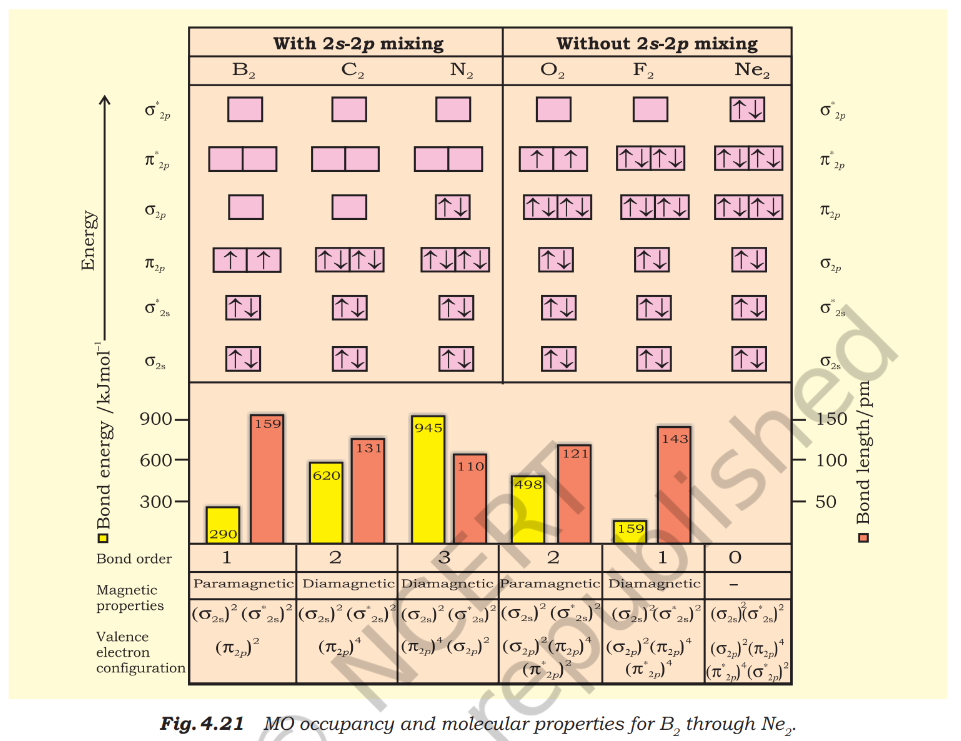
Important implications
- Bond strength: A higher bond order generally means a stronger bond and a shorter bond length.
- Oxygen: Molecular orbital theory explains why is paramagnetic: it has one unpaired electron in each of two orbitals.
- Nitrogen: has bond order and no unpaired electrons, so it is diamagnetic.
Hydrogen Bonding
Hydrogen bond — An attraction between a hydrogen atom bonded to a highly electronegative atom and an electronegative atom, usually , or , in another molecule or in the same molecule.
Cause and nature
- Polarity: When hydrogen is covalently bonded to a strongly electronegative atom , the shared electrons shift towards ; hydrogen becomes partially positive () and partially negative ().
- Attraction: The hydrogen is attracted to an electronegative atom on another molecule or elsewhere in the same molecule.
- Strength and notation: A hydrogen bond is weaker than a covalent bond and is represented by a dotted line; a solid line represents a covalent bond.
- Physical state: Hydrogen bonding is strongest in the solid state and weakest in the gaseous state; it can strongly affect structure and properties.
Example: hydrogen fluoride
- Intermolecular attraction: In HF, the hydrogen of one molecule forms a hydrogen bond with the fluorine of another molecule.
- Representation: ; the solid line is covalent and the dotted line is the hydrogen bond.
| Type | Where the bond forms | Examples |
|---|---|---|
| Intermolecular | Between different molecules of the same or different compounds. | HF, alcohol molecules, water molecules. |
| Intramolecular | Within one molecule, between suitable electronegative atoms or groups. | o-Nitrophenol, where hydrogen lies between two oxygen atoms. |
Why is paramagnetic?
Calculate the bond order of and state its stability.
Distinguish between intermolecular and intramolecular hydrogen bonding.
Quick recap
- Bond order is half the difference between bonding and antibonding electron counts.
- Positive bond order indicates bonding; zero bond order corresponds to instability in examples such as and .
- Unpaired electrons cause paramagnetism: and are paramagnetic.
- – mixing changes the molecular-orbital order for , and .
- Hydrogen bonding is an attraction involving partially positive hydrogen and an electronegative atom, commonly , or .
- Hydrogen bonds may be intermolecular or intramolecular and are weaker than covalent bonds.
Summary
Ionic Bonding and Electrovalency
Electrovalency — The ionic combining capacity associated with forming ions by electron transfer.
- Kössel’s idea: Electropositive and electronegative ions form by electron loss and gain, respectively, tending to attain noble-gas configurations.
- Stability: Electrostatic attraction between oppositely charged ions stabilises ionic compounds.
Lewis Symbols and Covalent Bonds
Covalent bond — A bond formed when atoms share one or more pairs of electrons.
- Lewis’s idea: Sharing electron pairs helps atoms attain noble-gas configurations.
- Lewis dot symbol: Dots around an element symbol show its valence electrons.
- Lewis dot structure: A pictorial representation of bonding, showing bonded pairs and lone pairs around atoms.
| Bond type | Shared electron pairs |
|---|---|
| Single | One pair |
| Double | Two pairs |
| Triple | Three pairs |
Ionic Crystal Lattices
Crystal lattice — The ordered, three-dimensional arrangement of positive and negative ions in an ionic solid.
- Charge balance: A crystalline ionic solid has balanced total positive and negative charges.
- Stabilisation: The lattice is stabilised by the enthalpy of lattice formation; it is an ionic aggregation, not a collection of separate molecules.
Bond Pairs, Lone Pairs and Bond Parameters
Lone pair — A pair of electrons on an atom that is not involved in bonding.
- Lewis structures: Show shared bonding pairs and unshared lone pairs around atoms.
- Bond parameters: Bond length, bond angle, bond enthalpy, bond order and bond polarity significantly affect compound properties.
| Parameter | What it describes |
|---|---|
| Bond length | Distance between the nuclei of bonded atoms |
| Bond angle | Angle between bonds around a central atom |
| Bond enthalpy | Energy required to break a bond |
| Bond order | Number of bonds between a pair of atoms |
| Bond polarity | Unequal sharing of bonding electrons |
Resonance
Resonance — A representation using multiple Lewis structures when one structure alone cannot accurately describe a molecule or ion.
- Canonical forms: The contributing structures have the same skeletal arrangement but differ in electron placement.
- Resonance hybrid: The contributing forms taken together represent the molecule or ion.
VSEPR Model
VSEPR model — A model that predicts molecular shape by assuming electron pairs repel and arrange themselves as far apart as possible.
- Geometry: Molecular shape depends on repulsions between lone pairs and bonding pairs around the central atom.
- Repulsion order: Lone pair–lone pair repulsion is strongest; bonding pair–bonding pair is weakest.
Valence Bond Theory and Orbital Overlap
Valence bond (VB) theory — A theory that explains covalent bond formation through the overlap of atomic orbitals.
- Distinctive focus: VB theory addresses the energetics of covalent bond formation, which the Lewis and VSEPR models do not explain.
- H₂ formation: Singly occupied orbitals of two hydrogen atoms overlap.
- Energy change: As the atoms approach, potential energy falls to a minimum at the equilibrium bond distance; bringing nuclei closer raises energy sharply and destabilises the molecule.
- Electron density: Overlap increases electron density between the nuclei, helping to hold them together.
- Limitation: Orbital overlap alone does not predict the actual bond enthalpy and bond length; other variables must also be considered.
Hybridisation
Hybridisation — The mixing of atomic orbitals used to explain characteristic molecular shapes and bonding.
- Pauling’s concept: Hybridisation explains characteristic shapes of polyatomic molecules.
- Applications: It explains bonding and shapes in molecules such as , , , and .
- Multiple bonds: It also helps explain bonding in and .
| Hybridisation | Molecular examples |
|---|---|
| , and |
Molecular Orbital Theory
Molecular orbital (MO) theory — A theory in which atomic orbitals combine to form molecular orbitals associated with the molecule as a whole.
- Number of orbitals: The number of molecular orbitals formed equals the number of atomic orbitals combined.
- Bonding MO: Lower in energy than the individual atomic orbitals, with increased electron density between the nuclei.
- Antibonding MO: Higher in energy than the individual atomic orbitals, with a region of zero electron density between the nuclei.
- Filling orbitals: Electrons fill molecular orbitals in increasing energy order, following the Pauli exclusion principle and Hund’s rule.
- Stability: A molecule is stable when bonding molecular orbitals contain more electrons than antibonding molecular orbitals.
| Orbital type | Energy | Electron-density feature |
|---|---|---|
| Bonding MO | Lower than the individual atomic orbitals | Increased between nuclei |
| Antibonding MO | Higher than the individual atomic orbitals | A zero-density region between nuclei |
Hydrogen Bonding
Hydrogen bond — An interaction formed when a hydrogen atom lies between two highly electronegative atoms, such as , or .
| Type | Where it occurs |
|---|---|
| Intermolecular | Between two or more molecules of the same or different substances |
| Intramolecular | Within the same molecule |
- Effect: Hydrogen bonding can strongly influence the structure and properties of compounds.
What distinct aspect of covalent bonding does valence bond theory explain?
State the VSEPR electron-pair repulsion order.
Quick recap
- Kössel related ion formation to attaining noble-gas configurations; electrostatic attraction stabilises oppositely charged ions.
- Lewis symbols show valence electrons, while Lewis structures show bonding pairs and lone pairs.
- Resonance uses contributing canonical forms together to represent a molecule or ion.
- VSEPR predicts shape from electron-pair repulsions, with lone pair–lone pair repulsion strongest.
- VB theory explains covalent bond formation energetics through orbital overlap; hybridisation helps explain molecular shapes.
- MO theory distinguishes bonding from antibonding orbitals and links electron populations to molecular stability.
- Hydrogen bonds may be intermolecular or intramolecular and affect compound structure and properties.
Chemistry — ALL CHAPTERS
1
Some Basic Concepts Of Chemistry
2
Structure Of Atom
3
Classification Of Elements And Periodicity In Properties
4
Chemical Bonding And Molecular Structure
5
Thermodynamics
6
Equilibrium
7
Redox Reactions
8
Organic Chemistry – Some Basic Principles And Techniques
9
Hydrocarbons