Class 11 PCB . Chemistry . Chemistry Part II . Hydrocarbons
Chapter 9: Hydrocarbons
Ch 9
Chemistry
Class 11 PCB
Introduction And Classification Of Hydrocarbons
Hydrocarbon — A compound made up of carbon and hydrogen only.
Importance and sources
- Fuel abbreviations: LPG = liquefied petroleum gas; CNG = compressed natural gas; LNG = liquefied natural gas.
- Fuel sources: Petrol, diesel and kerosene are obtained by fractional distillation of petroleum; coal gas comes from destructive distillation of coal.
- Natural gas: It occurs in upper strata during oil-well drilling; compression gives CNG and liquefaction gives LNG.
- Uses: Hydrocarbons provide energy and raw materials for polythene, polypropene, polystyrene, dyes and drugs; higher hydrocarbons are paint solvents.
- Pollution: LPG is used as a low-pollution domestic fuel; petrol- and CNG-powered automobiles cause less pollution than some alternatives.
Classification of Hydrocarbons
| Class | Bonding / structure | Examples |
|---|---|---|
| Saturated | Only C–C and C–H single bonds; open chains are alkanes, rings are cycloalkanes. | Alkanes, cycloalkanes |
| Unsaturated | Contains C=C double bonds, C≡C triple bonds, or both. | Alkenes, alkynes |
| Aromatic | A special type of cyclic hydrocarbon. | Benzene and related compounds |
Alkanes: Structure and General Formula
Alkanes — Saturated open-chain hydrocarbons containing only carbon–carbon and carbon–hydrogen single bonds.
For an alkane containing carbon atoms.
Key features
- Homologous series: Successive alkanes differ by a unit: methane, ethane, propane, butane, and so on.
- Formation pattern: Replacing one hydrogen atom in methane with a group gives ethane; repeating this extends the carbon chain.
- Reactivity: Alkanes are relatively unreactive under ordinary conditions and were called paraffins, meaning “little affinity.”
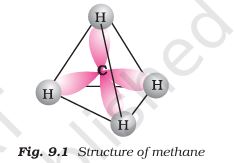
- Methane: The simplest alkane, , occurs in coal mines and marshy places.
- Bonding: Carbon is hybridised; C–C and C–H sigma bonds form by head-on overlap of carbon orbitals with carbon or hydrogen orbitals.
- Bond lengths: C–C is ; C–H is .
Alkane Nomenclature and Isomerism
Structural isomers — Compounds with the same molecular formula but different structural arrangements; their properties may differ.
Chain isomerism
- Chain isomers: Structural isomers that differ in the arrangement of the carbon chain, such as straight and branched chains.
- Counts: has two chain isomers; has three.
- First members: Methane, ethane and propane each have only one carbon-chain structure.
- Examples: Butane and 2-methylpropane are isomers; pentane, 2-methylbutane and 2,2-dimethylpropane are isomers.
| Condensed structure | IUPAC name |
|---|---|
| Hexane | |
| 2-Methylpentane | |
| 3-Methylpentane | |
| 2,3-Dimethylbutane | |
| 2,2-Dimethylbutane |
Rules for naming branched alkanes
- Parent chain: Choose the longest continuous carbon chain and use its alkane name.
- Numbering: Number from the end that gives the substituents the lowest possible locants.
- Substituents: Name each branch as an alkyl group and show its position; use di-, tri- or tetra- for repeated groups.
- Alphabetical order: List different substituents alphabetically; ignore prefixes such as di- when alphabetising. In the cited examples, *sec-* is ignored and *isopropyl* is treated as one word.
- Punctuation: Separate locants with commas and locants from words with hyphens.
| Structure / issue | Correct name or principle |
|---|---|
| 4-Ethyl-2-methylhexane | |
| A chain with ethyl substituents at carbon 3, an isopropyl at 5 and a methyl at 4 on an octane parent. | 3,3-Diethyl-5-isopropyl-4-methyloctane |
| 5-sec-Butyl-4-isopropyldecane; *sec-* is ignored alphabetically. | |
| 5-(2,2-Dimethylpropyl)nonane; number the substituent branch as needed. | |
| “2-Ethylpentane” has a longer six-carbon parent chain. | Correct name: 3-methylhexane. |
| “5-Ethyl-3-methylheptane” has numbering that can be improved. | Correct name: 3-ethyl-5-methylheptane. |
| Alcohol structure | IUPAC name |
|---|---|
| Pentan-1-ol | |
| Pentan-2-ol | |
| Pentan-3-ol | |
| 3-Methylbutan-1-ol | |
| 2-Methylbutan-1-ol | |
| 2-Methylbutan-2-ol | |
| 2,2-Dimethylpropan-1-ol | |
| 3-Methylbutan-2-ol |
Build a structure from an alkane name
- Draw the longest parent chain and number it from the correct end.
- Attach each named substituent at its stated carbon number.
- Add hydrogen atoms so every carbon has four bonds.
- Example: 3-ethyl-2,2-dimethylpentane.
| IUPAC name | Condensed structure |
|---|---|
| 3,4,4,5-Tetramethylheptane | |
| 2,5-Dimethylhexane |
Preparation of Alkanes
Main sources
- Natural sources: Petroleum and natural gas are the main sources of alkanes.
1. Hydrogenation of Unsaturated Hydrocarbons
Hydrogenation — Addition of hydrogen to an alkene or alkyne to form an alkane, using a finely divided metal catalyst.
Catalysts and conditions
- Catalysts: Platinum, palladium or nickel adsorb hydrogen on their surfaces and activate the H–H bond.
- Conditions: Pt and Pd catalyse the reaction at room temperature; Ni generally requires higher temperature and pressure.
- Hydrogen needed: One mole of adds across a double bond; two moles add across a triple bond.
2. Preparation from Alkyl Halides
Reduction
- Method: Alkyl halides except fluorides are reduced with zinc and dilute hydrochloric acid to alkanes.
- Change: The halogen is replaced by hydrogen; for example, chloromethane gives methane.
Wurtz reaction — Coupling of alkyl halides with sodium in dry ether to form a higher alkane.
Wurtz reaction: key point
- Use: Useful for making higher alkanes with an even number of carbon atoms by coupling identical alkyl groups.
- Solvent: Ether must be dry, meaning free from moisture.
3. Preparation from Carboxylic Acids
Decarboxylation — Removal of carbon dioxide; heating a sodium carboxylate with soda lime gives an alkane with one fewer carbon atom than the original acid.
Soda-lime decarboxylation
- Reagent: Soda lime is a mixture of and ; heat the sodium salt with it.
- Carbon count: The product alkane has one fewer carbon atom than the parent carboxylic acid.
- Example: Sodium butanoate gives propane.
Kolbe's electrolytic method — Electrolysis of an aqueous sodium or potassium carboxylate solution forms an alkane by coupling radicals at the anode.
Kolbe method: key points
- Anode: Carboxylate ions lose electrons, release and form alkyl radicals; two radicals combine to form an alkane.
- Product pattern: Coupling of two identical alkyl radicals generally gives an alkane with an even number of carbon atoms.
- Cathode: Water forms hydrogen gas and hydroxide ions.
- Methane: It cannot be made by this method because electrolysis of formate produces hydrogen radicals, which couple to form rather than a carbon-containing alkane.
How many chain isomers does have? Name them.
What is the carbon-number relationship in soda-lime decarboxylation?
Why does Kolbe electrolysis generally produce alkanes with an even number of carbon atoms?
Quick recap
- Hydrocarbons contain only carbon and hydrogen; LPG, CNG and LNG mean liquefied petroleum gas, compressed natural gas and liquefied natural gas.
- Hydrocarbons are classified as saturated, unsaturated or aromatic according to bonding and structure.
- Open-chain alkanes are saturated, contain C–C and C–H single bonds, and follow .
- Chain isomers share a molecular formula but differ in their carbon-chain arrangement.
- Name branched alkanes using the longest chain, lowest locants and alphabetical substituent order.
- Alkanes can be prepared by hydrogenation, reduction, the Wurtz reaction, decarboxylation and Kolbe electrolysis.
Properties
Physical Properties of Alkanes
Polarity, solubility and physical state
- Polarity: Alkanes are almost non-polar because their and bonds are covalent and carbon and hydrogen have only a small electronegativity difference.
- Intermolecular forces: Alkanes have weak van der Waals attractions; they are colourless and odourless.
- Solubility: Alkanes are hydrophobic and insoluble in water. Non-polar petrol can dissolve greasy, non-polar substances, so it is used for dry cleaning.
- Rule: Like dissolves like: polar substances dissolve in polar solvents and non-polar substances in non-polar solvents.
| Number of carbon atoms | Physical state |
|---|---|
| – | Gases |
| – | Liquids |
| and above | Solids |
Melting and Boiling Points
Trends
- Molecular size: Boiling point generally rises with molecular mass and surface area because larger molecules have stronger van der Waals attractions.
- Branching: More branching makes molecules more compact, reducing their contact area and weakening intermolecular attractions; boiling point therefore falls.
- Pentane isomers: Pentane () > 2-methylbutane () > 2,2-dimethylpropane () in boiling point.
| Alkane | Molecular mass (u) | Boiling point (K) | Melting point (K) |
|---|---|---|---|
| Methane | 16 | 111.0 | 90.5 |
| Ethane | 30 | 184.4 | 101.0 |
| Propane | 44 | 230.9 | 85.3 |
| Butane | 58 | 272.4 | 134.6 |
| 2-Methylpropane | 58 | 261.0 | 114.7 |
| Pentane | 72 | 309.1 | 143.3 |
| 2-Methylbutane | 72 | 300.9 | 113.1 |
| 2,2-Dimethylpropane | 72 | 282.5 | 256.4 |
| Hexane | 86 | 341.9 | 178.5 |
| Heptane | 100 | 371.4 | 182.4 |
| Octane | 114 | 398.7 | 216.2 |
| Nonane | 128 | 423.8 | 222.0 |
| Decane | 142 | 447.1 | 243.3 |
| Eicosane | 282 | 615.0 | 236.2 |
Chemical Properties of Alkanes
General Reactivity
- Typical behaviour: Alkanes are generally inert towards acids, bases, oxidising agents and reducing agents, but react under particular conditions.
Substitution Reactions: Halogenation
Conditions and Reactivity
- Other groups: Hydrogen may be replaced by halogen, nitro or sulphonic acid groups; lower alkanes do not undergo nitration or sulphonation.
- Conditions: Halogenation occurs at – or in diffused sunlight/ultraviolet light.
- Halogen reactivity: The reaction rate follows .
- Hydrogen replacement: The relative rate is .
- Limits: Fluorination is too violent to control. Iodination is slow and reversible; oxidising agents such as or help drive it forward.
Free-Radical Chain Mechanism
Three Stages
- Initiation: Light or heat breaks the relatively weak chlorine bond by homolysis, forming chlorine radicals.
- Propagation: A chlorine radical removes hydrogen from methane to form and a methyl radical. The methyl radical then reacts with chlorine, forming chloromethane and regenerating a chlorine radical.
- Chain growth: Repeated propagation steps continue the reaction; further steps can produce more highly chlorinated products.
- Termination: Radical combination removes radicals, ending the chain. Reactant consumption can also bring the reaction to a stop.
Combustion
Complete and Incomplete Combustion
- Complete combustion: With sufficient air or dioxygen, alkanes form carbon dioxide and water and release a large amount of heat.
- Incomplete combustion: Insufficient oxygen can produce carbon black, used in ink, printer ink, black pigments and filters.
Controlled Oxidation
Conditions and Key Point
- Conditions: A regulated supply of dioxygen or air, heating, high pressure and suitable catalysts can produce different oxidation products.
- Tertiary hydrogen: Although alkanes usually resist oxidation, those with a tertiary hydrogen can be oxidised by potassium permanganate to the corresponding alcohol.
Isomerisation
Conditions and Example
- Conditions: Heat an -alkane with anhydrous aluminium chloride and hydrogen chloride.
- Major products: -Hexane forms 2-methylpentane and 3-methylpentane; minor products may also form.
Aromatisation (Reforming)
Conditions and Examples
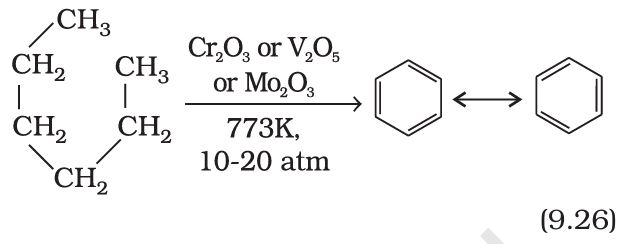
- Suitable alkanes: -Alkanes with six or more carbon atoms undergo aromatisation.
- Conditions: Heat at and – with vanadium, molybdenum or chromium oxides supported on alumina.
- Examples: -Hexane forms benzene; -heptane is used to prepare toluene, the methyl derivative of benzene.
Reaction with Steam
Industrial Preparation of Hydrogen
- Reaction: Methane reacts with steam at over a nickel catalyst to form carbon monoxide and dihydrogen; this is an industrial method of preparing hydrogen.
Pyrolysis (Cracking)
Features and Uses
- Mechanism: Pyrolysis is believed to proceed through a free-radical reaction.
- Use: Oil gas or petrol gas can be produced from kerosene or petrol by applying the principle of pyrolysis.
Conformations of Alkanes
Bond Rotation and Torsional Strain
- Rotation: The electron distribution in a carbon–carbon sigma bond is symmetrical around the bond axis, allowing rotation and an infinite number of conformations.
- Torsional strain: Repulsion between adjacent bond electron clouds hinders rotation; the energy barrier is about –.
- Geometry: Rotation changes spatial arrangements, but bond lengths and bond angles remain unchanged.
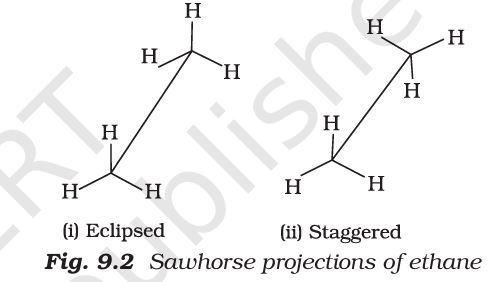
Ethane Conformations and Stability
| Conformation | Arrangement of hydrogen atoms | Repulsion / torsional strain | Relative stability |
|---|---|---|---|
| Staggered | As far apart as possible | Minimum | Most stable; preferred |
| Eclipsed | As close together as possible | Maximum | Less stable |
| Skew | Intermediate arrangement | Intermediate | Intermediate |
Energy and Rotation
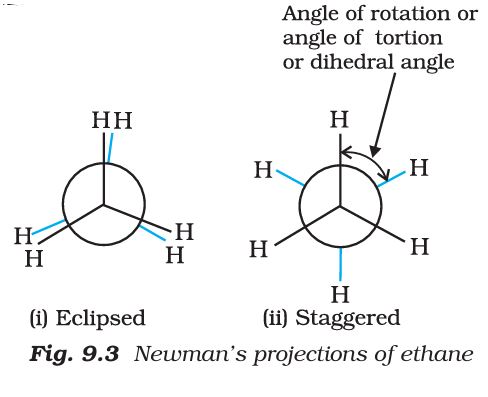
- Dihedral (torsional) angle: The angle of rotation around the carbon–carbon bond; torsional strain changes with this angle.
- Energy difference: Eclipsed and staggered ethane differ by about . The staggered form has least strain and lowest energy.
- Practical rotation: At ordinary temperatures, collisions provide enough energy to overcome the barrier, so rotation is almost free in practice; ethane conformers cannot be isolated.
Sawhorse and Newman Projections
How to Read the Projections
- Sawhorse: The carbon–carbon bond is drawn as a longer slanted line; the front carbon is at the lower end and the rear carbon at the upper end. Each carbon has three bonds shown about apart.
- Newman: View along the carbon–carbon bond. The front carbon is a point and the rear carbon is a circle; each carbon’s three bonds are shown about apart.
Why does boiling point decrease as branching increases among pentane isomers?
State the three stages of free-radical chlorination of methane.
Which ethane conformation is more stable, and why?
Quick recap
- Alkanes are nearly non-polar, hydrophobic and follow the rule like dissolves like; their physical state changes with chain length.
- Boiling point generally rises with molecular size but falls with branching because branching reduces intermolecular contact.
- Alkanes undergo substitution, combustion, controlled oxidation, isomerisation, aromatisation, reaction with steam and pyrolysis under suitable conditions.
- Methane halogenation is a radical chain reaction with initiation, propagation and termination.
- Rotation around carbon–carbon single bonds gives an infinite number of conformations, but torsional strain hinders rotation slightly.
- Staggered ethane is more stable than eclipsed ethane; Sawhorse and Newman projections show these arrangements.
Alkenes
Definition and general formula
- Definition: Alkenes are unsaturated hydrocarbons containing at least one carbon–carbon double bond.
- General formula: Acyclic alkenes with one double bond have the formula ; ethene, , is the first stable member.
Structure of the carbon–carbon double bond
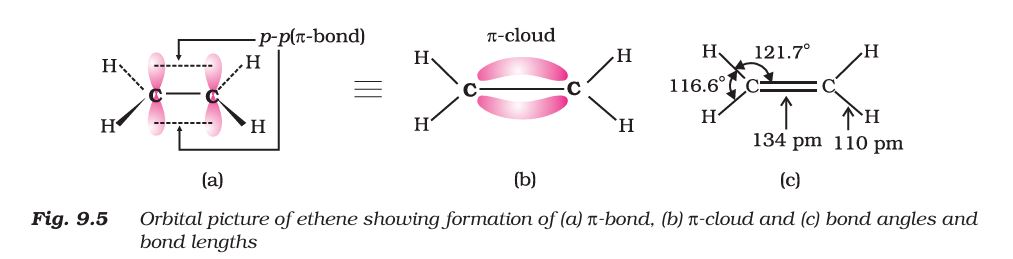
IUPAC nomenclature
Further naming and bond-counting examples
- Example: is 2,8-dimethyldeca-3,6-diene.
- Example: is octa-1,3,5,7-tetraene.
- Example: is 2-propylpent-1-ene.
- Example: is 4-ethyl-2,6-dimethyldec-4-ene.
- Bond counting: Each double bond has one pi bond; count the sigma framework separately. The four larger examples above have sigma/pi counts of , , , and , respectively.
Isomerism in alkenes
- Types: Alkenes exhibit both structural and geometrical isomerism.
- Geometrical isomerism: Restricted rotation about the C=C bond can give cis and trans arrangements when each double-bonded carbon has two different groups.
Structural isomerism
| Structure | IUPAC name |
|---|---|
| Pent-1-ene | |
| Pent-2-ene | |
| 2-Methylbut-2-ene | |
| 3-Methylbut-1-ene | |
| 2-Methylbut-1-ene |
Geometrical (cis–trans) isomerism
Polarity of but-2-ene isomers
- Cis-but-2-ene: More polar; its dipole moment is about .
- Trans-but-2-ene: Nearly non-polar, with dipole moment close to zero because the C–CH bond dipoles cancel.
A C=C bond alone does not ensure cis–trans isomerism: both double-bonded carbons must each carry two different groups.
Which compounds show cis–trans isomerism: , , , and ?
Preparation of alkenes
1. From alkynes: partial reduction
- Lindlar catalyst: Palladised charcoal partially deactivated with poisons such as sulphur compounds or quinoline; controlled hydrogenation gives cis-alkenes.
- Sodium in liquid ammonia: Reduction of alkynes gives trans-alkenes.
- Example: Ethyne gives ethene and propyne gives propene; propene cannot show geometrical isomerism because its terminal carbon has two identical hydrogen atoms.
2. From alkyl halides: dehydrohalogenation
- Conditions: Heat the alkyl halide with alcoholic potassium hydroxide.
- Type: Beta-elimination; hydrogen is removed from the beta carbon, next to the carbon bearing the halogen.
- Halogen: may be , , or .
3. From vicinal dihalides: dehalogenation
- Reaction: Zinc removes the two halogens as , forming a C=C bond.
4. From alcohols: acidic dehydration
- Conditions: Heat the alcohol with concentrated sulphuric acid.
- Type: Beta-elimination; the hydroxyl group and a hydrogen from the adjacent beta carbon are removed.
Physical properties
- Physical state: The first three alkenes are gases, the next fourteen are liquids, and higher members are solids.
- Solubility and appearance: Alkenes are colourless and insoluble in water but dissolve fairly well in non-polar solvents; ethene has a faint sweet smell.
- Boiling point: It increases with molecular size; straight-chain alkenes generally boil at higher temperatures than their branched isomers.
Chemical properties
- Reactivity: Alkenes can undergo free-radical substitution under special conditions, in addition to their characteristic reactions at the double bond.
- Other reactions: Oxidation and ozonolysis are prominent; alkenes can also polymerise to form useful polymers such as polyethene and polypropene.
Addition reactions
1. Addition of dihydrogen
- Hydrogenation: One molecule of hydrogen adds across C=C in the presence of finely divided nickel, palladium, or platinum, producing an alkane.
2. Addition of halogens
- Products: Bromine and chlorine add across C=C to form vicinal dihalides; iodine does not add under normal conditions.
- Test for unsaturation: Reddish-orange bromine solution in carbon tetrachloride is decolourised as bromine adds at the double bond.
- Reaction type: Electrophilic addition involving a cyclic halonium ion.
3. Addition of hydrogen halides
- Reagents and order: in reactivity.
- Products: Hydrogen halides add to alkenes to form alkyl halides by electrophilic addition.
- Symmetrical alkenes: Similar groups on the double-bonded carbons give a single orientation of product.
Markovnikov rule — When an unsymmetrical reagent adds to an unsymmetrical alkene, its negative part attaches to the double-bond carbon with fewer hydrogen atoms.
Markovnikov addition: propene and HBr
- Major product: Propene gives 2-bromopropane rather than 1-bromopropane.
- Reason: The first step forms a carbocation. The secondary carbocation is more stable and forms faster than the primary one; it is then attacked by .
- Date: Markovnikov formulated the rule in 1869.
Peroxide effect (Kharash effect) — In the presence of peroxide, HBr adds to an unsymmetrical alkene contrary to Markovnikov’s rule by a free-radical chain mechanism.
Peroxide effect: essential points
- Specificity: The effect occurs with HBr, not with HCl or HI.
- Orientation: With propene, anti-Markovnikov addition gives 1-bromopropane as the major product.
- Radical stability: Bromine-radical addition forms the more stable secondary carbon radical; it then abstracts hydrogen from HBr, regenerating .
- Names and date: M. S. Kharash and F. R. Mayo observed the reaction in 1933.
4. Addition of cold concentrated sulphuric acid
- Product: Alkenes form alkyl hydrogen sulphates by electrophilic addition.
- Orientation: Addition follows Markovnikov’s rule.
5. Addition of water: hydration
- Conditions: Water adds in the presence of a few drops of concentrated sulphuric acid.
- Orientation: The alcohol product follows Markovnikov’s rule.
Oxidation and ozonolysis
6. Oxidation with potassium permanganate
- Cold, dilute aqueous : Converts an alkene into a vicinal glycol (1,2-diol).
- Test for unsaturation: Decolourisation of potassium permanganate solution indicates reaction at the double bond.
- Strong oxidation: Acidic or acidic can form ketones and/or acids, depending on the alkene and conditions.
Ozonolysis — Ozone cleaves the carbon–carbon double bond; reductive work-up with zinc and water gives carbonyl compounds.
Polymerisation
Quick recap
- Alkenes: Open-chain alkenes with one double bond have formula ; C=C contains one sigma and one pi bond.
- Double-bond reactivity: The weaker pi bond provides mobile electrons, makes alkenes less stable than alkanes, and favours addition.
- Naming and isomerism: Choose the longest chain with C=C and number from the nearer end; alkenes show structural and, when both alkene carbons have different groups, cis–trans isomerism.
- Preparation: Alkenes form by partial reduction of alkynes, dehydrohalogenation, dehalogenation, and acidic dehydration.
- Addition: Hydrogen, halogens, hydrogen halides, and water add across C=C; HBr follows Markovnikov’s rule unless peroxide produces anti-Markovnikov addition.
- Oxidation: Cold dilute permanganate gives glycols; ozonolysis cleaves C=C into carbonyl compounds.
- Polymers: Ethene and propene form polyethene and polypropene, respectively.
Alkynes, Nomenclature And Isomerism
Alkynes
Alkyne — An unsaturated hydrocarbon containing at least one carbon–carbon triple bond.
- General formula: Open-chain alkynes with one triple bond follow .
- Hydrogen content: Alkynes have fewer hydrogen atoms than corresponding alkenes and alkanes.
- First stable member: Ethyne, commonly called acetylene; it is used in oxyacetylene welding.
- Importance: Alkynes are starting materials for many organic compounds.
Nomenclature and Isomerism
Naming alkynes
- IUPAC system: Name the corresponding alkane by replacing -ane with -yne.
- Numbering: Number the longest chain from the end nearest the triple bond; state the number of the first carbon in that bond.
- Common system: Name an alkyne as a derivative of acetylene, e.g. methylacetylene.
| Formula | Structure | Common name | IUPAC name |
|---|---|---|---|
| \ce{HC#CH} | Acetylene | Ethyne | |
| \ce{CH3-C#CH} | Methylacetylene | Propyne | |
| \ce{CH3CH2-C#CH} | Ethylacetylene | But-1-yne | |
| \ce{CH3-C#C-CH3} | Dimethylacetylene | But-2-yne |
| Point | Position isomerism | Chain isomerism |
|---|---|---|
| Cause | Same carbon skeleton, but the triple bond is at different positions. | Different arrangement or branching of the carbon skeleton. |
| Example | Pent-1-yne and pent-2-yne. | Pent-1-yne and 3-methylbut-1-yne. |
| Structure | IUPAC name | Relationship |
|---|---|---|
| \ce{HC#C-CH2-CH2-CH3} | Pent-1-yne | Position isomer of pent-2-yne; chain isomer of 3-methylbut-1-yne. |
| \ce{CH3-C#C-CH2-CH3} | Pent-2-yne | Position isomer of pent-1-yne; chain isomer of 3-methylbut-1-yne. |
| \ce{CH3-CH(CH3)-C#CH} | 3-Methylbut-1-yne | Chain isomer of both unbranched pentynes. |
| Structure | IUPAC name | Isomer group |
|---|---|---|
| \ce{HC#C-CH2-CH2-CH2-CH3} | Hex-1-yne | Unbranched; position isomer |
| \ce{CH3-C#C-CH2-CH2-CH3} | Hex-2-yne | Unbranched; position isomer |
| \ce{CH3-CH2-C#C-CH2-CH3} | Hex-3-yne | Unbranched; position isomer |
| \ce{HC#C-CH(CH3)-CH2-CH3} | 3-Methylpent-1-yne | Branched; chain isomer |
| \ce{HC#C-CH2-CH(CH3)-CH3} | 4-Methylpent-1-yne | Branched; chain isomer |
| \ce{CH3-C#C-CH(CH3)-CH3} | 4-Methylpent-2-yne | Branched; chain isomer |
| \ce{HC#C-C(CH3)2-CH3} | 3,3-Dimethylbut-1-yne | Branched; chain isomer |
Structure of the Triple Bond
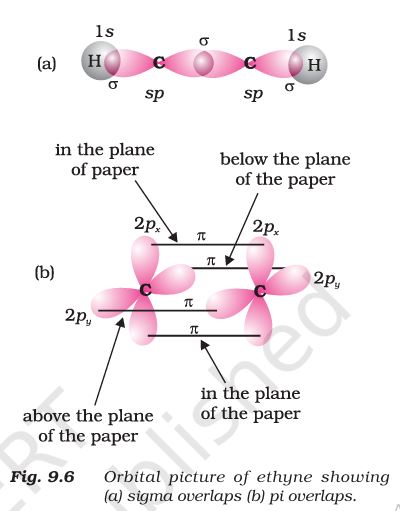
Ethyne structure
- Sigma bonds: Head-on overlap of one orbital from each carbon forms the sigma bond; the other orbital on each carbon overlaps with hydrogen to form two sigma bonds.
- Pi bonds: Each carbon has two unhybridised orbitals. Sideways overlap of parallel orbitals forms two pi bonds.
- Geometry: The bond angle is ; the electron cloud around the carbon–carbon axis is cylindrically symmetrical.
- Bond enthalpy: \ce{C#C} is , compared with for and for .
- Bond length: \ce{C#C} is shortest at ; is and is .
Preparation of Ethyne
From calcium carbide
- Starting material: Limestone is heated to make quicklime; quicklime is heated with coke to form calcium carbide.
From a vicinal dihalide
- First elimination: Alcoholic converts 1,2-dibromoethane to bromoethene.
- Second elimination: removes the remaining hydrogen and bromine to form ethyne.
Properties of Alkynes
Physical properties
- State: The first three members are gases, the next eight are liquids, and higher members are solids.
- Appearance and odour: All are colourless; ethyne has a characteristic odour, while other members are odourless.
- Polarity and solubility: Alkynes are weakly polar, lighter than water, and immiscible with it; they dissolve in organic solvents such as ethers, carbon tetrachloride and benzene.
- Trend: Melting point, boiling point and density increase with increasing molar mass.
Chemical Properties
Acidic character
- Reason: A terminal hydrogen is bonded to an -hybridised carbon with s-character.
- Effect of hybridisation: Greater s-character makes carbon more electronegative, stabilising the conjugate base and making hydrogen easier to release as a proton than in alkenes or alkanes.
- Scope: Only hydrogen attached directly to a triple-bonded carbon is acidic; not every hydrogen in an alkyne is acidic.
- Relative acidity: \ce{HC#CH > H2C=CH2 > CH3-CH3}; among the given alkynes, \ce{HC#CH > CH3-C#CH >> CH3-C#C-CH3}.
Addition reactions — Alkyne triple bonds can add up to two molecules of hydrogen, halogen, hydrogen halide or water.
Addition pattern
- Mechanism: Most alkyne additions are electrophilic; the product depends on the stability of the vinylic cation intermediate.
- Orientation: Addition to an unsymmetrical alkyne follows Markovnikov's rule.
Bromine test for unsaturation
- Test: Alkynes decolourise the reddish-orange bromine solution in carbon tetrachloride.
- Inference: Decolourisation indicates unsaturation.
Polymerisation
Linear polymerisation
- Structure: It contains repeating conjugated units, represented as .
- Use: Specially prepared polyacetylene conducts electricity; thin films can serve as lightweight, relatively inexpensive battery electrodes.
Cyclic polymerisation
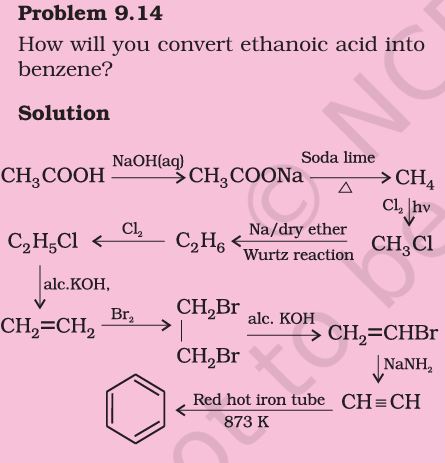
- Conditions: Passing ethyne through a red-hot iron tube at causes cyclic polymerisation.
- Importance: Benzene is a starting material for derivatives including dyes and drugs.
Why is ethyne more acidic than ethene and ethane?
Distinguish position isomerism from chain isomerism in alkynes.
Quick recap
- Alkynes contain a carbon–carbon triple bond and, for one open-chain triple bond, follow .
- IUPAC alkynes use the suffix -yne and identify triple-bond position with the lowest possible number.
- Alkynes exhibit position and chain isomerism; the fifth member is and has seven listed isomers.
- Ethyne is linear and has one carbon–carbon sigma bond and two pi bonds.
- Ethyne is prepared from calcium carbide or by successive elimination from a vicinal dihalide.
- Terminal alkynes are acidic; alkynes also undergo addition reactions and decolourise bromine solution.
- Ethyne polymerises linearly to polyacetylene or cyclically to benzene.
Aromatic Hydrocarbon
Arenes and Their Classification
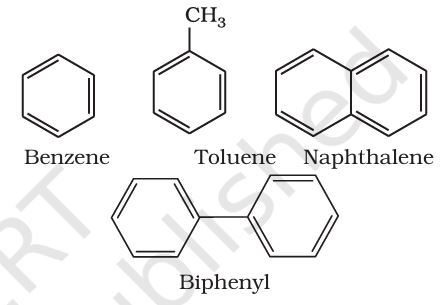
Nomenclature and Isomerism
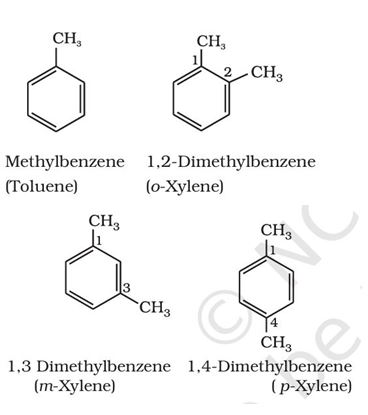
Structure and Stability of Benzene
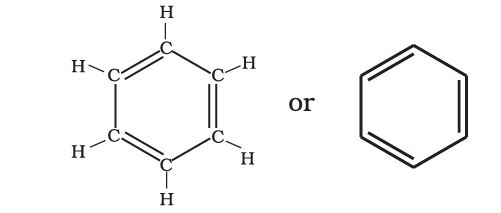
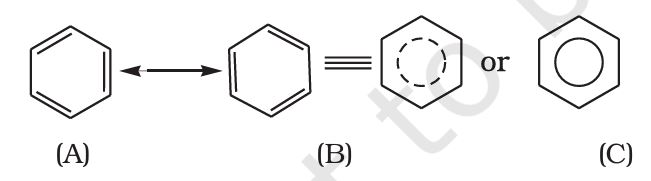
Resonance — Benzene is a resonance hybrid of contributing structures, not a molecule that switches between fixed single- and double-bond arrangements.
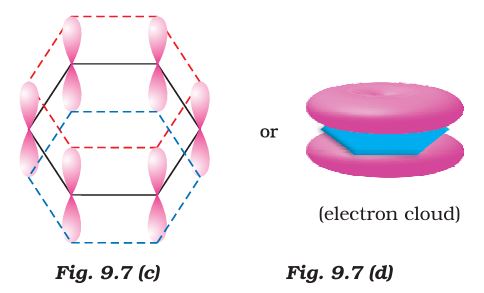
Orbital Picture and Bond Lengths
- Hybridisation: Each carbon atom is hybridised, creating a planar hexagonal framework.
- Sigma bonds: Each carbon forms two bonds with neighbouring carbons and one bond.
- Pi system: Each carbon has one unhybridised orbital perpendicular to the ring; sideways overlap forms a delocalised system above and below it.
- Equal bonds: X-ray diffraction shows all six bonds are equal, about long.
- Intermediate length: The bond length lies between a single bond () and double bond ().
- Reaction consequence: Benzene resists ordinary addition reactions because addition would disrupt its stable delocalised ring.
Do not treat benzene as having three permanently localised double bonds: resonance makes all six carbon–carbon bonds equivalent.
Aromaticity and Hückel Rule
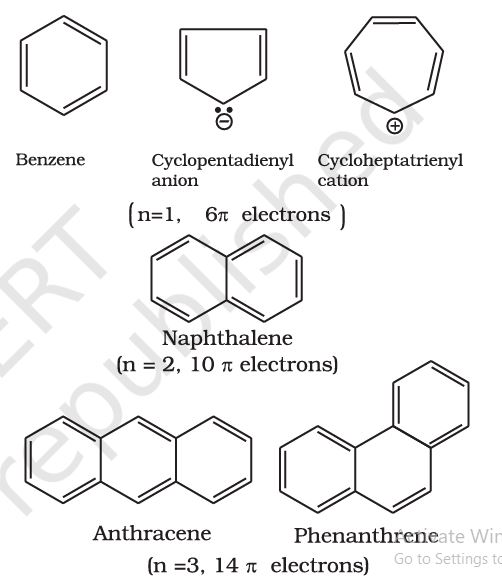
Preparation of Benzene
Laboratory Reactions
- Cyclic polymerisation: Ethyne undergoes cyclic polymerisation to form benzene.
- Decarboxylation: Sodium benzoate heated with soda lime gives benzene.
- Phenol reduction: Phenol vapour passed over heated zinc dust gives benzene and zinc oxide.
Properties of Aromatic Hydrocarbons
Electrophilic substitution — A reaction in which an electrophile replaces a hydrogen atom on an aromatic ring, usually preserving aromaticity.
| Reaction | Electrophile / reagent | Product |
|---|---|---|
| Nitration | Nitronium ion, | Nitrobenzene |
| Halogenation | Halogen with a Lewis acid such as anhydrous , or | Haloarene |
| Sulphonation | Fuming sulphuric acid (oleum) | Benzenesulphonic acid |
| Friedel–Crafts alkylation | Alkyl halide with anhydrous | Alkylbenzene |
| Friedel–Crafts acylation | Acyl halide or acid anhydride with a Lewis acid | Acylbenzene |
Friedel–Crafts Alkylation
- Definition: Benzene reacts with an alkyl halide in the presence of anhydrous to form an alkylbenzene.
- Examples: Methyl chloride gives toluene; ethyl chloride gives ethylbenzene.
- Propyl case: Benzene and -chloropropane form isopropylbenzene rather than -propylbenzene.
Friedel–Crafts acylation — Benzene reacts with an acyl halide or acid anhydride in the presence of a Lewis acid such as anhydrous to form an acylbenzene.
Further Substitution
- Excess electrophile: Further substitution can replace additional ring hydrogens.
- Example: Excess chlorine reacts with benzene in the dark and cold, with anhydrous , to form hexachlorobenzene.
Mechanism of Electrophilic Substitution
Three Mechanistic Stages
- 1. Generate the electrophile: A Lewis acid such as helps produce the electrophile from the attacking reagent.
- 2. Form the sigma complex: The electrophile bonds to a ring carbon, producing a carbocation intermediate called the arenium ion.
- 3. Remove a proton: A base removes from the carbon bearing the new substituent; the ring regains aromaticity.
Electrophile Generation
- Lewis acid role: Anhydrous helps generate electrophiles in halogenation, alkylation and acylation.
- Electrophiles formed: Chlorination forms , alkylation forms , and acylation forms the acylium ion .
- Nitration: Sulphuric acid protonates nitric acid; protonated nitric acid then loses water to form nitronium ion, .
- Acid–base step: In nitronium-ion formation, sulphuric acid acts as the acid and nitric acid as the base.
Arenium Ion and Aromaticity Restoration
- Sigma complex: Electrophilic attack creates a new bond to the ring and a positively charged intermediate.
- Temporary loss of aromaticity: One ring carbon becomes hybridised, interrupting -electron delocalisation.
- Deprotonation: removes the proton in halogenation, alkylation and acylation; removes it in nitration.
- Outcome: Electrons from the carbon–hydrogen bond restore the delocalised ring, producing substituted benzene.
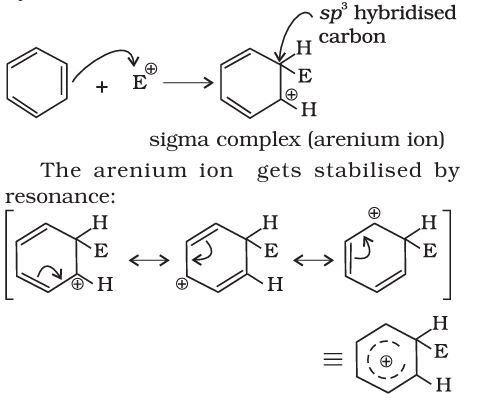
Arenium-ion formation temporarily destroys aromaticity. Proton loss—not electrophile attachment alone—restores the aromatic ring.
Addition and Combustion Reactions
Combustion
- Benzene: On burning in air, benzene forms carbon dioxide and water and gives a sooty flame.
- Balancing idea: Each carbon atom forms one ; hydrogen atoms form water, determining the oxygen required.
Use for complete combustion of a hydrocarbon with carbon atoms and hydrogen atoms.
Directive Influence of Substituents
| Point | Ortho/para directing groups | Meta directing groups |
|---|---|---|
| Preferred positions | Ortho and para | Meta |
| Examples | ; halogens such as | , , , , , , |
| Typical electronic effect | donates by resonance; halogens withdraw inductively but donate by resonance | Strong electron withdrawal makes the ring less electron-rich |
Why Groups Direct to Particular Positions
- Hydroxyl group: The group donates electron density into the ring by resonance, increasing electron density at the ortho and para positions.
- Halogens: Their strong effect deactivates the ring overall, but resonance donation makes ortho and para positions relatively electron-rich; halogens are deactivating yet ortho/para directing.
- Nitro group: The group withdraws electron density strongly by its effect and resonance, deactivating nitrobenzene.
- Meta direction: In nitrobenzene, ortho and para positions are relatively less electron-rich than the meta position, so incoming electrophiles favour meta substitution.
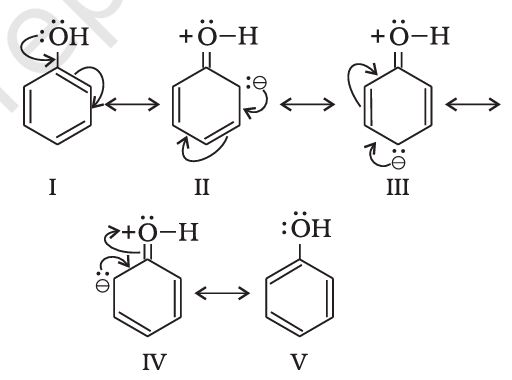
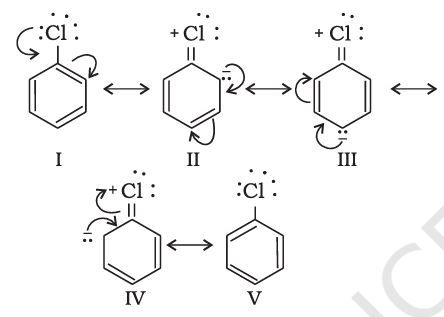
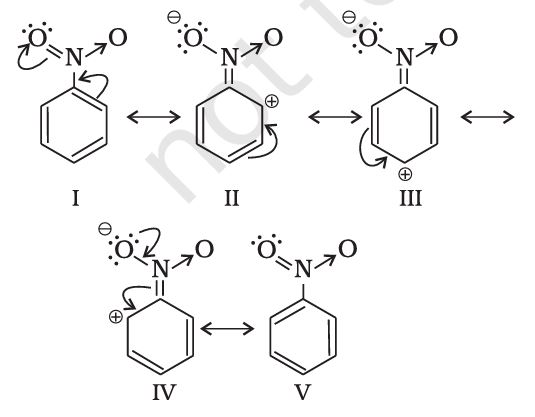
Halogens: Deactivating but Ortho/Para Directing
Keep the effects separate: induction deactivates; resonance directs to ortho and para.
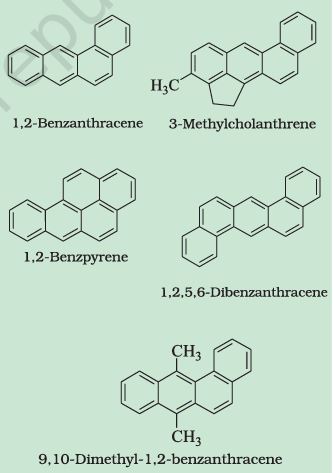
Carcinogenicity and Toxicity
State the conditions for aromaticity according to Hückel’s rule.
Why are all carbon–carbon bonds in benzene equal?
Explain why halogens are deactivating but ortho/para directing.
Quick recap
- Arenes include benzenoid and non-benzenoid aromatic hydrocarbons.
- Benzene is planar, has six delocalised electrons and six equal, intermediate-length carbon–carbon bonds.
- Aromatic systems satisfy Hückel’s -electron rule.
- Benzene can be obtained from coal tar or prepared in the laboratory by polymerisation, decarboxylation or phenol reduction.
- Arenes mainly undergo electrophilic substitution; the mechanism proceeds through electrophile generation, an arenium ion and deprotonation.
- Substituents direct further substitution to ortho/para or meta positions and can activate or deactivate the ring.
- Some fused-ring aromatic hydrocarbons produced by incomplete combustion are toxic and carcinogenic.
Chemistry — ALL CHAPTERS
1
Some Basic Concepts Of Chemistry
2
Structure Of Atom
3
Classification Of Elements And Periodicity In Properties
4
Chemical Bonding And Molecular Structure
5
Thermodynamics
6
Equilibrium
7
Redox Reactions
8
Organic Chemistry – Some Basic Principles And Techniques
9
Hydrocarbons