Class 11 PCB . Chemistry . Chemistry Part II . Redox Reactions
Chapter 7: Redox Reactions
Ch 7
Chemistry
Class 11 PCB
Classical Idea Of Readox Reactions-Oxidation And Reduction Rractions
Redox Reactions and Their Importance
Where redox reactions matter
- Energy and industry: Fuel burning, metal extraction, chemical manufacture, and the operation of dry and wet batteries involve redox processes.
- Other fields: Redox reactions are important in biological, pharmaceutical, metallurgical, and agricultural processes.
- Everyday and environmental relevance: Corrosion of metals and issues such as hydrogen as a fuel and the ozone hole are linked to redox phenomena.
Classical Definitions of Oxidation
Oxidation — A process involving the addition of oxygen or another electronegative element to a substance, or the removal of hydrogen or an electropositive element from it.
How the definition broadened
- Initially: Oxidation meant the addition of oxygen to an element or compound.
- Later: Removal of hydrogen was also recognised as oxidation.
- Broader meaning: Addition of an electronegative element, or removal of an electropositive element, also counts as oxidation.
Classical Definitions of Reduction
Reduction — A process involving the removal of oxygen or another electronegative element from a substance, or the addition of hydrogen or an electropositive element to it.
Reduction examples
- Oxygen removal: Mercuric oxide loses oxygen to form mercury.
- Electronegative element removal: Ferric chloride loses chlorine as it forms ferrous chloride.
- Hydrogen addition: Ethene gains hydrogen to form ethane.
- Electropositive element addition: In the mercuric chloride reaction, mercury is added to mercuric chloride.
| Change | Oxidation | Reduction |
|---|---|---|
| Oxygen | Addition | Removal |
| Hydrogen | Removal | Addition |
| Electronegative element | Addition | Removal |
| Electropositive element | Removal | Addition |
Redox: Oxidation and Reduction Together
Redox reaction — A chemical reaction in which oxidation and reduction occur simultaneously.
Identifying oxidation and reduction
- Hydrogen sulphide with chlorine: Hydrogen sulphide is oxidised; chlorine is reduced by gaining hydrogen.
- Aluminothermic reaction: Aluminium is oxidised as it gains oxygen; iron oxide is reduced as it loses oxygen.
- Sodium and hydrogen: Sodium is oxidised and hydrogen is reduced.
- Oxidation: Add oxygen/electronegative element, or remove hydrogen/electropositive element.
- Reduction: Remove oxygen/electronegative element, or add hydrogen/electropositive element.
- Redox: Oxidation and reduction always occur simultaneously.
Quick recap
- Redox reactions are important in energy, industry, biology, corrosion, and environmental processes.
- Oxidation includes oxygen or electronegative-element addition and hydrogen or electropositive-element removal.
- Reduction includes oxygen or electronegative-element removal and hydrogen or electropositive-element addition.
- Oxidation and reduction always occur together in a redox reaction.
- Identify the process by tracking which elements are added to or removed from each substance.
Redox Reactions In Terms Of Electron Transfer Reactions
Electron Transfer: Oxidation and Reduction
Examples of redox reactions
- Sodium and chlorine: Sodium loses electrons; chlorine gains them.
- Sodium and oxygen or sulphur: Sodium is oxidised, while oxygen or sulphur is reduced.
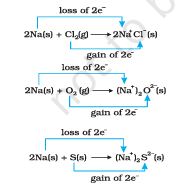
Half-reactions
- Half-reaction: A redox process can be split into oxidation and reduction steps, each showing electron transfer.
- Overall reaction: Adding the half-reactions cancels electrons and gives the complete reaction.
- Ionic products: The products can be written as ions, such as , and .
Oxidation — Loss of one or more electrons by a species.
Reduction — Gain of one or more electrons by a species.
| Term | Electron role | What happens to it? |
|---|---|---|
| Oxidising agent | Accepts electrons | Is reduced |
| Reducing agent | Donates electrons | Is oxidised |
Identifying agents in sodium reactions
- Sodium donates electrons, so it is oxidised and acts as the reducing agent.
- Chlorine, oxygen and sulphur accept electrons from sodium, so they are reduced and act as oxidising agents.
Do not confuse the agents: the oxidising agent gains electrons and is reduced; the reducing agent loses electrons and is oxidised.
Recognising a Redox Change
Sodium hydride formation
- Ionic product: Sodium hydride can be represented as , indicating electron transfer from sodium to hydrogen.
- Conclusion: Sodium loses electrons and is oxidised; hydrogen gains electrons and is reduced. The reaction is a redox change.
Competitive Electron-Transfer Reactions
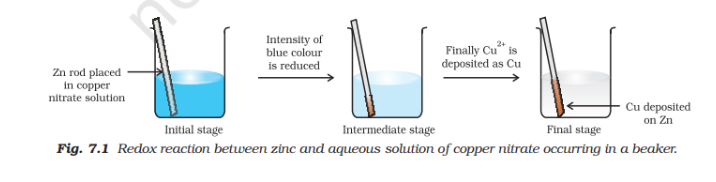
Zinc and copper(II) ions
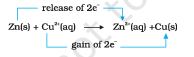
- Reaction: Zinc transfers electrons to copper(II) ions, producing zinc ions and copper metal.
- Evidence: Reddish copper deposits on zinc, while the blue colour due to disappears as forms.
- Electron change: Zinc is oxidised; copper(II) ions are reduced.
Copper and silver ions
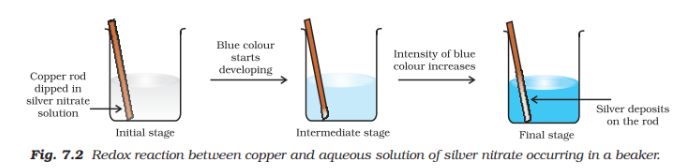
- Reaction: Copper metal donates electrons to silver ions, forming copper(II) ions and silver metal.
- Observation: Silver deposits form and the solution turns blue due to .
- Equilibrium: Products are strongly favoured.
Cobalt and nickel ions
- Reaction: Cobalt transfers electrons to nickel(II) ions, forming cobalt(II) ions and nickel metal.
- Equilibrium: Both reactants and products remain at moderate concentrations; neither side is strongly favoured.
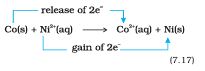
Metal Electron-Releasing Tendency
Comparing metals
- Electron competition: A metal that gives electrons to another metal's ions has a greater electron-releasing tendency.
- Observed order: Zinc transfers electrons to copper ions, and copper transfers electrons to silver ions; therefore, in electron-releasing tendency.
- Electrochemical series: Metals and their ions can be arranged by their tendency to release electrons; this arrangement is also called the metal activity series.
- Galvanic cells: Competitive electron-transfer reactions can produce electrical energy in galvanic cells.
Why is the reaction between zinc and copper(II) ions a redox reaction?
Define an oxidising agent and a reducing agent in terms of electron transfer.
Quick recap
- Oxidation is electron loss; reduction is electron gain.
- Oxidising agents accept electrons; reducing agents donate them.
- Half-reactions show oxidation and reduction separately; adding them gives the overall reaction.
- Sodium forms redox products with chlorine, oxygen and sulphur.
- Zinc displaces copper from solution, and copper displaces silver.
- The electron-releasing tendency shown is ; galvanic cells use redox reactions to produce electrical energy.
Oxidation Number
Oxidation Number and Electron Shifts
Oxidation number (oxidation state) — The oxidation state assigned to an element in a compound or ion by treating each covalent bond’s electron pair as belonging entirely to the more electronegative atom.
Why oxidation numbers are useful
- Covalent reactions: Electron transfer may be partial in reality, but oxidation numbers track electron shifts by assuming complete transfer to the more electronegative atom.
- Bookkeeping model: The complete-transfer assumption is a useful convention, not necessarily a claim that full electrons actually move.
- Multiple atoms: If an element has two or more atoms in a molecule or ion, its stated oxidation number may be the average for those atoms.
Rules for Assigning Oxidation Numbers
| Rule | Oxidation number | Examples / exceptions |
|---|---|---|
| Free elements | Each atom is | , , , , , and free metals such as Na and Mg |
| Monatomic ions | Equals the ion charge | , , , , |
| Common metallic elements | Alkali metals: ; alkaline-earth metals: ; aluminium: | Applies in their compounds |
| Oxygen | Usually | Peroxides: (e.g. , ); superoxides: (e.g. , ) |
| Oxygen bonded to fluorine | Oxygen is positive | : O is ; : each O is |
| Hydrogen | Usually | In binary metal hydrides, H is (e.g. , , ) |
| Fluorine and other halogens | F is always in compounds; Cl, Br, and I are usually as halides | Cl, Br, and I can be positive when combined with oxygen, as in oxoacids and oxoanions |
| Sum in a neutral compound | Algebraic sum of all oxidation numbers is | Use this to find an unknown oxidation number |
| Sum in a polyatomic ion | Algebraic sum equals the ion charge | For , the total for C and three O atoms is |
Applying the sum rule
- Unknown value: Assign the known oxidation numbers, multiply each by the number of atoms, then set the total equal to for a neutral compound or to the ion charge.
- Average value: When equivalent atoms of the same element have different oxidation states, the oxidation number assigned to that element is their average.
Oxidation-Number Trends and Stock Notation
Patterns across elements
- Metals: Usually have positive oxidation numbers; non-metals may have positive or negative values.
- Transition elements: Commonly show several positive oxidation states.
- Highest oxidation number: For representative elements, it is generally the group number in Groups 1–2 and the group number minus in Groups 13–18.
- Across a period: The highest oxidation number generally rises; in Period 3 it ranges from for sodium to for chlorine.
- Terminology: Oxidation number and oxidation state are used interchangeably.
| Group | 1 | 2 | 13 | 14 | 15 | 16 | 17 |
|---|---|---|---|---|---|---|---|
| Element | Na | Mg | Al | Si | P | S | Cl |
| Example compound | |||||||
| Highest oxidation number |
Stock notation — A system that shows a metal’s oxidation number as a Roman numeral in parentheses after its symbol in the formula.
Stock notation examples
- Gold chlorides: Aurous chloride is ; auric chloride is .
- Tin chlorides: Stannous chloride is ; stannic chloride is .
- Oxidation state comparison: is the reduced form relative to .
| Compound | Metal oxidation number | Stock notation |
|---|---|---|
| Au: | ||
| Tl: | ||
| Fe: | ||
| Fe: | ||
| Cu: | ||
| Cu: | ||
| Mn: | ||
| Mn: |
Oxidation, Reduction, and Redox Reactions
Oxidation — An increase in the oxidation number of an element in a substance.
Reduction — A decrease in the oxidation number of an element in a substance.
Oxidising agent (oxidant) — A reagent that causes another element’s oxidation number to increase; the agent itself is reduced.
Reducing agent (reductant) — A reagent that causes another element’s oxidation number to decrease; the agent itself is oxidised.
Redox reaction — A reaction in which interacting species undergo changes in oxidation number, so oxidation and reduction occur together.
Agents in the copper reaction
- Oxidant: helps sulphur in increase its oxidation number; copper(I) in is reduced.
- Reductant: Sulphur in increases from to and helps copper in both reactants become metallic copper.
Do not confuse the agents: the oxidant causes oxidation but is itself reduced; the reductant causes reduction but is itself oxidised.
How do oxidation numbers identify a redox reaction?
In the reaction of with , identify the oxidant and reductant.
Quick recap
- Oxidation number tracks electron shifts using a complete-transfer bookkeeping assumption.
- Free elements have oxidation number ; monatomic ions have oxidation number equal to their charge.
- Oxygen is usually , hydrogen usually , and fluorine always , with key exceptions.
- The oxidation-number sum is in a neutral compound and equals the charge in a polyatomic ion.
- Oxidation is an increase; reduction is a decrease in oxidation number.
- An oxidant is reduced, while a reductant is oxidised.
- Stock notation shows a metal’s oxidation number as a Roman numeral in parentheses.
Types Of Redox Reactions
Combination Reactions
- Combination reaction: Two or more substances combine to form a single product, represented as .
- Redox condition: It is a redox reaction when at least one reactant is in its elemental form; for example, .
Decomposition Reactions
A decomposition that is not redox
- Calcium carbonate: It decomposes without any oxidation-state change: calcium stays at , carbon at , and oxygen at .
- Check: Classify by checking oxidation-state changes, not by the reaction pattern alone.
Displacement Reactions
- Displacement reaction: An atom or ion in a compound is replaced by an atom or ion of another element.
- Types: Displacement reactions are classified as metal displacement and non-metal displacement.
Metal Displacement
- Metal displacement: A metal in its uncombined state replaces another metal in a compound.
- Redox change: The replacing metal is oxidised, while the displaced metal ion is reduced to the metal.
- Reducing ability: The metal that displaces another is the stronger reducing agent.
Non-Metal Displacement: Hydrogen and Oxygen
Halogen Displacement
Disproportionation Reactions
| Element | Reaction | Oxidation-state changes |
|---|---|---|
| Phosphorus | and | |
| Sulfur | and to an average of in | |
| Chlorine | and |
Halogens in alkali
- Bleaching: The hypochlorite ion, , oxidises coloured stains to colourless compounds.
- Bromine and iodine: They show a disproportionation trend similar to chlorine in alkali.
- Fluorine exception: Fluorine cannot have a positive oxidation state, so it does not disproportionate. It forms fluoride and oxygen difluoride with alkali; it also attacks water, producing some oxygen.
| Species | Chlorine oxidation state | Disproportionates? |
|---|---|---|
| Yes | ||
| Yes | ||
| Yes | ||
| (highest) | No |
Classifying Redox Reactions
- Classification: Redox reactions are grouped by how reactants and products change: combination, decomposition, displacement, and disproportionation.
- Identification: Check the oxidation numbers of the elements to confirm that oxidation and reduction occur.
Fractional Oxidation Numbers
Further examples
- Mixed oxides: , , and have fractional average oxidation numbers because the metal atoms occur in more than one whole-number state.
- Dioxygen ions: Oxygen has oxidation state in and in .
Why Lead Tetroxide Reacts Differently with Acids
Why does not undergo disproportionation?
What does a fractional oxidation number usually represent?
Why does produce chlorine with hydrochloric acid but not with nitric acid?
Quick recap
- Combination, decomposition, displacement, and disproportionation are major redox reaction types.
- Non-metal displacement includes hydrogen and halogen displacement, as well as the rare displacement of oxygen by fluorine.
- Check oxidation-state changes: a decomposition such as breakdown is not necessarily redox.
- More reactive metals or halogens displace less reactive species; metal reducing activity decreases as .
- In disproportionation, one intermediate oxidation state gives both higher and lower states; cannot disproportionate because chlorine is at .
- Fractional oxidation numbers usually represent averages of different whole-number states, not fractional electron transfer.
- contains both and , explaining its contrasting reactions with hydrochloric and nitric acids.
Balancing Of Redox Reactions
Methods of Balancing Redox Reactions
Two approaches
- Oxidation number method: Balance using the increase and decrease in oxidation numbers.
- Half-reaction method: Separate the reaction into oxidation and reduction half-reactions, balance each, then add them.
- Choice of method: Either method may be used; choose the one that is more convenient for the reaction.
Oxidation Number Method
Oxidation number method — A method that balances a redox equation by making the total increase and decrease in oxidation number equal.
Procedure
- 1. Write formulas: Write correct formulas for all reactants and products.
- 2. Assign oxidation numbers: Identify the atoms whose oxidation numbers change.
- 3. Equalise electron change: Calculate the increase or decrease per atom and per species; use coefficients so total increase equals total decrease.
- 4. Balance charge: In aqueous reactions, use in acidic solution or in basic solution to equalise ionic charges.
- 5. Balance H and O: Add to balance hydrogen, then verify oxygen, all atoms and total charge.
A valid redox reaction must contain both oxidation and reduction. If the equation appears to contain only one, recheck the formulas or oxidation-number assignments.
Example: dichromate and sulphite in acidic solution
- Oxidation-number changes: Cr changes from to ; S changes from to .
- Electron-change match: Two Cr atoms gain units in total; three S atoms lose units in total.
- Agents: is the oxidising agent; is the reducing agent.
Example: permanganate and bromide in basic solution
- Oxidation-number changes: Mn changes from to (gain of ); Br changes from to (loss of ).
- Electron-change match: Use permanganate ions for each bromide ion.
Half-Reaction Method
Half-reaction method — A method that balances oxidation and reduction separately, then combines them after equalising electron transfer.
Balancing by half-reactions
- Write the unbalanced ionic equation and separate it into oxidation and reduction half-reactions.
- Balance atoms other than oxygen and hydrogen in each half-reaction.
- In acidic solution, balance oxygen with and hydrogen with .
- In basic solution, first balance as for acidic solution; add an equal number of ions to both sides for every , then combine and on the same side to form water and cancel excess water.
- Balance charge in each half-reaction by adding electrons to the more positive side.
- Multiply the half-reactions, if needed, to make the numbers of electrons equal; add them and cancel electrons and any common species.
- Check that atoms and total charge are equal on both sides.
Example: Fe²⁺ oxidised by dichromate in acidic solution
- Oxidation half-reaction: Iron loses one electron per ion.
- Reduction half-reaction: Dichromate gains six electrons; multiply the iron half-reaction by to match.
Example: permanganate oxidises iodide in basic solution
- Half-reactions: Iodide is oxidised to iodine; permanganate is reduced to manganese dioxide.
- Electron match: Multiply the oxidation half-reaction by and the reduction half-reaction by ; both then exchange electrons.
Redox Reactions as the Basis for Titrations
Redox titration — A titration that determines the strength of an oxidising or reducing solution using a redox reaction and an indicator.
| Indicator method | How the endpoint is detected | Example |
|---|---|---|
| Self-indicator | The reagent's own colour signals the endpoint. The first persistent pink tint appears when the last reductant has been oxidised. | Permanganate, |
| Separate redox indicator | The oxidant changes the indicator's colour just after the equivalence point. | Dichromate oxidises diphenylamine to an intense blue form. |
| Iodine–starch method | Iodine gives an intense blue colour with starch; the blue colour disappears when thiosulphate consumes the iodine. | Oxidation of iodide by |
Important endpoint details
- Permanganate endpoint: The lasting pink tint is detectable at about , giving only a small colour overshoot.
- Equivalence point: The oxidant and reductant are present in the mole ratio required by the balanced equation.
- Iodine in solution: Although iodine is sparingly soluble in water, it remains in a solution containing KI as .
Limitation of the Oxidation-Number Concept
- Modern interpretation: Oxidation is viewed as a decrease in electron density around the atoms involved; reduction is an increase in electron density.
- Key idea: Oxidation number is a useful accounting tool, but redox can also be understood through changes in electron density.
How are oxygen and hydrogen balanced in acidic and basic half-reactions?
Distinguish the equivalence point from the endpoint in a redox titration.
Quick recap
- Redox equations can be balanced by oxidation-number changes or by balancing separate half-reactions.
- In the oxidation-number method, total oxidation-number increase must equal total decrease.
- Half-reactions are balanced for atoms, charge and electrons before they are combined.
- Acidic equations use and water; basic equations are converted using .
- Redox titration endpoints can be detected by a self-indicator, a separate indicator, or the iodine–starch method.
- Oxidation corresponds to decreased electron density; reduction corresponds to increased electron density.
Redox Reactions And Electrode Processes
Redox Reactions and Redox Couples
Redox reaction — A reaction in which oxidation and reduction occur simultaneously.
Direct Electron Transfer
- Zinc and copper ions: When zinc is dipped in copper sulphate solution, zinc transfers electrons directly to copper ions; heat is evolved.
- Oxidation: Zinc loses electrons to form zinc ions; reduction: copper ions gain electrons to form copper metal.
Redox couple — The oxidised and reduced forms of a substance involved in an oxidation or reduction half-reaction, considered together.
Redox-Couple Notation
- Order: Write the oxidised form first, followed by a slash or vertical line for the interface, then the reduced form.
- Examples: Zinc and copper couples are written and .
Daniell Cell
Cell Setup and Operation
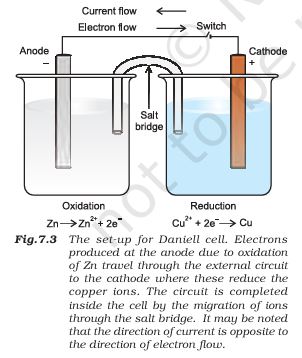
- Set-up: A zinc rod sits in zinc sulphate solution and a copper rod in copper sulphate solution; the rods connect by a wire and the solutions by a salt bridge.
- Salt bridge: A U-tube containing an electrolyte such as potassium chloride or ammonium nitrate, often set in agar gel; it permits electrical contact without allowing the solutions to mix.
- Closed circuit: Electrons pass from zinc to copper through the external wire; ions migrate through the salt bridge to complete the circuit.
- Open switch: No reaction occurs in either beaker and no current flows through the wire.
- Potential difference: Current flows when a potential difference exists between the zinc and copper electrodes.
Electrode Potential and Standard Electrode Potential
Electrode potential — The potential associated with an electrode due to its electrode process.
Standard electrode potential — The electrode potential when each species has unit concentration, any gas is at , and the temperature is ; it is denoted .
Reference and Meaning
- Reference: By convention, the standard potential of the hydrogen electrode, , is .
- Significance: Electrode potential measures the relative tendency of the active species in a redox couple to remain in its oxidised or reduced form.
- Negative : The redox couple is a stronger reducing agent than the couple.
- Positive : The redox couple is a weaker reducing agent than the couple.
| Reduction half-reaction | |
|---|---|
Trends in the Potential Table
- Oxidising strength: Increases upward in the standard reduction-potential table.
- Reducing strength: Increases downward in the table; the reducing forms of couples with more negative are stronger.
Redox Concepts and Reaction Classification
| Conceptualisation | Oxidation | Reduction |
|---|---|---|
| Classical | Addition of oxygen or removal of hydrogen | Removal of oxygen or addition of hydrogen |
| Electronic | Loss of electrons | Gain of electrons |
| Oxidation number | Increase in oxidation number | Decrease in oxidation number |
Agents and Redox-Equation Methods
- Oxidising agent (oxidant): Accepts electrons and is itself reduced.
- Reducing agent (reductant): Donates electrons and is itself oxidised.
- Equation writing: Oxidation-number and ion–electron methods are useful for writing and balancing redox equations.
| Type | General feature |
|---|---|
| Combination | Two or more reactants combine to form one product. |
| Decomposition | One reactant breaks down into two or more products. |
| Displacement | An element displaces another element from a compound. |
| Disproportionation | The same element in one species is simultaneously oxidised and reduced. |
What does a negative standard reduction potential indicate?
State the standard conditions for measuring an electrode potential.
Quick recap
- Redox reactions involve oxidation and reduction together; zinc transfers electrons to copper ions in the zinc–copper reaction.
- A redox couple lists the oxidised form before the reduced form, as in .
- In a Daniell cell, electrons travel through the wire and ions migrate through the salt bridge.
- Standard electrode potentials use unit concentration, for gases, and ; hydrogen is assigned .
- Oxidising strength increases upward and reducing strength increases downward in the standard reduction-potential table.
- Redox can be described classically, by electron transfer, or by oxidation-number change; equation methods include oxidation-number and ion–electron balancing.
- The four redox categories are combination, decomposition, displacement, and disproportionation.
Chemistry — ALL CHAPTERS
1
Some Basic Concepts Of Chemistry
2
Structure Of Atom
3
Classification Of Elements And Periodicity In Properties
4
Chemical Bonding And Molecular Structure
5
Thermodynamics
6
Equilibrium
7
Redox Reactions
8
Organic Chemistry – Some Basic Principles And Techniques
9
Hydrocarbons