Class 11 PCB . Chemistry . Chemistry Part I . Some Basic Concepts of Chemistry
Chapter 1: Some Basic Concepts Of Chemistry
Ch 1
Chemistry
Class 11 PCB
Development Of Chemistry
Chemistry and Its Early Aims
Chemistry — The branch of science that studies the preparation, properties, structure and reactions of material substances.
Early motivations for chemical study
- Early goal: Searchers sought a philosopher’s stone (Paras) that could turn base metals, such as iron and copper, into gold.
- Second goal: They also searched for an “elixir of life” believed to grant immortality.
- Early traditions: Chemistry developed through alchemy and iatrochemistry; Chinese and Indian traditions also developed chemical processes and techniques.
Broad development of chemistry
- 1300–1600 CEChemistry developed mainly through alchemy and iatrochemistry.
- 18th centuryModern chemistry took shape in Europe after centuries of alchemical traditions introduced there by Arabs.
- Later part of the 19th centuryModern science began to appear in India.
- Mid-19th centuryEuropean scientists began coming to India, and modern chemistry started growing.
Chemistry in Ancient India
Names and scope
- Names: Chemistry was known as Rasayan Shastra, Rastantra, Ras Kriya or Rasvidya.
- Scope: It included metallurgy, medicine, cosmetics, glass-making and dyes.
- Evidence: Excavations at Mohenjodaro in Sindh and Harappa in Punjab show that Indian chemical practices have a long history.
| Evidence or material | What it indicates |
|---|---|
| Baked bricks and mass-produced pottery | Pottery was an early chemical process: materials were mixed, moulded and heated to gain desired qualities. |
| Glazed pottery and gypsum cement | Gypsum cement contained lime, sand and traces of . |
| Faience at Harappan sites | A glass-like material used for ornaments. |
| Lead, silver, gold and copper objects | Metal objects were melted and forged; copper hardness was increased using tin and arsenic. |
| Glass objects at Maski | Finds date to 1000–900 BCE. |
| Glass objects at Hastinapur and Taxila | Finds date to 1000–200 BCE. |
| Coloured glass and glazes | Colouring agents such as metal oxides were added. |
Metallurgy and craft processes
- Copper metallurgy: It dates back to the beginning of Chalcolithic cultures in the subcontinent.
- Metal extraction: Archaeological evidence supports the indigenous development of technologies for extracting copper and iron.
- Kiln control: The glossy finish of northern India’s black polished ware shows skilled control of kiln temperatures; its golden gloss remains a chemical mystery.
Chemical Knowledge in Texts and Practices
| Source or evidence | Chemical knowledge described |
|---|---|
| Rigveda, 1000–400 BCE | Tanning leather and dyeing cotton were practised. |
| Kautilya’s Arthashastra | Describes obtaining salt from seawater and mentions different kinds of liquor. |
| Sushruta Samhita | Explains the importance of alkalies. |
| Charaka Samhita | Mentions preparation of sulphuric acid, nitric acid, oxides of copper, tin and zinc, sulphates of copper, zinc and iron, and carbonates of lead and iron. |
| Rasopanishada and Tamil texts | Describe gunpowder mixture and fireworks using materials including sulphur, charcoal, saltpetre (potassium nitrate), mercury and camphor. |
Nagarjuna and metallurgical writing
- Nagarjuna: An Indian chemist, alchemist and metallurgist whose work *Rasratnakar* discusses mercury compounds and extracting gold, silver, tin and copper.
- Rasarnavam: A text appearing around 800 CE; it describes furnaces, ovens and crucibles for different purposes, and identifying metals by flame colour.
Soap, paints and building materials
- Chakrapani: Credited with discovering mercury sulphide and inventing soap; soap was made using mustard oil and alkalies.
- Soap-making: In the 18th century CE, ingredients included castor oil, Mahua seeds and calcium carbonate.
- Ajanta and Ellora: Long-lasting wall paintings indicate advanced materials knowledge.
- Varahamihira’s Brihat Samhita: Composed in the 6th century CE; describes an adhesive for walls and roofs made by concentrating plant, fruit, seed and bark extracts by boiling, then treating them with resins.
| Material or source | Examples and uses |
|---|---|
| Atharvaveda, 1000 BCE | Dyes included turmeric, madder, sunflower, orpiment, cochineal and lac; other tinting substances included kamplcica, pattanga and jatuka. |
| Hair dyes | Recipes used plants such as indigo and minerals such as iron powder, black iron or steel, with acidic extracts of sour rice gruel. |
| Gandhayukli | Describes scents, mouth perfumes, bath powders, incense and talcum powder. |
| Taxila ink | Excavations indicate that ink was used in India from the 4th century; colours included chalk, red lead and minium. |
| Paper | Known in India by the 17th century, according to the account of the Chinese traveller I-tsing. |
Fermentation
- Evidence of practice: The Vedas and Kautilya’s Arthashastra mention different types of liquor.
- Asavas: Charaka Samhita lists ingredients such as plant bark, stems, flowers, leaves, wood, cereals, fruits and sugarcane.
Atomic Ideas and Medicine
Kanada’s atomic theory — A philosophical theory that all substances are made from small, indivisible units called Paramanu, comparable to atoms.
Kanada’s ideas
- Identity: Acharya Kanada, also known as Kashyap, was born in 600 BCE and authored the *Vaiseshika Sutras*.
- Paramanu: These units were described as eternal, indestructible, spherical, beyond sensory perception and in motion in their original state.
- Variety and combination: Different kinds of atoms correspond to different substances; atoms could form pairs, triplets and other combinations.
- Interaction: Unseen forces were proposed to cause interactions between these units.
- Historical comparison: Kanada’s idea preceded John Dalton (1766–1844) by about 2,500 years.
Charaka Samhita and particle size
- Medicine: The *Charaka Samhita*, an ancient Ayurvedic text, describes disease treatment and the use of metal bhasmas.
- Fine particles: It discusses reducing the particle size of metals; extreme reduction of particle size is associated with nanotechnology.
- Modern finding: Metal bhasmas have been shown to contain metal nanoparticles.
Decline and the Scope of Modern Chemistry
Changing chemical traditions in India
- Alchemy declined, and iatrochemistry later reached a steady state.
- The Western medical system spread and was practised in the 20th century.
- Ayurveda-based pharmaceutical production continued but gradually declined.
- Foreign products and techniques came in; Indians took about 100–150 years to learn and adopt new techniques.
- Traditional indigenous techniques gradually declined as modern chemistry grew in India from the 19th century.
Modern chemistry — The study of matter’s composition, structure, properties and interactions, best understood through its basic constituents: atoms and molecules.
- Chemistry is often called the science of atoms and molecules.
- It connects the composition and properties of matter with changes and interactions in everyday life.
- Quantitative chemistry relates the mass of matter to the number of its constituent particles and describes properties using numerical values and units.
State Kanada’s atomic theory and name his text.
Give examples of chemical knowledge found in ancient Indian texts.
Quick recap
- Chemistry studies the preparation, properties, structure and reactions of material substances.
- Early chemical pursuits included the philosopher’s stone and elixir of life; alchemical traditions developed in several cultures.
- Harappan evidence includes pottery, faience, glass, cement and metal-working practices.
- Ancient Indian texts record knowledge of metallurgy, dyes, medicines, salts, fermentation and other chemical processes.
- Kanada proposed an early theory of indivisible Paramanu; Charaka Samhita discusses fine metal particles and bhasmas.
- Modern chemistry took shape in 18th-century Europe and began growing in India during the 19th century.
Importance Of Chemistry
Why Chemistry Matters
Chemistry in everyday life and society
- Across science: Chemical principles help explain processes in areas such as weather, brain function and computer operation.
- Useful products: Chemistry supports the manufacture of fertilisers, pesticides, acids, alkalis, salts, dyes, polymers, drugs, soaps, detergents, metals and alloys.
- Food and health: Fertilisers and improved pesticides help food production; chemistry also enables the isolation and synthesis of life-saving drugs.
- Examples of drugs: Cisplatin and taxol are used in cancer therapy; AZT (azidothymidine) helps patients with AIDS.
- Materials and industry: Designing materials with specific magnetic, electrical or optical properties has led to superconducting ceramics, conducting polymers and optical fibres.
- Economic contribution: Chemical industries produce useful goods, support the national economy and create employment.
Chemistry and environmental challenges
- Ozone protection: Safer refrigerants have been synthesised as alternatives to CFCs (chlorofluorocarbons), which contribute to stratospheric ozone depletion.
- Ongoing concern: Managing greenhouse gases such as methane and carbon dioxide remains a major environmental challenge.
- Future challenges: Chemists work on understanding biochemical processes, using enzymes to produce chemicals on a large scale and synthesising new materials.
- Need for chemists: Developing countries such as India need creative chemists to address these challenges; understanding matter is a foundation for this work.
Nature and States of Matter
Matter — Anything that has mass and occupies space is matter.
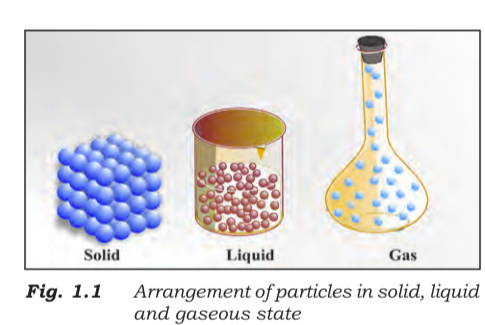
| State | Particle arrangement and movement | Shape | Volume |
|---|---|---|---|
| Solid | Particles are very close and orderly; movement is restricted. | Definite | Definite |
| Liquid | Particles are close but can move around one another. | Not definite; takes the container's shape | Definite |
| Gas | Particles are far apart and move easily and rapidly. | Not definite; fills the container | Not definite; occupies the container's space |
Interconversion of states
- Heating: solid → liquid → gas (or vapour).
- Cooling: gas → liquid → solid.
- Temperature and pressure changes can convert one physical state into another.
Classification of Matter
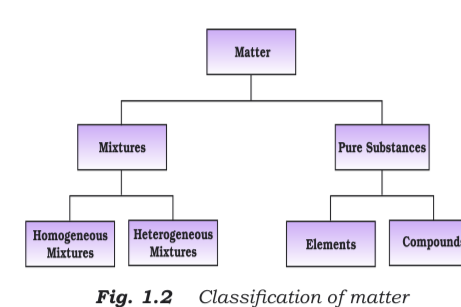
| Point | Mixture | Pure substance |
|---|---|---|
| Particles | Contains particles of two or more substances. | All constituent particles have the same chemical nature. |
| Composition | Variable; components may be present in any ratio. | Fixed composition. |
| Separation | Components can be separated by physical methods. | Constituents cannot be separated by simple physical methods. |
| Examples | Air, tea, sugar solution in water. | Copper, silver, gold, water, glucose. |
| Type | Composition and appearance | Examples |
|---|---|---|
| Homogeneous | Components are uniformly distributed; composition is uniform throughout. | Sugar solution, air |
| Heterogeneous | Composition is not uniform; different components may be visible. | Salt and sugar; grains and pulses mixed with dirt or stones |
Separating mixtures
- Components: The pure substances present in a mixture are called its components.
- Physical separation: Mixture components can be separated by methods such as hand-picking, filtration, crystallisation and distillation.
Elements and Compounds
| Point | Element | Compound |
|---|---|---|
| Constituents | Only one type of atom. | Atoms of two or more different elements. |
| Composition | One kind of atom; particles may be atoms or molecules. | Elements combine in a definite, fixed ratio. |
| Separation | An element is not described as a combination of simpler substances. | Constituent elements cannot be separated by physical methods, but can be separated by chemical methods. |
| Examples | Sodium, copper, silver, hydrogen, nitrogen, oxygen. | Water, ammonia, carbon dioxide, sugar. |
Atoms, molecules and compounds
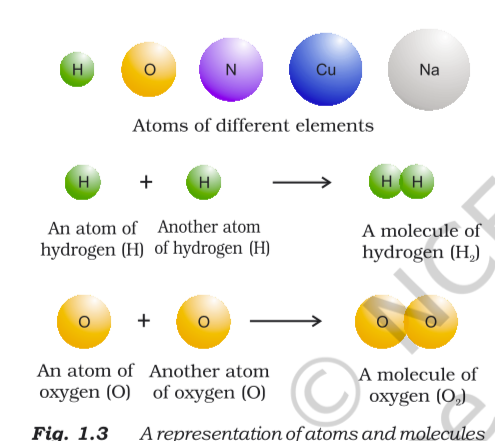
- Element particles: An element may consist of individual atoms, as in sodium or copper, or molecules made from atoms of the same element.
- Molecular elements: Hydrogen, nitrogen and oxygen gases contain two-atom molecules: , and .
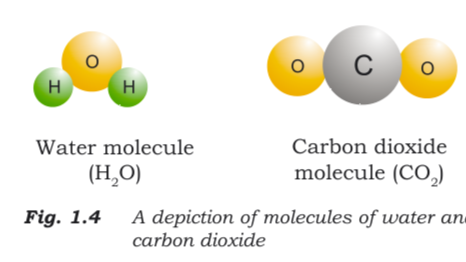
- Compound formation: Atoms of different elements combine in a definite ratio to form compound molecules.
- Fixed ratio: Water is (two hydrogen atoms to one oxygen atom); carbon dioxide is (one carbon atom to two oxygen atoms).
- Different properties: A compound can have properties unlike its constituent elements. Hydrogen and oxygen are gases, while water is a liquid; water can extinguish fires even though hydrogen burns and oxygen supports combustion.
- Glucose example: Glucose contains carbon, hydrogen and oxygen in a fixed ratio, and its elements cannot be separated by simple physical methods.
How does a homogeneous mixture differ from a heterogeneous mixture?
How can the constituents of a compound be separated?
Quick recap
- Chemistry supports science, healthcare, food production, useful materials, industry and national development.
- Chemistry helps address environmental issues, though greenhouse-gas management remains a challenge.
- Matter has mass and occupies space; its three states are solid, liquid and gas.
- Temperature and pressure changes can convert matter between physical states.
- Mixtures have variable composition and can be separated physically; they may be homogeneous or heterogeneous.
- Pure substances have fixed composition and are classified as elements or compounds.
- Compounds contain different elements in fixed ratios, have distinct properties and can be separated chemically.
Properties Of Matter And Their Measurement
Physical and Chemical Properties
Physical property — A property observed or measured without changing a substance’s identity or composition.
Chemical property — A property determined through a chemical change in which the substance’s composition or identity changes.
| Point | Physical property | Chemical property |
|---|---|---|
| What it describes | Appearance or measurable characteristics | Composition and chemical behaviour |
| Change needed to observe it | No chemical change | Chemical change |
| Examples | Colour, odour, melting point, boiling point, density | Combustibility, acidity, basicity, reaction with acids or bases |
- Use: Chemists use physical and chemical properties to describe, interpret and predict how substances behave.
Measurement and the SI System
Quantitative measurement — A measurement expressed as a number together with the unit used.
- Example: A room length of has as the numerical value and metre () as the unit.
- Need: Quantitative measurements are essential for scientific investigation and comparison.
- Systems: The English and Metric systems were used in different regions; the decimal-based Metric system originated in France in the late eighteenth century.
- Common standard: The SI system was established in to provide a shared international system of measurement.
SI and Measurement Standards
- SI: The International System of Units (French name: *Le Système International d’Unités*) was established by the 11th General Conference on Weights and Measures (CGPM).
- Metre Convention: The international treaty establishing cooperation on measurement was signed in Paris in .
- Changing definitions: SI unit definitions may be updated when improved measurement principles provide greater accuracy.
- National standards: National Metrology Institutes maintain each country’s measurement standards; in India, this responsibility belongs to the National Physical Laboratory (NPL), New Delhi.
- Comparison: National standards are periodically compared with those of other institutes and the international standards bureau in Paris.
| Base physical quantity | Quantity symbol | SI unit | Unit symbol |
|---|---|---|---|
| Length | metre | ||
| Mass | kilogram | ||
| Time | second | ||
| Electric current | ampere | ||
| Thermodynamic temperature | kelvin | ||
| Amount of substance | mole | ||
| Luminous intensity | candela |
| Unit | Definition by fixed constant |
|---|---|
| metre () | Speed of light in vacuum: . |
| kilogram () | Planck constant: . |
| second () | Caesium-133 hyperfine transition frequency: . |
| ampere () | Elementary charge: . |
| kelvin () | Boltzmann constant: . |
| mole () | One mole contains exactly specified elementary entities; this is the fixed value of Avogadro’s constant, . The amount of substance, symbol , measures the number of specified elementary entities in a system, such as atoms, molecules, ions, electrons or specified groups of particles. |
| candela () | Luminous efficacy at frequency : . |
- Derived quantities: Quantities such as speed, volume and density are derived from the seven base quantities.
- Prefixes: SI prefixes indicate multiples or submultiples of a unit; the symbol’s case matters (for example, is milli, while is mega).
| Factor | Prefix | Symbol |
|---|---|---|
| yocto | ||
| zepto | ||
| atto | ||
| femto | ||
| pico | ||
| nano | ||
| micro | ||
| milli | ||
| centi | ||
| deci | ||
| deca | ||
| hecto | ||
| kilo | ||
| mega | ||
| giga | ||
| tera | ||
| peta | ||
| exa | ||
| zetta | ||
| yotta |
Mass and Weight
Mass — The amount of matter in a substance.
Weight — The gravitational force exerted on an object.
| Point | Mass | Weight |
|---|---|---|
| Meaning | Amount of matter | Gravitational force on an object |
| Effect of location | Remains constant | Can vary as gravity changes |
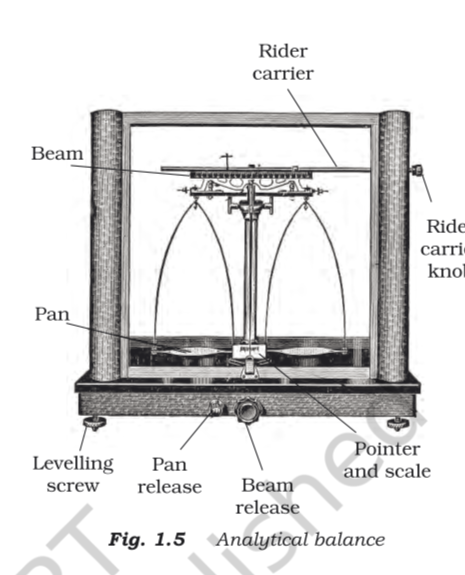
- Laboratory measurement: An analytical balance measures mass by balancing the sample against standard masses and, when needed, a rider.
- Balance condition: At equilibrium, .
- Common unit: The SI unit is kilogram (), but gram is convenient for laboratory quantities: .
Volume
Volume — The amount of space occupied by a substance.
Volume Units and Measurement
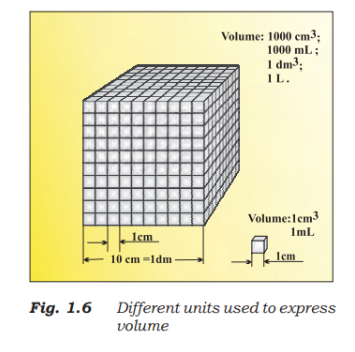
- Dimension and SI unit: Volume has dimensions of length cubed; its SI unit is cubic metre, .
- Laboratory units: Smaller volumes are often expressed in cubic centimetres () or cubic decimetres ().
- Litre: The litre () is commonly used for liquids but is not an SI unit.
- Conversions: , and .
- Measuring liquids: Graduated cylinders, burettes and pipettes measure liquid volumes; a volumetric flask prepares a known solution volume.
Density
Density — The mass of a substance per unit volume.
Use this relation to calculate density from mass and volume.
- SI unit: ; a common chemistry unit is .
- Particle packing: Greater density generally indicates that particles are more closely packed.
Temperature
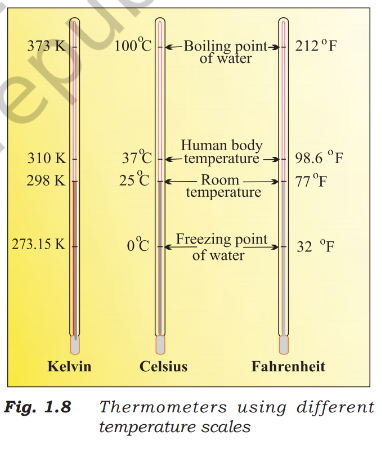
- Scales: The common temperature scales are Celsius (), Fahrenheit () and kelvin (); kelvin is the SI unit.
- Reference points: Water freezes at and boils at ; the corresponding Fahrenheit points are and .
- Temperature below zero: Celsius temperatures can be negative; the Kelvin scale does not have negative temperatures.
Convert a Celsius temperature to Fahrenheit using this relation.
Convert a Celsius temperature to kelvin using this relation.
How do physical and chemical properties differ?
State the SI units of density and volume.
Write the conversion relations between Celsius, Fahrenheit and kelvin.
Quick recap
- Properties: Physical properties need no chemical change; chemical properties are revealed through chemical change.
- Measurement: A quantitative measurement combines a number and a unit; SI supplies a common international standard.
- SI base units: The seven base quantities are length, mass, time, electric current, temperature, amount of substance and luminous intensity.
- Mass and volume: Mass is constant with location; volume is measured in cubic units, with .
- Density: ; its SI unit is .
- Temperature: and .
Uncertainty In Measurement
Reference Standards
- Reference standards: Calibrated measuring devices are compared with agreed standards to ensure reliable measurements.
- Standards in chemistry: They provide common references for measuring physical quantities such as mass and length.
Scientific Notation
Operations with Scientific Notation
- For multiplication, multiply the coefficients and add the exponents.
- For division, divide the coefficients and subtract the denominator’s exponent from the numerator’s exponent.
- For addition or subtraction, first rewrite both numbers with the same exponent; then add or subtract their coefficients.
- If needed, rewrite the answer so its coefficient is at least 1 and less than 10.
Scientific Notation Examples
- Multiplication: .
- Division: .
- Addition: .
- Subtraction: .
Significant Figures
- Significant figures: They express the meaningful digits in a measured value: all certain digits plus one estimated digit.
- Rules: Non-zero digits and zeros between non-zero digits are significant; leading zeros are not. A final zero is significant when it follows a decimal point.
- Calculations: For addition or subtraction, round to the fewest decimal places; for multiplication or division, use the fewest significant figures in the given values.
Precision and Accuracy
| Point | Precision | Accuracy |
|---|---|---|
| Meaning | Closeness of repeated measurements to one another. | Closeness of a measurement to the true value. |
| True value | Student A: and are close to each other, but not to the true value. | Student C: and are close to each other and the true value. |
| Student B | and are not close to each other. | The observations are neither precise nor accurate. |
| Student | Measurement 1 (g) | Measurement 2 (g) | Average (g) |
|---|---|---|---|
| A | 1.95 | 1.93 | 1.940 |
| B | 1.94 | 2.05 | 1.995 |
| C | 2.01 | 1.99 | 2.000 |
Calculations with Significant Figures
| Operation | Rule | Example |
|---|---|---|
| Addition and subtraction | The result cannot have more decimal places than the input with the fewest decimal places. | ; report as . |
| Multiplication and division | The result cannot have more significant figures than the input with the fewest significant figures. | ; report as because has 2 significant figures. |
| First digit removed | Rule | Example |
|---|---|---|
| Greater than 5 | Increase the preceding retained digit by 1. | when rounding to 2 decimal places. |
| Less than 5 | Leave the preceding retained digit unchanged. | when rounding to 2 decimal places. |
| Exactly 5 | Leave the preceding retained digit unchanged if it is even; increase it by 1 if it is odd. | and when rounding to 1 decimal place. |
Do not apply the multiplication/division significant-figure rule to addition or subtraction: sums and differences are limited by decimal places.
What are significant figures?
How do precision and accuracy differ?
What determines the significant figures in a sum and in a product?
Quick recap
- Reference standards calibrate instruments; the Pt–Ir cylinder remained the kilogram standard in the source, while proposed replacements had not been adopted.
- The metre was defined using a Pt–Ir bar, then a krypton wavelength in 1960, and light’s travel in vacuum in 1983.
- Scientific notation expresses numbers as ; multiply by adding exponents, divide by subtracting, and align exponents before adding or subtracting.
- Significant figures include all certain digits plus one estimated digit; leading zeros are not significant, but captive zeros are.
- Precision compares repeated measurements with each other; accuracy compares measurements with the true value.
- Addition and subtraction are limited by decimal places; multiplication and division are limited by significant figures.
- When rounding, digits above 5 increase the retained digit, below 5 leave it unchanged, and an exact 5 rounds to an even retained digit.
Dimensional Analysis
Dimensional Analysis
Dimensional analysis — A method for converting a quantity between unit systems by multiplying it by suitable unit factors.
Unit factors
- Unit factor: A ratio of equivalent quantities equals ; multiplying by it does not change the quantity.
- Choose the orientation: Put the desired unit in the numerator so unwanted units cancel.
- Handle units algebraically: Units can be multiplied, divided, cancelled, or raised to powers.
Since , choose the factor that cancels inches.
Convert a quantity using unit factors
- Write the given quantity with its unit.
- Multiply by equivalent unit factors, oriented to cancel the old units and leave the target units.
- Calculate the numerical value and check that the final units are correct.
Convert to centimetres.
Convert to cubic metres using and .
Convert days to seconds using day h, h min, and min s.
Laws of Chemical Combinations
- Core idea: The formation of compounds follows definite relationships between the amounts of their elements.
- Five laws: Conservation of mass, definite proportions, multiple proportions, gaseous volumes, and Avogadro’s law.
Law of Conservation of Mass — In a physical or chemical change, the total mass remains constant; matter is neither created nor destroyed.
Conservation of mass
- Proposed by: Antoine Lavoisier in .
- Meaning: Total mass before a change equals total mass after it.
Law of Definite Proportions — A given compound always contains the same elements combined in the same proportion by mass, regardless of its source.
Definite proportions
- Also called: Law of Definite Composition.
- Proposed by: Joseph Proust.
- Evidence: Natural and synthetic cupric carbonate samples had identical mass percentages of copper, carbon, and oxygen.
| Sample | Copper by mass | Carbon by mass | Oxygen by mass |
|---|---|---|---|
| Natural | |||
| Synthetic |
Law of Multiple Proportions — When two elements form more than one compound, the masses of one element combining with a fixed mass of the other are in a ratio of small whole numbers.
Multiple proportions
- Proposed by: John Dalton in .
- Example: For a fixed of hydrogen, water contains of oxygen while hydrogen peroxide contains .
- Ratio: Oxygen masses are .
Gay-Lussac’s Law of Gaseous Volumes — Reacting gases and gaseous products have simple whole-number volume ratios when measured at the same temperature and pressure.
Gaseous volume ratios
- Proposed by: Joseph Gay-Lussac in .
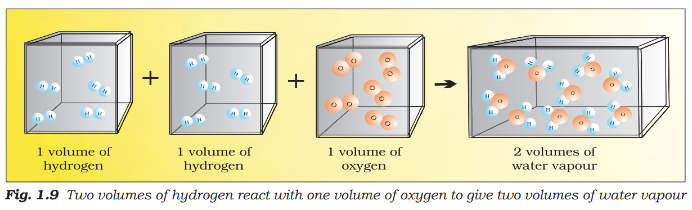
- Example: hydrogen combines with oxygen to form water vapour.
- Ratio: Hydrogen : oxygen : water vapour .
- Relation to definite proportions: This law describes simple ratios by volume; the earlier law concerns ratios by mass.
Avogadro’s Law — Equal volumes of all gases at the same temperature and pressure contain equal numbers of molecules.
Avogadro’s law and molecular explanation
- Proposed by: Amedeo Avogadro in .
- Application: Two volumes of hydrogen react with one volume of oxygen to produce two volumes of water vapour, with no oxygen left over.
- Explanation: Avogadro distinguished atoms from molecules and proposed that molecules could be polyatomic; hydrogen and oxygen molecules are now known to be diatomic.
- Historical context: Dalton and others then believed atoms of the same element could not combine, so they did not accept diatomic hydrogen or oxygen molecules.
- Recognition: Avogadro’s proposal gained little support at first. In , at the international chemistry conference in Karlsruhe, Stanislao Cannizzaro highlighted its importance.
State the Law of Multiple Proportions and illustrate it.
How does Avogadro’s law explain the volume relationship in water-vapour formation?
Quick recap
- Dimensional analysis converts units by multiplying quantities by correctly oriented unit factors equal to .
- Cancel units algebraically; raise conversion factors to powers when converting squared or cubed units.
- Conservation of mass: total mass remains unchanged during a physical or chemical change.
- Definite proportions: a compound has a fixed composition by mass, regardless of its source.
- Multiple proportions: masses combining with a fixed mass of another element form a small whole-number ratio.
- Gay-Lussac’s law concerns simple gas-volume ratios; Avogadro’s law links equal gas volumes to equal molecule counts at equal temperature and pressure.
Dalton’s Atomic Theory
Dalton’s Atomic Theory
- Dalton’s theory: Proposed in 1808, it described matter as being composed of atoms and explained the laws of chemical combination.
- Chemical reactions: Atoms are rearranged, not created or destroyed, and compounds form when atoms of different elements combine in fixed ratios.
Atomic Mass
In grams, one unified mass unit is approximately . For example, hydrogen has an atomic mass of about and oxygen-16 about .
Average Atomic Mass
For carbon, the weighted sum gives an average atomic mass of approximately .
Molecular Mass
Use the subscripts in a molecular formula as the number of each atom.
Formula Mass
State Dalton’s postulates about compounds and chemical reactions.
How are average atomic mass and molecular mass calculated?
Quick recap
- Dalton’s 1808 theory described matter as atoms and chemical reactions as atomic rearrangements.
- Dalton’s theory explained laws of chemical combination but not gaseous-volume laws or why atoms combine.
- One unified mass unit is one-twelfth the mass of a carbon-12 atom.
- Average atomic mass is a relative-abundance-weighted average of isotope masses.
- Molecular mass sums atomic masses in a molecule; formula mass is used for substances such as ionic solids.
Mole Concept And Molar Masses
The Mole and Avogadro Constant
Mole — The mole, symbol , is the SI unit of amount of substance; one mole contains exactly specified elementary entities.
Amount of substance and entities
- SI base quantity: Amount of substance is an SI base quantity; the mole was introduced as the seventh SI base unit.
- Symbol: Amount of substance is represented by and measures the number of specified entities in a system.
- Entities counted: These may be atoms, molecules, ions, electrons, other particles, or specified groups of particles.
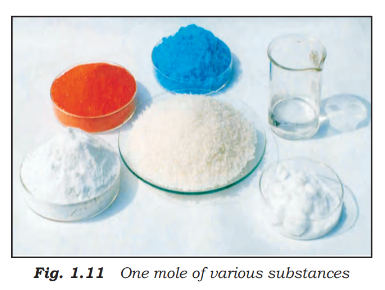
- Constant count: One mole of any substance contains the same number of entities, whatever the substance.
Avogadro constant — The Avogadro constant, , is the number of specified entities in one mole: .
What one mole counts
- Hydrogen atoms: contains hydrogen atoms.
- Water molecules: contains water molecules.
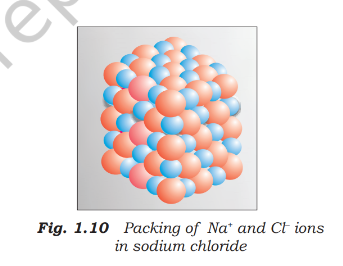
- Sodium chloride: contains formula units.
Molar Mass
Molar mass — Molar mass is the mass of one mole of a substance, usually expressed in .
Percentage Composition
Purpose of percentage composition
- Meaning: Mass percentages show the fraction of a compound’s total mass contributed by each element.
- Uses: They help identify a compound’s elemental composition and check whether a sample has the same composition as the pure substance.
Use the element’s total mass in one mole of the compound and the compound’s molar mass.
| Compound | Element | Calculation | Mass percentage |
|---|---|---|---|
| Water, ; molar mass | Hydrogen | ||
| Water, ; molar mass | Oxygen | ||
| Ethanol, ; molar mass | Carbon | ||
| Ethanol, ; molar mass | Hydrogen | ||
| Ethanol, ; molar mass | Oxygen |
Reading percentage composition
- Ethanol atom count: contains 2 carbon, 6 hydrogen, and 1 oxygen atom per molecule.
- Ethanol molar mass: .
- Check: Elemental mass percentages should total approximately ; small differences may result from rounding.
Empirical and Molecular Formulae
| Point | Empirical formula | Molecular formula |
|---|---|---|
| Meaning | Simplest whole-number ratio of the different atoms in a compound. | Actual number of each type of atom in one molecule. |
| Connection | Gives the simplest atom ratio. | Is a whole-number multiple of the empirical formula when the molar mass is known. |
Find the multiplier by dividing the compound’s molar mass by its empirical formula mass; multiply each empirical-formula subscript by this integer.
Find empirical and molecular formulae from mass percentages
- Assume a 100 g sample, so each element’s percentage becomes its mass in grams.
- Convert each element’s mass to moles by dividing by its atomic mass. For 4.07% H, 24.27% C and 71.65% Cl: , , and .
- Divide each mole value by the smallest value to obtain the simplest ratio; multiply all ratios by a suitable number if needed to make them whole numbers. Here, H:C:Cl is .
- Use the whole-number ratio as the subscripts in the empirical formula: .
- Add the atomic masses in the empirical formula: . Then calculate .
- Multiply every empirical-formula subscript by to obtain the molecular formula: .
How many entities are present in one mole?
What is the difference between empirical and molecular formulae?
Quick recap
- The mole is the SI unit of amount of substance, an SI base quantity and the seventh SI base unit.
- One mole contains exactly specified entities.
- Molar mass is the mass of one mole, expressed in .
- Mass percentage equals an element’s mass in the compound divided by the compound’s molar mass, multiplied by 100.
- Percentage composition can help determine a compound’s formula and check sample purity.
- The empirical formula gives the simplest atom ratio; the molecular formula gives the actual atom counts.
- Find a molecular formula by dividing molar mass by empirical formula mass, then multiplying all empirical subscripts by the resulting factor.
Stoichiometry And Stoichiometric Calculations
Stoichiometry and Balanced Equations
Stoichiometry — The calculation of the amounts of reactants and products involved in a chemical reaction.
- Balanced equation: Its coefficients give the relative numbers of molecules and moles of reactants and products.
- State symbols: Use for gas, for liquid and for solid.
- Conservation of mass: A balanced equation has the same number of atoms of each element on both sides.
- Balancing rule: Change coefficients only; never change subscripts in chemical formulas.
| Basis | Stoichiometric ratio |
|---|---|
| Molecules or moles | CH : O : CO : HO |
| Gas volumes at the stated conditions | L CH : L O : L CO : L HO |
| Masses | g CH + g O → g CO + g HO |
Converting stoichiometric quantities
- Calculation path: Convert given mass to moles, use the balanced-equation ratio, then convert to the required mass, particle number or gas volume.
- Mass–mole relation: Use molar mass to move between mass and moles; particle counts follow from moles.
- Density relation: Mass and volume are related by density: .
Balancing a chemical equation
- Write the correct formulas for all reactants and products.
- Balance one element at a time by changing coefficients.
- Check that each element has equal atom counts on both sides; reduce coefficients to the smallest whole-number ratio if needed.
Limiting Reagent
Limiting reagent — The reactant consumed first, which limits how much product can form.
- Excess reactant: Any other reactant is present in more than the stoichiometric amount required.
- How to identify it: Convert reactants to moles and compare their available amounts with the coefficients in the balanced equation.
- Product yield: Calculate product formed from the limiting reagent; extra reactant cannot make the reaction continue once the limiting reagent is used up.
Limiting-reagent example
- Given: kg N is about mol; kg H is about mol.
- Check required ratio: The available N would need mol H, but only mol is present; therefore H is limiting.
- Maximum ammonia: The available H forms about mol NH, or approximately kg.
Reactions in Solutions
- Concentration: The amount of solute present in a specified amount of solution or solvent.
- Common concentration measures: Mass percent, mole fraction, molarity and molality.
| Measure | Defined using | Symbol / basis |
|---|---|---|
| Mass percent | Mass of solute divided by mass of solution | % by mass (w/w %) |
| Mole fraction | Moles of one component divided by total moles | ; no unit |
| Molarity | Moles of solute per litre of solution | ; mol L |
| Molality | Moles of solute per kilogram of solvent | ; mol kg |
Mass Percent and Mole Fraction
Mass percent — The mass of solute expressed as a percentage of the total mass of the solution.
Use the total mass of the solution, not just the solvent, in the denominator.
Example
- Calculation: g of solute A + g water gives g solution; mass percent of A .
Mole fraction — The moles of a component divided by the total moles of all components in the solution.
For components A and B, their mole fractions add to one.
Molarity and Dilution
Molarity — The number of moles of solute per litre of solution; it is denoted by .
Volume must be expressed in litres.
Molarity example
- Calculation: g NaOH has mol; in mL ( L), its molarity is M.
- Temperature: Molarity can change with temperature because solution volume changes with temperature.
Dilution — Adding solvent lowers concentration while leaving the amount of solute unchanged.
Use when a solution is diluted without adding or removing solute.
Dilution example
- Preparation: To make L of M NaOH from M stock solution, take L ( mL) stock solution and add water until the total volume is L.
- Stock solution: A solution of known, relatively high concentration used to prepare a more dilute solution.
Molality
Molality — The number of moles of solute per kilogram of solvent; it is denoted by .
Use the mass of solvent in kilograms, not the mass of the whole solution.
Molality example and temperature
- Calculation: A M NaCl solution has mol NaCl ( g) per litre. At density g mL, that litre weighs g, so solvent mass is g and molality is m.
- Temperature: Molality does not change with temperature because it uses masses, which remain essentially unaffected by temperature.
What is a limiting reagent?
State the difference between molarity and molality.
How much water is produced when g methane burns completely?
Quick recap
- Balanced-equation coefficients give the mole and particle ratios used in stoichiometric calculations.
- Convert known reactant amounts to moles, apply the equation ratio, then convert to the required quantity.
- The limiting reagent is consumed first and determines the maximum product formed.
- Mass percent uses mass of solution; mole fraction uses total moles of all components.
- Molarity is based on solution volume, while molality is based on solvent mass.
- Dilution changes concentration but preserves solute amount: .
Chemistry — ALL CHAPTERS
1
Some Basic Concepts Of Chemistry
2
Structure Of Atom
3
Classification Of Elements And Periodicity In Properties
4
Chemical Bonding And Molecular Structure
5
Thermodynamics
6
Equilibrium
7
Redox Reactions
8
Organic Chemistry – Some Basic Principles And Techniques
9
Hydrocarbons