Class 11 PCB . Chemistry . Chemistry Part I . Classification of Elements and Periodicity in Properties
Chapter 3: Classification Of Elements And Periodicity In Properties
Ch 3
Chemistry
Class 11 PCB
Why Do We Need To Classify Elements ?
Why Classify Elements?
Why classification is needed
- Many elements: The number known grew from 31 in 1800 to 63 in 1865; the lecture states that 114 were known at the time of writing, including recently synthesised elements.
- Study becomes manageable: Studying each element and its many compounds individually is difficult.
- Patterns become clear: Grouping elements rationalises known chemical facts and reveals recurring properties.
- Predictions become possible: Systematic patterns can suggest undiscovered elements and properties for further investigation.
Early Attempts at Periodic Classification
| Scientist and date | Arrangement and idea | Importance / limitation |
|---|---|---|
| Johann Döbereiner, 1829 | Grouped some similar elements into sets of three called triads. | The middle element's atomic weight was about midway between the other two; its properties were also intermediate. The rule fitted only a few elements. |
| A. E. B. de Chancourtois, 1862 | Arranged elements by increasing atomic weight on a cylindrical table. | Displayed periodic recurrence of properties, but attracted little attention. |
| John Newlands, 1865 | Arranged elements by increasing atomic weight; every eighth element had properties like the first, as in musical octaves. | The Law of Octaves worked only up to calcium and was not widely accepted at the time. |
| Triad | Atomic weights | Middle element |
|---|---|---|
| 7, 23, 39 | : weight and properties intermediate | |
| 40, 88, 137 | : weight and properties intermediate | |
| 35.5, 80, 127 | : weight and properties intermediate |
| Sequence | Elements in order | Eighth-element relationship |
|---|---|---|
| First sequence | is the eighth element and resembles the first element, . | |
| Next sequence | is the eighth element beginning with ; it is not adjacent to . | |
| Scope | Elements were arranged in increasing atomic weight. | The pattern was considered to work only up to calcium. |
Mendeleev and the Periodic Law
Lothar Meyer and Dmitri Mendeleev
- Independent work, 1869: Lothar Meyer and Dmitri Mendeleev proposed that arranging elements by increasing atomic weight produced regular recurrence in physical and chemical properties.
- Meyer: Plotted atomic volume, melting point and boiling point against atomic weight; the patterns repeated, but their lengths varied. His table, developed by 1868, was published after Mendeleev's work.
- Mendeleev: Published the Periodic Law and developed a more elaborate classification, using a broad range of properties, especially the formulas and properties of compounds.
- Publication date: Mendeleev's Periodic Table was published in 1905.
Mendeleev's Periodic Law — The properties of the elements are a periodic function of their atomic weights.
Mendeleev's arrangement
- Order: Elements were generally arranged by increasing atomic weight in horizontal rows and vertical columns.
- Groups: Elements with similar properties were placed in the same vertical column.
- Exceptions: When strict atomic-weight order conflicted with similar properties, Mendeleev prioritised the properties and suspected some atomic-weight measurements were wrong.
- Example: Tellurium has a higher atomic weight than iodine, but iodine was placed with fluorine, chlorine and bromine because of their similar properties.
| Property | Eka-aluminium (predicted) | Gallium (found) | Eka-silicon (predicted) | Germanium (found) |
|---|---|---|---|---|
| Atomic weight | 68 | 70 | 72 | 72.6 |
| Density | 5.9 g/cm³ | 5.94 g/cm³ | 5.5 g/cm³ | 5.36 g/cm³ |
| Melting point | Low | 302.93 K | High | 1231 K |
| Oxide formula | ||||
| Chloride formula |
Gaps and successful predictions
- Gaps: Mendeleev left spaces for elements he believed had not yet been discovered, rather than forcing an unsuitable element into a group.
- Eka-aluminium: The predicted element was later discovered as gallium; Mendeleev had left a gap below aluminium.
- Eka-silicon: The predicted element was later discovered as germanium; Mendeleev had left a gap below silicon.
- Significance: The later discoveries and close agreement between predicted and measured properties supported Mendeleev's classification.
| Group | Higher oxide formula | Higher gaseous hydrogen compound |
|---|---|---|
| I | — | |
| II | — | |
| III | — | |
| IV | ||
| V | ||
| VI | ||
| VII | ||
| VIII | — |
State Mendeleev's Periodic Law.
Why did Mendeleev leave gaps in his table?
What was the limitation of Newlands' Law of Octaves?
Quick recap
- Classifying elements makes the study of many elements and compounds manageable and reveals shared patterns.
- Döbereiner grouped some similar elements into triads with an approximately intermediate middle atomic weight.
- Chancourtois used a cylindrical arrangement; Newlands proposed the Law of Octaves, which worked only up to calcium.
- Meyer and Mendeleev independently proposed periodic recurrence when elements were arranged by increasing atomic weight.
- Mendeleev's Periodic Law linked periodic properties to atomic weights; his Periodic Table was published in 1905.
- Mendeleev left gaps and predicted properties of undiscovered elements, including gallium and germanium.
Modern Periodic Law And The Present Form Of The Periodic Table
Modern Periodic Law
Modern Periodic Law — The physical and chemical properties of elements are periodic functions of their atomic numbers.
Basis and significance
- Moseley (1913): Henry Moseley found that a plot of , the X-ray frequency measure, against atomic number gives a straight line; the plot against atomic mass does not.
- Conclusion: Atomic number is more fundamental than atomic mass, so Mendeleev’s law was revised to use atomic number.
- Atomic number: is the nuclear charge, equal to the number of protons; in a neutral atom, it also equals the number of electrons.
- Underlying basis: Periodicity arises from recurring electronic configurations, which determine the properties of elements and their compounds.
- Significance: The law reveals similarities among 94 naturally occurring elements and also accommodates artificially produced, short-lived elements. Neptunium and plutonium are also found in pitch blende.
The Present Form of the Periodic Table
Long-form Periodic Table — The widely used arrangement of elements in horizontal periods and vertical groups, ordered by atomic number and reflecting their electronic configurations.
Periods, groups and layout
- Periods: The seven horizontal rows are periods; the period number corresponds to the highest principal quantum number, , in the elements of that period.
- Groups: The vertical columns are groups or families. Their elements have similar outer electronic configurations and often similar properties.
- IUPAC numbering: Groups are numbered 1–18, replacing older notations such as IA–VIIA, VIII, IB–VIIB and 0. The 1–18 numbering follows IUPAC recommendations from 1984.
- Representative elements: Groups 1–2 and 13–18.
- Transition elements: -transition elements are in groups 3–12; -inner transition elements are displayed separately below the main table.
- Group 18: Contains the noble gases.
| Period | Number of elements | Key note |
|---|---|---|
| 1 | 2 | Shortest period |
| 2 and 3 | 8 each | Short periods |
| 4 and 5 | 18 each | Long periods |
| 6 | 32 | Includes 14 lanthanoids, shown separately below the main table |
| 7 | Incomplete; theoretical maximum of 32 | Includes 14 actinoids, shown separately below the main table |
| Block or type | Position | General outer configuration |
|---|---|---|
| Representative elements | Groups 1–2 and 13–18 | Electrons enter or subshells |
| -transition elements | Groups 3–12 | Electrons enter a subshell |
| Lanthanoids | Separate panel; sixth period | |
| Actinoids | Separate panel; seventh period |
Reading the table
- Across a period: Electrons fill subshells in a systematic sequence; the period number indicates the highest principal quantum number.
- Within a group: Similar outer configurations help explain recurring chemical properties.
- Examples: Sodium has outer configuration and is in period 3, group 1; chlorine has and is in period 3, group 17.
- Separate panels: The 14 lanthanoids and 14 actinoids are placed below the main table to keep it compact.
Systematic Nomenclature of Elements with Atomic Numbers Above 100
Why systematic names are used
- Challenge: Superheavy elements are highly unstable and may be made in only minute quantities, so synthesis and confirmation are difficult.
- Temporary naming: IUPAC uses a systematic name based on the atomic number until discovery is established and a permanent name is approved.
- Naming disputes: Discovery claims have sometimes conflicted; for element 104, American and Soviet scientists proposed Rutherfordium and Kurchatovium, respectively.
- Permanent names: IUPAC representatives approve the final name and symbol; a name may honour a scientist or refer to the place of discovery.
- Status in the source: Official names had been announced for elements up to atomic number 118.
| Digit | Root | Abbreviation |
|---|---|---|
| 0 | nil | n |
| 1 | un | u |
| 2 | bi | b |
| 3 | tri | t |
| 4 | quad | q |
| 5 | pent | p |
| 6 | hex | h |
| 7 | sept | s |
| 8 | oct | o |
| 9 | enn | e |
Temporary naming rules
- Name: Join the digit-roots in order and add “ium” at the end.
- Symbol: Combine the first letters of the digit-roots in order; the temporary symbol has three letters.
- Example, atomic number 104: gives un + nil + quad + ium → unnilquadium; temporary symbol Unq.
Constructing a Temporary Systematic Name
- Separate the atomic number into its digits.
- Replace each digit, in order, with its IUPAC root.
- Join the roots and add “ium” to form the temporary name.
- Use the first letter of each root, in order, to form the temporary symbol.
State the Modern Periodic Law and identify its basis.
How many periods are in the modern periodic table, and what does the period number indicate?
Give the temporary systematic name and symbol for element 120.
Quick recap
- Modern periodic law states that physical and chemical properties are periodic functions of atomic number.
- Moseley’s 1913 X-ray work showed atomic number to be more fundamental than atomic mass.
- Electronic configurations explain periodicity and similarities among elements in a group.
- The long-form table has seven periods and 18 groups; period lengths are 2, 8, 8, 18, 18, 32 and an incomplete seventh period.
- Representative elements occupy groups 1–2 and 13–18, transition elements groups 3–12, and the inner transition elements are displayed separately.
- Temporary names above atomic number 100 use digit-roots in order followed by “ium”; the symbol uses the roots’ initial letters.
Electronic Configurations Of Elements And The Periodic Table
Electronic configuration — The distribution of an atom’s electrons among its orbitals is its electronic configuration; the last-filled orbital helps determine the element’s position in the Periodic Table.
Electronic Configurations in Periods
How periods relate to electron filling
- Period number: Indicates the principal quantum number, , of the outermost (valence) shell.
- Across a period: Electrons fill orbitals associated with the next higher principal energy level, though lower-level or orbitals may fill in between.
- Period length: Each orbital holds up to two electrons; the number of elements equals twice the total number of orbitals filled.
- Table structure: The and series are placed separately to preserve the table’s structure and keep elements with similar properties in columns.
| Period | Main filling sequence | Elements | Key endpoint or series |
|---|---|---|---|
| 1 () | 2 | Hydrogen: ; helium: completes the first shell. | |
| 2 () | 8 | Begins with lithium; ends with neon, . | |
| 3 () | 8 | Begins with sodium; ends with argon. | |
| 4 () | 18 | The transition series runs from scandium () to zinc (); the period ends with krypton. | |
| 5 () | 18 | The transition series begins with yttrium (); the period ends with xenon. | |
| 6 () | 32 | The lanthanoid series runs from cerium () to lutetium (). | |
| 7 () | 32 | The actinoid series follows actinium (); the period ends at element , in the noble-gas family. |
Key period examples
- Period 4: Zinc has the configuration , completing the subshell before filling proceeds to .
- Period 6: Filling of the subshell forms the lanthanoid series; filling of the subshell in period 7 forms the actinoid series.
- Period 7: Includes most man-made radioactive elements.
Each orbital holds two electrons; use the total number of orbitals filled in that period.
Why does the fifth period contain 18 elements?
Groupwise Electronic Configurations
Groupwise electronic configuration — Elements in the same vertical group have similar valence-shell configurations and therefore similar chemical properties.
Group 1 example
- Valence configuration: All Group 1 alkali metals have the general outer configuration .
- Shared feature: Each has one electron in its outermost orbital, which explains its similar properties to other Group 1 elements.
| Element | Atomic number | Abbreviated configuration |
|---|---|---|
| Lithium (Li) | 3 | |
| Sodium (Na) | 11 | |
| Potassium (K) | 19 | |
| Rubidium (Rb) | 37 | |
| Cesium (Cs) | 55 | |
| Francium (Fr) | 87 |
Why do elements in the same group generally have similar properties?
Quick recap
- The last-filled orbital helps establish an element’s position in the Periodic Table.
- A period number identifies the principal shell of the outermost electrons.
- Period lengths from periods 1 to 7 are 2, 8, 8, 18, 18, 32 and 32.
- The and series are the lanthanoids and actinoids, respectively.
- Group 1 elements share the valence configuration .
Electronic Configura Ions And Types Of Elements: S-, P-, D-, F- Blocks
Basis of Block Classification
Group or family — A vertical column in the periodic table; its elements show similar chemical behaviour because their outermost electrons have the same number and distribution.
- Aufbau principle: The order in which orbitals fill provides a basis for explaining periodic classification.
- Blocks: Elements are classified as s-, p-, d- or f-block according to the type of orbital being filled.
- Helium: Its configuration is , so it is technically s-block; it is placed in Group 18 because its filled shell gives it noble-gas properties.
- Hydrogen: Its single s-electron suggests a link to Group 1, while gaining an electron could give it a noble-gas arrangement like Group 17. It is placed separately at the top of the periodic table.
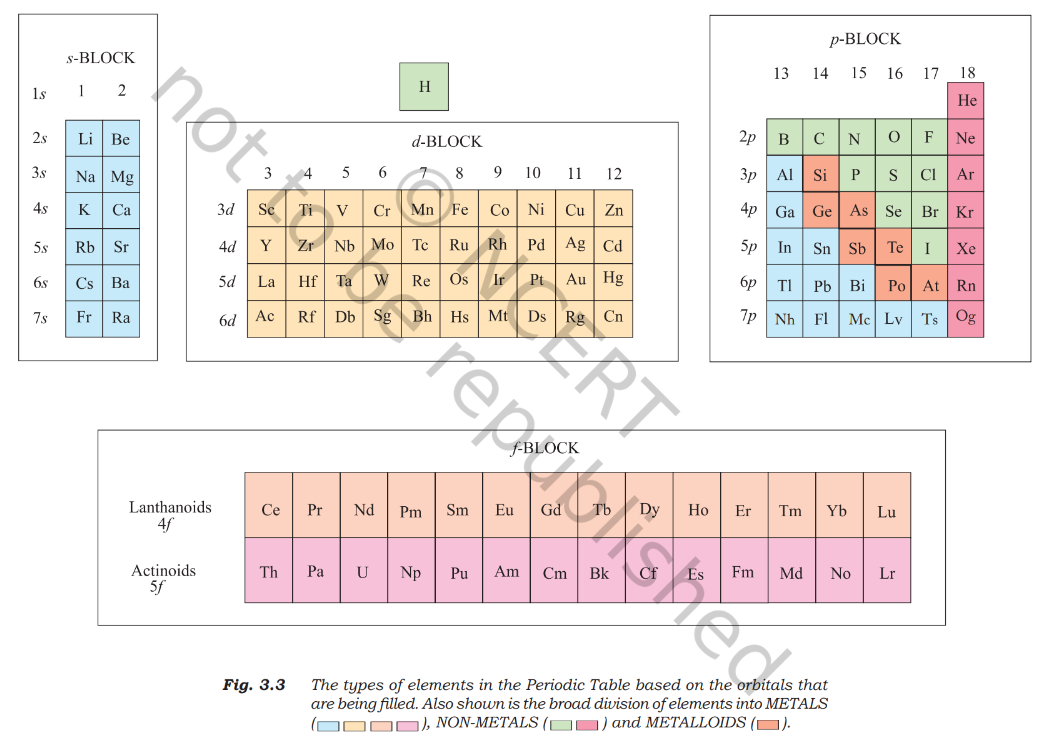
s-Block Elements
s-block elements — Group 1 and Group 2 elements with outermost configurations and , respectively.
- Properties: These reactive metals have low ionisation enthalpies and readily lose their outermost electron(s).
- Ions: Group 1 metals form ions; Group 2 metals form ions.
- Trends and occurrence: Metallic character and reactivity increase down each group; because they are highly reactive, they are not found pure in nature.
- Bonding: Their compounds are predominantly ionic, with compounds of lithium and beryllium as exceptions.
p-Block Elements
p-block elements — Elements of Groups 13–18, in which the last electron enters a p-orbital.
- Main-group elements: The s- and p-block elements together are called representative or main-group elements.
- Configurations: Across each period, the outer configuration ranges from to .
- Noble gases: Group 18 elements generally have filled valence shells, , and very low chemical reactivity because this arrangement is stable.
- Halogens and chalcogens: Group 17 halogens tend to gain one electron; Group 16 chalcogens tend to gain two, attaining a noble-gas configuration. Both have highly negative electron-gain enthalpies.
- Periodic trends: Non-metallic character increases from left to right across a period; metallic character increases down a group.
d-Block Elements (Transition Elements)
d-block elements — Elements of Groups 3–12 in which electrons fill inner d-orbitals.
- General configuration: ; palladium is an exception with configuration .
- Typical properties: These are metals that commonly form coloured ions, show variable oxidation states and paramagnetism, and are often used as catalysts.
- Filled d-subshell exception: Zn, Cd and Hg have configurations and do not show most typical transition-element properties.
- Name: They form a bridge between chemically active s-block metals and the less active elements of Groups 13 and 14.
f-Block Elements (Inner-Transition Elements)
f-block elements — The two rows below the main periodic table, where the last electron enters an f-orbital.
- Series: Lanthanoids run from Ce () to Lu (); actinoids run from Th () to Lr ().
- General configuration: .
- Shared features: Both series are metals, and elements within each series have quite similar properties.
- Actinoids: They are radioactive and can show many oxidation states. The chemistry of the early actinoids is more complicated than that of the corresponding lanthanoids.
- Limited study: Many actinoids have been produced only in tiny quantities, so their chemistry is not fully studied. Elements after uranium are called transuranium elements.
Predicted Positions of Undiscovered Elements
- Element with : Predicted to belong to Group 17 (halogens), with configuration .
- Element with : Predicted to belong to Group 2 (alkaline earth metals), with configuration .
Metals, Non-metals and Metalloids
| Property | Metals | Non-metals |
|---|---|---|
| Location and abundance | Mostly on the left side; more than 78% of known elements | Mostly at the upper-right side |
| State and melting/boiling points | Usually solids at room temperature with high melting and boiling points; Hg is liquid, while Ga and Cs melt at about and | Usually solids or gases at room temperature, with low melting and boiling points; B and C are exceptions to the low-melting-point trend |
| Conductivity | Generally good conductors of heat and electricity | Generally poor conductors of heat and electricity |
| Mechanical behaviour | Usually malleable (can be hammered into sheets) and ductile (can be drawn into wires) | Most solid non-metals are brittle, neither malleable nor ductile |
Metalloids (semi-metals) — Elements bordering the zig-zag boundary between metals and non-metals that show properties of both.
- Examples: Silicon, germanium, arsenic, antimony and tellurium.
- Change in character: Metallic character increases down a group and decreases from left to right across a period; the change from metallic to non-metallic character is gradual.
Arrange Si, Be, Mg, Na and P in increasing order of metallic character.
Quick recap
- Block classification is based on the orbital being filled; helium and hydrogen have special placements.
- The s-block contains Groups 1 and 2; these reactive metals commonly form and ions.
- The p-block contains Groups 13–18; noble gases are very unreactive, while halogens and chalcogens tend to gain electrons.
- The d-block spans Groups 3–12 and commonly shows coloured ions, variable oxidation states, paramagnetism and catalytic behaviour.
- The f-block contains lanthanoids and actinoids; actinoids are radioactive and can show many oxidation states.
- Metallic character increases down a group and decreases across a period; metalloids lie along the boundary between metals and non-metals.
Periodic Trends In Properties Of Elements
Overview of Periodic Trends
- Periodicity: Physical and chemical properties show recurring patterns across periods and down groups.
- Cause: These trends arise from changes in atomic structure, especially the number of electrons and occupied energy levels.
Atomic Radius
Atomic radius — An estimate of atomic size, defined using half the distance between neighbouring nuclei in a bonded or metallic structure.
| Radius type | Meaning | Example |
|---|---|---|
| Covalent radius | Half the distance between two atoms joined by a single covalent bond. | Cl₂ bond distance = 198 pm; radius of Cl = 99 pm. |
| Metallic radius | Half the distance between adjacent metal nuclei in a metallic crystal. | Cu–Cu distance = 256 pm; radius of Cu = 128 pm. |
Used for covalent or metallic radius, according to the bonding arrangement.
Periodic trend and explanation
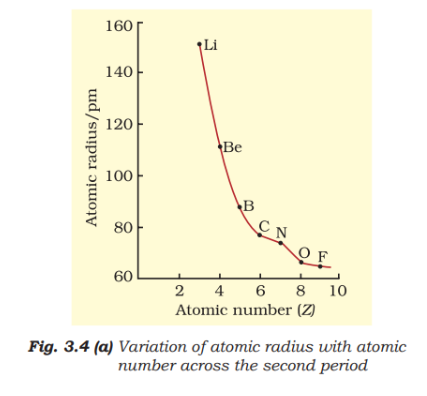
- Across a period: atomic radius generally decreases because electrons enter the same shell while effective nuclear charge increases.
- Down a group: atomic radius increases as new energy levels are added; inner electrons shield the valence electrons from the nucleus.
- Typical values: Period 2 radii decrease from Li (152 pm) to F (64 pm); Group 1 radii increase from Li (152 pm) to Cs (262 pm).
- Noble gases: their non-bonded radii are van der Waals radii, so compare them with van der Waals—not covalent—radii.
Ionic Radius
Ionic radius — The size of an ion, estimated from distances between cations and anions in ionic crystals.
Ionic-radius trends
- General trend: ionic radii of elements generally show the same trend as their atomic radii.
- Cations: smaller than their parent atoms because they have fewer electrons but the same nuclear charge.
- Anions: larger than their parent atoms because added electrons increase electron–electron repulsion.
- Examples: F (64 pm) → F⁻ (136 pm); Na (186 pm) → Na⁺ (95 pm).
Isoelectronic species — Atoms or ions having the same number of electrons.
Comparing isoelectronic species
- Rule: among isoelectronic species, greater nuclear charge holds the electrons more strongly and gives a smaller radius.
- Example: , , and each have 10 electrons; radii decrease in the order .
- Anions: among ions of the same element, a more negative charge generally means a larger radius because of increased electron repulsion.
Which is largest and which is smallest: Mg, , Al or ?
Ionization Enthalpy
Ionization enthalpy — The energy required to remove an electron from an isolated gaseous atom or ion in its ground state.
Trend and explanation
- Across a period: first ionization enthalpy generally increases; increasing nuclear charge outweighs the small change in shielding.
- Down a group: it generally decreases; the outer electron is farther from the nucleus and more shielded, so it is easier to remove.
- Periodic pattern: maxima occur at noble gases (stable, closed shells); minima occur at alkali metals, consistent with their high reactivity.
- Shielding: inner-shell electrons reduce the effective nuclear attraction experienced by a valence electron.
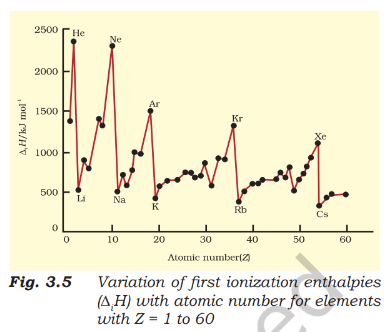
| Comparison | Why the expected trend is reversed |
|---|---|
| Be > B | Be loses a 2s electron, while B loses a 2p electron. The 2p electron is less penetrating and more shielded, so it is easier to remove. |
| N > O | N has three unpaired 2p electrons. O has a paired 2p electron, whose extra repulsion makes removal easier. |
| Mg > Al (the trend locally dips at Al) | Al loses a 3p electron, which is more shielded than Mg's 3s electron; therefore Al's first ionization enthalpy is lower. |
For Na, Mg and Si, the first ionization enthalpies are 496, 737 and 786 kJ mol⁻¹. Should Al's value be closer to 575 or 760 kJ mol⁻¹?
Electron Gain Enthalpy
Electron gain enthalpy — The enthalpy change when an electron is added to an isolated neutral gaseous atom to form a negative ion.
Trend and key exceptions
- Across a period: electron gain enthalpy generally becomes more negative as effective nuclear charge rises and the atom attracts an added electron more strongly.
- Down a group: it generally becomes less negative as atomic size and distance from the nucleus increase.
- Halogens: have very negative values because gaining one electron completes a noble-gas configuration; Cl is more negative than F.
- Noble gases: have positive values because the added electron must enter a higher principal energy level.
- O and F exception: their values are less negative than those of S and Cl; an added electron enters compact orbitals and experiences stronger repulsion.
Among P, S, Cl and F, which has the most negative and which the least negative electron gain enthalpy?
Electronegativity
Electronegativity — The qualitative ability of an atom in a chemical compound to attract shared electrons towards itself.
Scales and periodic trend
- Nature: unlike ionization enthalpy and electron gain enthalpy, electronegativity is not directly measurable and has no fixed value independent of bonding context.
- Scales: Pauling, Mulliken–Jaffe and Allred–Rochow scales are used; the Pauling scale is the most widely used.
- Pauling scale: fluorine was assigned the highest value, 4.0.
- Across a period: electronegativity generally increases as atomic radius decreases and attraction for shared electrons strengthens.
- Down a group: electronegativity generally decreases as atomic radius increases.
| Trend | Across a period | Down a group |
|---|---|---|
| Electronegativity | Increases | Decreases |
| Non-metallic character | Increases | Decreases |
| Metallic character | Decreases | Increases |
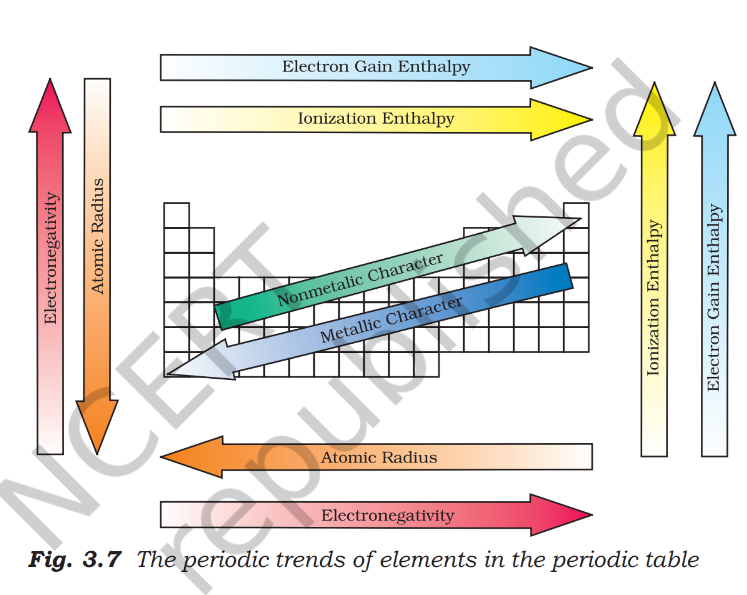
- Across a period: radius and metallic character decrease; ionization enthalpy and electronegativity increase; electron gain enthalpy generally becomes more negative.
- Down a group: radius and metallic character increase; ionization enthalpy and electronegativity decrease; electron gain enthalpy generally becomes less negative.
Quick recap
- Atomic radius generally decreases across a period and increases down a group because of changing effective nuclear charge, shells and shielding.
- Ionic radii generally follow atomic-radius trends; cations are smaller than parent atoms and anions are larger.
- In an isoelectronic series, greater nuclear charge means a smaller radius.
- Ionization enthalpy generally increases across a period and decreases down a group; Be/B, N/O and Mg/Al are key exceptions.
- Electron gain enthalpy generally becomes more negative across a period and less negative down a group; Cl is more negative than F.
- Electronegativity increases across a period and decreases down a group; fluorine is highest on the Pauling scale.
- Metallic character varies opposite to electronegativity and non-metallic character.
Periodic Trends In Chemical Properties
Periodicity of Valence and Oxidation States
Valence — The combining capacity of an element, understood from its electronic configuration.
Valence of Representative Elements
- Rule: Valence is usually the number of outermost electrons, or minus that number; exceptions occur.
- Variable valence: Many elements, especially transition elements and actinoids, show more than one valence.
| Group | 1 | 2 | 13 | 14 | 15 | 16 | 17 | 18 |
|---|---|---|---|---|---|---|---|---|
| Valence electrons | ||||||||
| Typical valence |
Oxidation state — The charge an atom would acquire in a compound if bonding electrons were assigned according to the electronegativity of the atoms.
Oxidation-State Examples
- In : The electronegativity order is ; each fluorine is , so oxygen is .
- In : Oxygen is more electronegative, so oxygen is and each sodium is .
| Group | Representative hydrides | Representative oxides |
|---|---|---|
| 1 | ||
| 2 | ||
| 13 | ||
| 14 | ||
| 15 | ||
| 16 | ||
| 17 |
Predict the formulas of compounds formed by silicon and bromine, and by aluminium and sulphur.
Anomalous Behaviour of Second-Period Elements
Diagonal relationship — The similarity between a second-period element and the element diagonally below it in the next group.
Why the First Element Differs
- Examples: Lithium resembles magnesium, while beryllium resembles aluminium; lithium and beryllium form compounds with greater covalent character than their group members.
- Causes: The first element is small, has a high charge-to-radius ratio, and is relatively electronegative.
- Bonding capacity: Second-period atoms have only four valence orbitals ( and ); the next-period atoms have nine (, , ).
- Covalency limit: The maximum covalency of a second-period element is ; boron forms , whereas aluminium can form .
- Multiple bonding: Second-period p-block elements form multiple bonds more readily, both to themselves and to other second-period elements.
Examples of Multiple Bonds
- Between like atoms: , \ce{C#C}, and \ce{N#N}.
- Between different atoms: , , \ce{C#N} and .
| Element | Metallic radius (pm) | Ionic radius (pm) |
|---|---|---|
| Li | 152 | 76 |
| Be | 111 | 31 |
| B | 88 | — |
| Na | 186 | 102 |
| Mg | 160 | 72 |
| Al | 143 | — |
Are the oxidation state and covalency of aluminium the same in ?
Periodic Trends and Chemical Reactivity
Reactivity Across a Period
- Atomic and ionic radii generally decrease from left to right.
- Ionization enthalpy generally increases; electron-gain enthalpy generally becomes more negative across the period.
- Exception: Noble gases have completely filled shells and rather positive electron-gain enthalpy values.
- Reactivity is high at both extremes and generally lowest near the centre; the far-left element has the lowest ionization enthalpy, while halogens have highly negative electron-gain enthalpy.
- Left end: alkali metals lose electrons to form cations. Right end: halogens gain electrons to form anions.
- Metallic character decreases and non-metallic character increases from left to right; these trends relate to reducing and oxidizing behaviour.
Reactivity and Oxides Across a Period
- Reactivity indicator: Reactions with oxygen and halogens show chemical reactivity; elements at both ends readily combine with oxygen.
- Left end: Oxides are strongly basic, e.g. .
- Right end: Oxides are strongly acidic, e.g. .
- Centre: Oxides may be amphoteric, such as and , or neutral, such as , and .
- Amphoteric oxides: Behave as acids with bases and as bases with acids; neutral oxides show neither acidic nor basic properties.
Transition and Inner-Transition Elements
- Across transition metals: Atomic radii change less than they do across representative elements; ionization enthalpies are intermediate between those of the s- and p-blocks.
- Result: Transition metals are less electropositive than Group 1 and 2 metals.
- Across inner-transition metals: Radius changes are even smaller; the 4f series shows a particularly small change.
Trends Down a Group
- Atomic number and atomic/ionic radii generally increase down a main-group column.
- Ionization enthalpy generally decreases; electron-gain enthalpy generally becomes less negative, with exceptions.
- Metallic character increases and non-metallic character decreases down the group.
- Transition elements show a reverse trend; atomic size and ionization enthalpy help explain the difference.
Do not treat valence, oxidation state and covalency as interchangeable: for example, aluminium in has oxidation state but covalency .
Quick recap
- Representative-element valence usually follows the outer-electron count or minus that count; oxidation state uses electronegativity-based electron assignment.
- Hydride and oxide formulas show periodic patterns in valence, while many transition elements and actinoids have variable valence.
- Second-period elements differ because of their small size, high charge-to-radius ratio, high electronegativity and limited valence orbitals.
- Diagonal similarities include Li–Mg and Be–Al; second-period p-block elements also form multiple bonds readily.
- Across a period, metallic character falls and non-metallic character rises; oxide character changes from basic through amphoteric or neutral to acidic.
- Noble gases are the exception to the across-period electron-gain-enthalpy trend: their filled shells give rather positive values.
- Down main groups, metallic character generally rises; transition elements show different trends and smaller radius changes.
Summary
Periodic Law and the Periodic Table
Arrangement and periodicity
- Mendeleev’s table arranged elements mainly by atomic mass; the modern table follows increasing atomic number.
- Modern table has seven horizontal periods and eighteen vertical groups (families).
- Atomic numbers are consecutive across a period and increase down a group in a pattern.
- Groups contain elements with similar valence-shell electronic configurations and, therefore, similar chemical properties.
- Periods show a progressive increase in electrons from left to right, so elements have different valencies.
Blocks and Element Types
| Block | Basis of classification |
|---|---|
| s-block | Valence electrons occupy an s orbital |
| p-block | Valence electrons occupy a p orbital |
| d-block | Differentiating electrons enter a d orbital |
| f-block | Differentiating electrons enter an f orbital |
Metals, non-metals and metalloids
- Hydrogen has one electron in the 1s orbital and occupies a unique position in the periodic table.
- Metals make up more than 78% of known elements.
- Non-metals are located mainly at the top of the periodic table and number fewer than twenty.
- Metalloids (semi-metals) lie near the boundary between metals and non-metals; examples include Si, Ge and As.
- Metallic character increases down a group and decreases from left to right across a period.
Periodic Trends in Properties
Periodicity — The physical and chemical properties of elements recur in patterns when elements are arranged by increasing atomic number.
| Property | Across a period (left to right) | Down a group |
|---|---|---|
| Atomic radii | Decrease | Increase |
| Ionization enthalpy | Generally increases | Generally decreases |
| Electronegativity | Generally increases | Generally decreases |
| Electron gain enthalpy | Generally becomes more negative | Generally becomes less negative |
| Metallic character | Decreases | Increases |
Valence
- Representative elements show a periodic pattern in valence.
- Valence rule: it is generally either the number of electrons in the outermost shell or eight minus that number.
Reactivity and Nature of Oxides
Reactivity across a period
- Reactivity is generally highest at the two ends of a period and lowest near its centre.
- Left-hand elements react readily by losing electrons; their low ionization enthalpy makes electron loss easier.
- Highly reactive elements are usually found in combined forms in nature, not as free elements.
| Position of elements | Typical nature of oxides |
|---|---|
| Left side | Basic |
| Centre | Amphoteric or neutral |
| Right side | Acidic |
How do atomic radii and ionization enthalpy generally change across a period and down a group?
Quick recap
- The modern periodic table arranges elements by atomic number in seven periods and eighteen groups.
- Elements in a group have similar valence-shell configurations and chemical properties.
- Elements are classified into s-, p-, d- and f-blocks by electronic configuration.
- Atomic radii decrease across a period and increase down a group; ionization enthalpy and electronegativity generally show the opposite pattern.
- Electron gain enthalpies generally become more negative across a period and less negative down a group.
- Reactivity is highest near the ends of a period and lowest near the centre; oxide character changes from basic to amphoteric or neutral to acidic.
Chemistry — ALL CHAPTERS
1
Some Basic Concepts Of Chemistry
2
Structure Of Atom
3
Classification Of Elements And Periodicity In Properties
4
Chemical Bonding And Molecular Structure
5
Thermodynamics
6
Equilibrium
7
Redox Reactions
8
Organic Chemistry – Some Basic Principles And Techniques
9
Hydrocarbons