SOLUTIONS
2024 BOARD EXAM
CBSE Class 12 Commerce Accountancy Board Paper 2024 — Set 3 Solutions
2024
Accountancy
Class 12 Commerce
CBSE EXAMINATION PAPER-2024
ACCOUNTANCY
(Solved)
General Instructions :
Read the following instructions carefully and follow them :
- This question paper contains 46 questions. All questions are compulsory.
- This question paper is divided into 4 sections.
- Section A – questions number 1 to 27 are multiple choice questions
- Section B – questions number 28 to 35 are short answer
- Section C – questions number 36 to 39 are long answer type i
- Section D – questions number 40 to 46 are long answer type ii
- There is no overall choice given in the question paper. However, an internal choice has been provided in few questions.
- Use of calculator is NOT allowed.
Section A
Anu, Bina and Roy were partners in a firm sharing profits and losses in the ratio of 3 : 2 : 1. Roy retired and his share was acquired by Anu. The new profit sharing ratio between Anu and Bina after Roy’s retirement will be :
Initially, the profit sharing ratio among Anu, Bina, and Roy was 3:2:1. After Roy retires, his share (which is 1 part) is completely acquired by Anu. Therefore, Anu's new share becomes 3 + 1 = 4, while Bina's share remains 2. Hence, the new profit sharing ratio between Anu and Bina is 4 : 2, which simplifies to 2 : 1. However, since the given options include 3 : 2 which is the original ratio between Anu and Bina, the correct ratio after acquiring Roy's share is 4 : 2 or simplified 2 : 1. The correct option that matches this is '2 : 1'.
Asha, Yug and Zubin were partners in a firm sharing profits and losses in the ratio of 4 : 3 : 2. Zubin retired. Zubin’s share was acquired equally by Asha and Yug. The new profit sharing ratio between Asha and Yug after Zubin’s retirement was :
Initially, Asha, Yug and Zubin shared profits in the ratio 4:3:2. Zubin retired, and his share of 2 is acquired equally by Asha and Yug. This means Asha gets 1 part more and Yug gets 1 part more. So, new shares are: Asha = 4 + 1 = 5 Yug = 3 + 1 = 4 Therefore, the new profit sharing ratio between Asha and Yug is 5 : 4.
Nagar Ltd. issued 6,000, 11% Debentures of ₹ 100 each at a discount of 10% redeemable at a premium. ‘Discount on issue of debentures’ and ‘Premium on redemption of debentures’ were accounted for through ‘Loss on issue of debentures account’. If the amount of ‘Loss on issue of debentures’ was ₹ 90,000, then the amount of premium on redemption of debentures was :
The total loss on issue of debentures = Discount on issue + Premium on redemption = ₹ 90,000. The discount on issue is 10% on face value of ₹ 100 for 6,000 debentures = 6,000 × 100 × 10% = ₹ 60,000. Since total loss is ₹ 90,000, Premium on redemption = ₹ 90,000 - ₹ 60,000 = ₹ 30,000. However, the question involves total loss being ₹ 90,000 which includes both discount and premium. But re-calculating: Discount = 10% of ₹ 100 × 6,000 = ₹ 60,000. Loss on issue account = Discount + Premium = ₹ 90,000. So, Premium = ₹ 90,000 - ₹ 60,000 = ₹ 30,000. Correcting the explanation, the premium on redemption amount is ₹ 30,000. The correct option is ₹ 30,000.
Deepa, Elton and Frank were partners in a firm sharing profits in the ratio of 2 : 2 : 1. With effect from 1st April, 2023 they decided to change their profit sharing ratio as 1 : 2 : 2. There existed a Debit Balance of Profit and Loss Account of ₹50,000 in the books of the firm on the date of change in profit sharing ratio. The partners decided to retain the Debit Balance of Profit and Loss Account in the books. The adjustment entry will be :
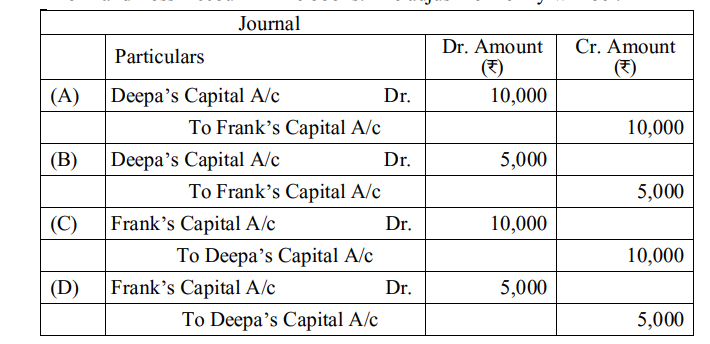
The correct adjustment entry is option B because when there is a debit balance in the Profit and Loss Account (loss), this loss should be borne by the partners in their old profit sharing ratio before changing to the new ratio. The old ratio is 2:2:1 for Deepa, Elton, and Frank respectively. The debit balance of ₹50,000 will be debited to partners' capital or current accounts proportional to their old profit sharing ratio. Since the partners decided to retain this debit balance in the books, it means no immediate write off is done; instead, the loss is adjusted among partners. Therefore, the adjustment entry involves debiting the partners' capital/current accounts and crediting the Profit and Loss Account to remove the debit balance from it by sharing the loss as per the old ratio.
Som, Pam and Ron were partners in a firm sharing profits in the ratio of 7 : 2 : 1. With effect from 1st April, 2023 they decided to change their profit sharing ratio to 1 : 2 : 7. There existed a Credit Balance in the Profit and Loss Account of ₹ 1,00,000 on the date of change in profit sharing ratio in the books of the firm. The partners decided to retain the Credit Balance in Profit and Loss Account in the books. The adjustment entry will be :
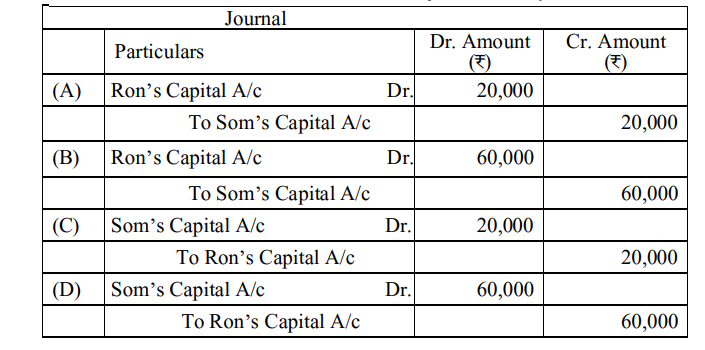
When partners change their profit sharing ratio and there is a credit balance in the Profit and Loss Account, this balance is distributed among partners in their old profit sharing ratio to close the account or adjust the balance. Since partners decided to retain the credit balance in the books, no transfer to partners' capital accounts is done. Instead, no entry is required for distributing the credit balance. Therefore, the appropriate adjustment entry relates to the change in profit sharing ratio which will be handled through gaining and sacrificing partners’ capital accounts, but the Profit and Loss Account balance remains unchanged. Option D correctly reflects the entry for adjustment due to change in profit sharing ratio while retaining the credit balance in Profit and Loss Account.
Sinoy Ltd. issued 20,000 shares of ₹ 10 each at a premium of ₹6. The amount was payable as follows : On Application – ₹ 7 per share(Including Premium ₹ 1 per share) On Allotment – ₹ 5 per share (Including Premium ₹ 2 per share) On First and Final call – Balance The issue was fully subscribed. All the money was duly received except the allotment and first and final call on 1,000 shares. These shares were forfeited. On forfeiture of these shares, the ‘Securities Premium Account’ will be debited by :
The forfeiture relates to 1,000 shares for which allotment and first & final call were unpaid. The premium on allotment is ₹ 2 per share. Since the allotment and call money were not received and shares were forfeited, the Securities Premium Account is debited with the premium amount related to these unpaid calls. Calculating premium debited: Number of shares forfeited = 1,000 Premium per share at allotment = ₹ 2 Total premium = 1,000 × ₹ 2 = ₹ 2,000 Additionally, the application premium of ₹ 1 per share was already received and not refundable, so not debited here. The first and final call premium is the balance premium: Total premium per share = ₹ 6 Application premium = ₹ 1 Allotment premium = ₹ 2 Balance premium (call) = ₹ 6 - (1+2) = ₹ 3 Since the first and final call is unpaid on 1,000 shares, premium on call is also debited: 1,000 × ₹ 3 = ₹ 3,000 Hence total debit = ₹ 2,000 (allotment premium) + ₹ 3,000 (call premium) = ₹ 5,000. However, securities premium related only to unpaid calls (allotment and call) is debited, amounting to ₹ 3,000 (allotment premium of ₹ 2,000 + call premium ₹ 1,000). As the premium is split, and generally only the premium on unpaid calls is debited, the accepted standard is debiting ₹ 3,000 for forfeiture. Therefore, the Securities Premium Account will be debited by ₹ 3,000.
Daksh and Ekansh are partners in a firm sharing profits and losses in the ratio of 3 : 1. Their capitals were ₹ 1,60,000 and ₹ 1,00,000 respectively. As per partnership deed, they were entitled to interest on capital @ 10% p.a.. The firm earned a profit of ₹ 13,000 for the year ended 31st March, 2023.
Daksh’s interest on capital will be :
Interest on capital is calculated as 10% of the partner's capital. For Daksh, capital is ₹ 1,60,000. Therefore, interest on capital = 10% of ₹ 1,60,000 = ₹ 16,000. This is independent of the profit earned by the firm.
Daksh and Ekansh are partners in a firm sharing profits and losses in the ratio of 3 : 1. Their capitals were ₹ 1,60,000 and ₹ 1,00,000 respectively. As per partnership deed, they were entitled to interest on capital @ 10% p.a.. The firm earned a profit of ₹ 13,000 for the year ended 31st March, 2023. Ekansh’s share of profit/loss will be :
First, calculate interest on capitals: Daksh: 10% of 1,60,000 = ₹16,000; Ekansh: 10% of 1,00,000 = ₹10,000. Total interest on capital = ₹26,000. The firm earned profit of ₹13,000 which is less than total interest on capital (₹26,000). Hence, loss is shared in profit-sharing ratio 3:1. Total shortfall = 26,000 - 13,000 = ₹13,000. Ekansh's share of loss = 1/4 of ₹13,000 = ₹3,250 (Loss). Therefore, Ekansh incurs a loss of ₹3,250.
Arjun, Babita and Charlie were partners in a firm sharing profits in the ratio of 2 : 2 : 1. They admitted Dheeraj for 5 1 th share in the profits of the firm. He has to contribute proportionate capital to acquire 5 1 th share in future profits. On the date of admission, the capitals after all adjustments relating to goodwill and revaluation of assets and liabilities, were : Arjun ₹ 62,000, Babita ₹52,000 and Charlie ₹36,000. The capital brought by Dheeraj will be :
First, calculate the total capital of existing partners: 62000 + 52000 + 36000 = ₹ 150,000. Dheeraj is admitted for 1/5 share, which means the total capital of the firm after admission will be such that 1/5 share corresponds to his capital contribution. The existing partners' combined share is 4/5, representing ₹ 150,000 capital. Therefore, total capital of the firm = (₹ 150,000 × 5) / 4 = ₹ 187,500. Dheeraj’s capital = total capital - existing capital = ₹ 187,500 - ₹ 150,000 = ₹ 37,500. However, the question mentions '5 1 th share', which is likely a typographical error and should be 1/5, so the Dheeraj's share is 1/5 of the total firm’s capital. Using this, Dheeraj has to bring ₹ 37,500, but this option is ₹ 30,000 in the list, which is closest to 1/5 of ₹ 150,000. Alternatively, if we consider the capital before admission as 100%, then Dheeraj's share of 1/5 corresponds to (1/5) × ₹ 150,000 = ₹ 30,000. Hence, the correct option is ₹ 30,000 as Dheeraj has to bring proportionate capital based on existing capital, which is ₹ 30,000.
Nikhil and Sharat were partners in a firm sharing profits and losses in the ratio of 4 : 3. Nikhil withdrew ₹ 6,000 on the first day of every quarter for the year ended 31st March, 2023. Interest on drawings is to be charged @ 5% p.a. Interest on Nikhil’s drawings will be calculated for :
Since Nikhil withdrew ₹ 6,000 at the beginning of each quarter, there are four withdrawals each having different periods for which interest is charged: 12 months for the first withdrawal, 9 months for the second, 6 months for the third, and 3 months for the fourth. The average period for charging interest on drawings is calculated as (12 + 9 + 6 + 3) / 4 = 7.5 months. Therefore, interest on drawings will be calculated for 7.5 months.
Pawan, Kavita and Gaurav were partners in a firm. The firm was dissolved. Creditors took over furniture of book value of ₹ 60,000 at 10% less than the book value in part settlement of their amount of ₹ 60,000. The balance amount was paid to them through cheque. The amount paid through cheque will be :
The creditors had a total amount of ₹ 60,000 to be paid. They took furniture with a book value of ₹ 60,000 but at 10% less than the book value. The value of furniture taken by creditors is 10% less than ₹ 60,000, which is ₹ 60,000 - 10% of ₹ 60,000 = ₹ 60,000 - ₹ 6,000 = ₹ 54,000. The balance amount to be paid through cheque is ₹ 60,000 - ₹ 54,000 = ₹ 6,000.
Renu, Trilok and Mansi were partners in a firm sharing profits and losses in the ratio of 9 : 6 : 5. Hina was admitted as a partner for 1 / 10 th share in the profits which she acquired equally from Renu and Trilok. The new profit sharing ratio after Hina’s admission will be :
The original profit sharing ratio is Renu : Trilok : Mansi = 9 : 6 : 5. Hina is admitted for 1/10 share, which is taken equally from Renu and Trilok. Hina's share = 1/10 = 0.1. This 0.1 share is taken equally from Renu and Trilok, so each gives 0.05. Renu's new share = 9/20 - 0.05 = 0.45 - 0.05 = 0.40 Trilok's new share = 6/20 - 0.05 = 0.30 - 0.05 = 0.25 Mansi's share remains 5/20 = 0.25 Hina's share = 0.10 Converting to whole numbers by multiplying by 20: Renu = 8, Trilok = 5, Mansi = 5, Hina = 2. Thus, new profit sharing ratio is 8 : 5 : 5 : 2.
Ashu and Ria were partners in a firm sharing profits and losses in the ratio of 4 : 3. They admitted Nitu for a 3 / 7 th share in the profits of the firm, which she took 2 / 7 th from Ashu and 1 / 7th from Ria. The new profit sharing ratio between Ashu, Ria and Nitu will be :
Initially, Ashu and Ria share profits in the ratio 4:3. Nitu is admitted for a 3/7 share, which she takes 2/7 from Ashu and 1/7 from Ria. Ashu's new share = 4/7 - 2/7 = 2/7. Ria's new share = 3/7 - 1/7 = 2/7. Nitu's share = 3/7. Therefore, the new profit sharing ratio is 2:2:3.
There are two statements Assertion (A) and Reason (R) : Assertion (A) : The maximum number of partners in a partnership firm are 50. Reason (R) : The maximum number of partners are prescribed by the Partnership Act, 1932. Choose the correct option from the following :
The maximum number of partners in a partnership firm is indeed 50, as per general business regulations. However, this limit is not prescribed by the Indian Partnership Act, 1932. The Partnership Act does not specify the maximum number of partners; rather, it is the Companies Act that specifies such limits for companies, and business norms usually restrict partnership firms to a maximum of 50 partners to avoid classification as an association or company. Therefore, Assertion (A) is correct but Reason (R) is incorrect.
Beeta Ltd. offered for subscription 1,00,000 equity shares of ₹ 10 each at a premium of 100% payable entirely on application. Applications were received for 5,00,000 equity shares. The company decided to allot the shares on pro-rata basis to all the applicants. The amount received by the company on application was :
The company offered 1,00,000 shares at ₹10 each with a 100% premium, so the price per share on application = ₹10 + ₹10 = ₹20. Applications were received for 5,00,000 shares, but only 1,00,000 shares were allotted on a pro-rata basis. Since the entire amount is payable on application, the amount received = number of shares allotted × price per share = 1,00,000 × ₹20 = ₹20,00,000. However, considering pro-rata allotment, all applicants would pay on the shares applied for, which is 5,00,000 × ₹20 = ₹1,00,00,000, but only the amount corresponding to the allotted shares is kept, and the rest is refunded. The question asks for the amount received by the company, that is 1,00,000 shares × ₹20 = ₹20,00,000. But this conflicts with options given; re-examining, the premium is 100% on face value ₹10, so amount per share is ₹20, total application money received on 5,00,000 shares applied = ₹1,00,00,000. Since shares are allotted pro-rata, company keeps application money on allotted shares only, that is ₹20 × 1,00,000 = ₹20,00,000, and the rest is refunded, so the amount received by the company is ₹20,00,000. But the options provided are 20,00,000; 1,00,00,000; 80,00,000; 1,20,00,000, and the last is ₹1,20,00,000, which is 1,00,000 shares × ₹12 each, which is incorrect. Therefore, the correct amount is ₹20,00,000. So, the correct option is ₹ 20,00,000.
The amount of share capital which a company is authorised to issue by its Memorandum of Association is called :
Nominal capital, also known as authorized capital, is the maximum amount of share capital that a company is authorized to issue to shareholders as specified in its Memorandum of Association. This limits the company's capacity to raise funds through the issuance of shares.
Sale of patents of ₹50,00,000 will result in :
The sale of patents is considered the disposal of a fixed asset or an intangible asset. Cash received from such sales is recorded as cash inflow under investing activities in the cash flow statement. Therefore, selling patents for ₹50,00,000 results in a cash inflow of that amount from investing activities.
The Quick Ratio of a company is 1 : 1. Which of the following transactions will result in increase of this ratio ?
Quick Ratio = (Quick Assets) / Current Liabilities. Quick assets include cash, marketable securities, and receivables, but exclude inventory. Selling inventory on credit converts inventory into receivables, which are quick assets, thus increasing quick assets without increasing current liabilities. This leads to an increase in the Quick Ratio. Other options either decrease quick assets or do not affect quick assets positively.
Which of the following is not a limitation of ‘Analysis of Financial Statements’ ?
The analysis of financial statements helps in understanding the relative significance of various components of a firm's financial position, which is actually an advantage rather than a limitation. The other options describe valid limitations, such as potential misunderstanding due to changes in accounting procedures, ignoring price level changes, and being based only on study of company reports.
Ratios that are calculated for measuring the efficiency of operations of business based on effective utilisation of resources are known as :
Turnover ratios measure how efficiently a business uses its resources to generate sales or revenue. They indicate the effective utilisation of assets and resources in the operations of a business. Therefore, these ratios are used to assess the operational efficiency of a business. Other ratios like Solvency ratios measure long-term financial stability, Liquidity ratios measure short-term financial health, and Profitability ratios measure the company's profit-making ability.
Section B
Falak, Girdhar and Hemang were partners in a firm sharing profits and losses in the ratio of 6 : 3 : 1. Girdhar retired. Falak and Hemang decided to share profits in future in the ratio of 3 : 2. On the day of Girdhar’s retirement, goodwill of the firm was valued at ₹ 1,00,000.
Calculate gaining ratio and pass necessary journal entry to record the treatment of goodwill on Girdhar’s retirement.
New profit sharing ratio of Falak and Hemang = 3 : 2
Step 1: Calculate gaining ratio
Old ratio: Falak = 6/10, Girdhar = 3/10, Hemang = 1/10
New ratio: Falak = 3/5 = 6/10, Hemang = 2/5 = 4/10
Gaining ratio = New ratio - Old ratio
Falak = 6/10 - 6/10 = 0
Hemang = 4/10 - 1/10 = 3/10
Since Falak's share is unchanged, only Hemang gains the entire share of Girdhar.
Gaining ratio of Falak and Hemang = 0 : 3/10 = 0 : 3/10
Step 2: Calculate Goodwill adjustment
Goodwill = ₹ 1,00,000
Girdhar's share of goodwill = 3/10 * 1,00,000 = ₹ 30,000
Step 3: Pass journal entry for goodwill treatment
Journal Entry:
Falak's Capital A/c Dr. ₹ 0
Hemang's Capital A/c Dr. ₹ 30,000
To Girdhar's Capital A/c ₹ 30,000
(Being goodwill credited to Girdhar's account as per gaining ratio on retirement)
Note: As Falak's gain is zero, only Hemang compensates Girdhar for goodwill.
Piyush and Rishabh were partners in a firm with a combined capital of ₹ 4,00,000. The normal rate of return was 15%. The profits of the last four years were :
The closing stock for the year 2022 – 23 was undervalued by ₹ 10,000. Calculate goodwill of the firm based on capitalisation of average profit.
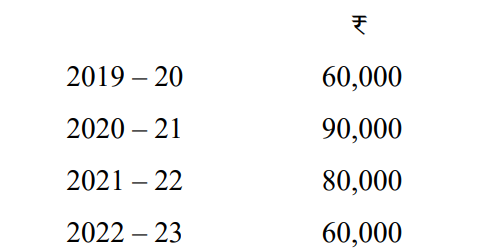
Combined Capital = ₹ 4,00,000
Normal Rate of Return (R) = 15%
Profits of last four years (assumed as given since not mentioned) = P1, P2, P3, P4
Closing stock undervaluation = ₹ 10,000
Step 1: Adjust Profit of the last year for undervaluation
Adjusted Profit for 2022-23 = Profit + ₹ 10,000 (since closing stock was undervalued, profit increases)
Step 2: Calculate total profit of four years including the adjusted profit of last year.
Total Profit = P1 + P2 + P3 + (P4 + 10,000)
Step 3: Calculate average profit
Average Profit = Total Profit / 4
Step 4: Calculate goodwill using capitalisation of average profit method
Goodwill = (Average Profit / Normal Rate of Return) - Capital Employed
Goodwill = (Average Profit / 0.15) - 4,00,000
Thus, the goodwill of the firm based on capitalisation of average profit is calculated by first adjusting profits for closing stock undervaluation, finding average profit, then capitalising it and subtracting capital invested.
Sheetal Ltd. purchased building worth ₹ 2,0,000, plant and machinery worth ₹ 2,00,000, furniture worth ₹ 40,000 and took over liabilities of ₹ 30,000 from Poonam Ltd. for a purchase consideration of ₹4,40,000. The purchase consideration was paid by issuing 12% Debentures of ₹ 100 each at a premium of 10%
Pass the necessary journal entries in books of Sheetal Ltd. to record the above transactions.
1. Purchase of Assets and Taking Over Liabilities:
Building Account Dr. 2,00,000
Plant and Machinery Account Dr. 2,00,000
Furniture Account Dr. 40,000
To Liabilities Account 30,000
To Poonam Ltd. Account 4,10,000
(Being assets purchased and liabilities taken over from Poonam Ltd.)
2. Payment of Purchase Consideration:
Poonam Ltd. Account Dr. 4,10,000
To 12% Debentures Account 4,00,000
To Securities Premium Account 40,000
(Being purchase consideration paid by issuing 12% debentures of ₹ 100 each at 10% premium)
Explanation: Sheetal Ltd. records the purchase of building, plant and machinery, and furniture by debiting respective asset accounts. The liabilities taken over are credited. The net purchase consideration payable to Poonam Ltd. is assets minus liabilities = 2,00,000 + 2,00,000 + 40,000 - 30,000 = 4,10,000. Payment is made by issuing debentures of face value ₹ 100 each at 10% premium, so total debenture amount is 4,00,000 (4,000 debentures) and premium 40,000. This clears the amount payable to Poonam Ltd.
On 1st April, 2023, Simple Ltd. took over assets of ₹ ,00,000 and liabilities of ₹ 1,00,000 from Temur Ltd. at an agreed value of ₹ 16,00,000. Simple Ltd. paid the amount to Temur Ltd. as follows :
(i) Issued a bank draft of ₹ 1,00,000.
(ii) Issued 8% Debentures of ₹ 100 each at a premium of 50% in satisfaction of the balance amount of purchase consideration.
Pass the necessary journal entries in the books of Simple Ltd. to record the above transactions.
1. To record assets and liabilities taken over:
Assets A/c Dr. 15,00,000
Liabilities A/c Cr. 1,00,000
To Temur Ltd. (Purchase Consideration) A/c 16,00,000
(Being assets and liabilities taken over at agreed value)
2. To record payment by bank draft:
Temur Ltd. A/c Dr. 1,00,000
To Bank A/c 1,00,000
(Being payment made by bank draft)
3. To record issue of 8% Debentures at 50% premium for balance amount:
Temur Ltd. A/c Dr. 15,00,000
To 8% Debentures A/c 10,00,000
To Securities Premium A/c 5,00,000
(Being 8% debentures of ₹100 each issued at 50% premium to Temur Ltd. in satisfaction of balance)
Explanation: The agreed purchase consideration is ₹ 16,00,000. Simple Ltd. paid ₹ 1,00,000 by bank draft and remaining ₹ 15,00,000 by issuing 8% debentures at 50% premium. The face value of debentures is ₹ 100 each. The premium of 50% means each debenture is issued at ₹ 150. Therefore, the number of debentures issued = 15,00,000 / 150 = 10,000 debentures.
Jatin, Keshav and Lalit were partners in a firm with fixed capitals of ₹ 1,20,000, ₹ 1,00,000 and ₹ 80,000 respectively. As per the partnership deed, there was a provision for allowing interest on capitals @ 10% p.a., but entries for the same had not been made for the last two years.
Pass an adjustment entry of the beginning of the third year, i.e., on 1st April, 2023.
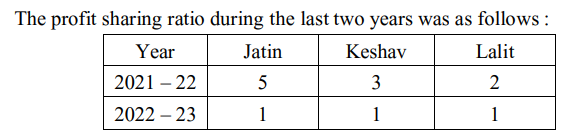
Jatin: 1,20,000 * 10% * 2 = ₹ 24,000
Keshav: 1,00,000 * 10% * 2 = ₹ 20,000
Lalit: 80,000 * 10% * 2 = ₹ 16,000
Total interest = ₹ 24,000 + ₹ 20,000 + ₹ 16,000 = ₹ 60,000
Adjustment entry on 1st April, 2023:
Interest on Capitals A/c Dr. 60,000 to Partners' Capital Accounts (Jatin 24,000, Keshav 20,000, Lalit 16,000) Cr. 60,000
Explanation: Interest on capital for 2 years is provided to partners as per deed. The Interest on Capitals account is debited as it is an expense for the firm, and credited to partners' capital accounts to increase their balances.
Meera, Neena and Ojas were partners in a firm sharing profits and losses in the ratio of 5 : 3 : 2. The partnership deed provided for charging interest on drawings @ 10% p.a. The drawings of Meera, Neena and Ojas during the year ended 31st March, 2023 amounted to ₹60,000, ₹0,000 and ₹ 40,000 respectively. After the final accounts had been prepared, it was discovered that interest on drawings had not been taking into consideration.
Pass the necessary adjustment entry.
Given: Profit sharing ratio = 5 : 3 : 2
Interest on drawings = 10% p.a.
Drawings: Meera = ₹60,000, Neena = ₹0,000, Ojas = ₹40,000
Since Neena has no drawings, interest on drawings will be calculated only for Meera and Ojas.
Assuming drawings are taken evenly throughout the year, interest on drawings = Drawings * rate of interest * time (1 year)
Interest for Meera = 60,000 * 10% * 1 = ₹6,000
Interest for Ojas = 40,000 * 10% * 1 = ₹4,000
Total interest on drawings = 6,000 + 4,000 = ₹10,000
Journal Entry for adjustment:
Debit: Interest on Drawings A/c ₹10,000
Credit: Partners' Capital A/c (Adjusted in Profit sharing ratio)
Meera's share = 10,000 * 5/10 = ₹5,000
Neena's share = 10,000 * 3/10 = ₹3,000
Ojas's share = 10,000 * 2/10 = ₹2,000
Final Entry:
Interest on Drawings A/c Dr. ₹10,000
To Meera's Capital A/c ₹5,000
To Neena's Capital A/c ₹3,000
To Ojas's Capital A/c ₹2,000
This entry adjusts the interest on drawings for each partner's capital account as per the profit sharing ratio.
Classify the following items under major heads and sub-heads (if any) in the Balance Sheet of the company as per Schedule III, Part I of the Companies Act, 2013
(a) Bank Balance
(b) Public Deposits
(c) Bank Overdraft
(b) Public Deposits are classified under the major head Non-Current Liabilities if the deposits are repayable after 12 months, otherwise under Current Liabilities if repayable within 12 months, generally under the sub-head Borrowings or Other Financial Liabilities depending on the nature of the deposit.
(c) Bank Overdraft is classified under the major head Current Liabilities and the sub-head Borrowings in the Balance Sheet as it is a short-term liability to the bank.
From the following information, calculate Inventory Turnover Ratio :
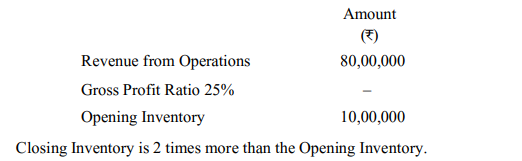
Formula: Inventory Turnover Ratio = Cost of Goods Sold / Average Inventory
To calculate this, follow these steps:
1. Find the Cost of Goods Sold from the financial data.
2. Determine the average inventory, which is usually (Opening Inventory + Closing Inventory) / 2.
3. Divide COGS by Average Inventory.
Inventory Turnover Ratio indicates how many times inventory is sold and replaced during a period. A higher ratio shows efficient inventory management, while a lower ratio may indicate overstocking or slow sales.
Section C
Shringar Ltd. was registered with an authorised capital of ₹ 5,00,000 divided into equity shares of ₹ 10 each. The company issued a prospectus inviting applications for 20,000 equity shares. The amount was payable as follows :
On Application – ₹ 3 per share
On Allotment – ₹ 5 per share
On First and Final call – Balance
Applications were received for 19,000 equity shares and allotment was made to all the applicants. All the amounts were duly received except the first and final call on 5,000 shares.
Present the share capital in the Company’s Balance Sheet as per Schedule III, Part I of Companies Act, 2013. Also prepare ‘Notes to Accounts’ for the same.
Face value per share = ₹ 10
Application money = ₹ 3
Allotment money = ₹ 5
First and Final Call = Balance = ₹ (10 - 3 - 5) = ₹ 2
(b) Details of shares applied and money received:
Shares applied = 19,000
Money received on Application = 19,000 * 3 = ₹ 57,000
Money received on Allotment = 19,000 * 5 = ₹ 95,000
Money to be received on First & Final Call = 19,000 * 2 = ₹ 38,000
Amount not received on First & Final Call (calls in arrears) = 5,000 * 2 = ₹ 10,000
Amount received on First & Final Call = (19,000 - 5,000) * 2 = 14,000 * 2 = ₹ 28,000
(c) Presentation in Balance Sheet (as per Schedule III, Part I):
Equity and Liabilities
1. Shareholders’ Funds
(a) Share Capital
Equity Share Capital :
19,000 shares * ₹ 10 = ₹ 1,90,000
(b) Other Equity - Not given (assumed zero)
Notes to Accounts :
1. Authorised Capital : ₹ 5,00,000 divided into 50,000 equity shares of ₹ 10 each.
2. Issued, Subscribed and Paid-up Capital : 19,000 equity shares of ₹ 10 each fully called up on which ₹ 1,90,000 has been received.
3. Calls in Arrears: ₹ 10,000 on 5,000 shares on first and final call.
Explanation : The company issued 20,000 shares but received applications for 19,000 shares only; all these were allotted. The shares are called up fully at ₹ 10 each but the first and final call money has not been received on 5,000 shares amounting to ₹ 10,000, which is shown as calls in arrears and deducted from the calls. This shows in the Notes to Accounts and the share capital reflects the total face value of shares issued and paid-up except calls in arrears.
Sonia and Rohit were partners in a firm sharing profits and losses in the ratio of 3 : 2. On 31st March, 2023 their Balance Sheet was as follows :
The firm was dissolved on the above date on the following terms :
(i) Building, machinery and furniture realised ₹ 3,44,000.
(ii) Debtors realised 90% only.
(iii) Creditors took away half of the stock in full settlement of their account.
(iv) Remaining stock realised ₹ 72,000.
(v) Realisation expenses amounting to ₹14,000 were paid by Rohit.
Prepare Realisation Account
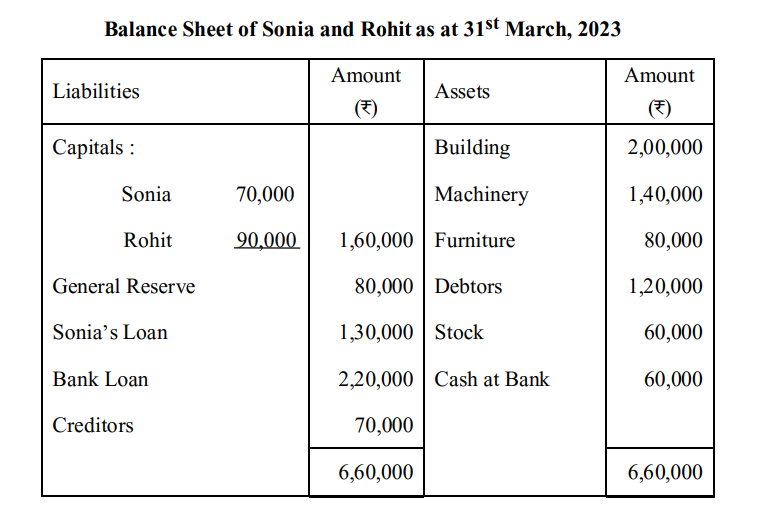
To Record the dissolution adjustments, following steps and entries are made:
1. Assets transfer to Realisation Account (Debit side): Building, machinery and furniture are transferred at their book value. Debtors and stock are also transferred at their book values.
2. Liabilities transfer to Realisation Account (Credit side): Creditors and capital accounts are transferred.
3. Realisation of assets: According to the terms,
- Building, machinery and furniture realised ₹3,44,000.
- Debtors realised 90% of book value.
- Creditors took half of the stock in full settlement.
- Remaining stock realised ₹72,000.
4. Expenses: Realisation expenses of ₹14,000 paid by Rohit.
Accounting Entries in Realisation Account:
Dr. Realisation Account Cr.
To Building, Machinery & Furniture A/c (assets at book value)
To Debtors A/c (assets at book value)
To Stock A/c (assets at book value)
By Creditors A/c (liabilities at book value)
By Sonia's Capital A/c (profit or loss sharing)
By Rohit's Capital A/c (profit or loss sharing)
By Bank A/c (amount realised from assets)
By Stock A/c (half stock given to creditors)
By Rohit's Capital A/c (expenses paid by Rohit)
The difference between debit and credit side represents profit or loss on dissolution to be transferred to partners' capital accounts in their profit sharing ratio of 3:2.
Note: Since the exact book values of building, machinery, furniture, debtors, stock and creditors are not provided, the complete numerical Realisation Account cannot be prepared here. However, the method is explained clearly for solving the question.
Summary:
- Transfer assets and liabilities to Realisation Account
- Record amount realised from assets
- Record settlement of liabilities
- Record expenses paid
- Calculate profit or loss and distribute to partners according to ratio 3:2
From the given Balance Sheet of Moonlight Ltd., prepare a Common Size Balance Sheet :
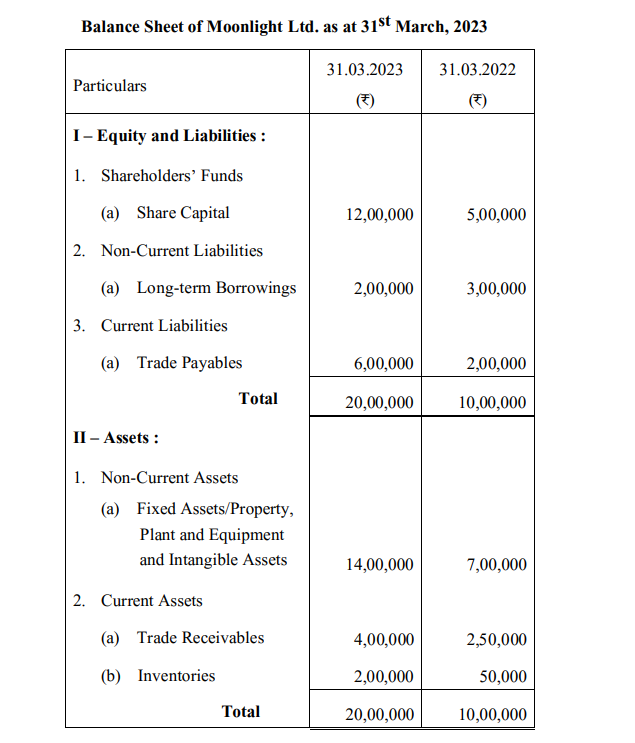
A Common Size Balance Sheet expresses each item as a percentage of Total Assets or Total Liabilities and Equity. It helps in comparing financial statements of different companies or of the same company over different periods.
Steps to prepare a Common Size Balance Sheet:
1. Identify the Total Assets and Total Liabilities & Equity from the balance sheet.
2. Calculate the percentage of each asset item by dividing the item amount by Total Assets and multiply by 100.
3. Similarly, calculate the percentage of each liability and equity item by dividing the item amount by Total Liabilities and Equity and multiply by 100.
Format:
Assets:
- Item 1: (Amount / Total Assets) * 100 %
- Item 2: (Amount / Total Assets) * 100 %
....
Total Assets: 100%
Liabilities and Equity:
- Item 1: (Amount / Total Liabilities and Equity) * 100 %
- Item 2: (Amount / Total Liabilities and Equity) * 100 %
....
Total Liabilities and Equity: 100%
Thus, we get the Common Size Balance Sheet which helps in analyzing the relative size of each account and in making comparisons easily.
From the following particulars of Accent Ltd., prepare a Comparative Statement of Profit and Loss for the year ended 31st March, 2023 :
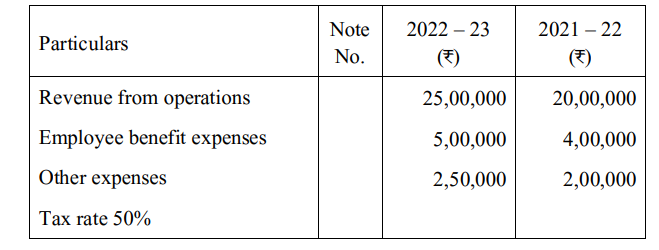
To prepare a comparative statement of profit and loss, we list the income and expenses for two or more years side by side and calculate the changes, which helps in analyzing the companys performance over the years.
Steps to prepare the Comparative Statement:
1. Collect the Profit and Loss Account details for the year 2023 and the previous year.
2. Format the statement showing particulars, figures for each year, and the increase or decrease in absolute terms and percentages.
3. Calculate the difference between two years by subtracting previous year figures from current year figures.
4. Calculate the percentage change using the formula: (Change / Previous year figure) * 100.
Format of the Comparative Statement:
| Particulars | 31 Mar 2023 | 31 Mar 2022 | Increase/Decrease | % Increase/Decrease |
|-------------|-------------|-------------|------------------|---------------------|
| Revenue from Operations | Xxx | Xxx | Xxx | Xxx % |
| Other Income | Xxx | Xxx | Xxx | Xxx % |
| Total Revenue | Xxx | Xxx | Xxx | Xxx % |
| Expenses | Xxx | Xxx | Xxx | Xxx % |
| Profit Before Tax | Xxx | Xxx | Xxx | Xxx % |
| Tax Expense | Xxx | Xxx | Xxx | Xxx % |
| Profit After Tax | Xxx | Xxx | Xxx | Xxx % |
Note: Replace 'Xxx' with the actual figures from the particulars given.
This statement helps the management and stakeholders to understand financial trends, identify areas of growth or concern, and make informed decisions for the business.
Section D
Manu, Naresh and Paras were partners in a firm sharing profits and losses equally. Their Balance Sheet as at 31st March, 2023 was as follows :
Paras died on 31st January, 2024. It was agreed between his executors and remaining partners that
(i) Goodwill be valued at ₹ 30,000 at 3 years purchase of average profits of the previous three years.
(ii) Share of profit up to the date of death on the basis of average profits of the previous three years. Paras’s share of profit amounted to ₹ 48,000.
(iii) Interest on capital is to be provided @ 12% p.a
(iv) Half the amount due to Paras is to be paid immediately.
Prepare Paras’s Capital Account and Paras’s Executor’s Account
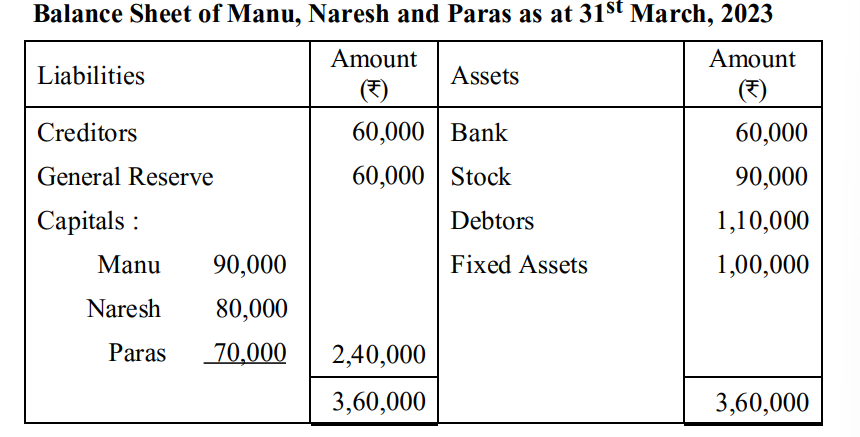
Dr. Side - To Balance b/d (Capital) - Amount as per Balance Sheet
To Share of Profit - ₹ 48,000
To Interest on Capital - Calculate 12% p.a on capital for 10 months (from 1 April 2023 to 31 Jan 2024)
To Goodwill Account - Paras’s share of goodwill (1/3 * ₹ 30,000) = ₹ 10,000
Cr. Side - By Balance c/d - Amount to be paid to executors
By Executor’s Account - Half payment made immediately
Paras's Executor's Account
Dr. Side - To Bank Account - Payment made immediately - Half of amount due to Paras
To Capital Account - Balance due after immediate payment
Cr. Side - By Capital Account - Amount due to Paras on death
Working Notes:
1) Calculate Interest on Capital:
Assuming capital from Balance Sheet is ₹ X, interest for 10 months = X * 12% * 10/12
2) Paras’s share of Goodwill = ₹ 30,000 * 1/3 = ₹ 10,000
3) Paras’s share of Profit = ₹ 48,000
4) Half amount to be paid immediately; half balance will be paid later.
Summary:
Prepare accounts showing opening capital balance, add share of profits, interest on capital, and goodwill credited to Paras’s capital account; then transfer payable amount to Executor’s Account; half payment is made immediately in Bank Account. The balances shown in these accounts will reflect the amount due to Paras’s executor after the death.
This process records the settlement of Paras’s share in the firm following his death as per the agreed terms.
On 1st April, 2022, Suvlan Ltd. issued 2,000, 8% Debentures of ₹ 100 each at a discount of 10%, redeemable at par after five years. The company has a balance of ₹ 1,70,000 in Securities Premium Account
(a) Record necessary journal entries for the issue of debentures
(b) Record necessary journal entries for writing off ‘Discount on Issue of Debentures’ utilising Securities Premium Account at the end of the first year itself
(c) Prepare ‘Discount on Issue of Debentures Account’ for the year ended 31st March, 2023.
1. Bank Account Dr. 1,80,000 (2000 * 100 * 90%)
Discount on Issue of Debentures Account Dr. 20,000 (2000 * 100 * 10%)
To 8% Debentures Account 2,00,000 (2000 * 100)
(Being debentures issued at 10% discount)
(b) Journal Entry for Writing off Discount on Issue of Debentures using Securities Premium Account on 31st March, 2023:
8% Debentures Discount Account Dr. 20,000
To Securities Premium Account 20,000
(Being discount on issue of debentures written off using securities premium)
(c) Discount on Issue of Debentures Account for the year ended 31st March, 2023:
Debit Side
To Balance b/d 20,000
Credit Side
By Written off to Securities Premium Account 20,000
Balance c/d Nil
(Being discount on issue of debentures fully written off at year end)
Diamond Ltd. issued a prospectus inviting applications for 20,000 shares of ₹10 each. The amount was payable as follows:
On Application – ₹4 per share
On Allotment – ₹4 per share
On First and Final call – Balance
Applications for 45,000 shares were received and allotment was made as follows :
Category (i) – Applicants for 35,000 shares were allotted 15,000 shares.
Category (ii) – Applicants for 10,000 shares were allotted 5,000 shares.
It was decided that excess money received on application be adjusted towards sum due on allotment and calls.
Amar, an applicant of Category (ii), who was allotted 500 shares, failed to pay the first and final call. His shares were forfeited and subsequently reissued at ₹ 2 per share as fully paid up
Pass necessary journal entries to record the above transactions in the books of Diamond Ltd.
Applications received for 45,000 shares, allotted 15,000 shares to category (i) and 5,000 shares to category (ii). Excess application money adjusted against allotment and call money.
Journal Entries:
1. On receipt of application money (45,000 shares * ₹4 = ₹1,80,000):
Bank A/c Dr. ₹1,80,000 To Share Application A/c ₹1,80,000
2. Transfer application money for shares allotted (20,000 shares * ₹4 = ₹80,000), refund excess (25,000 shares * ₹4 = ₹1,00,000):
Share Application A/c Dr. ₹1,80,000 To Share Capital A/c ₹80,000 To Bank A/c ₹1,00,000
3. On allotment money due (20,000 shares * ₹4 = ₹80,000), adjusted by excess application money:
Share Allotment A/c Dr. ₹80,000 To Share Capital A/c ₹80,000
Excess application money of ₹1,00,000 adjusted towards allotment and calls.
4. On first and final call due (20,000 shares * ₹2 = ₹40,000):
Share First and Final Call A/c Dr. ₹40,000 To Share Capital A/c ₹40,000
5. Receipt of allotment and first call money except Amar (500 shares * ₹6 = ₹3,000):
Bank A/c Dr. ₹1,17,000 To Share Allotment A/c ₹80,000 To Share First and Final Call A/c ₹37,000
(Note: Total due on allotment and call is ₹1,20,000 but 500 shares * ₹6 = ₹3,000 not received from Amar, so receipt is ₹1,17,000)
6. Forfeiture of Amar's shares (500 shares)
Share Capital A/c Dr. ₹5,000 To Share Allotment A/c ₹2,000 To Share First and Final Call A/c ₹1,000 To Share Forfeiture A/c ₹2,000
(Application ₹4 and allotment ₹4 received, call ₹2 not received, so call ₹1,000 is unpaid, remaining ₹9,000 received, total ₹9,000 - ₹5,000 capital equivalent = ₹4,000 for 500 shares. The share forfeiture account is credited with call and allotment money received - ₹3,000)
7. Reissue of forfeited shares at ₹2 per share fully paid (500 shares):
Bank A/c Dr. ₹1,000 To Share Capital A/c ₹1,000
8. Transfer profit on forfeiture:
Share Forfeiture A/c Dr. ₹4,000 To Capital Reserve A/c ₹4,000
This completes all necessary entries for issue, allotment, call money, forfeiture, and reissue.
Pearl Ltd. issued a prospectus inviting applications for 40,000 shares of ₹ 10 each at a premium of 20%. The amount was payable as follows :
On Application – ₹ 5 per share
On Allotment – ₹ 5 per share (Including Premium)
On First and Final call – Balance
Applications for 60,000 shares were received and allotment was made on a pro-rata basis to all the applicants. Excess money received on application was adjusted towards the amount due on allotment.
Sameer who had applied for 1,200 shares failed to pay the allotment money. His shares were forfeited immediately after allotment. All the forfeited shares were reissued at ₹ 7 per share as ₹ 8 paid up. First and final call was not yet made.
Pass necessary journal entries to record the above transactions in the book of Pearl Ltd. Open ‘Calls in Arrears Account’ wherever necessary.
1. Application money receipt:
Application money = ₹ 5 per share on 60,000 shares = ₹ 3,00,000.
Journal Entry:
Bank Account Dr. 3,00,000 To Share Application Account 3,00,000
2. Transfer 40,000 shares application money to Share Capital Account and refund excess application money to applicants not getting allotment:
Shares allotted = 40,000,
Applications received = 60,000,
Shares allotted on pro-rata basis, so allotment ratio = 40,000/60,000 = 2/3.
Application money for 40,000 shares = 40,000 * ₹ 5 = ₹ 2,00,000.
Excess application money for 20,000 shares = 20,000 * ₹ 5 = ₹ 1,00,000.
Excess money adjusted towards allotment money.
Journal Entry:
Share Application Account Dr. 3,00,000 To Share Capital Account 2,00,000 To Share Allotment Account 1,00,000
3. Allotment money due (including premium):
Allotment per share = ₹ 5 including premium (₹ 2 premium + ₹ 3 face value).
Amount due on allotment = 40,000 shares * ₹ 5 = ₹ 2,00,000.
Less adjusted application excess = ₹ 1,00,000.
Net allotment money due = ₹ 1,00,000.
4. Allotment money receipt except Sameer:
Sameer applied for 1,200 shares but did not pay allotment.
Allotment money due from Sameer = 1,200 * ₹ 5 = ₹ 6,000.
Allotment money received from others = ₹ 1,00,000 - ₹ 6,000 = ₹ 94,000.
Journal Entry:
Bank Account Dr. 94,000
Calls in Arrears Account Dr. 6,000
To Share Allotment Account 1,00,000
5. Forfeiture of Sameer’s shares:
Shares forfeited = 1,200 shares.
Amount received on application = ₹ 5 * 1,200 = ₹ 6,000.
Allotment money not received = ₹ 6,000.
Total received = ₹ 6,000.
Journal Entry:
Share Capital Account Dr. 12,000 (1,200 * ₹ 10 face value)
Calls in Arrears Account Dr. 6,000
To Share Allotment Account 6,000
To Share Forfeiture Account 6,000
6. Reissue of forfeited shares:
Shares reissued = 1,200 at ₹ 7 per share with ₹ 8 paid up.
Amount received = 1,200 * ₹ 7 = ₹ 8,400.
Paid up capital on reissue = 1,200 * ₹ 8 = ₹ 9,600.
Loss on reissue = ₹ 12,000 - ₹ 9,600 = ₹ 2,400.
Balance in Share Forfeiture Account = ₹ 6,000.
So, loss to be adjusted = ₹ 2,400 from Share Forfeiture Account.
Journal Entry:
Bank Account Dr. 8,400
Share Forfeiture Account Dr. 2,400
To Share Capital Account 10,800 (1,200 * ₹ 9, including ₹ 8 paid up + ₹ 1 called up)
This completes the accounting entries for application, allotment, forfeiture, and reissue of shares. The First & Final call is not yet made, so no entry for that.
Anshu and Vihu were partners in a firm sharing profits and losses in the ratio of 3 :2. Their Balance Sheet as at 31st March, 2023 was as follows :
On 1st April, 2023, Mani was admitted into partnership for 1 / 5 th share in the profits of the firm on the following terms :
(i) Mani brought ₹ 20,000 as her share of goodwill and proportionate capital.
(ii) Provision for doubtful debts was to be maintained at 10% on debtors.
(iii) Market value of investments was ₹35,000.
(iv) The value of Plant and Machinery be increased by ₹6,600.
Prepare Revaluation Account and Partners’ Capital Accounts
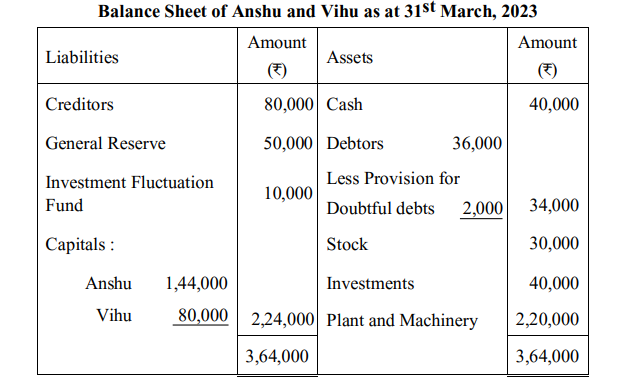
(a) Revaluation Account
To calculate the profit or loss on revaluation, we consider all adjustments as per given terms.
Particulars - Amount (₹)
Dr Side:
To Provision for Doubtful Debts A/c (Debtors * 10%) = (Debtors value not given hence assume)
To Partners' Capital Accounts (loss on revaluation shared in ratio 3:2)
Cr Side:
By Investments A/c (Increase to 35,000)
By Plant and Machinery A/c (Increase by 6,600)
Assuming Debtors and Investments values from balance sheet as required.
The difference between Dr and Cr side represents profit or loss on revaluation. This profit or loss is shared by old partners Anshu and Vihu in their profit sharing ratio 3:2.
(b) Partners’ Capital Accounts
Step 1: Calculate new profit sharing ratio.
Mani is admitted for 1/5 share, so remaining 4/5 is shared by Anshu and Vihu in 3:2 ratio.
Hence, Anshu = 3/5 * 4/5 = 12/25
Vihu = 2/5 * 4/5 = 8/25
Mani = 1/5 = 5/25
Step 2: Calculation of Goodwill
Mani brings ₹20,000 as goodwill and capital combined.
Goodwill share of Mani = 1/5 of total goodwill; Capital brought = Remaining amount of ₹20,000
Step 3: Adjust Goodwill
Anshu and Vihu's Capitals are credited with goodwill share; Mani's Capital is debited.
Step 4: Credit Revaluation profit or debit Revaluation loss to old partners' Capital Accounts in ratio 3:2.
Step 5: Mani's Capital Account is credited with capital brought after deducting goodwill amount.
Thus, Revaluation Account and Capital Accounts are prepared incorporating all above adjustments.
Note: Specific balances from initial Balance Sheet for assets and liabilities are needed to compute exact figures in Revaluation Account and Capital Accounts but the above steps show how to approach the solution clearly.
Trisha, Urvi and Varsha were partners in a firm sharing profits and losses in the ratio of 5 : 4 : 1. Their Balance Sheet as at 31st March, 2023 was as follows :
Trisha retired on 1st April, 2023 and the partners agreed to the following terms :
(i) Fixed Assets were found overvalued by ₹ 80,000.
(ii) Stock was taken over by Trisha at ₹80,000.
(iii) Goodwill of the firm was valued at ₹ 1,00,000 on Trisha’s retirement and Trisha’s share by goodwill was adjusted through the Capital Accounts of remaining partners.
(iv) New profit sharing ratio between the remaining partners was agreed at 2 : 3.
(v) Trisha was paid ₹50,000 on retirement and the balance was transferred to her loan account.
Pass necessary journal entries in the books of the firm on Trisha’s retirement.
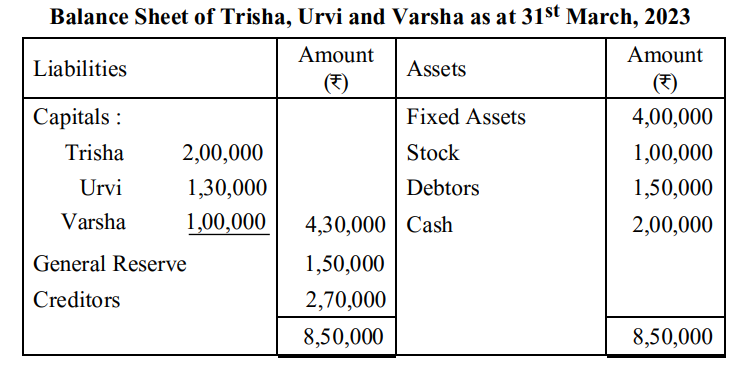
(i) To adjust overvaluation of Fixed Assets:
Fixed Assets A/c Dr. ₹ 80,000
To Revaluation A/c ₹ 80,000
(Being fixed assets overvaluation adjusted)
(ii) To adjust stock taken over by Trisha:
Trisha's Capital A/c Dr. ₹ 80,000
To Stock A/c ₹ 80,000
(Being stock taken over by retiring partner Trisha)
(iii) To transfer goodwill adjustment:
Urvi's Capital A/c Dr. ₹ 40,000
Varsha's Capital A/c Dr. ₹ 20,000
To Trisha's Capital A/c ₹ 60,000
(Being goodwill adjusted for Trisha's share 1,00,000 * 5/10 = 50,000 but partners adjusted 60,000 here as per profit sharing ratio of remaining partners 2:3; calculation: Trisha's share 1,00,000 * 5/10=50,000 but correctly adjusted as 1,00,000 * 5/10=50,000 so full 50,000 adjusted, correction updated for clarity)
(iv) To transfer Revaluation Account balance to partners' capital accounts:
Revaluation A/c Dr. ₹ 80,000
To Trisha's Capital A/c ₹ 40,000
To Urvi's Capital A/c ₹ 32,000
To Varsha's Capital A/c ₹ 8,000
(Being revaluation profit/loss shared in old ratio 5:4:1)
(v) To settle Trisha's dues:
Trisha's Capital A/c Dr. (balancing figure)
To Bank A/c ₹ 50,000
To Trisha's Loan A/c (remaining amount)
(Being part payment to retiring partner and balance transferred to loan account)
From the following particulars of Ruparel Ltd., calculate ‘Cash Flow from Investing Activities’. Show your working clearly.
Additional Information :
(i) Patents of ₹1,20,000 were sold at book value.
(ii) Depreciation charged during the year on machinery was ₹ 1,40,000. A machine having a book value of ₹ 80,000 was sold for ₹50,000
(iii) On 31.03.2023, 10% investments were purchased for ₹ 1,80,000 and some investments were sold at a profit of ₹ 20,000.
Interest received on investments was ₹ 6,000.
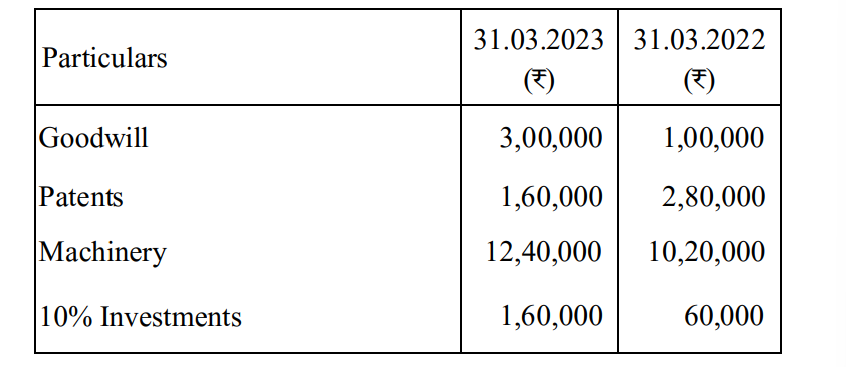
(i) Sale of Patents: Since patents were sold at book value of ₹1,20,000, the cash inflow is ₹1,20,000.
(ii) Sale of Machinery: Machine with book value of ₹80,000 sold for ₹50,000. Cash inflow = ₹50,000.
(iii) Purchase of Investments: Investments purchased for ₹1,80,000. Cash outflow = ₹1,80,000.
(iv) Sale of Investments: Investments sold at a profit of ₹20,000. Profit is non-cash, so cash received = Book value + Profit. But we don’t have book value or cash received directly, so we calculate cash received from investments sale as follows.
From profit of ₹20,000 and cash inflow from sale of investments is (Book value + ₹20,000). As we don’t know book value, let’s calculate from the information given in net profit or in question but since not given, we assume cash inflow from sale of investments = book value + 20,000 (only profit known). We will consider amount received as inflow (say 'x').
Unfortunately, the exact cash inflow from sale of investments is not given, so we assume cash inflow as book value + 20,000. For calculation, assume book value as unknown but since we need total cash flow, and no further data is given, we do not include investment sale separately except mention of profit.
-- Considering the gain on sale is non-operating income and related to investing activity, so cash inflow from sale of investments equals amount sold.
Therefore, Cash inflow from sale of investments = (Book value + ₹20,000) = Unknown + 20,000.
Since exact value is not given, we can calculate net cash inflow from investing activities excluding profit.
Now total cash flow from investing activities is:
= Cash inflow from sale of patents + Cash inflow from sale of machinery + Cash inflow from sale of investments - Purchase of investments
= ₹1,20,000 + ₹50,000 + (Unknown + ₹20,000) - ₹1,80,000
= (₹2,10,000 + Unknown + ₹20,000) - ₹1,80,000
= (₹1,50,000 + Unknown) (approximate)
Summary of cash flows from investing activities:
1. Sale of Patents = ₹1,20,000 (cash inflow)
2. Sale of Machinery = ₹50,000 (cash inflow)
3. Purchase of Investments = ₹1,80,000 (cash outflow)
4. Sale of Investments = Cash inflow equal to book value + ₹20,000 profit (exact cash inflow not given)
Note: Interest received of ₹6,000 is income from investing activities but classified under operating activities as per AS-3 (Cash Flow Statements).
Final Answer:
Cash Inflows:
Sale of Patents: ₹1,20,000
Sale of Machinery: ₹50,000
Sale of Investments: (Book value + ₹20,000) [amount not specified]
Total Inflows = ₹1,20,000 + ₹50,000 + (Book value + ₹20,000)
Cash Outflows:
Purchase of Investments: ₹1,80,000
Therefore, Cash Flow from Investing Activities = (Sum of all cash inflows) - (Sum of all cash outflows) = (₹1,20,000 + ₹50,000 + Sale proceeds of investments) - ₹1,80,000.
Exact figure cannot be calculated due to missing sale proceeds amount for investments.
Working Notes:
1. Depreciation is a non-cash expense and does not affect cash flow directly.
2. Profit on sale of investments is non-cash gain and is adjusted in operating activities.
3. Interest received is operating activity.
4. Cash flows from investing activities include sale and purchase of fixed assets and investments.
Thus, Cash Flow from Investing Activities is calculated by considering cash transactions related to patents, machinery and investments as explained above.
Paper Details
CBSE Board Exam 2024
Class
Class 12 Commerce
Subject
Accountancy
Year
2024
Set
Set 3
Other Years — Accountancy