Class 12 Humanities . Economics . Indian Economic Development . Human Capital Formation in India
Chapter 4: Human Capital Formation In India
Ch 4
Economics
Class 12 Humanities
Introduction
Why Education and Training Matter
Education’s contribution
- Productivity: Education and training improve people’s labour skills, helping them work more efficiently.
- Income and growth: A skilled, educated worker can earn more and contribute more to economic growth than an uneducated worker.
- Personal and social benefits: Education can improve social standing and pride, help people make better life choices, and deepen understanding of social change.
- Innovation and technology: Education stimulates innovation and helps workers adapt to new technologies.
- Development: Expanding educational opportunities can accelerate a nation’s development.
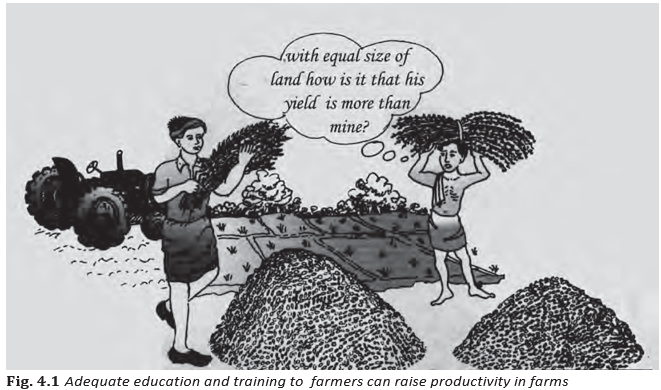
Human Capital
Human capital — The skills and capabilities developed in people through education and training, which enable them to contribute productively to the economy.
From human resources to human capital
- Human resources include people such as nurses, farmers, teachers and students.
- Investment in people through education and training develops their abilities and helps turn human resources into skilled human capital, such as doctors, engineers and other professionals.
- Human capital produces human capital: Educated and trained professionals, including professors, help educate and train others.
Human capital formation
- Investment in education and training
- More skilled and capable people
- Higher productivity and contribution to economic growth
- Skilled people educate and train the next generation
Key Questions in the Chapter
- Sources: What investments and resources help form human capital?
- Growth: How is human capital related to a country’s economic growth?
- Development: How is human capital formation linked to people’s broader human development?
- Government: What role can the government play in human capital formation in India?
Quick recap
- Education and training build skills and improve labour productivity.
- Skilled workers can earn more and contribute more to economic growth.
- Education also supports better choices, social understanding, innovation and technology adoption.
- Investment in people turns human resources into human capital.
- Human capital, in turn, helps develop and train more human capital.
Sources of Human Capital?
Human capital formation — The process of building people’s skills, knowledge and health through investment.
Human Capital and Economic Growth
How Human Capital Contributes to Economic Growth
Economic growth — An increase in a country’s real national income.
Human capital — The enhanced productivity and income-generating capacity of people, developed through education, health and other inputs.
- Education: Develops knowledge and skills, enabling workers to contribute more to production and national income.
- Health: Supports a longer, more reliable supply of labour and helps people work productively.
- Other contributors: On-the-job training, job-market information and migration also increase an individual’s income-generating capacity.
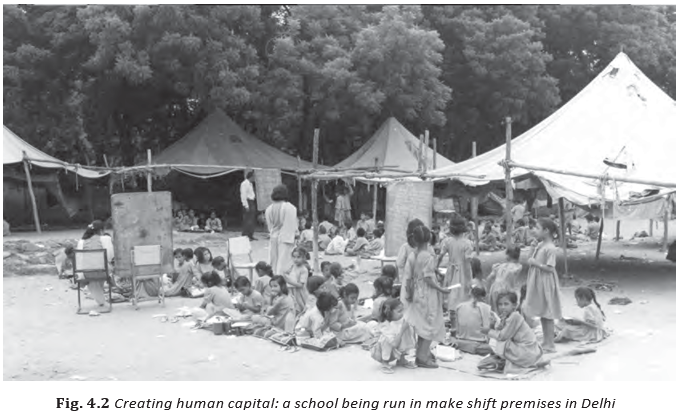
Productivity, Innovation and Technology
- Productivity: Human capital raises labour productivity, supporting higher output and income.
- Innovation: Education helps people understand social change and scientific advances, encouraging inventions and new ideas.
- Technology: An educated workforce is better able to understand and adapt to new technologies.
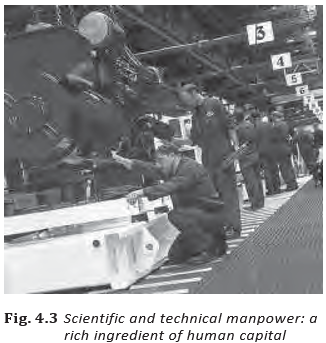
Evidence, Measurement and Causality
- Evidence is uncertain: It is difficult to prove that human-capital growth alone causes economic growth; empirical findings are not conclusive.
- Education measures: Years of schooling, teacher–pupil ratios and enrolment rates may not show the quality of education.
- Health measures: Health-service expenditure, life expectancy and mortality rates may not fully capture people’s true health status.
- Different trends: Human-capital indicators converged across developing and developed countries, but real per-capita income did not. Human capital grew faster in developing countries than their per-capita income.
- Two-way causality: Higher income can support better education and health, while stronger human capital can also raise income.
Human Capital and Income: Two-Way Causality
- Higher income → greater ability to invest in education and health → stronger human capital
- Stronger human capital → higher productivity and innovation → potential growth in income
India’s Development Strategy
- Seventh Five Year Plan: Assigned human-resource development a key role in development, especially in a country with a large population.
- People as an asset: A large population, when properly educated and trained, can accelerate economic growth and support desired social change.
- Interconnected progress: Education, health and income indicators improved together; growth in each sector may reinforce the others, though this does not by itself prove cause and effect.
| Indicator | 1951 | 1981 | 1991 | 2001 | 2016–17 |
|---|---|---|---|---|---|
| Real per-capita income (Rs.) | 7,651 | 12,174 | 15,748 | 23,095 | 77,659 |
| Crude death rate (per 1,000 population) | 25.1 | 12.5 | 9.8 | 8.1 | 6.3 |
| Infant mortality rate | 146 | 110 | 80 | 63 | 33 |
| Life expectancy at birth: male (years) | 37.2 | 54.1 | 59.7 | 63.9 | 67 |
| Life expectancy at birth: female (years) | 36.2 | 54.7 | 60.9 | 66.9 | 70 |
| Literacy rate (%) | 16.67 | 43.57 | 52.21 | 65.20 | 76 |
National Education Policy 2020 and Future Skills
- Changing work: Big data, machine learning and artificial intelligence may replace some unskilled jobs, increasing demand for skilled workers.
- In-demand skills: Mathematics, computer science and data science will be important, alongside multidisciplinary learning across sciences, social sciences and humanities.
- Environmental challenges: Climate change, pollution and resource depletion will require skills in biology, chemistry, physics, agriculture, climate science and social science.
- Health challenges: Epidemics and pandemics increase the need for collaborative infectious-disease research, vaccine development and understanding related social issues.
- Humanities and arts: Demand for these fields will also grow as India moves towards becoming a developed country and one of the world’s three largest economies.
- Growth pathway: The policy vision is that human-capital formation can move India towards a higher growth trajectory in a changing knowledge landscape.
India as a Knowledge Economy
- IT and services: India’s software industry has shown an impressive record over the past two decades, supporting the vision of an IT-based knowledge economy.
- Examples: Use of e-mail in villages and e-governance are cited as possible applications of information technology.
- Important condition: The value of IT depends greatly on the existing level of economic development; technology alone does not guarantee human development.
How does human capital contribute to economic growth?
Why is it difficult to establish a direct causal link between human capital and economic growth?
Can IT-based services in rural areas lead to human development?
Quick recap
- Human capital—built through education, health and other inputs—raises people’s productivity and income-generating capacity.
- Education supports innovation and technology adoption; health supports a longer, more reliable supply of labour.
- Human-capital measures have limitations, and human-capital indicators and income do not necessarily improve at the same pace.
- Causality is two-way: human capital can promote income growth, and higher income can support human-capital formation.
- India’s education and health indicators improved alongside real per-capita income over the reported years.
- The National Education Policy 2020 stresses multidisciplinary skills and identifies growing demand in technology, environmental, health, humanities and arts fields.
- IT can support a knowledge economy, but its value depends on the level of economic development.
Human Capital and Human Development
Human Capital vs Human Development
| Point | Human capital | Human development |
|---|---|---|
| Purpose of education and health | Means to increase labour productivity and output of goods and services | Essential to human well-being and valuable in themselves |
| View of people | People are a means to higher productivity | People are ends in themselves |
| Capabilities | Focuses on how education and health improve productivity | Literacy and a long, healthy life enable people to make other choices they value |
| Value of investment | Investment is productive when it enhances output | Investment matters even if it does not raise labour productivity |
| Basic services | Valued mainly for their contribution to productivity | Basic education and health care are important in themselves and are individual rights |
Human Capital Formation in India
Human capital formation — The outcome of investments in education, health, on-the-job training, migration and information.
Shared Government Responsibility
- Key sources: Education and health are especially important sources of human capital formation.
- Federal structure: India has union, state and local governments; the Constitution assigns functions to each level.
- Joint responsibility: All three tiers—union, state and local—spend on education and health.
- Scope: This section analyses education; the health sector is discussed separately in Chapter 8.
Why Government Intervention Is Needed
Need for Regulation
- Private and social benefits: Education and health benefit individuals as well as society, so both private and public institutions provide these services.
- Long-term effects: Spending decisions have lasting consequences and are difficult to reverse; poor services can cause serious harm before a person can switch providers.
- Incomplete information: Consumers may not know the quality or cost of services fully.
- Risk of exploitation: Providers can gain monopoly power when consumers lack information and may exploit them.
- Government role: Ensure private providers meet required standards and charge the correct price.
Why Regulation Matters
- Education and health decisions have lasting effects and are difficult to reverse
- Consumers may have limited information about quality and cost
- Providers can gain monopoly power
- Consumers may face exploitation
- Government regulation protects service standards and fair prices
| Sector | Ministries and departments | Organisations named |
|---|---|---|
| Education | Union and state ministries of education; departments of education | National Council of Educational Research and Training (NCERT); University Grants Commission (UGC); All India Council of Technical Education (AICTE) |
| Health | Union and state ministries of health; departments of health | National Medical Commission; Indian Council for Medical Research (ICMR) |
Access, Rights and Public Spending
Affordability and Government Support
- Affordability gap: Many people below the poverty line cannot afford basic education or health care; many also cannot access higher education or super-specialty health care.
- Rights perspective: If basic education and health care are citizens’ rights, government provision is essential.
- Targeted support: Government should provide education and health services free of cost for deserving citizens and socially oppressed classes.
- Spending objective: Union and state governments have increased education expenditure to pursue 100% literacy and substantially raise Indians’ average educational attainment.
How do human capital and human development differ?
Why is government intervention needed in education and health services?
What are the objectives of increased education expenditure in India?
Quick recap
- Human capital treats education and health mainly as investments to improve labour productivity.
- Human development values education and health as essential to well-being and human rights.
- Human capital formation comes from education, health, on-the-job training, migration and information.
- Union, state and local governments share responsibility for education and health expenditure.
- Government regulation addresses lasting effects, limited consumer information and possible provider exploitation.
- Education expenditure aims for 100% literacy and higher average educational attainment.
Education Sector In India
Government Expenditure on Education
Measuring education expenditure
- Share of government spending: Education expenditure as a percentage of total government expenditure indicates the priority given to education in the government budget.
- Share of GDP: Education expenditure as a percentage of GDP indicates the share of national income committed to developing education.
- 1952–2014: The share of total government expenditure rose from 7.92% to 15.7%; the share of GDP rose from 0.64% to 4.13%.
- Trend: The rise was irregular, with increases and falls. Including private and philanthropic spending would make total education expenditure higher.
| Measure | What it indicates |
|---|---|
| Education expenditure as a percentage of total government expenditure | How important education is among government spending priorities |
| Education expenditure as a percentage of GDP | How much of national income is committed to education |
Spending Across Education Levels
Elementary and tertiary education
- Elementary education: Receives a major share of total government education expenditure.
- Tertiary education: Receives the smallest overall share, but its expenditure per student is higher than in elementary education.
- Why both matter: Expanding school education requires more teachers trained in higher educational institutions.
- Policy implication: Resources should not simply be shifted from tertiary to elementary education; expenditure should increase at every level.
| State | Per capita public expenditure |
|---|---|
| Himachal Pradesh | Rs 34,651 (highest) |
| Bihar | Rs 4,088 (lowest) |
Effects of unequal state spending
- Large differences in per capita public spending across states
- Unequal educational opportunities
- Differences in educational attainment
Recommended Spending and Government Measures
Recommendations and policy measures
- 1964–66The Education Commission recommended spending at least 6% of GDP on education to achieve noticeable growth in educational attainment.
- 1998–99 to 2006–07The Tapas Majumdar Committee estimated that around Rs 1.37 lakh crore was needed over 10 years to bring all children aged 6–14 under school education.
- 1999The Government of India appointed the Tapas Majumdar Committee.
- 2009The Right of Children to Free and Compulsory Education Act made free education a fundamental right for children aged 6–14.
Funding initiatives
- Spending target: The current level of a little over 4% of GDP was considered inadequate compared with the recommended 6%; reaching 6% was accepted as a goal.
- Education cess: A 2% cess on Union taxes is earmarked for elementary education.
- Higher education: The government also provides substantial funding and student loan schemes to support higher education.
Educational Attainment in India
Educational attainment — A country's educational achievements are commonly measured through adult literacy, primary completion and youth literacy rates.
| Indicator | Group | 1990 | 2000 | 2011 | 2017–18 |
|---|---|---|---|---|---|
| Adult literacy (people aged 15+) | Male | 61.9 | 68.4 | 79 | 82 |
| Adult literacy (people aged 15+) | Female | 37.9 | 45.4 | 59 | 66 |
| Primary completion (relevant age group) | Male | 78 | 85 | 92 | 93 |
| Primary completion (relevant age group) | Female | 61 | 69 | 94 | 96 |
| Youth literacy (ages 15–24) | Male | 76.6 | 79.7 | 90 | 93 |
| Youth literacy (ages 15–24) | Female | 54.2 | 64.8 | 82 | 90 |
Main patterns
- Overall progress: All six attainment measures increased between 1990 and 2017–18.
- Gender gap: Female rates rose substantially; by 2017–18, female primary completion (96%) was above male completion (93%), while adult and youth literacy remained higher for males.
- Tertiary education
- Higher education provided by colleges, polytechnics and universities.
- Education cess
- A tax levy earmarked here for spending on elementary education.
- Primary completion rate
- The percentage of the relevant age group completing primary education.
Why should expenditure on all levels of education increase?
What did the Education Commission recommend, and why was the target considered unmet?
Quick recap
- Education spending is measured as a share of total government expenditure and as a share of GDP.
- Between 1952 and 2014, both measures rose, but the growth was irregular.
- Elementary education receives a large share of spending; tertiary education costs more per student and helps train teachers.
- Differences in state spending contribute to unequal educational opportunities and outcomes.
- The Education Commission recommended a 6% of GDP target; the 2009 Act established free and compulsory education as a right for ages 6–14.
- Adult literacy, primary completion and youth literacy improved across the reported years, with female primary completion exceeding male completion by 2017–18.
Future Prospects
Education for All: Still a Distant Goal
Education and Employment Indicators
- 1950The Directive Principles set a goal of free and compulsory education for children up to age 14 within 10 years.
- 2011–12NSSO data showed high unemployment among graduates, especially young rural women.
- 2017–18The Periodic Labour Force Survey indicated that the higher-education employment situation still needed improvement.
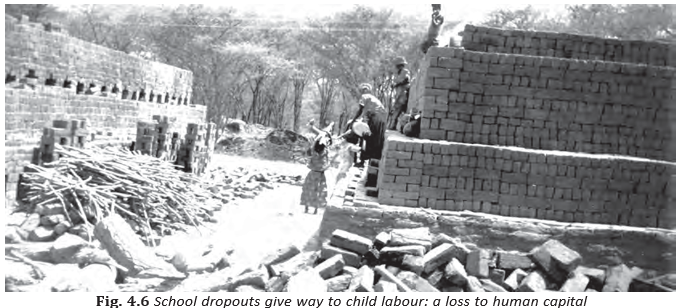
Gender Equity: Progress, but More Needed
- Progress: The gap between male and female literacy rates is narrowing, but achieving universal adult literacy remains a priority.
- Women’s education: It promotes economic independence and social status, and benefits fertility rates and the health of women and children.
Higher Education: Few Reach It, Many Face Unemployment
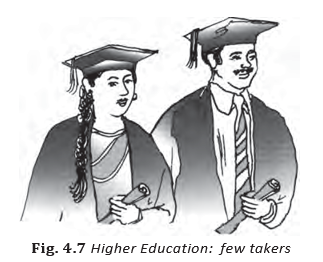
Do not assume that higher education automatically guarantees employment: graduate unemployment can be higher than unemployment among less-educated youth.
Conclusion: Priorities for Human Capital Development
- Public investment: Union and state governments should continue supporting education and health services and ensure their benefits reach all sections of society.
- Skilled manpower: India should improve the quality of its scientific and technical workforce and create conditions that enable its skills to be used effectively within the country.
Human Capital, Investment and Human Development
Human capital — Human capital is the acquired ability that raises labour productivity, developed through deliberate investment with the expectation of increasing future income.
Key ideas
- Sources of formation: Education, on-the-job training, health, migration and information build human capital.
- Physical capital link: The concept of physical capital provides the basis for understanding human capital; the two forms of capital formation have similarities as well as differences.
- Growth effect: Investment in human capital is considered efficient and growth-enhancing.
Human development — Human development treats education and health as essential to well-being: literacy and a long, healthy life enable people to make other choices they value.
Why should higher education receive greater attention?
State two benefits of promoting women’s education.
How do education and health contribute to human development?
Quick recap
- Universal literacy remains unfinished despite rising adult and youth literacy rates; the constitutional goal was free, compulsory education up to age 14.
- Narrowing literacy gaps show progress in gender equity, but women’s education remains vital for independence, social status, fertility and health.
- Graduate unemployment—especially among rural female graduates—is much higher than among primary-educated youth; higher education needs more investment and employable skills.
- Human capital is acquired ability that raises labour productivity, developed through investment expected to increase future income.
- Education, on-the-job training, health, migration and information are sources of human capital formation; such investment is considered efficient and growth-enhancing.
- Human development relies on education and health so people can live healthy lives and make valued choices; services should be shared equitably.
- Government education spending as a share of total expenditure signals its importance, and India should improve and make use of its scientific and technical manpower.
Economics — ALL CHAPTERS
1
Indian Economy On The Eve Of Independence
2
Indian Economy 1950–1990
3
Liberalisation, Privatisation And Globalisation: An Appraisal
4
Human Capital Formation In India
5
Rural Development
6
Employment : Growth, Informalisation And Other Issues
7
Environment and Sustainable Development
8
Comparative Development Experiences of India And Its Neighbours
1
Introduction
2
National Income Accounting
3
Money and Banking
4
Determination of Income and Employment
5
Government Budget and the Economy
6
Open Economy Macroeconomics