Class 12 Humanities . Economics . Introductory Macro Economics . Money and Banking
Chapter 3: Money and Banking
Ch 3
Economics
Class 12 Humanities
Introduction
Money — Money is a commonly accepted medium of exchange used to facilitate market transactions.
Why money is needed
- Role: Money is useful when people engage in exchanges through markets; it has no role in a solitary or non-market setting.
- Barter: An exchange of goods or services directly, without using money.
- Double coincidence of wants: Barter requires each person to want what the other offers at the same time.
- Difficulty: Finding a suitable trading partner takes time and effort, and search costs rise as the number of people increases.
- Solution: People sell goods for money, then use that money to buy the goods they need.
From barter to money
- A person has a surplus good to exchange.
- Barter requires finding someone who wants that good and has the desired good to offer.
- This search can be difficult and costly.
- An acceptable intermediate good—money—lets each person sell and buy separately.
Functions of Money
| Function | What it does | Example or condition |
|---|---|---|
| Medium of exchange | Enables people to buy and sell without barter. | A seller accepts money for a product and uses it to buy other goods. |
| Unit of account | Provides a common unit for expressing and comparing the value of goods and services. | A wristwatch priced at Rs. 500 has a value expressed in rupees. |
| Store of value | Allows wealth to be kept for use in the future. | Money is non-perishable, relatively inexpensive to store, and widely accepted; stable value helps it perform this function well. |
Unit of account and purchasing power
- Relative prices: If a pencil costs Rs. 2 and a pen costs Rs. 10, one pen is worth pencils.
- Value of money: At those prices, one rupee can buy of a pencil or of a pen.
- Purchasing power: This is the quantity of goods that a unit of money can buy.
- General rise in prices: When the overall price level rises, each unit of money buys less; its purchasing power falls.
| Point | Barter goods | Money |
|---|---|---|
| Storage | Goods such as rice may perish and require considerable space. | Money is non-perishable and generally has lower storage costs. |
| Future exchange | The owner must find someone willing to accept the stored good. | Money is generally acceptable for buying goods at different times. |
| Main limitation | Storing and later exchanging goods can be difficult. | A rise in the price level can erode money’s purchasing power; sufficiently stable value is needed for money to store value well. |
Other stores of value
- Examples: Gold, land, houses and bonds can also store wealth.
- Limitation: These assets may not be as easily converted into other goods and may not be universally accepted.
Cashless society — An economic state in which financial transactions take place through digital information transfers rather than physical banknotes or coins.
Digital transactions and financial inclusion in India
- Digital payments: Transfer an electronic representation of money between transacting parties instead of using physical cash.
- Initiatives: Jan Dhan accounts, Aadhaar-enabled payment systems, e-wallets and the National Financial Switch (NFS) support wider financial inclusion and movement towards less-cash transactions.
- Enabler: Wider access to mobile phones and smartphones has helped make financial inclusion a more realistic goal.
- Barter exchange
- Direct exchange of goods or services without money.
- Double coincidence of wants
- The condition in barter that each trader wants what the other offers.
- Unit of account
- A common monetary measure for expressing and comparing values.
- Purchasing power
- The quantity of goods and services a unit of money can buy.
- Store of value
- A way to preserve wealth for future use.
What is the double coincidence of wants, and why does it make barter difficult?
How does a general rise in the price level affect the value of money?
Quick recap
- Money is a commonly accepted medium of exchange for market transactions.
- It overcomes barter’s need for a double coincidence of wants and reduces search difficulties.
- Money functions as a medium of exchange, a unit of account and a store of value.
- Money stores value well when its value is sufficiently stable; a rise in the general price level lowers its purchasing power.
- Other assets can store value but may be less easily exchanged and less widely accepted.
- Digital transactions and Indian financial-inclusion initiatives support movement towards a less-cash economy.
Demand For Money And Supply Of Money
Demand for Money
Main influences on money demand
- Income rises → transactions increase → demand for money rises.
- Interest rate rises → opportunity cost of holding money rises → demand for money falls.
Supply of Money
Institutions in the money-creating system
- Central bank: Issues currency and influences the money supply; its currency held by the public and commercial banks forms the base for credit creation.
- Commercial banks: Accept deposits and lend part of these funds, creating credit through the banking system.
Central Bank
India's central bank
- 1935India's central bank, the Reserve Bank of India (RBI), was established.
Commercial Banks and Credit Creation
How bank lending creates deposit money
- People deposit funds with a bank.
- The bank keeps a portion available for withdrawals and lends the remainder.
- The borrower spends the loan; the recipient may deposit the money in a bank.
- The new deposit can support further lending, increasing deposit money in the economy.
Illustration of credit creation
- Example: Lala holds 100 kg of deposited gold and has issued receipts for 100 kg. He lends 25 kg; Ramu pays Ali, who deposits the 25 kg with Lala and receives a receipt.
- Result: Receipts now represent claims for 125 kg, although Lala still holds only 100 kg of gold; the extra claim arises because not all depositors withdraw at once.
- Modern parallel: Banks create deposit money through lending, while maintaining reserves to meet withdrawals.
- High-powered money
- Central-bank currency held by the public and commercial banks; also called reserve money or the monetary base.
- Spread
- The difference between the interest rate banks charge borrowers and the rate they pay depositors.
- Credit creation
- The increase in deposit money as banks lend part of deposits and loan funds are redeposited.
How do income and the interest rate affect demand for money?
What is high-powered money?
Why must a commercial bank balance lending with the funds it keeps available?
Quick recap
- Money demand rises with income and falls when interest rates rise.
- Modern money includes cash and bank deposits; money measures vary with the deposits counted.
- The central bank issues currency and influences the money supply; its currency is high-powered money.
- Commercial banks accept deposits, pay depositors interest and lend at a higher interest rate; the difference is the spread.
- Lending and redepositing can increase deposit money, while banks must keep funds available for withdrawals.
- The Reserve Bank of India was established in 1935.
Money Creation By Banking System
How Banks Create Money
Here, and are old and newly created deposits, and is currency.
Example
- Example: If a bank lends Rs. 100 to a person, the bank records a claim of Rs. 100 as a loan asset and opens a new deposit for the borrower.
Bank Balance Sheet
Assets — Things a firm owns or claims from others; a bank’s main financial assets are reserves and loans.
A bank’s assets
- Loans: Amounts lent to the public; they are assets because they are claims the bank can collect.
- Reserves: Commercial bank deposits with the Reserve Bank of India (RBI), together with the bank’s cash.
- Form of reserves: Reserves are held partly as cash and partly as RBI-issued financial instruments, such as bonds and Treasury bills.
- Example: Deposits that commercial banks such as the State Bank of India keep with the RBI are called reserves.
A bank’s assets consist of reserves and loans.
Liabilities — Debts or obligations a firm owes to others; a bank’s main liability is the deposits it owes its customers.
For a bank, deposits are its main liability.
Net Worth and Balance
This makes the balance-sheet identity hold.
How does a bank loan increase the money supply?
What are the main assets and liability of a bank?
Quick recap
- Banks can lend because they do not expect all depositors to withdraw at once.
- A bank loan creates a new deposit, adding to the money supply.
- A bank’s main assets are reserves and loans.
- A bank’s main liability is customer deposits.
- Net worth equals assets minus liabilities and helps balance the balance sheet.
Balance Sheet of a Fictional Bank
A Bank’s Balance Sheet and Money Supply
Money supply in the example
- Money supply is currency held by the public plus bank deposits.
- Assumption: If no currency is in circulation, money supply equals deposits.
- Example: With currency at Rs. 0 and deposits at Rs. 100, money supply is Rs. 100.
Use this relationship to calculate money supply.
Limits to Credit Creation
Statutory Liquidity Ratio (SLR) — The SLR is the requirement for banks to keep some reserves in liquid form for the short term.
How the reserve requirement limits lending
- Example: At a CRR of , a bank with deposits of Rs. 100 must keep Rs. 20 as reserves.
- Lendable amount: The remaining Rs. 80 can be lent.
- Effect: As deposits grow, the required reserves grow too, restricting further lending.
Calculate the reserves a bank must hold from its deposits and CRR.
Credit creation at a CRR of 20%
- Initial deposit: Rs. 100; required reserves: Rs. 20; first loan: Rs. 80.
- The Rs. 80 loan is deposited in the bank, bringing total deposits to Rs. 180.
- Required reserves rise to Rs. 36; the bank can lend a further Rs. 64.
- Further loans are redeposited and the cycle repeats, with each round adding less to deposits.
- The process reaches total deposits of Rs. 500, supported by Rs. 100 in reserves; total loans are Rs. 400.
| Round | Deposits | Required reserves | Loan made |
|---|---|---|---|
| 1 | Rs. 100 | Rs. 20 | Rs. 80 |
| 2 | Rs. 180 | Rs. 36 | Rs. 64 |
| Last | Rs. 500 | Rs. 100 | Rs. 400 total loans |
Final balance sheet and money supply
- Final assets: Rs. 100 in reserves plus Rs. 400 in loans, totalling Rs. 500.
- Final liabilities: Deposits total Rs. 500.
- Money supply: With no currency in circulation, deposits rise from Rs. 100 to Rs. 500.
- Limit: At a CRR of , the bank cannot create loans beyond Rs. 400 in this example.
The money multiplier shows the maximum deposit expansion supported by a given amount of reserves, under the assumptions in this example.
Multiplier example
- Convert the CRR: .
- Multiplier: .
- Deposits supported: Rs. 100 in reserves can support deposits of Rs. 500.
How does a reserve requirement limit credit creation?
With a CRR of 20% and reserves of Rs. 100, what are the money multiplier and maximum deposits?
Quick recap
- A bank’s assets include reserves and loans; deposits are liabilities.
- With no currency in circulation, money supply equals deposits.
- The RBI sets the CRR, which limits the share of deposits available for lending.
- SLR requires banks to hold some reserves in liquid form for short-term needs.
- Repeated lending and redepositing can expand deposits, but each round is limited by required reserves.
- At a CRR of 20%, Rs. 100 in reserves supports Rs. 500 in deposits and Rs. 400 in loans.
Policy Tools To Control Money Supply
RBI and the Lender of Last Resort
Lender of last resort — The central bank’s role of being ready to lend funds to commercial banks at all times.
- Currency issue: The Reserve Bank of India (RBI) is the only institution that can issue currency.
- Bank funding: Commercial banks can seek funds from the market or borrow from the Central Bank to support credit creation.
Types of Monetary Policy Tools
| Type | How it works | Examples |
|---|---|---|
| Quantitative | Changes the overall extent of money supply. | CRR, bank rate, open market operations |
| Qualitative | Encourages or discourages lending by commercial banks, including through persuasion. | Moral suasion, margin requirements |
Reserve Ratio and Money Supply
- Higher reserve ratio: Banks must hold a greater share of deposits as reserves, leaving less available for lending.
- Effect: Reduced lending lowers the creation of deposits and therefore reduces money supply.
- Example: At a 25% reserve ratio, Rs. 100 in reserves can support Rs. 400 in deposits; banks can lend only Rs. 300 and may need to call back loans to meet the higher reserve requirement.
Open Market Operations
Open Market Operations — RBI purchases and sales of government bonds in the open market on behalf of the Government.
- RBI buys bonds: It pays by cheque, increasing reserves in the economy and raising money supply.
- RBI sells bonds: The sale reduces reserves in the economy and lowers money supply.
| Operation | Transaction | Effect / rate |
|---|---|---|
| Outright purchase | RBI buys securities without an agreement to sell them later. | Permanently injects money into the system. |
| Outright sale | RBI sells securities without an agreement to buy them later. | Permanently withdraws money from the system. |
| Repo | RBI buys a security with an agreement to resell it on a specified date and at a specified price. | Funds are lent temporarily; the lending rate is the repo rate. |
| Reverse repo | RBI sells a security with an agreement to repurchase it on a specified date and at a specified price. | Funds are temporarily withdrawn; the withdrawal rate is the reverse repo rate. |
Repo and Reverse Repo in Practice
- Maturities: RBI conducts repo and reverse repo operations for periods such as overnight, 7 days and 14 days.
- Policy role: These operations have become the RBI’s main tool of monetary policy.
Bank Rate
Bank Rate — The rate at which the RBI lends to commercial banks.
- Higher bank rate: Loans become more expensive for commercial banks.
- Effect: Costlier borrowing reduces reserves held by commercial banks and therefore decreases money supply.
- RBI bond purchase → reserves rise → money supply rises; bond sale → reserves fall → money supply falls.
- Higher reserve ratio or bank rate → lending becomes more restricted → money supply falls.
- Outright OMO is permanent; repo and reverse repo agreements specify a future reversal.
Quick recap
- The RBI issues currency and is ready to lend to banks at all times as lender of last resort.
- Quantitative tools include CRR, bank rate and open market operations; qualitative tools include moral suasion and margin requirements.
- A higher reserve ratio restricts lending and reduces money supply.
- OMO purchases add reserves and money; OMO sales withdraw reserves and money.
- Outright OMO is permanent, while repo and reverse repo specify a future reversal.
- A higher bank rate makes borrowing costlier for banks and reduces money supply.
Important Boxes For Money and Banking
Demand for Money
- Money demand: The amount of money people wish to hold at a given time is called demand for money, or liquidity preference.
- Key influences: It reflects the trade-off between money’s liquidity and the interest income forgone; demand rises with income and falls as interest rates rise.
Transaction Motive
is the total nominal value of transactions over a unit period; is a positive fraction. Velocity is the number of times a unit of money changes hands during that period.
Transaction Demand and GDP
- GDP link: Total annual transactions include intermediate goods and services, so they exceed nominal GDP; however, transaction value and nominal GDP have a stable, positive relationship.
- Implication: Higher real GDP or a higher general price level raises nominal GDP and transaction demand for money.
is real GDP and is the general price level, measured by the GDP deflator.
Speculative Motive
Bond Example and Present Value
- Bond terms: The example bond has a face value of Rs. 100, a two-year maturity period and a 10% coupon rate; it pays Rs. 10 after year one and Rs. 110 after year two.
- Present value: Discount each future return using the market interest rate; the bond’s price equals this present value in competitive-market equilibrium.
- At 5%: The bond’s present value is approximately Rs. 109.29, so it is more attractive than a savings account if offered at its Rs. 100 face value.
- Price adjustment: Competition raises the bond price toward its present value; if price exceeds present value, excess supply pushes the price down.
Each return is discounted to its present value using the market interest rate.
When the market rate rises from to , the bond’s present value and price fall.
Expectations and Speculative Demand
- Expected rate rise: A bondholder expects bond prices to fall and may sell bonds to avoid a capital loss, holding money instead.
- High interest rate: People commonly expect rates to fall and bond prices to rise, so they buy bonds; speculative money demand is low.
- Low interest rate: People may expect rates to rise and bond prices to fall, so they sell bonds and hold money; speculative money demand is high.
is the market interest rate; and are its positive upper and lower limits. As falls from to , speculative demand rises from zero to infinity.
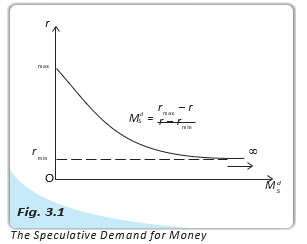
Liquidity trap — At the interest-rate floor , people expect rates to rise and bond prices to fall, so they hold wealth as money; extra money is absorbed without lowering interest rates further, and speculative money demand is infinitely elastic.
Money Supply and Interest Rates
- Bond-market effect: If the money supply increases and people use the extra money to buy bonds, bond demand and prices rise, causing interest rates to fall.
- Liquidity-trap limit: At the interest-rate floor, people prefer money to bonds; further money creation does not push the rate below that floor.
Total money demand is the sum of transaction demand and speculative demand.
The Supply of Money: Measures
| Point | Currency notes and coins | Demand deposits |
|---|---|---|
| Value and acceptance | Fiat money; its value comes from the issuing authority’s guarantee, not intrinsic worth. | Bank balances usable for payments by cheque. |
| Legal tender | Legal tender: citizens cannot refuse it to settle transactions. | Not legal tender: a recipient may refuse a cheque. |
| Issuer or provider | RBI issues notes; the Government of India issues coins. | Held by the public in commercial banks. |
Why Currency Is Accepted
- Fiat money: Notes and coins have little intrinsic value; their value comes from the guarantee of the issuing authority.
- Notes: Each note carries the RBI Governor’s promise that RBI is responsible for providing purchasing power equal to its printed value when presented to RBI or another commercial bank.
- Legal tender: Currency notes and coins cannot be refused for settling transactions; demand deposits are not legal tender because a cheque may be refused.
| Measure | Components |
|---|---|
| Currency held by the public () + net demand deposits of commercial banks () | |
| + savings deposits with Post Office savings banks | |
| + net time deposits of commercial banks | |
| + total deposits with Post Office savings organisations, excluding National Savings Certificates |
Interpreting the Measures
- Net deposits: Include deposits of the public held by banks, but exclude interbank deposits.
- Narrow money: and are narrow measures; is the most liquid.
- Broad money: and are broad measures; is the least liquid of the four.
- Common measure: is the most commonly used measure and is also called aggregate monetary resources.
Demonetisation
Demonetisation: Key Dates
- November 2016The demonetisation initiative was announced; old Rs. 500 and Rs. 1,000 notes were withdrawn as legal tender.
- 12 December 2016End date for specified temporary acceptance of old notes at selected services and for government dues.
- 31 December 2016Last date to deposit old notes in bank accounts without a declaration.
- 31 March 2017Last date stated for depositing old notes with the RBI with a declaration.
Effects of Demonetisation
- Withdrawal of high-denomination notes → queues at banks and ATMs and a shortage of currency in circulation.
- Cash shortage → adverse effects on economic activity, followed over time by improvement and a return to normalcy.
- Deposits entering banks and the formal financial system → more resources available to banks for lending, potentially at lower interest rates.
- Greater reporting and formalisation of transactions → improved tax compliance and a shift toward electronic payment technologies.
- Policy action against unreported cash → a stated signal against tax evasion, with financial penalties and social condemnation.
Why is speculative demand for money inversely related to the interest rate?
Quick recap
- Money demand reflects the trade-off between liquidity and foregone interest.
- Transaction demand arises because income receipt and spending do not occur at the same time; it rises with nominal GDP.
- Velocity links the money stock held for transactions to the flow of transactions: .
- Bond prices equal the present value of future returns and move inversely to the market interest rate; speculative demand also moves inversely to the rate.
- Aggregate money demand combines transaction and speculative demand; a liquidity trap occurs at the interest-rate floor.
- India’s money-supply measures run from (most liquid) to (least liquid); and are narrow money.
- Demonetisation withdrew old Rs. 500 and Rs. 1,000 notes in November 2016 and affected cash use, banking, tax compliance and payment methods.
Economics — ALL CHAPTERS
1
Indian Economy On The Eve Of Independence
2
Indian Economy 1950–1990
3
Liberalisation, Privatisation And Globalisation: An Appraisal
4
Human Capital Formation In India
5
Rural Development
6
Employment : Growth, Informalisation And Other Issues
7
Environment and Sustainable Development
8
Comparative Development Experiences of India And Its Neighbours
1
Introduction
2
National Income Accounting
3
Money and Banking
4
Determination of Income and Employment
5
Government Budget and the Economy
6
Open Economy Macroeconomics