Class 12 Humanities . Economics . Indian Economic Development . Indian Economy on the Eve of Independence
Chapter 1: Indian Economy On The Eve Of Independence
Ch 1
Economics
Class 12 Humanities
Introduction
Why Study the Economy Before Independence?
End of British Rule
- 15 August 1947India became independent after nearly two centuries of British colonial rule.
India’s Economy Before British Rule
Bengal’s Muslin Industry
- Muslin: A fine cotton textile associated with Bengal, especially places around Dhaka (formerly spelled Dacca).
- Daccai Muslin: This Bengal textile became famous worldwide for its exceptional quality.
- Malmal: The finest variety of muslin; also called malmal shahi or malmal khas, names suggesting royal quality or use.
Colonial Policies and Economic Transformation
Effect of Colonial Economic Policy
- Colonial policies prioritised Britain’s economic interests
- India’s economy was reorganised to serve Britain’s industrial expansion
- India supplied raw materials to Britain
- India became a market for Britain’s finished industrial products
National Income Estimates and Economic Growth
- Colonial economy
- An economy shaped to serve the interests of a ruling colonial power.
- Daccai Muslin
- A renowned fine cotton textile produced in Bengal, especially around Dhaka.
How did colonial rule change the structure of India’s economy?
Name important estimators of India’s national income during the colonial period.
Quick recap
- Before British rule, India had an independent economy with agriculture and well-regarded handicraft industries.
- Bengal’s Daccai Muslin, especially the finest malmal variety, was famous worldwide.
- Colonial policies prioritised Britain’s interests over India’s economic development.
- India was reshaped into a raw-material supplier and a market for British manufactured goods.
- Colonial income estimates were inconsistent; V.K.R.V. Rao’s estimates were especially significant.
- In the first half of the 20th century, annual aggregate real output growth was below 2%, while per capita output growth was about 0.5%.
Agricultural Sector
Agriculture under Colonial Rule
- Agrarian economy: About 85% of India’s population lived mainly in villages and depended directly or indirectly on agriculture.
- Low productivity: Agriculture remained stagnant and often deteriorated, despite some growth in cultivated area.
- Commercialisation: Some farmers shifted from food crops to cash crops, often for use by British industries.
Causes of Agricultural Stagnation
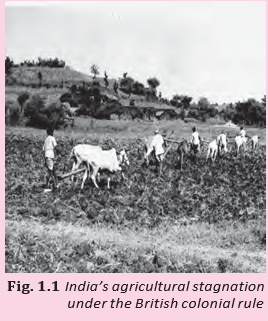
Commercialisation and Limited Investment
How Colonial Land Settlements Deepened Stagnation
- Colonial revenue settlements set fixed payment deadlines and threatened zamindars with loss of rights.
- Zamindars prioritised rent collection and transferred pressure to cultivators.
- Cultivators faced hardship and had little ability or incentive to invest.
- Low investment, weak technology and inadequate irrigation kept productivity low.
- Zamindari system
- A colonial land-revenue arrangement in which zamindars collected revenue from cultivators.
- Commercialisation of agriculture
- Shifting production from food crops towards crops grown for sale and industrial use.
- Sharecropper
- A cultivator who gives the landowner a share of the crop as payment for using land.
Why did agricultural productivity remain low under British rule?
Why did commercialisation not generally improve farmers’ economic condition?
Quick recap
- About 85% of India’s population depended directly or indirectly on agriculture.
- Agriculture stagnated and productivity stayed low despite some expansion in cultivated area.
- Colonial land settlements, especially zamindari, strengthened rent extraction rather than agricultural improvement.
- Limited technology, irrigation and fertiliser use further depressed yields.
- Commercial crops benefited British industry but did not generally improve cultivators’ economic condition.
- Many tenants, small farmers and sharecroppers lacked the means and incentives to invest.
Industrial Culture
Industrial Development under Colonial Rule
Growth of Modern Industry
- Second half of the nineteenth centuryModern industry began to take root, initially through cotton and jute textile mills, but progress was slow.
- Beginning of the twentieth centuryIron and steel industries began to emerge.
- 1907The Tata Iron and Steel Company (TISCO) was incorporated.
- After the Second World WarSome sugar, cement and paper industries were established.
Limits of Industrialisation
- Industrial base: Industrialisation remained inadequate to replace the decline of traditional handicrafts or support broad-based economic development.
- Limited capacity: The industrial sector contributed little to GDP and lacked a substantial capital-goods industry.
- Public sector: Its industrial activity was largely confined to railways, power, communications, ports and a few departmental undertakings.
Foreign Trade under Colonial Rule
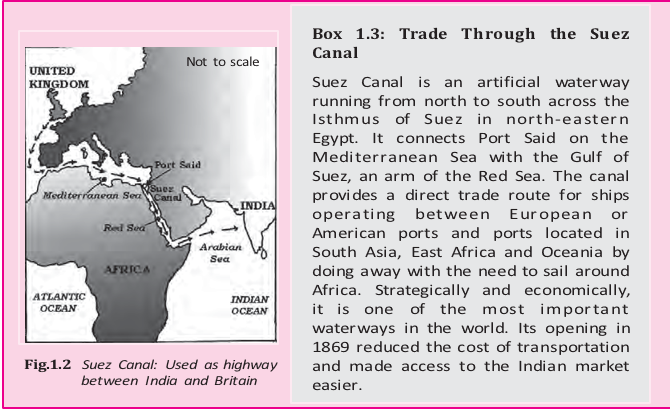
Export Surplus and Drain of Wealth
How Colonial Trade Drained Indian Wealth
- Colonial trade and production policies → India exports primary products and imports British manufactures.
- Trade generates a large export surplus → essential goods remain scarce in India.
- Surplus is used for colonial expenses, war costs and invisible imports → it does not return as gold or silver.
- Payments flow out of India → Indian wealth is drained.
- Deindustrialisation
- Decline of traditional industries without adequate modern industrial replacement.
- Capital goods industry
- Industry producing machine tools used to manufacture consumption goods.
- Export surplus
- Exports exceeding imports in value.
- Invisible items
- Non-physical items involved in foreign payments; the text identifies their import payments as a use of the surplus.
What were the two main aims of colonial industrial policy in India?
Why did India’s export surplus not benefit the domestic economy?
Quick recap
- Colonial policy weakened handicrafts and oriented India toward supplying raw materials and buying British manufactures.
- Modern industry developed slowly, beginning with cotton and jute textiles; TISCO was incorporated in 1907.
- India lacked a significant capital goods industry, and the new industrial sector contributed little to GDP.
- Britain dominated Indian foreign trade, with India exporting primary products and importing finished goods and machinery.
- A large export surplus coincided with domestic scarcity and was used for colonial payments, draining Indian wealth.
Demographic Condition
Population and Demographic Transition
Census and demographic transition
- 1881The first census to collect population details for British India was conducted. Despite limitations, it revealed uneven population growth; censuses were then conducted every ten years.
- Before 1921India was in the first stage of demographic transition.
- After 1921The second stage of demographic transition began, but neither the total population nor its growth rate was very high.
Social and Health Indicators
- Literacy: Overall literacy was below 16%; female literacy was about 7%, an exceptionally low level.
- Public health: Facilities were unavailable to large sections of the population or were highly inadequate.
- Disease and mortality: Water- and air-borne diseases were widespread, contributing to very high mortality.
- Infant mortality: About 218 deaths per 1,000 births, compared with 33 per 1,000 at present.
- Life expectancy: About 32 years, compared with 69 years at present.
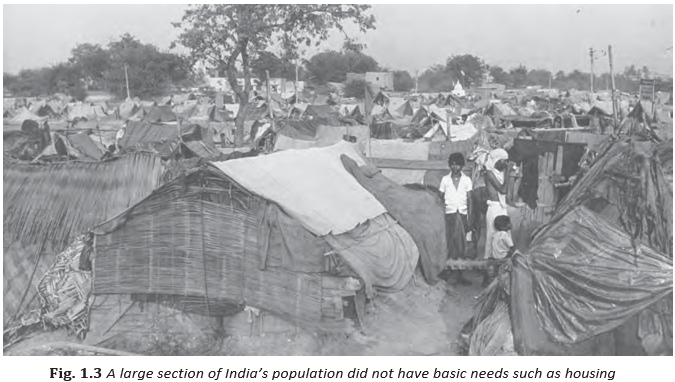
- Poverty: Extensive poverty prevailed, but its extent cannot be specified because reliable data were unavailable; it worsened the population’s condition.
Occupational Structure
Occupational structure — The distribution of working people across different industries and sectors.
| Sector | Approximate workforce share | Pattern |
|---|---|---|
| Agriculture | 70–75% | Largest share; dependence remained high overall. |
| Manufacturing | About 10% | Accounted for a small share of workers. |
| Services | About 15–20% | Accounted for a smaller share than agriculture. |
Regional Differences
- Declining agricultural dependence: Parts of Madras Presidency, Bombay and Bengal saw a shift of workers away from agriculture towards manufacturing and services.
- Rising agricultural dependence: The share of workers in agriculture increased in Orissa, Rajasthan and Punjab.
- Overall pattern: Occupational structure showed little change nationally, but regional trends differed.
Quick recap
- The first census of British India was conducted in 1881; despite its limitations, it revealed uneven population growth, and censuses followed every ten years.
- India was in the first stage of demographic transition before 1921; the second stage began after 1921.
- Literacy was below 16%, female literacy about 7%, and extensive poverty prevailed despite unavailable reliable estimates.
- Poor health facilities, widespread disease and high mortality marked the period; infant mortality was about 218 per 1,000 and life expectancy 32 years.
- Agriculture employed 70–75% of workers, manufacturing about 10% and services about 15–20%.
- Agricultural dependence declined in parts of Madras Presidency, Bombay and Bengal, but rose in Orissa, Rajasthan and Punjab.
Infrastructure
Colonial Infrastructure: Purpose and Roads
Colonial infrastructure — Transport and communication facilities developed under British rule, mainly to serve colonial interests rather than provide public amenities.
Roads and colonial infrastructure
- Facilities developed: Railways, ports, water transport, postal services and telegraphs grew under colonial rule, but mainly served British interests.
- Pre-British roads: Roads built before British rule were not suitable for modern transport.
- Main purposes of roads: Roads helped move the colonial army and carry raw materials from the countryside to railway stations or ports for export.
- Rural access: All-weather roads were scarce, especially for reaching rural areas during the rainy season.
- Consequences: Poor road access left rural people more exposed to hardship during natural calamities and famines.
Railways
Railway Development
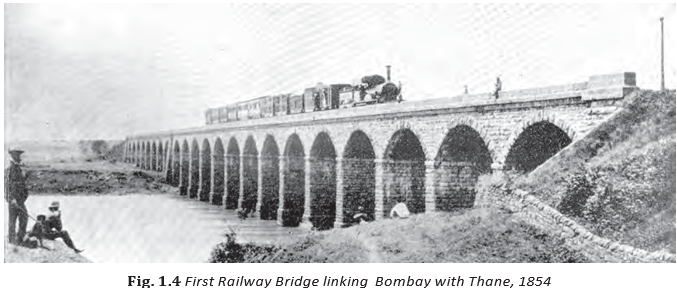
- 1850The British introduced railways in India.
- 1854The first railway bridge linking Bombay and Thane illustrates railway development.
| Point | Benefits | Costs |
|---|---|---|
| Travel and society | Enabled long-distance travel and helped break geographical and cultural barriers. | — |
| Agriculture and villages | Expanded commercialisation of agriculture. | Commercialisation weakened the self-sufficiency of village economies. |
| Trade and economic gains | India’s exports increased. | Export benefits rarely reached Indian people; economic losses outweighed the social benefits. |
Water Transport and Communication
- Waterways and sea lanes: The colonial government developed inland trade routes and sea lanes, but these efforts were limited and often unsatisfactory.
- Coast Canal: Built at great public expense on the Orissa coast, it could not compete with a railway running parallel to it and was eventually abandoned.
- Telegraph: This expensive system mainly helped the colonial government maintain law and order.
- Postal services: They served a useful public purpose but remained inadequate.
Economic and Social Challenges at Independence
- Agriculture: The sector had surplus labour and extremely low productivity.
- Industry: India’s famous handicraft industries had collapsed, without significant replacement by a modern industrial base. Industry needed modernisation, diversification, greater capacity and increased public investment.
- Foreign trade: It was organised largely to support Britain’s Industrial Revolution.
- Infrastructure: Railways and other facilities needed upgrading, expansion and a stronger public orientation.
- Health and hardship: Inadequate public health facilities, frequent calamities and famines impoverished people and contributed to high mortality.
- Poverty and unemployment: Their widespread prevalence called for welfare-focused public economic policy.
- Overall challenge: Independent India inherited enormous social and economic problems and had to build on the existing infrastructure through planning.
- All-weather road
- A road usable in different weather conditions, including during the rainy season.
- Commercialisation of agriculture
- A shift towards producing agricultural goods for sale and trade.
- Village self-sufficiency
- The ability of a village economy to meet many of its own needs.
- Public orientation
- Planning infrastructure to meet public needs, not only colonial or commercial interests.
How did railways affect the Indian economy under colonial rule?
Why was the Coast Canal on the Orissa coast abandoned?
- Colonial purpose: Infrastructure was developed mainly to serve British interests, not to meet Indian public needs.
- At independence: India inherited infrastructure needing expansion and public-oriented development, alongside severe economic and social challenges.
Quick recap
- Colonial infrastructure was built mainly to serve British interests; roads supported army movement and raw-material exports, while rural all-weather roads remained scarce.
- Railways, introduced in 1850, enabled long-distance travel but also promoted commercial agriculture and weakened village self-sufficiency.
- Exports increased, but their benefits rarely reached Indians; the railway system’s economic losses outweighed its social benefits.
- Waterways, telegraphs and postal services were limited or inadequate; the telegraph mainly helped maintain colonial law and order.
- At independence, infrastructure needed upgrading, expansion and a stronger public orientation; independent India had to build on this base through planning.
- India faced low agricultural productivity, surplus labour, collapsed handicrafts with little modern industrial replacement, poverty and unemployment.
- Inadequate public health facilities, calamities and famines impoverished people and contributed to high mortality.
Economics — ALL CHAPTERS
1
Indian Economy On The Eve Of Independence
2
Indian Economy 1950–1990
3
Liberalisation, Privatisation And Globalisation: An Appraisal
4
Human Capital Formation In India
5
Rural Development
6
Employment : Growth, Informalisation And Other Issues
7
Environment and Sustainable Development
8
Comparative Development Experiences of India And Its Neighbours
1
Introduction
2
National Income Accounting
3
Money and Banking
4
Determination of Income and Employment
5
Government Budget and the Economy
6
Open Economy Macroeconomics