Class 8 . English . Poorvi . A Tale of Valour Major Somnath Sharma and the Battle of Badgam
Chapter 4: A Tale of Valour:Major Somnath Sharma and the Battle of Badgam
Ch 4
English
Class 8
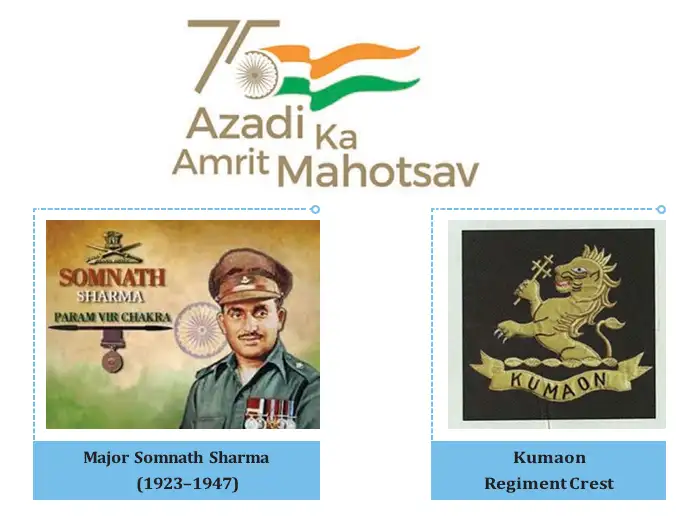
Major Somnath Sharma: A True Hero
A tribute to Major Somnath Sharma
- Recognition: Major Somnath Sharma was India’s first recipient of the Param Vir Chakra.
- Legacy: His bravery and sacrifice are remembered through memorials, patriotic songs, books and national celebrations.
- Inspiration: His courage and devotion to India continue to inspire generations.
The setting and mission
- Setting: The events unfold in Kashmir, among the Himalayas, during a cold November dawn.
- Mission: Major Sharma and his soldiers were sent to protect Srinagar airport from a guerrilla force trained and supported by Pakistan.
- Scale: The account describes 90 Indian soldiers facing about 500 infiltrators who aimed to capture Srinagar and the Kashmir Valley.

Events leading to the battle
- August 1947: Pakistan launched Operation Gulmarg to annex Kashmir, contrary to its commitment not to attack the state.
- Invasion plan: The Pakistani Army trained and equipped around 1,000 invaders familiar with mountain passes and local terrain.
- Objective: The invaders sought to seize strategic places, including Srinagar airport, encourage a revolt, overthrow the government and take control of Kashmir.
- Strategic stakes: Success could have given them control of important mountain passes, peaks and rivers.
The invasion and Indian response
- 22 October 1947: Operation Gulmarg began, and the infiltrators invaded Kashmir.
- 26 October 1947: The princely state of Jammu and Kashmir became part of India.
- 27 October 1947: India sent troops to defend Kashmir’s people and its borders.
- Airlift: Troops were flown into Srinagar because the land route through Pathankot was in poor condition.
Major Somnath Sharma
- Committed: He insisted on accompanying his company despite having his left hand in plaster.
- Courageous: He was willing to join his men in a dangerous mission.
- Loyal leader: He believed his soldiers should not enter combat without him.
Major Sharma and his company
- 31 October 1947: D Company of the 4th Battalion, Kumaon Regiment, was flown into Srinagar under Major Sharma’s command.
- Despite injury: His left hand was in plaster, but he refused to remain behind.
- Reason: He knew his men and insisted on sharing the danger with them.
““I know my men better than anyone else, and if they are going into action, they are not going in without me.””
Major Somnath Sharma
Courage, duty and leadership
Major Sharma’s choice to stand with his injured hand and lead his soldiers shows courage, loyalty to his men and devotion to the defence of the country.
- etched
- fixed permanently in someone’s memory
- beacon
- a source of inspiration or guidance
- valour
- great courage, especially in danger
- infiltrators
- people who secretly enter a place, often to invade it
- annex
- to take control of another territory
- combat
- fighting between armed forces
- contingent
- a group of people or soldiers assigned to a task
Why was Major Somnath Sharma’s decision to accompany his company significant?
Quick recap
- Major Somnath Sharma was India’s first Param Vir Chakra recipient.
- Operation Gulmarg was launched in August 1947 to annex Kashmir.
- The invasion began on 22 October; Jammu and Kashmir joined India on 26 October 1947.
- Indian troops were airlifted into Srinagar from 27 October because the Pathankot land route was in poor condition.
- On 31 October, Major Sharma led D Company of the 4th Battalion, Kumaon Regiment, despite his injured hand.
- His decision to go with his men reflects courageous and loyal leadership.
The Battle of Badgam
Why Badgam Was Important
Strategic importance and patrol
- Location: Badgam was less than 5 km from Srinagar airport and stood at a higher altitude; access to the airfield passed through the village.
- Importance: Holding Badgam helped protect Indian troops and keep air supplies reaching Srinagar.
- Patrol: On 3 November 1947, companies including Major Somnath Sharma’s D Company were sent to assess threats around the village.
- D Company: Its 90 soldiers were the last to return and were expected back by 2:00 p.m.; the valley had remained eerily silent.
The Battle Begins
Attack on D Company
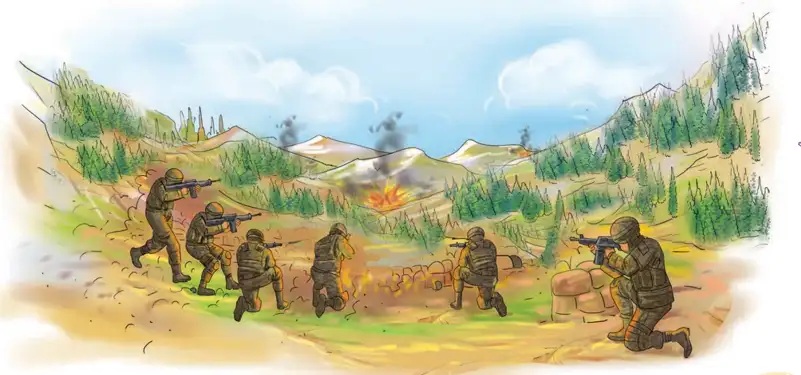
- Enemy attack: Tribal guerrilla invaders, operating under the Pakistani army’s command, attacked when they saw that only a small Indian force remained.
- Two-pronged assault: Major Somnath recognised that the first attack was a distraction; a much larger attack followed from another direction.
- Unequal numbers: D Company’s 90 soldiers faced about 500 invaders, who aimed to capture Srinagar airfield and nearby areas.
- Air support: Major Somnath requested air strikes and laid ground panels to guide aircraft. The strikes hit the invaders, but the attack continued.
Major Somnath Sharma’s Leadership
Holding the position
- Resolve: Though heavily outnumbered and under intense fire, Major Somnath urged his men to keep fighting.
- Personal courage: Despite being injured, he moved across the battlefield, directed fire, filled gun magazines and encouraged his soldiers.
- Last stand: When ammunition ran low, headquarters told him to withdraw. He refused, declaring that his men would fight to the last man and the last round.
- Death: A mortar shell struck his position while he was helping a machine-gun operator load the gun, killing him instantly.
“The enemy is only 50 yards from us. We are heavily outnumbered. We are under devastating fire. I shall not withdraw an inch but will fight to the last man and the last round”
Major Somnath Sharma
The Outcome and Honours
Reinforcements and recognition
- Continued resistance: After Major Somnath’s death, his men held their position for over six more hours before being overrun.
- Time gained: Their resistance allowed reinforcements, including soldiers flown in from the Punjab Regiment, to reach Srinagar.
- Enemy losses: The invaders suffered more than 300 casualties, and their leader was injured.
- Significance: D Company’s sacrifice and Major Somnath’s leadership helped save Srinagar for India; 4 Kumaon Battalion received the Battle Honour, Srinagar.
- Award: Major Somnath Sharma, who died at 24, was posthumously awarded the Param Vir Chakra (PVC)—the first recipient of this gallantry award.
Major Somnath Sharma
- Brave: Continued leading his men despite heavy fire and his own injuries.
- Determined: Refused to withdraw while the enemy threatened the position.
- Selfless leader: Helped his soldiers directly and inspired them to hold on after his death.
Courage and sacrifice
The account honours the courage, patriotism and self-sacrifice of Major Somnath Sharma and his soldiers, whose resistance helped protect Srinagar.
- unfounded
- Not based on facts or reason
- eerily
- In a strange, frightening way
- outnumbered
- Facing a larger number of people
- resolute
- Firmly determined
- tenacity
- Determination to continue
- unparalleled
- Unmatched; having no equal
- magazines
- Containers that feed cartridges into a gun
- ammunition
- Bullets, shells and other supplies used in weapons
- crouched
- Bent low with knees bent
- conspicuous
- Clearly noticeable
- posthumously
- After death
Why was it important for Indian forces to hold Badgam?
How did Major Somnath Sharma’s actions help defend Srinagar?
Which award did Major Somnath Sharma receive, and why was it significant?
Quick recap
- Badgam’s position near Srinagar airfield made it strategically important.
- On 3 November 1947, D Company’s 90 soldiers faced about 500 invaders.
- Major Somnath Sharma directed his men and refused to withdraw despite severe danger.
- D Company’s resistance gave reinforcements time to reach Srinagar.
- Major Somnath Sharma was the first recipient of the Param Vir Chakra, awarded posthumously.
Early Life & Legacy
Early Life and Military Service
Early life and service
- Birth and family: Somnath Sharma was born on 31 January 1923 at Dadh, Kangra, Himachal Pradesh. His father, Major General Amar Nath Sharma, had a distinguished military career.
- Inspiration and education: His grandfather’s stories from the Mahabharata inspired him. He studied at Sherwood College, Nainital, and trained at the Royal Military College, Sandhurst.
- Service: Commissioned into the 8th Battalion, 19th Hyderabad Regiment, in 1942, he served in the Arakan Campaign in Burma during World War II and was mentioned in despatches for bravery.
The Battle of Badgam and Sacrifice
The stand at Badgam
- War context: The Battle of Badgam took place during the Indo–Pakistan War of 1947–1948. On 3 November 1947, Sharma’s company reached Badgam at first light and took up a position south of the village at 11:00 a.m.
- The attack: An enemy force estimated at 500 attacked from three sides, causing heavy casualties. Sharma knew that if the attack was not held, Srinagar and its aerodrome would be threatened.
- His leadership: He urged his men to hold until reinforcements could arrive, crossed exposed ground to encourage them and directed their fire. He also laid out cloth strips to guide aircraft towards their targets.
- Personal courage: Although his left hand was in plaster, he filled magazines and supplied them to the light machine-gunners. A mortar shell exploded among the ammunition and killed him.
- Result: His company held its position until almost completely surrounded. The men fought at a seven-to-one disadvantage for six hours; one of those hours was after Sharma had been killed.
- Importance: The defence delayed the enemy for six hours, giving reinforcements time to reach Humhama and stem the advance towards Srinagar.
Legacy
A lasting example
- Legacy: Sharma’s courage and sacrifice represent duty, honour and patriotism. His example continues to inspire soldiers and citizens.
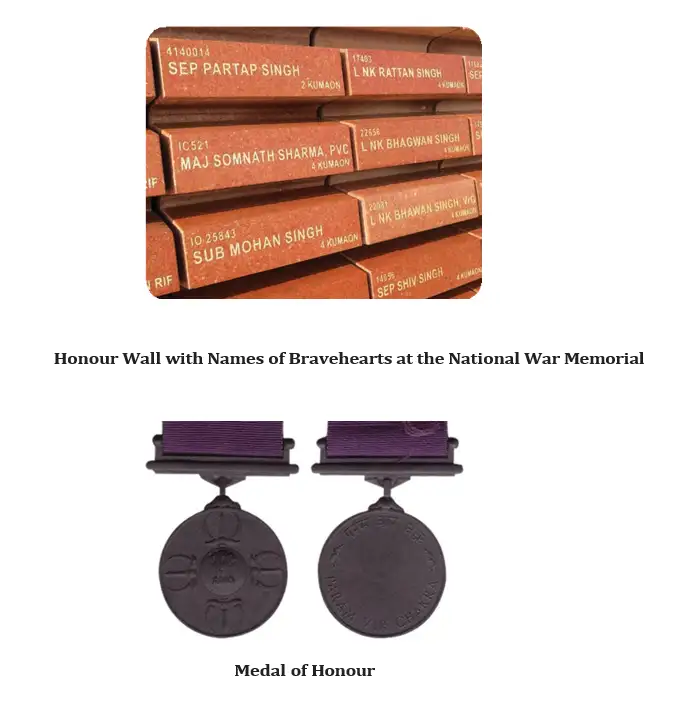
- Remembrance: His name is on the Honour Wall of the National War Memorial. His story honours all who sacrifice their lives in defence of the country.
Major Somnath Sharma
- Brave: Exposed himself to enemy fire while encouraging his men and directing their defence.
- Selfless and devoted: Continued supporting his troops despite having his left hand in plaster.
- Steadfast leader: Helped his company hold its position long enough for reinforcements to arrive.
Duty, courage and sacrifice
Sharma’s actions at Badgam show how courage and commitment to duty can protect others and help defend a nation.
- legacy
- Values, beliefs and experiences passed down or remembered over time.
- testament
- Strong evidence or proof.
- despatches
- Official military reports.
- forged
- Shaped or strengthened, often through hardship.
- poignant
- Deeply emotional, often with sadness.
How did Major Somnath Sharma’s defence at Badgam help protect Srinagar?
What actions showed Sharma’s courage and concern for his company?
Quick recap
- Somnath Sharma was born in Dadh, Kangra, on 31 January 1923, into a military family.
- He served in the Arakan Campaign during World War II and was mentioned in despatches for bravery.
- The Battle of Badgam was fought during the Indo–Pakistan War of 1947–1948; Sharma’s company faced an enemy force estimated at 500 attacking from three sides.
- His men fought at a seven-to-one disadvantage for six hours, including one hour after Sharma’s death.
- The defence delayed the enemy and gave reinforcements time to reach Humhama.
- His name is remembered on the National War Memorial’s Honour Wall.
English — ALL CHAPTERS
1
The Wit That Won Hearts
2
Poem- A Concrete Example
3
Wisdom Paves The Way
4
A Tale of Valour:Major Somnath Sharma and the Battle of Badgam
5
Poem- Somebody’s Mother
6
Verghese Kurien - I Too Had A Dream
7
The Case of the Fifth World
8
Poem - The Magic Brush of Dreams
9
Spectacular Wonder
10
The Cherry Tree
11
Poem-Harvest Hymn
12
Waiting for the Rain
13
Feathered Friend
14
Poem - The Magnifying Glass
15
Bibha Chowdhuri: The Beam of Light That Lit the Path for Women in Indian Science