Class 8 . English . Poorvi . Wisdom Paves the Way
Chapter 3: Wisdom Paves The Way
Ch 3
English
Class 8
The Road to Ujjain
Characters and Setting
- Main characters: The young King of Ujjain; four young men—Ram Datt, Shiv Datt, Har Datt and Dev Datt; a merchant; and two sentries.
- Setting: A road leading to Ujjain, followed later by the King’s richly decorated court. The time is midday.
Scene I: The Road to Ujjain
The Four Travellers
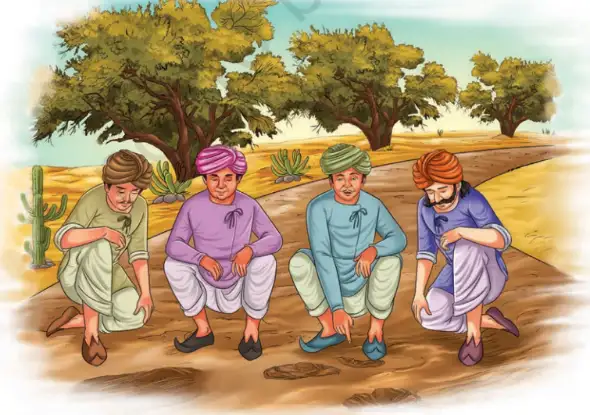
- Ram Datt, Shiv Datt, Har Datt and Dev Datt have travelled from their village for ten days, hoping to find suitable work.
- They hope the King of Ujjain will recognise their talents and employ them, though Har Datt notes that gaining an audience will require a strategy.
- As they approach the city, they notice fresh camel tracks and examine them carefully. Each man says he has noticed something unusual.
The Merchant Appears
- Har Datt suggests resting beneath a tree to share their observations, but before they do, the men notice a merchant hurrying towards them.
- The merchant appears distressed. Ram Datt guesses that he has lost something valuable, perhaps his camel.
Ram Datt
- Confident: believes the King will recognise the men’s talents.
- Observant: studies the camel tracks and notices the approaching merchant.
Shiv Datt
- Hopeful: agrees that the King may give them work.
- Attentive: spots the fresh camel tracks.
Har Datt
- Thoughtful: recognises that meeting the King will require a strategy.
- Observant: says he, too, has noticed something unusual about the camel.
Dev Datt
- Patient and encouraging: reminds the others that finding work may take time.
- Confident in his own observation: says his discovery differs from the others’.
Observation and Cooperation
The travellers carefully study the tracks and each notices something different. Their plan to share their findings highlights the value of observation and cooperation.
- adorned
- decorated or beautified
- resolute
- determined
- tapestries
- heavy decorative fabrics with woven designs
- bustling
- busy and full of activity
- eludes
- remains difficult to obtain
- devise
- think of or plan
- deliberate
- think carefully
- scrutinise
- examine closely
- in haste
- in a hurry
- pursued
- chased
- countenance
- facial expression
- distressed
- worried or upset
Quick recap
- The four young men have travelled for ten days in search of work.
- They hope the King of Ujjain will employ them and recognise their talents.
- The travellers notice fresh camel tracks and each observes something unusual.
- Har Datt suggests resting to share their findings, but a merchant approaches before they do.
- The distressed merchant seems to have lost something valuable, perhaps his camel.
The Lost Camel
The Merchant Searches for His Camel
- The search: A distressed merchant asks four young men whether they have seen his missing camel.
- Their descriptions: Ram Datt says it is lame in one leg; Shiv Datt says it is blind in the right eye; Har Datt says it has a short tail; and Dev Datt says it has a stomach ailment.
- The accusation: The merchant is astonished by their accurate descriptions, assumes they must have seen or stolen the camel, and threatens to take the matter to the King.
- The response: The young men insist they have never seen the camel and calmly agree to go with the merchant to the King.
- The ending: They head towards the palace, where the merchant speaks to a sentry. The excerpt ends before the King hears the case.
The Merchant
- Distressed and anxious: He urgently seeks help finding his lost camel.
- Suspicious: He believes the young men are deceivers because they describe the camel without claiming to have seen it.
- Determined: He insists they accompany him to the King.
The Four Young Men
- Observant and knowledgeable: They identify several distinctive features and the camel’s illness.
- Calm and confident: They deny having seen the camel and agree to face the King.
Wisdom and Hasty Judgement
The young men’s accurate descriptions raise the question of how careful observation can reveal information. The merchant, however, quickly assumes they are guilty without proof.
- Astray
- Away from the correct path.
- Indignant
- Angry because something seems unfair or wrong.
- Yonder
- Over there.
What details do the four young men give about the camel?
Why does the merchant accuse the young men?
Quick recap
- A merchant searches for his missing camel and asks four young men for help.
- The young men describe the camel’s leg, eye, tail, and illness.
- They say they have never seen the camel.
- The merchant accuses them and takes them towards the King.
- The excerpt ends before the King hears their explanation.
The King’s Court
Scene II: The King’s Court
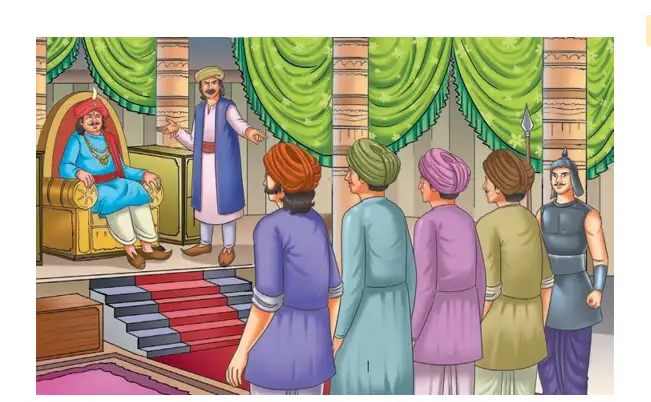
- The merchant accuses four travellers of stealing his camel because they know details about it, although they say they have never seen it.
- The King asks the merchant to state his accusation clearly, then questions the travellers about how they reached their conclusions.
- Ram Datt says the camel was lame: three footprints were distinct, while the fourth was faint, suggesting an uneven gait.
- Shiv Datt says the camel was blind in its right eye: it nibbled foliage only on the left side of the road and left the right-side leaves untouched.
- Draperies
- Long, thick curtains.
- Canopy
- A decorative cover fixed over a seat.
- Grievance
- A complaint.
- Accusation
- A claim that someone has done something wrong.
- Deduce
- To reach a conclusion through reasoning.
- Discern
- To notice or recognise something.
- Foliage
- Green leaves and plants.
Quick recap
- The merchant accuses four travellers because they know details about his missing camel despite claiming they have never seen it.
- The King asks for a clear accusation and questions the travellers about their evidence.
- Three distinct tracks and one faint track lead Ram Datt to infer that the camel was lame.
- The camel’s nibbling on the left side of the road, while leaving right-side foliage untouched, leads Shiv Datt to infer right-eye blindness.
The King’s Decision
The King Recognises the Men’s Reasoning
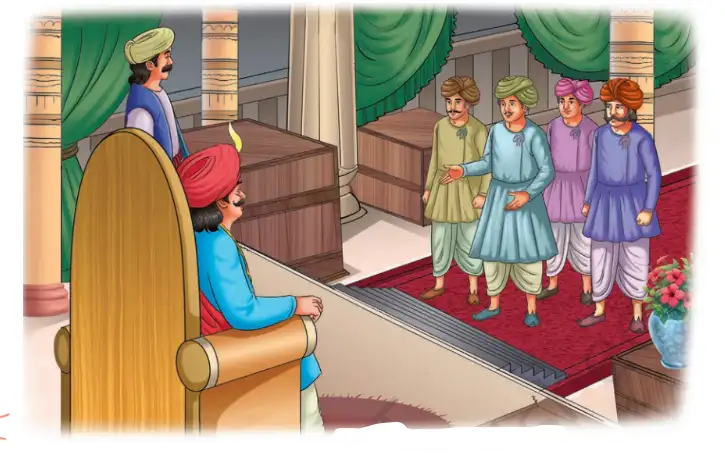
- Har Datt explains that small blood droplets along the track suggested mosquito bites. He reasons that a camel with a long tail could have fended off the mosquitoes, so the camel had a short tail.
- Dev Datt notices that the camel’s forefoot prints are deep and clear, while the prints of its sound hind foot are faint. He infers that the camel was drawing up its hind legs because of discomfort and moving cautiously to spare itself further suffering from belly pain.
- The King praises their observation and deduction, rejects the Merchant’s accusations as baseless, and tells him to continue searching for his camel.
The Men Become Advisers
- The King’s offer: Impressed by the four men’s ability to see beyond the obvious, the King invites them to become advisers in his court.
- Their response: Ram Datt, Shiv Datt, Har Datt and Dev Datt gratefully accept and promise to serve the King with their insight and counsel.
- The conclusion: The King announces that they will advise him and help guide Ujjain towards prosperity. The court applauds.
The King
- Wise and perceptive: Recognises the men’s reasoning as evidence of wisdom.
- Just: Dismisses the baseless accusation and corrects the Merchant.
- Appreciative: Offers the four men positions as advisers.
Har Datt
- Observant: Notices blood droplets along the track.
- Logical: Deduces from the likely mosquito bites that the camel had a short tail.
Dev Datt
- Careful observer: Notices the difference between the camel’s deep forefoot prints and faint prints from its sound hind foot.
- Insightful: Infers that discomfort and belly pain made the camel draw up its hind legs and move cautiously; he does not claim that the leg itself was painful.
The Merchant
- Wrongly accusatory: Accuses the four men of being thieves.
- Chastened: Feels embarrassed when the King exposes the weakness of his accusation.
Observation and Wisdom
Careful observation and logical deduction can reveal facts that are not immediately visible. True wisdom means looking beyond appearances.
- fended off
- guarded against
- insight
- clear or deep understanding
- sound
- healthy
- intimately
- in great detail
- flawless
- perfect; without mistakes
- chastened
- made to feel sorry or ashamed
- counsel
- advice
- beacon
- a guiding light or influence
How did Har Datt conclude that the camel had a short tail?
What did Dev Datt infer from the camel’s footprints?
Quick recap
- Har Datt used blood droplets and likely mosquito bites to infer that the camel had a short tail.
- Dev Datt interpreted the uneven footprints as signs of discomfort and belly pain, not a painful leg.
- The King rejects the Merchant’s accusation as baseless.
- Impressed by their wisdom, the King appoints all four men as advisers.
- The men accept the honour and promise to serve Ujjain with their counsel.
English — ALL CHAPTERS
1
The Wit That Won Hearts
2
Poem- A Concrete Example
3
Wisdom Paves The Way
4
A Tale of Valour:Major Somnath Sharma and the Battle of Badgam
5
Poem- Somebody’s Mother
6
Verghese Kurien - I Too Had A Dream
7
The Case of the Fifth World
8
Poem - The Magic Brush of Dreams
9
Spectacular Wonder
10
The Cherry Tree
11
Poem-Harvest Hymn
12
Waiting for the Rain
13
Feathered Friend
14
Poem - The Magnifying Glass
15
Bibha Chowdhuri: The Beam of Light That Lit the Path for Women in Indian Science