Class 8 . English . Poorvi . Spectacular Wonder
Chapter 9: Spectacular Wonder
Ch 9
English
Class 8
Natural Wonders of India Part-1
Introduction
- India has remarkable natural phenomena that inspire wonder and imagination.
The Valley of Flowers, Uttarakhand
- The valley has around 600 species of exotic flowers, including orchids, poppies, primulas, marigolds, daisies and anemones.
- Waterfalls, wild streams and rare wildlife—including grey langurs, flying squirrels, red foxes, lime butterflies and snow leopards—add to its natural beauty.
- Set against the Himalayas in Chamoli district, the Valley of Flowers National Park is a UNESCO World Heritage Site.
- Between May and October, the valley becomes a colourful botanical wonderland.
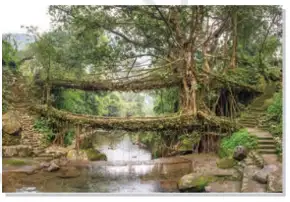
The Living Root Bridges, Meghalaya
- Indigenous people developed living root bridges to cross waterways, where bamboo and wooden bridges could not withstand heavy monsoon rains and strong currents.
- The bridges are made by guiding and intertwining living roots, creating a natural structure and ecosystem.
- The passage describes these bridges as tangible UNESCO World Heritage sites. They reflect local people’s knowledge of their environment and its cultural importance.
- Under ideal conditions, a bridge may last for hundreds of years. Many rise 50–100 feet above the ground; the longest in Meghalaya is said to be 175 feet long, and around 100 are known across different villages.
The Lonar Crater Lake, Maharashtra
- Located in Lonar town, Buldhana district, the crater formed thousands of years ago when a huge, fast-moving meteorite struck Earth.
- It is India’s only meteorite-impact crater formed in basaltic rock and ranks as the world’s third-largest crater.
- A circular depression at the centre holds a saline lake, contrasting with the rough surrounding terrain.
- The crater’s rim offers views of a landscape shaped by a powerful impact and the Earth’s ancient past.
Nature and Human Ingenuity
India’s natural wonders reveal the beauty and power of nature, while the living root bridges show how local knowledge can work in harmony with the environment.
- mystifying; spectacle
- Strange or difficult to explain; an unusual sight that attracts attention.
- exotic; botanical
- Uncommon or unusual; related to plants.
- feats; tangible
- Difficult tasks requiring skill; noticeable or able to be perceived.
- indigenous
- Native to a place.
- futile; intertwined
- Useless or unsuccessful; twisted together.
- persist; whopping
- Continue to exist; huge.
- nestled; colossal
- Situated in a sheltered or half-hidden position; extremely large.
- cradles; rugged
- Holds or supports; rough and uneven.
- terrestrial; allure
- Related to Earth; attraction.
Quick recap
- The Valley of Flowers has around 600 flower species and is a UNESCO World Heritage Site.
- The Valley of Flowers is in Chamoli district, Uttarakhand, and blooms from May to October.
- Meghalaya’s living root bridges are made from guided, intertwined roots and withstand monsoon conditions.
- Living root bridges can last for centuries; the longest mentioned is about 175 feet long.
- Lonar Crater Lake formed after a meteorite struck basaltic rock in Maharashtra.
- Lonar is India’s only meteorite-impact crater in basaltic rock and the world’s third-largest crater.
Natural Wonders of India Part-2
Magnetic Hills in Leh District, Ladakh
- Location: Magnetic Hill lies about 30 km from Leh. A signboard calls it “The Phenomenon That Defies Gravity”.
- What visitors see: Vehicles parked at a marked spot appear to roll uphill at nearly 20 km/h.
- Explanation: This is an optical illusion caused by the alignment of the surrounding slopes and the horizon.
Glowing Waters of Kerala
- Location: Kumbalangi is a green village about 15 km from Kochi, with serene backwaters.
- Phenomenon: The waters glow at night due to a high concentration of micro-planktons. This natural light-producing phenomenon is called bioluminescence.
- Significance: The sight attracts locals and tourists, making Kumbalangi an eco-tourism village where visitors can experience local life, cuisine and culture.
The Sundarbans
- Mangroves: These coastal forests grow in low-oxygen soil, with tree roots under water. Their roots slow tidal waters, stabilise the coastline and reduce erosion.
- Location and name: The Sundarbans extend over 1,400 km in the delta of the Ganga, Brahmaputra and Meghna rivers in West Bengal. The name comes from the abundant sundari trees.
- Wildlife: The area has diverse flora and fauna, including many bird species and the Bengal tiger. The estuarine crocodile and Indian python are threatened species found there.
The Invisible Chandipur Beach, Odisha
- Location: Chandipur Beach is in Odisha’s Balasore district and is known for the sea seeming to disappear and return.
- Cause: During ebb tide, the seawater retreats 2–5 km from the shore; it returns at high tide.
- Pattern: This daily movement creates the beach’s striking hide-and-seek effect.
Nature’s Wonders
India’s landscapes display extraordinary natural phenomena. They inspire curiosity, reveal forces that shape the environment, and combine scientific intrigue with the magic of folklore.
- optical illusion
- Something that tricks the eyes into seeing things differently from how they really are.
- serene
- Calm and peaceful.
- backwaters
- A part of a river where the water does not flow.
- bioluminescence
- Light produced inside a living organism by a chemical reaction.
- eco-tourism
- Tourism that is responsible towards preserving the environment.
- acquaint
- To become familiar with something.
- estuarine
- Living in an estuary, where a freshwater river meets the ocean.
- retreats
- Goes backwards.
- ebb tide
- The period when water flows away from the shore.
- mystique
- Mystery.
- enigmatic
- Puzzling.
- intrigue
- Interest.
Quick recap
- Magnetic Hill’s apparent uphill movement is an optical illusion caused by the landscape and horizon.
- Kumbalangi’s waters glow at night because of a high concentration of micro-planktons; this is called bioluminescence.
- Sundarbans mangrove roots slow tidal waters, stabilise the coastline and reduce erosion.
- The Sundarbans support diverse wildlife, including threatened estuarine crocodiles and Indian pythons.
- At Chandipur Beach, ebb tide moves the sea 2–5 km away before it returns at high tide.
- These wonders show how natural processes can create striking sights.
English — ALL CHAPTERS
1
The Wit That Won Hearts
2
Poem- A Concrete Example
3
Wisdom Paves The Way
4
A Tale of Valour:Major Somnath Sharma and the Battle of Badgam
5
Poem- Somebody’s Mother
6
Verghese Kurien - I Too Had A Dream
7
The Case of the Fifth World
8
Poem - The Magic Brush of Dreams
9
Spectacular Wonder
10
The Cherry Tree
11
Poem-Harvest Hymn
12
Waiting for the Rain
13
Feathered Friend
14
Poem - The Magnifying Glass
15
Bibha Chowdhuri: The Beam of Light That Lit the Path for Women in Indian Science