Class 8 . English . Poorvi . Poem the Magic Brush of Dreams
Chapter 8: Poem - The Magic Brush of Dreams
Ch 8
English
Class 8
Poem I
The Magic Brush of Dreams
- Gopi is asked to collect food and bring it home.
- The repeated instructions establish her household task.
- Instead of gathering food, Gopi enjoys drawing with a twig.
- Her pictures in the sand show her imagination and love of art.
- The wind quickly erases Gopi’s drawings.
- Her art seems temporary until the magical brush appears.
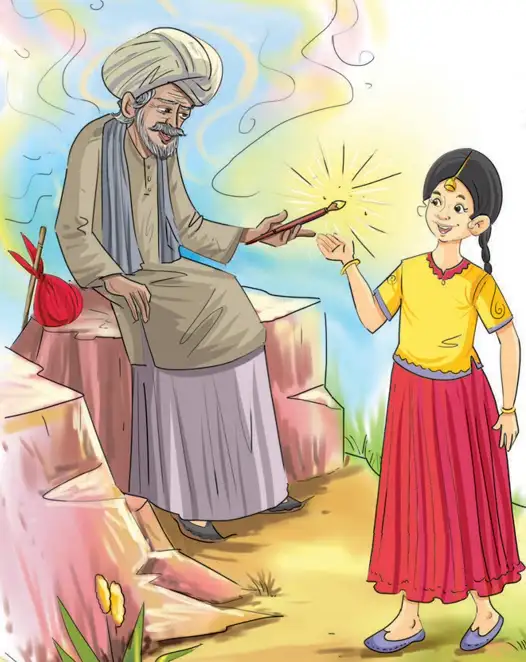
- A mysterious man has a magic brush and secretly calls Gopi over.
- He warns her to keep the brush’s magic hidden from the village.
- The man gives Gopi the brush and sets a condition for its use.
- She must use its power to help poor people, not the wealthy.
- Gopi is asked again whether she completed her chores.
- The repeated questions connect this moment to the poem’s opening.
- Gopi has gathered none of the requested food, but she is cheerful.
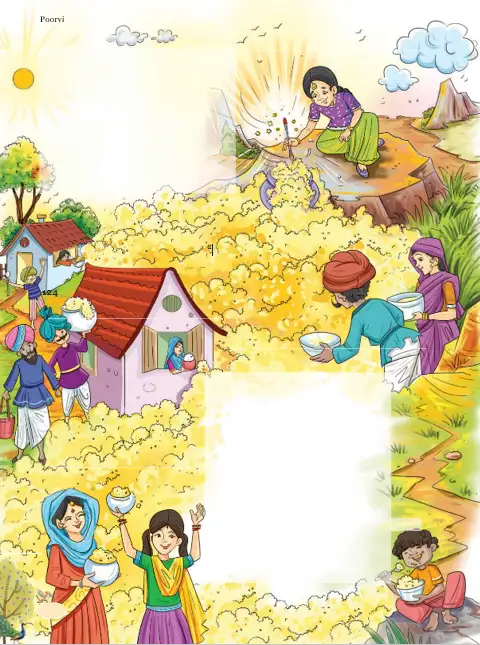
- She paints a bowl of khichdi and waits for the magic to work.
- The painted bowl becomes full of khichdi, astonishing the villagers.
- People of all ages gather to see the magical brush.
- Gopi paints useful things for people in need.
- Her creations bring practical help to villagers of different ages.
- News of Gopi’s magical gifts travels across the region.
- Even the Zamindar hears about the brush and its benefits.
| Device | Example | Effect |
|---|---|---|
| Repetition | “Go and gather”; “Go and fetch” | Emphasises the repeated instructions given to Gopi. |
| Rhyme | “rice” / “nice”; “hand” / “sand” | Creates a musical rhythm that makes the poem easy to remember. |
| Imagery | “Pictures in the sand” | Helps readers picture Gopi drawing outdoors. |
| Dialogue | “Paint not for the wealthy ones, / But only for the poor.” | Reveals the rule that guides Gopi’s use of the brush. |
Kindness and Helping Others
Gopi uses the magical brush to create useful things for poor villagers. The poem highlights generosity and the value of using one’s gifts to help others.
- Banyan
- A large tree with spreading branches.
- Twig
- A small, thin branch.
- Khichdi
- A dish commonly made from rice and lentils.
- Plough
- A tool used to turn soil for farming.
- Zamindar
- A landowner, often one with authority over a large area.
Quick recap
- Gopi is asked to gather food but prefers drawing pictures in the sand.
- A mysterious man gives Gopi a magic brush and tells her to paint for the poor.
- Gopi paints a bowl of khichdi, which becomes full of food.
- She paints useful items for villagers, including a farmer, a grandmother and a girl.
- News of the magic brush spreads until the Zamindar hears about it.
Poem II
The Magic Brush of Dreams
- The Zamindar orders Gopi to paint a grand fortress and valuable riches for him.
- He wants wealth and power over the land.
- Gopi refuses the Zamindar’s demand politely but firmly.
- She keeps her promise to use the brush to help people in need.
- Angry at Gopi’s refusal, the Zamindar orders his men to capture her.
- He also demands that they take her magic brush.
- Gopi is imprisoned and left on the cold floor.
- The Zamindar later returns to make his demand again.
- The Zamindar threatens Gopi and orders her to paint riches.
- He promises to release her only if she obeys.
- While the Zamindar dreams of wealth, Gopi uses the brush to plan her escape.
- She paints a road and a strong horse.
- The painted road leads beyond the prison, and Gopi rides away quickly.
- She travels through fields and villages on the horse.
- The villagers are happy to see Gopi return.
- She continues onward because the Zamindar’s men are chasing her.
- Gopi paints a broad, deep river between herself and her pursuers.
- The Zamindar and his men cannot cross it.
- Gopi warns that she may paint a beast to chase the men.
- Her warning frightens them and challenges them to stop pursuing her.
- The Zamindar gives up the chase and agrees to leave.
- His men are too frightened to remain.
- Gopi uses her brush to create a celebration for the villagers.
- The feast, music and songs mark their victory.
| Device | Example | Effect |
|---|---|---|
| Rhyme | “grand” / “land”; “deep” / “leap” | Gives the poem a musical rhythm. |
| Repetition | “Paint...” and “No, no, no more!” | Emphasises the Zamindar’s commands and fear. |
| Imagery | “A mighty river wide, / Its currents fast and deep.” | Creates a clear picture of the obstacle Gopi paints. |
Courage, Kindness and Freedom
Gopi’s courage and clever use of the magic brush defeat greed and oppression. She remains true to her promise to help others and shares her victory with the village.
Quick recap
- The Zamindar wants Gopi to paint riches, but she refuses because she promised to help the needy.
- Imprisoned by the Zamindar, Gopi paints a road and horse to escape.
- She stops her pursuers by painting a wide, deep river and warning them of a beast.
- The frightened Zamindar abandons the chase, and Gopi celebrates with the villagers.
English — ALL CHAPTERS
1
The Wit That Won Hearts
2
Poem- A Concrete Example
3
Wisdom Paves The Way
4
A Tale of Valour:Major Somnath Sharma and the Battle of Badgam
5
Poem- Somebody’s Mother
6
Verghese Kurien - I Too Had A Dream
7
The Case of the Fifth World
8
Poem - The Magic Brush of Dreams
9
Spectacular Wonder
10
The Cherry Tree
11
Poem-Harvest Hymn
12
Waiting for the Rain
13
Feathered Friend
14
Poem - The Magnifying Glass
15
Bibha Chowdhuri: The Beam of Light That Lit the Path for Women in Indian Science