Sentila’s Dream
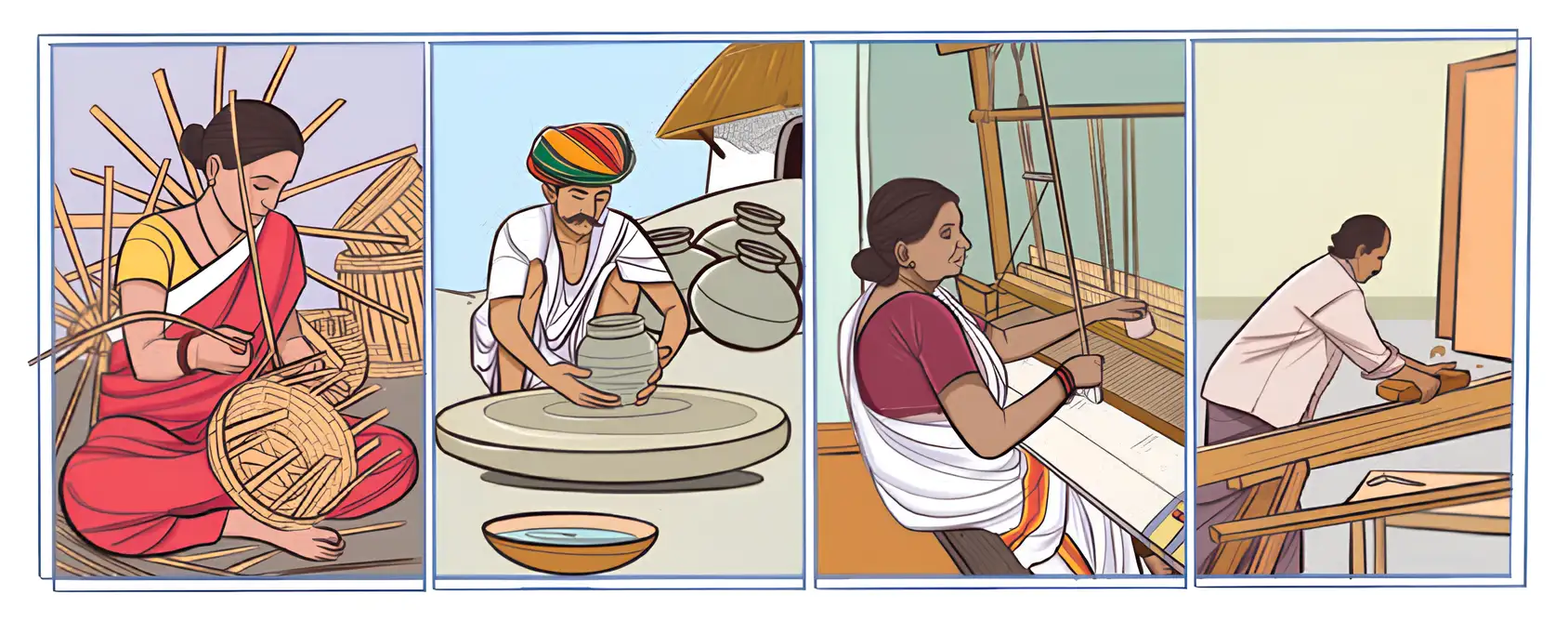
Vocation — A vocation is a type of work or occupation that often involves a particular skill, such as pottery, weaving, basket-making or carpentry.
Sentila’s Dream
- Sentila’s ambition: From childhood, Sentila dreams of becoming a pot maker like her mother and grandmother. While her parents are away, she approaches skilled potters to learn.
- Arenla’s preference: Sentila’s mother wants her to learn weaving, which she considers easier, quicker and more profitable than pottery.
- The burden of pottery: Clay must be collected from a riverbank 16 kilometres away, carried uphill, and pounded before it can be shaped. The work is exhausting and a batch takes months, yet brings little income.
- Sentila’s silence: After overhearing her mother’s complaints about pottery and her preference for weaving, Sentila keeps her own ambition to herself.
Sentila
- Determined: Continues to pursue pottery even when expert potters initially assume her interest is childish.
- Curious and self-motivated: Seeks out experienced potters to learn the craft.
- Reserved: Hides her dream after hearing her mother’s views.
Arenla
- Practical: Prefers weaving because it takes less time and earns more.
- Experienced but weary: Describes pottery as physically demanding, tedious and poorly paid.
- Concerned for her family: Believes weaving can provide income as well as cloth for the household.
Personal ambition and practical choices
Sentila’s dream of learning pottery contrasts with her mother’s practical preference for weaving. The story introduces the tension between pursuing a personal interest and choosing work for its income and convenience.
- outgrow
- To lose interest in something while growing older.
- indifference
- Lack of interest or concern.
- pittance
- A very small amount of income.
- pounding
- Beating something repeatedly.
- tedious
- Tiring and boring because it takes a long time.
Quick recap
- Sentila dreams of becoming a pot maker like her mother and grandmother.
- She secretly seeks lessons from expert potters.
- Arenla wants her to weave because weaving is faster, easier to do indoors and more profitable.
- Pottery requires difficult clay gathering and preparation, months of work and yields little income.
- Sentila keeps her ambition private after overhearing her mother’s concerns.
- Skill-based occupations such as pottery and weaving are called vocations.
Pot Making Process
Learning the Pot-Making Process
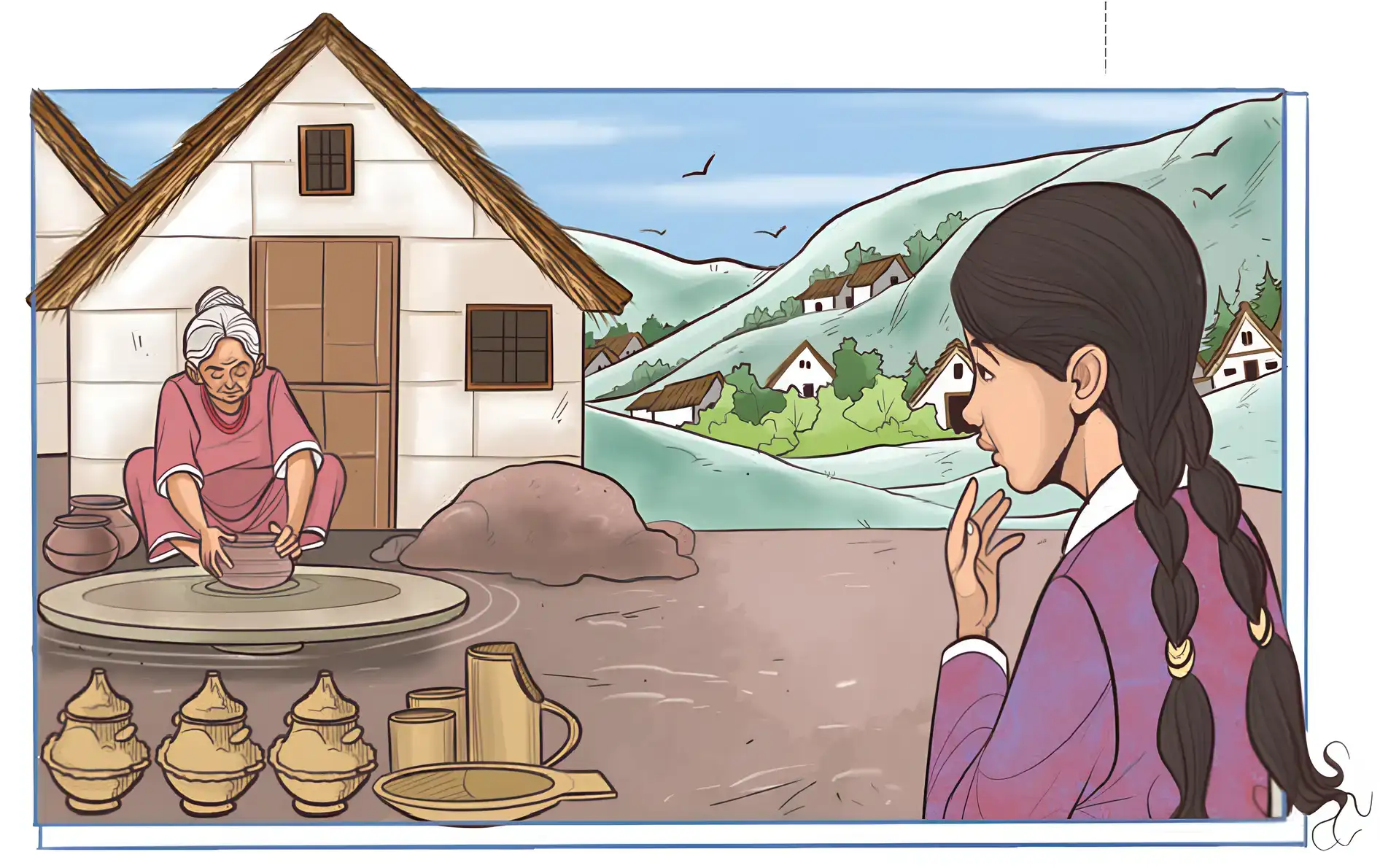
Sentila watches the potters
- Preparing the clay: Potters mix clay with water and pound it until soft.
- Shaping: They push a hand into the clay and rotate it, using a spatula to shape the pot.
- Finishing: After two or three days, they touch up the pots to preserve their shape and check their consistency.
- Drying and firing: The pots are sun-dried, arranged in the kiln on hay and dried bamboo, covered with another layer, and fired.
- Careful firing: The fire must be tended closely; over-firing or under-firing can ruin the whole batch.
A Skill Passed Down
The village council speaks to Mesoba
- Sentila’s visits: She returns home before her mother comes back from the fields, but her visits become village gossip.
- The village’s concern: People fear that if potters do not teach younger learners, the village will lose its skilled potters.
- Mesoba’s explanation: He tells the council that Arenla has not refused to teach Sentila; the family wanted their daughter to grow stronger after her illness.
- The council’s message: The elders remind Arenla that pot making must be passed from generation to generation.
- Shared heritage: Pot making serves people’s needs and represents their tradition and history; it does not belong to one person. Experts should teach their children and anyone else who wants to learn.
- After the meeting: Mesoba returns home and discusses the council’s message with Arenla.
Sentila
- Curious and determined: she keeps visiting the potters to learn the craft.
- Hopeful: she dreams of becoming a pot maker.
Arenla
- She knows of Sentila’s visits but pretends not to know.
- She has not clearly refused to teach Sentila; the family has been waiting for her to recover strength after illness.
Mesoba
- He answers the council respectfully and explains why Sentila has not yet been taught.
- He is confident that Sentila will become an excellent potter.
Passing on traditional skills
Pot making is both a practical skill and part of a community’s heritage. Skilled people have a responsibility to pass it on so it can continue.
- Deftly
- Skillfully.
- Spatula
- A tool used by a potter to shape a pot.
- Tend
- Take care of.
- Followed suit
- Did the same thing as someone else.
Is pot making easy? Give a reason.
Would Sentila be able to fulfil her dream of becoming a pot maker?
Would Mesoba and Arenla support Sentila?
Quick recap
- Clay is softened, shaped with a spatula, finished, sun-dried and fired in a kiln.
- Correct firing is essential because either over-firing or under-firing can spoil the batch.
- Sentila secretly visits potters because she wants to learn their craft.
- Mesoba tells the village council that the family delayed teaching Sentila until she recovered strength.
- The council says traditional skills belong to the community and should be passed on.
Sentila’s Struggle to Learn
Learning Pottery from Arenla
Sentila Practises with Her Mother
- Preparation: Arenla took Sentila to the riverbank to collect grey and red clay. She taught her to dig it with a dao, carry it, soak it, and pound it in the right proportion.
- Early progress: Sentila quickly made the clay into malleable dough, but struggled to hold and shape it into a pot.
- Repeated attempts: Arenla watched Sentila try again and again, then shaped the lump herself into a beautiful pot.
- Outcome: The lessons continued for almost a year, but Sentila could not learn pottery from her mother.
Onula Notices Sentila’s Difficulty
A New Chance to Learn
- Dormitory: The following year, when Sentila matured, custom required her to spend some nights in a girls’ dormitory supervised by Onula, a kind, middle-aged widow.
- Onula’s concern: Having heard about the discord in Sentila’s family, Onula was determined to help her.
- What Onula saw: One evening, while the other girls attended a musical event, Sentila quietly took out clay and tools to practise.
- The difficulty: Onula noticed Sentila’s clumsy effort and tension; her anxiety seemed to prevent the clay from taking the right shape.
Sentila
- Quick learner: She prepared the clay dough successfully.
- Persistent but tense: She kept practising, yet struggled to shape the pot and became frustrated.
Onula
- Kind and attentive: She noticed Sentila practising alone.
- Helpful: She was determined to support Sentila after learning about the discord in her family.
- dao
- A tool used for digging.
- malleable
- Able to be shaped without breaking or cracking.
- dormitory
- A large room with beds, such as in a hostel.
- resolved
- Determined to do something.
Quick recap
- Arenla taught Sentila how to collect and prepare grey and red clay.
- Sentila made the clay dough quickly but could not shape it into a pot.
- Arenla’s lessons continued for almost a year without success.
- Sentila later stayed in a girls’ dormitory supervised by Onula.
- Onula noticed Sentila’s tension while she practised alone and decided to help.
A Turning Point in Sentila’s Life
Learning to Shape Pots
- Onula’s guidance: After Sentila struggles with a pot, Onula demonstrates how to shape one and encourages her to try again.
- First success: Sentila makes a beautiful pot, but Onula points out that its mouth is not shaped correctly.
- Careful observation: Sentila watches Arenla’s hand and spatula movements, her slower rhythm when shaping the mouth, and how she adds elongated dough to form the rim.
Sentila’s Breakthrough
- Arenla’s request: On a sunny day, Arenla asks Sentila to make as many pots as possible so they can dry in the sunshine.
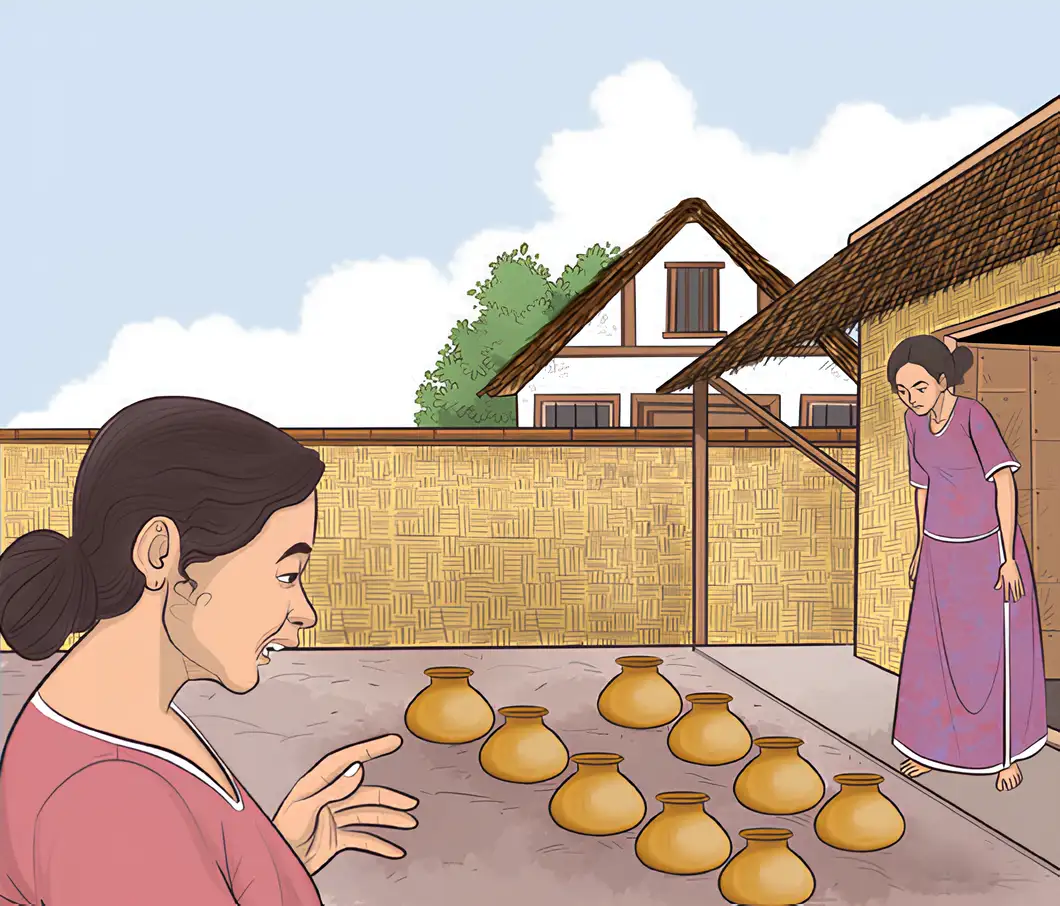
- Independent work: Left alone in the shed, Sentila applies what she has observed and soon makes pot after pot with speed and skill.
- Progress: Sentila’s row is only one pot short of Arenla’s tally.
A New Pot Maker
- Arenla’s death: Sentila discovers her mother lying unresponsive and runs to get help; Arenla’s body is carried out the next morning.
- Sentila’s grief: She asks her mother’s forgiveness, saying that her new skill seemed to come to her without intention.
- Onula’s realisation: Onula finds two rows of equally neat pots and understands that Sentila has become a pot maker.
- Turning point: The pots reveal Sentila’s newly developed skill and mark a major change in her life.
Sentila
- Determined: She tries again after her first pot’s mouth is criticised.
- Observant: She studies Arenla’s technique and applies it.
- Skilled and grieving: She makes many pots, then mourns her mother’s death.
Onula
- Encouraging: She reassures Sentila and teaches her to make a pot.
- Perceptive: She recognises Sentila’s achievement from the two rows of pots.
Arenla
- Experienced: She makes pots quickly and demonstrates the technique Sentila learns by watching.
- Trusting: She leaves Sentila to continue the work independently.
Learning, Loss and Transformation
Patient observation and practice help Sentila develop her skill. The pots become a sign of her transformation into a pot maker, while the moment is shadowed by her mother’s death.
- wearily
- in a tired way
- slackened
- became slower or more relaxed
- momentum
- force that keeps an action moving
- dexterity
- skill in using the hands
- tally
- a count or total
- threshold
- the entrance to a room or building
- intuitively
- by instinct or feeling
- momentous
- very important
- phenomenon
- an unusual or notable event
- profound
- deep or powerful
- revelation
- a significant realisation
Quick recap
- Onula encourages Sentila and teaches her the basics of shaping a pot.
- Sentila makes a beautiful pot, then learns to shape its mouth by observing Arenla closely.
- Working alone, Sentila quickly makes almost as many pots as her mother.
- After Arenla’s death, Onula recognises Sentila’s new skill in the two rows of pots.
- The story presents Sentila’s development as a pot maker amid grief and loss.
English — ALL CHAPTERS
1
How I Taught My Grandmother to Read
2
Bharat Our Land
3
The Pot Maker
4
Gifts of Grace: Honouring Our Vocations
5
Winds of Change
6
Canvas of Soil
7
Vitamin-M
8
I Cannot Remember My Mother
9
The World of Limitless Possibilities
10
Nine Gold Medals
11
Twin Melodies
12
A Friend Found in Music
13
Carrier of Words
14
Word
15
Follow That Dream
16
Believe in Yourself