Class 11 PCM . English . Snapshots . The Summer of the Beautiful White Horse
Chapter 1: The Summer of the Beautiful White Horse
Ch 1
English
Class 11 PCM
Introduction: Tales of White Horse
The Dawn Visit
- Nine-year-old Aram and his cousin Mourad are Armenian boys from the Garoghlanian tribe, known for trust and honesty.
- At four in the morning, Aram wakes to find Mourad sitting on a beautiful white horse.
- Aram has always longed to ride a horse, so the sight fills him with excitement and wonder.
- The Garoghlanian family is extremely poor and cannot afford a horse, yet it is famous for honesty—a reputation lasting about eleven centuries.
- Aram cannot believe the horse was stolen, because he believes no member of his family could be a thief.
Aram
- Imaginative and wonder-filled: he sees childhood as a world of magnificence and mystery.
- Longs to ride horses, but is troubled by the possibility that the horse was stolen.
- Trusts his family’s reputation for honesty and refuses to accept that Mourad is a thief.
Mourad
- Aram’s Armenian cousin, considered crazy by everybody who knows him except Aram.
- Lively and daring; he arrives before dawn riding a magnificent white horse.
- His possession of the horse creates a conflict between Aram’s suspicion and the family’s reputation for honesty.
Honesty and Temptation
The boys’ poverty and their tribe’s deep-rooted trust and honesty create the central tension: Aram suspects the horse may be stolen but cannot reconcile that possibility with his family’s values.
Childhood Wonder
Aram’s deep love of horses makes the unexpected sight of Mourad riding one feel thrilling and almost dreamlike.
- Magnificence
- Great beauty or splendour.
- Longings
- Strong desires or wishes.
- Poverty-stricken
- Extremely poor.
- Garoghlanian
- The family name shared by Aram and Mourad.
- Pious
- Deeply sincere or solemn.
- Stillness
- A state of quiet or calm.
Why does Aram find it difficult to believe that Mourad has a horse?
What values are associated with the Garoghlanian tribe?
Quick recap
- Aram and Mourad are Armenian boys from the Garoghlanian tribe, whose hallmarks are trust and honesty.
- Nine-year-old Aram is surprised when Mourad arrives before dawn on a white horse.
- Aram has long wished to ride a horse.
- The Garoghlanian family is extremely poor but famous for honesty.
- Aram struggles to believe that Mourad could have stolen the horse.
A Journey with Mourad
The Morning Ride
Aram Joins Mourad
- The invitation: Aram asks where Mourad got the white horse; Mourad invites him to ride, and Aram quickly joins him.
- Aram’s reasoning: He believes borrowing the horse for a ride is not really stealing, since they do not intend to sell it.
- The ride: The cousins race through the countryside as Mourad sings loudly; Aram delights in the fresh air and the horse’s movement.
The Family’s Crazy Streak
- Family reputation: Mourad is seen as a natural heir to the family’s supposedly crazy streak.
- Uncle Khosrove: He is huge, hot-tempered, impatient and famous for roaring that people should ignore whatever problem is being discussed.
- The house fire: Even when his son tells him their house is burning, Khosrove dismisses the news in the same manner.
- Spirit and family: Mourad’s father, Zorab, is practical, but the family believes a son can inherit his spirit from someone other than his biological father.
Mourad
- Adventurous: He brings Aram to ride the horse and enjoys racing it.
- Confident: He claims to have a special understanding of horses and insists Aram get down before he rides alone.
- Impatient and exuberant: He urges Aram to hurry and expresses his excitement by roaring out a song.
Aram
- Horse-loving: He eagerly joins the ride and thinks of the horse as something they may ride without truly stealing.
- Cautious but eager: He asks to ride alone, though he experiences intense fear when he gets onto the horse.
Uncle Khosrove
- Quick-tempered: He is easily irritated and roars to stop others from talking.
- Dismissive: He treats even serious trouble, such as the family house being on fire, as unimportant.
Mourad Rides Alone
- The challenge: Mourad says the horse will decide whether Aram can ride alone; Aram insists he has a way with horses too.
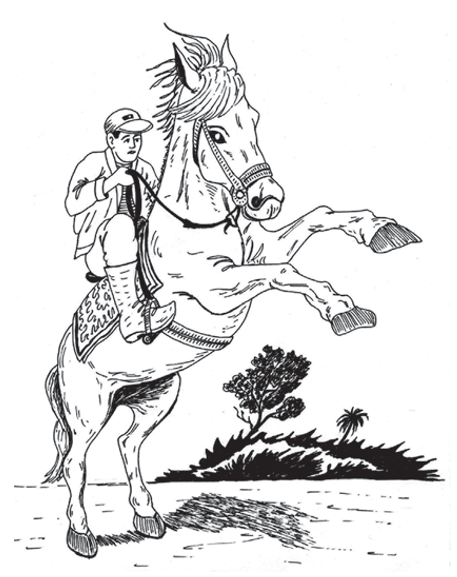
- Mourad’s ride: The horse rears and races across dry grass, crosses an irrigation ditch, and returns with Mourad soaked.
- Aram’s turn: At sunrise, Aram climbs onto the horse, but it does not move; he feels overwhelming fear.
Childhood Adventure and Rationalisation
The cousins’ joy in riding the horse makes Aram excuse their wrongdoing. Their adventure combines youthful excitement with an uneasy awareness that the horse is not theirs.
Quick recap
- Aram joins Mourad for a ride on a horse Mourad has taken without permission.
- Aram rationalises the act because the cousins only want to ride, not sell the horse.
- Mourad is associated with the family’s wild streak, especially the temperament of Uncle Khosrove.
- The story suggests that a person’s spirit may come from someone other than their biological father.
- Mourad rides boldly across the countryside and returns soaked after crossing a ditch.
- When Aram tries to ride alone, the horse stands still and Aram is frightened.
The Adventure of Finding a Lost Horse
The Horse Escapes
- Aram’s ride: The horse bolts through a vineyard and throws Aram off.
- Mourad’s help: He searches for the horse and brings it back.
The Plan to Hide the Horse
Mourad
- Confident: He stays calm after the horse escapes and manages to recapture it.
- Skilled with animals: He claims to understand horses and gets the horse to behave.
- Protective: He invites Aram to ride because he knows how much Aram longs to do so.
Aram
- Eager: He is thrilled to ride the horse but is unsure how to control it.
- Conscientious: He questions how long Mourad has been riding the horse and recognises the dishonesty in their situation.
Love of Horses and Moral Conflict
The boys’ excitement about riding the horse conflicts with the question of whether keeping and hiding it is right. Aram is more troubled by the truth than Mourad appears to be.
Quick recap
- Aram’s kick sends the horse running through a vineyard, and he falls.
- Mourad searches for half an hour before finding the horse.
- Mourad plans to hide the horse in a deserted vineyard barn.
- Aram suspects Mourad has ridden the horse before, despite Mourad’s claim.
- Mourad says he has a natural understanding with horses.
The White Horse Escape
John Byro Visits Aram’s Home
- John Byro, an Assyrian farmer who had learned Armenian out of loneliness, tells the family that his white horse was stolen a month earlier.
- Khosrove dismisses Byro’s distress, comparing the loss of a horse with the loss of the homeland and shouting that money does not matter.
- Byro explains that he needs the horse for his surrey and has a painful leg. Aram’s mother says Khosrove is homesick, though he has a gentle heart.
Mourad’s Promise
- Aram finds Mourad caring for the injured wing of a young robin and tells him that Byro wants his horse back.
- Aram asks Mourad to let him keep riding until he learns. Mourad refuses to let their family be seen as thieves: the horse belongs to its true owner.
- Mourad says they will return the horse within six months at the latest. The robin eventually flies away.
Riding Practice
- For two weeks, the boys take the horse from the barn in the deserted vineyard where they hide it and ride each morning.
- When Aram rides alone, the horse leaps over vines and small trees, throws him off and runs away. Aram still hopes to learn to ride like Mourad.
John Byro Recognises the Horse
- The boys meet Byro on their way to the vineyard. Mourad does the talking and calls the horse “My Heart.”
- Byro checks the horse’s teeth and says it is identical to his stolen horse. He trusts the boys because their family is famous for honesty, so he does not accuse them.
The Horse Is Returned
- The next morning the boys return the horse to Byro’s vineyard and leave it in the barn. The dogs follow them silently; Mourad says he knows how to handle dogs.
- Mourad affectionately embraces the horse before they leave. Byro later tells Aram’s mother that the horse has returned stronger and better-tempered.
- Khosrove again tells Byro to be quiet and pay no attention to the matter.
Mourad
- Confident and resourceful: rides skilfully and claims to understand animals and farmers.
- Compassionate: cares for the injured robin and treats the horse affectionately.
- Honourable: insists the horse must return to its owner and protects the family’s reputation for honesty.
Aram
- Eager to learn riding, even though the horse repeatedly throws him off.
- Initially wants to keep the horse longer, but goes along with Mourad’s decision to return it.
John Byro
- A lonely Assyrian farmer who has learned Armenian.
- Honest and trusting: recognises his horse but avoids accusing the boys because he respects their family’s reputation.
Khosrove
- Short-tempered and dismissive: interrupts Byro and tells him not to worry about the horse.
- Homesick, but described by Aram’s mother as having a gentle heart.
Honesty and Family Reputation
Mourad insists that the horse must be returned, and Byro’s trust in the Garoghlanian family’s honesty keeps him from accusing the boys.
Compassion for Animals
Mourad’s care for the injured robin and his affectionate farewell to the horse reveal his tenderness towards animals.
Quick recap
- John Byro tells Aram’s family that his white horse has been stolen.
- Mourad refuses to keep the horse permanently, citing the family’s honesty.
- Aram practises riding for two weeks but is repeatedly thrown off.
- Byro recognises the horse but trusts the boys because of their family’s reputation.
- The boys return the horse, and Byro reports that it is in better condition.
Exercise
Reading and Interpreting the Story
What makes the story interesting despite its lack of thrilling action?
Did the boys return the horse because of conscience or fear?
Personal Response and Cultural Research
Writing About a Childhood Memory
- Nostalgic opening: The narrator looks back on childhood as a time of wonder, when the world seemed full of magnificence and life felt like a delightful, mysterious dream.
- Choose one incident from childhood that was memorable, exciting, puzzling, or funny.
- Narrate it in order: introduce the setting, describe what happened, and finish with your response or reflection.
What does the exercise say about the Garoghlanian family, and what should your research add?
Quick recap
- Story’s appeal: Humour, vivid characters, and the boys’ conflict between their love of horses and their family’s honesty make the story engaging.
- Returning the horse: The boys return it because their conscience and the Garoghlanian family’s honour require them to do what is right, not because they are afraid.
- The story opens nostalgically, recalling childhood as a time of wonder and magnificence.
- A childhood-memory narrative should present an incident clearly and in sequence.
- The exercise identifies Mourad and Aram as members of the Garoghlanian family and their tribe as being in Armenia.
- Use an atlas and reliable sources for the requested Armenia and Assyria research; do not treat research as information stated by the exercise.
English — ALL CHAPTERS
1
The Portrait of a Lady
2
“We’ re Not Afraid To Die...If We Can All Be Together”
3
Discovering Tut: The Saga Continues
4
The Ailing Planet: The Green Movement’s Role
5
The Adventure
6
Silk Road
7
Note-making
8
Summarising
9
Sub-titling
10
Essay-writing
11
Letter-writing
12
Creative Writing
1
The Summer of the Beautiful White Horse
2
The Address
3
Mother’s Day
4
Birth
5
The Tale of Melon City