SOLUTIONS
2023 BOARD EXAM
CBSE Class 12 Commerce Business Studies Board Paper 2023 — Set 1 Solutions
2023
Business Studies
Class 12 Commerce
CBSE EXAMINATION PAPER-2023
BUSINESS STUDIES
(Solved)
General Instructions :
Read the following instructions carefully and follow them :
- This question paper contains 40 questions. All questions are compulsory.
- This question paper is divided into 4 sections.
- Section A – questions number 1 to 20 are multiple choice questions
- Section B – questions number 21 to 26 are short answer type i
- Section C – questions number 27 to 34 are short answer type ii
- Section D – questions number 35 to 40 are long answer
- There is no overall choice given in the question paper. However, an internal choice has been provided in few questions.
- Use of calculator is NOT allowed.
Section A
Project ′Nanhi Kali' run by Shivam and Sohan Ltd. was started in 1998 and is one of the largest programmes that enables underprivileged girls to complete 10 years of schooling. The project has impacted the lives of over 5 lakh girls from low income group families across the country.
The objective achieved by Shivam and Sohan Ltd. by doing so is :
Shivam and Sohan Ltd. is running Project 'Nanhi Kali' to support underprivileged girls in completing their education, which benefits society at large. This reflects a social objective, as the project aims to address social issues like education and empowerment of underprivileged girls, rather than just organizational profits or personal goals.
From the following, identify the Incorrect Statement as per Consumer Protection Act, 2019 :
The Consumer Protection Act, 2019 establishes that District Commissions are set up by the State Governments, however, State Commissions are also established by the State Governments and National Commission by the Central Government. The incorrect part is that both District and State Commissions are set by State Governments only; National Commission is not set by State Governments. Hence, the statement 'District Commission and State Commission are set by the State Governments.' is incorrect, as it omits the role of the Central Government in setting up the National Commission.
Statement I : Financial planning is essentially the preparation of financial blueprint of an organisation's future operations.
Statement II : Financial planning is done only for long-term and focuses on capital expenditure programmes only.
Choose the correct option from the options given below :
Statement I is correct because financial planning involves preparing a financial blueprint that outlines the organization's future financial activities and requirements. However, Statement II is incorrect because financial planning is not done only for the long-term or capital expenditure programs; it encompasses short-term as well as long-term financial planning and includes various aspects such as working capital management and operational expenses, not just capital expenditures.
Which of the following is not a factor affecting price of a product or service ?
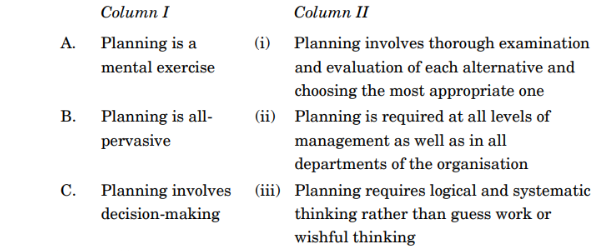
'Managing public opinion of an organisation is an important task performed by the marketing department.' It is included under which of the following element of marketing mix ?
Managing public opinion of an organisation is related to communication and building a favorable image, which falls under the Promotion mix. The Promotion mix includes all activities undertaken to promote the product or the organisation, such as advertising, public relations, and publicity. Product mix, Place mix, and Price mix focus on different aspects like product features, distribution channels, and pricing strategies respectively, and do not directly deal with managing public opinion.
Section B
Ananta Ltd. is a firm manufacturing electronic goods. To increase its sales and earn profits, its General Manager, Kamal is thinking in advance what to do and how to do it. He is also preparing forecasts to reduce the risk of uncertainty and to achieve its targets.
By doing so Kamal is performing an important function of management.
Identify and state the function of management highlighted above. Also state any two points of importance of this function.
(b) Planning means thinking in advance about what to do, how to do it and when to do it. It involves preparing forecasts and setting targets to reduce uncertainty.
(c) Importance of Planning:
1. It provides a clear direction to the activities of the organization, helping to achieve set goals effectively.
2. It helps in identifying potential risks and uncertainties in advance, enabling the firm to prepare and reduce their impact.
Thus, planning is essential to increase sales and earn profits, as shown by Kamal's actions in the firm.
Explain the first two steps in the process of 'controlling' function of management.
(1) Setting Performance Standards: This is the first step in controlling where management sets clear, measurable and achievable standards or benchmarks which serve as the basis for control. These standards can be related to quantity, quality, cost, time or any other performance aspect.
(2) Measuring Actual Performance: After setting standards, the next step is to measure the actual performance of employees or processes. This measurement is done by observing, recording or collecting data on the ongoing activities to find out how well the tasks are being performed compared to the set standards.
Explain any two features of 'directing' function of management.
(a) Guiding and Supervising: Directing involves guiding employees to perform tasks in the best possible way. Managers give instructions, supervise the work to ensure that tasks are done correctly and efficiently.
(b) Motivation: Directing helps to motivate employees by encouraging them, providing incentives, and maintaining a positive work environment. Motivation helps employees to stay focused and achieve organizational goals effectively.
'Burgers and Fudge' was among the first fast food chains in India which pioneered the concept of family-style restaurants. However, over the years it started losing business to multinational food chains like McDonalds and Pizza Hut, etc. and soon had to shut down.
The reason to shut down was the inability of managers to identify, understand, evaluate and to react to the forces external to their firm.
In the light of the above situation, explain with the help of any two points, how understanding of business environment is important for managers.
(a) Understanding business environment helps managers to identify the opportunities and threats in the market. For example, it would have helped 'Burgers and Fudge' to foresee the competition from multinational firms like McDonalds and Pizza Hut and plan their strategies effectively.
(b) It enables managers to adapt to changes such as customer preferences, technology, and economic conditions. If managers of 'Burgers and Fudge' had better understood these external changes, they could have modified their offerings or marketing techniques to retain customers and remain competitive.
Thus, knowledge of the business environment is essential for making informed decisions and ensuring the survival and growth of a business.
State any three benefits of staffing function of management to the organisation.
(c) It also helps in employee development and growth through training and career planning, leading to higher employee satisfaction and retention.
State any three benefits of training to employees.
(a) Improved skills and knowledge: Training provides employees with updated skills and knowledge which help them perform their tasks more efficiently and effectively.
(b) Increased job satisfaction: When employees receive training, they feel valued and confident in their work, which increases their job satisfaction and motivation.
(c) Better career growth: Training helps employees to enhance their qualifications and capabilities, enabling them to seek promotions and grow professionally within the organization.
Section C
Pallavi started a wedding planner company 'Dreams Unlimited' in 2016and her target was to be amongst the top 10 companies in this field within the next three years. For this she employed people having different skills. She worked hard and united the efforts of different people to achieve this goal. The requirements of the customers in this industry changed very fast and the company adapted to keep pace with the changing environment. As planned, the company achieved its target within three years. All the employees of the organisation were happy and satisfied and the effect of management was noticeable in the organisation.
The way Pallavi was managing her business highlights some of the features of management. By quoting lines from the above paragraph, explain any two such features.
(b) Adaptability to Change: The sentence "The requirements of the customers in this industry changed very fast and the company adapted to keep pace with the changing environment" indicates that management is flexible and adapts to changes in the environment to ensure success. This shows that management is dynamic and responsive.
These two features demonstrate how effective management helps an organisation achieve its goals efficiently and successfully.
Explain any two features of ❛motivation❜ as an element of directing function of management.
(a) Psychological Process: Motivation is an internal psychological process that stimulates individuals to act towards achieving their goals. It arises from the needs and desires of employees, thereby encouraging them to perform better.
(b) Goal-Oriented: Motivation is always directed towards achieving specific organizational goals. It aligns the interests of employees with the objectives of the organization, leading to higher productivity and job satisfaction.
Explain the following as elements of communication process :
(i) Message
(ii) Encoding
(iii) Media
(iv) Decoding
(ii) Encoding: Encoding is the process of converting the message into a suitable form such as language, symbols, or signals so that it can be transmitted to the receiver.
(iii) Media: Media refers to the channel or medium through which the encoded message is transmitted from the sender to the receiver. It can be verbal, non-verbal, written, electronic, etc.
(iv) Decoding: Decoding is the process by which the receiver interprets or converts the received message back into meaningful information so that it can be understood.
Explain the following as factors affecting the working capital requirements of a business :
(i) Nature of business
(ii) Credit availed
(ii) Credit availed: Credit availed by a business also influences working capital needs. If a business gets credit from suppliers or lenders, it means it can delay payments, thus reducing the amount of working capital required. Similarly, if the business offers credit to its customers, it increases the working capital demand because cash inflow is delayed. Therefore, more credit availed from suppliers and fewer credits given to customers reduce working capital requirements.
State any four objectives of ❛Securities and Exchange Board of India❜.
1. Protection of Investors: SEBI aims to protect the interests of investors in securities and promote their education and awareness.
2. Regulating the Securities Market: SEBI regulates the activities of stock exchanges, brokers, and other intermediaries to ensure fair and transparent trading.
3. Prevention of Malpractices: SEBI works to prevent fraudulent and unfair trade practices like insider trading and price rigging.
4. Development of the Securities Market: SEBI promotes the development of the securities market to make it efficient, transparent, and competitive.
State any four functions of Stock Exchange.
1. Providing Liquidity: Stock exchanges provide a platform where shares can be easily bought and sold, ensuring liquidity for investors.
2. Price Determination: They help in determining the prices of securities based on supply and demand.
3. Raising Capital: Companies can raise long-term funds by issuing shares and debentures to the public through the stock exchange.
4. Safeguarding Investors Interest: The stock exchange regulates trading and ensures transparency, protecting investors from fraud or malpractice.
Ankush bought a high end microwave on Diwali from a leading electronic store. The microwave had ISI mark and Ankush diligently went through the instruction manual so that he could use it properly. However, due to faulty wiring there was a short-circuit in the microwave. He called up the consumer helpline of the company many times but no solution was provided by the company. Ankush now decided to file a case in the consumer court.
(a) Identify and explain the right which Ankush will exercise.
(b) State two responsibilities which Ankush had fulfilled while purchasing and using the microwave.
(b) The two responsibilities Ankush fulfilled are:
1. He checked the ISI mark on the microwave, which assures quality and safety.
2. He read the instruction manual carefully to use the microwave properly, showing care in usage.
Srijan, after completing his bechelor's degree in culinary arts from a reputed institute, took over his family restaurant specialising in South Indian dishes. This business was promoted by his grandfather many years back in the form of a company. Now he wants to get the restaurant renovated to open a special section for bakery products. It is estimated that an investment of ₹5 crore will be required to execute this plan. At present the cash flow position of the company is not strong and fixed operating costs of business are also high.
Keeping in view the above situation, name with two reasons, the source of finance which Srijan should choose for modernization and expansion of his business. Also explain one more factor, apart from those stated above which Srijan should keep in mind while taking this decision.
Section D
Abhishek studied management principles and techniques of Henri Fayol and F.W. Taylor when he was in class XII. Now he is trying to apply his knowledge while doing his business. By using different techniques and scientifically analysing work he found one best way of doing the job. By removing unproductive movements of the workers he reduces the time to complete the job. Not only this, to increase productivity and to regain stamina he started giving more rest intervals to his employees. He followed no discrimination policy on account of sex, religion, caste, etc. in his organisation. He ensured that the compensation should be fair to both, employees and the organisation.
Identify and explain any two techniques of scientific management and two principles of general management adopted by Abhishek.
1. Time and Motion Study: Abhishek scientifically analysed work and found the best way of doing the job by eliminating unproductive movements of workers which reduced the time to complete the job.
2. Rest Pause System: He gave more rest intervals to his employees to regain their stamina and increase productivity.
(b) Two principles of General Management of Henri Fayol adopted by Abhishek are:
1. Equity: Abhishek followed a no-discrimination policy on the basis of sex, religion, caste, etc., ensuring fairness and justice towards all employees.
2. Remuneration of Personnel: He ensured that compensation was fair to both employees and the organisation, motivating workers and maintaining satisfaction.
Thus, Abhishek effectively applied both scientific management techniques of F.W. Taylor and general management principles of Henri Fayol in his business to improve efficiency and employee welfare.
F.M. Tech Ltd. is one of the leading information technology service provider company in Delhi. To enable smooth functioning of the enterprise, job description and rules and procedures related to work processes are laid down. The company specifies clearly the boundaries of authority and responsibility and there is a systematic co-ordination among the various activities to achieve organisational goals.
(a) Identify and explain the 'Type of organisation' discussed above.
(b) State any two advantages and two limitations of the 'Type of organisation' identified in (a) above.
(b) Advantages of Formal Organisation:
1. Clear authority and responsibility: Since boundaries of authority and responsibility are clearly specified, it helps avoid confusion and conflicts among employees.
2. Systematic Coordination: Organised and formal procedures enable smooth coordination among various departments and employees, leading to better achievement of goals.
Limitations of Formal Organisation:
1. Inflexibility: Formal organisations may become rigid due to strict rules and procedures which can limit creativity and quick decision making.
2. Impersonal Relations: Emphasis on rules and formal authority may reduce personal and informal relationships among employees, affecting morale and teamwork.
Explain the steps in the staffing process of management after ❛Placement and Orientation❜.
After placement and orientation, the staffing process continues with the following important steps:
1. Training and Development: Newly placed employees undergo training to improve their skills and knowledge related to their job roles. Continuous development programs help employees grow professionally and increase their efficiency.
2. Performance Appraisal: This step involves evaluating the performance of employees periodically to assess their progress and identify areas for improvement. It helps management make decisions about promotions, increments, and training needs.
3. Compensation and Benefits: Ensuring employees receive fair compensation and benefits based on their performance and company policies is crucial for motivation and retention.
4. Promotion and Transfer: Based on their performance and organizational needs, employees may be promoted to higher positions or transferred to different departments or locations.
5. Career Planning: Helping employees plan their career paths within the organization encourages long-term growth and loyalty.
6. Maintenance of Employee Relations: Maintaining good relationships through effective communication, conflict resolution, and healthy work environment ensures employee satisfaction and reduces turnover.
These steps collectively ensure that employees remain productive, motivated, and aligned with organizational goals after their placement and orientation.
Explain the steps in the selection process of staffing function of management after ❛Reference and Background checks❜..
After the reference and background checks, the following steps take place in the selection process:
(a) Medical Examination: The candidate is subjected to a medical examination to ensure that he or she is physically and mentally fit for the job. This step helps to confirm that the candidate meets the health requirements of the organization.
(b) Job Offer: Once the candidate passes the medical examination, a formal job offer is made. This offer usually includes details about the position, salary, benefits, joining date, and other important terms and conditions.
(c) Acceptance of Offer: The candidate reviews the job offer and if everything is satisfactory, accepts the offer by signing the appointment letter or contract.
(d) Appointment Letter: After acceptance, the organization issues an appointment letter that officially confirms the employment. It serves as a legal document binding both parties.
(e) Induction and Orientation: The final step is the induction or orientation program where the new employee is introduced to the organization’s policies, culture, colleagues, and job responsibilities. This helps the employee to adjust to the new working environment effectively.
These steps ensure a systematic and fair selection process, leading to the recruitment of the right candidate for the organization.
Explain the following as functions of marketing :
(i) Marketing Planning
(ii) Product Designing and Development
(iii) Standardisation and Grading
(b) Product Designing and Development: This function focuses on creating and improving products to meet customer requirements. It includes designing the product’s features, appearance, quality, and functionality. Effective product design attracts customers and differentiates the product from competitors. Development ensures that the product is feasible and can be produced economically.
(c) Standardisation and Grading: Standardisation means producing goods of uniform quality and features to meet certain standards. Grading involves grouping products into categories based on their quality, size, or other attributes. These functions help customers make informed choices, build trust in the brand, and facilitate easier marketing and distribution.
❛The important product related decisions include decisions about the packaging, labelling and branding of products.❜ Explain these important decisions.
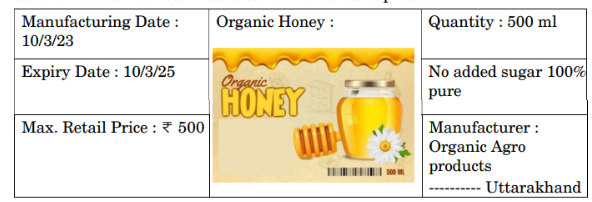
Labeling: Labeling means providing information related to the product on its package. It includes details such as the product name, ingredients, usage instructions, manufacturing date, expiry date, price, and manufacturer details. Labels help consumers make informed decisions and ensure safety and legal compliance.
Branding: Branding is the process of creating a unique name, symbol, or design to identify and differentiate a product from others. It helps build customer loyalty, creates a strong image of the product in the market, and supports marketing and promotional activities. Good branding increases the perceived value and trust in the product.
These decisions are important because they influence customer buying behavior, product recognition, and overall business success.
Paper Details
CBSE Board Exam 2023
Class
Class 12 Commerce
Subject
Business Studies
Year
2023
Set
Set 1
Other Years — Business Studies