SOLUTIONS
2023 BOARD EXAM
CBSE Class 12 Commerce Business Studies Board Paper 2023 — Set 3 Solutions
2023
Business Studies
Class 12 Commerce
CBSE EXAMINATION PAPER-2023
BUSINESS STUDIES
(Solved)
General Instructions :
Read the following instructions carefully and follow them :
- This question paper contains 39 questions. All questions are compulsory.
- This question paper is divided into 4 sections.
- Section A – questions number 1 to 20 are multiple choice questions
- Section B – questions number 21 to 25 are short answer type i
- Section C – questions number 26 to 33 are short answer type ii
- Section D – questions number 34 to 39 are long answer
- There is no overall choice given in the question paper. However, an internal choice has been provided in few questions.
- Use of calculator is NOT allowed.
Section A
Ashita works in a company where her basic task is to integrate diverse elements and co-ordinate the activities of different departments according to the overall objectives of the organisation. At which level of management is Ashita working ?
Ashita's role involves integrating diverse elements and coordinating activities of different departments to achieve the overall objectives of the organisation. This is the primary responsibility of top level management, who focus on setting objectives and integrating activities across the whole company. Middle level and supervisory levels typically focus on implementing strategies within specific departments or supervising day-to-day operations.
Statement I : Financial planning is essentially the preparation of financial blueprint of an organisation's future operations.
Statement II : Financial planning is done only for long-term and focuses on capital expenditure programmes only.
Choose the correct option from the options given below :
Statement I is correct because financial planning involves preparing a financial blueprint that outlines an organization's future financial operations to achieve its objectives. Statement II is incorrect because financial planning is not done only for the long-term nor does it focus solely on capital expenditure; it includes both short-term and long-term planning and covers various aspects like working capital, capital expenditures, and other financial needs.
___________ are detailed statements about a project which outline the objectives, policies, procedures, rules, tasks, budgets, etc. to implement any course of action.
Programmes are comprehensive plans or detailed statements working as a framework for a project, which include objectives, policies, procedures, rules, tasks, budgets, and other elements to implement any course of action effectively. Other options like Procedures and Methods refer to specific sets of steps or techniques, while Budgets are only related to financial planning.
Project 'Nanhi Kali' run by Shivam and Sohan Ltd. was started in 1988 and is one of the largest programmes that enables underprivileged girls to complete 10 years of schooling. The project has impacted the lives of over 5 lakh girls from low income group families across the country.
The objective achieved by Shivam and Sohan Ltd. by doing so is :
The project 'Nanhi Kali' reflects an organizational objective because it is run by Shivam and Sohan Ltd., indicating the company's aim to contribute positively to society. It also fulfills a social objective because it helps underprivileged girls complete their education, thereby promoting social welfare and development. Hence, both organizational and social objectives are achieved.
From the following, identify the Incorrect Statement as per Consumer Protection Act, 2019 :
According to the Consumer Protection Act, 2019, the District Commission and State Commission are constituted by the Central Government in consultation with the State Government, not solely by the State Governments. Therefore, the statement that they are set by the State Governments is incorrect. All other statements are correct: the National Commission has territorial jurisdiction over the whole country, appeal against District Commission orders can be filed in the National Commission, and appeal mechanisms are properly outlined.
Providing job security and pension plan, etc. will satisfy which of the following needs of employees ?
Job security and pension plans are related to the employees' need to feel safe and secure in their employment and future. These fall under Safety or Security needs, which include protection from danger, risk, or deprivation such as job security and financial security after retirement. Belongingness needs are about social connections, Esteem needs are about recognition and respect, and Basic physiological needs relate to fundamental survival requirements such as food and shelter.
With rising pollution levels, consumers are becoming conscious about the harmful effects of polluted air, so the demand for home air-purifiers is increasing day-by-day. Which dimension of business environment is discussed here ?
The question highlights that consumers' awareness and concern about pollution and its effects on health is influencing their buying behavior, leading to increased demand for air-purifiers. This reflects changes in social factors such as lifestyle, attitudes, and values, which are part of the social environment in business. Hence, the correct dimension discussed is the Social Environment.
In advertising 'there is no direct face-to-face contact between the prospect and the advertiser'. The feature of advertising stated here is:
The picture given below depicts important information related to a decision that a marketer has to take in the area of product.
Identify from the following the correct option :
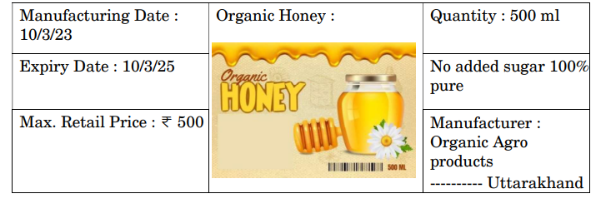
Labelling involves providing important information on the product, which is a crucial decision for marketers in the product area. It helps consumers understand the product details, such as its usage, ingredients, and other necessary information. This distinguishes it from branding and packaging, which focus more on product identity and protection rather than conveying information.
'Managing public opinion of an organisation is an important task performed by the marketing department. It is included under which of the following element of marketing mix ?
Managing public opinion involves activities such as advertising, public relations, and communication with customers to create a positive image of the organisation. These activities are part of the Promotion mix, which focuses on informing and persuading customers about the product or organisation. Therefore, managing public opinion falls under the Promotion mix element of the marketing mix.
Section B
'Burgers and Fudge' was among the first fast food chains in India which pioneered the concept of family-style restaurants. However, over the years it started losing business to multinational food chains like McDonalds and Pizza Hut, etc. and soon had to shut down.
The reason to shut down was the inability of managers to identify, understand, evaluate and to react to the forces external to their firm.
In the light of the above situation, explain with the help of any two points, how understanding of business environment is important for managers.
(a) Helps in identifying opportunities and threats: By understanding the external environment, managers can identify new opportunities for growth and be alert to threats that may harm the business. For example, multinational chains like McDonalds understood changing consumer preferences and adapted quickly, which Burgers and Fudge failed to do.
(b) Facilitates effective decision making: Knowledge of the business environment enables managers to make informed and timely decisions. It helps them react appropriately to changes such as new competitors entering the market or changes in customer tastes. Lack of this understanding can lead to poor strategies and business failure, as with Burgers and Fudge.
Explain any two points that highlight the importance of 'controlling' function of management.
(a) Helps to Achieve Organizational Goals: Controlling ensures that activities are aligned with the planned objectives. It helps in monitoring progress and correcting deviations to achieve goals efficiently.
(b) Improves Efficiency and Reduces Errors: Through controlling, managers can identify any errors or problems early, take corrective actions, and improve the overall efficiency of the organization by avoiding wastage of resources.
Explain 'Supervision' and 'Communication' as elements of 'directing' function of management.
Communication: It is the exchange of information and ideas between managers and employees. Effective communication ensures that instructions and feedback are clearly conveyed and understood, which motivates employees, reduces confusion, and coordinates activities for achieving organizational goals. Both supervision and communication are essential to direct employees and achieve desired results efficiently.
Ananta Ltd. is a firm manufacturing electronic goods. To increase its sales and earn profits, its General Manager, Kamal is thinking in advance what to do and how to do it. He is also preparing forecasts to reduce the risk of uncertainty and to achieve its targets.
By doing so Kamal is performing an important function of management.
Identify and state the function of management highlighted above. Also state any two points of importance of this function.
(b) Explanation: Planning involves thinking in advance about what to do and how to do it. It helps to set objectives and prepare forecasts to reduce uncertainty and take necessary steps to achieve the targets.
(c) Importance of Planning: 1. Planning helps in reducing risks and uncertainties by making forecasts and preparing for future challenges.
2. It provides direction to all the activities, helping the organization to focus on its goals and use resources efficiently.
State any three benefits of staffing function of management to the organisation.
Section C
Srijan, after completing his bechelor's degree in culinary arts from a reputed institute, took over his family restaurant specialising in South Indian dishes. This business was promoted by his grandfather many years back in the form of a company. Now he wants to get the restaurant renovated to open a special section for bakery products. It is estimated
that an investment of ₹ 5 crore will be required to execute this plan. At present the cash flow position of the company is not strong and fixed operating costs of business are also high.
Keeping in view the above situation, name with two reasons, the source of finance which Srijan should choose for modernization and expansion of his business. Also explain one more factor, apart from those stated above which Srijan should keep in mind while taking this decision.
(b) Two reasons for choosing equity shares are:
1. Since the cash flow position is weak, equity shares do not require fixed interest payments, so there is less financial burden.
2. Equity shares help in raising a large amount of capital which is suitable for investment less than 5 crore.
(c) Another factor Srijan should keep in mind is the impact on control of the company. Issuing equity shares may dilute the ownership and control of existing shareholders, so he must consider how much control he is willing to share.
Ankush bought a high end microwave on Diwali from a leading electronic store. The microwave had ISI mark and Ankush diligently went through the instruction manual so that he could use it properly. However, due to faulty wiring there was a short-circuit in the microwave. He called up the consumer helpline of the company many times but no solution was provided by the company. Ankush now decided to file a case in the consumer court.
(a) Identify and explain the right which Ankush will exercise.
(b) State two responsibilities which Ankush had fulfilled while purchasing and using the microwave.
(b) The two responsibilities Ankush fulfilled are:
1. He checked for the ISI mark, which ensures the product's quality and safety.
2. He read the instruction manual carefully to use the microwave properly and safely.
Explain the following as factors affecting the fixed capital requirements of a business :
(i) Nature of business
(ii) Choice of technique
(ii) Choice of technique: The technology or production technique chosen by a business also affects its fixed capital needs. Modern techniques often involve the use of expensive machinery and automation, which increase fixed capital investment. On the other hand, traditional or labor-intensive techniques require less fixed capital but more working capital. Therefore, the decision to adopt capital-intensive or labor-intensive techniques directly influences the amount of fixed capital required in the business.
Differentiate between 'Capital Market' and 'Money Market' on the basis of following:
(i) Instruments
(ii) Investment outlay
(iii) Duration
(iv) Liquidity
(ii) Investment outlay: Capital Market requires a high investment outlay as it involves buying of shares and bonds with larger amounts. Money Market generally requires a lower investment amount since the instruments are short-term and usually safer.
(iii) Duration: Capital Market instruments have a long duration, usually more than one year. Money Market instruments have a short duration, typically less than one year.
(iv) Liquidity: Money Market instruments are highly liquid and easily convertible into cash. Capital Market instruments are less liquid and may take time to sell or convert into cash.
State any four regulatory functions of 'Securities and Exchange Board of India'.
(a) Protecting the Interests of Investors: SEBI ensures that investors are not cheated by companies or brokers and provides guidelines for fair practices.
(b) Regulating Stock Exchanges and Intermediaries: SEBI regulates and supervises stock exchanges, brokers, and other intermediaries to maintain transparency and integrity in the securities market.
(c) Prohibiting Fraudulent and Unfair Practices: SEBI takes action against insider trading, price rigging, and other fraudulent activities to maintain a fair market.
(d) Promoting Development of Securities Market: SEBI helps in developing the securities market by introducing new rules, creating awareness among investors, and encouraging new financial instruments and technology adoption.
Explain any two features of 'motivation' as an element of directing function of management.
(a) Psychological Process: Motivation is a psychological process that stimulates a person to act in a particular way. It arises from the needs and desires of individuals which push them to achieve goals.
(b) Goal-Oriented Behavior: Motivation directs the behavior of employees towards achieving organizational goals. It helps align individual goals with organizational objectives, resulting in increased productivity and job satisfaction.
Explain the following as elements of communication process :
(i) Message
(ii) Encoding
(iii) Media
(iv) Decoding
(ii) Encoding: It is the process of converting the message into symbols, words, pictures or gestures so that it can be sent to the receiver.
(iii) Media: It is the channel or medium through which the encoded message is transmitted from sender to receiver, like telephone, internet, print media, or face-to-face communication.
(iv) Decoding: It is the process by which the receiver interprets or understands the encoded message sent by the sender.
Pallavi started a wedding planner company 'Dreams Unlimited' in 2016 and her target was to be amongst the top 10 companies in this field within the next three years. For this she employed people having different skills. She worked hard and united the efforts of different people to achieve this goal. The requirements of the customers in this industry changed very fast and the company adapted to keep pace with the changing environment. As planned, the company achieved its target within three years. All the employees of the organisation were happy and satisfied and the effect of management was noticeable in the organisation.
The way Pallavi was managing her business highlights some of the features of management. By quoting lines from the above paragraph, explain any two such features.
(b) Management is a Group Effort: She "employed people having different skills" and "united the efforts of different people to achieve this goal." This indicates management involves coordinating the efforts of many people to reach the objectives effectively.
Section D
Abhishek studied management principles and techniques of Henri Fayol and F.W. Taylor when he was in class XII. Now he is trying to apply his knowledge while doing his business. By using different techniques and scientifically analysing work he found one best way of doing the job. By removing unproductive movements of the workers he reduces the time to complete the job. Not only this, to increase productivity and to regain stamina he started giving more rest intervals to his employees. He followed no discrimination policy on account of sex, religion, caste, etc. in his organisation. He ensured that the compensation should be fair to both, employees and the organisation.
Identify and explain any two techniques of scientific management and two principles of general management adopted by Abhishek.
1. Scientific Work Study: Abhishek scientifically analysed the work and found the one best way of doing the job. This means he studied the tasks carefully using time and motion study to improve efficiency.
2. Standardization and Rest Intervals: He removed unproductive movements to reduce time and gave more rest intervals to workers to increase their stamina and productivity. This balance helps maintain consistent performance.
(b) Two principles of General Management adopted by Abhishek:
1. Equity: Abhishek followed a no discrimination policy on the basis of sex, religion, caste, etc. and treated all employees fairly and equally.
2. Fair Compensation: He ensured that remuneration was fair for both employees and the organisation which motivates workers and maintains organisational balance.
Thus, Abhishek applied scientific methods to improve work efficiency and followed important management principles to maintain fairness and motivation among employees.
F.M. Tech Ltd. is one of the leading information technology service provider company in Delhi. To enable smooth functioning of the enterprise, job description and rules and procedures related to work processes are laid down. The company specifies clearly the boundaries of authority and responsibility and there is a systematic co-ordination among the various activities to achieve organisational goals.
(a) Identify and explain the 'Type of organisation' discussed above.
(b) State any two advantages and two limitations of the 'Type of organisation' identified in (a) above.
(b) Advantages of Functional Organisation:
1. Specialization: Employees become experts in their specific functions, enhancing efficiency and productivity.
2. Clarity: Clear roles, responsibilities, and authority reduce confusion and overlap of work.
Limitations of Functional Organisation:
1. Poor Communication: Departments may work in isolation leading to lack of coordination and delay in decision making.
2. Rigidity: Strict departmental boundaries may reduce flexibility and cooperation across functions which can hamper innovation and quick response to changes.
Explain any four semantic barriers to communication.
(a) Language Differences: People speaking different languages or dialects may misinterpret the message because they understand words differently.
(b) Use of Jargon: Specialized or technical language used by experts may not be understood by others, causing confusion.
(c) Ambiguity: When words or phrases have more than one meaning, the receiver may interpret the message differently from the sender's intention.
(d) Overuse of Abstractions: Using abstract words or generalizations that lack specific meaning can make it hard for the receiver to grasp the actual message.
In conclusion, semantic barriers occur when the meaning of words is unclear or interpreted differently, making communication ineffective. To overcome them, clear and simple language should be used and the message must be adapted to the receiver's understanding.
Explain any four merits of internal sources of recruitment.
(a) Cost-effective: Recruiting internally saves money on advertising, recruitment agencies, and other expenses related to external recruitment.
(b) Faster Process: Internal recruitment is quicker because the organization already knows the candidates and there is no need to conduct lengthy interviews and background checks.
(c) Boosts Employee Morale: Providing promotion and transfer opportunities motivates employees, enhances their loyalty, and increases job satisfaction.
(d) Reduces Induction and Training Time: Since internal candidates are already familiar with the company culture and processes, the training and orientation period is shorter, leading to faster productivity.
Explain the following marketing philosophies :
(i) Product Philosophy
(ii) Production Philosophy
(iii) Marketing Philosophy
(b) Production Philosophy: This philosophy emphasizes efficient production and wide distribution. It assumes that customers want products that are affordable and easily available. Companies focus on mass production, low costs, and large-scale distribution to achieve higher sales and profits. This approach works well when demand exceeds supply, but it may neglect product quality and customer preferences.
(c) Marketing Philosophy: This philosophy centers around understanding customer needs and wants. It focuses on creating and delivering value to customers through products and services that satisfy their requirements better than competitors. Marketing philosophy involves market research, customer feedback, and continuous adaptation to customer expectations. It ensures long-term success by building strong customer relationships and delivering satisfaction.
Explain the following as elements of marketing mix :
(i) Product
(ii) Place
(iii) Price
(b) Place : Place means the distribution channels through which the product reaches the customers. It involves selecting the right locations, outlets, warehouses, and logistics to ensure the product is available conveniently to the target market. Effective placement helps in making the product accessible, increasing sales and customer satisfaction.
(c) Price : Price is the amount of money a customer pays to purchase the product. It is a crucial element as it affects demand, profitability, and perceived value of the product. Factors like cost of production, competition, customer willingness, and market conditions influence pricing decisions. A right price strategy balances attracting customers and earning profit.
Paper Details
CBSE Board Exam 2023
Class
Class 12 Commerce
Subject
Business Studies
Year
2023
Set
Set 3
Other Years — Business Studies