SOLUTIONS
2023 BOARD EXAM
CBSE Class 12 Commerce Business Studies Board Paper 2023 — Set 2 Solutions
2023
Business Studies
Class 12 Commerce
CBSE EXAMINATION PAPER-2023
BUSINESS STUDIES
(Solved)
General Instructions :
Read the following instructions carefully and follow them :
- This question paper contains 40 questions. All questions are compulsory.
- This question paper is divided into 4 sections.
- Section A – questions number 1 to 20 are multiple choice questions
- Section B – questions number 21 to 26 are short answer type i
- Section C – questions number 27 to 34 are short answer type ii
- Section D – questions number 35 to 40 are long answer
- There is no overall choice given in the question paper. However, an internal choice has been provided in few questions.
- Use of calculator is NOT allowed.
Section A
Statement I : Financial planning is essentially the preparation of financial blueprint of an organisation's future operations.
Statement II : Financial planning is done only for long-term and focuses on capital expenditure programmes only.
Choose the correct option from the options given below :
Statement I is correct because financial planning involves preparing a detailed financial blueprint or plan that outlines the organization's future financial activities to achieve its goals. Statement II is incorrect because financial planning is not limited only to long-term plans or capital expenditure; it also includes short-term financial planning and operational expenditure, covering all aspects of financial management.
___________ provides the prescribed ways or manner in which a task has to be performed, considering the objective.
Project ❛Nanhi Kali❜ run by Shivam and Sohan Ltd. was started in 1998 and is one of the largest programmes that enables underprivileged girls to complete 10 years of schooling. The project has impacted the lives of over 5 lakh girls from low income group families across the country. The objective achieved by Shivam and Sohan Ltd. by doing so is :
From the following, identify the Incorrect Statement as per Consumer Protection Act, 2019 :
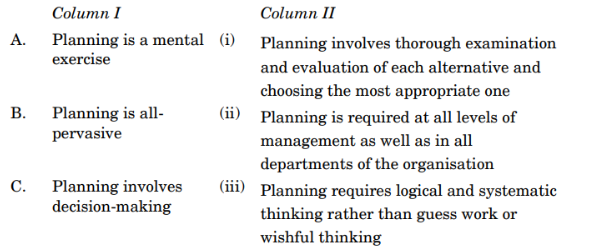
Providing job security and pension plan, etc. will satisfy which of the following needs of employees ?
Job security and pension plans are closely related to an employee's need for safety and security. According to Maslow's hierarchy of needs, safety needs include protection from harm and financial security, which are fulfilled by job stability and future financial benefits like pensions.
The picture given below depicts important information related to a decision that a marketer has to take in the area of product.
Identify from the following the correct option :
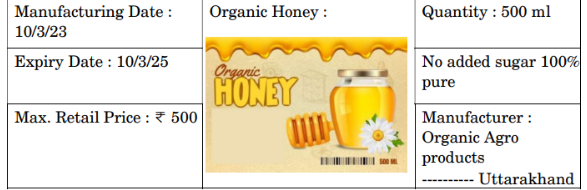
Packaging is a key decision in the area of product marketing because it involves designing and producing the container or wrapping for a product that protects it, facilitates its use, and appeals to the consumer. It differentiates the product and communicates important information, which aligns with the description of important information related to a marketing decision.
❛Managing public opinion of an organisation is an important task performed by the marketing department❜ It is included under which of the following element of marketing mix ?
Managing public opinion of an organisation is related to communication and creating a positive image about the company. This activity falls under the 'Promotion mix' element of the marketing mix, which focuses on promoting the product and the organisation through advertising, public relations, sales promotion, and personal selling.
Section B
'Burgers and Fudge' was among the first fast food chains in India which pioneered the concept of family-style restaurants. However, over the years it started losing business to multinational food chains like McDonalds and Pizza Hut, etc. and soon had to shut down.
The reason to shut down was the inability of managers to identify, understand, evaluate and to react to the forces external to their firm.
In the light of the above situation, explain with the help of any two points, how understanding of business environment is important for managers.
(a) Helps in Identifying Opportunities and Threats: By analyzing external forces like competition, government policies, and customer preferences, managers can identify new opportunities to grow the business and prepare for potential threats. For example, knowing the entry of multinational fast food chains could have helped 'Burgers and Fudge' to strategize better.
(b) Aids in Making Informed Decisions: Knowledge of the business environment enables managers to make well-informed and timely decisions. Understanding factors such as economic conditions, technology changes, and social trends helps managers react quickly to changes and adapt their strategies accordingly to stay competitive.
Explain any three points that highlight the relationship between 'planning' and 'controlling function of management.
Explain any two points of importance of 'directing' function of management.
(a) Guidance and Leadership: Directing provides proper guidance and leadership to employees. It helps in guiding the efforts of employees towards achieving organizational goals efficiently and effectively.
(b) Motivation to Employees: Through directing, managers motivate employees to perform better. It involves inspiring and encouraging employees to give their best, which increases productivity and job satisfaction.
State any three benefits of 'staffing' function of management to the organisation.
(a) Right People at Right Place: Staffing ensures that the organisation has the right number of employees with the right skills for various jobs, which increases efficiency and productivity.
(b) Effective Utilisation of Human Resources: Staffing helps in proper recruitment, selection, training, and placement of employees, so their abilities are fully utilised for organisational growth.
(c) Improved Employee Motivation: Through appropriate staffing, employees get clarity on their roles and responsibilities which enhances job satisfaction and reduces turnover, benefiting the organisation overall.
State any three benefits of training to employees.
(a) Skill Development: Training helps employees improve their skills and gain new knowledge, making them more efficient in their work.
(b) Better Performance: With proper training, employees can perform their tasks more effectively and contribute to the success of the organisation.
(c) Increased Confidence: Training boosts employees' confidence by making them familiar with their job roles and responsibilities, leading to more job satisfaction.
Ananta Ltd. is a firm manufacturing electronic goods. To increase its sales and earn profits, its General Manager, Kamal is thinking in advance what to do and how to do it. He is also preparing forecasts to reduce the risk of uncertainty and to achieve its targets.
By doing so Kamal is performing an important function of management.
Identify and state the function of management highlighted above. Also state any two points of importance of this function.
(b) Planning means thinking in advance about what is to be done and how it is to be done. It involves preparing forecasts and deciding the best course of action to achieve the goals of the organisation.
(c) Importance of Planning:
1. Planning helps to reduce the risk of uncertainty by preparing for future situations.
2. It helps in setting clear objectives and directing all efforts towards achieving them, thus increasing the chances of success.
Section C
Ankush bought a high end microwave on Diwali from a leading electronic store. The microwave had ISI mark and Ankush diligently went through the instruction manual so that he could use it properly. However, due to faulty wiring there was a short-circuit in the microwave. He called up the consumer helpline of the company many times but no solution was provided by the company. Ankush now decided to file a case in the consumer court.
(a) Identify and explain the right which Ankush will exercise.
(b) State two responsibilities which Ankush had fulfilled while purchasing and using the microwave.
(b) Two responsibilities Ankush fulfilled are:
1. He checked for the ISI mark, which ensures the product meets quality standards.
2. He read the instruction manual carefully to use the microwave properly, showing he used the product responsibly as per the guidelines provided.
Srijan, after completing his bechelor's degree in culinary arts from a reputed institute, took over his family restaurant specialising in South Indian dishes. This business was promoted by his grandfather many years back in the form of a company. Now he wants to get the restaurant renovated to open a special section for bakery products. It is estimated
that an investment of ₹ 5 crore will be required to execute this plan. At present the cash flow position of the company is not strong and fixed operating costs of business are also high.
Keeping in view the above situation, name with two reasons, the source of finance which Srijan should choose for modernization and expansion of his business. Also explain one more factor, apart from those stated above which Srijan should keep in mind while taking this decision.
Explain the following as factors affecting the working capital requirements of a business :
(i) Business cycle
(ii) Operating efficiency
(ii) Operating efficiency: Operating efficiency is how well a business manages its operations including production, inventory, and receivables. Higher operating efficiency means faster turnover of inventory and receivables, leading to lower working capital requirements. Poor efficiency causes more cash to be tied up in stocks and debtors, increasing working capital needs.
State any four points to difference between 'Primary Market' and 'Secondary Market.'
1. In the Primary Market, new securities are issued and sold for the first time to investors, whereas in the Secondary Market, existing securities are traded among investors.
2. The Primary Market helps companies to raise fresh capital, but the Secondary Market provides liquidity to investors by allowing them to buy and sell securities.
3. Transactions in the Primary Market happen directly between the issuer and investors, while in the Secondary Market, trading occurs between investors on stock exchanges or over-the-counter.
4. Prices of securities in the Primary Market are fixed by the issuer, but in the Secondary Market, prices fluctuate based on supply and demand.
State any four protective functions of 'Securities and Exchange Board of India'.
1. Protecting Investors: SEBI safeguards the interests of investors by regulating the securities market and preventing malpractices.
2. Preventing Fraud and Malpractices: It controls and prohibits fraudulent and unfair trade practices to ensure a fair market.
3. Regulating Stock Exchanges: SEBI regulates stock exchanges to ensure transparent and efficient operations.
4. Promoting Investor Education: It conducts investor awareness programs to educate investors about their rights and duties in the securities market.
Pallavi started a wedding planner company 'Dreams Unlimited' in 2026 and her target was to be amongst the top 10 companies in this field within the next three years. For this she employed people having different skills. She worked hard and united the efforts of different people to achieve this goal. The requirements of the customers in this industry changed very fast and the company adapted to keep pace with the changing environment. As planned, the company achieved its target within three years. All the employees of the organisation were happy and satisfied and the effect of management was noticeable in the organisation.
The way Pallavi was managing her business highlights some of the features of management. By quoting lines from the above paragraph, explain any two such features.
(b) Management is dynamic: Management must adapt to the changing environment. The paragraph states, "The requirements of the customers in this industry changed very fast and the company adapted to keep pace with the changing environment." This shows that management continuously changes its strategies according to the external environment to stay successful.
Explain any two features of 'motivation' as an element of directing function of management.
(a) Psychological Process: Motivation is a psychological process that stimulates a person to act in a desired way. It involves internal desire and willingness of employees to perform tasks efficiently.
(b) Goal Oriented: Motivation is aimed at achieving organizational goals. It aligns individual needs with organizational objectives, encouraging employees to contribute effectively towards common aims.
Explain the following as elements of communication process :
(i) Message
(ii) Encoding
(iii) Media
(iv) Decoding
(ii) Encoding: It is the process of converting the message into symbols, words, pictures, or gestures that can be understood by the receiver.
(iii) Media: It refers to the channel or medium used to transmit the encoded message from the sender to the receiver, such as face-to-face talk, telephone, letters, or electronic media.
(iv) Decoding: It is the process by which the receiver interprets or makes sense of the encoded message and understands the information conveyed by the sender.
Section D
F.M. Tech Ltd. is one of the leading information technology service provider company in Delhi. To enable smooth functioning of the enterprise, job description and rules and procedures related to work processes are laid down. The company specifies clearly the boundaries of authority and responsibility and there is a systematic co-ordination among the various activities to achieve organisational goals.
(a) Identify and explain the 'Type of organisation' discussed above.
(b) State any two advantages and two limitations of 'Type of organisation' identified in (a) above.
(b) Advantages of Formal Organisation:
1. Clear authority and responsibility: Everyone knows what is expected of them, which helps in reducing confusion and improving efficiency.
2. Systematic coordination: It ensures proper coordination among activities and departments, leading to the achievement of organisational goals.
Limitations of Formal Organisation:
1. Rigidity: Strict rules and procedures can reduce flexibility and creativity among employees.
2. May ignore informal relationships: It often overlooks informal communication and bonds that exist among employees which can sometimes affect morale and work environment.
Abhishek studied management principles and techniques of Henri Fayol and F.W. Taylor when he was in class XII. Now he is trying to apply his knowledge while doing his business. By using different techniques and scientifically analysing work he found one best way of doing the job. By removing unproductive movements of the workers he reduces the time to complete the job. Not only this, to increase productivity and to regain stamina he started giving more rest intervals to his employees. He followed no discrimination policy on account of sex, religion, caste, etc. in his organisation. He ensured that the compensation should be fair to both, employees and the organisation.
Identify and explain any two techniques of scientific management and two principles of general management adopted by Abhishek.
1. Scientific Analysis of Work: Abhishek scientifically analysed the work by studying different methods and selecting one best way of doing the job. This technique is about finding the most efficient method to perform tasks.
2. Motion Study: He removed unproductive movements of workers to reduce the time to complete the job. This technique involves identifying and eliminating unnecessary motions to increase efficiency.
(b) Two principles of General Management of Henri Fayol followed by Abhishek:
1. Equity: Abhishek maintained fairness by following no discrimination policy based on sex, religion, or caste. Equity means fair treatment to all employees.
2. Remuneration: He ensured that the compensation given was fair to both employees and the organization. This principle emphasizes fair and adequate payment for work done to motivate employees properly.
Explain any four psychological barriers of communication.
(a) Prejudices: When a person holds preconceived opinions or biases about others, it affects how they interpret messages, often leading to misunderstanding.
(b) Emotional State: Emotions like anger, sadness, or excitement can distort the meaning of messages or reduce the ability to listen attentively.
(c) Assumptions: Assuming information without verifying leads to miscommunication because the receiver may not receive the correct message intended.
(d) Lack of Confidence: A person who lacks confidence might fail to express ideas clearly or misunderstand messages due to hesitation or anxiety.
These psychological factors create barriers that block the clear flow of communication, resulting in confusion and conflict. Recognizing and managing these barriers helps improve effective communication.
Explain any four merits of external sources of recruitment.
(1) Larger Talent Pool: External recruitment opens up access to a wider and more diverse group of candidates, increasing the chances of finding highly skilled and suitable individuals.
(2) New Ideas and Perspectives: Hiring from outside the organization brings fresh ideas, new approaches, and different perspectives that can contribute to innovation and improve organizational performance.
(3) Faster Filling of Vacancies: When internal sources are limited, external recruitment helps fill vacancies more quickly by casting a wider net and attracting ready-to-join candidates.
(4) Specialized Skills Availability: Sometimes, the required skills or expertise are not available within the company. External recruitment helps find candidates with the specific qualifications and experience needed for certain roles.
Overall, external recruitment enhances the quality and diversity of the workforce and helps the organization grow and adapt to changing demands.
Explain the following as functions of marketing :
(i) Gathering and analysing market information
(ii) Customer support services
(iii) Pricing of product
This function involves collecting data about customers, competitors and market trends. It helps businesses understand the needs and preferences of customers and identify new opportunities. Analysing this information allows companies to make informed decisions about product development, marketing strategies and sales approaches.
(ii) Customer support services
This function focuses on assisting customers after they have purchased a product or service. It includes services such as installation, maintenance, complaint handling, and providing information. Good customer support increases customer satisfaction and loyalty, leading to repeat purchases and positive word-of-mouth.
(iii) Pricing of product
This involves deciding the right price for a product based on costs, competition, customer demand and perceived value. Pricing affects sales volume and profitability. Setting the right price is essential to attract customers while ensuring the company makes adequate profit. Pricing strategies can include discounting, premium pricing, and competitive pricing among others.
Explain the following as components of Physical Distribution :
(i) Order Processing
(ii) Transportation
(iii) Warehousing
(i) Order Processing: This is the first step in physical distribution. It involves receiving, handling, and fulfilling customer orders promptly and accurately. Efficient order processing ensures that the right product reaches the right customer at the right time. It includes activities such as order entry, order confirmation, inventory checking, and dispatch planning.
(ii) Transportation: Transportation is the movement of goods from the point of production to the point of consumption. It plays a critical role in physical distribution as it affects the speed and cost of delivery. Common modes of transportation include roadways, railways, airways, and waterways. Proper transportation management helps in reducing delivery time and damage to goods.
(iii) Warehousing: Warehousing means the storage of goods at a place to ensure their availability when needed. It acts as a buffer between production and consumption. Warehouses help in maintaining sufficient stock and protecting goods from damage or theft. They also facilitate sorting, packing, and managing inventory effectively.
In conclusion, order processing, transportation, and warehousing are essential components of physical distribution that work together to ensure timely and safe delivery of products to customers.
Paper Details
CBSE Board Exam 2023
Class
Class 12 Commerce
Subject
Business Studies
Year
2023
Set
Set 2
Other Years — Business Studies