SOLUTIONS
2024 BOARD EXAM
CBSE Class 12 Commerce Business Studies Board Paper 2024 — Set 1 Solutions
2024
Business Studies
Class 12 Commerce
CBSE EXAMINATION PAPER-2024
BUSINESS STUDIES
(Solved)
General Instructions :
Read the following instructions carefully and follow them :
- This question paper contains 40 questions. All questions are compulsory.
- This question paper is divided into 4 sections.
- Section A – questions number 1 to 20 are multiple choice questions
- Section B – questions number 21 to 26 are short answer type i
- Section C – questions number 27 to 34 are short answer type ii
- Section D – questions number 35 to 40 are long answer
- There is no overall choice given in the question paper. However, an internal choice has been provided in few questions.
- Use of calculator is NOT allowed.
Section A
The level(s) of packaging shown in the picture given below is/are :

Packaging typically involves three levels: primary packaging which directly holds the product, secondary packaging which groups primary packages together for sale or handling, and transportation packaging which ensures safe distribution and handling during transit. Since the picture shows all these levels, the correct answer is 'Primary, secondary and transportation packaging levels'.
Aparna and Priyanka are working in ‘Shreya Industries’, a company dealing in readymade garments for women. Each of them was assigned the responsibility of producing 10 dresses each within 5 days at a cost of ₹ 1,000 per dress. Aparna was able to produce 10 dresses at a cost of ₹ 1,100 per dress within 5 days, whereas Priyanka was able to produce only 8 dresses at a cost of ₹ 900 per dress in 5 days. Which of the following statements is correct with respect to the above ?
Effectiveness is about completing the assigned task or achieving the desired goal. Aparna produced all 10 dresses as assigned, so she is effective. Efficiency is about producing with minimum cost or resources. Priyanka produced 8 dresses (less than assigned), but at a lower cost per dress (₹900 instead of ₹1,000), indicating she used resources more efficiently. Hence, Aparna is effective (completed the target) but Priyanka is efficient (used fewer resources per dress).
Which of the following options denotes the correct sequence of steps in the process of ‘Organizing’ function of management ?
The correct sequence of steps in the 'Organizing' function of management begins with Identification and division of work, where the total work is divided into smaller tasks. Next is Departmentalisation, grouping the divided tasks into departments based on similarity or function. Then comes Assignment of duties, where duties are assigned to individuals or teams. Finally, Establishing authority and reporting relationships determines who has authority and establishes the chain of command, ensuring coordination and control.
‘If there is a fixed place for everything and it is present there, then there will be no hindrance in the activities of business/factory.’ The principle of management that is highlighted in the above statement is :
Statement I : As per the Consumer Protection Act, 2019, the District Commission has a jurisdiction to entertain complaints where value of goods or services paid as consideration does not exceed ₹ 10 crores.
Statement II : If any of the parties is not satisfied by the order of the District Commission, they can appeal against such order to the State Commission on the grounds of facts or law within a period of forty-five days from the date of order.
Choose the correct option from the following :
According to the Consumer Protection Act, 2019, the District Commission entertains complaints where the value of goods or services does not exceed ₹ 1 crore, not ₹ 10 crores. The State Commission has jurisdiction for complaints where the value exceeds ₹ 1 crore but does not exceed ₹ 10 crores. Also, if any party is not satisfied with the order of the District Commission, they can appeal to the State Commission within 45 days on grounds of fact or law. Therefore, Statement I is incorrect while Statement II is correct.
‘V.K. Public School’ had a vacancy for an English teacher for Class XII. After preliminary screening of the applications, they shortlisted 10 candidates. Now, the school management asked the candidates to give a demonstration lesson related to the curriculum of Class XII. The purpose of these demonstration lessons was to measure the existing teaching skills of the candidates and proficiency in the area of profession. Identify the type of selection test used by ‘V.K. Public School’ in the above case :
Which of the following statements is correct for ‘short term investment decisions’ ?
Short term investment decisions are concerned with managing current assets and liabilities, which directly impact the liquidity and profitability of the business. They usually involve smaller amounts of investment compared to long-term decisions and are reversible. Therefore, the option stating that these decisions affect liquidity as well as profitability is correct.
‘The management should not close its ears to any constructive suggestions made by the employees but reward them for their suggestions which results in substantial reduction in costs.’
Which principle of scientific management is discussed in the above statement ?
The principle 'Cooperation, Not Individualism' emphasizes that management and workers should work together harmoniously. The statement highlights that management should encourage and reward employees for their constructive suggestions, reflecting cooperation rather than working individually or in conflict.
Statement I : Shareholders’ funds involve commitment regarding the payment of returns or the repayment of capital.
Statement II : Debt is considered to be the cheapest of all the sources of funds and tax deductability of interest makes it still cheaper.
Choose the correct option from the following :
Statement I is false because shareholders' funds (equity capital) do not involve any legal commitment to pay returns (dividends) or repay capital; dividends are paid only out of profits and repayment of capital is done on liquidation or buyback. Statement II is true because debt is generally the cheapest source of funds due to lower risk compared to equity, and interest paid on debt is tax-deductible, which reduces the effective cost of debt financing.
Prakhar Ltd. is the manufacturer of life-saving drugs. There was an outbreak of flu two years back that spread quickly and affected many people. Prakhar Ltd. made huge investment on research and development and was able to develop a medicine for the same. The medicine was very effective in controlling the flu and now it has become a necessity for the patients. As a result, the demand for the medicine increased manifold. Considering the demand, the company increased the price of the medicine. The government observed the situation. Since it was the only available medicine to combat flu, the Government declared it as an essential medicine and regulated its price to make it affordable for the public. From the following, identify the factor(s) affecting the determination of price discussed in the above case : (i) Product cost (ii) Marketing methods used (iii) Utility and demand (iv) Government and legal regulations
The case mentions that Prakhar Ltd. made huge investment in research and development, indicating product cost affects price. The demand for the medicine increased greatly due to its utility in controlling flu, so utility and demand affect the price. Later, the government regulated the price as it is an essential medicine, representing government and legal regulations influence on price. Marketing methods are not mentioned, so option (i), (iii) and (iv) is correct.
Techpack Ltd. is a company in Hyderabad that produces and sells packaging material to various industries across the nation in a B2B e-business form. It is a dynamic company. Over the years, due to rising concerns for climate change and shift of preferences of Indian customers towards environment-friendly products, the company has shifted to the production of biodegradable packaging material. Moreover, due to its digital transformation, the company has tremendously benefited as its customers could place orders and make cashless payments in various online modes. The dimensions of business environment discussed in the above case are :
The case highlights the shift in customer preferences towards environment-friendly products, which relates to the social environment dimension. It also mentions digital transformation and online orders and payments, which relate to the technological environment. Hence, the correct answer is 'Social and technological environments'.
Read the following statements : Assertion (A) and Reason (R). Choose the correct alternative from theoptions given below :
Assertion (A) : While taking dividend decision, the extent of retained earnings also influences the financing decision of the firm.
Reason (R) : The firm does not require funds to the extent of re-invested retained earnings.
The assertion is true because the dividend decision directly impacts the amount of retained earnings that remain within the firm. These retained earnings reduce the need for external financing, hence influencing the financing decision. The reason is also true because funds that are retained (not paid out as dividends) are reinvested in the firm, thus eliminating the need to raise that amount from external sources. Therefore, Reason (R) correctly explains Assertion (A).
Ashok Industries Ltd. is a company manufacturing components for automobile industries. In this company, standards have been set for every manufacturing activity including standardisation of process, raw material, time, product, machinery and methods which must be adhered to during production. This has been done to bring excellence in quality of the materials produced. The foreman of the company, Mehra, has designed the jobs of the workers in such a manner that unnecessary movements are eliminated and it takes less time to complete the jobs efficiently. He has also scientifically analysed the duration and frequency of rest intervals that should be provided to the workers in the factory so that they can regain stamina and work efficiently. Out of the following, which technique of scientific management has not been discussed in the above paragraph ?
In T-pex Ltd, a company trading in stationery items, it was decided that all purchases would be made from AK Ltd. on credit basis with credit period of at least 7 days. This was done because no other company was offering credit facility. Which type of plan has been referred to in the above paragraph ?
Match the explanation of different sources of external recruitment given in Column I with the sources given in Column II. Choose the correct option from the following :
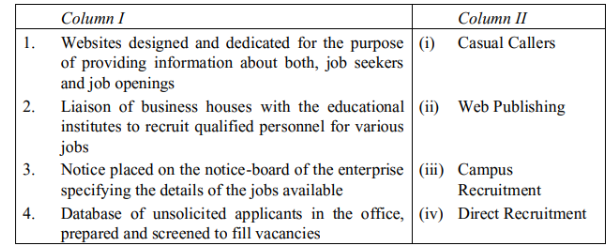
The correct matching is 1-(ii), 2-(iii), 3-(iv), 4-(i) because each source of external recruitment corresponds to its explanation in Column I as follows: (ii) refers to a specific explanation that matches source 1, (iii) corresponds to source 2, (iv) corresponds to source 3, and (i) corresponds to source 4. This matching aligns with the logical definitions or typical characteristics of various external recruitment sources.
Section B
A popular magazine published an article on job cuts across the globe. It stated that due to reasons like cost cutting, market conditions and technological advancement, almost two lakh people in the IT sector have lost their jobs during the last year. This was read and discussed by employees of Techwire Ltd. a software development company in India. It created a lot of unrest among them and their morale came down. The productivity of the employees started declining. The Chief Executive Officer of the company observed the insecurity among the staff about their jobs. Understanding his role as the leader, he wrote an e-mail to all the employees assuring them about the stability of their future income and job.
This communication gave the employees psychological and emotional satisfaction and showed positive results in terms of their performance. The Chief Executive Officer was able to make the subordinates act in a desired manner to achieve the organizational goals, without giving them any monetary incentives.
(i) Identify and explain the incentive used by the Chief Executive Officer to improve the performance of the employees.
(ii) State the need of the employees as per Maslow’s Hierarchy of Needs theory which was satisfied in the above case.
(ii) As per Maslow's Hierarchy of Needs theory, the need satisfied in this case was the safety need. Safety needs include job security, financial stability, and safe working conditions. The CEO's assurance fulfilled the employees' safety need by removing their fear of losing jobs and providing them a sense of stability and security at the workplace.
Explain ‘Democratic (Participative) style of leadership'.
In this style, communication flows in all directions and the leader acts more as a facilitator than a commander. It helps in developing trust, promoting creativity, and improving group satisfaction.
However, decision-making may take longer due to consultations, but the outcomes are generally more accepted by the group. This style is useful in environments where collaboration and employee engagement are important.
‘An intelligent manager should make use of positive aspects of informal channels and minimise the use of negative aspects of this channel of communication.’
In the light of the above statement, explain any one positive and any two negative aspects of informal channels of communication.
(b) Two negative aspects of informal channels are: (1) It can lead to the spread of rumors and misinformation, which can cause confusion and damage to the reputation of the organization. (2) It may create misunderstandings and conflicts among employees if incorrect or sensitive information is shared without proper verification.
Dhiren Patel is the Chief Executive Officer of a milk processing company. He is a very effective manager. He is quite organized in his work and exhibits exemplary behaviour. Dhiren Patel insists that all managers and subordinates in the organization should follow a chain of authority that runs from top to bottom for all communication purposes. Identify and explain the general principle of management highlighted in the above case.
Explanation: Unity of Command means that each employee should receive orders from only one superior to avoid confusion and conflict. This ensures clear communication and accountability. The Scalar Chain refers to a clear line of authority from the top management to the lowest ranks in an organization. Dhiren Patel insists that all managers and subordinates follow a chain of authority from top to bottom to maintain discipline and effective communication. This helps in proper coordination and smooth functioning of the organization. Thus, by enforcing these principles, he manages the company efficiently and in an organized manner.
State any three factors affecting financing decision.
(a) Cost of Capital: It is important to consider the cost of various sources of finance. The financing decision aims to choose the source with the lowest cost.
(b) Risk Factor: Different sources of finance have different risk levels. A business must evaluate the risk involved in using debt or equity.
(c) Financial Flexibility: A company should maintain flexibility to raise funds in the future. Financing decisions should not limit future borrowing capacity.
State any three protective functions of Securities and Exchange Board of India.
(a) SEBI protects investors by regulating and supervising the securities market to prevent fraudulent activities and unfair trade practices.
(b) It ensures that companies disclose all necessary information to investors so that they can make informed decisions.
(c) SEBI controls insider trading and makes sure that no one takes undue advantage of private information, thus safeguarding investors' interests.
Section C
Ishaan wanted to buy five litres of mustard oil. Before he went to the market, he surfed the Internet to find out about the various brands of mustard oil available in the market. On visiting the retail shop, he could find five different brands of mustard oil but to his surprise, only one of them had ‘FSSAI’ certification mark, which he decided to buy. He read the label on the oil container to find out the price and weight of the oil. While paying for the oil he ensured that the cashier gave him the cash memo.
Ishaan was a responsible consumer. State any four responsibilities that Ishaan kept in mind while purchasing the mustard oil.
(a) He gathered information about different brands by surfing the Internet, which shows that he did research before buying.
(b) He chose the product with the FSSAI certification mark, ensuring the quality and safety of the oil.
(c) He carefully checked the label on the container to know the price and weight, showing that he was aware of product details.
(d) He ensured that the cashier gave him the cash memo, which is important for future reference or in case of any complaint.
These steps show that Ishaan was a well-informed and responsible consumer who made safe and smart choices.
Anmol Pathak, a restaurant owner, observed that over a period of one year, the costs of raw material, transportation and packaging had increased. As a result the total cost had increased by 15%. He thought that it was not easy to keep a check on each and every activity in the organisation, so he decided to study deeply the increase in these three costs. He prepared a table of acceptable and actual increase in cost as given below :
Explain the two concepts related to a function of management that will be used by Anmol Pathak to analyse the deviations.
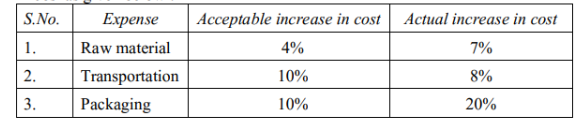
1. Standard or Planned Performance: This refers to the acceptable level of cost or expected increase set as a benchmark. Anmol prepared a table showing acceptable increase in costs of raw material, transportation and packaging. This helps in planning and setting standards to compare actual performance.
2. Measurement and Comparison of Actual Performance: After actual cost increases are recorded, these are compared with the planned or acceptable increases. Deviations or differences between actual and standard values are analysed to find causes of variation.
By using these two concepts, Anmol can identify areas where cost exceeds acceptable limits and take corrective actions to control the expenses effectively.
Give the meaning of Capital Market. Distinguish between Capital Market and Money Market on the basis of the following :
(i) Participants
(ii) Duration
(iii) Investment outlay
Difference between Capital Market and Money Market:
(i) Participants: Capital Market includes investors like individuals, companies, mutual funds, and financial institutions. Money Market involves banks, financial institutions, corporations, and governments.
(ii) Duration: Capital Market deals with long-term securities usually with maturity more than one year. Money Market deals with short-term instruments with maturity up to one year.
(iii) Investment Outlay: Investments in Capital Market are generally large and long-term whereas Money Market investments are shorter duration and often involve smaller amounts compared to Capital Market.
Explain any four points of importance of ‘Controlling’ function of management.
(a) Helps in Achieving Goals: Controlling ensures that activities are performed according to the plans and helps in achieving organizational goals efficiently.
(b) Facilitates Coordination: It helps in coordinating different departments and activities by monitoring performance and taking corrective actions.
(c) Improves Efficiency: Controlling identifies deviations from standards and helps in correcting them, thereby enhancing efficiency.
(d) Reduces Costs and Wastage: By monitoring resources and performance regularly, controlling minimizes wastage and controls costs.
Explain the relationship between ‘Planning’ and ‘Controlling’ with the help of any four points.
1. Planning sets the standards: Planning involves setting objectives and deciding the course of action. These form the standards against which actual performance is measured in the controlling process.
2. Controlling follows planning: Controlling is performed after planning has been done as it checks whether the plans are being followed and goals are achieved.
3. Planning provides direction to controlling: Without planning, controlling can become ineffective as there would be no benchmarks or standards to compare actual results.
4. Controlling ensures planning is effective: Controlling helps identify deviations from the plan and enables corrective actions, ensuring that planning achieves its intended objectives.
Thus, both are closely related management functions that complement each other in the process of achieving organizational goals.
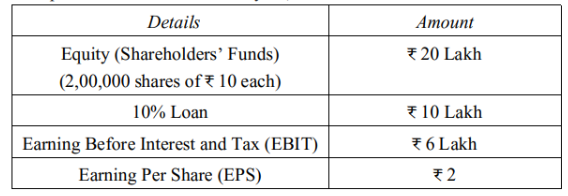
Silk Ltd. had an EPS of ₹ 1. It raised a loan of ₹ 10 lakhs at an interest rate of 10% p.a. from a bank. After one year, the results were as follows :
Tax rate 20%.
(i) Why did EPS in Silk Ltd. rise with the use of debt ?
(ii) If EBIT of the company would have been ₹ 3 lakh, would using debt still be favourable for the company ? Explain.
Explain the following methods of training :
(i) Vestibule training
(ii) Internship training
(ii) Internship Training: Internship training involves placing students or trainees in an organization for a fixed period to gain practical experience. Interns work under supervision on real projects or tasks, developing their skills and understanding of the job. It provides hands-on learning and exposure to the work environment, improving employability.
Explain any four features of ‘Directing’ function of management.
(a) Leadership: Directing involves influencing and motivating employees to perform their tasks effectively.
(b) Communication: It ensures clear communication between managers and employees to avoid misunderstandings and improve coordination.
(c) Motivation: It involves encouraging and inspiring employees through rewards and recognition to enhance their performance.
(d) Supervision: Directing includes overseeing the work of employees to ensure tasks are completed correctly and on time.
Section D
BJ Pvt. Ltd. is a company manufacturing organic shampoos with the brand name ‘Pure Shine’. This name will help the company in creating product differentiation. To satisfy the needs of the customers in the target market the company used natural ingredients like curry leaves, neem, rice, etc. The focus of the company is on satisfaction of customers needs. To have higher demand of shampoo it decided to fix a lower price in comparison to the other shampoos available in the market. To inform the customers about the shampoo and its features etc., the company used various promotional tools. For maximum satisfaction of customers, the company provides the contact details of the customer care centre to handle customer complaints.
Identify and explain any three functions of marketing discussed in the above paragraph.
(b) Pricing Function: The company fixes a lower price than competitors to increase demand. This pricing strategy makes the product affordable and attractive to customers in the target market.
(c) Promotion Function: Various promotional tools are used to inform customers about the shampoo and its features. Promotion helps in creating awareness and attracting customers.
(d) Customer Service Function: By providing contact details for a customer care centre, the company handles complaints effectively. This ensures customer satisfaction and builds trust.
Explain any four points that highlight the significance of business environment.
(a) Identification of Opportunities and Threats: Business environment helps firms to identify new opportunities for growth as well as potential threats, so they can plan strategies accordingly.
(b) Reducing Uncertainty: By analyzing the business environment, companies can reduce uncertainty about market conditions and make better decisions.
(c) Helps in Planning and Policy Formulation: Understanding the environment allows businesses to formulate effective policies and plans keeping in mind external factors like economic, social, and legal conditions.
(d) Improves Adaptability and Flexibility: A good knowledge of the business environment helps companies to be flexible and adapt quickly to changes such as technological advancements or changes in consumer preferences.
Thus, the business environment plays a crucial role in the success and sustainability of any business.
Explain any four points of significance of management for an organization.
Management plays an important role in the success of any organization. Here are four significant points explaining its importance:
(a) Achieving Goals Efficiently: Management helps in setting clear objectives and plans the activities accordingly. It ensures optimal use of resources to achieve organizational goals efficiently without wastage.
(b) Better Utilization of Resources: Through proper planning, organizing, and controlling, management helps in utilizing resources like human, financial, and material effectively, reducing costs and increasing productivity.
(c) Creates Sound Organizational Structure: Management defines roles, responsibilities, and authority clearly which leads to smooth working in the organization. A good organizational structure helps in coordination and improves efficiency.
(d) Adapting to Change: Management helps organizations to adapt changes in the external environment such as technology, market conditions, and competition. This flexibility ensures survival and growth of the organization in a dynamic environment.
Explain with the help of any four points why planning is important in an organization.
Planning is a fundamental function in management and plays a crucial role in the success of any organization. Here are four important points explaining why planning is important:
1. Provides Direction: Planning gives a clear sense of direction to all members of the organization. It sets goals and outlines the steps required to achieve them, ensuring everyone works towards common objectives.
2. Reduces Uncertainty: Through proper planning, organizations can anticipate potential challenges and uncertainties. It helps in preparing for possible risks and reduces the chances of unexpected problems.
3. Efficient Resource Utilization: Planning ensures that all resources like manpower, money, and materials are allocated and used efficiently, avoiding wastage and duplication of efforts.
4. Facilitates Coordination: A good plan integrates various activities of departments and individuals, promoting coordination among them to achieve optimal results. It eliminates confusion and conflict.
Thus, planning is essential for organizing activities, achieving goals effectively, and ensuring long-term success of the organization.
‘Effective delegation of authority leads to many benefits.’ Explain the above statement with the help of any four points.
1. Faster Decision Making: When authority is delegated, decisions can be made quickly at different levels without waiting for approvals from the top management.
2. Development of Subordinates: Delegation allows employees to take responsibility and learn new skills, which helps in their growth and development.
3. Focus on Important Tasks: Managers can concentrate on planning and strategic issues instead of routine work, improving overall productivity.
4. Increased Motivation: Giving authority and responsibility boosts employee confidence and motivation as they feel trusted and valued.
Thus, effective delegation improves efficiency, growth, and motivation within the organization.
‘Health Relax Ltd.’ is one of India’s leading consumer healthcare brands in diagnostic services. It has an integrated nationwide network of diagnostic centers. The company was exploring new avenues for its expansion. The top level managers analysed the business environment and found that since the year 2023 was the International Year of Millets, it was expected that the global demand for millets will grow by around 5% annually. India being one of the leading producer and exporter of millets, it was realised that there was a great business opportunity in the millet industry. The Board of Directors approved the idea of venturing into the business of selling bread, noodles and dosa mix made of millets. The company had to restructure itself. It diversified into varied product categories and created a structure comprising of separate business units. Each unit had a manager responsible for performance who had authority over the unit. Manpower was grouped on the basis of different products manufactured.
(i) Identify the type of organizational structure of Health Relax Ltd. after restructuring and give its meaning.
(ii) Explain any two advantages and two disadvantages of the type oforganisational structure identified in the above case.
Meaning: In a divisional structure, the company is divided into separate business units or divisions, each responsible for a particular product or service. Each division operates like a separate unit with its own manager who has authority and responsibility for the division's performance.
(ii) Advantages of Divisional Structure:
1. Focus on Product: Since each division focuses on a specific product category, it helps in better management and development of those products.
2. Flexibility and Quick Decision Making: Each division is autonomous and can make decisions quickly without waiting for top management approval.
Disadvantages of Divisional Structure:
1. Duplication of Resources: Each division may have its own departments leading to duplication of activities and increased costs.
2. Poor Coordination: Divisions may work in silos focusing on their own goals, which can lead to conflicts and lack of coordination among different divisions.
Paper Details
CBSE Board Exam 2024
Class
Class 12 Commerce
Subject
Business Studies
Year
2024
Set
Set 1
Other Years — Business Studies