SOLUTIONS
2025 BOARD EXAM
CBSE Class 12 Commerce Business Studies Board Paper 2025 — Set 3 Solutions
2025
Business Studies
Class 12 Commerce
CBSE EXAMINATION PAPER-2025
BUSINESS STUDIES
(Solved)
General Instructions :
Read the following instructions carefully and follow them :
- This question paper contains 40 questions. All questions are compulsory.
- This question paper is divided into 4 sections.
- Section A – questions number 1 to 20 are multiple choice questions
- Section B – questions number 21 to 26 are short answer type i
- Section C – questions number 27 to 34 are short answer type ii
- Section D – questions number 35 to 40 are long answer
- There is no overall choice given in the question paper. However, an internal choice has been provided in few questions.
- Use of calculator is NOT allowed.
Section A
Which of the following are ‘Standing Plans’ ?
(i) Budgets
(ii) Policies
(iii) Programmes
(iv) Procedures
(v) Methods
(vi) Rules
Choose the correct alternative :
Standing plans are the ongoing plans that provide guidelines for repetitive situations. They include Policies, Procedures, Methods, and Rules because these are used repeatedly over time to guide actions. Budgets and Programmes are types of single-use plans. Therefore, the correct options representing standing plans are Policies, Procedures, Methods, and Rules.
Which of the following is not a factor affecting investment decision ?
Investment decisions are influenced by factors such as control considerations, rate of return, and cash flows of the project. 'Investment criteria involved' refers to the standards or benchmarks used to evaluate investments rather than a factor affecting the decision itself. Therefore, it is not a direct factor affecting the investment decision.
‘The stock exchange can play a vital role in ensuring wider share ownership by regulating new issues, better trading practices and taking effective steps in educating the public about investments.’ The function of the stock exchange highlighted above is :
The statement highlights how the stock exchange helps to increase public participation in share ownership by educating investors, regulating new share issues, and promoting fair trading practices. This function is known as spreading the 'equity cult,' which means encouraging more people to invest in shares and become part owners of companies.
Bisphenol A is one of the most harmful chemicals used to make plastic water bottles. Its levels increase when the water is stored in these bottles for a long period of time. Keeping health considerations in mind, Ketan ordered six glass water bottles and decided not to use plastic bottles in the future. On receiving the parcel, he found that two bottles were broken as the container or wrapper was not adequate to protect the bottles. The product-related decision neglected by the marketer was :
The marketer neglected the packaging aspect because the glass bottles were not adequately protected during transportation, resulting in two broken bottles. Packaging is crucial for protecting fragile products like glass bottles, and inadequate packaging can lead to damage during delivery.
Read the following statements : Assertion (A) and Reason (R).
Assertion (A) : Informal organisation has a definite structure or form.
Reason (R) : Informal organisation is a complex network of social relationships among members.
Choose the correct alternative from the options given below :
The assertion that informal organisation has a definite structure or form is incorrect because informal organisation does not have a formal or definite structure. It emerges naturally based on social interactions among members. The reason is true because informal organisation is indeed a complex network of social relationships among members, formed spontaneously without any formal direction.
Identify and explain the three principles of management given by Henri Fayol which can help in addressing the challenges faced by the company.

Among the given options, 'Rule' is closest to the principles given by Henri Fayol. Fayol's principles of management include Division of Work, Authority and Responsibility, Discipline, Unity of Command, Unity of Direction, Subordination of Individual Interest to General Interest, Remuneration, Centralization, Scalar Chain, Order, Equity, Stability of Tenure of Personnel, Initiative, and Esprit de Corps. These principles act as rules or guidelines for effective management to help address challenges faced by companies. The other options such as Strategy, Method, and Policy are related but not specifically the principles defined by Fayol.
‘GEO Builders’ were to complete a housing project by December 2024 and hand over the flats to the buyers. Due to excessive heat in the month of May and June 2024, the work slowed down and the project was getting delayed. The firm, in order to complete the project on time, hired more workers through a contractor and asked all the workers to work overtime. Due to the above measures taken by the management, the project was completed on time but the cost of building the flats increased by 10%.
Identify the correct option. ‘GEO Builders’ were :
‘GEO Builders’ achieved their goal of completing and handing over the project on time, which means they were effective. However, since the cost increased by 10% due to additional workers and overtime, they did not use their resources in the most economical way, thereby lacking efficiency. Efficiency relates to doing a task with minimum cost or effort. Hence, they were effective but not efficient.
‘KM Creations’, a leading fashion brand, has been expanding its business into new markets. However, recently the company is facing challenges due to changes in inflation rates and disposable income of people. These factors have started affecting the company’s pricing strategy and profitability. ‘KM Creations’ is now closely monitoring these changes to minimise their impact on its operations.
The component of business environment highlighted in the above para is :
The paragraph highlights changes in inflation rates and disposable income, which are economic factors. These affect pricing strategy and profitability, indicating that the business is influenced by the Economic Environment. The Economic Environment includes all economic factors like inflation, income levels, and market conditions that impact business operations.
Read the following statements : Assertion (A) and Reason (R).
Assertion (A) : The dividend in growth companies is smaller than that in the non-growth companies.
Reason (R) : Companies having good growth opportunities retain more money out of their earnings so as to finance the required investment.
Choose the correct alternative from the options given below :
Growth companies retain most of their earnings to reinvest in expanding their operations and to finance new projects, resulting in lower dividend payouts. Non-growth companies typically have fewer investment opportunities and therefore distribute a higher portion of their earnings as dividends. Hence, both Assertion and Reason are true, and Reason correctly explains the Assertion.
Read the following statements carefully :
Statement I : Staffing is the most fundamental and critical drive of organisational performance and this function has assumed greater importance because of rapid advancement of technology.
Statement II : Understanding manpower requirements is, only to know the number of persons needed in the organisation.
In the light of the statements given, choose the correct alternative from the following :
Statement I is correct because staffing is indeed a fundamental function that significantly influences organisational performance, especially with rapid technological advancements requiring skilled personnel. Statement II is incorrect because understanding manpower requirements involves not only knowing the number of persons needed but also understanding the skills, qualifications, and types of employees required for the organisation.
Match the concepts given in Column-II with their meanings given in Column-I.
Choose the correct option from the following :
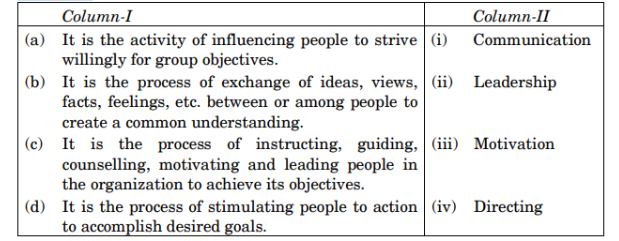
The correct matching is option (a)-(ii), (b)-(i), (c)-(iv), (d)-(iii) because each concept in Column-II correctly corresponds to its meaning in Column-I as per the definitions provided in the context. This option correctly aligns each concept with its accurate meaning, ensuring conceptual clarity.
Read the following statements carefully :
Statement I : Financial market is the market for the creation and exchange of financial assets.
Statement II : On the basis of ‘‘maturity of financial instruments traded’’, financial market is classified into money market and capital market.
In the light of the given statements, choose the correct alternative from the following :
Statement I is correct because the financial market indeed involves the creation and exchange of financial assets such as stocks, bonds, and other securities. Statement II is also correct because based on the maturity of financial instruments traded, financial markets are classified into money market (for short-term instruments) and capital market (for long-term instruments). Therefore, both statements are true.
Section B
State the three leadership styles.
1. Autocratic Leadership: In this style, the leader makes decisions alone without consulting others. The leader has complete control over the team and expects obedience.
2. Democratic Leadership: Also called participative leadership, here the leader involves team members in decision making. Ideas and suggestions are welcomed, promoting teamwork.
3. Laissez-Faire Leadership: This style allows team members to make decisions independently with minimal interference from the leader. The leader provides tools and support but gives freedom to the team.
State any three financial incentives which may be used to motivate people.
(a) Salary Increase: A rise in the basic pay of an employee encourages them to work more efficiently and remain loyal to the organization.
(b) Bonus: This is an additional payment given for achieving specific targets or for good performance which motivates employees to excel.
(c) Commission: Payment based on the amount of sales made or work done which motivates employees to increase their efforts and productivity.
State any three ‘Regulatory functions’ of the Securities and Exchange Board of India.
(a) Regulating Stock Exchanges: SEBI regulates the working of stock exchanges to ensure fair practices and protect investors from malpractices.
(b) Registration and Regulation of Market Intermediaries: SEBI registers and regulates intermediaries such as brokers, merchant bankers, and mutual funds to ensure they follow rules and operate transparently.
(c) Prohibition of Fraudulent and Unfair Trade Practices: SEBI frames guidelines to prevent fraudulent activities and unfair trade practices in the securities market, thereby protecting investors' interests.
Differentiate between ‘Capital Market’ and ‘Money Market’ on the basis of the following :
(i) Liquidity
(ii) Safety
(iii) Expected Return
(ii) Safety: Money Market is considered safer because it deals with short-term debt instruments with low risk. Capital Market has higher risk due to long-term investments in equities and bonds.
(iii) Expected Return: Money Market offers lower returns as it involves low-risk short-term funds. Capital Market offers higher returns due to the greater risk associated with long-term investments.
‘Chaman Pharmaceuticals Ltd.’ is a company providing medicines all over the country. After establishing itself and making a name in the field of medicines, it decided to enter into the field of medical devices, baby care products and nutritional supplements. Each product category had a different head accountable for profits, revenues and costs. In case of poor performance of their product, the heads were held responsible. But as the heads of different product categories were different, conflict could arise among different heads with reference to allocation of funds. Also providing a separate set of similar functional heads for each product category increased expenditure.
(i) Identify and explain the type of organisation structure ‘Chaman Pharmaceuticals Ltd.’ had followed after entering into the field of medical devices, baby care products and nutritional supplements.
(ii) Also state any one advantage and any one disadvantage of the organizational structure discussed in the above para by quoting lines.
(ii) Advantage: "Each product category had a different head accountable for profits, revenues and costs." This helps in better control and accountability within each product division.
Disadvantage: "Providing a separate set of similar functional heads for each product category increased expenditure." This means the company has to spend more money due to duplication of functional activities in each division. Also, "conflict could arise among different heads with reference to allocation of funds," which can create disagreements and affect coordination.
‘Refresh Zone’ was a popular coffee house chain offering premium coffee and snacks in a cozy environment. However, over time, the company began to face challenges in maintaining its market position. Customers had started complaining about lack of variety failing to cater to evolving consumer preferences. Also the price of coffee in ‘Refresh Zone’ was significantly higher than its competitors. Many consumers felt that the quality of coffee was not justifying its premium pricing.
Identify and explain two components of marketing mix that the management of ‘Refresh Zone’ needs to work on.
(a) Product: The customers complained about lack of variety in the offerings, which shows that the product component needs improvement. Refresh Zone should introduce new flavors, different types of coffee, and snacks to match changing consumer preferences. This will help attract more customers and retain existing ones.
(b) Price: The price of coffee at Refresh Zone was significantly higher than competitors, and customers felt that the quality did not justify the premium pricing. The management should reconsider their pricing strategy, possibly by reducing prices, offering discounts, or adding value to justify higher prices. This will make their products more competitive and appealing to customers.
Section C
‘Global Foods Ltd.’, a multinational company in the food processing industry, has a good customer base. Recently it has expanded into new international markets. But due to increased awareness for health care,
there is a shift in consumer demand for healthier food options. For this reason, the company needs to adapt to frequent technological advancements in production processes so that healthy food product options can be made available in the market. Additionally, the company is concerned about fluctuations at global level in commodity prices, exchange rates and political conditions. ‘Global Foods Ltd.’ is finding it increasingly difficult to predict future outcomes due to the constantly changing nature of the market. In order to effectively cope up with these significant changes, managers have to understand and examine the environment to develop suitable courses of action. By continuously monitoring the environment and adopting suitable business practices, the company will not only improve its present performance but also continue with it for a long period in achieving its objectives.
Identify and explain two features and two points of importance of business environment discussed in the above para.
1. Dynamic Nature: The business environment is constantly changing as seen by the shift in consumer demand for healthier food options and fluctuations in commodity prices and political conditions.
2. Complex and Uncertain: The environment includes many factors like technology changes, exchange rates and political situations, making it difficult for the company to predict future outcomes.
(b) Two points of importance of business environment:
1. Helps in Planning: By understanding the environment, managers can develop suitable strategies to adapt to changes and meet customer needs effectively.
2. Ensures Sustainable Growth: Continuous monitoring and adoption of practices based on environmental changes help the company improve current performance and sustain its success in the long run.
Kapila is working at ‘Cresa Engineering Solutions’, an engineering
consultancy firm. Despite being frequently enticed by many competitive
companies offering her a higher pay package, Kapila chooses to stay with
‘Cresa Engineering Solutions’. She enjoys her work as her job is designed
with greater variety of work content requiring higher level of knowledge
and skill and provides the opportunity for personal growth. The company
has appropriate skill development programmes and a sound promotion
policy due to which Kapila has been getting promotions year after year.
Not only this, Kapila’s work is being appreciated by the management
from time to time. She always gives valuable suggestions and is being
rewarded for that also. Over and above, the company implements
measures to ensure stability of the employees in the organisation. All
these factors motivate Kapila to continue to work in ‘Cresa Engineering
Solutions’.
Identify and explain the four non-financial incentives discussed in the
above case.
(a) Job Design and Work Content: Kapila enjoys her job because it involves a variety of tasks that require higher knowledge and skills. This makes her work interesting and challenging, which keeps her motivated.
(b) Skill Development Programmes: The company provides appropriate training and skill development opportunities. This helps Kapila to improve her abilities and grow professionally.
(c) Promotion Policy: The firm has a sound promotion system that rewards Kapila with promotions year after year, giving her a sense of advancement and recognition.
(d) Appreciation and Recognition: Kapila is regularly appreciated by the management and rewarded for her valuable suggestions, which boosts her morale.
Additionally, the company ensures job security by taking measures to stabilize employees which increases Kapila’s loyalty towards the organisation.
Explain the following features of Coordination :
(i) Coordination ensures unity of action.
(ii) Coordination is the responsibility of all managers.
(ii) Coordination is the responsibility of all managers: Coordination is not only the role of top management but also every manager at different levels. Each manager must communicate and cooperate with others to synchronize efforts. This shared responsibility ensures smooth functioning of the organization and timely accomplishment of tasks.
Explain the following features of Management :
(i) Management is a goal-oriented process.
(ii) Management is all pervasive.
(ii) Management is all pervasive: Management is required in all types of organizations like businesses, schools, hospitals, and government bodies. It is applicable in all areas and at all levels of management such as top-level, middle-level, and lower-level management. Hence, management is universal and found everywhere.
‘Pestle’, is the country’s largest biscuit manufacturing company, that makes high quality biscuits with focus on customer satisfaction. The company strives to understand what people want and provides tasty and healthy biscuits. To ensure the quality, a robust control system has been installed by the company. This helps the organisation to measure progress towards its goals and brings to light the deviations, if any. It also enables the management to verify whether the standards set are accurate and objective or not.
The above para highlights the importance of the Controlling function of management.
Identify and explain any two points of importance of the Controlling function discussed above.
(b) Identification of Deviations and Verification of Standards: Controlling brings to light any deviations from the set standards. It also helps management verify if the standards are accurate and objective. This ensures continual improvement and customer satisfaction.
Explain any two points of importance of consumer protection from the point of view of business.
(a) Builds Customer Loyalty: When businesses ensure consumer protection, customers feel safe and valued. This increases trust and encourages repeat purchases, which leads to long-term customer loyalty and stable sales.
(b) Enhances Business Reputation: Consumer protection helps businesses maintain a good reputation in the market. Satisfied customers often spread positive word of mouth, attracting new customers and helping the business to grow sustainably.
Explain the following functions of Marketing :
(i) Standardisation and Grading
(ii) Gathering and Analysing Market Information
(ii) Gathering and Analysing Market Information: This involves collecting data about customers, competitors, and market trends. Analysing this information helps businesses understand customer needs, preferences, and market demand. It is essential for making informed decisions related to product development, pricing, and promotion strategies, thus reducing business risks and improving competitiveness.
Explain the following components of Physical Distribution :
(i) Order Processing
(ii) Transportation
(ii) Transportation: Transportation is the movement of goods from the manufacturer or warehouse to the end customer. It plays a crucial role in ensuring timely delivery and maintaining product quality during transit. Different modes like road, rail, air, or sea are used based on cost, speed, and nature of the product.
Section D
A company, ‘SK Energy Ltd.’ is providing solar energy solutions in some states of the country. Now it wants to expand its operations in some other states also. It needs ₹ 30,00,000 for its expansion. The Chief Financial Officer suggested two options for this.
Option I : To raise the entire funds through issue of shares of ₹ 10 each.
Option II : To raise ₹ 10,00,000 through issue of shares of ₹ 10 each and ₹ 20,00,000 by raising debt @ 10% p.a.
The return on investment of the firm is 12% and tax rate is 30%.
(i) Which of the two options will maximise shareholders’ wealth ? Give reason in support of your answer.
(ii) Will the earning per share improve if return on investment of the company is 8% ? Give reason in support of your answer. Show your working clearly.
Option I: Entire funds raised through equity.
Total funds required = 30,00,000
Face value per share = ₹ 10
No. of shares = 30,00,000 / 10 = 3,00,000 shares
Return on investment (ROI) = 12%
Total Earnings = 12% of 30,00,000 = ₹ 3,60,000
Earnings available to shareholders = 3,60,000 (no interest payment)
EPS = Earnings / No. of shares = 3,60,000 / 3,00,000 = ₹ 1.20
Option II: ₹ 10,00,000 by equity and ₹ 20,00,000 by debt at 10% p.a.
No. of shares = 10,00,000 / 10 = 1,00,000 shares
Interest on debt = 10% of 20,00,000 = ₹ 2,00,000
Earnings before interest and tax = 12% of 30,00,000 = ₹ 3,60,000
Less: Interest = 2,00,000
Earnings before tax (EBT) = 3,60,000 - 2,00,000 = ₹ 1,60,000
Tax @ 30% = 30% of 1,60,000 = ₹ 48,000
Earnings after tax (EAT) = 1,60,000 - 48,000 = ₹ 1,12,000
EPS = EAT / No. of shares = 1,12,000 / 1,00,000 = ₹ 1.12
Comparison:
EPS under Option I = ₹ 1.20
EPS under Option II = ₹ 1.12
Since EPS is higher in Option I, issuing whole amount through equity maximises shareholders' wealth.
Reason: Although Option II uses cheaper debt finance, the interest expense reduces earning after tax and EPS.
(ii) If ROI drops to 8%, will EPS improve under Option II?
Calculate EPS for ROI = 8%
Total earnings = 8% of 30,00,000 = ₹ 2,40,000
Option I:
No. of shares = 3,00,000
EPS = 2,40,000 / 3,00,000 = ₹ 0.80
Option II:
Interest on debt = ₹ 2,00,000 (unchanged)
EBT = 2,40,000 - 2,00,000 = ₹ 40,000
Tax @ 30% = 12,000
EAT = 40,000 - 12,000 = ₹ 28,000
EPS = 28,000 / 1,00,000 = ₹ 0.28
Since EPS in Option II (₹ 0.28) is less than Option I (₹ 0.80) at 8% ROI, EPS does not improve with the introduction of debt when ROI is less than cost of debt.
Reason: When ROI is lower than debt cost, debt worsens earnings due to interest burden.
Conclusion: Option I maximises shareholders’ wealth both at 12% and 8% ROI.
Therefore, the company should raise entire funds through equity to maximise EPS and shareholders' wealth.
Explain any four points of importance of Planning function of management.
Planning is a fundamental function of management that provides direction and purpose to an organization. The following are four important points highlighting the significance of planning:
(a) Provides Direction: Planning helps in setting objectives and determining the best course of action to achieve those objectives. It guides all the activities of the organization towards common goals.
(b) Reduces Uncertainty: By forecasting future conditions and preparing appropriate strategies, planning minimizes the uncertainty in decision making. It allows managers to anticipate changes and adapt accordingly.
(c) Facilitates Coordination: Planning coordinates the efforts of different departments and individuals by aligning their activities. It ensures that everyone works harmoniously to achieve organizational targets.
(d) Improves Efficiency: Effective planning enables optimal utilization of resources by identifying the requirements in advance. It helps in avoiding wastage and reduces costs, thereby improving overall efficiency.
Thus, planning is essential for successful management as it lays the foundation for all other functions like organizing, staffing, directing, and controlling.
Explain any four points of importance of Decentralisation.
(a) Better Decision Making: Decentralisation allows decisions to be taken at different levels closer to the operational area which results in faster and more effective decisions.
(b) Encourages Initiative and Innovation: When authority is delegated, employees feel more responsible and motivated to take initiatives and come up with innovative ideas.
(c) Reduces Burden on Top Management: By delegating authority, top management can focus on planning and policy making rather than routine work.
(d) Improves Flexibility and Adaptability: Decentralised organisations can respond quickly to changes in the environment as decisions are made locally based on immediate circumstances.
Thus, decentralisation improves efficiency and growth of an organisation.
Explain any four organisational barriers to communication.
(a) Hierarchy Barrier: In organisations with multiple levels of hierarchy, information may get distorted or lost as it travels up or down the chain of command, causing misunderstanding.
(b) Departmental Barriers: Different departments may have different goals and jargon, which can create confusion and reduce cooperation between teams.
(c) Physical Barriers: Physical distance or poor office layout can limit face-to-face communication and prompt delays or miscommunication.
(d) Information Overload: When employees receive too much information at once, it becomes difficult to process and prioritize, leading to missed or ignored messages.
These barriers reduce organisational efficiency and affect relationships, so it is important to identify and address them for better communication.
Explain the following steps in the process of Selection :
(i) Preliminary screening
(ii) Selection tests
(iii) Job offer
(ii) Selection tests: After preliminary screening, shortlisted candidates are asked to undergo various selection tests. These tests may include written tests, aptitude tests, physical tests, skill tests, and psychological tests. The purpose is to assess the candidate's abilities, knowledge, personality traits, and suitability for the job. These tests help employers make informed decisions about the candidate’s potential performance.
(iii) Job offer: Once the suitable candidates are selected based on test results and interviews, a job offer is made. This offer includes important details such as job role, salary, terms of employment, and other benefits. The candidate can accept or reject the offer. If accepted, the candidate becomes an employee of the organization and the final joining formalities begin.
‘Marut Enterprises’ is a large company manufacturing washing machines. From the last few months, employees have been reporting dissatisfaction with the overall work environment which has led to a decline in productivity. The management realized that there is no coordination between various departments. On one hand, the Production Manager is giving instructions to the workers to speed up the work to achieve the targets whereas on the other hand, the Sales Manager is also giving instructions to the workers of the production department to slow down the production as sales are not picking up. It was also observed by the company’s management that there is a lack of proper communication among different levels of superiors and subordinates. Even in case of emergencies, a worker is not in a position to contact the Chief Executive Officer directly, which is affecting the productivity and the morale of the workforce. The management felt a need to foster a positive environment which may promote team spirit of unity and harmony among the employees.
Identify and explain the three principles of management given by Henri Fayol which can help in addressing the challenges faced by the company.
(a) Unity of Direction: This principle states that all activities having the same objective should be directed by one manager using one plan. In Marut Enterprises, the conflicting instructions given by Production Manager and Sales Manager show a lack of unity of direction. By adopting this principle, the company can ensure coordination among departments and a common plan to achieve organizational goals effectively.
(b) Scalar Chain: This principle refers to a clear and unbroken line of authority from the top level to the lowest level. In the case given, workers cannot directly contact the CEO in emergencies which hampers communication and morale. Implementing scalar chain properly allows smooth communication through defined channels, but also includes 'gang plank' or shortcuts in emergencies for effective decision-making.
(c) Espirit de Corps: This principle emphasizes promoting team spirit and unity among employees. Marut Enterprises needs to foster a positive environment that encourages harmony and cooperation. When employees feel united and motivated, productivity improves and dissatisfaction reduces.
Thus, by applying these principles, Marut Enterprises can improve coordination, communication and overall work environment leading to better productivity and employee satisfaction.
Paper Details
CBSE Board Exam 2025
Class
Class 12 Commerce
Subject
Business Studies
Year
2025
Set
Set 3
Other Years — Business Studies