SOLUTIONS

2025 BOARD EXAM

CBSE Class 12 Commerce Business Studies Board Paper 2025 — Set 2 Solutions

2025

Business Studies

Class 12 Commerce

CBSE EXAMINATION PAPER-2025

BUSINESS STUDIES

(Solved)

Time allowed : 3 hours

Maximum Marks : 104

General Instructions :

Read the following instructions carefully and follow them :

  1. This question paper contains 40 questions. All questions are compulsory.
  2. This question paper is divided into 4 sections.
  3. Section A – questions number 1 to 20 are multiple choice questions
  4. Section B – questions number 21 to 26 are short answer type i
  5. Section C – questions number 27 to 34 are short answer type ii
  6. Section D – questions number 35 to 40 are long answer
  7. There is no overall choice given in the question paper. However, an internal choice has been provided in few questions.
  8. Use of calculator is NOT allowed.

Section A

Question 1. ‘KM Creations’, a leading fashion brand, has been expanding its business into new markets. However, recently the company is facing challenges due to changes in inflation rates and disposable income of people. These factors have started affecting the company’s pricing strategy and profitability. ‘KM Creations’ is now closely monitoring these changes to minimise their impact on its operations. The component of business environment highlighted in the above para is :
[1 Mark]
  • (A) Political Environment
  • (B) Technological Environment
  • (C) Social Environment
  • (D) Economic Environment
Explanation: The paragraph highlights changes in inflation rates and disposable income, which are economic factors affecting the company's pricing strategy and profitability. These elements are part of the Economic Environment, which includes factors like inflation, income levels, and economic policies that influence business operations.
Question 2. Read the following statements : Assertion (A) and Reason (R). Assertion (A) : The dividend in growth companies is smaller than that in the non-growth companies. Reason (R) : Companies having good growth opportunities retain more money out of their earnings so as to finance the required investment. Choose the correct alternative from the options given below :
[1 Mark]
  • (A) Both Assertion (A) and Reason (R) are true and Reason (R) is the correct explanation of Assertion (A).
  • (B) Assertion (A) is true, but Reason (R) is false.
  • (C) Both Assertion (A) and Reason (R) are true, but Reason (R) is not the correct explanation of Assertion (A).
  • (D) Assertion (A) is false, but Reason (R) is true.
Explanation: In growth companies, the dividend is smaller compared to non-growth companies because they need to retain a larger portion of their earnings to finance new investments and expansion. Hence, the assertion that dividends in growth companies are smaller is true. The reason given, that companies with good growth opportunities retain more money to finance investment, correctly explains why the dividend is smaller. Therefore, both the assertion and reason are true, and the reason correctly explains the assertion.
Question 3. ‘The membership of a stock exchange is well-regulated and its dealings are well-defined according to the existing legal framework. This ensures that the investing public gets a fair deal on the market.’ The function of the stock exchange highlighted above is :
[1 Mark]
  • (A) Pricing of securities
  • (B) Providing liquidity and marketability to existing securities
  • (C) Contributing to economic growth
  • (D) Safety of transaction
Explanation: The description highlights regulation and legal framework governing the stock exchange membership and dealings, which ensures that investors get a fair deal. This refers to the function of 'Safety of transaction,' where the stock exchange provides a secure and transparent environment for buying and selling securities, protecting investors from fraud and malpractice.
Question 4. Identify the incorrect statement with respect to ‘Product’ as an element of Marketing Mix :
[1 Mark]
  • (A) A buyer buys a product or service for what it does or the benefit it provides.
  • (B) A customer may seek to satisfy functional, promotional and technological benefits from the purchase of a product.
  • (C) A product is a bundle of utilities, which is purchased because of its capability to provide satisfaction of a certain need.
  • (D) Product relates to not only the physical product, but also the benefits offered by it from the customer’s view point
Explanation: The statement is incorrect because customers generally seek to satisfy functional, social, and psychological benefits from a product, not promotional benefits. Promotional benefits relate to marketing efforts, not directly to the product's value to the customer. Hence, functional and technological benefits are valid, but promotional benefits are not considered a direct benefit sought by customers in the context of 'Product' in the Marketing Mix.
Question 5. Read the following statements carefully : Statement I : Staffing is the most fundamental and critical drive of organisational performance and this function has assumed greater importance because of rapid advancement of technology. Statement II : Understanding manpower requirements is, only to know the number of persons needed in the organisation. In the light of the statements given, choose the correct alternative from the following :
[1 Mark]
  • (A) Statement I is false and Statement II is true.
  • (B) Statement I is true and Statement II is false.
  • (C) Both Statement I and Statement II are false.
  • (D) Both Statement I and Statement II are true.
Explanation: Statement I is correct because staffing is indeed a fundamental and critical function that significantly impacts organizational performance, especially with rapid technological advancements requiring skilled personnel. Statement II is incorrect because understanding manpower requirements involves not only knowing the number of persons needed but also the types of skills, qualifications, and roles required to meet organizational goals effectively.
Question 6. The process of holding securities in an electronic form is known as :
[1 Mark]
  • (A) Rematerialisation
  • (B) Dematerialisation
  • (C) Depository
  • (D) Capitalisation
Explanation: Dematerialisation is the process of converting physical certificates of securities into electronic form, allowing investors to hold and trade securities electronically. This process eliminates the need for physical certificates and simplifies transactions.
Question 7.

Match the concepts given in Column-II with their meanings given in Column-I. Choose the correct option from the following :
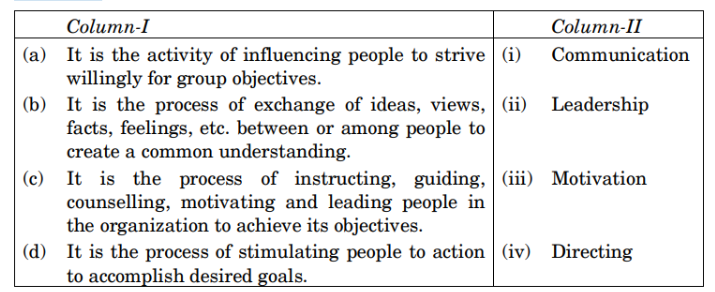
[-1 Marks] Diagram 1 – CBSE Class 12 Commerce Business Studies 2025 Set 2 Solutions
  • (A) (a)-(iii), (b)-(i), (c)-(ii), (d)-(iv)
  • (B) (a)-(iv), (b)-(iii), (c)-(ii), (d)-(i)
  • (C) (a)-(ii), (b)-(iii), (c)-(iv), (d)-(i)
  • (D) (a)-(ii), (b)-(i), (c)-(iv), (d)-(iii)
Explanation:

The correct matching aligns each concept in Column-II with its accurate meaning in Column-I. Option (a)-(ii), (b)-(i), (c)-(iv), (d)-(iii) correctly pairs the concepts with their respective definitions, as per the given context.

Question 8. __________ is a legally enforceable document issued by the broker to the investor within 24 hours of executing trade which helps to settle disputes/claims between the investor and the broker.
[1 Mark]
  • (A) Contract note
  • (B) Unique order code
  • (C) Client registration form
  • (D) Order confirmation slip
Explanation: A contract note is a legally enforceable document issued by the broker to the investor within 24 hours after the execution of a trade. It contains details of the transaction and helps in settling disputes or claims between the investor and the broker, making it the correct answer.
Question 9. Read the following statements carefully : Statement I : Financial market is the market for the creation and exchange of financial assets. Statement II : On the basis of ‘‘maturity of financial instruments traded’’, financial market is classified into money market and capital market. In the light of the given statements, choose the correct alternative from the following :
[1 Mark]
  • (A) Both Statement I and Statement II are false.
  • (B) Statement I is true and Statement II is false.
  • (C) Statement I is false and Statement II is true.
  • (D) Both Statement I and Statement II are true.
Explanation: Both statements are correct. Statement I is true because financial markets facilitate the creation and exchange of financial assets like stocks, bonds, and other securities. Statement II is also true because based on the maturity of financial instruments, the financial market is classified into money market (for short term instruments) and capital market (for long term instruments).
Question 10. ‘GEO Builders’ were to complete a housing project by December 2024 and hand over the flats to the buyers. Due to excessive heat in the month of May and June 2024, the work slowed down and the project was getting delayed. The firm, in order to complete the project on time, hired more workers through a contractor and asked all the workers to work overtime. Due to the above measures taken by the management, the project was completed on time but the cost of building the flats increased by 10%. Identify the correct option. ‘GEO Builders’ were :
[1 Mark]
  • (A) Effective as well as efficient
  • (B) Effective but not efficient
  • (C) Neither effective nor efficient
  • (D) Efficient but not effective
Explanation: ‘GEO Builders’ completed the project on time, which means they were effective because they achieved the desired goal. However, the cost increased by 10% due to hiring extra workers and overtime, indicating they were not efficient since efficiency relates to achieving goals with minimum cost or resources.
Question 11.

Which of the following are ‘Standing Plans’ ? (i) Budgets (ii) Policies (iii) Programmes (iv) Procedures (v) Methods (vi) Rules Choose the correct alternative :

[1 Mark]
  • (A) (i), (ii), (iii) and (iv)
  • (B) (iii), (iv), (v) and (vi)
  • (C) (ii), (iii), (v) and (vi)
  • (D) (ii), (iv), (v) and (vi)
Explanation:

Standing plans are used repeatedly by management to handle situations of a similar nature. They remain in force for a long duration. Examples of standing plans are Policies, Procedures, Methods, and Rules because they guide repetitive actions. Budgets and Programmes are single-use plans and therefore not considered standing plans.

Question 12. After identifying the needs and wants of the target market and understanding that parents were increasingly looking for eco-friendly and safe toys for their children, a toy manufacturing company ‘Deepak Toys Ltd.’ decides to use eco-friendly materials for their toys. The company also ensures that their manufacturing process will not harm the environment. The marketing management philosophy that guided the efforts of ‘Deepak Toys Ltd.’ is :
[1 Mark]
  • (A) Product concept
  • (B) Marketing concept
  • (C) Selling concept
  • (D) Societal marketing concept
Explanation: The societal marketing concept focuses on meeting the needs and wants of consumers while also considering the long-term interests of society and the environment. Deepak Toys Ltd. is not only addressing customer needs for eco-friendly and safe toys but also ensuring their manufacturing process protects the environment, which aligns with the societal marketing concept. Other concepts like the selling concept, marketing concept, or product concept do not specifically emphasize societal welfare or environmental concerns.
Question 13.

Identify the type of plan shown on the Notice Board of the factory, from the picture given below :
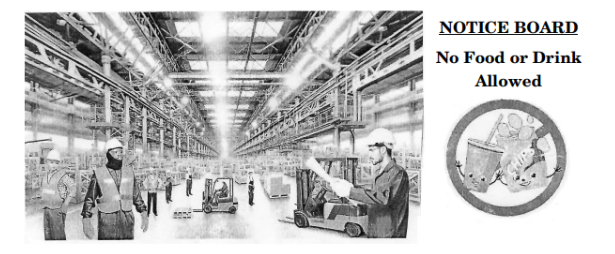
[1 Mark] Diagram 2 – CBSE Class 12 Commerce Business Studies 2025 Set 2 Solutions
  • (A) Strategy
  • (B) Policy
  • (C) Method
  • (D) Rule
Explanation: A rule is a specific guideline or instruction that directs the actions of employees in a factory or organization. Since the plan is displayed on a Notice Board, it is most likely a rule that employees need to follow consistently to ensure smooth operations and discipline. Rules are strict and mandatory, unlike policies or strategies which are broader and less prescriptive.
Question 14.

Organising involves a series of steps that need to be taken in order to achieve the desired goal. Identify the correct sequence of steps of organising function of management from the following :

[1 Mark]
  • (A) Departmentalisation, Identification and Division of work, Assignment of duties, Establishing reporting relationships.
  • (B) Departmentalisation, Assignment of duties, Identification and Division of work, Establishing reporting relationships.
  • (C) Identification and Division of work, Departmentalisation, Assignment of duties, Establishing reporting relationships.
  • (D) Identification and Division of work, Departmentalisation, Establishing reporting relationships, Assignment of duties.
Explanation:

The organising process starts with identifying and dividing the total work into smaller tasks (Identification and Division of work). Then, similar tasks are grouped together to form departments (Departmentalisation). After that, specific duties are assigned to individuals (Assignment of duties). Finally, reporting relationships are established to define who reports to whom (Establishing reporting relationships). This sequence ensures a systematic approach to organising.

Question 15. ‘Green Tech Solutions’, a renewable energy company, set a target of reducing its production cost by 15% in the current financial year. After a few months, the management reviews the progress and finds that the cost reduction measures implemented have not been as effective as planned. By reviewing the progress ‘Green Tech Solutions’ has completed one of the steps of controlling process. Identify the step of controlling process from the following :
[1 Mark]
  • (A) Setting performance standards
  • (B) Comparing actual performance with standards
  • (C) Analysing deviations
  • (D) Taking corrective actions
Explanation: In the controlling process, the step where management reviews and checks the actual performance against the set standards or targets is called 'Comparing actual performance with standards'. Here, Green Tech Solutions reviewed the progress of cost reduction to see if it met the target of 15%. Identifying deviations or gaps happens at this stage before taking any corrective actions.
Question 16. ‘‘With the growth of computers, more and more companies are using interactive sites on the Internet, to gather customer views and opinions, before taking important business decisions.’’ Identify the marketing function highlighted in the above lines.
[1 Mark]
  • (A) Marketing planning
  • (B) Product designing and development
  • (C) Branding
  • (D) Gathering and Analysing Market Information
Explanation: The marketing function described involves collecting customer views and opinions through interactive internet sites, which is a process of gathering and analyzing market information. This helps companies understand customer needs and preferences before making important business decisions. Therefore, the correct answer is 'Gathering and Analysing Market Information'.
Question 17. Bisphenol A is one of the most harmful chemicals used to make plastic water bottles. Its levels increase when the water is stored in these bottles for a long period of time. Keeping health considerations in mind, Ketan ordered six glass water bottles and decided not to use plastic bottles in the future. On receiving the parcel, he found that two bottles were broken as the container or wrapper was not adequate to protect the bottles. The product-related decision neglected by the marketer was :
[1 Mark]
  • (A) Labelling
  • (B) Branding
  • (C) Packaging
  • (D) Both (B) and (C)
Explanation: Packaging refers to the materials used to protect a product during transportation and storage. Since two glass bottles were broken due to inadequate protection, the marketer neglected proper packaging. Labelling and branding are related to product identification and brand recognition, but here the main issue is the insufficient packaging to protect fragile glass bottles.
Question 18. From the following, identify the incorrect statement with respect to ‘Delegation’ :
[1 Mark]
  • (A) It has a narrow scope as it is limited to the superior and his immediate subordinate.
  • (B) Delegation is a compulsory act because no individual can perform all tasks on his own.
  • (C) It increases the role of the subordinates in the organisation by giving them more autonomy.
  • (D) It is a process followed to share tasks.
Explanation: Delegation is the process of assigning responsibility and authority from a superior to a subordinate, but it is not limited only to the immediate subordinate. It can involve multiple levels within the organization, increasing overall efficiency. Therefore, the statement claiming delegation has a narrow scope limited to the superior and immediate subordinate is incorrect.
Question 19.

Which of the following is not a factor affecting investment decision ?

[1 Mark]
  • (A) Investment criteria involved
  • (B) Control considerations
  • (C) Cash flows of the project
  • (D) Rate of return
Explanation: Investment decisions are generally influenced by factors such as control considerations, cash flows of the project, and rate of return, as these directly impact the viability and benefits of the investment. 'Investment criteria involved' refers more to the standards or rules used to evaluate investment options rather than a direct factor affecting the decision itself.
Question 20. Read the following statements : Assertion (A) and Reason (R). Assertion (A) : Informal organisation has a definite structure or form. Reason (R) : Informal organisation is a complex network of social relationships among members. Choose the correct alternative from the options given below :
[1 Mark]
  • (A) Both Assertion (A) and Reason (R) are true and Reason (R) is the correct explanation of Assertion (A).
  • (B) Both Assertion (A) and Reason (R) are true, but Reason (R) is not the correct explanation of Assertion (A).
  • (C) Assertion (A) is false, but Reason (R) is true.
  • (D) Assertion (A) is true, but Reason (R) is false.
Explanation: Informal organisation does not have a definite structure or form; rather, it emerges naturally based on social relationships among members. Therefore, the assertion that it has a definite structure is false. The reason states that informal organisation is a complex network of social relationships among members, which correctly explains the nature of informal organisations as per the context.

Section B

Question 21.

‘Refresh Zone’ was a popular coffee house chain offering premium coffee and snacks in a cozy environment. However, over time, the company began to face challenges in maintaining its market position. Customers had started complaining about lack of variety failing to cater to evolving consumer preferences. Also the price of coffee in ‘Refresh Zone’ was significantly higher than its competitors. Many consumers felt that the quality of coffee was not justifying its premium pricing.

Identify and explain two components of marketing mix that the management of ‘Refresh Zone’ needs to work on.

[3 Marks]
Answer: The two components of marketing mix that Refresh Zone needs to work on are:
(a) Product: Customers complained about lack of variety and not meeting evolving preferences. Refresh Zone should diversify its product range by introducing new coffee flavors, snacks, and catering to current consumer trends to attract and retain customers.
(b) Price: The price of coffee at Refresh Zone is higher than competitors, but customers do not feel the quality matches the premium pricing. The company should review its pricing strategy either by reducing prices to provide better value or enhancing the perceived quality of its products to justify the higher price.
Key Points: Product variety improvement - Price adjustment strategy - Meeting customer preferences
Question 22.

State any three ‘Development functions’ of the Securities and Exchange Board of India

[3 Marks]
Answer: Development functions of SEBI are:
(a) Promoting the development of securities market by encouraging new instruments and institutions.
(b) Educating investors and conducting training programs to improve investor awareness and confidence.
(c) Facilitating the growth of the stock market by regulating intermediaries and improving market infrastructure.
These functions help in creating an efficient, transparent, and orderly securities market in India.
Key Points: Promote securities market development - Educate investors - Facilitate market growth and infrastructure
Question 23.

Give the meaning of ‘Money Market’. Differentiate between ‘Capital Market’ and ‘Money Market’ on the basis of the following :

(i) Investment Outlay

(ii) Duration

[3 Marks]
Answer: Meaning of Money Market: Money Market is a market for short-term funds where financial instruments with high liquidity and short maturity are traded. It deals with borrowing and lending of money for short durations, generally less than one year.

Difference between Capital Market and Money Market:
(i) Investment Outlay: In Capital Market, the investment outlay is usually large as it involves long-term securities like shares and debentures. In Money Market, the investment outlay is comparatively small as it involves short-term instruments like treasury bills and commercial papers.
(ii) Duration: Capital Market deals with long-term funds which have a maturity period of more than one year. Money Market deals with short-term funds having maturities of less than one year.
Key Points: Meaning of Money Market - Investment outlay large in Capital Market and small in Money Market - Duration long-term in Capital Market and short-term in Money Market
Question 24.

State the three leadership styles.

[3 Marks]
Answer: Three Leadership Styles
1. Autocratic Leadership: In this style, the leader makes decisions alone and expects subordinates to follow instructions without input or feedback. It is useful in situations requiring quick decision-making.
2. Democratic Leadership: Here, the leader involves the team members in decision-making, values their opinions, and encourages participation. This style fosters teamwork and motivation.
3. Laissez-Faire Leadership: The leader provides minimal supervision and allows team members to take decisions on their own. This style works best with experienced and self-motivated teams.
Key Points: Autocratic Leadership - Democratic Leadership - Laissez-Faire Leadership
Question 25.

State any three financial incentives which may be used to motivate people.

[3 Marks]
Answer: Financial incentives are monetary rewards given to motivate people to perform better. Three common financial incentives are:
(a) Bonuses: Extra money paid to employees for achieving targets or good performance.
(b) Commission: Payment based on the amount of sales or work done, encouraging higher productivity.
(c) Profit sharing: A scheme where employees receive a share of the company’s profits, motivating them to work for the company’s success.
Key Points: Bonuses - Commission - Profit sharing
Question 26.

‘Chaman Pharmaceuticals Ltd.’ is a company providing medicines all over the country. After establishing itself and making a name in the field of medicines, it decided to enter into the field of medical devices, baby

care products and nutritional supplements. Each product category had a different head accountable for profits, revenues and costs. In case of poor performance of their product, the heads were held responsible. But as the heads of different product categories were different, conflict could arise among different heads with reference to allocation of funds. Also providing a separate set of similar functional heads for each product category increased expenditure.

(i) Identify and explain the type of organisation structure ‘Chaman Pharmaceuticals Ltd.’ had followed after entering into the field of medical devices, baby care products and nutritional supplements.

(ii) Also state any one advantage and any one disadvantage of the organizational structure discussed in the above para by quoting lines.

[3 Marks]
Answer: (i) The organisation structure followed by Chaman Pharmaceuticals Ltd. is a Divisional Structure. In this structure, the organisation is divided into divisions based on products, such as medical devices, baby care products and nutritional supplements. Each division has a separate head who is responsible for profits, revenues and costs of that product category. This helps in focusing on specific products and accountability for performance.
(ii) Advantage: As mentioned in the paragraph, "Each product category had a different head accountable for profits, revenues and costs." This leads to clear accountability and better control over the results of each product line.
Disadvantage: The paragraph states, "conflict could arise among different heads with reference to allocation of funds" and "providing a separate set of similar functional heads for each product category increased expenditure." This indicates that divisional structure may lead to conflicts and higher costs due to duplication of functions.
Key Points: Divisional structure - Accountability to product heads - Conflict and higher expenditure due to duplication

Section C

Question 27.

Explain any two points of importance of consumer protection from the point of view of business.

[4 Marks]
Answer: Importance of consumer protection from the point of view of business:
(a) Builds Customer Loyalty: When businesses ensure consumer protection, customers feel safe and valued. This increases their trust and loyalty towards the business, leading to repeat purchases and long-term relationships.
(b) Improves Business Reputation: Protecting consumers from unfair practices helps businesses build a good reputation in the market. A positive image attracts new customers and helps sustain growth by avoiding legal issues and negative publicity.
Key Points: Builds customer loyalty - Improves business reputation - Encourages repeat purchases
Question 28.

‘Global Foods Ltd.’, a multinational company in the food processing industry, has a good customer base. Recently it has expanded into new international markets. But due to increased awareness for health care,

there is a shift in consumer demand for healthier food options. For this reason, the company needs to adapt to frequent technological advancements in production processes so that healthy food product options can be made available in the market. Additionally, the company is concerned about fluctuations at global level in commodity prices, exchange rates and political conditions. ‘Global Foods Ltd.’ is finding it increasingly difficult to predict future outcomes due to the constantly changing nature of the market. In order to effectively cope up with these significant changes, managers have to understand and examine the

environment to develop suitable courses of action. By continuously monitoring the environment and adopting suitable business practices, the company will not only improve its present performance but also continue with it for a long period in achieving its objectives.

Identify and explain two features and two points of importance of business environment discussed in the above para.

[4 Marks]
Answer: (a) Two features of business environment:
1. Dynamic nature: The business environment is constantly changing as seen in the paragraph where Global Foods Ltd. faces changes in consumer preferences and technological developments.
2. Complexity: It consists of various factors like commodity prices, exchange rates, political conditions which affect business decisions.
(b) Two points of importance of business environment:
1. Helps in identifying opportunities and threats: By monitoring environment, the company can adapt to health-conscious consumer demand and technological advancements.
2. Aids in planning and decision making: Understanding changing global market conditions helps managers develop suitable strategies to improve performance and sustain business in long run.
Key Points: Dynamic nature - Complexity - Helps identify opportunities and threats - Aids planning and decision making
Question 29.

Explain the following features of Coordination :

(i) Coordination integrates group efforts.

(ii) Coordination is a delibrate function.

[4 Marks]
Answer: (i) Coordination integrates group efforts: Coordination is the process of harmonizing the activities of different individuals or groups to achieve common objectives. It ensures that everyone works together effectively, avoids duplication of efforts, and uses resources optimally. This integration leads to better teamwork and higher efficiency.
(ii) Coordination is a deliberate function: Coordination is not accidental; it is a planned and conscious activity. Managers must intentionally design systems and processes to align the efforts of all team members. This deliberate action helps in resolving conflicts, setting clear roles, and ensuring smooth workflow in an organization.
Key Points: Coordination harmonizes group efforts - Coordination avoids duplication and enhances efficiency - Coordination requires intentional planning and management
Question 30.

Explain the following features of Management :

(i) Management is an intangible force.

(ii) Management is a continuous process.

[4 Marks]
Answer: (i) Management is an intangible force: Management cannot be seen or touched as it is not a physical entity. It exists through the activities performed by managers. It is a force that influences the efforts of people to achieve organisational goals. Just like electricity powers machines, management powers the organisation by guiding and coordinating human efforts.
(ii) Management is a continuous process: Management involves a series of functions like planning, organizing, staffing, directing, and controlling. These functions are interlinked and go on continuously to ensure that organisational objectives are achieved. As the environment and conditions change, management adapts and repeats these functions making it a continuous and never-ending process.
Key Points: Management is intangible - Management is a force influencing people - Management involves continuous functions - Management adapts to changes - Management is never-ending
Question 31.

Kapila is working at ‘Cresa Engineering Solutions’, an engineering consultancy firm. Despite being frequently enticed by many competitive companies offering her a higher pay package, Kapila chooses to stay with ‘Cresa Engineering Solutions’. She enjoys her work as her job is designed with greater variety of work content requiring higher level of knowledge and skill and provides the opportunity for personal growth. The company

has appropriate skill development programmes and a sound promotion policy due to which Kapila has been getting promotions year after year. Not only this, Kapila’s work is being appreciated by the management from time to time. She always gives valuable suggestions and is being rewarded for that also. Over and above, the company implements measures to ensure stability of the employees in the organisation. All these factors motivate Kapila to continue to work in ‘Cresa Engineering Solutions’.

Identify and explain the four non-financial incentives discussed in the above case.

[4 Marks]
Answer: Answer:
In the given case, the four non-financial incentives motivating Kapila are:
(a) Job Enrichment: Kapila’s job involves a variety of work content requiring higher knowledge and skills which makes her work interesting and challenging.
(b) Promotion Policy: The company has a sound promotion policy, and Kapila receives promotions year after year, which recognizes her efforts and motivates her.
(c) Recognition and Appreciation: Management appreciates Kapila’s work regularly and rewards her valuable suggestions, providing her with a sense of achievement.
(d) Job Security and Stability: The organisation ensures stability of employees, providing Kapila job security which increases her loyalty towards the company.
These non-financial incentives satisfy Kapila’s higher level needs such as self-esteem and personal growth, encouraging her to stay committed to the organisation.
Key Points: Job enrichment - Promotion policy - Recognition and appreciation - Job security and stability
Question 32.

‘Pestle’, is the country’s largest biscuit manufacturing company, that makes high quality biscuits with focus on customer satisfaction. The company strives to understand what people want and provides tasty and

healthy biscuits. To ensure the quality, a robust control system has been installed by the company. This helps the organisation to measure progress towards its goals and brings to light the deviations, if any. It

also enables the management to verify whether the standards set are accurate and objective or not.

The above para highlights the importance of the Controlling function of management.

Identify and explain any two points of importance of the Controlling function discussed above.

[4 Marks]
Answer: (a) Measuring Progress: The controlling function helps the company to measure its progress towards the set goals. It enables management to check whether the production of high quality and healthy biscuits is going as planned to satisfy customers.
(b) Detecting Deviations: Controlling helps to identify deviations from the planned standards or objectives. If there are any differences between actual and desired outcomes, management can take corrective actions promptly to maintain quality and customer satisfaction.
Key Points: Measuring progress towards goals - Detecting deviations and taking corrective action - Verifying accuracy and objectivity of standards
Question 33.

Explain the following features of Marketing :

(i) Customer Value

(ii) Exchange Mechanism

[4 Marks]
Answer: (i) Customer Value: Customer value means the benefits a customer receives from a product or service compared to the price paid. It is the satisfaction or utility gained by the customer. In marketing, creating customer value is important because it helps attract and retain customers by fulfilling their needs and wants effectively.
(ii) Exchange Mechanism: Exchange mechanism is the basic concept of marketing where two or more parties give something of value to each other to satisfy their needs. In marketing, exchange happens when a customer buys a product in return for money. This process involves communication, delivery, and agreement between buyer and seller to complete the transaction.
Key Points: Customer value means benefits received compared to price - It creates satisfaction - Exchange mechanism involves giving something of value to get something in return - It is the core of marketing transactions
Question 34.

Explain the following elements of Promotion Mix :

(i) Advertising

(ii) Public Relations

[4 Marks]
Answer: (i) Advertising: Advertising is a paid form of non-personal communication about products, services or ideas by an identified sponsor. It aims to inform, persuade and remind customers about a product or brand through various media like TV, radio, newspapers, internet, billboards, etc. It helps in creating awareness and increasing sales.
(ii) Public Relations (PR): Public Relations involves managing the public image and maintaining good relation between the company and its stakeholders like customers, employees, investors, media, and the general public. It includes activities like press releases, sponsorships, events, and community involvement. The goal is to build a positive image and gain goodwill without direct payment like advertising.
Key Points: Advertising is paid non-personal communication - Uses various media - Creates awareness and persuades customers - Public Relations manages company image - Builds good relations with stakeholders - Uses press releases, events, sponsorships to gain goodwill

Section D

Question 35.

‘Marut Enterprises’ is a large company manufacturing washing machines. From the last few months, employees have been reporting dissatisfaction with the overall work environment which has led to a decline in productivity. The management realized that there is no coordination between various departments. On one hand, the Production Manager is giving instructions to the workers to speed up the work to achieve the targets whereas on the other hand, the Sales Manager is also giving instructions to the workers of the production department to slow down the production as sales are not picking up. It was also observed by the company’s management that there is a lack of proper communication among different levels of superiors and subordinates. Even in case of emergencies, a worker is not in a position to contact the Chief Executive Officer directly, which is affecting the productivity and the morale of the workforce. The management felt a need to foster a positive environment which may promote team spirit of unity and harmony among the employees.

Identify and explain the three principles of management given by Henri Fayol which can help in addressing the challenges faced by the company.

[6 Marks]
Answer: The challenges faced by Marut Enterprises can be addressed by applying the following three principles of management given by Henri Fayol:
(a) Unity of Command: This principle states that an employee should receive orders and instructions from only one superior. In the company, workers are getting conflicting orders from the Production Manager and the Sales Manager which causes confusion and reduces productivity. If the company follows the unity of command, each worker will have only one boss to report to, minimizing conflicts and improving coordination.
(b) Scalar Chain: Scalar chain refers to a clear line of authority from the top level to the lowest level. It helps in proper communication and quick decision-making. Currently, workers cannot contact the Chief Executive Officer directly even in emergencies, leading to communication gaps. By establishing a proper scalar chain, communication will be smooth and effective in all directions, boosting morale and productivity.
(c) Harmony, Not Discord: Fayol emphasized the importance of harmony among employees and between different departments. The lack of coordination and poor work environment is affecting team spirit at Marut Enterprises. By promoting harmony through teamwork and mutual respect, the company can create a positive work environment that encourages unity and better cooperation, enhancing overall performance.
Key Points: Unity of Command - Scalar Chain - Harmony, Not Discord
Question 36.

Explain any four limitations of Planning function of management.

[6 Marks]
Answer: Four limitations of Planning function of management are:
(1) Rigidity: Once a plan is made and approved, it becomes rigid and may not allow much flexibility for changes. This can be a problem when unexpected situations arise.
(2) Inability to predict future accurately: Planning is based on forecasting future events, but since the future is uncertain, plans may not always be accurate or reliable.
(3) Time-consuming process: Planning requires thorough analysis and consideration of various factors, which can take a lot of time and delay decision-making.
(4) Does not guarantee success: Even a well-prepared plan cannot ensure success because external factors such as market conditions, competition, and economic changes are beyond control.
Hence, while planning is essential, managers should be flexible and ready to modify plans when required.
Key Points: Rigidity - Inability to predict future accurately - Time-consuming process - Does not guarantee success
Question 37.

Explain any four points of importance of ‘Delegation’.

[6 Marks]
Answer: Importance of Delegation:
Delegation is an important management process where a manager assigns responsibility and authority to subordinates to complete specific tasks. Its importance is as follows:
(a) Efficiency: Delegation helps in efficient utilization of time and resources because managers focus on important tasks while routine work is assigned to others.
(b) Employee Development: It provides opportunity for employees to learn new skills and improve their capabilities which leads to their growth.
(c) Motivation: By delegating authority and responsibility, employees feel trusted and valued which increases their motivation and job satisfaction.
(d) Better Decision Making: Delegation allows decisions to be taken at different levels, closer to the point of action, making decision making faster and more effective.
Key Points: Efficiency - Employee Development - Motivation - Better Decision Making
Question 38.

Explain any four semantic barriers to communication.

[6 Marks]
Answer: Semantic barriers to communication refer to obstacles in understanding the meaning of words or symbols used in communication. These barriers cause misinterpretation and confusion between the sender and receiver. Here are four important semantic barriers:

(a) Language Differences: When people speak different languages or dialects, the meaning of words may not be clear, leading to misunderstanding.

(b) Use of Jargon: Specialized terms or jargon used within a particular profession or group can confuse those who are not familiar with them.

(c) Word Connotations: Words may have different meanings or emotional associations for different people, causing misinterpretation.

(d) Ambiguity: When a word or sentence has more than one meaning, it can create confusion about the intended message.

To overcome semantic barriers, clear and simple language should be used, avoiding jargon if the audience is unfamiliar, and clarifying ambiguous terms.
Key Points: Language differences - Use of jargon - Word connotations - Ambiguity
Question 39.

Explain the following steps in the process of Staffing :

(i) Selection

(ii) Placement and Orientation

(iii) Training and Development

[6 Marks]
Answer: (i) Selection: Selection is the process of choosing the most suitable candidate from a pool of applicants. It involves various stages such as screening, interviews, tests, and background checks to assess the skills, qualifications, and suitability of the candidates. The goal is to find the right person for the right job who can contribute effectively to the organisation.
(ii) Placement and Orientation: Placement means assigning the selected candidate to a specific job role where they can perform best. Orientation is the process of introducing the new employee to the organisation’s culture, policies, work environment, and colleagues. It helps the employee adjust quickly and understand their responsibilities clearly.
(iii) Training and Development: Training is the process of enhancing the skills and knowledge of employees to perform their current job effectively. Development focuses on preparing employees for future roles and responsibilities by providing opportunities for personal and professional growth. Both are essential for improving productivity and ensuring continuous learning within the organisation.
Key Points: Selection chooses the best candidate - Placement assigns job roles and helps employees adjust - Training develops skills for present and future roles
Question 40.

A company, ‘SK Energy Ltd.’ is providing solar energy solutions in some states of the country. Now it wants to expand its operations in some other states also. It needs ₹ 30,00,000 for its expansion. The Chief Financial Officer suggested two options for this.

Option I : To raise the entire funds through issue of shares of ₹ 10 each.

Option II : To raise ₹ 10,00,000 through issue of shares of ₹ 10 each and ₹ 20,00,000 by raising debt @ 10% p.a.

The return on investment of the firm is 12% and tax rate is 30%.

(i) Which of the two options will maximise shareholders’ wealth ? Give reason in support of your answer.

(ii) Will the earning per share improve if return on investment of the company is 8% ? Give reason in support of your answer. Show your working clearly.

[6 Marks]
Answer: (i) To find out which option maximises shareholders’ wealth, we calculate Earnings Per Share (EPS) for both options.
Option I: Total funds = ₹ 30,00,000 raised by shares of ₹ 10 each.
Number of shares = 30,00,000 / 10 = 3,00,000 shares.
Return on investment (ROI) = 12%, thus Earnings before interest and tax (EBIT) = 12% of 30,00,000 = ₹ 3,60,000.
No interest as there is no debt.
Tax @ 30%: Tax = 30% of 3,60,000 = ₹ 1,08,000.
Net Income = EBIT - Tax = 3,60,000 - 1,08,000 = ₹ 2,52,000.
EPS = Net Income / Number of shares = 2,52,000 / 3,00,000 = ₹ 0.84.

Option II: Funds raised: ₹ 10,00,000 by shares and ₹ 20,00,000 by debt.
Number of shares = 10,00,000 / 10 = 1,00,000 shares.
ROI on total funds = 12% of 30,00,000 = ₹ 3,60,000.
Interest on debt = 10% of 20,00,000 = ₹ 2,00,000.
Earnings before tax = 3,60,000 - 2,00,000 = ₹ 1,60,000.
Tax @30% = 30% of 1,60,000 = ₹ 48,000.
Net Income = 1,60,000 - 48,000 = ₹ 1,12,000.
EPS = Net Income / Number of shares = 1,12,000 / 1,00,000 = ₹ 1.12.

Conclusion: Option II gives higher EPS (₹ 1.12 > ₹ 0.84), so it maximises shareholders’ wealth because the firm is earning more than the cost of debt (ROI 12% > Interest 10%).

(ii) If ROI is 8%, less than interest rate 10%, then EPS will reduce in case of debt.
Calculate EPS for Option II with 8% ROI:
ROI = 8% of 30,00,000 = ₹ 2,40,000.
Interest = ₹ 2,00,000.
Earnings before tax = 2,40,000 - 2,00,000 = ₹ 40,000.
Tax @30% = 12,000.
Net Income = 40,000 - 12,000 = ₹ 28,000.
EPS = 28,000 / 1,00,000 = ₹ 0.28.
EPS for Option I with 8% ROI:
EBIT = 8% of 30,00,000 = ₹ 2,40,000.
Tax = 30% of 2,40,000 = ₹ 72,000.
Net Income = 2,40,000 - 72,000 = ₹ 1,68,000.
Number of shares = 3,00,000.
EPS = 1,68,000 / 3,00,000 = ₹ 0.56.

Conclusion: EPS is higher in Option I (₹ 0.56) than Option II (₹ 0.28) when ROI is less than interest. So, EPS will not improve with debt when ROI is less than cost of debt.
Key Points: Calculate EPS for both options - Compare ROI and interest rate - EPS higher option maximises shareholders wealth

Paper Details

CBSE Board Exam 2025

Class

Class 12 Commerce

Subject

Business Studies

Year

2025

Set

Set 2

Other Years — Business Studies

2022 Set-1

2022 Set-2

2022 Set-3

2023 Set-1

2023 Set-2

2023 Set-3

2024 Set-1

2024 Set-2

2024 Set-3

2025 Set-1

2025 Set-2

2025 Set-3

CBSE Class 12 Business Studies 2025 Set 2 Solutions | Prepzy