Class 12 PCB . English . Kaleidoscope . Poems By Milton
Chapter 7: Poems By Milton
Ch 7
English
Class 12 PCB
‘ On Time’and And ‘On Shakespear’ (1630)
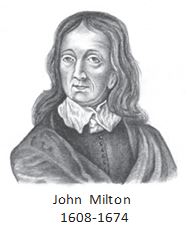
John Milton
- Dates and beginnings: John Milton lived from 1608 to 1674 and began writing poetry at the age of ten.
- Education: After Cambridge, he read widely in Latin, Greek, Italian and English.
- Career and blindness: He served as Latin Secretary and became totally blind at about 45 after years of eyestrain from reading.
- Key works: In later life, he dictated *Paradise Lost* and *Paradise Regained*.
What the poems are about
- “On Time”: Time destroys mortal and evil things, but cannot defeat the eternal goodness and joy of the soul’s union with God.
- “On Shakespear”: Shakespeare’s poetry gives him a lasting monument in readers’ minds, greater than any physical tomb.
“On Time”
On Time
- Time’s apparent power: The speaker challenges Time to consume the passing, mortal things of the world.
- Limited victory: Since those things are false, vain and temporary, their loss is small and Time gains little.
- Eternity and God: After Time and evil are ended, the divinely guided soul reaches God and shares in eternal joy, truth, peace and love.
- Final victory: The soul leaves earthly limitations behind and triumphs over death, chance and Time.
Mortality and eternity
Time can consume mortal things, but its power is temporary. The soul’s divine, eternal life ultimately triumphs over Time, death and chance.
“On Shakespear”
On Shakespear (1630)
- No stone tomb needed: Shakespeare’s verse and fame make a lasting monument in the minds of his readers.
- Power of poetry: His lines deeply affect readers; his literary memorial is so grand that even kings might envy it.
The immortality of poetry
Shakespeare’s works preserve his fame beyond death. The lasting impression of his poetry is a stronger monument than a tomb or pyramid.
| Device | Example | Effect |
|---|---|---|
| Personification | Time is addressed as envious and greedy. | Presents Time as a force that consumes and can itself be consumed. |
| Metaphor | “lazy leaden-stepping hours”; Shakespeare’s “live-long Monument.” | Makes slow time tangible and presents poetry as a lasting memorial. |
| Simile | “Joy shall overtake us as a flood.” | Suggests the abundance and overwhelming force of eternal joy. |
| Hyperbole | “Kings for such a Tomb would wish to die.” | Emphasises the extraordinary greatness of Shakespeare’s poetic legacy. |
- Envious
- Jealous; the poem personifies Time as eager to consume. The mythological Cronos devoured each of his children at birth.
- Leaden-stepping
- Moving slowly and heavily, like lead.
- Plummets
- Lead weights whose slow mechanism activates the ticking mechanism in a clock.
- Glut
- To consume or satisfy greedily.
- Dross
- Worthless or impure matter; here, mortal things.
- Entomb’d
- Buried; put into a tomb.
- Reliques
- Remains of a dead person.
- Pyramid
- A monumental tomb, shaped like a pyramid.
- Delphic
- Mysterious or prophetic; referring to the oracle at Delphi.
- Numbers
- Poetic lines or verse.
- Sepulcher’d
- Placed in a tomb or buried.
Quick recap
- “On Time”: Time consumes mortal things but cannot defeat eternal goodness.
- The soul: Divine guidance leads the soul beyond earthly limits to God.
- Final triumph: Eternity, joy and the soul’s life with God outlast Time and death.
- “On Shakespear”: Shakespeare needs no stone tomb because his poetry is his monument.
- Poetry’s legacy: His work lives in readers’ memories and secures lasting fame.
Exercise
Understanding the Poem
Comprehension focus
- Milton says Shakespeare’s poetry has made him a lasting “live-long Monument,” so a stone tomb or pyramid is unnecessary; the “weak witness” is a physical monument to his name. Shakespeare’s flowing verse and deeply impressed readers inspire later poets, while posterity’s finest tribute is the lasting honour and admiration his works have earned.
Language Study: Etymology
Etymology — The study of linguistic change; for an individual word, it covers the word’s history and derivation.
Word origins
- Dictionary entries may give a word’s origin and historical forms after its definition.
- “Entomb’d” is traced as “late ME entoumbe(n), MF entombe(r)”: late Middle English form, French origin, and use recorded from 1578.
- French influence accounts for about 30% of English words. Borrowing from French peaked between 1250 and 1400, after the Norman Conquest of 1066.
- Suggested reading: “On His Blindness” by John Milton.
Quick recap
- Shakespeare’s poetry is his enduring monument, earning him the lasting admiration of posterity.
- Etymology studies linguistic change and the history and derivation of words.
- The entry for “entomb’d” gives the forms “late ME entoumbe(n)” and “MF entombe(r).”
- The word is of French origin and is recorded in use from 1578.
- About 30% of English words are of French origin; borrowing peaked between 1250 and 1400.
- The Norman Conquest took place in 1066; the suggested reading is Milton’s “On His Blindness.”
English — ALL CHAPTERS
1
The Last Lesson
2
Lost Spring (Stories of Stolen Childhood)
3
Deep Water
4
The Rattrap
5
Indigo
6
Poets and Pancakes
7
The Interview (From the Introduction to The Penguin Book of Interviews edited by Christopher Silvester).
8
Going Places
9
My Mother at Sixty-six
10
Keeping Quiet
11
A Thing of Beauty
12
A Roadside Stand
13
Aunt Jennifer’s Tigers
1
I Sell My Dreams
2
Eveline
3
A Wedding In Brownsville
4
Tomorrow
5
One Centimetre
6
A Lecture Upon The Shadow
7
Poems By Milton
8
Poems By Blake
9
Kubla Khan OR A Vision In A Dream: A Fragment
10
Trees
11
The Wild Swans At Coole
12
Time And Time Again
13
Blood
14
Freedom
15
The Mark On The Wall
16
Film-making
17
Why The Novel Matters
18
The Argumentative Indian
19
On Science Fiction
20
Chandalika
21
Broken Images
1
The Third Level
2
The Tiger King
3
Journey to the end of the Earth
4
The Enemy
5
On The Face Of It
6
Memories of Childhood