Class 11 Humanities . History . Themes In World History . An Empire Across Three Continents
Chapter 2: AN EMPIRE ACROSS THREE CONTINENTS
Ch 2
History
Class 11 Humanities
Introduction & the Early Empire
Empires and Connections Across Regions
| Power or period | Key development |
|---|---|
| Iranian empires | By the sixth century BCE, Iranians controlled major parts of the Assyrian empire. |
| Alexander's empire | From the late fourth century BCE, Alexander of Macedon conquered parts of North Africa, West Asia and Iran, reaching the Beas. His troops turned back; his empire fragmented after his death. |
| Hellenistic period | For almost three centuries after Alexander's death, Greek language and culture remained influential and blended with local traditions. Iranian culture was also highly important. |
| Rome | From the second century BCE, Rome expanded into North Africa and the eastern Mediterranean. Under Julius Caesar, Roman power later extended to present-day Britain and Germany. |
| Arab empires | From the seventh century, Arab rulers and their successors took over much of the eastern Roman Empire; Greek and Islamic traditions interacted. |
| Mongols | In the thirteenth century, Mongol forces under Genghis Khan and his successors expanded across West Asia, Europe, Central Asia and China. |
Trade, Culture and Religious Traditions
- Trade grew overland and along Mediterranean coasts, linking regions and attracting pastoral peoples to wealthy cities.
- Languages such as Persian, Greek, Latin and Arabic were spoken and written across the region, alongside many others.
- Religions that crossed ethnic and linguistic boundaries helped support large empires: Christianity originated in Palestine in the early first century CE; Islam originated in the seventh century CE.
- Pastoral peoples supported trade and supplied labour for production and armies, but conflict with empires could also cause instability.
- Non-city-based empire — The Mongol empire showed that pastoral peoples could maintain a large empire successfully.
The Roman Empire: Scope and Sources
| Source group | Examples and use |
|---|---|
| Texts | Histories, letters, speeches, sermons and laws. Histories arranged year by year were often called annals. |
| Documents | Inscriptions, often carved in Greek or Latin on stone, and papyri containing contracts, accounts, letters and official records. |
| Material remains | Buildings, monuments, pottery, coins, mosaics and landscapes studied through archaeology, excavation, field survey and aerial photography. |
Reading the Evidence
- Papyri — Writing material made from a reed-like plant growing along the Nile; papyrologists study and publish the surviving documents.
- Evidence limits — Each source reveals only part of the past. Combining different sources can give a fuller account, depending on the historian's skill.
Rome, Iran and the Mediterranean
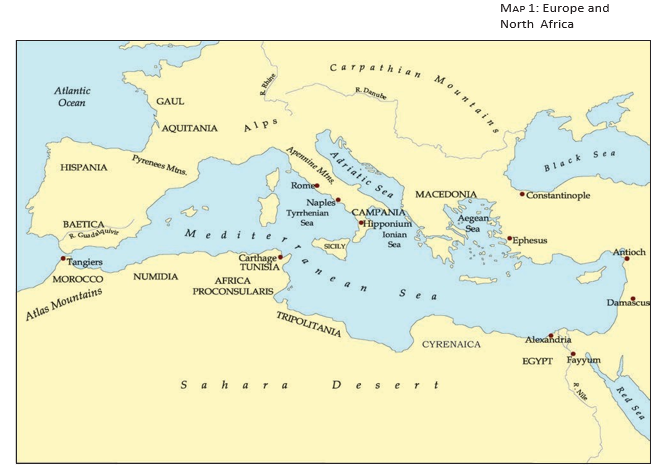
The Early Empire and Cultural Diversity
| Point | Roman Empire | Iranian Empire |
|---|---|---|
| Population and culture | A culturally diverse mosaic of territories and peoples. | The population was largely Iranian. |
| Ruling dynasties | Ruled by emperors. | The Parthians and later the Sasanians ruled Iran. |
| Languages | Latin and Greek were the main languages of administration. | The population was predominantly Iranian in culture. |
| Military | A paid professional army. | A conscripted army. |
Principate — The system established by Augustus in 27 BCE: the emperor held real authority but was presented as the “leading citizen” (Princeps), rather than an absolute ruler.
The Senate and the Republican Tradition
- Senate — A long-standing body representing wealthy Roman and later Italian families, especially landowners; membership was for life.
- Republic — From 509 to 27 BCE, power in practice rested with the Senate and a small wealthy nobility; wealth and office-holding mattered more than birth for senatorial membership.
- Augustus's position — The language of the Principate preserved the appearance of respect for the Senate, although Augustus was the sole ruler and real source of authority.
- Senatorial histories — Many surviving Roman histories were written by senators; they often judged emperors by their treatment of the senatorial class.
The Army and Political Power
Conscripted army — An army whose members are forcibly recruited, with military service compulsory for designated groups.
| Player | Role and influence |
|---|---|
| Emperor | Held supreme authority; an emperor's success depended heavily on controlling the army. |
| Aristocracy and Senate | Represented wealthy families and shaped political opinion; senators often resented emperors hostile to their class. |
| Army | Defended the empire but could mutiny, support a ruler or help decide succession. |
Power, Succession and Civil War
- An emperor's control of the army helped secure rule.
- A divided army weakened the emperor's authority.
- Rival claims to power could lead to civil war.
Succession and Stability
- Family succession — Rule usually passed through natural or adoptive family descent, a principle supported by the army.
- Tiberius — Augustus adopted Tiberius, emperor from 14–37 CE, to help ensure a smooth transfer of power.
- Relative stability — Apart from 69 CE, when four emperors took power in quick succession, the first two centuries were largely free from civil war.
- Augustan peace — Augustus's age followed decades of internal strife and centuries of conquest.
Civil war — An armed struggle for power within the same country, rather than a conflict between different countries.
Expansion, Provinces and Local Administration
Province — A territory of the Roman Empire, other than Italy, organised under Roman rule and subject to taxation.
Cities as the Basis of Imperial Government
- Scale — The empire had about 60 million people in the mid-second century, yet no modern-style central government to manage every locality.
- Urban centres — Mediterranean cities such as Carthage, Alexandria and Antioch were the foundation of imperial administration.
- Local collaboration — Provincial upper classes worked with Rome to govern territories and collect taxes from the countryside.
- City and countryside — Cities helped the state reach rural wealth; during shortages, city residents could be better supplied with food than country people.
- Roman city — An urban centre with its own magistrates and city council, plus a territory containing villages under its jurisdiction. Villages could gain or lose city status, often as a sign of imperial favour or disapproval.
How Rome Governed a Vast Empire
- Provincial cities connected Roman authorities to local territories.
- Local upper classes administered their regions and collected taxes.
- Taxes and cooperation helped sustain imperial government and the army.
The Rise of Provincial Elites
- Roman citizenship spread beyond Italy.
- Provincial upper classes increasingly supplied administrators and army commanders.
- These elites gained influence with imperial support, while Italy's political and economic importance declined.
- Emperor Gallienus (253–268 CE) barred senators from military command to prevent control of the empire falling into their hands.
Changing Social and Regional Power
- Provincial leadership — By the late first, second and early third centuries, the army and administration drew increasingly on the provinces.
- Senate — People of Italian origin continued to dominate it until the third century, when senators of provincial origin became the majority.
- New elites — Wealthier, urbanised regions such as southern Spain, Africa and the eastern Mediterranean gained importance.
The Later Empire and Its Successors
Why the Western Roman Empire Collapsed
- Arrangements between Rome and frontier tribes, including Goths, Visigoths and Vandals, covered trade, military recruitment and settlement.
- These arrangements broke down, and the tribes increasingly attacked the Roman administration.
- Conflicts grew in scale while internal dissensions weakened the empire.
- The Roman Empire in the west collapsed by the fifth century CE; tribes established kingdoms in its former territory.
Urban Life and the Countryside
Key Dates in Roman Political History
- 509–27 BCEThe Roman Republic, in which power in practice rested with the Senate and wealthy families.
- 27 BCEAugustus established the Principate.
- 14–37 CETiberius, adopted by Augustus, ruled as emperor.
- 69 CEFour emperors took the throne in quick succession.
- 113–117 CETrajan occupied territory beyond the Euphrates; his successors abandoned it.
- Mid-second century CEThe empire reached its peak, with a population of about 60 million.
- Third century CEA broad watershed between the early and late empire; provincial elites gained political and military power.
- 253–268 CEGallienus ruled and excluded senators from military command.
- Fourth century CEThe empire was divided into eastern and western halves; it was substantially Christianised after Constantine became Christian.
- Fifth century CEThe western Roman Empire collapsed.
- Ninth century CEA Holy Roman Empire formed from some successor kingdoms, claiming continuity with Rome.
- Principate
- Augustus's system presenting the emperor as the leading citizen while he held real power.
- Senate
- A lifelong body representing wealthy Roman and Italian families.
- Province
- A Roman territory, other than Italy, organised under Roman rule and taxation.
- Client kingdom
- A local kingdom permitted to remain under its ruler in return for supporting Rome.
- Conscripted army
- An army recruited by compulsion from designated groups.
- Civil war
- Armed conflict for power within one country.
Who were the three main political players in the Roman Empire?
How did Rome govern its vast provinces?
Why did the western Roman Empire collapse, and what followed?
Quick recap
- Trade, resources and cultural exchange shaped successive empires across the Mediterranean, West Asia and beyond.
- Rome was culturally diverse, governed mainly through common institutions, and shared the region with its rival Iran.
- Augustus established the Principate in 27 BCE; the emperor, Senate and army were the chief political players.
- Rome governed its provinces through cities and cooperating local elites, while provincial elites gradually gained influence.
- The empire was divided in the fourth century and became substantially Christianised after Constantine became Christian.
- The western empire collapsed in the fifth century after frontier arrangements broke down amid tribal attacks and internal dissension; the eastern empire endured.
- The Holy Roman Empire formed from some successor kingdoms from the ninth century and claimed continuity with Rome.
The Third-century Crisis & Economic Expansion
The Third-Century Crisis
- Military pressure: From the 230s, Rome faced simultaneous attacks from the Sasanians in the east and Germanic confederacies along the Rhine and Danube.
- Political instability: Repeated invasions and military strain brought rapid changes of ruler, with 25 emperors in 47 years.
Gender, Literacy and Culture
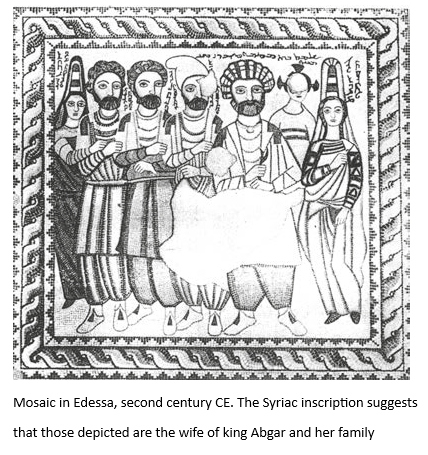
Casual literacy — The ability to read and write in everyday contexts; its prevalence varied greatly across the Roman Empire.
Economic Expansion
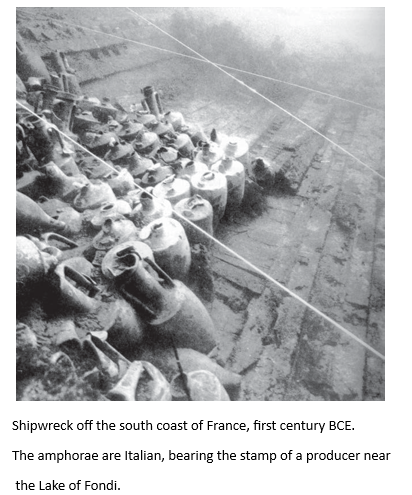
Changing Olive-Oil Markets
- Large numbers of Spanish Dressel 20 amphorae found across Mediterranean sites → evidence that Spanish olive oil circulated widely.
- Spanish producers supplied oil at better quality and lower prices → they captured markets from Italian producers.
- North African olive estates expanded their market position → they dominated production through much of the third and fourth centuries.
- After 425, North African dominance weakened → Aegean, southern Asia Minor, Syria and Palestine became major wine and oil exporters in the later fifth and sixth centuries.
| Region | Economic or settlement feature |
|---|---|
| Campania, Italy | A densely settled and wealthy region; renowned for its wine. |
| Sicily and Byzacium (Tunisia) | Exported large quantities of wheat to Rome. |
| Fayum, Egypt; Galilee; southern Gaul (Gallia Narbonensis); Baetica, southern Spain | Among the empire’s fertile, densely settled or wealthy regions. |
| Galilee | Intensively cultivated; the historian Josephus described cultivation across the land. |
| Baetica, southern Spain | Olive oil came from many estates along the Guadalquivir River. |
| Numidia, modern Algeria | Transhumance was widespread. Pastoral communities moved with mapalia huts; expanding estates reduced pastures and restricted movement. |
| Northern Spain | Less developed than the south; many Celtic-speaking peasants lived in hilltop castella. |
Sophistication of the Roman Economy
- Technology: Water power was used in varied ways, and water-powered milling technology advanced.
- Mining: Hydraulic methods were used in Spanish gold and silver mines, worked on a huge industrial scale in the first and second centuries.
- Output: Mine production reached levels not matched again until the nineteenth century.
- Commercial systems: Well-organised trade and banking networks, together with widespread use of money, show that the Roman economy was highly sophisticated.
- Regional variation: Prosperity rose or fell according to how well regions organised production and transport, and the quality of their goods.
How do amphorae help historians understand Roman trade?
What property rights did Roman women commonly retain in marriage?
Quick recap
- The third century brought Sasanian expansion, Germanic invasions and rapid imperial turnover.
- Roman women could hold property independently, but arranged marriages, age gaps and male authority created inequality.
- Literacy and languages varied widely across the empire; Latin displaced the written form of Celtic.
- Amphora remains help trace the origins, contents and distribution of traded goods.
- Spanish, North African and eastern producers successively dominated olive-oil markets.
- The Roman economy combined regional specialisation with advanced water power, mining, banking and monetary systems.
Controlling Workers
Slavery and the Roman Labour Force
Slavery — A deeply rooted institution in the ancient Mediterranean and Near East; Christianity becoming the state religion in the fourth century did not seriously challenge it.
Slaves, Wage Workers and Freedmen
- Not the majority everywhere: Slaves may have done much of the work in parts of Republican Italy, but they did not make up most of the labour force across the empire.
- Scale in Italy: Under Augustus, Italy had about 3 million slaves in a population of 7.5 million.
- Economic calculation: Slaves had to be fed and maintained year-round, so they could be costly for seasonal work or in unhealthy settings such as malaria-prone areas.
- Declining supply: As warfare became less widespread with peace in the first century, fewer enslaved captives were available; owners turned to slave breeding or wage labour.
- Slave breeding: Owners encouraged enslaved women and their partners to have children, who were also enslaved.
- Agricultural change: Slaves were not widely used in later-period agriculture, especially in the eastern provinces.
- Public works and business: Free workers were widely hired for Rome’s public works because maintaining large numbers of slaves was expensive. Slaves and freedmen also managed businesses, often using capital supplied by masters.
| Labour type | Main feature | Example or significance |
|---|---|---|
| Slave labour | Workers were maintained throughout the year | Could be costly for seasonal or large-scale work |
| Wage labour | Free workers were hired as needed and could be dismissed | Used extensively on Roman public works |
| Freedmen | Former slaves who had been set free | Could manage businesses for former masters or themselves |
| Slave breeding | Enslaved people were encouraged to have children | Their children were also enslaved |
Treatment and Management of Workers
Supervision and Work Organisation
- Tacitus’s account: After City Prefect Lucius Pedanius Secundus was murdered by a slave, custom demanded the execution of every slave living in the household.
- Senate and Nero: The Senate upheld the executions despite public opposition; Nero rebuked the crowd and stationed troops along the route to the executions.
- Columella: This first-century agricultural writer advised landowners to keep twice as many tools as needed so production would not stop if tools were lost; replacing tools cost less than lost slave labour-time.
- Supervision: Employers assumed workers would not work without oversight, so free and enslaved labourers were supervised and sometimes organised into teams.
- Squads of ten: Columella recommended groups of ten to make it easier to identify workers who were not making an effort.
- Pliny the Elder: He condemned slave gangs as a particularly bad system because workers were often chained together by their feet.
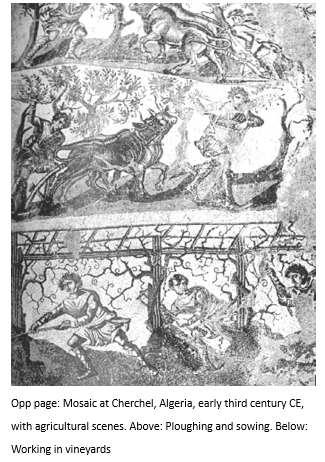
Coercion, Debt and Wage Labour
- Factory controls: In Alexandria’s frankincense factories, workers’ aprons were sealed, their heads covered, and they had to remove their clothes before leaving.
- Avoiding work: An early-third-century edict referred to Egyptian peasants abandoning villages to escape agricultural labour.
- Branding: A law of 398 referred to branding workers so runaways could be recognised.
- Debt contracts: Employers sometimes framed work agreements as debts to claim greater control over workers.
- Debt bondage: A second-century writer reported that thousands of free people entered servitude to survive. Augustine heard that some parents sold children into service for 25 years and asked whether they could be freed after their father’s death.
- Rural debt: During the Jewish revolt of 66 CE, rebels destroyed moneylenders’ bonds to gain popular support.
- Paid work remained important: In the late fifth century, Anastasius built Dara in under three weeks by attracting workers from across the East with high wages. Sixth-century papyri show wage labour was widespread in parts of the Mediterranean, especially the East.
Labour and Slavery: Key Dates
- First centuryWider peace reduced the supply of enslaved captives.
- 66 CEDuring the Jewish revolt, rebels destroyed moneylenders’ bonds.
- Early third centuryAn Egyptian edict referred to peasants deserting villages to avoid farm work.
- 398A law referred to branding workers so they could be identified if they ran away.
- Late fifth centuryAnastasius attracted workers with high wages to build Dara in less than three weeks.
- Sixth centuryPapyri indicate widespread wage labour in parts of the eastern Mediterranean.
Social Hierarchies
Early and Late Imperial Society
- Tacitus’s early-imperial groups: Senators (*patres*), leading equites, respectable people attached to great houses, the lower *plebs sordida*, and slaves.
- Senate: In the early third century, it had roughly 1,000 members; about half still came from Italian families.
- Late empire: Beginning with Constantine I’s reign in the early fourth century, senators and equites merged into an expanded aristocracy.
- Changing origins: At least half of late Roman aristocratic families came from Africa or the East.
- Military elites: The aristocracy was extremely wealthy but often less powerful than military leaders, many of whom came from non-aristocratic backgrounds.
| Point | Early empire | Late empire |
|---|---|---|
| Elite | Senators and equites were distinct leading groups | They formed a unified, expanded aristocracy |
| Middle groups | Respectable people were often connected to great senatorial houses | Bureaucrats, soldiers, and prosperous merchants and farmers were prominent |
| Lower groups | Tacitus described the lower section as *plebs sordida* | The broad lower population was known collectively as *humiliores* |
| Enslaved people | Present in Roman society | Still numerous, particularly in the western empire |
The Humiliores and Aristocratic Wealth
- Humiliores: Included estate labourers, industrial and mining workers, migrant harvest and building workers, self-employed artisans, city casual labourers, and slaves.
- Artisans: Self-employed artisans were said to be better fed than wage labourers.
- Aristocratic incomes: In the early fifth century, leading Roman houses could earn up to 4,000 pounds of gold annually from estates, excluding produce consumed directly.
- Second-ranking households: Their annual incomes were about 1,000–1,500 pounds of gold.
- Additional produce: Grain, wine, and other goods could add roughly one-third of the gold income if sold.
Money, Government and the Rule of Law
Late Roman Economy and Government
- Currency change: The late empire moved away from the silver-based coinage of the first three centuries as Spanish silver mines were exhausted and the government lacked enough silver for a stable currency.
- Constantine’s reform: Constantine based the new monetary system on gold, which circulated in large quantities during late antiquity.
- Bureaucracy: Higher- and middle-ranking officials were comparatively affluent, received much of their salary in gold, and often invested in land.
- Corruption: Extortion by senior officials and greed among provincial governors were notorious, especially in the judiciary and military supply administration.
- Criticism and laws: Government repeatedly legislated against corruption; historians and intellectuals also denounced it.
- Authoritarian rule: Dissent was rarely tolerated, and protests—especially in eastern cities—could be met with violence.
- Legal restraint: Roman law developed as a brake on imperial power and was used to protect civil rights. In the later fourth century, bishops such as Ambrose could confront emperors over harsh treatment of civilians.
Social and Political Changes
- Fourth centuryChristianity became the state religion, while Roman law increasingly restrained imperial power.
- Early fourth centuryThe late empire began under Constantine I; the senatorial and equestrian groups merged into an expanded aristocracy.
- Later fourth centuryBishops such as Ambrose could challenge emperors over repressive actions.
- Early fifth centuryOlympiodorus recorded the exceptional incomes of Rome’s aristocratic households.
- Freedman
- A formerly enslaved person who had been set free by a master.
- Debt bondage
- Servitude entered into to repay or secure a debt.
- Equites
- The traditionally wealthy second order, originally linked to property qualifications for cavalry service.
- Humiliores
- The broad lower classes of the late Roman Empire.
- Plebs sordida
- Tacitus’s term for the lower section of the people in the early empire.
Name three writers whose accounts help explain Roman labour management and treatment.
Give two methods used to control workers.
Quick recap
- Slavery was widespread, but slaves did not perform most labour across the whole empire; in later agriculture, they were especially uncommon in the East.
- Free wage labour was used extensively, including on public works and in eastern provinces.
- Employers controlled workers through supervision, teams, factory restrictions, branding, and debt contracts.
- Late Roman society had an expanded aristocracy, a varied middle group, and a large lower class called the humiliores.
- The late empire adopted a gold-based monetary system; officials could be wealthy, while corruption remained a concern.
- Despite authoritarian rule, Roman law could restrain emperors and protect civil rights.
Late Antiquity
Late Antiquity and Imperial Reforms
- Dux (plural: duces)
- A military commander; under Diocletian, commanders gained greater autonomy and influence.
- Solidus
- Constantine’s gold coin, containing 4½ g of pure gold; widely minted and used long after the Roman Empire ended.
- Constantinople
- The empire’s second capital, established at Byzantium (modern Istanbul), with the sea on three sides.
- Christianisation
- The gradual spread of Christianity among different populations until it became dominant.
- Laity
- Ordinary members of a religious community, rather than its official clergy.
Economic and Urban Prosperity
- Currency and capital: Constantine introduced the solidus, minted in large quantities, and established Constantinople as a second capital. A new senate expanded the governing classes.
- Rural investment: Estates developed industrial facilities such as oil presses and glass factories, and adopted technologies including screw presses and multiple water-mills.
- Trade and growth: Monetary stability and population growth encouraged economic expansion and revived long-distance trade with the East.
- Urban life: Prosperity supported new architecture, conspicuous luxury and wealthier, more powerful elites.
- Egypt: Papyri indicate extensive use of money and affluent estates. Under Justinian, Egypt paid over 2½ million solidi in annual taxes—about 35,000 lb of gold.
- Near East: Parts of its countryside were more developed and densely settled in the fifth and sixth centuries than even in the twentieth century.
Religious Diversity and Christianisation
Religious Change
- Classical traditions: Greek and Roman religion was polytheist, including Roman/Italian gods such as Jupiter, Juno, Minerva and Mars, alongside Greek and eastern deities worshipped across the empire.
- Judaism: Jewish communities were diverse; Judaism was not a single, uniform tradition.
- Christianisation: Constantine decided to make Christianity the official religion; its spread and dominance in the fourth and fifth centuries was gradual and complex, not an overnight change.
- Continuity: Polytheist beliefs and practices persisted, especially in western provinces. Christian bishops campaigned against them, sometimes more strongly than ordinary Christians did.
- Church leadership: Bishops sought to discipline followers and enforce more uniform beliefs and practices, making religious boundaries more rigid over time.
Diverging Paths in the West and East
| Point | West | East |
|---|---|---|
| Political development | Fragmented as Germanic groups—including Goths, Vandals and Lombards—took over provinces and formed post-Roman kingdoms. | The empire remained united, with continuing prosperity and imperial ambition. |
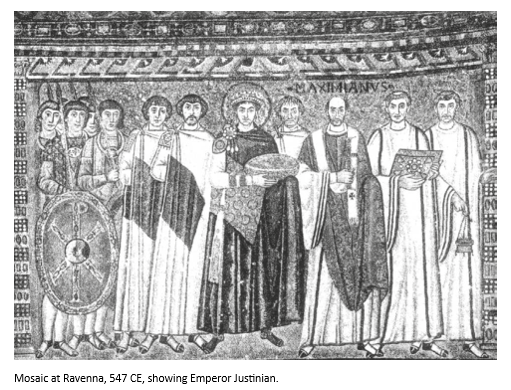
| Kingdoms and key events | Visigoths in Spain (defeated by the Arabs between 711 and 720); Franks in Gaul (c. 511–687); Lombards in Italy (568–774). | Justinian’s reign (527–565) marked a high point. He recaptured Africa from the Vandals in 533, but the recovery of Italy from the Ostrogoths devastated the country. |
| Long-term outcome | The post-Roman kingdoms foreshadowed the beginnings of the medieval world. | Increasingly known as Byzantium, the empire recovered eastern provinces from the Sasanians in the 620s, shortly before the Arab conquests. |
Conflict and Political Change
- The Mediterranean plague affected the East in the 540s, although its population had continued expanding up to the sixth century.
- Renewed war between Rome and Iran led the Sasanians, rulers of Iran since the third century, to invade eastern Roman provinces, including Egypt (602–628).
- Byzantium recovered these provinces in the 620s, only a few years before the Arab conquests.
- Justinian’s recovery of Italy from the Ostrogoths left the country devastated, helping pave the way for the Lombard invasion in 568.
The Rise and Expansion of Islam
The Early Arab Conquests
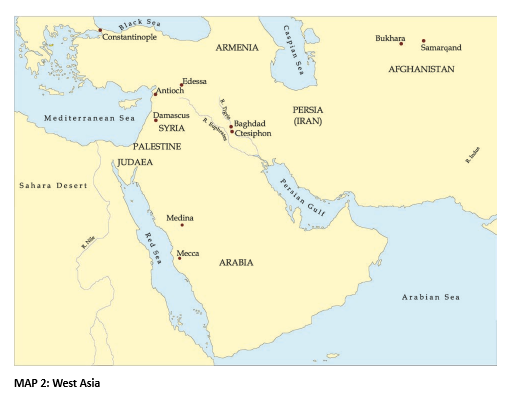
- Origins: Islamic expansion began in Arabia and has been described as a major political revolution of the ancient world.
- Key factor: The emerging Islamic state first united Arab tribes within Arabia, then extended its authority into the Syrian desert and the fringes of Iraq.
- By 642: Barely ten years after Prophet Muhammad’s death, Arab forces had taken large parts of both the eastern Roman and Sasanian empires.
- Further expansion: Over the following century, Islamic rule extended as far as Spain, Sind and Central Asia.
Key Dates in Late Antiquity
- Fourth to seventh centuriesBroad period known as Late Antiquity.
- 284–305Diocletian ruled and reorganised the empire; in 284 he arranged shared rule with a colleague.
- 312Constantine converted to Christianity.
- 324; 330Constantine became sole ruler and founded Constantinople in 324; the city was inaugurated in 330.
- 378The Goths inflicted a crushing defeat on Roman armies at Adrianople.
- 391The Serapeum, a temple of Serapis in Alexandria, was destroyed.
- 410; 455; 476Visigoths sacked Rome in 410; Vandals sacked it in 455; Odoacer deposed Romulus Augustulus in 476, traditionally marking the end of the western Roman Empire.
- 430The Vandals captured Africa.
- 527–565Justinian ruled; the Vandal kingdom was reconquered in 533–534.
- 541–542Bubonic plague broke out in the Mediterranean world.
- 568The Lombards invaded Italy.
- 602–628The Sasanian ruler Khosrau II invaded and occupied eastern Roman territories.
- 622Muhammad and his companions left Mecca for Medina.
- 633–642The first major Arab conquests took Syria, Palestine, Egypt, Iraq and parts of Iran.
- 698; 711Arabs captured Carthage in 698 and invaded Spain in 711; the Visigothic kingdom in Spain was destroyed between 711 and 720.
What were Diocletian’s main reforms?
Why was Christianisation a gradual process?
What enabled the rapid early expansion of Islam?
Quick recap
- Late Antiquity (fourth to seventh centuries) brought major changes to Roman government, economy and religion.
- Diocletian strengthened frontiers and military command; Constantine introduced the solidus and established Constantinople.
- Christianisation was gradual amid religious diversity and continuing polytheist practices.
- Stable currency, investment, trade and population growth supported prosperity, especially in the East; parts of the Near East were exceptionally developed and densely settled.
- The West fragmented into post-Roman kingdoms, while the East remained united through Justinian’s reign and later wars.
- Arab expansion followed the unification of tribes in Arabia and rapidly transformed former Roman and Sasanian territories.