Class 11 Humanities . History . Themes In World History . Displacing Indigenous Peoples
Chapter 6: DISPLACING INDIGENOUS PEOPLES
Ch 6
History
Class 11 Humanities
Introduction & European Imperialism
Modernisation and Industrialisation
Modernisation — The transformation of societies through industrialisation and political change; different societies followed distinct paths.
Industrialisation and Modern Change
- Context: Feudalism, the European Renaissance and encounters with Asia, Africa and the Americas helped shape the modern world, especially from the mid-15th century.
- Political revolutions: The American Revolution (1776–81) and French Revolution (1789–94) helped transform subjects into citizens.
- Britain: The first industrial nation; its experience influenced the USA and Germany but was not a universal model.
- Different sequences: Britain developed coal and cotton textiles early, with railways marking a later stage; Russia industrialised from the late 19th century, with railways and heavy industry in its initial phase.
- National variations: The roles of the state and banks in industrialisation differed between countries.
- Human and environmental costs: Industrialisation brought hardship for labourers, especially children, environmental damage and diseases such as cholera and tuberculosis.
- Japan’s industrial pollution: Cadmium and mercury poisoning helped trigger mass movements against indiscriminate industrialisation.
Different Paths to Modernity
Japan, China and Other East Asian Paths
- Distinct modernities: Societies shaped modernisation according to their own circumstances; Japan, China, Taiwan and South Korea offer instructive examples.
- Japan: Remained free from colonial control and achieved rapid economic and industrial progress during the 20th century.
- Japan’s foundations: Its post-Second World War rebuilding was not simply a sudden ‘post-war miracle’; it built on gains made in the 19th and early 20th centuries.
- Education in Japan: By 1910, primary-school tuition fees had more or less ended and enrolment had become universal.
- Japanese tensions: Modernisation involved conflicts between democracy and militarism, ethnic nationalism and civic nation-building, and tradition and Westernisation.
- China’s resistance: Peasant rebellion, reform and revolution challenged colonial exploitation and the bureaucratic landed elite.
- CCP before 1949: By the early 1930s, the Chinese Communist Party (CCP), supported by peasant mobilisation, confronted imperial powers and the Nationalists, and began applying its ideas in selected areas.
- CCP’s rise: Egalitarian ideas, land reform and attention to women’s problems helped the CCP defeat foreign imperialism and the Nationalists in 1949.
- China after 1949: The CCP reduced inequalities, spread education and encouraged political awareness; single-party rule and state repression contributed to dissatisfaction after the mid-1960s.
- CCP’s continuing control: By embracing some market principles and seeking to make China an economic powerhouse, the party reinvented itself and largely retained control.
Imperialism, Colonies and Nationalism
Imperialism — The extension of a country’s power over other peoples or territories, through direct rule or other forms of control.
| Form | How control worked | Example |
|---|---|---|
| Settler colonisation | European immigrants settled on Indigenous lands; colonies could later become independent states. | America, South Africa, Ireland, New Zealand and Australia |
| Direct imperial control | A trading company or colonial power took political control, defeated local rulers and annexed territory. | East India Company rule in South Asia |
| Semi-colonial influence | Foreign powers exploited resources and compromised sovereignty without directly taking over the state. | China in the 19th and early 20th centuries |
European Expansion and Colonial Rule
- Expansion: Spain and Portugal’s American empires stopped expanding after the 17th century; France, Holland and England expanded trade and established colonies in America, Africa and Asia.
- Motive: The prospect of profit drove colonisation, although the form of control varied by region.
- South Asia: Companies such as the East India Company became political powers, defeated local rulers and annexed territory.
- Colonial administration: Rulers retained established administrative systems, collected taxes from landowners and later built railways, excavated mines and established plantations.
- Africa: Europeans mainly traded on the coast, except in South Africa, until the late 19th century; they then moved inland and divided much of Africa into colonies.
- Ireland: It was virtually an English colony, with most landowners being English settlers.
- Settlers and language: ‘Settler’ refers to Europeans in places such as America, South Africa, Ireland, New Zealand and Australia. English became the official language in these colonies; Canada also has French as an official language.
- Wider imperialism: Western mercantile, industrial and financial capitalism, and early 20th-century Japanese capitalism, created colonies across much of the developing world.
| Point | Civic nationalism | Ethnic or religious nationalism |
|---|---|---|
| Basis of nationhood | Common citizenship and rights | Shared language, religion or traditions |
| Who belongs | All citizens, regardless of language, ethnicity, religion or gender | A chosen ethnic or religious group may be treated as the true nation |
| Political effect | Aims to create a community of rights-exercising citizens | May limit sovereignty and privilege one group over minorities |
Nationalism in Different Countries
- Colonial and non-colonial contexts: Nationalist movements often challenged colonial exploitation, but nationalism also developed without colonial rule, including in the West and Japan.
- Western countries: Most define nationhood through common citizenship rather than common ethnicity.
- Germany: Ethnic nationalism has a long and troubling history, linked to the reaction against French imperial occupation of German states in 1806.
- Global debate: Civic nationalism has competed with ethnic or religious nationalism in India, China, Japan and elsewhere.
Indigenous Peoples and Displacement
Indigenous people — People belonging naturally to a place, often with histories and cultures that predate colonial settlement.
Settlement and Indigenous Displacement
- From the 18th century, European migration and settlement expanded across parts of the Americas, South Africa, Australia and New Zealand.
- Settlers established colonies and claimed land and resources.
- Many Indigenous peoples were pushed from their lands into other areas.
- Asian migration also occurred in the 19th and 20th centuries; immigrant populations became majorities in many places while Indigenous populations became small and less visible.
Settlement, Representation and Indigenous Histories
- Place names: Indigenous names survive in Ohio, Mississippi and Seattle in the USA, Saskatchewan in Canada, and Wollongong and Parramatta in Australia.
- Textbook history: Until the mid-20th century, American and Australian textbooks often described Europeans as having ‘discovered’ these lands and gave little attention to Indigenous peoples, except to portray them as hostile.
- Historical study: Anthropologists studied native peoples in America from the 1840s; from the 1960s, Indigenous people were encouraged to write or dictate their own histories, including oral histories.
- Museums: Indigenous histories, art and ways of life are now represented in museums; the National Museum of the American Indian in the USA was curated by American Indians themselves.
Key Dates in Indigenous History and European Settlement
- From the 18th centuryEuropean settlement expanded across parts of the Americas, South Africa, Australia and New Zealand, displacing Indigenous peoples.
- 1840sAnthropologists in America began studying native peoples.
- From the 1960sIndigenous people were encouraged to write or dictate their histories, including oral histories.
European Names for New World Places
| Name | Origin or meaning |
|---|---|
| America | Used after the publication of the travels of Amerigo Vespucci (1451–1512). |
| Canada | From kanata, meaning ‘village’ in a Huron-Iroquois language, as heard by Jacques Cartier in 1535. |
| Australia | A 16th-century name for lands in the Great Southern Ocean; Latin austral means ‘south’. |
| New Zealand | Named by Dutch navigator Tasman, who sighted the islands in 1642; zee means ‘sea’ in Dutch. |
North America: Land and Native Peoples
Native — A person born in the place where they live; Europeans historically used the term for people in countries they colonised.
North America: Geography and Resources
- Extent: North America stretches from the Arctic Circle to the Tropic of Cancer and from the Pacific to the Atlantic Ocean.
- Landforms: It includes the Rocky Mountains, Arizona and Nevada deserts, Sierra Nevada, Great Plains, Great Lakes, Mississippi and Ohio valleys, and Appalachian Mountains; Mexico lies to the south.
- Resources: About 40% of Canada is forested; oil, gas and minerals support major industries in the USA and Canada.
- Agriculture and fishing: Wheat, corn and fruit are grown extensively, and fishing is a major Canadian industry.
- Recent development: Large-scale mining, industry and agriculture developed mainly in the last 200 years through immigrants from Europe, Africa and China; Indigenous peoples had lived there for thousands of years before Europeans arrived.
Early North American Peoples and European Settlement
- Over 30,000 years agoThe earliest inhabitants came from Asia across a land bridge at the Bering Strait.
- About 10,000 years agoDuring the last Ice Age, people moved farther south.
- 11,000 years agoThe oldest artefact mentioned is an arrow-point from this period.
- About 5,000 years agoThe population began to increase as the climate became more stable.
- 1497John Cabot reached Newfoundland.
- 1534Jacques Cartier travelled down the St Lawrence River and met native peoples.
- 1607The British founded the colony of Virginia.
- 1608The French founded the colony of Quebec.
- 1620The British founded Plymouth in Massachusetts.
- 1838During the Trail of Tears, thousands of eastern Native Americans were forced west; many died on the journey.
| Term | Meaning or use |
|---|---|
| Aborigine | A native person of Australia; from Latin ab (‘from’) and origine (‘beginning’). |
| Aboriginal | An adjective for Indigenous people; it is often misused as a noun. |
| American Indian / Amerind / Amerindian | Terms used for native peoples of North and South America and the Caribbean. |
| First Nations peoples | Organised native groups recognised by the Canadian government; the Indian Act of 1876 used ‘bands’, while ‘nations’ came into use from the 1980s. |
| Native American | The term now commonly used for Indigenous people of the Americas. |
| ‘Red Indian’ | An outdated label for brown-complexioned peoples, based on Columbus mistaking the Americas for India. |
Indigenous North American Ways of Life
- Diversity: More than a hundred languages were spoken; communities combined hunting, fishing, gathering, gardening and farming according to local conditions and traditions.
- Communities and food: Many lived in bands and river-valley villages, eating fish, meat, vegetables and maize.
- Hunting: People sometimes travelled long distances to hunt bison, but killed only what they needed; from the 17th century, horses acquired from Spanish settlers made travel and hunting easier.
- Land and surplus: Extensive agriculture and large surpluses were uncommon, so kingdoms and empires like those in Central and South America did not generally develop.
- Land ownership: Many were content with the food and shelter provided by the land and did not feel the need to own it; territorial quarrels occurred but were not generally central.
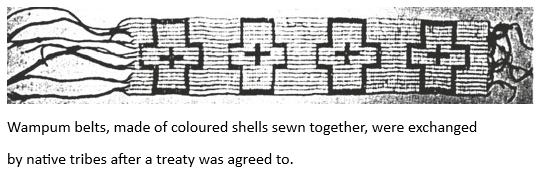
- Exchange: Formal alliances, friendships and gift-giving were important ways of obtaining goods.
- Knowledge and history: Languages were generally not written; origin stories and histories were passed down orally, time was often understood in cycles, and people were skilled craftspeople with detailed knowledge of the land.
Encounters with Europeans
| Point | Indigenous perspectives in the text | European settler perspectives |
|---|---|---|
| Land and resources | Land, water, fish and animals were not necessarily things to own or sell; exchange could take the form of gifts. | A commercial outlook treated land and resources as things that could be bought and sold. |
| Cultural judgement | Indigenous societies had diverse languages, livelihoods and traditions. | Settlers often regarded native peoples as uncivilised and claimed to bring civilisation. |
Trade and Cultural Encounters
- Northern trade: In the 17th century, European traders arrived after difficult voyages and found native peoples welcoming and expert at hunting; trade centred on fish and furs.
- French trade: Along the Mississippi, native peoples held gatherings to exchange handicrafts and foods unavailable in other regions.
- European goods: Traders offered blankets, iron vessels, guns and alcohol; guns supplemented bows and arrows.
- Unequal effects: Alcohol was unfamiliar to native peoples, and addiction helped Europeans dictate trade terms. Europeans, in turn, acquired an addiction to tobacco.
- Hopi account: A Hopi story described Spanish conquistadors in armour as foretold ‘turtles’; the Hopis offered a handshake, but a Spanish man placed a trinket in the hand instead.
- Names taken from tribes: Dakota, Cherokee, Pontiac and Mohawk names were used for unrelated things such as an aeroplane, jeep, car and haircut.
How did colonial control differ between South Asia, Africa and China?
How did Indigenous North American communities commonly relate to land and exchange?
Quick recap
- Modernisation: Countries followed distinct paths; Britain influenced others but was not a universal model.
- Industrialisation: Its sequence and the roles of the state and banks differed, and it brought human and environmental costs.
- Japan and China: Japan’s post-war growth rested on earlier gains; the CCP came to power in 1949 and later adopted some market principles.
- Imperialism: European powers used settler colonisation, direct rule and semi-colonial influence to control or exploit territories.
- Nationalism: Civic nationalism bases nationhood on citizenship; ethnic or religious nationalism defines it through shared identity and may exclude minorities.
- Displacement: European settlement pushed Indigenous peoples from their lands and often made immigrant populations the majority.
- Indigenous histories and exchange: North American peoples had diverse livelihoods and oral traditions; gift exchange was important, while European trade could create unequal terms.
Mutual Perceptions
European and Indigenous Perceptions of Each Other and Nature
European views of Indigenous peoples
- European idea of civilisation: In the eighteenth century, Europeans associated being “civilised” with literacy, organised religion and urban life; they often labelled Indigenous Americans “uncivilised”.
- Rousseau: The French philosopher admired people untouched by the corruptions of civilisation; the popular image of them as the “noble savage” grew from this view.
- Wordsworth: Though he had never met Indigenous Americans, he portrayed people close to nature as having limited imagination and emotions.
- Thomas Jefferson: The third US president described Indigenous people in terms that seemed to justify their extermination.
- Washington Irving: Having met Indigenous people, Irving challenged poetic stereotypes. He explained their silence around white people as mutual distrust and language barriers, and noted their humour among themselves and the whites’ dismissive treatment of them.
| Point | Indigenous peoples | Europeans |
|---|---|---|
| Exchange | Goods were gifts exchanged in friendship. | Fish and furs were commodities to sell for profit in Europe. |
| Prices | They had little understanding of a distant European market and were puzzled by changing amounts offered in exchange. | Prices varied with supply, so traders sometimes offered more and sometimes less. |
| Animals | People feared that the slaughter of hundreds of beavers might bring the animals’ revenge. | Traders pursued furs greedily, causing widespread slaughter. |
| Forests | People knew tracks through the forests that Europeans could not see; land was not something to own. | Settlers saw forests as land to clear for farms and cornfields. |
| Land and farming | Crops were grown for people’s own needs, not for sale; owning land seemed wrong. | Land ownership and small farms were central to Jefferson’s vision of a European-populated country. |
European Settlement and Pressure on Indigenous Lands
- From the seventeenth century, Christians persecuted for belonging to a minority sect left Europe for America.
- As European settlers moved inland, they approached Indigenous villages and used iron tools to clear forests.
- Settlers established farms and expanded land ownership, while Indigenous people’s different relationship with land was labelled “uncivilised” by Jefferson.
Early Political Changes in Canada and the USA
- 1701French treaty with Indigenous peoples of Quebec.
- 1763Britain conquered Quebec from France.
- 1774Quebec Act.
- 1781Britain recognised the USA as an independent country.
- 1783Britain gave the Midwest to the USA.
- 1791Canada Constitutional Act.
Territorial Expansion and the Moving Frontier
- New countries: Canada and the USA emerged at the end of the eighteenth century, initially controlling only a fraction of their present territories.
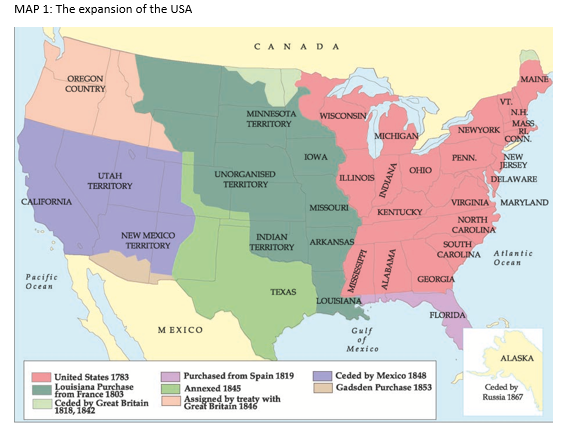
- US expansion: The USA acquired land through purchases, including Louisiana from France and Alaska from Russia, and through war, including much of the south from Mexico.
- Indigenous consent: Land was acquired without asking the consent of the Indigenous people who lived there.
- Moving frontier: As the US western frontier shifted westward, Indigenous peoples were forced to move back.
Expansion and Conflict in Canada and the USA
- 1803The USA purchased Louisiana from France.
- 1825–1858Indigenous peoples in the USA were moved to reserves.
- 1832Justice Marshall’s judgement.
- 1837French Canadian rebellion.
- 1840Union of Upper and Lower Canada.
- 1849American Gold Rush.
- 1859Canada Gold Rush.
- 1861–1865American Civil War.
- 1865–1890American Indian Wars.
- 1867Confederation of Canada.
- 1869–1885Red River Rebellion by the Métis in Canada.
- 1870Transcontinental railway in the USA.
- 1876Canada Indians Act.
- 1885Canadian transcontinental railway linked the east and west coasts.
- 1890The American bison was almost exterminated.
- 1892The American frontier was declared to have ended.
Changing Landscapes, Farming and Ranching
Settlement and Agriculture
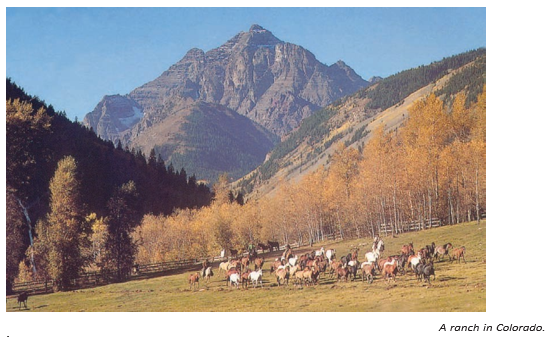
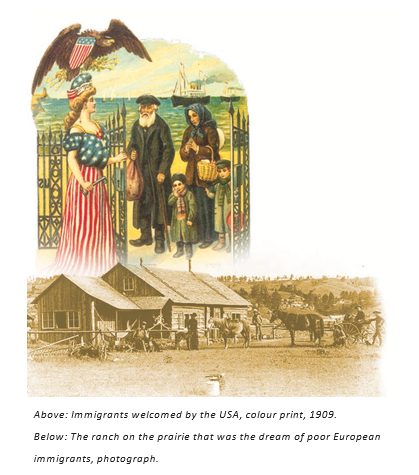
- Reasons for migration: Younger sons from Britain and France sought land they would not inherit at home. Later migrants from Germany, Sweden and Italy often wanted farms after losing land to large farmers.
- Prairie settlement: Polish migrants welcomed the grasslands, which reminded them of home, and the chance to buy large properties cheaply.
- Commercial farming: Settlers cleared land and grew crops such as rice and cotton, which could not grow in Europe and could be sold there for profit.
- Wildlife and fencing: Farmers hunted wolves and mountain lions to protect their farms. Barbed wire, invented in 1873, later helped them feel secure.
Slavery and the Civil War
Slavery, Abolition and Civil Rights
- The hot southern climate discouraged Europeans from outdoor plantation work; Indigenous people enslaved in parts of the Americas died in large numbers.
- Plantation owners turned to enslaved Africans; although the slave trade was later banned after protests, Africans already in the USA and their children remained enslaved.
- Northern states, whose economies did not depend on plantations, opposed slavery as inhuman; conflict with states defending slavery led to the Civil War (1861–1865).
- The anti-slavery side won and slavery was abolished, but African Americans gained civil liberties and the end of segregation in schools and public transport only in the twentieth century.
Canada’s Political Settlement
- French settlers: After Britain won Canada from France in 1763, French settlers repeatedly demanded autonomous political status.
- Confederation: The political question was settled in 1867 by organising Canada as a confederation of autonomous states; it had seemed more urgent to the government than the issue of Indigenous peoples.
- Noble savage
- A European idealisation of Indigenous people as unspoilt by civilisation.
- Commodity
- A good treated as something to buy and sell for profit.
- Frontier
- The shifting western edge of US settlement and control.
- Reserve
- Land to which Indigenous peoples in the USA were moved.
How did Indigenous and European peoples view trade and land differently?
What happened as the US frontier moved west?
Why did Canada become a confederation in 1867?
Quick recap
- Eighteenth-century European views ranged from idealising Indigenous people as “noble savages” to judging them as uncivilised.
- Indigenous people saw trade as friendly exchange; Europeans treated goods as commodities for profit.
- Different ideas about forests and land ownership drove settlement and the displacement of Indigenous people.
- The USA expanded through purchase and war, often without Indigenous consent, and its frontier moved westward.
- European settlement transformed landscapes through farming, hunting and ranching; enslaved Africans provided plantation labour in the south.
- The Civil War ended slavery, but African Americans did not gain civil liberties and an end to segregation until the twentieth century.
- Canada formed a confederation of autonomous states in 1867 after repeated demands for autonomy from French settlers.
The Native Peoples Lose Their Land & the Gold Rush, and the Growth of Industries
How Native Peoples Lost Their Land
Land seizure and displacement
- Treaties: Native peoples were induced or forced to sell land for very low prices; settlers sometimes took more land or paid less than promised.
- Justification: Settlers claimed Native peoples did not use land productively and criticised their crafts, language and clothing.
- Expansion: Prairies were cleared for farms and bison were killed. Settlers argued that Native peoples would ‘die out’ along with the bison.
- Repeated displacement: Tribes were moved west and sometimes relocated again when gold, lead or oil was found on their new land.
- Reservations: Many peoples were confined to small areas, often land they had no earlier connection with; tribes were sometimes forced to share one another’s territory.
| Population group | USA (1820) | Spanish America (1800) |
|---|---|---|
| Natives | 0.6 million | 7.5 million |
| Whites | 9.0 million | 3.3 million |
| Mixed Europeans | 0.1 million | 5.3 million |
| Blacks | 1.9 million | 0.8 million |
| Total | 11.6 million | 16.9 million |
The Cherokee and the Trail of Tears
State power versus Native rights
- Cherokee position: Georgia officials claimed the Cherokee were subject to state laws but denied them citizens’ rights—even though they had made considerable efforts to learn English and adopt American ways.
- John Marshall’s judgment (1832): The US Chief Justice recognised the Cherokee as a distinct community on its own territory, where Georgia’s laws had no force, and affirmed their sovereignty in certain matters.
- Andrew Jackson’s response: The US President refused to enforce the judgment and ordered the army to evict the Cherokee and drive them west.
- Trail of Tears: Of the 15,000 Cherokee forced to move, more than a quarter died on the journey to the Great American Desert.
Resistance to dispossession
- 1865–1890The US army crushed a series of Native rebellions.
- 1869–1885The Metis in Canada launched armed revolts.
- After 1890Organised resistance diminished.
Anthropology and Native Culture
Ideas about Native peoples
- Anthropology: Introduced in North America from the 1840s, it studied perceived differences between Native communities labelled ‘primitive’ and European communities labelled ‘civilised’.
- Discriminatory theory: Some anthropologists predicted that Native peoples, like Europe’s supposedly ‘primitive’ peoples, would disappear.
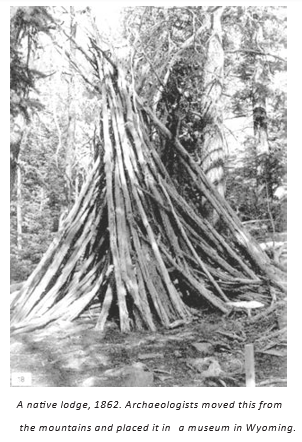
- Chief Seattle’s response (1854): He described land, air, water, plants and animals as sacred and inseparable from his people’s memories and ancestors.
- Different views of land: The proposed sale and reservation of land clashed with Native beliefs that land was sacred and could not simply be owned or bought.
The Gold Rush and Industrial Growth
Gold, railways and industry
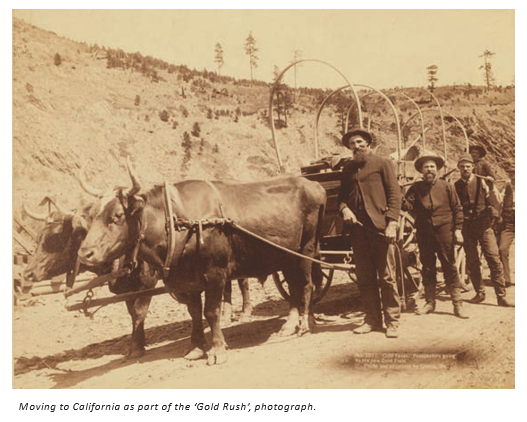
- Gold Rush: Traces of gold found in California in the 1840s drew thousands of Europeans hoping to make quick fortunes.
- Railways: Continental railway construction connected distant regions and recruited thousands of Chinese workers.
- Completion: The US railway was completed by 1870 and Canada’s by 1885.
- Industrial demand: Industries grew to manufacture railway equipment and machinery that made large-scale farming easier.
- Urban growth: Industrial towns expanded and factories multiplied in both the USA and Canada.
| Point | England | North America |
|---|---|---|
| Main cause described | Small peasants lost land to large farmers and moved into factory work. | Industry grew to make railway equipment and machinery for large-scale farming. |
Expansion and economic change
- 1860The USA was still an undeveloped economy.
- 1870The US continental railway was completed.
- 1885Canada’s continental railway was completed.
- 1890The USA had become the world’s leading industrial power; bison were almost exterminated.
- 1892Continental expansion reached completion: the land between the Atlantic and Pacific was divided into states.
- Within a few years after 1892The USA established colonies in Hawaii and the Philippines and became an imperial power.
Farming, the frontier and imperial power
- Large-scale agriculture: Vast areas were cleared and divided into farms, transforming the prairies and Native ways of life.
- Bison and hunting: By 1890, bison were almost exterminated, ending a way of life Native peoples had followed for centuries.
- End of the frontier: By 1892, no western frontier remained to draw European settlers across the continent.
- Imperial expansion: The USA soon established colonies in Hawaii and the Philippines.
- Sovereignty
- The authority of a community to govern itself in certain matters.
- Reservation
- An area set aside for Native peoples, often after they were displaced from their ancestral lands.
- Metis
- People of Native and European descent in Canada.
- Gold Rush
- The movement of people to a region after gold discoveries, hoping to become wealthy.
- Frontier
- The advancing edge of European settlement across the continent.
What was the significance of the 1832 Cherokee judgment, and what followed?
How did the Gold Rush contribute to industrial growth?
Quick recap
- Native peoples were displaced through unfair treaties, forced removals and repeated relocation onto reservations.
- The 1832 Cherokee ruling affirmed limited sovereignty, but Andrew Jackson’s refusal to enforce it led to the Trail of Tears.
- Native resistance continued in the USA and Canada through the late nineteenth century but was eventually crushed.
- Chief Seattle expressed a Native view of land as sacred and inseparable from ancestors, memory and community.
- California’s Gold Rush encouraged migration and railway building, stimulating industry in the USA and Canada.
- Large-scale farming, the near-extermination of bison and the end of the frontier reshaped the continent; the USA became an imperial power.
Constitutional Rights
Democratic Ideals and Unequal Rights
Rights in the United States
- Democratic ideal: The settlers’ fight for independence in the 1770s made democracy central to the identity of the USA, in contrast with Old World monarchies and aristocracies.
- Property right: The Constitution protected an individual’s right to property from being overridden by the state.
- Unequal access: Voting for Congress and the President, and property rights, were reserved for white men; Indigenous peoples were excluded.
- Daniel Paul’s argument: In 2000, Paul argued that Thomas Paine used Indigenous peoples as models of social organisation, helping inspire Europe’s long movement towards democracy.
- Frontier interpretation: Karl Marx described the American frontier as a capitalist utopia, where vast land and space accommodated the limitless pursuit of profit.
| Group | Treatment | Rationalisation |
|---|---|---|
| Indians under British rule | Arbitrarily taxed and treated as unequal | Claimed to be unready for representative government |
| Natives in America and Australia | Denied citizenship and treated as unequal | Called “primitive” for lacking settled agriculture, future planning and towns |
| African slaves in America | Denied personal liberty and treated as unequal | Slavery claimed to be part of their social system; Black people described as inferior |
The Winds of Change
Reform and Indigenous Assertion
- Conditions in reservations: The 1928 Meriam survey reported severely inadequate health and education facilities for Indigenous peoples.
- Indian Reorganisation Act (1934): The landmark US law allowed Indigenous people in reservations to buy land and take loans.
- Assimilation policy: In the 1950s and 1960s, the US and Canadian governments considered ending special provisions to encourage Indigenous peoples to adopt European culture and join the mainstream.
- Indigenous response: Native peoples rejected assimilation and defended their reservations, traditions and cultural rights.
- US Declaration of Indian Rights (1954): Many Indigenous peoples accepted US citizenship on the condition that their reservations remain and their traditions not be interfered with.
- Continuing rights: Indigenous peoples in both countries asserted cultural rights; in Canada, they also asserted rights to sacred lands. Many details of these rights remained unresolved.
Key Developments
- 1770sThe settlers’ independence movement made democratic ideals central to the identity of the USA.
- 1920sConditions began to improve for Indigenous peoples in the USA and Canada.
- 1928Lewis Meriam directed a survey exposing poor health and education facilities in reservations.
- 1934The US Indian Reorganisation Act granted reservation residents the right to buy land and take loans.
- 1950s–1960sUS and Canadian governments considered ending special provisions to assimilate Indigenous peoples.
- 1954The Declaration of Indian Rights set conditions for accepting US citizenship, including protection of reservations and traditions.
- 1969Canada announced it would not recognise Aboriginal rights; Indigenous peoples responded with organised demonstrations and debates.
- 1982Canada’s Constitution Act accepted existing Aboriginal and treaty rights.
Canadian Rights Campaign
- Canada announced in 1969 that it would not recognise Aboriginal rights.
- Indigenous peoples organised demonstrations and debates against the policy.
- The issue remained unresolved until 1982.
- The Constitution Act accepted existing Aboriginal and treaty rights, though many details still needed to be worked out.
| Aspect | Settlers | Indigenous peoples |
|---|---|---|
| Territory | Expansion | Contraction |
| Political life | Democracy | Tyranny |
| Economic conditions | Prosperity | Poverty |
| Freedom | Liberty | Confinement |
What rights did the Indian Reorganisation Act of 1934 provide?
What condition did Indigenous peoples place on accepting US citizenship in 1954?
Quick recap
- The democratic and property rights celebrated by the USA initially applied only to white men.
- Indigenous peoples were denied equal rights through rationalisations that portrayed them as inferior or unprepared.
- The 1928 Meriam survey exposed severe reservation health and education problems.
- The 1934 Indian Reorganisation Act allowed reservation residents to buy land and take loans.
- Indigenous peoples resisted assimilation and sought to protect their cultures, reservations and traditions.
- Canada’s 1982 Constitution Act recognised existing Aboriginal and treaty rights.
Australia
Australia’s Indigenous Peoples
Land and settlement
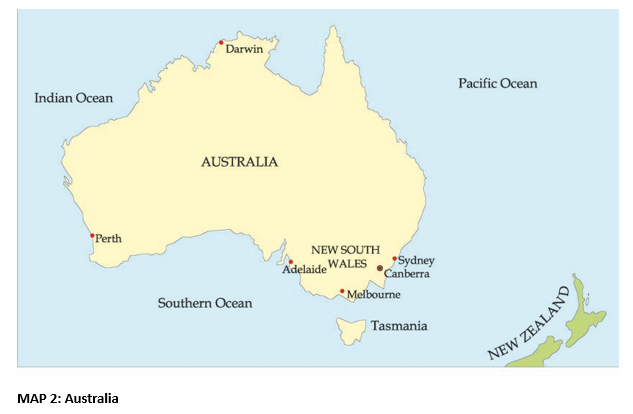
- Population pattern: Australia is sparsely populated; most towns lie along the coast, where the British first arrived, because the centre is arid desert.
- Indigenous land connection: Land was sacred and sustained Indigenous communities; European settlement disrupted access to it and its resources.
European Arrival and Indigenous Dispossession
European arrival
- 1606Dutch travellers sighted Australia.
- 1642Tasman landed on the island later named Tasmania.
- 1770James Cook reached Botany Bay and named the region New South Wales.
- 1788The British established a penal colony in Australia.
From first contact to violence and dispossession
- Cook and his crew initially described friendly encounters with Indigenous people.
- Cook was later killed by a native person in Hawaii, not Australia.
- British colonisers used this separate incident to justify violence against Indigenous Australians.
- Penal transportation continued in Australia after similar practices were abandoned in Brazil and the American colonies.
- Many convicts remained in Australia after their sentences, on condition they did not return to Britain; settlers took Indigenous land for cultivation.
Impact on the Daruk people
- Pressure on food: In the Sydney area, a large and growing settler population placed unprecedented pressure on local food resources.
- Damage to sacred places: Clearing land, moving stones, digging clay and building structures seemed inexplicable and violent to the Daruk people.
- Avoidance: Daruk people avoided the settlement; officials resorted to kidnapping to bring them back.
- Mass death: In the nineteenth and twentieth centuries, nearly 90% of Indigenous people died from germs, loss of land and resources, and battles with settlers.
Economic and Political Development
Development of Australia
- 1850Self-government was granted to the Australian colonies.
- 1851Chinese coolie immigration began; it was stopped by law in 1855.
- 1851–1961Gold rushes took place.
- 1901The Australian Federation was formed, joining six states.
- 1911Canberra was established as the capital.
- 1948–1975Two million Europeans migrated to Australia.
Economy, labour and immigration
- Economic base: Vast sheep farms and mining stations developed over time, followed by vineyards and wheat farming.
- Capital name: “Woolwheatgold” was suggested for the new capital; Canberra comes from a native word meaning “meeting place.”
- Indigenous labour: Some Indigenous people worked on farms under conditions little different from slavery.
- Chinese labour and exclusion: Chinese immigrants supplied cheap labour, but fear of dependence on non-white workers led Australia and the United States to restrict Chinese immigration.
- White Australia policy: Until 1974, fear of migration from South and Southeast Asia supported policies to keep non-white people out.
Recognition, Rights and Reconciliation
Changing public understanding and policy
- 1968Anthropologist W.E.H. Stanner’s lecture “The Great Australian Silence” criticised historians’ neglect of Aboriginal peoples.
- From the 1970sInterest grew in Indigenous cultures, knowledge, arts and stories, and in recording and respecting them.
- 1974Multiculturalism became official policy, and the White Australia policy ended, allowing Asian immigrants to enter.
- 1992In the Mabo case, the High Court declared terra nullius legally invalid and recognised Indigenous land claims predating 1770.
- 1995A national inquiry examined the separation of Aboriginal and Torres Strait Islander children from their families.
- 26 May 1999National Sorry Day apologised for children separated from their families from the 1820s to the 1970s.
| Point | Older narrative | Broader approach |
|---|---|---|
| Starting point | Often treated Captain Cook’s arrival as the beginning of Australian history. | Recognises Indigenous history and societies long before Cook. |
| Indigenous peoples | Often ignored or treated as objects of anthropological curiosity. | Understood as communities with distinct cultures, knowledge and historical ties to land. |
| Recording culture | Indigenous stories and skills risked being forgotten. | Universities, galleries and museums increasingly studied and presented Indigenous cultures; Indigenous people began writing their own life histories. |
- Dreamtime
- Indigenous understanding of the past in which the distinction between past and present is blurred.
- Terra nullius
- The claim that the land belonged to nobody; the High Court declared it legally invalid in 1992.
- Mabo case
- The 1992 High Court decision recognising Indigenous land claims from before 1770.
- Multiculturalism
- Official Australian policy from 1974 giving respect to Indigenous cultures and immigrant cultures.
Land rights and separation of children
- Treaties: Unlike the United States, Canada and New Zealand, Australia had no treaties formalising the European takeover of Indigenous land.
- Land connection: Enquiries recognised Indigenous peoples’ historic and sacred bonds with the land, which should be respected.
- Forced separation: Children of mixed Indigenous and European descent were forcibly taken from their families to separate “white” and “coloured” people.
- Public apology: Past acts could not be undone, but a public apology was made for the injustice done to the separated children.
Key voices
- W.E.H. Stanner: His 1968 lecture “The Great Australian Silence” drew attention to historians’ silence about Aboriginal peoples.
- Henry Reynolds: His book *Why Weren’t We Told?* criticised histories that began with Cook’s “discovery.”
- Judith Wright (1915–2000): An Australian writer and champion of Aboriginal rights; her poem “Two Dreamtimes,” written for Oodgeroo Noonuccal, reflects on racial separation and Indigenous loss of land.
How did European settlement affect the Daruk people?
What was terra nullius, and what changed in 1992?
What did “The Great Australian Silence” refer to?
Quick recap
- Aboriginal societies have lived in Australia for over 40,000 years, with diverse communities, languages and traditions.
- British settlement began with a penal colony in 1788 and brought land loss, resource pressure, violence and disease.
- Australian prosperity developed through sheep farming, mining, vineyards and wheat farming, alongside coercive Indigenous labour and immigration restrictions.
- From the 1960s and 1970s, public recognition of Indigenous cultures and history grew; multiculturalism became official in 1974.
- The 1992 Mabo decision rejected terra nullius and recognised Indigenous land claims predating 1770.
- The 1995 inquiry and 1999 National Sorry Day addressed the forced separation of Aboriginal and Torres Strait Islander children.