Class 11 Humanities . History . Themes In World History . Changing Cultural Traditions
Chapter 5: CHANGING CULTURAL TRADITIONS
Ch 5
History
Class 11 Humanities
Introduction & the Revival of Italian Cities
The Renaissance and a New Urban Culture
Renaissance — Meaning rebirth, this term was used by historians from the nineteenth century for cultural changes in Europe from the fourteenth to the seventeenth century.
Urban Culture and Changing Ideas
- Growing towns developed a distinct urban culture; townspeople often considered themselves more civilised than rural people.
- Art and learning flourished especially in Florence, Venice and Rome, supported by wealthy and aristocratic patrons.
- Printing spread books and prints to more people, including those in distant towns and countries.
- Historical outlook changed as Europeans contrasted their modern age with the ancient Greek and Roman worlds.
- Religion and science: religion increasingly came to be seen as an individual choice; scientists overturned the Church’s earth-centred view of the universe.
- Geographical knowledge overturned the Eurocentric idea that the Mediterranean Sea was the centre of the world.
Historical Interpretation and Sources
- Historical sources include documents, printed books, paintings, sculptures, buildings and textiles; many are preserved in archives, galleries and museums.
- Leopold von Ranke (1795–1886) stressed writing about states and politics through government papers and files.
- Jacob Burckhardt (1818–97), a Swiss historian and Ranke’s student, argued that history should consider culture as well as politics.
- The Civilisation of the Renaissance in Italy (1860) highlighted literature, architecture and painting, describing humanist culture in Italian towns from the fourteenth to seventeenth centuries.
- Individual potential was central to Burckhardt’s account: people could make their own decisions and develop their skills, unlike the medieval person he portrayed as controlled by the Church.
| Historian | Approach to history |
|---|---|
| Leopold von Ranke | Emphasised states and politics, using government papers and files. |
| Jacob Burckhardt | Argued history should also examine culture, including literature, architecture and painting. |
The Revival of Italian Cities
Trade and the Revival of Italian Cities
- Trade expanded between the Byzantine Empire and Islamic countries.
- Italian coastal ports revived through this trade.
- From the twelfth century, Mongol links opened trade with China via the Silk Route, while trade with western Europe also increased.
- Italian towns became central commercial hubs and increasingly acted as independent city-states.
Italian City-States
- Earlier decline: after the western Roman Empire fell, many Italian political and cultural centres fell into ruin; Italy lacked unified government.
- Political setting: the Pope ruled his own state but was not a strong political figure; Italy was fragmented while western Europe was shaped by feudalism and the Latin Church, eastern Europe by the Byzantine Empire, and parts of the west by Islamic civilisation.
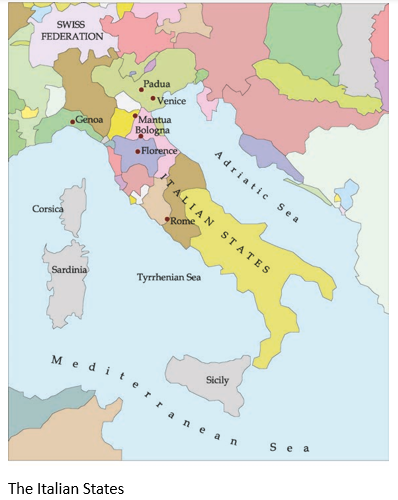
- Independent cities: Florence and Venice were republics; many other Italian towns were court-cities ruled by princes.
- Merchant influence: in Venice and Genoa, rich merchants and bankers participated in government; clergy and powerful feudal lords were less politically dominant.
- Citizenship: civic pride took root among townspeople and could persist even when a city was ruled by a military despot.
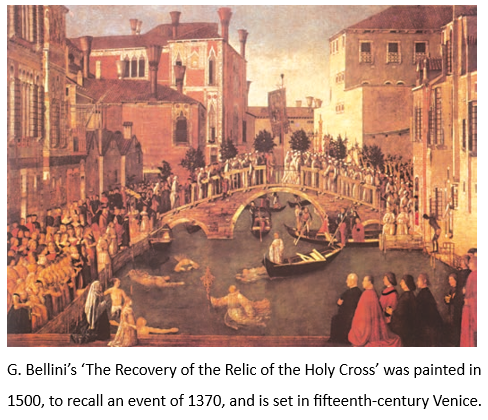
The City-State of Venice
Venetian commonwealth — The Venetian state, whose governing authority was held by a council of eligible citizens, according to Cardinal Gasparo Contarini.
Contarini’s Account (1534)
- Council membership: in *The Commonwealth and Government of Venice*, Contarini says gentlemen aged over 25 could enter the governing council.
- Restricted participation: ordinary people were excluded because popular rule was believed likely to cause disorder and tumults.
- Basis of rule: Contarini favoured noble lineage over wealth, while allowing those noble by birth or ennobled by virtue to govern.
- Qualification: Venice’s commonwealth was an elite system, not democracy in the modern sense.
Fourteenth- and Fifteenth-Century Milestones
- 1300Humanism was taught at Padua University.
- 1341Petrarch received the title Poet Laureate in Rome.
- 1349A university was established in Florence.
- 1390Geoffrey Chaucer’s *Canterbury Tales* was published.
- 1436Brunelleschi designed the Duomo in Florence.
- 1453Ottoman Turks defeated the Byzantine ruler of Constantinople.
- 1454Gutenberg printed the Bible using movable type.
- 1484Portuguese mathematicians calculated latitude by observing the Sun.
- 1492Columbus reached America.
- 1495Leonardo da Vinci painted *The Last Supper*.
- 1512Michelangelo painted the Sistine Chapel ceiling.
Universities and Humanism
Humanism — An educational and intellectual movement that stressed classical learning and the abilities individuals develop through study, discussion and debate.
Universities and Humanist Learning
- Early universities: the earliest universities in Europe were established in Italian towns; Padua and Bologna were centres of legal studies from the eleventh century.
- Trade and law: commerce created demand for lawyers and notaries to interpret rules and record written agreements.
- Classical focus: law was increasingly studied in the context of ancient Roman culture.
- Petrarch (1304–78): he urged close reading of the actual works of ancient Greek and Roman authors, viewing antiquity as a distinct civilisation.
- Humanist teachers: by the early fifteenth century, “humanist” referred to masters who taught grammar, rhetoric, poetry, history and moral philosophy.
- Humanities: the term comes from *humanitas*, used by Cicero (106–43 BCE) to mean culture; these subjects were not drawn from or connected with religion.
- Individual skills: humanist learning stressed abilities developed through discussion and debate.
Debate, Learning and Florence
- Pico della Mirandola (1463–94) argued in *On the Dignity of Man* (1486) that debate strengthens the mind, just as exercise strengthens the body.
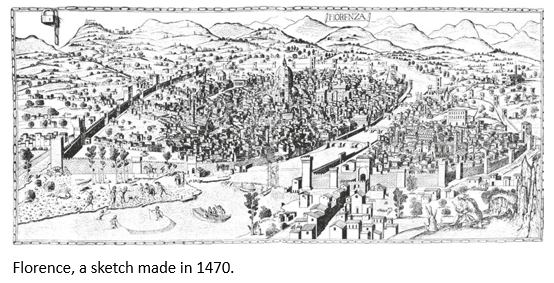
- Florence’s rise: the city became a leading centre of learning and artistic creativity, particularly in the fifteenth century.
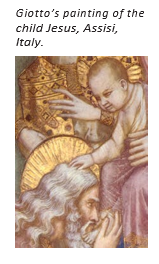
- Dante Alighieri (1265–1321) was a layman who wrote on religious themes; Giotto (1267–1337) painted lifelike portraits, unlike the stiff figures of earlier artists.
- Renaissance Man describes a person with many interests and skills, such as a scholar, diplomat, theologian and artist combined.
- City-state
- An independent city and its surrounding territory, governed as a state.
- Humanism
- Classical learning that emphasised human abilities, education and debate.
- Notary
- A professional who records and helps interpret written agreements.
- Renaissance Man
- A person known for skill and knowledge across several fields.
How did trade contribute to the revival of Italian cities?
What did humanist education emphasise?
Who could participate in the Venetian council, according to Contarini?
Quick recap
- From the fourteenth to seventeenth centuries, urban culture, artistic patronage and printing helped reshape European life.
- Renaissance historians, especially Burckhardt, stressed cultural change and individual potential.
- Trade revived Italian ports and encouraged independent city-states such as Florence and Venice.
- Venice’s council represented a restricted, elite form of civic government.
- The earliest European universities were established in Italian towns, and humanism promoted classical learning and debate.
- Florence became a leading centre of intellectual and artistic creativity.
The Humanist View of History
Humanist Periodisation of History
Humanist view and later reassessment
- Humanist claim: Humanists believed they were restoring ‘true civilisation’ after a period of darkness that began with the fall of the Roman Empire.
- Middle Ages: They applied this term to the thousand years after Rome’s fall and argued that Church influence had obscured Greek and Roman learning.
- Modern Age: Humanists used ‘modern’ for the period from the fifteenth century onwards.
- Later reassessment: Historians now question sharp cultural divisions between centuries and consider it unfair to label the whole period the ‘Dark Ages’.
| Period | Classification |
|---|---|
| 5th–14th century | Middle Ages |
| 5th–9th century | Dark Ages |
| 9th–11th century | Early Middle Ages |
| 11th–14th century | Late Middle Ages |
| 15th century onwards | Modern Age |
Science and Philosophy: The Arabs’ Contribution
Transmission of learning
- Greek and Roman works: Some were known to monks and clergy during the Middle Ages, but were not widely circulated.
- Arabic translations: In the fourteenth century, European scholars increasingly read Greek thinkers such as Plato and Aristotle through Arabic translations preserved by Arab scholars.
- Two-way translation: Greek works were translated into Arabic; works by Arabic and Persian scholars were also translated into Greek and then passed on to other Europeans.
- Fields transmitted: These works covered natural science, mathematics, astronomy, medicine and chemistry.
- Example: Ptolemy’s *Almagest*, written in Greek before 140 CE and later translated into Arabic, retains the Arabic article ‘al’ in its title.
- Universities: Law, medicine and theology remained dominant, while humanist subjects gradually entered schools in Italy and other European countries.
| Scholar | Known in Latin as | Contribution |
|---|---|---|
| Ibn Sina (980–1037) | Avicenna | Physician and philosopher from Bukhara in Central Asia |
| Al-Razi | Rhazes | Author of a medical encyclopaedia |
| Ibn Rushd (1126–1198) | Averroes | Philosopher of Spain who sought to reconcile philosophical knowledge and religious belief; Christian thinkers adopted his method |
Artists and Realism
Realism — A style that aimed to represent people and the visible world accurately, using observation and scientific knowledge.
Art, observation and science
- Art as learning: Art, architecture and books spread humanist ideas beyond formal education.
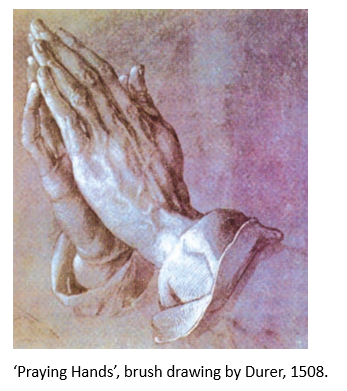
- Albrecht Dürer (1471–1528): He argued that artists should study and copy nature; geometry could guide their work, and careful observation helped them create convincing forms.
- Praying Hands: Dürer’s 1508 drawing reflects deep religious feeling alongside confidence in human skill and the ability to explore the world.
Realism in sculpture and painting
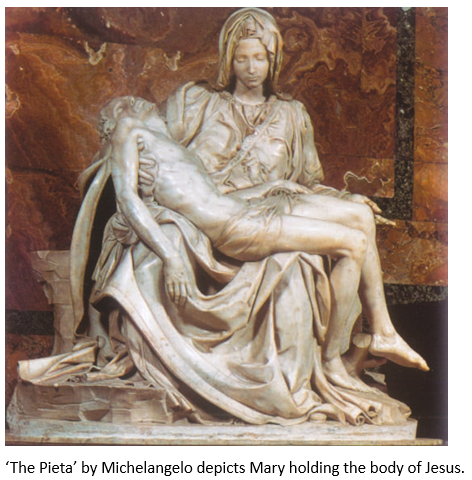
- Classical models: Artists studied ancient texts and Roman sculptures; admiration for ideal proportions inspired Italian sculptors to continue classical traditions.
- Donatello: In 1416, he broke new ground with lifelike statues.
- Anatomy: Artists studied human bone structures in medical schools. Andreas Vesalius (1514–1564), a Belgian professor at the University of Padua, was the first to dissect the human body; this began modern physiology.
- Perspective and light: Geometry helped painters create perspective, while observing changing light gave paintings a three-dimensional appearance.
- Oil paint: Oil as a medium gave paintings richer colour.
- Artistic influences: Costume colours and designs show influences from Chinese and Persian art, made available through the Mongols.
- Result: Anatomy, geometry, physics, observation and a sense of beauty gave Italian art a new quality called realism, which continued until the nineteenth century.
Leonardo da Vinci
- Range of interests: Leonardo da Vinci (1452–1519) studied botany, anatomy, mathematics and art; he painted the *Mona Lisa* and *The Last Supper*.
- Experiment and invention: He observed birds in flight for years and designed a flying machine.
- Self-description: He signed his name ‘Leonardo da Vinci, disciple of experiment’.
Architecture
Revival of classical architecture
- Rome’s revival: The city revived spectacularly in the fifteenth century. From 1417, the popes were politically stronger after the rivalry of two elected popes, which had begun in 1378, ended.
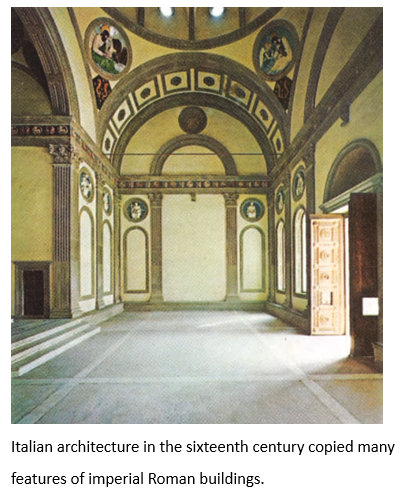
- Classical inspiration: Popes encouraged the study of Roman history. Archaeological excavation of Roman ruins inspired a revived imperial Roman style, known as classical architecture.
- Patrons and decoration: Popes, wealthy merchants and aristocrats employed architects familiar with classical forms; artists and sculptors decorated buildings with paintings, sculptures and reliefs.
- Michelangelo Buonarroti (1475–1564): He painted the Sistine Chapel ceiling, sculpted the *Pietà* and designed the dome of St Peter’s Church in Rome.
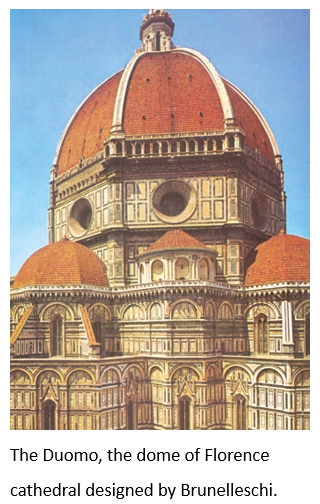
- Filippo Brunelleschi (1337–1446): Initially a sculptor, he designed Florence’s spectacular Duomo.
- Individual recognition: Artists increasingly became known by their own names, rather than only as members of a group or guild.
Architecture as a profession
- Leon Battista Alberti (1404–1472): He wrote on art theory and architecture and described an architect as someone able to design useful works that combine structural skill with beauty.
The First Printed Books
Printing and the spread of ideas
- Sources of technology: Europeans learned printing technology from the Chinese; European traders and diplomats became familiar with it through visits to Mongol courts. Firearms, the compass and the abacus were also important innovations known through these connections.
- Gutenberg’s press: In 1455, German inventor Johannes Gutenberg (1400–1458) printed 150 copies of the Bible in his workshop. Previously, a monk might spend the same time writing one copy by hand.
- Books by 1500: Many classical texts, nearly all in Latin, had been printed in Italy.
- Access to reading: Printed books could be bought, so students were no longer wholly dependent on lecture notes and individuals could own books. Reading habits grew.
- Rapid circulation: Ideas and information reached more people more quickly; a book promoting new ideas could reach hundreds of readers.
- Spread across Europe: From the late fifteenth century, circulating printed books helped Italian humanist culture spread across the Alps. Earlier intellectual movements had remained more regional.
How did Arab and Persian scholarship contribute to European learning?
What scientific methods and knowledge supported artistic realism?
How did printing help spread humanist culture?
Quick recap
- Humanists described the centuries after Rome’s fall as an age of decline and the fifteenth century onwards as modern; later historians question rigid labels such as ‘Dark Ages’.
- Arabic translators preserved Greek learning, and Arabic and Persian scholars contributed knowledge across several sciences and medicine.
- Renaissance realism combined anatomy, geometry, perspective, observation of light and oil painting; Donatello and Vesalius are key examples.
- Michelangelo and Brunelleschi exemplify the revival of classical architecture, while artists increasingly gained individual recognition.
- Gutenberg printed 150 Bibles in 1455; the circulation of printed books helped humanist ideas spread rapidly across Europe.
A New Concept of Human Beings
Humanism and the Individual
- Humanism: It encouraged individuals to develop their abilities and shape their own lives, rather than being defined only by their place in feudal society.
- Human nature: Humanists viewed people as many-sided, with varied qualities and interests; they also valued learning, good manners and personal achievement.
The Aspirations of Women
Women’s roles and opportunities
- Limited public role: The ideals of individuality and citizenship mainly excluded women. Aristocratic men dominated public decisions and family affairs.
- Aristocratic families: Sons were prepared for business or public life; daughters’ dowries could fund family businesses, but wives generally had little say in how their husbands ran them.
- Marriage and convents: Marriages could strengthen business alliances. Daughters without an adequate dowry might be sent to convents; women were often expected to manage the household.
- Merchant families: Wives might help run shops or manage businesses while male relatives travelled. A merchant’s early death could require his widow to take on a larger public role.
- Cassandra Fedele (1465–1558): The Venetian scholar urged women to study despite the lack of rewards or status offered to them. Skilled in Greek and Latin, she gave orations at the University of Padua.
- Women’s demands: Fedele and other Venetian women writers criticised freedoms defined to favour men. Their writings argued for women’s education, property and economic power.
- Isabella d’Este (1474–1539): The Marchesa of Mantua governed while her husband was away; her court was renowned for intellectual brilliance.
| Point | Cassandra Fedele | Balthasar Castiglione |
|---|---|---|
| Main emphasis | Women should pursue humanist learning and develop their own identity. | Women should cultivate virtues of mind while maintaining qualities he considered feminine. |
| Education and ability | Rejected the idea that women could not become humanist scholars. | Held that mental virtues such as prudence, good manners and intelligence were as necessary for women as for men. |
| Social expectations | Criticised a society that limited women’s freedom and favoured men. | Expected women to be graceful and tender, and to perform sports considered suitable for women. |
| Social class in view | A learned Venetian woman arguing for women’s education and wider opportunities. | A courtly ideal, focused on elite women rather than women of every class. |
Castiglione’s ideal
- The Courtier (1528): Balthasar Castiglione, an author and diplomat, set out expectations for women at court.
- Gender distinction: He argued that women should not imitate men in manners, speech or bearing, but should appear graceful and feminine.
- Shared virtues: He valued intelligence, prudence, good family, natural grace and good manners in women, as in men.
Debates within Christianity
Christian humanism and criticism of the Church
- Spread of ideas: Trade, travel, conquest and diplomacy connected Italian towns with the wider world. Educated and wealthy people adopted humanist culture, while few ideas reached ordinary people, many of whom could not read or write.
- Northern humanism: In the fifteenth and early sixteenth centuries, northern European scholars studied Greek and Roman classics alongside Christian texts. Unlike in Italy, many northern humanists were Church members.
- Religious reform: Christian humanists urged a return to early religious texts and rejection of rituals they saw as later additions. They viewed people as free, rational agents able to pursue happiness in this life.
- More and Erasmus: Thomas More (1478–1535) in England and Erasmus (1466–1536) in Holland criticised Church greed and the extraction of money from ordinary people.
- Indulgences: These documents were sold as a way to free buyers from the burden of their sins. Printed Bible translations in local languages helped people see that such practices were not permitted by their religion.
- Donation of Constantine: Humanist scholars showed that this document, used to support Church judicial and fiscal powers, was a later forgery rather than a genuine imperial grant.
- New Testament: The part of the Bible dealing with the life and teachings of Christ and his early followers.
Causes and spread of the Reformation
- Church abuses: Church taxes and clerical extortion angered peasants; interference by Church authorities also frustrated princes.
- Humanist criticism: Scholars exposed questionable Church claims, including the forged Donation of Constantine.
- Access to scripture: Printed Bible translations in local languages let people compare Church practices with scripture.
- Luther’s challenge: In 1517, Martin Luther argued that faith in God—not dependence on priests—guided a person to the right life and salvation.
- Reformation: The movement led churches in Germany and Switzerland to break their connection with the Pope and the Catholic Church.
Reformers and their ideas
- Martin Luther (1483–1546): A German monk who launched his campaign in 1517. He urged complete faith in God and argued that priests were not necessary for a person to reach God.
- Ulrich Zwingli (1484–1531) and Jean Calvin (1509–1564): They popularised Luther’s ideas in Switzerland.
- Urban and rural support: Backed by merchants, reformers gained more appeal in towns; the Catholic Church retained greater influence in rural areas.
- Anabaptists: These radical German reformers linked salvation with ending social oppression. They argued that people were equal before God, should not have to pay taxes and could choose their priests.
- William Tyndale (1494–1536): An English Lutheran who translated the Bible into English in 1506. He argued that scripture had to be available in the mother tongue so ordinary people could understand it and resist clerical superstition and greed.
- Luther and rebellion: Luther opposed radicalism and called on German rulers to suppress the peasants’ revolt; they did so in 1525.
- France: Protestant resistance continued, and persecuted Protestants claimed the right of people to remove an oppressive ruler and choose a ruler of their own. Eventually, the Catholic Church allowed Protestants in France, as in many other parts of Europe, to worship as they chose.
- England: The rulers ended the connection with the Pope; the king or queen became head of the Church.
- Catholic reform: The Catholic Church also reformed from within. In Spain and Italy, churchmen stressed simple living and service to the poor.
- Jesuits: Ignatius Loyola founded the Society of Jesus in 1540 to combat Protestantism. Its followers served the poor and broadened their knowledge of other cultures.
The Sixteenth and Seventeenth Centuries
- 1516Thomas More’s *Utopia* was published.
- 1517Martin Luther wrote the Ninety-Five Theses and began his campaign against the Catholic Church.
- 1522Luther translated the Bible into German.
- 1525The German peasant uprising was suppressed by the rulers.
- 1543Andreas Vesalius wrote *On Anatomy*.
- 1559The Anglican Church was established in England, with the king or queen as its head.
- 1569Gerhardus Mercator prepared a cylindrical map of the earth.
- 1582Pope Gregory XIII introduced the Gregorian calendar.
- 1628William Harvey linked the heart with blood circulation.
- 1673The Academy of Sciences was established in Paris.
- 1687Isaac Newton published *Principia Mathematica*.
- Humanism
- A cultural movement that stressed human potential, classical learning and individual life.
- Indulgence
- A document sold by the Church as freeing its buyer from the burden of committed sins.
- Protestant Reformation
- A movement that challenged the Catholic Church and led churches in Germany and Switzerland to break with the Pope.
- Anabaptists
- Radical German reformers who linked salvation with social equality and resistance to oppression.
What were the main issues on which Protestants criticised the Catholic Church?
How did women’s roles differ across social groups, and what did some women seek?
What was distinctive about the Anabaptists’ reform ideas?
Quick recap
- Humanism promoted individual potential and worldly learning without necessarily rejecting religion.
- Many-sided human nature challenged feudal society’s division into three separate orders.
- Machiavelli saw insatiable desires and self-interest as powerful forces shaping human actions.
- Women’s opportunities varied by social position, but women writers called for education, property and economic power.
- Christian humanists criticised Church abuses and promoted scripture-based religious practice.
- The Reformation challenged papal authority; Protestants eventually gained permission to worship in France and many other parts of Europe, while Catholic reform also followed, including the creation of the Jesuits.
The Copernican Revolution
The Copernican Revolution
Geocentric view — The traditional Christian model placed an immobile Earth at the centre of the universe, with celestial planets moving around it.
From an Earth-centred to a Sun-centred Universe
- Traditional belief: Earth was seen as sinful and burdened by sin, so it was thought to be immobile at the universe’s centre.
- Copernicus: He argued that Earth and the other planets move around the Sun. He feared opposition from traditionalist clergy and hesitated to publish *De revolutionibus* (The Rotation).
- Manuscript: Copernicus (1473–1543) entrusted *De revolutionibus* to his follower Joachim Rheticus on his deathbed.
- Kepler: His *Cosmographical Mystery* popularised the Sun-centred system and showed that planets move in ellipses, not circles.
- Heaven and Earth: More than half a century after Copernicus, Kepler’s and Galileo’s writings helped bridge the supposed divide between heaven and Earth.
- Galileo and Newton: Galileo Galilei (1564–1642) supported the idea of a dynamic world in *The Motion*; Isaac Newton’s theory of gravitation brought this scientific transformation to its climax.
| Thinker | Contribution |
|---|---|
| Nicolaus Copernicus (1473–1543) | Proposed that Earth and the other planets move around the Sun. |
| Johannes Kepler (1571–1630) | Popularised the Sun-centred system in *Cosmographical Mystery* and described planetary orbits as ellipses. |
| Galileo Galilei (1564–1642) | Supported the idea of a dynamic world in *The Motion*. |
| Isaac Newton | His theory of gravitation brought the scientific transformation to its climax. |
- Celestial
- Relating to the heavens or divine things.
- Terrestrial
- Relating to earthly or worldly things.
- Heliocentric
- Sun-centred; a system in which Earth and other planets move around the Sun.
- Scientific Revolution
- A new approach to understanding people and nature through observation and experiments.
Reading the Universe
A New Approach to Knowledge
- Evidence-based knowledge: These thinkers distinguished knowledge from belief by relying on observation and experiments to study nature.
- New fields: Investigations in physics, chemistry and biology expanded rapidly; historians later called this approach the Scientific Revolution.
- Changing views of God and nature: Some sceptics and non-believers saw Nature, rather than God, as the source of creation. Some believers retained faith but described God as distant from everyday material life.
- Public science: Scientific societies spread scientific culture through public lectures and experiments.
| Institution | Place | Established | Role |
|---|---|---|---|
| Royal Society | London | 1662 | Promoted natural knowledge through lectures and public experiments. |
| Paris Academy | Paris | 1670 | Promoted scientific learning through lectures and public experiments. |
Reconsidering the Renaissance
| Point | Sharp-break view | Revised interpretation |
|---|---|---|
| Renaissance and Middle Ages | The Renaissance was a rebirth of Greek and Roman ideas, sharply different from a dark and undeveloped Middle Ages. | Peter Burke argued that this contrast exaggerates the break; earlier centuries also had cultural achievement. |
| Classical and Christian cultures | The Renaissance replaced the Christian worldview with a pre-Christian one. | Greek and Roman cultures were known earlier, and religion remained important in people’s lives. |
| Cultural development | Dynamism and artistic creativity belonged mainly to the Renaissance. | Some Renaissance features had roots in the twelfth and thirteenth centuries; France had a literary and artistic flowering in the ninth century. |
Cultural Change and Global Connections
- Classical recovery: Archaeological and literary study of Roman culture inspired admiration, but European cultural change did not come only from Greece and Rome.
- Knowledge beyond Europe: Europeans learned from India, Arabia, Iran, Central Asia and China; technologies and skills in Asia had advanced beyond what the Greeks and Romans knew.
- Wider connections: Navigation techniques enabled longer voyages. Islamic expansion and Mongol conquests connected Europe with Asia and North Africa through trade and learning, not political unity.
- Eurocentric histories: These influences were often overlooked because historians first wrote about the period from a Europe-centred viewpoint.
Individuals, Public Life and Regional Identity
Changing Social and Political Identities
- Public sphere: Government and formal religion belonged to public life; family and personal religion belonged to private life. These spheres gradually became distinct.
- Individual identity: A person had private as well as public roles, not simply a place within one of the ‘three orders’. An artist could be recognised as an individual, not only as a guild member.
- Political expression: By the eighteenth century, individual identity was expressed in the belief that all individuals had equal political rights.
- Language and identity: European regions developed distinct identities based on language. The earlier unity associated with the Roman Empire, Latin and Christianity gave way to states united by common languages.
Key Periods and Dates
- Ninth centuryFrance experienced a literary and artistic flowering.
- Twelfth–thirteenth centuriesSome cultural developments associated with the Italian Renaissance had earlier roots.
- 1473–1543Lifetime of Nicolaus Copernicus, who proposed a Sun-centred system.
- 1564–1642Lifetime of Galileo Galilei, who supported the dynamic-world view.
- 1571–1630Lifetime of Johannes Kepler, who popularised the Sun-centred system and described planetary orbits as ellipses.
- 1662The Royal Society was formed in London to promote natural knowledge.
- 1670The Paris Academy was established.
- Eighteenth centuryThe idea of individual identity took political form in the belief in equal political rights.
How did the Copernican Revolution change ideas about the universe?
Why is it an oversimplification to describe the Renaissance as a sharp break from the Middle Ages?
Quick recap
- Copernicus proposed a Sun-centred system; Kepler popularised it and described elliptical planetary orbits.
- Kepler’s and Galileo’s writings helped bridge the supposed distinction between heaven and Earth; Newton’s gravitation theory brought the revolution to its climax.
- Observation and experiments distinguished scientific knowledge from belief and helped launch the Scientific Revolution.
- Scientific societies made natural knowledge more public through lectures and experiments.
- The Renaissance was not a complete break from earlier centuries or a simple replacement of Christian culture.
- European cultural change drew on classical traditions and knowledge from Asia and North Africa.
- The period saw clearer private and public spheres, growing individual identity and language-based regional identities.