Class 12 Commerce . Accountancy . Company Accounts and Analysis of Financial Accounts . Accounting for Share Capital
Chapter 1: Accounting for Share Capital
Ch 1
Accountancy
Class 12 Commerce
Features of a Company
Company — A company is an artificial legal person incorporated or registered under the Companies Act, 2013, or an earlier Companies Act; it exists separately from its members.
Basic nature
- Association: Persons contribute money or money’s worth to a common pool and use it for a common purpose.
- Artificial person: A company is invisible and intangible, existing in the eyes of the law; this description is attributed to Chief Justice Marshal.
- Ownership: Shareholders contribute capital and are the company’s real owners.
- Management: Shareholders elect a Board of Directors to manage the company’s affairs.
- Capital: A company usually raises funds through shares (share capital) and debentures (debt capital).
- Governance: The company’s affairs are governed by the Companies Act and applicable provisions.
Distinctive features
| Feature | Meaning |
|---|---|
| Body corporate | Formed according to law. In India, companies are generally formed and registered under company law; banking and insurance companies are formed under separate laws. |
| Separate legal entity | Distinct from its members; it can own and deal with property, enter contracts, and hold a bank account in its own name. |
| Limited liability | Members’ liability is generally limited to the unpaid amount on their shares or, for a guarantee company, the amount guaranteed. |
| Perpetual succession | The company continues despite changes in membership, including a member’s death, insanity, or insolvency. It ends only through law. |
| Common seal | As an artificial person, the company cannot sign for itself. The lecture states that every company must have a common seal as its official signature, and a document without it is not binding on the company. |
| Transferability of shares | Shares in a public company are freely transferable; the company’s articles may prescribe the manner of transfer. |
| May sue or be sued | The company can enforce contractual rights and can sue or be sued in its own name. |
Limited liability does not mean no liability: a member may still owe the unpaid amount on shares or the promised guarantee.
Kinds of companies
| Type | Extent of members’ liability |
|---|---|
| Company limited by shares | Limited to the nominal value of shares held. A member who has paid the full amount owes nothing further for company debts; liability, if any, may be enforced during the company’s existence or winding up. |
| Company limited by guarantee | Limited to the amount each member promises to contribute if the company is wound up; the obligation arises on winding up. |
| Unlimited company | No limit is placed on members’ liability. If company assets cannot pay debts, members’ private property may be used; such companies are permitted by law but are not found in India according to the lecture. |
Classification by number of members
- Public company: A company that is not a private company and is not a subsidiary of a private company.
- Private company: Its articles restrict share transfers and limit membership to 200, excluding employees; it generally requires at least two members, except in the case of an OPC.
- One Person Company (OPC): Under Section 2(62) of the Companies Act, 2013, a company with only one member.
| Condition | Provision |
|---|---|
| Eligible member | A natural person who is an Indian citizen and resident in India. |
| Restricted activity | Cannot carry out non-banking financial investment activities. |
| Paid-up share capital | Not more than Rs. 50 lakhs. |
| Average annual turnover | Does not exceed Rs. 2 crores over three years. |
Use the OPC conditions and limits prescribed by the syllabus or applicable law.
Distinguish a company limited by shares from a company limited by guarantee.
Explain separate legal entity and perpetual succession.
State the main features of a private company given in the lecture.
Quick recap
- A company is an association of persons who pool money or money’s worth for a common purpose.
- Shareholders own the company and elect directors to manage it.
- A company is an artificial legal person, distinct from its members, with perpetual succession.
- It can own property, contract, maintain a bank account, and sue or be sued in its own name.
- Members’ liability depends on whether the company is limited by shares, limited by guarantee, or unlimited.
- Public, private, and one-person companies are classified by their membership-related features.
- The lecture describes public-company shares as freely transferable and private-company articles as restricting transfers.
Share Capital of a Company
Share capital — Share capital is the amount contributed by a company’s shareholders and recorded collectively in the Share Capital Account.
Why contributions are pooled
- Shareholders: A company raises capital from the people who contribute to it.
- Common account: Since a company may have many shareholders, their contributions are recorded together rather than in separate capital accounts.
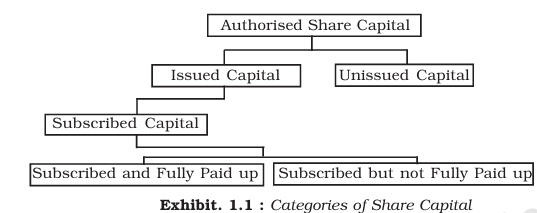
Categories of Share Capital
| Category | Meaning | Key point |
|---|---|---|
| Authorised capital | Maximum share capital the company is permitted to issue under its Memorandum of Association. | Also called nominal or registered capital; it may be increased or decreased as prescribed by the Companies Act. |
| Issued capital | Part of authorised capital actually issued for subscription, including shares allotted to vendors and memorandum signatories. | The authorised capital not offered is unissued capital; it may be offered later. |
| Subscribed capital | Part of issued capital actually subscribed by the public. | It is equal to or less than issued capital. Oversubscription does not increase the amount recorded; allotment cannot exceed the offer. |
| Called-up capital | Part of subscribed capital that the company has asked shareholders to pay. | The company may call all or only part of a share’s face value. |
| Paid-up capital | Part of called-up capital actually received from shareholders. | If all calls are paid, it equals called-up capital; otherwise, calls in arrears reduce it. |
| Uncalled capital | Part of subscribed capital that the company has not yet asked shareholders to pay. | It may be called when the company needs funds. |
| Reserve capital | Part of uncalled capital reserved to be called only if the company is wound up. | Available only to meet creditors’ claims on winding up. |
Here, is paid-up capital, is called-up capital, is calls in arrears, is uncalled capital, and is subscribed capital.
Do not treat applications for more shares than offered as extra subscribed capital: allotment and recorded subscribed capital cannot exceed the number of shares issued.
Balance Sheet Presentation: Sunrise Company Ltd.
Information from the example
- Authorised: 4,00,000 shares of Rs. 10 each, totalling Rs. 40,00,000.
- Offered and allotted: 2,00,000 shares; applications were received for 2,50,000, so 50,000 applications were rejected.
- Payment terms: Rs. 2 on application, Rs. 3 on allotment, Rs. 3 on first call and the balance on final call.
- Calls made: The final call was not made, so Rs. 2 per share remained uncalled.
- Arrears: First-call money was unpaid on 2,000 shares; calls in arrears were Rs. 6,000.
Prepare the relevant Share Capital extract for the Notes to Accounts.
- Calculate issued and subscribed capital from the shares offered and allotted.
- Find the called-up amount per share; the final call was not made.
- Calculate total called-up capital and calls in arrears.
- Deduct arrears to find paid-up capital.
| Particulars | Amount (Rs.) | Amount (Rs.) |
|---|---|---|
| Authorised / Registered / Nominal Capital: 4,00,000 shares of Rs. 10 each | 40,00,000 | |
| Issued Capital: 2,00,000 shares of Rs. 10 each | 20,00,000 | |
| Subscribed but not fully paid: 2,00,000 shares of Rs. 10 each, Rs. 8 called up | 16,00,000 | |
| Less: Calls in arrears | (6,000) | 15,94,000 |
A company has authorised capital of 1,00,000 shares of Rs. 10 each and issues 60,000 shares. Applications are received for 55,000 shares and all are allotted. Find unissued and subscribed capital.
A company has 10,000 subscribed shares of Rs. 10 each and has called Rs. 7 per share. Shareholders have not paid Rs. 4,000 of the calls. Find called-up, paid-up and uncalled capital.
What is reserve capital, and when can it be called?
Quick recap
- Shareholders’ contributions are recorded together in the Share Capital Account.
- Authorised capital is the maximum permitted; issued capital is the part offered for subscription.
- Subscribed capital cannot exceed issued capital; oversubscription does not raise the recorded amount.
- Called-up capital is the amount demanded; paid-up capital is called-up capital less calls in arrears.
- Uncalled capital has not yet been demanded; reserve capital is callable only on winding up.
- Sunrise’s paid-up subscribed capital is Rs. 15,94,000 after deducting Rs. 6,000 arrears.
Nature and Classes of Shares
Meaning and Classes of Shares
Share — A share is a unit of a company’s share capital and represents a fractional ownership interest in the company.
How share capital is set out
- Shareholders are people who contribute money to a company by subscribing for its shares.
- Memorandum of Association (MOA) states the authorised capital and the number of shares into which it is divided.
- Articles of Association (AOA) prescribe the share classes and their respective rights and obligations.
| Class | Also called | Main feature |
|---|---|---|
| Preference shares | — | Preferential rights to dividend and repayment of capital |
| Equity shares | Ordinary shares | No preferential rights; share in remaining distributable profits |
Preference Shares
Preference share — Under Section 43 of the Companies Act, 2013, a preference share carries preferential rights to dividend and repayment of capital over equity shares.
Preference rights
- Dividend priority: Preference shareholders receive a fixed amount or a dividend at a fixed rate on nominal value before any dividend is paid to equity shareholders.
- Capital priority: On winding up, their capital is repaid before any capital is repaid to equity shareholders.
- Surplus participation: The MOA or AOA may allow preference shareholders to participate fully or partly in company surpluses.
| Classification | Meaning |
|---|---|
| Participating / non-participating | May / may not share fully or partly in surplus profits, as provided by the company’s rules. |
| Cumulative / non-cumulative | Unpaid dividends accumulate for later payment / do not accumulate. |
| Redeemable / irredeemable | Capital is repayable under the terms of issue / is not repayable under those terms. |
Equity Shares
Equity share — Under Section 43 of the Companies Act, 2013, an equity share is any share that is not a preference share.
Key features
- No preferential rights: Equity shares have no priority for dividend or repayment of capital.
- Dividend: Equity shareholders share distributable profits after preference dividend rights are satisfied; their dividend is not fixed and can vary with profits available for distribution.
- Voting rights: Equity capital may carry ordinary voting rights or differential rights relating to voting, dividend or otherwise, subject to prescribed rules and conditions in the AOA.
| Point | Preference shares | Equity shares |
|---|---|---|
| Dividend | Priority; fixed amount or fixed rate of nominal value | Paid after preference dividend rights; amount can vary |
| Capital on winding up | Repaid before equity capital | Repaid after preference capital |
| Surplus | May participate if company rules provide | Share in distributable profits after preference rights are met |
Issue of Shares and Payment Instalments
Instalment payment — A company may collect the amount payable on its shares in stages to meet its financial requirements over time.
Stages of payment
- Application money
- Allotment money
- First call
- Second call and any further calls
- Final call, if there is a last instalment
- Full payment: A company may instead call the full amount on the shares at the time of application.
Procedure for Issue of Shares
Main steps
- Issue a prospectus inviting the public to subscribe; it gives company information and explains how the money will be collected.
- Receive applications and application money, deposited with a scheduled bank as specified in the prospectus.
- Obtain the minimum subscription and complete the required legal formalities before allotting shares.
- Send allotment letters to successful applicants and regret letters to applicants who receive no shares.
- Allotment creates a valid contract between the company and the applicants, who then become shareholders.
Minimum Subscription
Minimum subscription — The minimum subscription is the amount that directors consider necessary to meet the company’s specified business and issue-related needs.
What it must cover
- Property and issue costs: Amounts payable for property bought or to be bought from issue proceeds, preliminary expenses and share-issue commission.
- Related borrowing: Repayment of money borrowed to meet the property or issue costs above.
- Operations: Working capital and other expenditure required for the usual conduct of business.
Subscription and refund rules
- Minimum level: As stated in the source under SEBI (Disclosure and Investor Protection) Guidelines, 2000, minimum subscription cannot be less than of the issued amount.
- Time to obtain it: The company must receive minimum subscription within 120 days from the prospectus issue date; otherwise, it cannot proceed with allotment.
- Refund deadline: If minimum subscription is not received in time, application money must be returned within 130 days from the prospectus issue date.
- Delayed refund: If refund is delayed beyond 8 days from closure of the subscription list, the company is liable to pay interest at under Section 73(2), as stated in the source.
Issue at Par or at a Premium
| Point | At par | At a premium |
|---|---|---|
| Issue price compared with nominal value | Equal | Greater |
| Meaning | Shares are issued at their nominal (face) value | The excess over nominal value is the premium |
Let be premium per share, be issue price per share, and be nominal value per share.
Calculate the premium per share for a share with nominal value Rs. 10 issued at Rs. 12.
- A share with nominal value Rs. 10 is issued for Rs. 12; find the premium per share.
- The issue price is above nominal value, so the share is issued at a premium.
A company receives applications but does not obtain minimum subscription within 120 days of issuing its prospectus. What must it do?
State two preferential rights attached to preference shares and one usual feature of equity dividends.
Quick recap
- A share is a fractional unit of share capital; the MOA states authorised capital and the AOA sets share classes and rights.
- Preference shares have priority for specified dividends and repayment of capital; they may also be classified by participation, accumulation and redemption.
- Equity shares have no preferential rights; their dividends vary and their capital may carry ordinary or differential rights.
- Share payments may be collected through application, allotment and calls, though the full amount may be called with the application.
- A company must obtain minimum subscription before allotment and follow the stated application-money refund deadlines.
- At par, issue price equals nominal value; at a premium, issue price exceeds nominal value and the difference is the premium.
Accounting Treatment
Application Money
- Application money: Applicants submit the prescribed amount with their applications; the money is deposited in a separate bank account.
- Entry: Debit Bank A/c and credit Share Application A/c when application money is received.
Allotment of Shares
Combined refund and adjustment entry
- Combined entry: Debit Share Application A/c and credit Share Allotment A/c for the excess adjusted, and Bank A/c for the amount refunded.
Combined Share Application and Allotment Account
- Why combine: Application and allotment are closely connected: allotment follows an application, and application relates to allotment.
- Use: A company may use one Share Application and Allotment A/c instead of separate application and allotment accounts.
| Transaction | Debit | Credit |
|---|---|---|
| Receive application money | Bank A/c | Share Application and Allotment A/c |
| Transfer application money and record allotment amount due | Share Application and Allotment A/c | Share Capital A/c |
| Refund money on rejected applications | Share Application and Allotment A/c | Bank A/c |
| Receive allotment money | Bank A/c | Share Application and Allotment A/c |
ASBA: Applications Supported by Blocked Amount
- ASBA: The application amount is blocked in the applicant’s bank account instead of being transferred to the company immediately.
- Allotment: The bank transfers the amount for shares allotted; the remaining blocked amount is released.
Calls on Shares
Additional rules for calls
- Articles of Association: Calls must follow the company’s Articles. If the company has no Articles, the standard provisions traditionally associated with Table A include a maximum call of of face value, at least one month between calls and at least days’ notice.
- Uniformity: Calls must be made uniformly on all shares of the same class.
- Share types: Accounting treatment is the same for equity and preference shares; include “Equity” or “Preference” in account names to distinguish them.
Use to calculate application, allotment or call money due.
Record the transactions using separate application, allotment and call accounts.
- A company issues 10,000 shares and receives Rs. 3 application money on 12,000 shares. It allots 10,000 shares, with allotment money of Rs. 4 per share, and adjusts excess application money against allotment. It later makes and receives a First and Final Call of Rs. 3 per share. Calculate the amounts.
- Calculate total application money received and the excess available for adjustment.
- Calculate allotment due and the balance received after adjustment.
- Calculate the First and Final Call due and received.
A company receives Rs. 48,000 on applications. It allots shares for which application money is Rs. 40,000 and refunds the balance. Give the entries.
A company makes a Second and Final Call of Rs. 2 per share on 5,000 shares and receives the amount in full. Record the entries.
Quick recap
- Application: Receive application money through Bank A/c and initially credit Share Application A/c; the minimum is of face value.
- Allotment: Transfer application money for allotted shares to Share Capital; refund rejected applications and adjust excess against allotment due.
- Combined account: Share Application and Allotment A/c can be used instead of separate application and allotment accounts.
- ASBA: The bank blocks application money, debits the amount due for allotted securities and releases the balance.
- Calls: Debit the relevant Share Call A/c when a call becomes due; credit it when the money is received.
- Call rules: A call should not exceed of face value, with at least one month between calls unless the Articles provide otherwise; standard provisions where no Articles exist also include days’ notice and uniform calls within a class.
Illustration 1 based on Accounting Treatment
Share issue in instalments
Share capital instalments — The issue price of a share may be collected in stages such as application, allotment and calls.
Journal-entry pattern
- Money received: Debit Bank and credit the relevant Application, Allotment or Call account.
- Amount due: Debit the relevant instalment account and credit Share Capital.
- Transfer application money: Debit Share Application and credit Share Capital.
- Refund: Debit Share Application and credit Bank for application money returned to rejected applicants.
- Unpaid calls: Credit the relevant Call account only for the amount actually received; the unpaid balance remains due.
Use the number of shares to which the instalment applies.
Prepare the entries
- Calculate the amount received, due, transferred or refunded at each stage.
- Record each amount due by debiting the instalment account and crediting Share Capital.
- Record receipts through Bank; record refunds by crediting Bank.
- For a short receipt, record only the cash received against the call account.
Record the share issue transactions in the company's books.
- Mona Earth Mover Limited issued 12,000 shares of Rs. 100 each. Application was Rs. 30, allotment Rs. 40, first call Rs. 20 and final call Rs. 10 per share.
- Applications for 13,000 shares arrived; 1,000 were rejected and their application money was refunded.
- Transfer the application money for the 12,000 allotted shares to Share Capital.
- Allotment was fully received; first-call and final-call amounts were unpaid on 100 shares each.
| Particulars | Debit (Rs.) | Credit (Rs.) |
|---|---|---|
| Bank A/c Dr. To Share Application A/c — application received on 13,000 shares | 3,90,000 | 3,90,000 |
| Share Application A/c Dr. To Share Capital A/c — application money transferred for 12,000 shares | 3,60,000 | 3,60,000 |
| Share Application A/c Dr. To Bank A/c — refund on 1,000 rejected shares | 30,000 | 30,000 |
| Share Allotment A/c Dr. To Share Capital A/c — allotment due | 4,80,000 | 4,80,000 |
| Bank A/c Dr. To Share Allotment A/c — allotment received in full | 4,80,000 | 4,80,000 |
| Share First Call A/c Dr. To Share Capital A/c — first call due | 2,40,000 | 2,40,000 |
| Bank A/c Dr. To Share First Call A/c — received except on 100 shares | 2,38,000 | 2,38,000 |
| Share Second and Final Call A/c Dr. To Share Capital A/c — final call due | 1,20,000 | 1,20,000 |
| Bank A/c Dr. To Share Second and Final Call A/c — received except on 100 shares | 1,19,000 | 1,19,000 |
Fully subscribed issue at par
Eastern Company Limited
- Issue: 40,000 shares of Rs. 10 each; application Rs. 4, allotment Rs. 3 and first and final call Rs. 3 per share.
- Subscription: Applications matched the shares offered, all applicants received shares, and every instalment was paid in full.
- Treatment: Record the full amount due at each stage and then record its receipt.
| Particulars | Debit (Rs.) | Credit (Rs.) |
|---|---|---|
| Bank A/c Dr. To Share Application A/c — application money received | 1,60,000 | 1,60,000 |
| Share Application A/c Dr. To Share Capital A/c — application money transferred | 1,60,000 | 1,60,000 |
| Share Allotment A/c Dr. To Share Capital A/c — allotment due | 1,20,000 | 1,20,000 |
| Bank A/c Dr. To Share Allotment A/c — allotment received | 1,20,000 | 1,20,000 |
| Share First and Final Call A/c Dr. To Share Capital A/c — call due | 1,20,000 | 1,20,000 |
| Bank A/c Dr. To Share First and Final Call A/c — call received | 1,20,000 | 1,20,000 |
Combined Application and Allotment Account
- Combined account: Use one account for application and allotment receipts and dues when the question specifies this method.
- Application: Credit the combined account when money is received; debit it when application money is transferred to Share Capital.
- Allotment: Debit the combined account when allotment becomes due; credit it when the money is received.
A company offers 3,000 shares of Rs. 10 each: Rs. 3 on application, Rs. 2 on allotment, Rs. 2.50 on first call and Rs. 2.50 on second and final call. All shares are subscribed and all dues are received. Record the entries using a combined Application and Allotment Account.
The question gives an allotment date of May 1, 2015 even though the company was incorporated on April 1, 2019. This is inconsistent; use May 1, 2019 if the intended year is 2019.
Authorised, Issued and Subscribed Capital
| Point | Meaning |
|---|---|
| Authorised capital | Maximum share capital the company is permitted to issue under its constitutional documents. |
| Issued capital | Part of authorised capital offered for subscription, including shares issued to promoters. |
| Subscribed capital | Part of issued capital taken up by subscribers. |
Convert the number of shares in each category into its rupee value.
Harsha Ltd. has authorised capital of Rs. 25,00,000 divided into 2,50,000 shares of Rs. 10. Promoters subscribe 25,000 shares; the company offers 2,00,000 shares to the public, receives applications for 1,80,000 shares and allots them all. Find authorised, issued and subscribed capital.
- Due: Debit the instalment account; credit Share Capital.
- Received: Debit Bank; credit the instalment account.
- Capital: Authorised is the ceiling, issued is offered, and subscribed is taken up.
Quick recap
- Record each issue instalment as an amount due and as a receipt when paid.
- Refund rejected applicants by debiting Share Application and crediting Bank.
- Record only the cash received when calls are unpaid in part.
- A combined Application and Allotment Account covers both stages when specified.
- Authorised capital is the limit; issued capital is offered and subscribed capital is taken up.
- Promoter shares count toward issued and subscribed capital when taken up.
Calls in Arrears
Calls in Arrears
Use the period from the payment due date to the actual payment date.
| Particulars | Debit (Rs.) | Credit (Rs.) |
|---|---|---|
| Bank A/c Dr. | Total received | |
| To Calls in Arrears A/c | Call amount received | |
| To Interest on Calls in Arrears A/c | Interest received |
Record the share issue transactions and the second and final call for Cronic Limited. Shares are payable Rs. 2.50 on application, Rs. 3 on allotment, Rs. 2 on first call and Rs. 2.50 on final call. All amounts are received except the final call on 100 shares.
- Cronic Limited issued 10,000 shares; 100 shareholders’ shares remained unpaid on the second and final call of Rs. 2.50 per share.
- Calculate the unpaid call and the amount received from other shareholders.
- Record the call due and its receipt, identifying the unpaid portion.
| Particulars | Debit | Credit |
|---|---|---|
| Bank A/c Dr. | To Equity Share Application A/c | 25,000 | 25,000 |
| Equity Share Application A/c Dr. | To Equity Share Capital A/c | 25,000 | 25,000 |
| Equity Share Allotment A/c Dr. | To Equity Share Capital A/c | 30,000 | 30,000 |
| Bank A/c Dr. | To Equity Share Allotment A/c | 30,000 | 30,000 |
| Share First Call A/c Dr. | To Equity Share Capital A/c | 20,000 | 20,000 |
| Bank A/c Dr. | To Share First Call A/c | 20,000 | 20,000 |
| Share Second and Final Call A/c Dr. | To Equity Share Capital A/c | 25,000 | 25,000 |
| Bank A/c Dr.; Calls in Arrears A/c Dr. | To Share Second and Final Call A/c | 24,750; 250 | 25,000 |
Calls in Advance
Calculate interest for the period from the date the advance is received to the date the relevant call becomes due.
| Stage | Debit | Credit |
|---|---|---|
| Direct payment: Interest on Calls in Advance A/c Dr. | Interest on Calls in Advance | Bank |
| To Bank A/c | ||
| Interest due: Interest on Calls in Advance A/c Dr. | Interest on Calls in Advance | Sundry Shareholders |
| To Sundry Shareholders A/c | ||
| Interest paid: Sundry Shareholders A/c Dr. | Sundry Shareholders | Bank |
| To Bank A/c |
Show the accounting treatment for Rs. 12,000 received as calls in advance for 3 months at 12% p.a.
- A company receives Rs. 12,000 as calls in advance for 3 months at 12% p.a.
- Calculate interest for the period the company holds the advance.
- Record the advance when received; adjust it when the call becomes due. Record the interest payment or amount due separately.
A shareholder with 200 shares does not pay a call of Rs. 3 per share. Find calls in arrears and give the entry to record the unpaid amount when a separate account is maintained.
A company receives Rs. 8,000 in advance for 6 months at 9% p.a. Find the interest and state how the advance is classified in the balance sheet.
Do not treat calls in advance as share capital: it is a liability until adjusted against the call when due. Calls in arrears are unpaid amounts, not advances.
Quick recap
- Calls in arrears are calls unpaid by the due date; disclose them in the notes to accounts.
- Table F permits interest on calls in arrears up to 10% p.a., subject to the applicable Articles.
- Calls in advance are amounts received before a call is due and are liabilities, not paid-up capital.
- Adjust calls in advance against the relevant call when it becomes due.
- Table F permits interest on calls in advance up to 12% p.a.; calculate it only for the relevant period.
Illustration 4 based on Journal
Recording Share Capital Transactions
Calls in arrears — Share money that has become due but remains unpaid by a shareholder.
Calls in advance — Share money received before the company has called it; it is a liability until the relevant call becomes due.
Journal Treatment
- Application received: Debit Bank; credit Share Application.
- Application transferred: Debit Share Application; credit Share Capital.
- A call becomes due: Debit the relevant Call Account; credit Share Capital.
- Call money received: Debit Bank; credit the relevant Call Account.
- Unpaid amount: Debit Calls in Arrears when a call is due but not fully paid.
- Early payment: Credit Calls in Advance for money received beyond the current call.
Work Out Call Receipts
- Calculate the amount due for each call across all shares.
- Separate the amount actually received from unpaid and advance amounts.
- Record the call due as share capital, then record receipt, arrears and advance.
Konica Limited: First Call, Arrears and Advance
Given Information and Key Amounts
- Authorised capital: 2,000 equity shares of Rs. 100 each; 1,000 shares were issued.
- Payment schedule: Application Rs. 25, allotment Rs. 30, first call Rs. 20 per share; the remaining Rs. 25 was not called.
- First-call shortfall: 100 shares unpaid, so calls in arrears are Rs. 2,000.
- Advance payment: The holder of 50 shares paid the remaining Rs. 25 per share early; calls in advance are Rs. 1,250.
- Bank receipt at first call: Rs. 19,250, comprising current-call payments net of arrears plus the advance.
| Transaction | Debit account(s) | Credit account(s) |
|---|---|---|
| Application money received | Bank Rs. 25,000 | Equity Share Application Rs. 25,000 |
| Application money transferred to capital | Equity Share Application Rs. 25,000 | Equity Share Capital Rs. 25,000 |
| Allotment money due | Equity Share Allotment Rs. 30,000 | Equity Share Capital Rs. 30,000 |
| Allotment money received | Bank Rs. 30,000 | Equity Share Allotment Rs. 30,000 |
| First-call money due | Equity Share First Call Rs. 20,000 | Equity Share Capital Rs. 20,000 |
| First-call money received; arrears and advance recorded | Bank Rs. 19,250; Calls in Arrears Rs. 2,000 | Equity Share First Call Rs. 20,000; Calls in Advance Rs. 1,250 |
Record the first-call transaction for Konica Limited.
- Find first-call money due on 1,000 shares at Rs. 20 per share.
- The holder of 100 shares has not paid, leaving Rs. 2,000 in arrears.
- The 50-share holder has paid Rs. 25 per share beyond the current call, creating Rs. 1,250 in advance.
- The bank receives Rs. 19,250; debit Bank and Calls in Arrears, and credit the call due and Calls in Advance as shown in the journal.
Do not credit Calls in Advance to Share Capital before that call is due. Record the early receipt separately as a liability.
Unique Pictures Limited: Equity and Preference Shares
Issue and Calls
- Authorised capital: Rs. 5,00,000, comprising 30,000 equity shares and 20,000 5% preference shares of Rs. 10 each.
- Issued and subscribed: 15,000 equity shares and 10,000 preference shares; all were subscribed.
- Per-share calls: Application Rs. 2, allotment Rs. 3, first call Rs. 2.50 and second and final call Rs. 2.50.
- Unpaid final call: 100 equity shares and 200 preference shares did not pay the second and final call.
| Transaction | Debit account(s) | Credit account(s) |
|---|---|---|
| Application transferred to capital | Equity Share Application Rs. 30,000; 5% Preference Share Application Rs. 20,000 | Equity Share Capital Rs. 30,000; 5% Preference Share Capital Rs. 20,000 |
| Allotment money due | Equity Share Allotment Rs. 45,000; 5% Preference Share Allotment Rs. 30,000 | Equity Share Capital Rs. 45,000; 5% Preference Share Capital Rs. 30,000 |
| First-call money due | Equity Share First Call Rs. 37,500; 5% Preference Share First Call Rs. 25,000 | Equity Share Capital Rs. 37,500; 5% Preference Share Capital Rs. 25,000 |
| Second and final call money due | Equity Share Second and Final Call Rs. 37,500; 5% Preference Share Second and Final Call Rs. 25,000 | Equity Share Capital Rs. 37,500; 5% Preference Share Capital Rs. 25,000 |
| Final-call arrears recorded | Calls in Arrears Rs. 750 | Equity Share Second and Final Call Rs. 250; 5% Preference Share Second and Final Call Rs. 500 |
Cash Book and Balance Sheet Results
- Cash book: In practice, record amounts actually received in the cash book rather than repeating receipt entries in the journal.
- Cash received: Application Rs. 50,000; allotment Rs. 75,000; first call Rs. 62,500; final call Rs. 61,750.
- Closing cash: Rs. 2,49,250.
- Share capital: Rs. 2,49,250 after deducting final-call arrears of Rs. 750 from subscribed capital of Rs. 2,50,000.
| Category | Amount (Rs.) |
|---|---|
| 14,900 fully paid equity shares | 1,49,000 |
| 9,800 fully paid 5% preference shares | 98,000 |
| Fully paid subscribed capital | 2,47,000 |
| 100 partly paid equity shares, net of Rs. 250 arrears | 750 |
| 200 partly paid 5% preference shares, net of Rs. 500 arrears | 1,500 |
| Total share capital | 2,49,250 |
| Particulars | Amount (Rs.) |
|---|---|
| Shareholders’ funds: Share capital | 2,49,250 |
| Current assets: Cash and cash equivalents | 2,49,250 |
A company calls Rs. 3 per share on 2,000 shares. Holders of 80 shares do not pay. What is the entry for receipt and arrears?
A company calls Rs. 2 per share on 500 shares. A shareholder holding 40 shares pays an additional Rs. 1 per share in advance. Find the bank receipt and entry.
- Arrears: Due but unpaid; debit Calls in Arrears.
- Advance: Received before due; credit Calls in Advance.
- Capital: Credit Share Capital when an application or call becomes due and is transferred.
Quick recap
- Transfer application money to Share Capital after allotment.
- When a call becomes due, debit the call account and credit Share Capital.
- Record unpaid call money as Calls in Arrears.
- Record money received before a call as Calls in Advance.
- Amounts actually received are recorded in the cash book in practice.
- Deduct calls in arrears when presenting subscribed share capital.
Illustration 6 based on Journal
Calls in Arrears and Calls in Advance — Illustration 6
Calls in arrears — Share-call money that is due but has not been paid by a shareholder.
Calls in advance — Share-call money received before the company has made that call; it is recorded as a liability, not share capital.
Issue details and accounting treatment
- Issue terms Rohit & Company issued 30,000 shares of Rs. 10 each: Rs. 3 on application, Rs. 3 on allotment and Rs. 2 on first call.
- Allotment All allotment money was received in full.
- First-call default The holder of 400 shares did not pay the call: Calls in Arrears = Rs. 800.
- Advance payment The holder of 300 shares paid the unmade second and final call early: Calls in Advance = Rs. 600.
- Full call due Credit the call account with the full amount due; record unpaid money and advance money separately.
| Particulars | Debit (Rs.) | Credit (Rs.) |
|---|---|---|
| Bank A/c Dr. — application received; To Share Application A/c | 90,000 | 90,000 |
| Share Application A/c Dr.; To Share Capital A/c — application transferred | 90,000 | 90,000 |
| Share Allotment A/c Dr.; To Share Capital A/c — allotment due | 90,000 | 90,000 |
| Bank A/c Dr.; To Share Allotment A/c — allotment received | 90,000 | 90,000 |
| Share First Call A/c Dr.; To Share Capital A/c — first call due | 60,000 | 60,000 |
| Bank A/c Dr.; Calls in Arrears A/c Dr.; To Share First Call A/c; To Calls in Advance A/c | 59,800; 800 | 60,000; 600 |
Alternative: record the advance separately
- First-call settlement Bank A/c Dr. Rs. 59,200 and Calls in Arrears A/c Dr. Rs. 800; To Share First Call A/c Rs. 60,000.
- Advance received Bank A/c Dr. Rs. 600; To Calls in Advance A/c Rs. 600.
Let be shares called, the call per share, shares unpaid and shares paying the next call in advance.
Pass the first-call entry for Rohit & Company.
- Calculate the first call due on all shares.
- Calculate the unpaid first call and the next-call advance.
- Calculate the bank receipt after allowing for the arrears and advance.
Do not credit the call account only with the cash received. Credit the full call due, and show non-payment as Calls in Arrears and early payment as Calls in Advance.
Over-Subscription
Over-subscription — A situation in which applications are received for more shares than the number offered by the company.
Directors’ choices
- Full acceptance and rejection Accept selected applications in full and reject the remaining applications.
- Pro-rata allotment Allot shares to applicants in proportion to the number of shares they applied for.
- Combination Reject some applications and allot shares pro-rata to the remaining applicants; this is common in practice.
- Accounting sequence Record application receipts, then transfer application money, make refunds or adjustments, record allotment due and collect the net amount.
| Alternative | Application treatment | Excess application money |
|---|---|---|
| Full acceptance and rejection | Accept some applications and reject the rest | Refund application money for rejected applications |
| Pro-rata allotment | All applicants receive shares proportionately | Normally adjust excess against allotment; any further excess may be refunded or credited to Calls in Advance |
| Rejection plus pro-rata | Reject some applications and allot proportionately to the rest | Refund rejected applications; adjust pro-rata allottees’ excess against allotment |
A company offers 20,000 shares, receives applications for 25,000 shares, accepts applications for 20,000 shares in full and rejects 5,000. State the application and allotment entries.
- Find the excess applications and the number accepted in full.
- Calculate application money received, transferred to share capital and refunded. Let application money per share be .
- Record the application receipt and allocation/refund, then record allotment due on the 20,000 shares accepted. Let allotment money per share be .
Pro-Rata and Combined Allotment Entries
Pro-rata allotment
- Meaning Shares are allotted to applicants in a fixed proportion; for example, 20,000 shares allotted against 25,000 applied gives a ratio of .
- Adjustment Application money on shares applied for but not allotted is normally credited to Share Allotment A/c and set off against allotment due.
- Further excess If excess application money is more than the allotment due, the balance may be refunded or credited to Calls in Advance.
- Due amount Allotment money is calculated on shares actually allotted, not on shares applied for.
Let be shares applied for, shares allotted and application money per share.
| Entry | Debit (Rs.) | Credit (Rs.) |
|---|---|---|
| Application money received | Bank | Share Application |
| Transfer application money and adjust excess | Share Application | Share Capital ; Share Allotment |
| Allotment due on shares allotted | Share Allotment | Share Capital |
| Allotment collection after adjustment, if excess does not exceed allotment due | Bank | Share Allotment |
Combined alternative: rejection plus pro-rata allotment
- Lecture example Applications for 15,000 shares are received for 10,000 shares offered. Reject applications for 2,500 shares; allot 10,000 shares pro-rata among applicants for the remaining 12,500 shares.
- Ratio The remaining applicants receive four shares for every five applied for: .
- Application-money treatment Transfer application money for the 10,000 shares allotted to Share Capital; adjust the excess on 2,500 pro-rata shares against allotment; refund application money on 2,500 rejected shares.
- Allotment Record allotment due on 10,000 shares and collect the balance after adjusting the excess application money.
| Entry | Debit (Rs.) | Credit (Rs.) |
|---|---|---|
| Application money received | Bank | Share Application |
| Transfer, adjust and refund | Share Application | Share Capital ; Share Allotment ; Bank |
| Allotment due | Share Allotment | Share Capital |
| Allotment collection after adjustment, if excess does not exceed allotment due | Bank | Share Allotment |
Journal-entry method for over-subscription
- Record all application money received: debit Bank and credit Share Application.
- Transfer application money for shares allotted to Share Capital; refund rejected applications or adjust excess pro-rata money against Share Allotment.
- Record allotment due on shares actually allotted.
- Record net allotment cash received after the adjustment.
Do not charge allotment on all shares applied for. Calculate allotment on the shares actually allotted, and account separately for refunds or excess application money adjusted.
A company makes a first call of Rs. 2 per share on 5,000 shares. Holders of 50 shares do not pay; a holder of 30 shares pays a further Rs. 1 per share in advance. Give the combined call-settlement entry.
Applications for 1,250 shares are received and 1,000 shares are allotted pro-rata. Application money is Rs. 2 and allotment money is Rs. 3 per share. Give the application-transfer, allotment-due and allotment-receipt entries.
Quick recap
- Calls in arrears are unpaid calls; calls in advance are received before the call is made and are not share capital.
- When a call is made, credit the call account with the full amount due and account separately for arrears and advances.
- Over-subscription is resolved through full acceptance/rejection, pro-rata allotment, or a combination of both.
- Under full acceptance/rejection, refund application money on rejected shares.
- Under pro-rata allotment, normally adjust excess application money against allotment; refund or treat any further excess as calls in advance.
- Under combined allotment, refund rejected applications and adjust pro-rata allottees’ excess against allotment.
Illustration 7 based on Journal entries
Share Issue Details
Terms and Dates
- Issue: Janta Papers Limited offered 1,00,000 equity shares of Rs. 25 each; applications were received for 4,00,000 shares on January 1, 2017.
- Payment schedule: Application Rs. 5; allotment Rs. 7.50; first call Rs. 7.50; second and final call Rs. 5 per share.
- Dates: Allotment was made on February 1, 2017; first call was due April 1 and final call June 1, 2017.
- Total issue price: Application, allotment and both calls together equal Rs. 25 per share.
Pro-rata allotment — Shares are allotted to applicants in proportion to the number of shares they applied for.
Use these relationships to calculate application receipts and amounts due.
Journal-entry logic
- Application received: Debit Bank; credit Share Application.
- Application appropriated: Debit Share Application; credit Share Capital for the allotted shares, and credit Allotment, Calls in Advance or Bank as applicable.
- Amount due: Debit the relevant call account; credit Share Capital.
- Amount collected: Debit Bank; credit the relevant call account. When an advance is applied, debit Calls in Advance as well.
Alternative 1: Full Allotment to Selected Applicants
Treatment
- Allotment: 1,00,000 shares are issued in full to selected applicants; applications for the remaining 3,00,000 shares are rejected.
- Application money: Rs. 5,00,000 is transferred to Share Capital and Rs. 15,00,000 is refunded.
| Date | Particulars | Debit (Rs.) | Credit (Rs.) |
|---|---|---|---|
| Jan. 1, 2017 | Bank A/c Dr. | 20,00,000 | |
| To Equity Share Application A/c | 20,00,000 | ||
| Feb. 1, 2017 | Equity Share Application A/c Dr. | 20,00,000 | |
| To Equity Share Capital A/c | 5,00,000 | ||
| To Bank A/c (refund) | 15,00,000 | ||
| Equity Share Allotment A/c Dr. | 7,50,000 | ||
| To Equity Share Capital A/c | 7,50,000 | ||
| Bank A/c Dr. | 7,50,000 | ||
| To Equity Share Allotment A/c | 7,50,000 | ||
| Apr. 1, 2017 | Equity Share First Call A/c Dr. | 7,50,000 | |
| To Equity Share Capital A/c | 7,50,000 | ||
| Bank A/c Dr. | 7,50,000 | ||
| To Equity Share First Call A/c | 7,50,000 | ||
| June 1, 2017 | Equity Share Second and Final Call A/c Dr. | 5,00,000 | |
| To Equity Share Capital A/c | 5,00,000 | ||
| Bank A/c Dr. | 5,00,000 | ||
| To Equity Share Second and Final Call A/c | 5,00,000 |
Alternative 2: Pro-rata Allotment to All Applicants
Treatment
- Proportion: Applicants receive 25% of the shares they applied for, giving 1,00,000 shares in total.
- Excess application money: Of the Rs. 20,00,000 received, Rs. 5,00,000 is transferred to Share Capital. The remaining Rs. 15,00,000 covers the Rs. 7,50,000 allotment due and leaves Rs. 7,50,000 to refund.
- Later calls: First and final call entries are the same as in Alternative 1.
| Date | Particulars | Debit (Rs.) | Credit (Rs.) |
|---|---|---|---|
| Jan. 1, 2017 | Bank A/c Dr. | 20,00,000 | |
| To Equity Share Application A/c | 20,00,000 | ||
| Feb. 1, 2017 | Equity Share Application A/c Dr. | 20,00,000 | |
| To Equity Share Capital A/c | 5,00,000 | ||
| To Equity Share Allotment A/c | 7,50,000 | ||
| To Bank A/c (refund) | 7,50,000 | ||
| Equity Share Allotment A/c Dr. | 7,50,000 | ||
| To Equity Share Capital A/c | 7,50,000 | ||
| Apr. 1, 2017 | Equity Share First Call A/c Dr. | 7,50,000 | |
| To Equity Share Capital A/c | 7,50,000 | ||
| Bank A/c Dr. | 7,50,000 | ||
| To Equity Share First Call A/c | 7,50,000 | ||
| June 1, 2017 | Equity Share Second and Final Call A/c Dr. | 5,00,000 | |
| To Equity Share Capital A/c | 5,00,000 | ||
| Bank A/c Dr. | 5,00,000 | ||
| To Equity Share Second and Final Call A/c | 5,00,000 |
Alternative 3: Rejection, Full Allotment and Pro-rata Allotment
Treatment
- Applications rejected: Applications for 2,00,000 shares are rejected outright; Rs. 10,00,000 is refundable.
- Full allotment: 80,000 shares are allotted in full to selected applicants.
- Pro-rata allotment: The remaining applicants applied for 1,20,000 shares and receive 20,000 shares; this is a one-sixth allotment.
- Excess allocation: The Rs. 15,00,000 excess application money is applied to allotment (Rs. 1,50,000) and calls in advance (Rs. 2,50,000); the remaining Rs. 11,00,000 is refunded, including the rejected applications' money.
How is the excess application money treated in Alternative 3?
- Calculate total application money received.
- Deduct application money transferred to Share Capital for the 1,00,000 allotted shares.
- Transfer the excess to allotment and future calls for the 20,000 pro-rata shares.
- Refund the remaining excess application money.
| Date | Particulars | Debit (Rs.) | Credit (Rs.) |
|---|---|---|---|
| Jan. 1, 2017 | Bank A/c Dr. | 20,00,000 | |
| To Equity Share Application A/c | 20,00,000 | ||
| Feb. 1, 2017 | Equity Share Application A/c Dr. | 20,00,000 | |
| To Equity Share Capital A/c | 5,00,000 | ||
| To Equity Share Allotment A/c | 1,50,000 | ||
| To Calls in Advance A/c | 2,50,000 | ||
| To Bank A/c (refund) | 11,00,000 | ||
| Equity Share Allotment A/c Dr. | 7,50,000 | ||
| To Equity Share Capital A/c | 7,50,000 | ||
| Bank A/c Dr. | 6,00,000 | ||
| To Equity Share Allotment A/c | 6,00,000 | ||
| Apr. 1, 2017 | Equity Share First Call A/c Dr. | 7,50,000 | |
| To Equity Share Capital A/c | 7,50,000 | ||
| Bank A/c Dr. | 6,00,000 | ||
| Calls in Advance A/c Dr. | 1,50,000 | ||
| To Equity Share First Call A/c | 7,50,000 | ||
| June 1, 2017 | Equity Share Second and Final Call A/c Dr. | 5,00,000 | |
| To Equity Share Capital A/c | 5,00,000 | ||
| Bank A/c Dr. | 4,00,000 | ||
| Calls in Advance A/c Dr. | 1,00,000 | ||
| To Equity Share Second and Final Call A/c | 5,00,000 |
Do not credit the full allotment or call amount to Bank when part is settled from excess application money; credit the relevant account through the adjustment and record only the balance received in Bank.
Under Alternative 2, calculate the application money refunded and the amount adjusted against allotment.
Under Alternative 3, how much of the first call is received in Bank, and how much is adjusted from Calls in Advance?
Quick recap
- The company received Rs. 20,00,000 on applications for 4,00,000 shares.
- Application money for allotted shares is transferred to Share Capital; excess may be refunded or adjusted against later dues.
- Alternative 1 refunds all application money on rejected shares and collects allotment and calls in full.
- Alternative 2 adjusts Rs. 7,50,000 of excess application money against allotment and refunds Rs. 7,50,000.
- Alternative 3 adjusts Rs. 1,50,000 against allotment and Rs. 2,50,000 as Calls in Advance; Rs. 11,00,000 is refunded.
- When calls in advance are applied, debit Calls in Advance and Bank only for the remaining call money.
Under Subscription
Under-Subscription
Under-subscription — A share issue is under-subscribed when applications are received for fewer shares than the number offered to the public.
- Allotment: If the minimum subscription requirement is met, the company may allot the number of shares applied for.
- Minimum not met: The company must refund all application money received and cannot proceed with the allotment.
- Example: If 2,00,000 shares are offered and applications arrive for 1,90,000, it may allot 1,90,000 shares if the minimum subscription is met.
| Situation | Action |
|---|---|
| Minimum subscription is met | Allot the shares applied for and record entries for that number. |
| Minimum subscription is not met | Refund all application money received. |
Issue of Shares at a Premium
Share premium — A share is issued at a premium when its issue price exceeds its nominal (face) value.
Use these formulas to find the premium per share and total premium; is premium per share, is issue price, is nominal value, and is shares issued.
- Example: A share with a nominal value of Rs. 100 issued for Rs. 105 carries a premium of Rs. 5, or 5% of nominal value.
- Account: Credit the premium to the separate Securities Premium Account.
- Balance sheet: Show it under Reserves and Surplus within Equity and Liabilities.
- When collected: Premium may be called with application, allotment or call money; it is usually called with allotment money and rarely with call money.
| Use |
|---|
| Issue fully paid bonus shares, within the limit of the company's unissued share capital. |
| Write off preliminary expenses. |
| Write off expenses, commission or discount relating to an issue of the company's securities. |
| Pay premium on redemption of preference shares or debentures. |
| Purchase the company's own shares (buy-back). |
Journal Entries for Premium
| Stage | When amount becomes due or is transferred | When money is received |
|---|---|---|
| Application premium | Share Application A/c Dr. — To Share Capital A/c — To Securities Premium A/c | Bank A/c Dr. — To Share Application A/c |
| Allotment premium | Share Allotment A/c Dr. — To Share Capital A/c — To Securities Premium A/c | Bank A/c Dr. — To Share Allotment A/c |
| Call premium | Relevant Share Call A/c Dr. — To Share Capital A/c — To Securities Premium A/c | Bank A/c Dr. — To relevant Share Call A/c |
Journal-Entry Rule
- Separate credits: Credit only the nominal-value portion to Share Capital; credit the premium portion to Securities Premium Account.
- Receipt: When an instalment is received, debit Bank and credit the relevant Application, Allotment or Call Account.
Record the journal entries in Jupiter Company Limited's books.
- Jupiter Company issues 35,000 equity shares of Rs. 10 each at a premium of Rs. 2. Application money is Rs. 3 per share; allotment is Rs. 5 per share including premium; the balance is due on the first and final call. All shares are subscribed and all money is received.
- Calculate application money, allotment money, the allotment capital and premium portions, and the remaining call.
- Separate the premium from allotment, then find the remaining nominal value due on the call.
A company offers 50,000 shares but receives applications for 45,000. The minimum subscription is 40,000 shares. How many shares may it allot?
A company issues 10,000 shares of Rs. 10 each at Rs. 12. Allotment due is Rs. 6 per share, including premium. Give the allotment entry.
Do not credit the full premium-inclusive instalment to Share Capital: credit only the nominal-value portion to Share Capital and credit the premium separately to Securities Premium Account.
Quick recap
- Under-subscription means applications are fewer than shares offered; allotment may proceed if minimum subscription is met.
- If the minimum subscription is not met, refund all application money received.
- Share premium is the excess of issue price over nominal value and is credited to Securities Premium Account.
- Securities Premium may be used only for the specified purposes, including bonus shares, write-offs, redemption premium and buy-back.
- Credit nominal value to Share Capital and premium separately to Securities Premium Account.
Issue of Shares at a Discount
Issue of Shares at a Discount
Issue of shares at a discount — Shares are issued at a discount when their issue price is below their nominal (par) value.
Key points
- Discount = nominal value − issue price.
- Example: A share with a nominal value of Rs. 100 issued at Rs. 98 has a discount of Rs. 2, or of nominal value.
- General rule: A company ordinarily cannot issue shares at a discount.
- Exceptions stated in the lecture: Reissue of forfeited shares and issue of sweat equity shares.
Use to find the amount and rate of discount.
A share of nominal value Rs. 100 is issued at Rs. 98. Find its discount and discount rate.
- Find the discount on a share with nominal value Rs. 100 issued for Rs. 98.
- Calculate the discount as a percentage of nominal value.
Shares Issued for Consideration Other Than Cash
Issue for consideration other than cash — A company may pay a vendor for assets purchased by issuing fully paid shares instead of paying the full amount in cash.
Key points
- Issue price: Shares may be issued at par or at a premium; the lecture also notes issue at a discount, subject to applicable restrictions.
- Number of shares: Divide the amount payable to the vendor by the issue price per share.
- Premium: Credit the amount above nominal value to Securities Premium Reserve.
- Payment split: If part of the asset price is paid in cash, only the balance payable to the vendor is settled by share issue.
Use the amount still payable to the vendor, not necessarily the full asset price.
| Transaction | Debit | Credit |
|---|---|---|
| Asset purchased from vendor | Asset A/c | Vendor A/c |
| Shares issued at par to settle vendor | Vendor A/c | Share Capital A/c |
| Shares issued at a premium to settle vendor | Vendor A/c | Share Capital A/c for nominal value; Securities Premium Reserve A/c for premium |
A company buys a machine for Rs. 3,80,000, pays Rs. 20,000 in cash and settles the balance by issuing Rs. 100 shares at a 20% premium. Calculate the shares and amounts credited.
- A machine costs Rs. 3,80,000; Rs. 20,000 is paid in cash, so find the amount settled by shares.
- At a premium of 20%, the issue price of each Rs. 100 share is Rs. 120; calculate the number of shares.
- Separate share capital and premium in the settlement entry.
| Particulars | Debit (Rs.) | Credit (Rs.) |
|---|---|---|
| Machine A/c Dr.; To Bank A/c; To Vendor A/c | 3,80,000 | 20,000; 3,60,000 |
| Vendor A/c Dr.; To Share Capital A/c; To Securities Premium Reserve A/c | 3,60,000 | 3,00,000; 60,000 |
A vendor is due Rs. 5,40,000 for a building. Calculate the number of Rs. 100 shares issued at par, and then at a 20% premium.
A company owes a vendor Rs. 2,40,000 and settles the whole balance by issuing Rs. 100 shares at a 10% premium. Find the number of shares and the amount credited to each equity account.
Private Placement
Private placement — Under Section 42 of the Companies Act, 2013, private placement is an offer or invitation to subscribe for securities made to a select group of persons through a private placement offer letter.
Employees Stock Option Plan (ESOP)
Employees Stock Option Plan (ESOP) — An ESOP gives employees and employee directors an option to subscribe for company shares at a predetermined price, often below market or fair value, at a future date.
Nature and conditions
- Optional: An employee may choose whether or not to exercise the option.
- Category: ESOP is a form of sweat equity; sweat equity is the wider category.
- Share class: ESOP shares must be of the same class as shares already issued.
- Approval: The plan must be authorised by a special resolution.
- Resolution details: It must specify the number of shares, current market price, consideration (if any), and the class or classes of eligible directors or employees.
- Business age: At least one year must have elapsed from commencement of business by the date of issue.
- Listed companies: Issue must comply with SEBI regulations.
| Term | Meaning |
|---|---|
| Grant | Giving an employee an option to subscribe at a predetermined price. |
| Grant date | Date the company and employee agree to the ESOP terms. |
| Vesting | Process by which the employee gains the right to apply for shares. |
| Vesting date | Date the employee becomes entitled to apply after satisfying vesting conditions. |
| Vesting period | Time from the grant date until all specified vesting conditions must be met. |
| Exercise | Employee applies for shares using an option that has vested. |
| Exercise period | Period after vesting during which the employee must exercise the right. |
| Exercise price | Price payable by the employee when exercising the option. |
| Value of option | Difference between the market price and the issue price of the security. |
ESOP sequence
- Grant: option offered at a predetermined price.
- Vesting period: employee fulfils the specified conditions.
- Vesting date: employee becomes eligible to apply.
- Exercise period: employee decides whether to apply and pays the exercise price.
Quick recap
- A share is issued at a discount when issue price is below nominal value; ordinary discount issues are generally not permitted.
- The lecture identifies reissue of forfeited shares and sweat equity as exceptions to the general discount rule.
- For shares issued to a vendor, shares required = amount payable to vendor ÷ issue price per share.
- For premium issues, credit nominal value to Share Capital and the excess to Securities Premium Reserve.
- Private placement under Section 42 of the Companies Act, 2013 targets a select group through a private placement offer letter.
- ESOP gives eligible employees an option to subscribe; vesting creates the right to apply, and exercise is the application for shares.
Forfeiture of Shares
Meaning and General Treatment
- Meaning: Forfeiture is the cancellation of shares when a shareholder fails to pay an amount due on allotment or calls, in accordance with the company’s Articles.
- Accounting treatment: Debit Share Capital with the called-up amount; credit Share Forfeiture with the amount received and the relevant unpaid accounts with amounts due.
Forfeiture of Shares Issued at Par
Here, is the amount credited to Share Forfeiture, is called-up share capital, and is unpaid share capital.
Record the forfeiture of 300 shares of Rs. 100 each for unpaid calls of Rs. 20 and Rs. 30 per share, when Rs. 50 per share was already received.
- Find the called-up capital on 300 forfeited shares.
- Calculate the unpaid first and final calls.
- Calculate the capital received and credited to Share Forfeiture.
Forfeiture of Shares Issued at a Premium
| Account | Debit | Credit |
|---|---|---|
| Share Capital A/c | Called-up capital | |
| Securities Premium A/c | Premium not received | |
| Share Forfeiture A/c | Share capital amount received | |
| Share Allotment A/c and/or Share Call A/c(s) | Unpaid amounts | |
| Calls in Arrears A/c, if maintained | Unpaid amounts instead of the relevant dues accounts |
A company forfeits 200 shares of Rs. 10 each for non-payment of a Rs. 2 call. The shareholder had paid Rs. 8 per share toward share capital. Give the entry.
A holder’s 1,000 shares of Rs. 100 each, issued at Rs. 120, are forfeited for an unpaid final call of Rs. 20 per share. The premium was received. Give the entry.
Five hundred shares of Rs. 10 each are forfeited. Allotment of Rs. 4 per share, including Rs. 2 premium, and a final call of Rs. 3 per share were unpaid. Give the entry.
Do not debit Securities Premium if it has already been received. Debit only the premium that remains unpaid; Share Forfeiture represents capital received, not premium.
Quick recap
- Authority: Forfeiture for non-payment must be authorised by the company’s articles and carried out using the required procedure.
- Share Capital: Debit called-up capital on forfeited shares.
- Share Forfeiture: Credit capital already received; credit unpaid amounts to the relevant accounts.
- Premium received: Do not debit Securities Premium at forfeiture.
- Premium unpaid: Debit Securities Premium for the amount not received.
- Balance: Share Forfeiture is shown as an addition to paid-up Share Capital until the shares are reissued.
Illustration 13 based on Journal entries
Issue Terms and Pro-rata Allotment
The allotment instalment includes the premium; the remaining share capital is payable in two equal calls.
Journal Entries
How the Journal Figures Arise
- Application: 3,00,000 shares × Rs. 3 = Rs. 9,00,000 transferred to share capital; the excess Rs. 3,00,000 is transferred to allotment.
- Allotment: Amount due is Rs. 15,00,000; it comprises share capital of Rs. 9,00,000 and premium of Rs. 6,00,000.
- Calls: Each call is 3,00,000 shares × Rs. 2 = Rs. 6,00,000.
- Arrears: Mukesh’s 800 shares leave Rs. 1,600 unpaid on each call.
Forfeiture of Mukesh’s Shares
Find the call arrears and forfeiture entry for Mukesh’s 800 shares.
- Calculate the unpaid calls for Mukesh’s 800 shares.
- Add the arrears for both calls.
- The forfeiture entry balances the called-up capital against the capital forfeited and calls unpaid.
Do not treat all allotment money as share capital: Rs. 2 per share is securities premium. On forfeiture, credit Share Forfeiture only with capital received, not premium.
Balance Sheet and Notes
| Note | Particulars | Amount (Rs.) |
|---|---|---|
| 1 | Issued capital: 3,00,000 equity shares of Rs. 10 each | 30,00,000 |
| 1 | Subscribed and fully paid: 2,99,200 equity shares of Rs. 10 each | 29,92,000 |
| 1 | Add: Share forfeiture account | 4,800 |
| 1 | Total share capital | 29,96,800 |
| 2 | Securities Premium Reserve | 6,00,000 |
| 3 | Cash at bank | 35,96,800 |
Balance Check
- Cash at bank: Application, allotment, and paid calls total Rs. 35,96,800.
- Share capital: 2,99,200 shares × Rs. 10 plus Rs. 4,800 forfeiture = Rs. 29,96,800.
- Balance sheet: Share capital plus securities premium equals Rs. 35,96,800, matching total assets.
A company allots 3,00,000 shares after receiving applications for 4,00,000 shares. Application money is Rs. 3 per share. Find the excess application money.
A shareholder with 500 shares fails to pay two calls of Rs. 2 per share. Find total calls in arrears.
A shareholder holding 600 shares paid Rs. 3 on application and Rs. 3 capital on allotment, but paid neither of two Rs. 2 calls. Find the forfeiture entry.
Quick recap
- Pro-rata: Applications for 4,00,000 shares against 3,00,000 allotted produce a 4:3 application-to-allotment ratio.
- Excess application money: Rs. 3,00,000 is adjusted towards allotment.
- Premium: Allotment includes Rs. 2 premium per share, credited to Securities Premium Reserve.
- Calls: Each call is Rs. 2 per share; unpaid amounts are recorded in Calls in Arrears.
- Forfeiture: Debit called-up capital; credit capital received to Share Forfeiture and unpaid calls to Calls in Arrears.
- Balance sheet: Share capital is Rs. 29,96,800, securities premium is Rs. 6,00,000, and cash at bank is Rs. 35,96,800.
Illustration 14 based on Journal entries
Issue Terms and Pro-Rata Allotment
Use the ratio of shares allotted to shares applied for to find an applicant’s allotment.
Shareholder Defaults and Reissue
- Rohan: Allotted 600 shares; failed to pay allotment money, so his shares were forfeited immediately after allotment.
- Aman: Applied for 1,050 shares and received 900 under the pro-rata ratio; failed to pay first-call money, so his shares were forfeited.
- Final call: Made on 28,500 shares and received in full.
- Reissue: 1,000 forfeited shares, including all 900 of Aman’s shares, were reissued as fully paid at Rs. 80 each.
Journal Entries
- Issue transactions: Record amounts received and amounts due at each stage of the share issue in the relevant accounts.
- Later transactions: Record the consequences of default and reissue in accordance with the amounts unpaid, received and allowed as discount.
Key Working Notes
Share forfeiture — Forfeiture cancels shares when a shareholder fails to pay amounts due; debit Share Capital for called-up capital, reverse any unpaid premium, credit the unpaid call, and credit Share Forfeiture with the amount retained.
Forfeiture and Reissue Rules
- Unpaid premium: If premium due on forfeited shares was not received, debit Securities Premium Reserve to cancel the amount due.
- Unpaid call: Credit the relevant call account for the unpaid amount.
- Reissue discount: The discount on reissue cannot exceed the forfeiture balance available for the reissued shares.
- Capital Reserve: Transfer the surplus on reissue from Share Forfeiture to Capital Reserve.
- Unreissued shares: Keep their forfeiture balance in Share Forfeiture until those shares are reissued.
Calculate the surplus transferred to Capital Reserve after reissuing the shares.
- Find the forfeiture amount attributable to the 100 Rohan shares reissued.
- Add this to the forfeiture amount on Aman’s 900 reissued shares.
- Deduct the discount allowed on reissue to find the surplus transferred.
A company forfeits 100 equity shares of Rs. 10 each, issued at a premium of 20%, for non-payment of the final call of Rs. 5 per share, including premium. Pass the forfeiture entry.
A company forfeits 800 equity shares of Rs. 10 each, issued at a discount of 10%, because the first and final calls of Rs. 2 per share each were unpaid. Find the amount forfeited and pass the entry.
Quick recap
- Issue terms: 30,000 shares of Rs. 100 each were issued at a premium of Rs. 20, payable in four instalments.
- Pro-rata ratio: Applicants for 35,000 shares received 30,000 shares, a ratio of .
- Rohan: His 600 shares were forfeited for unpaid allotment; the Share Forfeiture credit was Rs. 22,000.
- Aman: His 900 shares were forfeited for unpaid first call; Rs. 45,000 was credited to Share Forfeiture.
- Reissue: 1,000 shares were reissued at Rs. 80 each; Rs. 28,667 was transferred to Capital Reserve.
- Remaining balance: Rs. 18,333 relating to Rohan’s 500 unreissued shares remains in Share Forfeiture.
Illustration 15 based on Journal entries
Share Issue and Pro-rata Allotment
Pro-rata allotment — Shares are allotted proportionately when applications for shares exceed the number available.
Issue terms and key calculations
- Issue terms: X Ltd. issued 40,000 shares of face value Rs. 10 each at a premium of Rs. 2 per share.
- Payment schedule: Application Rs. 4; allotment Rs. 5 (Rs. 3 capital + Rs. 2 premium); call Rs. 3 per share.
- Pro-rata ratio: Of 60,000 applications, 48,000 were eligible for 40,000 shares, so the ratio is ; applications for 12,000 shares were rejected.
- Application money: Rs. 2,40,000 received; Rs. 1,60,000 transferred to capital, Rs. 32,000 adjusted against allotment, and Rs. 48,000 refunded.
- Allotment due: Rs. 2,00,000 in total, comprising share capital of Rs. 1,20,000 and securities premium of Rs. 80,000.
- Call due: Rs. 1,20,000 on 40,000 shares.
Use the total eligible applications and total shares allotted to find the applications represented by an allotment.
How much allotment money did Chitnis leave unpaid?
- Find the number of shares Chitnis applied for, given that 1,600 shares were allotted to him.
- Calculate his excess application money, adjusted against allotment.
- Subtract the adjustment from his allotment amount due.
Journal Entries
Recording the issue and defaults
- Record application money received by debiting Bank and crediting Share Application.
- Transfer application money for allotted shares to Share Capital; adjust eligible applicants' excess against allotment and refund rejected applications.
- Record allotment due by crediting Share Capital and Securities Premium separately.
- On receipt of allotment or call money, debit Bank for amounts received and Calls-in-Arrears for amounts unpaid.
- On forfeiture, debit Share Capital for the called-up capital and reverse any premium not received; credit arrears and Share Forfeiture.
| Transaction | Debit | Credit |
|---|---|---|
| Application money received | Bank A/c 2,40,000 | Equity Share Application A/c 2,40,000 |
| Application money appropriated; excess adjusted and rejected applications refunded | Equity Share Application A/c 2,40,000 | Equity Share Capital A/c 1,60,000; Equity Share Allotment A/c 32,000; Bank A/c 48,000 |
| Allotment due, including premium | Equity Share Allotment A/c 2,00,000 | Equity Share Capital A/c 1,20,000; Securities Premium Reserve A/c 80,000 |
| Allotment received after application adjustment; Chitnis in arrears | Bank A/c 1,61,280; Calls-in-Arrears A/c 6,720 | Equity Share Allotment A/c 1,68,000 |
| Call due | Equity Share Call A/c 1,20,000 | Equity Share Capital A/c 1,20,000 |
| Call received; Jagdale in arrears on 2,000 shares | Bank A/c 1,14,000; Calls-in-Arrears A/c 6,000 | Equity Share Call A/c 1,20,000 |
| Forfeiture of Chitnis's 1,600 shares and Jagdale's 2,000 shares, following the defaults stated | Equity Share Capital A/c 36,000; Securities Premium Reserve A/c 3,200 | Share Forfeiture A/c 26,480; Calls-in-Arrears A/c 12,720 |
Forfeiture calculations and source inconsistency
- Chitnis's allotment arrears: Allotment due was Rs. 8,000; Rs. 1,280 excess application money was adjusted, leaving Rs. 6,720 unpaid.
- Jagdale's call arrears: ; the call receipt is Rs. 1,14,000.
- Unpaid premium: Chitnis did not pay allotment, so reverse premium of . Jagdale's premium was paid in full.
- Calls-in-Arrears at forfeiture: Rs. 6,720 allotment arrears + Rs. 6,000 call arrears = Rs. 12,720.
- Share Forfeiture credit: .
- Source discrepancy: The printed journal gives call arrears of Rs. 10,800 and forfeiture credit of Rs. 21,680, which treats Chitnis as also having missed the call. The stated facts name only Jagdale as the call defaulter; the entries above follow those stated defaults.
Calculate the application excess adjusted towards allotment.
Find the amount received on allotment.
Find the Share Forfeiture credit using the defaults stated in the question.
Quick recap
- The issue is 40,000 shares of face value Rs. 10 each, issued at a premium of Rs. 2.
- Pro-rata allotment is ; Rs. 32,000 excess application money is adjusted against allotment.
- Chitnis's allotment arrears after adjustment are Rs. 6,720.
- Jagdale's call arrears are Rs. 6,000; call receipts total Rs. 1,14,000.
- The unpaid premium on Chitnis's shares is reversed at forfeiture; Jagdale's premium remains received.
- Following the defaults explicitly stated, the Share Forfeiture credit is Rs. 26,480; the printed journal implies an additional call default by Chitnis.
Reissue of Forfeited Shares
Rules for Reissuing Forfeited Shares
Here, is forfeiture attributable to the reissued shares and is the discount allowed on their reissue.
Recording a Reissue
- Find the face value of the shares reissued and the cash received.
- Calculate the discount as face value less cash received; check that it does not exceed forfeiture on those shares.
- Record the cash and discount as debits, and credit Share Capital with the face value reissued.
- Transfer the remaining forfeiture balance for the reissued shares to Capital Reserve A/c.
Show the journal entries for the reissue.
- A company forfeited 200 shares of Rs. 10 each after receiving Rs. 600 in total, then reissued them as fully paid for Rs. 1,800.
- Find the discount and check it against the amount forfeited.
- Calculate the capital profit and record the reissue and transfer.
| Particulars | Debit (Rs.) | Credit (Rs.) |
|---|---|---|
| Bank A/c Dr. | ||
| Share Forfeiture A/c Dr. | ||
| To Share Capital A/c | ||
| Share Forfeiture A/c Dr. | ||
| To Capital Reserve A/c |
Do not transfer the entire Share Forfeiture A/c balance to Capital Reserve when only some shares have been reissued; transfer only the profit attributable to the reissued shares.
Partial Reissue: Proportionate Forfeiture
Calculate the forfeiture amount using only the number of shares actually reissued.
Pass the forfeiture, reissue, and capital reserve entries.
- Poly Plastic Limited forfeited 200 shares of Rs. 100 each for non-payment of the final call of Rs. 30 per share; Rs. 70 per share had been received.
- It reissued 150 shares as fully paid at Rs. 60 each; calculate the discount on those shares.
- Calculate the profit attributable to the reissued shares and the balance for the 50 unreissued shares.
| Particulars | Debit (Rs.) | Credit (Rs.) |
|---|---|---|
| Share Capital A/c Dr. | ||
| To Share Forfeiture A/c | ||
| To Share Second and Final Call A/c | ||
| Bank A/c Dr. | ||
| Share Forfeiture A/c Dr. | ||
| To Share Capital A/c | ||
| Share Forfeiture A/c Dr. | ||
| To Capital Reserve A/c |
Full Share Transaction: Issue, Forfeiture and Reissue
Record the main journal entries for X Ltd.'s issue, call, forfeiture, and reissue.
- X Ltd. issued 50,000 shares of Rs. 10 each at Rs. 12. Application was Rs. 5 per share, including premium; allotment was Rs. 4 and the final call was Rs. 3.
- Applications for 70,000 shares were received. Rs. 40,000 was refunded and Rs. 60,000 applied to allotment; the remaining allotment money was paid.
- One allottee of 500 shares did not pay the Rs. 3 final call; the shares were forfeited and reissued as fully paid for Rs. 8 each.
| Date | Debit entry | Credit entry |
|---|---|---|
| Feb. 10 | Bank A/c | Equity Share Application A/c |
| Feb. 16 | Equity Share Application A/c | Equity Share Capital A/c ; Securities Premium Reserve A/c |
| Feb. 16 | Equity Share Application A/c | Bank A/c ; Equity Share Allotment A/c |
| Feb. 16 | Equity Share Allotment A/c | Equity Share Capital A/c |
| Feb. 16 | Bank A/c | Equity Share Allotment A/c |
| May 1 | Equity Share First and Final Call A/c | Equity Share Capital A/c |
| May 1 | Bank A/c | Equity Share First and Final Call A/c |
| Sept. 29 | Equity Share Capital A/c | Shares Forfeiture A/c ; Equity Share First and Final Call A/c |
| Nov. 1 | Bank A/c ; Shares Forfeiture A/c | Equity Share Capital A/c |
| Nov. 1 | Shares Forfeiture A/c | Capital Reserve A/c |
A company forfeited 100 shares of Rs. 20 each after receiving Rs. 12 per share. It reissued them fully paid at Rs. 17 each. Find the discount and capital reserve.
Out of 300 forfeited shares, Rs. 6 per share had been received. If 200 shares of Rs. 10 each are reissued fully paid at Rs. 8, calculate the capital reserve and amount remaining for unreissued shares.
Quick recap
- Reissue may be at par, premium, or discount; the discount cannot exceed forfeiture on those shares.
- Debit reissue discount to Share Forfeiture A/c and credit Share Capital with the shares' face value.
- Transfer the remaining forfeiture profit for reissued shares to Capital Reserve A/c.
- When only some forfeited shares are reissued, transfer only their proportionate profit.
- On forfeiture, debit called-up Share Capital and credit amounts forfeited and calls unpaid.
- For shares issued at a premium, do not treat premium already credited as forfeited share capital.
Illustration 18 based on Journal entries
Share Issue by O Limited
Issue terms
- Issue: 2,00,000 equity shares of Rs. 10 each, issued at a premium of Rs. 2 per share.
- Application: Rs. 2.50 per share.
- Allotment: Rs. 4.50 per share, including Rs. 2 premium; the remaining Rs. 2.50 is share capital.
- Calls: First call and second and final call are each Rs. 2.50 per share.
Application Money and Pro-rata Allotment
| Category | Shares applied for | Shares allotted | Allotment ratio |
|---|---|---|---|
| Full allotment | 38,000 | 38,000 | 1:1 |
| Two shares for every three applied | 2,40,000 | 1,60,000 | 2:3 |
| One share for every four applied | 8,000 | 2,000 | 1:4 |
| Total successful applications | 2,86,000 | 2,00,000 |
Application-money calculation
- Refund: 31,000 rejected shares × Rs. 2.50 = Rs. 77,500.
- Received on successful applications: 2,86,000 × Rs. 2.50 = Rs. 7,15,000.
- Application due on allotted shares: 2,00,000 × Rs. 2.50 = Rs. 5,00,000.
- Excess application money: Rs. 7,15,000 − Rs. 5,00,000 = Rs. 2,15,000; the illustration transfers Rs. 2,09,000 to allotment and Rs. 6,000 to calls in advance.
Calls in advance — Money received from a shareholder before the related call has been formally made.
Calls in advance in this illustration
- Full payment ahead: Two applicants holding 4,000 shares each paid in full on allotment. The two future calls on these 8,000 shares total 8,000 × (Rs. 2.50 + Rs. 2.50) = Rs. 40,000.
- Call-wise adjustment: On this 8,000-share holding, Rs. 20,000 is adjusted against each call.
- Source-figure caution: The illustration also transfers Rs. 6,000 of excess application money to Calls in Advance. Its printed journal and cash figures do not all reconcile with the Rs. 20,000-per-call adjustment; do not combine the conflicting figures as if they formed one consistent ledger.
Journal Entries
| Date | Particulars | Debit (Rs.) | Credit (Rs.) |
|---|---|---|---|
| Apr. 30, 2017 | Share Application A/c Dr.; To Equity Share Capital A/c; To Bank A/c (refund); To Equity Share Allotment A/c; To Calls in Advance A/c | 7,92,500 | 5,00,000; 77,500; 2,09,000; 6,000 |
| Apr. 30, 2017 | Equity Share Allotment A/c Dr.; To Equity Share Capital A/c; To Securities Premium Reserve A/c | 9,00,000 | 5,00,000; 4,00,000 |
| Jul. 31, 2017 | Equity Share First Call A/c Dr.; To Equity Share Capital A/c | 5,00,000 | 5,00,000 |
| Jul. 31, 2017 | Calls in Advance A/c Dr.; To Equity Share First Call A/c | 20,000 | 20,000 |
| Oct. 31, 2017 | Equity Share Second and Final Call A/c Dr.; To Equity Share Capital A/c | 5,00,000 | 5,00,000 |
| Oct. 31, 2017 | Calls in Advance A/c Dr.; To Equity Share Second and Final Call A/c | 20,000 | 20,000 |
| Nov. 15, 2017 | Equity Share Capital A/c Dr.; To Calls in Arrears A/c; To Share Forfeiture A/c | 1,000 | 250; 750 |
| Nov. 16, 2017 | Bank A/c Dr.; Share Forfeiture A/c Dr.; To Equity Share Capital A/c (100 shares reissued as fully paid) | 900; 100 | 1,000 |
| Nov. 16, 2017 | Share Forfeiture A/c Dr.; To Capital Reserve A/c | 650 | 650 |
Forfeiture and reissue logic
- Forfeiture: On 100 shares, called-up capital was Rs. 1,000. The unpaid final call was Rs. 250, so Rs. 750 already received towards capital is credited to Share Forfeiture.
- Reissue: The shares were reissued as fully paid at Rs. 9 each. Bank receives Rs. 900; the Rs. 100 discount is debited to Share Forfeiture; share capital credited is the full nominal amount of Rs. 1,000.
- Capital reserve: Remaining forfeiture balance = Rs. 750 − Rs. 100 = Rs. 650, transferred to Capital Reserve.
Show the accounting amounts for forfeiture and reissue of the 100 shares.
- Find the forfeiture amount for 100 shares when the Rs. 2.50 final call is unpaid.
- The unpaid final-call amount is Calls in Arrears; the balance was received towards share capital.
- On reissue at Rs. 9 as fully paid, record the Rs. 900 proceeds, the Rs. 100 discount, and the full Rs. 1,000 share capital.
- Deduct the reissue discount from the forfeiture balance and transfer the remainder to Capital Reserve.
Interest and Balance-Sheet Presentation
What can be determined
- Interest: The source says interest due on calls in advance was paid on October 31, 2017, but gives no interest rate or interest amount. Therefore, the interest, payment entry, and exact post-payment bank balance cannot be calculated from the information provided.
- Balance sheet: Share capital after forfeiture and full-paid reissue is Rs. 20,00,000; Securities Premium Reserve is Rs. 4,00,000; Capital Reserve is Rs. 650.
- Cash: The source’s cash book shows Rs. 24,00,650 before any separately calculated interest payment. The actual balance after payment would be that balance less the interest paid, but the amount is not determinable here.
| Equity and liabilities | Amount (Rs.) | Assets | Amount (Rs.) |
|---|---|---|---|
| Equity Share Capital | 20,00,000 | Cash at Bank | Not determinable after interest payment |
| Securities Premium Reserve | 4,00,000 | ||
| Capital Reserve | 650 |
Do not credit Share Capital by only the Rs. 100 reissue discount. For 100 shares reissued as fully paid, credit share capital by Rs. 1,000; debit Bank Rs. 900 and Share Forfeiture Rs. 100.
Buy-back of Shares
Buy-back of shares — A buy-back occurs when a company purchases its own shares.
Sources, methods, and conditions
- Law: Section 68 of the Companies Act, 2013 governs buy-back.
- Sources of funds: Free reserves, securities premium, or proceeds of an issue of shares or other specified securities.
- Capital Redemption Reserve: If shares are bought back out of free reserves, transfer an amount equal to their nominal value to Capital Redemption Reserve.
- Methods: Buy from existing equity shareholders proportionately, through the open market, from odd-lot shareholders, or from company employees.
- Authorisation: The Articles of Association must authorise buy-back; a special resolution must be passed at the company’s Annual General Body meeting.
- Annual ceiling: Buy-back in any financial year must not exceed 25% of paid-up capital and free reserves.
- Debt-equity limit: After the buy-back, the debt-equity ratio must not exceed 2:1.
- Shares and timeline: Shares bought back must be fully paid; complete the buy-back within 12 months of passing the special resolution.
- Solvency declaration: File a declaration with the Registrar and SEBI, signed by at least two directors.
A company receives application money on 2,86,000 shares at Rs. 2.50 each and allots 2,00,000 shares. If Rs. 2,09,000 of excess money is adjusted to allotment, how much remains as calls in advance from the excess?
A company has paid-up capital of Rs. 80 lakh and free reserves of Rs. 40 lakh. What is the 25% buy-back ceiling before checking the other legal conditions?
For forfeiture and reissue, calculate called-up capital, unpaid calls, amount forfeited, and reissue discount separately. On a fully-paid reissue, credit Share Capital with the full nominal value.
Quick recap
- Application money: Rs. 77,500 is refunded; excess application money is Rs. 2,15,000.
- Allotment: Rs. 9,00,000 is due, split between Rs. 5,00,000 share capital and Rs. 4,00,000 premium.
- Forfeiture: On 100 shares, Rs. 250 is unpaid and Rs. 750 is credited to Share Forfeiture.
- Reissue: Rs. 900 is received, Rs. 100 discount is charged to Share Forfeiture, and Rs. 1,000 is credited to Share Capital.
- Interest and balance sheet: The rate is not provided, so the interest and exact post-payment bank balance cannot be calculated.
- Buy-back: Section 68 covers funding, methods, authorisation, limits, fully-paid shares, completion time, and solvency filing.
Illustration 19 based on Journal entries
Issue, Oversubscription and Allotment
- Issue: The company offered 3,000 shares of Rs. 100 each at a premium of Rs. 20, payable in instalments.
- Oversubscription: Applications exceeded the offer; 3,000 shares were allotted pro rata to applicants for 3,600 shares, while the remaining applications were rejected.
- Excess application money: The excess from applicants receiving pro-rata allotment was adjusted towards the allotment amount.
Forfeiture of Shares
Capital money paid on forfeited shares — It is the called-up share capital less the share capital unpaid at forfeiture; credit this amount to Shares Forfeiture.
Here, is called-up capital and is unpaid share capital.
Reissue and Capital Reserve
Use the forfeiture amount attributable to shares actually reissued, less the discount allowed on those shares.
Journal Entry Method and Exam Checks
Working out Garima Limited’s forfeiture and reissue
- Calculate application money received, excess money adjusted and rejected applicants’ refund.
- Find net allotment money due after adjustment and deduct Renuka’s unpaid amount.
- Calculate unpaid calls on Renuka’s and Kanika’s 560 shares.
- Find forfeiture credited, the reissue discount and the amount transferred to Capital Reserve.
Determine the forfeiture credit, unpaid premium and Capital Reserve transfer in Garima Limited’s case.
- Renuka applied for 432 shares to receive 360; her application money received was:
- Application money on 600 excess shares was adjusted against allotment, leaving net allotment due:
- Renuka’s allotment arrears include the unpaid premium; calculate the net arrears and premium separately.
- Total capital money received on the forfeited shares and the discount on reissue are:
- Transfer the remaining forfeiture balance to Capital Reserve:
Excel Company forfeits 400 Rs. 10 shares for non-payment of the Rs. 5 first and final call; application and allotment of Rs. 2.50 each were paid. It reissues 200 shares fully paid at Rs. 8. Give the entries and the Share Capital and Shares Forfeiture balances.
(a) A Rs. 10 share has Rs. 8 called up and Rs. 6 paid. What is the Share Capital debit on forfeiture? (b) A Rs. 10 share with Rs. 6 paid is forfeited. Find its minimum reissue price.
Ahluwalia Ltd. issued 1,000 equity shares of Rs. 100 each as fully paid-up in exchange for plant and machinery worth Rs. 1,00,000. Record the journal entry.
- Forfeiture debit: Debit Share Capital by called-up capital; reverse premium only if it was unpaid.
- Reissue discount: It cannot exceed the forfeiture amount available for the shares reissued.
- Capital Reserve: Transfer the remaining eligible forfeiture balance after charging the reissue discount.
Quick recap
- Applications exceeded the offer; excess application money was adjusted against allotment or refunded.
- Record amounts due separately from the cash collected at each stage.
- On forfeiture, debit Share Capital by called-up capital and reverse only unpaid premium.
- Credit Shares Forfeiture with capital money received on the forfeited shares.
- Charge reissue discount to Shares Forfeiture, within the balance available for the shares reissued.
- Transfer the remaining forfeiture balance for reissued shares to Capital Reserve.
Illustration 20 based on Journal entries
Given information
- Issue: Sunrise Company Limited offered 10,000 shares of Rs. 10 each at Rs. 11 per share.
- Payment terms: Rs. 3 on application, Rs. 4 on allotment (including Rs. 1 premium), and Rs. 4 on first and final call.
- Applications: 12,000 shares were applied for; 10,000 shares were allotted on a pro-rata basis.
- Defaults: Ahmad defaulted on allotment and call for his 100 allotted shares; Basu defaulted on the call for 200 shares.
- Forfeiture and reissue: All 300 defaulted shares were forfeited; 150 were reissued at Rs. 8 each, including all Ahmad’s shares.
Pro-rata allotment — Shares are allotted to applicants in proportion to the number of shares they applied for.
Journal entries
| Entry | Particulars | Debit (Rs.) | Credit (Rs.) |
|---|---|---|---|
| 1 | Bank A/c Dr. | To Share Application A/c — application money received | 36,000 | 36,000 |
| 2 | Share Application A/c Dr. | To Share Capital A/c | To Share Allotment A/c — application money transferred; excess applied to allotment | 36,000 | 30,000; 6,000 |
| 3 | Share Allotment A/c Dr. | To Share Capital A/c | To Securities Premium Reserve A/c — allotment due, including premium | 40,000 | 30,000; 10,000 |
| 4 | Bank A/c Dr. | To Share Allotment A/c — allotment money received | 33,660 | 33,660 |
| 5 | Share First and Final Call A/c Dr. | To Share Capital A/c — call money due | 40,000 | 40,000 |
| 6 | Bank A/c Dr. | To Share First and Final Call A/c — call money received on 9,700 shares | 38,800 | 38,800 |
| 7 | Share Capital A/c Dr. | Securities Premium Reserve A/c Dr. | To Share Allotment A/c | To Share First and Final Call A/c | To Share Forfeiture A/c — 300 shares forfeited | 3,000; 100 | 340; 1,200; 1,560 |
| 8 | Bank A/c Dr. | Share Forfeiture A/c Dr. | To Share Capital A/c — 150 shares reissued at a discount | 1,200; 300 | 1,500 |
| 9 | Share Forfeiture A/c Dr. | To Capital Reserve A/c — profit on reissue transferred | 360 | 360 |
Key calculations and Share Forfeiture Account
| Item | Working | Amount (Rs.) |
|---|---|---|
| Application money received | 12,000 applications at Rs. 3 each | 36,000 |
| Excess application money | Applications for 2,000 shares beyond the shares allotted; adjusted towards allotment | 6,000 |
| Net allotment money due | Allotment due Rs. 40,000 less excess application money Rs. 6,000 | 34,000 |
| Ahmad’s unpaid allotment | His 100 allotted shares’ net allotment amount after pro-rata adjustment | 340 |
| Allotment money received | Net amount due Rs. 34,000 less Rs. 340 unpaid | 33,660 |
| Call money received | Call paid on 9,700 shares; 300 shares were in default | 38,800 |
| Forfeiture amount: Ahmad | Application money for 120 applied shares; Rs. 60 excess was adjusted to allotment | 360 |
| Forfeiture amount: Basu | Application and allotment money received, excluding premium, on 200 shares | 1,200 |
| Total forfeiture amount | Ahmad Rs. 360 plus Basu Rs. 1,200 | 1,560 |
| Forfeiture amount on reissued shares | Ahmad’s 100 shares Rs. 360 plus 50 of Basu’s shares Rs. 300 | 660 |
| Discount on reissue | 150 shares reissued at Rs. 8 instead of Rs. 10 | 300 |
| Capital profit transferred | Amount forfeited on reissued shares Rs. 660 less discount Rs. 300 | 360 |
| Debit particulars | Amount (Rs.) | Credit particulars | Amount (Rs.) |
|---|---|---|---|
| Share Capital A/c — discount on reissue | 300 | Sundries — amount received on forfeited shares | 1,560 |
| Capital Reserve A/c — profit on reissued shares | 360 | ||
| Balance c/d — forfeited amount on shares not yet reissued | 900 | ||
| Total | 1,560 | Total | 1,560 |
Transfer to Capital Reserve only the forfeited amount relating to reissued shares, less any reissue discount.
Calculate the amount transferred to Capital Reserve on reissue.
- Find the total forfeited amount, excluding premium: Ahmad’s 120-share application payment was Rs. 360, and Basu had paid Rs. 1,200.
- For the 150 reissued shares, include Ahmad’s full Rs. 360 and Rs. 300 for 50 of Basu’s 200 shares.
- The reissue discount is Rs. 2 per share; subtract it from the forfeiture amount attached to the reissued shares.
Do not debit Securities Premium for all forfeited shares: only Rs. 100 premium due on Ahmad’s 100 shares was unpaid and reversed. Also, calculate Capital Reserve using only the forfeited amount on shares actually reissued.
A company receives applications for 12,000 shares at Rs. 3 per share and allots 10,000 shares. How much excess application money is available to adjust against allotment?
Of the forfeited shares, 120 shares carrying Rs. 480 forfeiture money are reissued at a discount of Rs. 2 per share. Find the capital profit transferred.
Quick recap
- Pro-rata: Excess application money is adjusted against allotment when shares are allotted in proportion to applications.
- Allotment received: Net allotment due was Rs. 34,000; Ahmad’s unpaid amount was Rs. 340, leaving Rs. 33,660 received.
- Forfeiture: The company forfeited 300 shares and credited Share Forfeiture with Rs. 1,560.
- Premium reversal: Debit Securities Premium only for the unpaid premium on Ahmad’s 100 shares: Rs. 100.
- Reissue: Reissue of 150 shares at Rs. 8 creates a discount of Rs. 300.
- Capital Reserve: Profit on the reissued shares is Rs. 360; Rs. 900 remains against forfeited shares not yet reissued.
Illustration 21 based on Journal entries
Issue Terms and Pro-rata Allotment
Pro-rata allotment — Shares are allotted proportionately when eligible applications exceed the shares available.
| Stage | Total per share | Share capital | Securities premium |
|---|---|---|---|
| Application | Rs. 3 | Rs. 2 | Rs. 1 |
| Allotment | Rs. 4 | Rs. 3 | Rs. 1 |
| First call | Rs. 4 | Rs. 3 | Rs. 1 |
| Second and final call | Rs. 3 | Rs. 2 | Rs. 1 |
| Total | Rs. 14 | Rs. 10 | Rs. 4 |
Key points
- Applications: 45,000 applications were received; 20% (9,000) were rejected and their Rs. 27,000 application money was refunded.
- Eligible applicants: The remaining 36,000 applicants were allotted 30,000 shares pro rata, a ratio of 5:6.
- Excess application money: The excess for 6,000 applied shares, Rs. 18,000, was adjusted against allotment.
Use the shares offered divided by eligible shares applied for.
Calls, Forfeiture and Reissue
Forfeiture of shares — Cancellation of shares for non-payment of a due call; debit called-up share capital and any premium due but unpaid.
Reissue of forfeited shares — Sale of forfeited shares to a new holder; any discount on reissue cannot exceed the forfeiture balance related to those shares.
Journal-entry rules
- Forfeiture: Debit Share Capital for called-up capital; debit Securities Premium Reserve for any premium due but unpaid.
- Credits on forfeiture: Credit the unpaid call account for the default and Share Forfeiture for capital already received.
- Reissue at a discount: Debit Share Forfeiture for the discount; transfer the related remaining forfeiture balance to Capital Reserve.
- Reissue above face value: Credit Share Capital with face value and Securities Premium Reserve with the excess.
Approach to a share issue journal problem
- Split each instalment into share capital and securities premium.
- Calculate rejected applications, pro-rata allotment and excess application money.
- Record each call becoming due and the cash actually received.
- For each forfeiture, separate unpaid calls and unpaid premium from capital already received.
- On reissue, apply any discount against forfeiture and transfer the remaining related balance to Capital Reserve.
Prepare the journal entries for Devam Limited's share issue, calls, forfeitures and reissues.
- Calculate rejected applications and the pro-rata ratio for the remaining applicants.
- Find Sudhir's allotment and excess application money.
- Find the allotment money received after excess adjustment and Sudhir's default.
- Calculate first-call and final-call dues after earlier forfeitures.
- Calculate the discount on Sudhir's reissue and the premium on the later reissue.
| Entry | Particulars | Debit | Credit |
|---|---|---|---|
| 1 | Bank A/c Dr. | 1,35,000 | |
| To Equity Share Application A/c | 1,35,000 | ||
| 2 | Equity Share Application A/c Dr. | 1,35,000 | |
| To Equity Share Capital A/c | 60,000 | ||
| To Securities Premium Reserve A/c | 30,000 | ||
| To Equity Share Allotment A/c | 18,000 | ||
| To Bank A/c (refund to rejected applicants) | 27,000 | ||
| 3 | Equity Share Allotment A/c Dr. | 1,20,000 | |
| To Equity Share Capital A/c | 90,000 | ||
| To Securities Premium Reserve A/c | 30,000 | ||
| 4 | Bank A/c Dr. | 1,00,300 | |
| To Equity Share Allotment A/c | 1,00,300 | ||
| 5 | Equity Share Capital A/c Dr. (Sudhir's forfeiture) | 2,500 | |
| Securities Premium Reserve A/c Dr. | 500 | ||
| To Equity Share Allotment A/c | 1,700 | ||
| To Share Forfeiture A/c | 1,300 | ||
| 6 | Equity Share First Call A/c Dr. | 1,18,000 | |
| To Equity Share Capital A/c | 88,500 | ||
| To Securities Premium Reserve A/c | 29,500 | ||
| 7 | Bank A/c Dr. | 1,15,000 | |
| To Equity Share First Call A/c | 1,15,000 | ||
| 8 | Equity Share Capital A/c Dr. (Muskan's forfeiture) | 6,000 | |
| Securities Premium Reserve A/c Dr. | 750 | ||
| To Equity Share First Call A/c | 3,000 | ||
| To Share Forfeiture A/c | 3,750 | ||
| 9 | Bank A/c Dr. (reissue of Sudhir's 500 shares) | 4,000 | |
| Share Forfeiture A/c Dr. | 1,000 | ||
| To Equity Share Capital A/c | 5,000 | ||
| 10 | Share Forfeiture A/c Dr. | 300 | |
| To Capital Reserve A/c | 300 | ||
| 11 | Equity Share Second and Final Call A/c Dr. | 86,250 | |
| To Equity Share Capital A/c | 57,500 | ||
| To Securities Premium Reserve A/c | 28,750 | ||
| 12 | Bank A/c Dr. | 83,250 | |
| To Equity Share Second and Final Call A/c | 83,250 | ||
| 13 | Equity Share Capital A/c Dr. (Amit's forfeiture) | 10,000 | |
| Securities Premium Reserve A/c Dr. | 1,000 | ||
| To Equity Share Second and Final Call A/c | 3,000 | ||
| To Share Forfeiture A/c | 8,000 | ||
| 14 | Bank A/c Dr. (reissue of 1,500 shares) | 18,000 | |
| To Equity Share Capital A/c | 15,000 | ||
| To Securities Premium Reserve A/c | 3,000 | ||
| 15 | Share Forfeiture A/c Dr. | 10,500 | |
| To Capital Reserve A/c | 10,500 |
Key calculations
- Allotment: Total due was Rs. 1,20,000; Rs. 18,000 was adjusted from excess application money. Sudhir's net unpaid allotment was Rs. 1,700, so Rs. 1,00,300 was received.
- Sudhir: Allotted 500 shares. The forfeiture credit was Rs. 1,300; discount on reissue was Rs. 1,000, leaving Rs. 300 transferred to Capital Reserve.
- Muskan: First-call default was Rs. 3,000; capital received before forfeiture was Rs. 3,750.
- Amit: Final-call default was Rs. 3,000, including Rs. 2,000 share capital and Rs. 1,000 premium; capital received before forfeiture was Rs. 8,000.
- Later reissue: Of 1,500 shares reissued, 1,000 were Amit's and 500 were Muskan's. Capital Reserve receives Rs. 8,000 for Amit and Rs. 2,500 for Muskan, totalling Rs. 10,500.
- Unreissued shares: Rs. 1,250 remains in Share Forfeiture for Muskan's 250 shares not reissued.
On Amit's forfeiture, credit the final-call account with Rs. 3,000 (the unpaid call) and Share Forfeiture with Rs. 8,000 (capital already received); do not interchange these credits.
Two hundred Rs. 10 shares, on which Rs. 800 in total had been paid, are forfeited and reissued for Rs. 1,500 in total as fully paid. Record the entries.
A, B and C hold 100, 200 and 300 Rs. 10 shares respectively. They paid Rs. 1, Rs. 3 and Rs. 6 per share respectively, then defaulted on remaining calls; all shares are forfeited and reissued at Rs. 11 each as fully paid. Record the combined entries.
Quick recap
- Each Rs. 10 share carries a Rs. 4 premium; the application, allotment and calls split between capital and premium as shown in the payment schedule.
- Reject 9,000 applications, refund Rs. 27,000 and allot the remaining 30,000 shares to eligible applicants in a 5:6 ratio.
- Apply excess application money of Rs. 18,000 against allotment; Sudhir's net allotment default is Rs. 1,700.
- On forfeiture, debit called-up capital and unpaid premium; credit the unpaid call and capital already received.
- Reissue discounts are charged to Share Forfeiture; transfer the relevant remaining balance for reissued shares to Capital Reserve.
- Amit's forfeiture credits the final-call account with Rs. 3,000 and Share Forfeiture with Rs. 8,000.
Summary
Company, Shares and Share Capital
Company — An organisation of shareholders that acts as a legal person in business through its board of directors.
Shares and Share Capital
- Share: A fractional part of a company’s capital and the basis of ownership.
- Shareholders: Own shares; the board of directors conducts the company’s business on its behalf.
- Share capital: Capital raised by issuing shares, through public offers or private placements to selected persons.
- Main classes: Under the Companies Act, 2013, shares are generally equity shares or preference shares; preference shares vary according to the rights attached.
Issue of Shares
Ways of Raising Share Capital
- For cash: The more common form of share issue.
- For non-cash consideration: A company may acquire a business or assets and issue fully paid shares to the vendors as payment.
- Issue route: Shares may be offered to the public or placed privately with a selected group of persons.
Stages of a Cash Share Issue
- Application for shares
- Allotment of shares
- Call or calls on shares
Calls in Arrears and Calls in Advance
| Point | Calls in Arrears | Calls in Advance |
|---|---|---|
| Meaning | Amounts called on allotment or calls but not received from shareholders; also called unpaid calls. | Amounts paid by a shareholder in excess of what is due, before they are called. |
| Account | A separate Calls-in-Arrears Account is not compulsory. | A separate Calls-in-Advance Account is maintained. |
| Interest | The company may charge interest on arrears. | If accepted, the company must pay interest on advances. |
| Articles of Association | Interest rules are governed by the Articles of Association. | Interest is payable in accordance with the Articles of Association if the company accepts the advance. |
Subscription to an Issue
- Minimum subscription: If receipts are less than 90% of the minimum subscription, the issue dissolves.
- Undersubscribed issue: Applications are received for fewer shares than the number offered to the public.
Issue at Par, Premium and Discount
| Issue type | Meaning | Accounting treatment / rule |
|---|---|---|
| At par | Issue price equals the nominal or face value. | No premium or discount arises. |
| At premium | Issue price exceeds the nominal or face value. | Credit the premium to Securities Premium Reserve; its use is restricted by law. |
| At discount | Issue price is below the nominal or face value. | Debit Discount on Issue of Share Account; the discount is a capital loss. Issue at a discount is ordinarily not permitted; under the Companies Act, 2013, only sweat equity shares can be issued at a discount. |
Key Rule
- Applicability: Shares may be issued at par or at a premium whether issued for cash or for consideration other than cash.
Forfeiture of Shares
Forfeiture of Shares — Cancellation of a shareholder’s allotment for failure to pay one or more instalments due on the shares.
Accounting for Forfeiture
- Effect: Forfeiture follows a breach of contract; amounts already received on the shares are treated as forfeited to the company.
- Entries: Reverse the entries passed up to the date of forfeiture and credit amounts already received to Share Forfeiture Account.
- Issue terms: The precise accounting treatment depends on whether the shares were issued at par, premium or discount.
Reissue of Forfeited Shares
Reissue Rules and Transfer of Balance
- Authority: Management may reissue forfeited shares subject to the relevant Articles of Association.
- Discount limit: Shares may be reissued at a discount, but it cannot exceed the credit balance in Share Forfeiture Account relating to the shares reissued.
- Accounting for discount: Debit the discount allowed on reissue to Share Forfeiture Account.
- All shares reissued: Transfer the remaining credit balance in Share Forfeiture Account to Capital Reserve as profit on forfeiture.
- Some shares unreissued: Carry forward the forfeiture amount relating to shares still unreissued; transfer only the remaining balance to Capital Reserve.
Quick recap
- Shares represent ownership; they are generally equity or preference shares, and companies raise share capital through public offers or private placements.
- Cash issue stages: application, allotment and calls; shares can also be issued for non-cash consideration.
- Calls in arrears are unpaid amounts called; calls in advance are paid before being called, with separate-account and interest rules.
- Minimum subscription: if receipts are below 90% of the minimum subscription, the issue dissolves; applications for fewer shares than offered make the issue undersubscribed.
- At par equals nominal value; premium is credited to Securities Premium Reserve; discount is a capital loss and is ordinarily prohibited except for sweat equity shares.
- Forfeiture cancels shares for non-payment and credits amounts received to Share Forfeiture Account; reissue discount is limited by the relevant forfeiture balance.
- Capital Reserve: after reissue, transfer the balance for reissued shares; retain the portion relating to forfeited shares not yet reissued.
Formula sheet
Accountancy — ALL CHAPTERS
1
Accounting for Share Capital
2
Issue and Redemption of Debentures
3
Financial Statements of a Company
4
Analysis of Financial Statements
5
Accounting Ratios
6
Cash Flow Statement
1
Overview Of Computerised Accounting System
2
Spreadsheet
3
Use Of Spreadsheet In Business Applications
4
Graphs And Charts For Business Data
1
Accounting for Partnership: Basic Concepts
2
Reconstitution of a Partnership Firm –Admission of a Partner
3
Reconstitution of a Partnership Firm –Retirement/Death of a Partner
4
Dissolution of Partnership Firm