Class 12 Commerce . Accountancy . Company Accounts and Analysis of Financial Accounts . Issue and Redemption of Debentures
Chapter 2: Issue and Redemption of Debentures
Ch 2
Accountancy
Class 12 Commerce
Meaning of Debentures
Why Companies Issue Debentures
- Long-term finance: Companies issue debentures when share capital is insufficient to meet their long-term financial needs.
- Borrowed capital: Funds raised through debentures are long-term debt and may be obtained through private placement or a public offer.
Meaning of Debentures
Debenture — A written instrument under a company’s common seal acknowledging its debt and stating the terms for repaying principal and paying interest.
Key Features
- Meaning: The word comes from Latin *debere*, meaning “to borrow”.
- Repayment: Principal may be repayable after a specified period, at intervals, or at the company’s option, according to the terms.
- Interest: The rate is generally fixed; interest is usually payable half-yearly or yearly on specified dates.
- Companies Act, 2013: Section 2(30) includes debenture stock, bonds and other company securities, whether or not they create a charge on company assets.
Bond — An instrument acknowledging debt; bonds are issued by governments and also by semi-government and non-government organisations.
- Debenture and bond are now often used interchangeably.
Shares vs Debentures
| Point | Shares | Debentures |
|---|---|---|
| Nature of capital | Owned capital; represent ownership | Borrowed capital; acknowledge a debt |
| Return | Dividend; may vary with profits | Interest; usually at a fixed rate |
| Payment | Dividend is an appropriation of profits | Interest is a charge on profits and is payable even if there is no profit |
| Repayment | Normally not repaid during the company’s life | Generally repaid after a specified period |
| Voting rights | Shareholders have voting rights | Debentureholders normally have no voting rights |
| Security | Not secured by a charge on company assets | Generally secured by a fixed or floating charge |
| Conversion | Shares cannot be converted into debentures | May be converted into shares if the issue terms allow |
In comparisons, distinguish dividend as an appropriation of profits from debenture interest as a charge on profits.
Types of Debentures
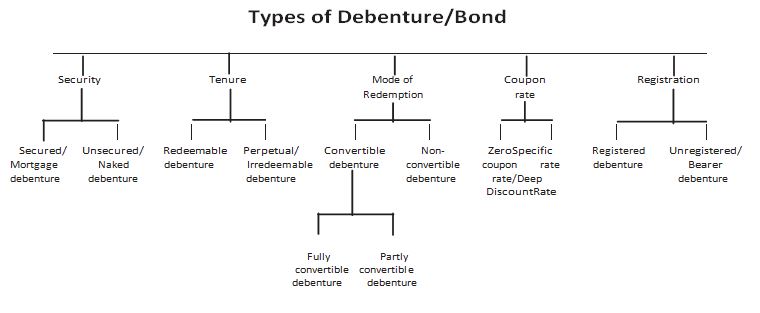
By Security
| Point | Secured | Unsecured |
|---|---|---|
| Charge on assets | A charge is created to secure payment in case of default | No specific charge is created; a floating charge may arise by default |
| Charge type | May be fixed or floating | Usually not issued |
| Fixed charge | Attached to a specific asset held for use in operations, not for sale | — |
| Floating charge | Covers general assets, excluding assets assigned to secured creditors | — |
By Tenure
| Point | Redeemable | Irredeemable |
|---|---|---|
| Meaning | Repayable after a specified period, in one sum or instalments | No fixed undertaking to repay the borrowed amount |
| Other name | — | Perpetual debentures |
| Repayment | May be redeemed at par or at a premium | Repayable on winding-up or after a long period |
By Convertibility
| Point | Convertible | Non-convertible |
|---|---|---|
| Meaning | Can be converted into equity shares or another security if the terms allow | Cannot be converted into shares or other securities |
| Extent | May be fully or partly convertible | Most company debentures fall in this category |
| Who may choose | Conversion may be at the option of the company or debentureholders | — |
By Registration
| Point | Registered | Bearer |
|---|---|---|
| Company records | Holder names, addresses and holding details are entered in the company register | The company keeps no record of holders |
| Transfer | Requires execution of a regular transfer deed | Transferred by delivery |
| Interest payment | Paid to the registered holder | Paid to the person presenting the attached interest coupon |
What is a debenture?
Give two differences between shares and debentures.
Distinguish between registered and bearer debentures.
Quick recap
- Debentures are borrowed capital; they acknowledge a company debt and usually carry fixed interest.
- The instrument is issued under the company’s common seal and states the principal repayment and interest terms.
- Interest is a charge on profits and is payable even when the company makes no profit.
- Shares represent ownership; debentures represent debt.
- Debentures may be classified by security, tenure, convertibility and registration.
- A fixed charge covers a specific asset; a floating charge covers general assets subject to stated exclusions.
- Bearer debentures transfer by delivery; registered debentures require a transfer deed.
Issue of Debentures
How Debentures Are Issued
Issue process
- Application: Investors apply for debentures in response to the company’s prospectus.
- Payment: The company may collect the full amount on application or in instalments, such as on application and allotment.
- Issue price: Debentures may be issued at par, at a premium, or at a discount.
- Other forms: Debentures may also be issued for consideration other than cash or as collateral security.
Issue of Debentures at Par
Issue at par — Debentures are issued at par when the issue price equals their face value.
Credit Debentures A/c with the face value when the amount becomes due. Debit Bank A/c when cash is received.
Use to calculate the total face value payable by debenture holders.
Recording an issue at par
- When application money is received, debit Bank and credit Debenture Application A/c (or Debenture Application and Allotment A/c if one instalment is collected).
- Transfer application money to Debentures A/c when allotted.
- When allotment or call money becomes due, debit the relevant account and credit Debentures A/c.
- On receipt of each instalment, debit Bank and credit the relevant Allotment or Call A/c.
| Situation | Debit | Credit |
|---|---|---|
| Full amount received in one instalment | Bank A/c | Debenture Application and Allotment A/c |
| Transfer application and allotment money | Debenture Application and Allotment A/c | Debentures A/c |
| Application money received in instalments | Bank A/c | Debenture Application A/c |
| Transfer application money on allotment | Debenture Application A/c | Debentures A/c |
| Allotment money becomes due | Debenture Allotment A/c | Debentures A/c |
| Allotment money received | Bank A/c | Debenture Allotment A/c |
| A call becomes due | Debenture Call A/c | Debentures A/c |
| Call money received | Bank A/c | Debenture Call A/c |
Prepare the key journal entries and determine the debenture liability for ABC Ltd.’s issue.
- ABC Ltd. offered 10,000 debentures of Rs. 100 each; 9,000 were applied for and fully allotted. Application money was Rs. 30 per debenture, with the balance payable on allotment.
- Record the application money received and transfer it to Debentures A/c on allotment.
- Calculate the balance due on allotment and record its receipt.
- The liability and total cash received equal the face value of the debentures allotted.
| Balance-sheet item | Amount |
|---|---|
| Long-term borrowings: 9,000 debentures of Rs. 100 each | Rs. 9,00,000 |
| Cash and cash equivalents: cash at bank | Rs. 9,00,000 |
Issue of Debentures at a Discount
Issue at a discount — Debentures are issued at a discount when their issue price is below their nominal value; the difference is a loss to the company.
At issue, credit Debentures A/c with the full face value due and debit Discount on Issue of Debentures A/c for the discount.
Calculate the discount and cash received when debentures are issued below face value.
Discount: treatment and presentation
- Example: A Rs. 100 debenture issued at Rs. 95 has a discount of Rs. 5.
- Write-off: The discount may be written off during the debentures’ life by debiting Securities Premium Reserve, if available; otherwise debit the Statement of Profit and Loss.
- Balance-sheet classification: Unwritten-off discount due to be written off within 12 months of the balance-sheet date or the operating cycle is shown under Other Current Assets; the later portion is shown under Other Non-Current Assets.
- Legal position: The Companies Act, 2013 does not impose restrictions on issuing debentures at a discount.
Recording an issue at a discount
- Calculate face value, issue price, and total discount.
- Record application money received, then transfer it to Debentures A/c on allotment.
- When allotment becomes due, debit Allotment A/c for the cash payable and Discount on Issue of Debentures A/c for the discount; credit Debentures A/c with the full face-value balance due. The face-value balance equals allotment cash payable plus discount.
- Record allotment cash received and write off the discount to Securities Premium Reserve, if available, or otherwise to the Statement of Profit and Loss.
| Transaction | Debit | Credit |
|---|---|---|
| Application money received | Bank A/c | Debenture Application A/c |
| Transfer application money | Debenture Application A/c | Debentures A/c |
| Allotment due; discount recognised | Debenture Allotment A/c; Discount on Issue of Debentures A/c | Debentures A/c |
| Allotment money received | Bank A/c | Debenture Allotment A/c |
| Discount written off | Securities Premium Reserve A/c, if available; otherwise Statement of Profit and Loss A/c | Discount on Issue of Debentures A/c |
Prepare the key journal entries and calculate the proceeds and discount for TV Components Ltd.’s issue.
- TV Components Ltd. issues 10,000 debentures of Rs. 100 each at a 5% discount. Cash payable is Rs. 40 on application and Rs. 55 on allotment.
- Record application money received and transferred to Debentures A/c.
- At allotment, the full face-value balance due is Rs. 60 per debenture; the discount is Rs. 5 per debenture.
- Record the allotment cash received and write off the discount to the Statement of Profit and Loss if no Securities Premium Reserve is used.
- Total cash proceeds are Rs. 9,50,000, against face value of Rs. 10,00,000.
| Balance-sheet item | Amount |
|---|---|
| Surplus: balance in Statement of Profit and Loss | (Rs. 50,000) |
| Long-term borrowings: 10,000 debentures of Rs. 100 each | Rs. 10,00,000 |
| Cash and cash equivalents: cash at bank | Rs. 9,50,000 |
Do not credit Debentures A/c with only the cash received when issuing at a discount. Credit it with the face-value amount due and record the discount separately as a debit.
A company issues 2,000 debentures of Rs. 100 each at par, payable Rs. 25 on application and Rs. 75 on allotment. Find each instalment total and state the journal entry for allotment due.
A company issues 4,000 debentures of Rs. 100 each at Rs. 96. Calculate the total discount and cash proceeds.
Quick recap
- Debentures may be issued at par, at a premium, at a discount, for non-cash consideration, or as collateral security.
- At par, issue price equals face value; credit Debentures A/c with the amount due.
- For instalment issues, record cash when received and transfer application money or calls as applicable.
- At a discount, credit Debentures A/c with the face-value amount due and debit the discount separately.
- Write off discount against Securities Premium Reserve if available; otherwise use the Statement of Profit and Loss.
- Unwritten-off discount is classified as current or non-current according to when it is due to be written off.
- In the balance-sheet illustrations, the 10-year redemption assumption supports presentation as long-term borrowings.
Debentures issued at Premium
Meaning and Accounting Treatment
Debentures issued at a premium — Debentures are issued at a premium when their issue price is greater than their nominal value.
Key accounting points
- Premium: The excess of issue price over nominal value; for example, a Rs. 100 debenture issued for Rs. 110 has a Rs. 10 premium.
- Credit: Credit the premium to Securities Premium Reserve when it becomes due.
- Balance sheet: Show Securities Premium Reserve under Reserves and Surplus; show debentures at nominal value under long-term borrowings.
- Cash received: Total cash includes both nominal value and premium.
Use for the number of debentures, for nominal value per debenture and for premium per debenture.
Recording the issue
- Record application money received: debit Bank and credit Debenture Application.
- Transfer application money to Debentures when it represents nominal value.
- When premium falls due, debit the relevant instalment account; credit Debentures for nominal value and Securities Premium Reserve for the premium.
- Record each instalment received by debiting Bank and crediting that instalment account.
Illustration: XYZ Industries Ltd.
Prepare the entries and balance sheet figures for the fully subscribed issue.
- Find the nominal value and premium on 2,000 debentures of Rs. 100 each, issued at a premium of Rs. 10 each.
- Application is Rs. 50 per debenture; allotment is Rs. 60 per debenture and includes the premium.
| Particulars | Debit | Credit |
|---|---|---|
| Bank A/c Dr. | To 10% Debenture Application A/c | 1,00,000 | 1,00,000 |
| 10% Debenture Application A/c Dr. | To 10% Debentures A/c | 1,00,000 | 1,00,000 |
| 10% Debenture Allotment A/c Dr. | To 10% Debentures A/c | To Securities Premium Reserve A/c | 1,20,000 | 1,00,000 | 20,000 |
| Bank A/c Dr. | To 10% Debenture Allotment A/c | 1,20,000 | 1,20,000 |
| Particulars | Amount |
|---|---|
| Reserves and Surplus — Securities Premium Reserve | 20,000 |
| Long-term borrowings — 2,000, 10% debentures of Rs. 100 each | 2,00,000 |
| Cash and cash equivalents — Cash at bank | 2,20,000 |
Illustration: A Limited
Issue details
- Issue: 5,000 debentures of Rs. 100 each, issued at a premium of Rs. 10 each.
- Payments: Application Rs. 25; allotment Rs. 45 including premium; first and final call Rs. 40.
- Premium due on allotment: The allotment of Rs. 45 per debenture comprises Rs. 35 nominal value and Rs. 10 premium.
| Particulars | Debit | Credit |
|---|---|---|
| Bank A/c Dr. | To 10% Debenture Application A/c | 1,25,000 | 1,25,000 |
| 10% Debenture Application A/c Dr. | To 10% Debentures A/c | 1,25,000 | 1,25,000 |
| 10% Debenture Allotment A/c Dr. | To 10% Debentures A/c | To Securities Premium Reserve A/c | 2,25,000 | 1,75,000 | 50,000 |
| Bank A/c Dr. | To 10% Debenture Allotment A/c | 2,25,000 | 2,25,000 |
| 10% Debenture First and Final Call A/c Dr. | To 10% Debentures A/c | 2,00,000 | 2,00,000 |
| Bank A/c Dr. | To 10% Debenture First and Final Call A/c | 2,00,000 | 2,00,000 |
| Particulars | Amount |
|---|---|
| Reserves and Surplus — Securities Premium Reserve | 50,000 |
| Long-term borrowings — 5,000, 10% debentures of Rs. 100 each | 5,00,000 |
| Cash and cash equivalents | 5,50,000 |
Do not add the premium to the Debentures A/c balance: credit nominal value to Debentures and credit the premium separately to Securities Premium Reserve.
A company issues 1,000 debentures of Rs. 100 each at a premium of Rs. 5 per debenture. The premium is due with allotment. Find the Debentures A/c credit and Securities Premium Reserve credit.
A company issues 2,000 debentures of Rs. 100 each at a premium of Rs. 10 each. All money is received. State the balance sheet amounts for debentures, premium reserve and cash received.
Quick recap
- Issue at a premium means the issue price exceeds the debenture's nominal value.
- Credit the premium to Securities Premium Reserve when it becomes due.
- Credit nominal value to Debentures A/c; keep the premium separate.
- Show debentures under long-term borrowings and the premium under Reserves and Surplus.
- Total cash proceeds equal total nominal value plus total premium.
Over Subscription
Over-Subscription
Accounting for Over-Subscription
- Record the application money received in the Bank Account and credit Debenture Application Account.
- Transfer application money for allotted debentures to Debentures Account; adjust excess against allotment or calls, and refund the rejected applicants’ money.
- Record the allotment amount due on all debentures allotted.
- Record the net allotment money received after deducting any adjustment.
Journalise the transactions.
- X Limited offered 10,000 debentures, payable Rs. 40 on application and Rs. 60 on allotment. Applications: 14,000; 9,000 were accepted in full, 2,000 received 1,000 debentures, and the remaining applications were rejected.
- Application money received is Rs. 5,60,000. Of this, Rs. 4,00,000 is transferred to Debentures Account, Rs. 40,000 is adjusted against allotment, and Rs. 1,20,000 is refunded.
- Allotment due is Rs. 6,00,000; after the Rs. 40,000 adjustment, Rs. 5,60,000 is received.
| Particulars | Debit | Credit |
|---|---|---|
| Bank A/c Dr. To 12% Debenture Application A/c | 5,60,000 | 5,60,000 |
| 12% Debenture Application A/c Dr. To 12% Debentures A/c To Debenture Allotment A/c To Bank A/c | 5,60,000 | 4,00,000 40,000 1,20,000 |
| 12% Debenture Allotment A/c Dr. To 12% Debentures A/c | 6,00,000 | 6,00,000 |
| Bank A/c Dr. To Debenture Allotment A/c | 5,60,000 | 5,60,000 |
Debentures Issued for Consideration Other than Cash
Recording an Asset Purchase Settled by Debentures
- Record the assets purchased: debit Sundry Assets Account and credit Vendor Account.
- Record settlement by debentures: debit Vendor Account and credit Debentures Account.
- For an issue at a premium, credit Securities Premium Reserve; for an issue at a discount, debit Discount on Issue of Debentures.
Record the necessary journal entries.
- Aashirward Company Limited bought assets valued at Rs. 2,00,000 and agreed to pay by issuing 2,000 debentures of Rs. 100 each.
- The face value of the debentures is Rs. 2,00,000, equal to the purchase consideration; therefore, they are issued at par.
| Particulars | Debit | Credit |
|---|---|---|
| Sundry Assets A/c Dr. To Vendors A/c | 2,00,000 | 2,00,000 |
| Vendors A/c Dr. To 10% Debentures A/c | 2,00,000 | 2,00,000 |
A company offers 1,200 debentures of Rs. 50 each, payable Rs. 10 on application and Rs. 40 on allotment. Applications are received for 1,500 debentures. Of these, 1,000 applications are accepted in full, 400 applicants receive 200 debentures, and the remaining applications are rejected. Journalise the transactions, assuming all money is received.
A company purchases assets for Rs. 90,000 and issues 1,000 debentures of Rs. 100 each at a 10% discount to settle the price. Record the entries.
Quick recap
- Over-subscription means applications exceed the number of debentures offered; allotment cannot exceed the offer.
- Excess application money may be adjusted against allotment or calls; rejected applicants’ money is refunded.
- For pro-rata allotment, identify the amount transferred, excess adjusted and refund separately.
- On an asset purchase, debit assets and credit the vendor for the purchase consideration.
- When debentures settle the vendor’s claim, record the issue at par, premium or discount as applicable.
Illustration 7 based on Journal entries
Assets Purchased and Paid for by Debentures
Purchase consideration — The amount payable to the vendor for assets or a business purchased; it may be settled by issuing debentures.
Recording the transaction
- On purchase: Debit Sundry Assets and credit Vendors for the purchase consideration.
- On settlement: Debit Vendors; credit Debentures at nominal value.
- Issue at premium: Credit Securities Premium Reserve for the premium; total credits equal the consideration.
- Issue at discount: Debit Discount on Issue of Debentures; the debenture face value exceeds the consideration paid.
Let be face value per debenture, the premium rate, the discount rate, the issue price per debenture and the purchase consideration.
Find the required total face value by dividing the consideration by the issue price as a fraction of face value.
| Issue terms | Debit | Credit |
|---|---|---|
| At par | Vendors | Debentures at face value |
| At premium | Vendors | Debentures at face value; Securities Premium Reserve for premium |
| At discount | Vendors; Discount on Issue of Debentures | Debentures at face value |
Record the journal entries for the asset purchase and settlement.
- Rai Company buys assets for Rs. 2,20,000 and issues 2,000 debentures of Rs. 100 each at a 10% premium.
- Calculate the total face value and premium.
- Record the asset purchase by debiting Sundry Assets A/c and crediting Vendors.
- Settle Vendors by crediting 10% Debentures A/c and Securities Premium Reserve A/c.
Illustrations: Issue at Par, Discount, or Premium
| Case | Journal entry |
|---|---|
| Asset purchase (common entry) | Dr Sundry Assets A/c Rs. 99,000; Cr Vendors Rs. 99,000 |
| At par | Dr Vendors Rs. 99,000; Cr 11% Debentures A/c Rs. 99,000 (990 debentures of Rs. 100) |
| At 10% discount | Dr Vendors Rs. 99,000; Dr Discount on Issue of Debentures Rs. 11,000; Cr 11% Debentures A/c Rs. 1,10,000 (1,100 debentures of Rs. 100) |
| At 10% premium | Dr Vendors Rs. 99,000; Cr 11% Debentures A/c Rs. 90,000; Cr Securities Premium Reserve A/c Rs. 9,000 (900 debentures of Rs. 100) |
Do not confuse debenture face value with issue proceeds. At a discount, the debenture credit is higher than the vendor balance; at a premium, it is lower, with the difference recorded separately.
Purchase of a Business Including Liabilities
Net assets — When a business is purchased along with its liabilities, purchase consideration is generally the value of assets taken over less the liabilities assumed.
Let be the value of assets taken over and the value of liabilities assumed.
| Transaction | Debit | Credit |
|---|---|---|
| Record business purchase | Sundry Assets A/c | Sundry Liabilities A/c; Vendors (net consideration) |
| Settle vendor entirely by debentures | Vendors | Debentures at face value, adjusted for any discount or premium |
A company purchases assets worth Rs. 1,90,000 and settles the amount by issuing 2,000 debentures of Rs. 100 each at a 5% discount. Give the entries.
Assets costing Rs. 3,00,000 are acquired together with liabilities of Rs. 50,000. The net purchase consideration is settled by issuing Rs. 100 debentures at par. Give the entries.
Quick recap
- Asset purchase: Debit Sundry Assets and credit Vendors.
- Vendor settlement: Debit Vendors and record debentures at face value.
- Premium: Credit Securities Premium Reserve; discount: debit Discount on Issue of Debentures.
- Issue proceeds: Face value adjusted for the premium or discount must equal the vendor balance.
- Business takeover: Purchase consideration equals assets taken over less liabilities assumed.
Illustration 10 based on Journal entries
Purchase of a Whole Business
Purchase consideration — The amount agreed to be paid by the purchasing company to the vendor for the business or assets acquired.
Net assets equal assets taken over less liabilities taken over. Compare purchase consideration with net assets to determine the balancing difference.
If purchase consideration exceeds net assets, debit the difference to Goodwill A/c. If net assets exceed purchase consideration, credit the difference to Capital Reserve A/c.
Entries for taking over a business
- Record the assets acquired as debits; credit liabilities taken over and the vendor for the purchase consideration.
- Balance the first entry with Goodwill A/c or Capital Reserve A/c, as appropriate.
- Debit the vendor when settling the purchase consideration; credit Debentures A/c and Securities Premium Reserve A/c if applicable.
| Particulars | Debit (Rs.) | Credit (Rs.) |
|---|---|---|
| Sundry Assets A/c Dr. | 20,00,000 | |
| To Kapil Enterprises | 18,00,000 | |
| To Sundry Creditors A/c | 2,00,000 | |
| Kapil Enterprises Dr. | 18,00,000 | |
| To 8% Debentures A/c | 18,00,000 |
Purchase Consideration Exceeds Net Assets
Record the acquisition and issue of 12% debentures for the purchase consideration.
- Blue Prints Ltd. acquires assets of Rs. 3,00,000, takes over liabilities of Rs. 20,000, and agrees on a purchase consideration of Rs. 3,15,000.
- Find net assets and goodwill.
- At a 5% premium, each Rs. 100 debenture is issued for Rs. 105. Calculate the number of debentures and premium.
| Particulars | Debit (Rs.) | Credit (Rs.) |
|---|---|---|
| Building A/c Dr. | 1,50,000 | |
| Plant & Machinery A/c Dr. | 1,40,000 | |
| Furniture A/c Dr. | 10,000 | |
| Goodwill A/c Dr. | 35,000 | |
| To Sundry Liabilities | 20,000 | |
| To XYZ Co. | 3,15,000 | |
| XYZ Co. Dr. | 3,15,000 | |
| To 12% Debentures A/c | 3,00,000 | |
| To Securities Premium Reserve A/c | 15,000 |
Net Assets Exceed Purchase Consideration
| Particulars | Debit (Rs.) | Credit (Rs.) |
|---|---|---|
| Sundry Assets A/c Dr. | 3,00,000 | |
| To Sundry Liabilities A/c | 10,000 | |
| To B & Co. Ltd. | 2,70,000 | |
| To Capital Reserve A/c | 20,000 | |
| B & Co. Ltd. Dr. | 2,70,000 | |
| To 15% Debentures A/c | 2,25,000 | |
| To Securities Premium Reserve A/c | 45,000 |
Debentures Issued for a Specific Asset
Issue price — The amount received per debenture; it determines how many debentures are needed to settle the agreed asset cost.
Use consideration divided by the issue price to find the number of debentures. Here, is face value, is the discount or premium rate, is issue price, is consideration and is the number issued.
| Case | Debit entry | Credit entry |
|---|---|---|
| Purchase | Machinery A/c Dr. Rs. 1,98,000 | To Suppliers Ltd. Rs. 1,98,000 |
| At par: 1,980 debentures | Suppliers Ltd. Dr. Rs. 1,98,000 | To 12% Debentures A/c Rs. 1,98,000 |
| At 10% discount: 2,200 debentures | Suppliers Ltd. Dr. Rs. 1,98,000; Discount on Issue of Debentures A/c Dr. Rs. 22,000 | To 12% Debentures A/c Rs. 2,20,000 |
| At 10% premium: 1,800 debentures | Suppliers Ltd. Dr. Rs. 1,98,000 | To 12% Debentures A/c Rs. 1,80,000; To Securities Premium Reserve A/c Rs. 18,000 |
Issue-price workings
- At 10% discount: Issue price = Rs. 90; Rs. 1,98,000 ÷ Rs. 90 = 2,200 debentures.
- At 10% premium: Issue price = Rs. 110; Rs. 1,98,000 ÷ Rs. 110 = 1,800 debentures.
Do not confuse a debenture's nominal value with its issue price: at discount, debit Discount on Issue of Debentures A/c for the difference; at premium, credit Securities Premium Reserve A/c for the excess.
A company takes over assets of Rs. 5,00,000 and liabilities of Rs. 50,000 for Rs. 4,80,000. It issues Rs. 100 debentures at 10% premium to settle the vendor. Find goodwill or capital reserve and the number of debentures.
Assets of Rs. 2,60,000 and liabilities of Rs. 20,000 are taken over for Rs. 2,20,000, settled by Rs. 100 debentures issued at 10% premium. Find Capital Reserve and pass the issue entry.
Quick recap
- Record assets taken over as debits and liabilities taken over as credits.
- Credit the vendor with the agreed purchase consideration in the acquisition entry.
- Consideration above net assets creates goodwill; net assets above consideration create capital reserve.
- On settlement, debit the vendor and credit debentures at nominal value.
- For an issue at discount, debit Discount on Issue of Debentures A/c; for an issue at premium, credit Securities Premium Reserve A/c.
- Find the number of debentures by dividing consideration by the issue price per debenture.
Issue of Debentures as a Collateral Security
Collateral security — Additional security given to a lender, besides the primary security, to help recover a loan if the primary security is insufficient.
Purpose and lender’s rights
- Purpose: A company may issue its own debentures to a bank or other lender as extra security for a loan or overdraft.
- Primary security first: If the company defaults, the lender can recover money by selling the primary security.
- Shortfall: If the primary security does not cover the amount due, the lender may use the collateral security.
- Debentures: The lender may present the collateral debentures for redemption or sell them in the open market.
Accounting treatment
| Point | No-entry method | Journal-entry method |
|---|---|---|
| At issue | No journal entry is passed; the loan remains a liability. | Debit Debenture Suspense A/c and credit Debentures A/c. |
| Balance-sheet disclosure | Show the loan and state in the note that it is secured by debentures issued as collateral. | Show the loan; in the note, show the debentures and deduct Debenture Suspense. |
| On repayment of loan | No debenture entry is required. | Reverse the original entry to cancel the collateral debentures. |
First method: no journal entry
- Reason: The debentures are held only as additional security; no separate liability is treated as created by their issue.
- Disclosure: Show the bank loan under long-term borrowings and add a note that it is secured by debentures issued as collateral.
- Example: A bank loan of Rs. 10,00,000 remains the liability; the note may state it is secured by 10,000 debentures of Rs. 100 each.
Second method: journal entries
- Issue: Record the collateral debentures using Debenture Suspense A/c.
- Repayment: Cancel the issue by passing the reverse entry.
- Presentation: In the notes to long-term borrowings, deduct Debenture Suspense from the debentures issued as collateral.
| Transaction | Account debited | Account credited | Amount |
|---|---|---|---|
| Issue of 10,000 9% debentures of Rs. 100 each as collateral for a bank loan | Debenture Suspense A/c | 9% Debentures A/c | Rs. 10,00,000 |
| Cancellation when the bank loan is repaid | 9% Debentures A/c | Debenture Suspense A/c | Rs. 10,00,000 |
| Particulars | Amount |
|---|---|
| Bank loan | Rs. 10,00,000 |
| 10,000 9% debentures of Rs. 100 each | Rs. 10,00,000 |
| Less: Debenture Suspense | Rs. 10,00,000 |
| Long-term borrowings shown in the balance sheet | Rs. 10,00,000 |
A company takes a bank loan of Rs. 10,00,000 and issues 10,000 9% debentures of Rs. 100 each as collateral. Record the issue and cancellation entries under the journal-entry method.
- A company takes a bank loan of Rs. 10,00,000 and issues 10,000 9% debentures of Rs. 100 each as collateral. Record the issue under the journal-entry method.
- Calculate the total face value of the debentures.
- On issue, debit Debenture Suspense A/c and credit 9% Debentures A/c.
- On repayment of the loan, pass the reverse entry to cancel the collateral debentures.
Do not treat the collateral debentures as an additional loan liability while also counting the bank loan. Under the journal-entry method, Debenture Suspense is deducted from the debentures in the note; the bank loan remains payable.
A company gives debentures to a bank as collateral for a loan. What does collateral security mean, and when may the bank use it?
Pass the journal entry for issuing 5,000 debentures of Rs. 100 each as collateral security for a bank loan, using the journal-entry method.
Quick recap
- Collateral security is additional security for a loan, beyond the primary security.
- If primary security leaves a shortfall after default, the lender may invoke the collateral debentures.
- Under the no-entry method, disclose the loan as secured by collateral debentures in a note.
- Under the journal-entry method, debit Debenture Suspense and credit Debentures when issued.
- On repayment, reverse the issue entry; show Debenture Suspense as a deduction from debentures in the note.
Illustration 14 based on Issue of Debentures
Debentures Issued as Collateral Security
Collateral security — Additional security provided to a lender alongside the primary security for a loan; the lender may use it if the borrower defaults.
Key treatment
- No additional cash: Giving debentures as collateral does not bring fresh proceeds to the company.
- Two methods: Make no journal entry and disclose the security, or record the debentures with an equal Debenture Suspense balance.
- Disclosure: Show the actual bank loan as a liability and describe the primary and collateral securities in the loan note.
- Suspense method: Deduct Debenture Suspense from the collateral debentures in the loan note; the net liability remains the actual loan.
Use to calculate the amount of collateral debentures disclosed or recorded; is the number of debentures and is the face value of each.
| Point | No-entry method | Debenture Suspense method |
|---|---|---|
| Journal entry for collateral | No entry | Debit Debenture Suspense; credit Debentures |
| Balance sheet treatment | Show the actual loan and disclose the collateral debentures in its note | Show the debentures and deduct the equal Debenture Suspense balance in the loan note |
| Net liability | Actual loan amount | Actual loan amount |
Apply the suspense method
- Calculate the face value of the debentures pledged as collateral.
- Record the collateral issue by debiting Debenture Suspense and crediting Debentures by equal amounts.
- Show the actual loan as a liability; in its note, offset the collateral debentures with Debenture Suspense.
How should the collateral debentures be treated in the books and balance sheet?
- A company borrows Rs. 10,00,000 from PNB and gives 12,000 debentures of Rs. 100 each as collateral. Under the no-entry method, make no entry for the collateral.
- Show the actual loan as a long-term borrowing and disclose the collateral debentures in the loan note.
- Under the suspense method, record the collateral debentures at face value.
- In the loan note, offset the debenture amount with Debenture Suspense; the net borrowing remains the actual loan.
| Particulars | Debit (Rs.) | Credit (Rs.) |
|---|---|---|
| Debenture Suspense A/c Dr. | 12,00,000 | — |
| To 10% Debentures A/c | — | 12,00,000 |
| Being 12,000 debentures of Rs. 100 each given as collateral security to PNB. | — | — |
| Particulars | Amount (Rs.) |
|---|---|
| Long-term borrowings: Secured loan from PNB | 10,00,000 |
| 12,000, 10% debentures of Rs. 100 each | 12,00,000 |
| Less: Debenture Suspense | (12,00,000) |
| Net long-term borrowing | 10,00,000 |
Do not add the face value of collateral debentures to the loan as a second borrowing. They secure the loan; under the suspense method, the equal suspense balance offsets them.
Practice: Applying the Treatment
Raghuveer Ltd. issued Rs. 10,00,000 of 8% debentures: Rs. 5,50,000 to cash subscribers at 90%, Rs. 2,00,000 to a machinery vendor in settlement of his claim, and Rs. 2,50,000 as collateral for a Rs. 20,00,000 bank loan. The cash-issued and vendor-issued debentures are redeemable at par after 10 years. How are these treated in the balance sheet?
Hassan Ltd. borrows Rs. 30,00,000 against primary security worth Rs. 40,00,000 and pledges 4,000 debentures of Rs. 100 each. One year later, it borrows Rs. 50,00,000 against plant and pledges 6,000 debentures of Rs. 100 each. Record the necessary entries and state the balance-sheet treatment.
Meghnath Ltd. borrows Rs. 1,20,000 and pledges 1,400 debentures of Rs. 100 each as collateral, along with primary security worth Rs. 2,00,000. Two months later, it borrows Rs. 80,000 and pledges 1,000 debentures of Rs. 100 each as collateral. Record the necessary entries and state the balance-sheet treatment.
Quick recap
- Collateral debentures provide extra security for a loan but bring no additional cash.
- Under the no-entry method, make no collateral entry and disclose the pledged debentures in the loan note.
- Under the suspense method, debit Debenture Suspense and credit Debentures by equal amounts.
- Deduct Debenture Suspense from collateral debentures in the loan note; the net liability is the actual loan.
- For Raghuveer Ltd., the cash-issued and vendor-issued debentures are redeemable at par after 10 years.
Terms of Issue of Debentures
Issue Terms and Redemption
- Redemption: It is the discharge of debenture liability by repayment to debentureholders according to the terms of issue.
- Issue and redemption terms: Debentures may be issued at par, discount or premium and redeemed at par or at a premium.
Amounts and Receipt Entry
Let be issue proceeds and be the amount payable on redemption. Use , , and as defined above.
| Account | Debit | Credit |
|---|---|---|
| Bank A/c | Issue proceeds | — |
| To Debenture Application & Allotment A/c | — | Issue proceeds |
Allotment Entries for the Six Combinations
| Issue and redemption terms | Debit account(s) and amount(s) | Credit account(s) and amount(s) |
|---|---|---|
| Issued at par; redeemable at par | Debenture Application & Allotment A/c — | Debentures A/c — |
| Issued at a discount; redeemable at par | Debenture Application & Allotment A/c — ; Discount on Issue of Debentures A/c — | Debentures A/c — |
| Issued at a premium; redeemable at par | Debenture Application & Allotment A/c — | Debentures A/c — ; Securities Premium Reserve A/c — |
| Issued at par; redeemable at a premium | Debenture Application & Allotment A/c — ; Loss on Issue of Debentures A/c — | Debentures A/c — ; Premium on Redemption of Debentures A/c — |
| Issued at a discount; redeemable at a premium | Debenture Application & Allotment A/c — ; Loss on Issue of Debentures A/c — | Debentures A/c — ; Premium on Redemption of Debentures A/c — |
| Issued at a premium; redeemable at a premium | Debenture Application & Allotment A/c — ; Loss on Issue of Debentures A/c — | Debentures A/c — ; Securities Premium Reserve A/c — ; Premium on Redemption of Debentures A/c — |
A redemption premium is debited to Loss on Issue of Debentures A/c. If the debentures are also issued at a discount, add the discount to this loss: . If they are issued at a discount but redeemable at par, debit Discount on Issue of Debentures A/c for instead.
Premium on Redemption of Debentures A/c represents a future liability. Until redemption, show it under Non-current Liabilities, within Long-term Borrowings.
Prepare the Journal Entries
- Find the total face value, issue discount or premium, and redemption premium.
- Record receipt of the issue proceeds: debit Bank and credit Debenture Application & Allotment.
- On allotment, credit Debentures with face value and credit the relevant premium accounts.
- Debit any issue discount or redemption loss, then check that total debits equal total credits.
What are the issue proceeds and journal entries for the debenture issue?
- A company issues 1,000 debentures of Rs. 100 each at a 5% discount, redeemable at a 10% premium. Find the issue proceeds and entries.
- Calculate the issue discount and redemption premium.
- Calculate cash proceeds and the loss on issue.
- On receipt, debit Bank A/c and credit Debenture Application & Allotment A/c by Rs. 95,000 each.
- On allotment, debit Debenture Application & Allotment A/c by Rs. 95,000 and Loss on Issue of Debentures A/c by Rs. 15,000; credit Debentures A/c by Rs. 100,000 and Premium on Redemption of Debentures A/c by Rs. 10,000.
A company issues debentures with a face value of Rs. 200,000 at a 4% premium, redeemable at par. What is the allotment entry?
Debentures with a face value of Rs. 150,000 are issued at par and redeemable at a 6% premium. Give the allotment entry.
Do not debit Discount on Issue of Debentures for issue discount when debentures are redeemable at a premium. Debit Loss on Issue of Debentures for the combined amount . The separate discount account is used when discounted debentures are redeemable at par.
Quick recap
- Debentures may be issued at par, at a discount or at a premium, and redeemed at par or at a premium.
- Receipt entry: debit Bank and credit Debenture Application & Allotment with the issue proceeds.
- On allotment, credit Debentures A/c with face value.
- Issue premium is credited to Securities Premium Reserve; redemption premium is credited to Premium on Redemption of Debentures.
- Debit redemption premium to Loss on Issue; add issue discount to this loss when debentures are redeemable at a premium.
- Show the unredeemed premium payable under Non-current Liabilities, within Long-term Borrowings.
Illustration 15 based on Journal entries
Understanding the Issue Terms
Issue of debentures — The company receives the issue price and records the face value of debentures as a liability.
Key principles
- Face value: Debentures A/c is credited with the total nominal value, regardless of the issue price.
- Issue at premium: Cash received exceeds face value; credit the excess to Securities Premium Reserve A/c.
- Issue at discount: Cash received is below face value; debit Discount on Issue of Debentures A/c.
- Redemption at premium: Record the future extra payment by crediting Premium on Redemption of Debentures A/c.
- Loss on issue: When both issue discount and redemption premium apply, debit Loss on Issue of Debentures A/c for their total.
Here, is face value; and are the issue premium and discount rates; is the redemption premium rate.
Prepare the Journal Entries
- Calculate the issue price from the face value and issue premium or discount.
- For receipt of application money, debit Bank A/c and credit Debenture Application & Allotment A/c.
- On allotment, debit Application & Allotment A/c; credit Debentures A/c and any relevant premium account.
- Debit the discount or total loss on issue where applicable; check that total debits equal total credits.
Pass the issue entries for Rs. 1,00,000 debentures issued at 5% discount and redeemable at 5% premium.
- For Rs. 1,00,000 face value issued at a discount of 5% and redeemable at a premium of 5%, calculate cash received.
- Calculate the loss on issue: discount plus redemption premium.
- Transfer the application money and record the liability and redemption premium.
Journal Entries for the Six Issue Conditions
| Case | Entry | Account | Debit | Credit |
|---|---|---|---|---|
| 1 | Receipt | Bank A/c | 1,00,000 | |
| 1 | Receipt | Debenture Application & Allotment A/c | 1,00,000 | |
| 1 | Transfer | Debenture Application & Allotment A/c | 1,00,000 | |
| 1 | Transfer | 9% Debentures A/c | 1,00,000 | |
| 2 | Receipt | Bank A/c | 1,05,000 | |
| 2 | Receipt | Debenture Application & Allotment A/c | 1,05,000 | |
| 2 | Transfer | Debenture Application & Allotment A/c | 1,05,000 | |
| 2 | Transfer | 9% Debentures A/c | 1,00,000 | |
| 2 | Transfer | Securities Premium Reserve A/c | 5,000 | |
| 3 | Receipt | Bank A/c | 95,000 | |
| 3 | Receipt | Debenture Application & Allotment A/c | 95,000 | |
| 3 | Transfer | Debenture Application & Allotment A/c | 95,000 | |
| 3 | Transfer | Discount on Issue of Debentures A/c | 5,000 | |
| 3 | Transfer | 9% Debentures A/c | 1,00,000 | |
| 4 | Receipt | Bank A/c | 1,00,000 | |
| 4 | Receipt | Debenture Application & Allotment A/c | 1,00,000 | |
| 4 | Transfer | Debenture Application & Allotment A/c | 1,00,000 | |
| 4 | Transfer | Loss on Issue of Debentures A/c | 5,000 | |
| 4 | Transfer | 9% Debentures A/c | 1,00,000 | |
| 4 | Transfer | Premium on Redemption of Debentures A/c | 5,000 | |
| 5 | Receipt | Bank A/c | 95,000 | |
| 5 | Receipt | Debenture Application & Allotment A/c | 95,000 | |
| 5 | Transfer | Debenture Application & Allotment A/c | 95,000 | |
| 5 | Transfer | Loss on Issue of Debentures A/c | 10,000 | |
| 5 | Transfer | 9% Debentures A/c | 1,00,000 | |
| 5 | Transfer | Premium on Redemption of Debentures A/c | 5,000 | |
| 6 | Receipt | Bank A/c | 1,05,000 | |
| 6 | Receipt | Debenture Application & Allotment A/c | 1,05,000 | |
| 6 | Transfer | Debenture Application & Allotment A/c | 1,05,000 | |
| 6 | Transfer | Loss on Issue of Debentures A/c | 5,000 | |
| 6 | Transfer | 9% Debentures A/c | 1,00,000 | |
| 6 | Transfer | Premium on Redemption of Debentures A/c | 5,000 | |
| 6 | Transfer | Securities Premium Reserve A/c | 5,000 |
How the Cases Differ
- Case 1: Issued at par and redeemed at par; no premium, discount or loss account.
- Case 2: Issue premium of Rs. 5,000 is credited to Securities Premium Reserve.
- Case 3: Issue discount of Rs. 5,000 is debited to Discount on Issue of Debentures.
- Case 4: Redemption premium of Rs. 5,000 creates a loss on issue, even though the debentures are issued at par.
- Case 5: Discount of Rs. 5,000 plus redemption premium of Rs. 5,000 gives total loss of Rs. 10,000.
- Case 6: Issue premium of Rs. 5,000 is credited to Securities Premium Reserve; redemption premium of Rs. 5,000 is also recorded, and the latter is a loss.
Do not credit Debentures A/c with cash received when the issue is at a discount or premium; credit it with the full face value. Also keep issue premium separate from redemption premium.
A company issues Rs. 1,00,000 debentures at par, redeemable at par. Give the entries.
A company issues Rs. 1,00,000 debentures at a premium of 5% and redeems them at a premium of 5%. Give the entries.
Quick recap
- Debentures A/c is credited with their full face value.
- Issue premium is credited to Securities Premium Reserve; issue discount is debited.
- Redemption premium is credited to Premium on Redemption of Debentures A/c.
- Loss on issue equals issue discount plus redemption premium.
- Bank is debited for the actual cash received.
- Check that debit and credit totals match in every journal entry.
Illustration 16 based on Issue of Debentures
Accounting for Issue of Debentures Loan Repayment Premiums and Discounts Info.
Key treatment
- Issue at discount: Cash received is less than face value; the discount is a loss on issue.
- Issue at premium: Credit the premium received to Securities Premium Reserve (SPR).
- Redemption at premium: Record the premium payable as a liability when debentures are issued.
- Loss on issue: Includes any issue discount and any premium payable on redemption.
Let be face value and the issue discount rate, expressed as a decimal.
Let be the discount on issue and the premium payable on redemption.
Journal-entry approach
- Calculate face value, cash proceeds, issue discount and redemption premium.
- On receipt, debit Bank and credit Debenture Application and Allotment.
- On allotment, debit the application account and any loss; credit Debentures and any redemption-premium liability.
- Write off the loss against available SPR first; charge any excess to Statement of Profit and Loss.
Record the issue entries for 150, 7% debentures of Rs. 1,000 each, issued at a 5% discount and redeemable at a 10% premium, when SPR has a balance of Rs. 20,000.
- Calculate the face value of 150 debentures of Rs. 1,000 each.
- At a 5% discount, cash received is 95% of face value.
- Calculate the 10% redemption premium.
- Combine the issue discount and redemption premium to find the loss.
- Use the Rs. 20,000 SPR balance first; charge the balance to Statement of Profit and Loss.
| Particulars | Debit (Rs.) | Credit (Rs.) |
|---|---|---|
| Bank A/c Dr.; To Debenture Application and Allotment A/c | 1,14,000 | 1,14,000 |
| Debenture Application and Allotment A/c Dr. | 1,14,000 | |
| Loss on Issue of Debentures A/c Dr. | 6,000 | |
| To 8% Debentures A/c | 1,20,000 | |
| Securities Premium Reserve A/c Dr.; To Loss on Issue of Debentures A/c | 6,000 | 6,000 |
In Case (a), the discount and loss on issue are Rs. 6,000, so write off Rs. 6,000—not Rs. 8,000.
| Particulars | Debit (Rs.) | Credit (Rs.) |
|---|---|---|
| Bank A/c Dr.; To Debenture Application and Allotment A/c | 1,42,500 | 1,42,500 |
| Debenture Application and Allotment A/c Dr. | 1,42,500 | |
| Loss on Issue of Debentures A/c Dr. | 22,500 | |
| To 7% Debentures A/c | 1,50,000 | |
| To Premium on Redemption of Debentures A/c | 15,000 | |
| Securities Premium Reserve A/c Dr. | 20,000 | |
| Statement of Profit and Loss A/c Dr. | 2,500 | |
| To Loss on Issue of Debentures A/c | 22,500 |
| Particulars | Debit (Rs.) | Credit (Rs.) |
|---|---|---|
| Bank A/c Dr.; To Debenture Application and Allotment A/c | 84,000 | 84,000 |
| Debenture Application and Allotment A/c Dr. | 84,000 | |
| To 9% Debentures A/c | 80,000 | |
| To Securities Premium Reserve A/c | 4,000 |
Debentures Issued as Collateral Security
Collateral security — Debentures given to a lender as additional security for a loan.
Collateral-security treatment
- Entry method: Debit Debenture Suspense and credit Debentures for their nominal value.
- Loan: Record the loan separately; the value of collateral debentures can differ from the loan amount.
- Alternative: Under the no-entry method, disclose the collateral debentures in a note to the balance sheet.
| Particulars | Debit (Rs.) | Credit (Rs.) |
|---|---|---|
| Debenture Suspense A/c Dr.; To 8% Debentures A/c | 40,000 | 40,000 |
A company issues 1,000 debentures of Rs. 100 each at a 4% discount, redeemable at a 5% premium. Find the issue loss and amount received.
A company gives 500 debentures of Rs. 100 each as collateral security for a loan. Give the collateral entry.
Quick recap
- Discount on issue is a loss; record debentures at face value and debit the discount as part of loss on issue.
- Premium on issue is credited to Securities Premium Reserve.
- Redemption premium is recorded as a liability when debentures are issued.
- Loss write-off: Use available Securities Premium Reserve first and charge any excess to Statement of Profit and Loss.
- Collateral issue entry: Debit Debenture Suspense and credit Debentures for their nominal value.
Interest on Debentures
Meaning and key features
Interest on debentures — The periodic return a company pays debentureholders at a fixed rate on the nominal value of the debentures.
- Rate and basis: The rate, such as or , is fixed; calculate interest on nominal value, not issue price.
- Frequency: Interest is commonly payable half-yearly until the debentures are repaid.
- Charge on profit: Interest is an expense charged against profit and remains payable even if the company has no profit.
- TDS: Under the Income Tax Act, 1961, if interest exceeds the prescribed limit, tax is deducted at the prescribed rate and deposited with the tax authorities. Debentureholders can adjust it against their tax due.
Here, is nominal value outstanding, is the annual interest rate in percent, and is the number of months.
When TDS applies, it is deducted from gross interest due. Here, is the TDS rate in percent.
Accounting treatment
| Transaction | Debit | Credit |
|---|---|---|
| Interest becomes due | Debenture Interest A/c — gross interest | Debentureholders A/c — net amount; Income Tax Payable A/c — TDS |
| Pay interest to holders | Debentureholders A/c | Bank A/c |
| Transfer interest expense | Statement of Profit and Loss A/c | Debenture Interest A/c |
| Pay TDS to government | Income Tax Payable A/c | Bank A/c |
Sequence of entries
- Interest due → debit Debenture Interest for gross interest; credit holders for the net amount and Income Tax Payable for TDS.
- Settlement → pay net interest to holders and deposit deducted tax with the government.
- Year-end transfer → transfer total Debenture Interest expense to Statement of Profit and Loss.
Prepare the issue and interest entries, assuming interest is paid half-yearly and TDS is 10%.
- A Ltd. issues 2,000 debentures of Rs. 100 each at a 10% discount, redeemable at a 10% premium. Find the issue loss and half-yearly interest at 10%.
- Calculate the issue proceeds, discount and redemption premium.
- The total loss on issue includes both the discount and redemption premium.
- Calculate six months’ gross interest, TDS at 10%, and net payment.
| Date / entry | Debit | Credit |
|---|---|---|
| 1 April — application and allotment money received | Bank A/c Rs. 180,000 | 10% Debentures Application and Allotment A/c Rs. 180,000 |
| 1 April — allotment at discount; redeemable at premium | 10% Debentures Application and Allotment A/c Rs. 180,000; Loss on Issue of Debentures A/c Rs. 40,000 | 10% Debentures A/c Rs. 200,000; Premium on Redemption of Debentures A/c Rs. 20,000 |
| Date / entry | Debit | Credit |
|---|---|---|
| 30 September — interest due; gross Rs. 10,000 | Debenture Interest A/c Rs. 10,000 | Debentureholders A/c Rs. 9,000; Income Tax Payable A/c Rs. 1,000 |
| 30 September — pay holders | Debentureholders A/c Rs. 9,000 | Bank A/c Rs. 9,000 |
| 30 September — deposit TDS | Income Tax Payable A/c Rs. 1,000 | Bank A/c Rs. 1,000 |
| 31 March — interest due; gross Rs. 10,000 | Debenture Interest A/c Rs. 10,000 | Debentureholders A/c Rs. 9,000; Income Tax Payable A/c Rs. 1,000 |
| 31 March — pay holders | Debentureholders A/c Rs. 9,000 | Bank A/c Rs. 9,000 |
| 31 March — deposit TDS | Income Tax Payable A/c Rs. 1,000 | Bank A/c Rs. 1,000 |
| 31 March — transfer total interest expense | Statement of Profit and Loss A/c Rs. 20,000 | Debenture Interest A/c Rs. 20,000 |
A company has Rs. 10,00,000 of 6% debentures. Interest is paid on 30 September and 31 March; TDS is 10%. Give the half-yearly entries and annual interest expense.
A company issues Rs. 7,00,000 of 8% debentures of Rs. 100 each at par. Interest is payable half-yearly and TDS is 10%. Calculate the interest entries and annual transfer.
Do not calculate interest on the discounted issue price: use nominal value. Record TDS as a liability until deposited, and transfer gross interest—not only the net cash paid—to Profit and Loss.
Quick recap
- Debenture interest is fixed and calculated on nominal value for the relevant period.
- Interest is a charge against profit and is payable even when the company makes no profit.
- Under the Income Tax Act, 1961, TDS is deducted when applicable and credited to Income Tax Payable.
- The holder receives net interest; the company separately deposits TDS with the government.
- Transfer total debenture interest to Statement of Profit and Loss.
Writing off Discount/Loss on Issue of Debentures
Meaning and Treatment of Discount or Loss
| Particulars | Debit (Rs.) | Credit (Rs.) |
|---|---|---|
| Bank A/c Dr. | 45,50,000 | |
| Loss on Issue of Debentures A/c Dr. | 8,00,000 | |
| To 8% Debentures A/c | 50,00,000 | |
| To Premium on Redemption of Debentures A/c | 3,50,000 |
| Particulars | Debit (Rs.) | Credit (Rs.) |
|---|---|---|
| Securities Premium Reserve A/c Dr. | 5,00,000 | |
| Statement of Profit and Loss A/c Dr. | 3,00,000 | |
| To Loss on Issue of Debentures A/c | 8,00,000 |
Applying Securities Premium Reserve
Steps for the Write-Off
- Find the total discount and any premium on redemption.
- Determine the Securities Premium Reserve balance available at the write-off date.
- Debit the reserve for the amount available and debit Statement of Profit and Loss for any shortfall.
- Credit Discount/Loss on Issue of Debentures for the total amount written off.
Rohit Ltd. issues 50,000 debentures of Rs. 100 each at a 9% discount, redeemable at a 7% premium. Its Securities Premium Reserve balance is Rs. 5,00,000. Find and write off the loss.
- For 50,000 debentures of Rs. 100, calculate the discount at 9%.
- Calculate the redemption premium at 7% of face value.
- Add the discount and redemption premium to get the total loss.
- Apply the Rs. 5,00,000 reserve balance first; the remaining Rs. 3,00,000 is charged to profit and loss.
| Particulars | Debit (Rs.) | Credit (Rs.) |
|---|---|---|
| Securities Premium Reserve A/c Dr. | 5,00,000 | |
| Statement of Profit and Loss A/c Dr. | 3,00,000 | |
| To Loss on Issue of Debentures A/c | 8,00,000 |
A company issues 15,00,000 debentures of Rs. 20 each at a discount of Rs. 6 per debenture. Securities Premium Reserve is Rs. 1,00,000. Find the write-off and entry.
A company incurs a total loss on issue of Rs. 2,00,000. It has Securities Premium Reserve of Rs. 70,000, then credits a further Rs. 1,00,000 from a share issue before writing off the loss. Find the write-off.
Do not treat the redemption premium as part of the discount alone: when debentures are issued at a discount and redeemable at a premium, both amounts form the loss on issue.
Quick recap
- Discount or loss on issue of debentures is a capital loss written off in the year of issue.
- The total loss can include issue discount and premium payable on redemption.
- Use the available Securities Premium Reserve first under Section 52(2).
- Charge any uncovered amount to the Statement of Profit and Loss.
- Use the Securities Premium Reserve balance available at the date of write-off.
Redemption of Debentures
Meaning and Methods of Redemption
Redemption of debentures — Repayment or discharge of a company’s debenture liability according to the terms of issue.
Four methods
- Lump-sum payment: Pay the full amount to debentureholders at maturity.
- Instalments: Repay portions on specified dates; select the debentures to be redeemed by drawing lots.
- Open-market purchase: Buy the company’s own debentures in the market and cancel them.
- Conversion: Exchange debentures for shares or a new class of debentures, if holders accept the offer.
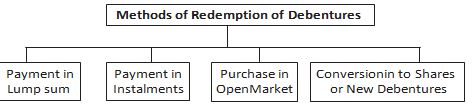
Conversion into Shares or New Debentures
Conversion — Convertible debentures are exchanged for shares or a new class of debentures.
Key points
- Issue terms: New shares or debentures may be issued at par, at a discount or at a premium.
- Calculation basis: Use the actual proceeds received when the original debentures were issued to calculate the securities issued on conversion.
- Original discount: If the debentures were issued at a discount, use the amount actually realised—not face value—as the basis.
- Applicability: This method applies only to convertible debentures.
Use the actual proceeds from the debenture issue and the issue price per share.
Formula symbols
- : Number of shares issued.
- : Actual proceeds received from the debentures.
- : Issue price per share.
Timing and Source of Redemption
Timing and source
- Timing: Debentures are generally redeemed on their due date. Early redemption is allowed if the company’s articles provide for it.
- Source: Redemption may be made out of capital or out of profits.
| Company category | DRR requirement stated in the lecture |
|---|---|
| All India financial institutions registered with the RBI; banking companies; NBFCs registered with the RBI; Housing Finance Companies registered with the National Housing Bank; companies listed on a stock exchange; and unlisted companies in the stated exempt categories | Exempt from creating a DRR; may redeem debentures out of capital. |
| Other unlisted companies | DRR adequacy must be at least 10% of the value of outstanding debentures. |
Debenture Redemption Investment
Debenture Redemption Investment — An investment or deposit set aside to help meet debentures maturing in the year ending the following March 31.
Requirements
- Deadline and amount: Invest or deposit at least of the debentures maturing during the relevant year, on or before April 30.
- Permitted forms: Deposit in a scheduled bank free from any charge or lien; Central or State Government securities; securities specified under section 20 of the Indian Trusts Act, 1982; or bonds of a company notified under that section.
- Restricted use: Use the investment or deposit only to redeem debentures maturing during the relevant year.
- Lump-sum redemption: Invest of the value of the debentures due for redemption.
- Instalment redemption: Carry investments forward for later requirements. Realise any excess and invest further if there is a shortfall.
Calculate the minimum using the face value of debentures due for redemption.
Formula symbols
- : Minimum redemption investment.
- : Face value of debentures due for redemption.
Kays Ltd. has 10,000 debentures of Rs. 100 each, redeemable in the instalments shown. Determine the required investments and realisations.
- Kays Ltd. has 10,000 debentures of Rs. 100 each, redeemed in instalments. Calculate the investment additions and realisations.
- For 2,000 debentures due on January 31, 2017, invest 15% of their face value by April 30, 2016.
- For 3,000 due on January 31, 2018, the investment requirement is Rs. 45,000; add Rs. 15,000 by April 30, 2017.
- For the 3,000 due on January 31, 2019, the existing Rs. 45,000 meets the requirement. Realise Rs. 15,000 at redemption, leaving Rs. 30,000.
- The remaining Rs. 30,000 equals 15% of the Rs. 2,00,000 due on January 31, 2020; realise the balance at that redemption.
| Redemption date | Debentures redeemed | Investment action |
|---|---|---|
| January 31, 2017 | 2,000 | Invest Rs. 30,000 by April 30, 2016. |
| January 31, 2018 | 3,000 | Add Rs. 15,000 by April 30, 2017; cumulative investment is Rs. 45,000. |
| January 31, 2019 | 3,000 | Carry Rs. 45,000; realise Rs. 15,000 at redemption, leaving Rs. 30,000. |
| January 31, 2020 | 2,000 | Realise the remaining Rs. 30,000 at redemption. |
Do not calculate shares using face value when the debentures were issued at a discount; use the actual proceeds realised at issue.
A company buys its own debentures in the open market and cancels them. Which method of redemption is this?
A company must redeem debentures with a face value of Rs. 8,00,000 in a lump sum. What is the minimum redemption investment?
Debentures with a face value of Rs. 5,00,000 were issued at a discount and are converted into shares. Which amount is used to calculate the number of shares?
Quick recap
- Redemption means repayment or discharge of debenture liability according to the issue terms.
- The four methods are lump-sum payment, instalments, open-market purchase and conversion.
- Early redemption is allowed when provided for in the company’s articles.
- For conversion, calculate the securities issued using actual proceeds from the original debenture issue.
- The lecture specifies DRR exemption categories and a 10% adequacy requirement for other unlisted companies.
- Invest or deposit at least 15% of the amount due for redemption by April 30, subject to the stated rules.
Redemption by Payment in Lump Sum
Lump-sum redemption — The company repays the full amount due on all debentures at one time on the redemption date.
Core accounting treatment
- Amount due is the face value plus any redemption premium.
- Amount-due entry transfers the liability to Debentureholders A/c.
- Payment entry settles Debentureholders A/c through Bank A/c.
- Issue price does not change the face value used to calculate redemption.
- Interest is separate from the principal redemption entries.
Use this to calculate the amount credited to Debentureholders A/c; is face value and is redemption premium.
Journal entries for lump-sum redemption
| Situation | Amount-due entry | Payment entry |
|---|---|---|
| Redeemed at par | Debentures A/c Dr. → To Debentureholders A/c | Debentureholders A/c Dr. → To Bank A/c |
| Redeemed at premium | Debentures A/c Dr. and Premium on Redemption of Debentures A/c Dr. → To Debentureholders A/c | Debentureholders A/c Dr. → To Bank A/c |
Illustration 21: Key amounts and conditions
- Case 1: debentures of Rs. 100 each give a face value of Rs. 5,00,000; they are redeemed at par out of capital.
- Case 2: debentures of Rs. 100 each give a face value of Rs. 1,00,000; a premium adds Rs. 10,000, making Rs. 1,10,000 payable.
- Case 3: Face value is Rs. 1,00,000; issue at a premium does not affect redemption at par.
- Case 4: Face value is Rs. 1,00,000; issue at a discount does not reduce redemption value. A redemption premium makes Rs. 1,05,000 payable.
| Case and entry | Account | Debit (Rs.) | Credit (Rs.) |
|---|---|---|---|
| 1: Amount due | 9% Debentures A/c | 5,00,000 | |
| To Debentureholders A/c | 5,00,000 | ||
| 1: Payment | Debentureholders A/c | 5,00,000 | |
| To Bank A/c | 5,00,000 | ||
| 2: Amount due | 12% Debentures A/c | 1,00,000 | |
| Premium on Redemption of Debentures A/c | 10,000 | ||
| To Debentureholders A/c | 1,10,000 | ||
| 2: Payment | Debentureholders A/c | 1,10,000 | |
| To Bank A/c | 1,10,000 | ||
| 3: Amount due | 12% Debentures A/c | 1,00,000 | |
| To Debentureholders A/c | 1,00,000 | ||
| 3: Payment | Debentureholders A/c | 1,00,000 | |
| To Bank A/c | 1,00,000 | ||
| 4: Amount due | 12% Debentures A/c | 1,00,000 | |
| Premium on Redemption of Debentures A/c | 5,000 | ||
| To Debentureholders A/c | 1,05,000 | ||
| 4: Payment | Debentureholders A/c | 1,05,000 | |
| To Bank A/c | 1,05,000 |
A company redeems 1,000 debentures of Rs. 100 each at a 10% premium. Calculate the amount due and state the two entries.
- Calculate the face value of the debentures.
- Find the redemption premium.
- Add the premium to face value to get the total amount due.
- Record the amount due, then record payment through Bank A/c.
Do not use the issue price to calculate redemption. An issue discount does not reduce the face value payable; use the stated redemption terms.
Issue, investment and reserve entries
Illustration 22: Key calculations
- Face value: debentures of Rs. 100 each total Rs. 20,000; issued at a discount, cash received is Rs. 18,000.
- Redemption premium: of Rs. 20,000 is Rs. 2,000; total due at redemption is Rs. 22,000.
- Loss on issue: Issue discount of Rs. 2,000 plus redemption premium of Rs. 2,000 gives Rs. 4,000.
- Debenture Redemption Investment (DRI): The illustration invests Rs. 3,000, equal to of the Rs. 20,000 face value.
- Debenture Redemption Reserve (DRR): For the other unlisted company in this example, DRR is created at of outstanding debentures, or Rs. 2,000.
| Stage and date | Account | Debit (Rs.) | Credit (Rs.) |
|---|---|---|---|
| Issue receipt — 1 April 2013 | Bank A/c | 18,000 | |
| To Debenture Application and Allotment A/c | 18,000 | ||
| Allotment — 1 April 2013 | Debenture Application and Allotment A/c | 18,000 | |
| Loss on Issue of Debentures A/c | 4,000 | ||
| To 15% Debentures A/c | 20,000 | ||
| To Premium on Redemption of Debentures A/c | 2,000 | ||
| DRI purchased — 30 April 2016 | Debenture Redemption Investment A/c | 3,000 | |
| To Bank A/c | 3,000 | ||
| DRI realised — 31 March 2017 | Bank A/c | 3,000 | |
| To Debenture Redemption Investment A/c | 3,000 | ||
| Amount due — 31 March 2017 | 15% Debentures A/c | 20,000 | |
| Premium on Redemption of Debentures A/c | 2,000 | ||
| To Debentureholders A/c | 22,000 | ||
| Payment — 31 March 2017 | Debentureholders A/c | 22,000 | |
| To Bank A/c | 22,000 |
| Point | Listed company | Other unlisted company |
|---|---|---|
| DRI in this example | Rs. 3,000 | Rs. 3,000 |
| DRR before redemption | No DRR entry shown | Create DRR of Rs. 2,000, equal to 10% of Rs. 20,000 |
| After redemption | No DRR transfer entry shown | Transfer DRR to General Reserve |
| Stage and date | Account | Debit (Rs.) | Credit (Rs.) |
|---|---|---|---|
| Create DRR — 31 March 2016 | Surplus (Balance in Statement of Profit and Loss) A/c | 2,000 | |
| To Debenture Redemption Reserve A/c | 2,000 | ||
| After redemption — 31 March 2017 | Debenture Redemption Reserve A/c | 2,000 | |
| To General Reserve A/c | 2,000 |
Date check: The question gives issue on 1 April 2013 and redemption at the end of year four, i.e. 31 March 2017. The printed solution instead shows issue in 2016, redemption in 2020 and DRR creation in 2019; these dates do not match the stated question.
Keep the three amounts distinct: face value is debited to Debentures A/c, redemption premium is debited to Premium on Redemption of Debentures A/c, and the total payable is credited to Debentureholders A/c.
A company has debentures of face value Rs. 1,00,000 redeemable at a 5% premium. Give the amount payable and the redemption entries.
Debentures with face value Rs. 1,00,000 are issued at a 5% discount and redeemable at a 5% premium. Find the amount due and give the redemption entries.
Quick recap
- Lump-sum redemption repays all debenture amounts due at one time.
- At par, transfer the face value to Debentureholders A/c; settle it through Bank A/c.
- At a premium, debit Premium on Redemption of Debentures A/c as well as Debentures A/c.
- Calculate redemption using face value and redemption terms, not issue price.
- Illustration 22 gives face value Rs. 20,000, total redemption payment Rs. 22,000 and DRI Rs. 3,000.
- In the other unlisted company example, DRR of Rs. 2,000 is created and later transferred to General Reserve.
- Illustration 22's printed dates conflict with its stated issue and fourth-year redemption dates.
Redemption by Payment in Instalments
Meaning and basic treatment
Here, is the total number of debentures, is the number of instalments, is the face value of one instalment, and is the redemption-premium rate.
| Transaction | Debit | Credit |
|---|---|---|
| Premium payable on redemption recognised at issue | Loss on Issue of Debentures A/c | Premium on Redemption of Debentures A/c |
| Instalment becomes due at par | Debentures A/c | Debentureholders A/c |
| Instalment becomes due at a premium | Debentures A/c; Premium on Redemption of Debentures A/c | Debentureholders A/c |
| Interest becomes due | Debenture Interest A/c | Debentureholders A/c |
| Payment to debentureholders | Debentureholders A/c | Bank A/c |
JK Ltd. illustration
JK Ltd. issues 6,000 debentures of Rs. 50 each at a 5% premium. They are redeemable in four equal instalments with a 10% redemption premium and carry 12% annual interest. Find the instalment and yearly cash payments.
- Calculate the issue value, number redeemed per instalment, and face value of each instalment.
- Find the issue premium, cash received on issue, and premium payable on redemption.
- Calculate the total redemption amount for each instalment.
- Calculate yearly interest on the debentures outstanding before each redemption and total cash paid.
| Date / transaction | Debit | Credit |
|---|---|---|
| 1 Apr 2014 — application money received | Bank A/c 3,15,000 | Debenture Application and Allotment A/c 3,15,000 |
| 1 Apr 2014 — application transferred | Debenture Application and Allotment A/c 3,15,000 | 12% Debentures A/c 3,00,000; Securities Premium Reserve A/c 15,000 |
| 1 Apr 2014 — redemption premium recognised | Loss on Issue of Debentures A/c 30,000 | Premium on Redemption of Debentures A/c 30,000 |
| 31 Mar 2015 and 31 Mar 2016 — interest due each year | Debenture Interest A/c 36,000 | Debentureholders A/c 36,000 |
| 31 Mar 2015 and 31 Mar 2016 — interest paid each year | Debentureholders A/c 36,000 | Bank A/c 36,000 |
| 30 Apr — investment in specified securities, as shown in the source | Debenture Redemption Investment A/c 11,250 | Bank A/c 11,250 |
| 31 Mar 2017 — interest due | Debenture Interest A/c 36,000 | Debentureholders A/c 36,000 |
| 31 Mar 2017 — first instalment due | 12% Debentures A/c 75,000; Premium on Redemption of Debentures A/c 7,500 | Debentureholders A/c 82,500 |
| 31 Mar 2017 — interest and instalment paid | Debentureholders A/c 1,18,500 | Bank A/c 1,18,500 |
| 31 Mar 2018 — interest due | Debenture Interest A/c 27,000 | Debentureholders A/c 27,000 |
| 31 Mar 2018 — second instalment due | 12% Debentures A/c 75,000; Premium on Redemption of Debentures A/c 7,500 | Debentureholders A/c 82,500 |
| 31 Mar 2018 — interest and instalment paid | Debentureholders A/c 1,09,500 | Bank A/c 1,09,500 |
| 31 Mar 2019 — interest due | Debenture Interest A/c 18,000 | Debentureholders A/c 18,000 |
| 31 Mar 2019 — third instalment due | 12% Debentures A/c 75,000; Premium on Redemption of Debentures A/c 7,500 | Debentureholders A/c 82,500 |
| 31 Mar 2019 — interest and instalment paid | Debentureholders A/c 1,00,500 | Bank A/c 1,00,500 |
| 31 Mar 2020 — investment realised | Bank A/c 11,250 | Debenture Redemption Investment A/c 11,250 |
| 31 Mar 2020 — interest due | Debenture Interest A/c 9,000 | Debentureholders A/c 9,000 |
| 31 Mar 2020 — final instalment due | 12% Debentures A/c 75,000; Premium on Redemption of Debentures A/c 7,500 | Debentureholders A/c 82,500 |
| 31 Mar 2020 — interest and instalment paid | Debentureholders A/c 91,500 | Bank A/c 91,500 |
Timing and interest
- Redemption dates: Four equal instalments fall at the ends of years 3, 4, 5 and 6: 31 March 2017, 2018, 2019 and 2020.
- Interest base: Interest is calculated on the debentures outstanding during that year; after each redemption, the next year's interest base decreases.
- Investment: The source records Rs. 11,250 invested in Debenture Redemption Investment A/c and realised on 31 March 2020.
Do not omit the stated redemption premium: Rs. 75,000 is the instalment's face value, not its total payment. Add the 10% premium, and keep interest as a separate liability.
A company has 8,000 debentures of Rs. 100 each, redeemable in four equal instalments at a 5% premium. Find the number and redemption amount per instalment.
A company has Rs. 4,00,000 of 10% debentures outstanding before a Rs. 1,00,000 instalment is redeemed. Find interest for that year and the following year.
What are the basic journal entries when an instalment becomes due and is then paid?
Quick recap
- Instalment redemption repays debentures in portions on scheduled dates; the portions are usually selected by draw of lots.
- Transfer the face value and any redemption premium to Debentureholders A/c when an instalment becomes due.
- Pay the amount due by debiting Debentureholders A/c and crediting Bank A/c.
- Calculate interest separately on the debentures outstanding during each interest period.
- In JK Ltd., each instalment comprises 1,500 debentures with face value Rs. 75,000.
- At the stated 10% redemption premium, each instalment is payable at Rs. 82,500 before interest.
Illustration 24 based on Issue of Debentures
Key details and calculations
Loss on issue of debentures — The redemption premium payable above the face value is a loss to the issuing company; here, the total loss is Rs. 30,000.
Use these calculations to find proceeds, instalments, redemption premium and yearly interest.
Journal entries
Entry logic
- Issue proceeds: Debit Bank A/c when application money is received; transfer the application balance when debentures are allotted.
- Issue premium: Credit Securities Premium Reserve A/c for Rs. 15,000; credit Debentures A/c only with face value of Rs. 3,00,000.
- Redemption premium: Credit Premium on Redemption of Debentures A/c on issue; debit it when instalments become due.
- Loss write-off: Debit Statement of Profit and Loss A/c and credit Loss on Issue of Debentures A/c for Rs. 30,000.
- Interest: Debit Debenture Interest A/c when due and credit Debentureholders A/c; debit Debentureholders A/c when paid.
- Outstanding balance: Interest falls as instalments are redeemed: Rs. 36,000, Rs. 27,000, Rs. 18,000, then Rs. 9,000.
| Date | Journal entry | Debit | Credit |
|---|---|---|---|
| 1 April 2014 | Bank A/c Dr. → Debenture Application and Allotment A/c | 3,15,000 | 3,15,000 |
| 1 April 2014 | Debenture Application and Allotment A/c Dr.; Loss on Issue of Debentures A/c Dr. → 12% Debentures A/c; Securities Premium Reserve A/c; Premium on Redemption of Debentures A/c | 3,15,000; 30,000 | 3,00,000; 15,000; 30,000 |
| 1 April 2014 | Statement of Profit and Loss A/c Dr. → Loss on Issue of Debentures A/c (loss written off) | 30,000 | 30,000 |
| 31 March 2015 | Debenture Interest A/c Dr. → Debentureholders A/c (interest due); Debentureholders A/c Dr. → Bank A/c (interest paid) | 36,000; 36,000 | 36,000; 36,000 |
| 31 March 2016 | Debenture Interest A/c Dr. → Debentureholders A/c (interest due); Debentureholders A/c Dr. → Bank A/c (interest paid) | 36,000; 36,000 | 36,000; 36,000 |
| 30 April 2017 | Debenture Redemption Investment A/c Dr. → Bank A/c (specified securities purchased) | 11,250 | 11,250 |
| 31 March 2017 | Debenture Interest A/c Dr. → Debentureholders A/c (interest due) | 36,000 | 36,000 |
| 31 March 2017 | 12% Debentures A/c Dr.; Premium on Redemption of Debentures A/c Dr. → Debentureholders A/c (first instalment due) | 75,000; 7,500 | 82,500 |
| 31 March 2017 | Debentureholders A/c Dr. → Bank A/c (first instalment and interest paid) | 1,18,500 | 1,18,500 |
| 31 March 2018 | Debenture Interest A/c Dr. → Debentureholders A/c (interest due on remaining debentures) | 27,000 | 27,000 |
| 31 March 2018 | 12% Debentures A/c Dr.; Premium on Redemption of Debentures A/c Dr. → Debentureholders A/c (second instalment due) | 75,000; 7,500 | 82,500 |
| 31 March 2018 | Debentureholders A/c Dr. → Bank A/c (second instalment and interest paid) | 1,09,500 | 1,09,500 |
| 31 March 2019 | Debenture Interest A/c Dr. → Debentureholders A/c (interest due on remaining debentures) | 18,000 | 18,000 |
| 31 March 2019 | 12% Debentures A/c Dr.; Premium on Redemption of Debentures A/c Dr. → Debentureholders A/c (third instalment due) | 75,000; 7,500 | 82,500 |
| 31 March 2019 | Debentureholders A/c Dr. → Bank A/c (third instalment and interest paid) | 1,00,500 | 1,00,500 |
| 31 March 2020 | Bank A/c Dr. → Debenture Redemption Investment A/c (investment realised) | 11,250 | 11,250 |
| 31 March 2020 | Debenture Interest A/c Dr. → Debentureholders A/c (interest due on remaining debentures) | 9,000 | 9,000 |
| 31 March 2020 | 12% Debentures A/c Dr.; Premium on Redemption of Debentures A/c Dr. → Debentureholders A/c (final instalment due) | 75,000; 7,500 | 82,500 |
| 31 March 2020 | Debentureholders A/c Dr. → Bank A/c (final instalment and interest paid) | 91,500 | 91,500 |
Calculate annual interest on the face value outstanding for that interest year. After each Rs. 75,000 instalment is redeemed, the next year's interest decreases.
What is the total payment at the first redemption date?
- Find the total payment for the first redemption date, including that year's interest.
- Find the face value of the first instalment.
- Find the 10% redemption premium.
- Find the interest due on all debentures before the first redemption.
- Add interest to the instalment and its redemption premium.
Do not credit Debentures A/c with the issue proceeds; credit it only with face value. Also, the first combined payment is Rs. 1,18,500, not Rs. 1,18,000, and interest must be based on the outstanding debentures.
Find interest for the year after the first instalment of Rs. 75,000 has been redeemed.
What amount is credited to Debentureholders A/c when 1,500 debentures of Rs. 50 each become due at a 10% premium?
Quick recap
- The face value issued is Rs. 3,00,000, and cash received at a 5% premium is Rs. 3,15,000.
- The total redemption premium and loss on issue are Rs. 30,000.
- Each of the four instalments has face value Rs. 75,000 and is payable at Rs. 82,500.
- Interest due across the four redemption years is Rs. 36,000, Rs. 27,000, Rs. 18,000 and Rs. 9,000.
- The combined redemption payments, including interest, are Rs. 1,18,500, Rs. 1,09,500, Rs. 1,00,500 and Rs. 91,500.
- The specified-securities investment and its realisation are each recorded at Rs. 11,250.
Illustration 25 based on Issue of Debentures
Key calculations
Loss on issue of debentures — The loss includes the discount allowed on issue and the premium payable on redemption.
ABC Ltd. issues 6,000 debentures of Rs. 50 each at a 5% discount and redeems them at a 10% premium.
Four equal instalments redeem one-fourth of the original face value each. Annual interest is calculated on the face value outstanding during that year.
| Year ending 31 March | Face value outstanding before redemption | Interest due | Redemption payment | Total cash paid |
|---|---|---|---|---|
| 2017 | Rs. 3,00,000 | Rs. 36,000 | Rs. 82,500 | Rs. 1,18,500 |
| 2018 | Rs. 2,25,000 | Rs. 27,000 | Rs. 82,500 | Rs. 1,09,500 |
| 2019 | Rs. 1,50,000 | Rs. 18,000 | Rs. 82,500 | Rs. 1,00,500 |
| 2020 | Rs. 75,000 | Rs. 9,000 | Rs. 82,500 | Rs. 91,500 |
Journal entries
| Date | Particulars | Debit | Credit |
|---|---|---|---|
| 1 April 2014 | Bank A/c Dr.; To Debenture Application and Allotment A/c | 2,85,000 | 2,85,000 |
| 1 April 2014 | Debenture Application and Allotment A/c Dr. 2,85,000; Loss on Issue of Debentures A/c Dr. 45,000; To 12% Debentures A/c 3,00,000; To Premium on Redemption of Debentures A/c 30,000 | 3,30,000 | 3,30,000 |
| 31 March 2015 | Statement of Profit and Loss A/c Dr.; To Loss on Issue of Debentures A/c (loss written off) | 45,000 | 45,000 |
| 31 March 2016 | Surplus, i.e. Statement of Profit and Loss A/c Dr.; To Debenture Redemption Reserve A/c (10% of outstanding debentures) | 30,000 | 30,000 |
| 30 April 2016 | Debenture Redemption Investment A/c Dr.; To Bank A/c (15% of the first instalment due) | 11,250 | 11,250 |
Debenture Redemption Reserve (DRR) — A reserve created from profits for debenture redemption; this illustration transfers Rs. 30,000 to DRR and transfers Rs. 7,500 to General Reserve after each instalment is redeemed.
| Date | Journal entry | Debit | Credit |
|---|---|---|---|
| 31 March 2015 | Debenture Interest A/c Dr.; To Debentureholders A/c (interest due); Debentureholders A/c Dr.; To Bank A/c (interest paid) | 36,000; 36,000 | 36,000; 36,000 |
| 31 March 2016 | Debenture Interest A/c Dr.; To Debentureholders A/c (interest due); Debentureholders A/c Dr.; To Bank A/c (interest paid) | 36,000; 36,000 | 36,000; 36,000 |
| 31 March 2017 | Debenture Interest A/c Dr.; To Debentureholders A/c; 12% Debentures A/c Dr. 75,000 and Premium on Redemption of Debentures A/c Dr. 7,500; To Debentureholders A/c; Debentureholders A/c Dr.; To Bank A/c (interest and first instalment paid); DRR A/c Dr.; To General Reserve A/c | 36,000; 82,500; 1,18,500; 7,500 | 36,000; 82,500; 1,18,500; 7,500 |
| 31 March 2018 | Debenture Interest A/c Dr.; To Debentureholders A/c; 12% Debentures A/c Dr. 75,000 and Premium on Redemption of Debentures A/c Dr. 7,500; To Debentureholders A/c; Debentureholders A/c Dr.; To Bank A/c (interest and second instalment paid); DRR A/c Dr.; To General Reserve A/c | 27,000; 82,500; 1,09,500; 7,500 | 27,000; 82,500; 1,09,500; 7,500 |
| 31 March 2019 | Debenture Interest A/c Dr.; To Debentureholders A/c; 12% Debentures A/c Dr. 75,000 and Premium on Redemption of Debentures A/c Dr. 7,500; To Debentureholders A/c; Debentureholders A/c Dr.; To Bank A/c (interest and third instalment paid); DRR A/c Dr.; To General Reserve A/c | 18,000; 82,500; 1,00,500; 7,500 | 18,000; 82,500; 1,00,500; 7,500 |
| 31 March 2020 | Debenture Interest A/c Dr.; To Debentureholders A/c; 12% Debentures A/c Dr. 75,000 and Premium on Redemption of Debentures A/c Dr. 7,500; To Debentureholders A/c; Debentureholders A/c Dr.; To Bank A/c (interest and final instalment paid); Bank A/c Dr.; To Debenture Redemption Investment A/c (investment realised); DRR A/c Dr.; To General Reserve A/c | 9,000; 82,500; 91,500; 11,250; 7,500 | 9,000; 82,500; 91,500; 11,250; 7,500 |
How to prepare the entries
- Calculate face value, issue discount, redemption premium and total loss.
- Record the cash received and transfer the debentures and redemption premium to their accounts.
- Calculate annual interest on the face value outstanding during that year.
- For each instalment, record its face value and premium as payable, then record payment including that year's interest.
- Record the specified DRR transfer and investment; realise the investment when due.
What total amount is paid on 31 March 2017 for the first redemption instalment, including that year's interest?
- Find the face value of the first instalment.
- Calculate its redemption premium and total redemption amount.
- Calculate interest for the year ending 31 March 2017, before the first instalment is redeemed.
- Add interest to the redemption amount to find the total payment.
Do not calculate later interest on the original Rs. 3,00,000 after instalments have been redeemed. The correct total payments are Rs. 1,09,500 in 2018 and Rs. 91,500 in 2020.
Calculate the total loss on issue of the debentures.
What interest is due for the year ending 31 March 2019?
Find the total payment for the final redemption on 31 March 2020, including interest.
Quick recap
- Total face value is Rs. 3,00,000; cash received after the issue discount is Rs. 2,85,000.
- Issue discount of Rs. 15,000 plus redemption premium of Rs. 30,000 gives a loss of Rs. 45,000.
- Each of the four instalments has face value Rs. 75,000 and redemption premium Rs. 7,500.
- Interest declines as debentures are redeemed: Rs. 36,000, Rs. 27,000, Rs. 18,000 and Rs. 9,000.
- Total annual payments are Rs. 1,18,500, Rs. 1,09,500, Rs. 1,00,500 and Rs. 91,500.
- The illustration transfers Rs. 30,000 to DRR and invests Rs. 11,250 in Debenture Redemption Investment.
Illustration 26 based on Issue of Debentures
Issue at a Discount and Instalment Redemption
Calculate the face value, issue discount and cash received as follows.
Calculate interest using the face value outstanding for the year.
| Year ended 31 March | Face value on which interest is calculated | Interest |
|---|---|---|
| 2013 | Rs. 3,00,000 | Rs. 42,000 |
| 2014 | Rs. 3,00,000 | Rs. 42,000 |
| 2015 | Rs. 3,00,000 | Rs. 42,000 |
| 2016 | Rs. 2,00,000 | Rs. 28,000 |
| 2017 | Rs. 1,00,000 | Rs. 14,000 |
For a year when an instalment is redeemed at year-end, calculate interest on the opening face value; use the reduced balance from the following year.
Prepare the Three Ledger Accounts
- Calculate the total face value, discount, cash received and equal redemption instalment.
- Credit 14% Debentures A/c with the cash received and the discount to recognise the full liability.
- Debit Debentures A/c for each Rs. 1,00,000 instalment redeemed at the end of years 3, 4 and 5.
- Calculate yearly interest on the face value outstanding and transfer it to the Statement of Profit and Loss.
- Write off the discount to the Statement of Profit and Loss as shown in the illustration.
Prepare the 14% Debentures, Discount on Issue of Debentures and Debenture Interest accounts for ABC Ltd.
- Find the issue proceeds, discount and annual redemption amount.
- Calculate interest for each year using the outstanding face value.
- After redemption on 31 March 2015, calculate 2016 interest on Rs. 2,00,000.
- After redemption on 31 March 2016, calculate 2017 interest on Rs. 1,00,000.
| Date | Dr. particulars | Dr. amount | Cr. particulars | Cr. amount |
|---|---|---|---|---|
| 1 Apr 2012 | — | — | Debenture Application | 2,85,000 |
| 1 Apr 2012 | — | — | Discount on Issue of Debentures | 15,000 |
| 31 Mar 2013 | Balance c/d | 3,00,000 | — | — |
| 1 Apr 2013 | — | — | Balance b/d | 3,00,000 |
| 31 Mar 2014 | Balance c/d | 3,00,000 | — | — |
| 1 Apr 2014 | — | — | Balance b/d | 3,00,000 |
| 31 Mar 2015 | Debentureholders A/c | 1,00,000 | — | — |
| 31 Mar 2015 | Balance c/d | 2,00,000 | — | — |
| 1 Apr 2015 | — | — | Balance b/d | 2,00,000 |
| 31 Mar 2016 | Debentureholders A/c | 1,00,000 | — | — |
| 31 Mar 2016 | Balance c/d | 1,00,000 | — | — |
| 1 Apr 2016 | — | — | Balance b/d | 1,00,000 |
| 31 Mar 2017 | Debentureholders A/c | 1,00,000 | — | — |
| Date | Dr. particulars | Dr. amount | Cr. particulars | Cr. amount |
|---|---|---|---|---|
| 1 Apr 2012 | 14% Debentures A/c | 15,000 | — | — |
| 31 Mar 2013 | — | — | Statement of Profit and Loss | 15,000 |
| Date | Dr. particulars | Dr. amount | Cr. particulars | Cr. amount |
|---|---|---|---|---|
| 31 Mar 2013 | Debentureholders | 42,000 | Statement of Profit and Loss | 42,000 |
| 31 Mar 2014 | Debentureholders | 42,000 | Statement of Profit and Loss | 42,000 |
| 31 Mar 2015 | Debentureholders | 42,000 | Statement of Profit and Loss | 42,000 |
| 31 Mar 2016 | Debentureholders | 28,000 | Statement of Profit and Loss | 28,000 |
| 31 Mar 2017 | Debentureholders | 14,000 | Statement of Profit and Loss | 14,000 |
Do not reduce the interest base before the year-end redemption: interest for 2015 is Rs. 42,000 on Rs. 3,00,000; the reduced Rs. 2,00,000 balance applies from 2016.
A company issues 2,000 debentures of Rs. 100 each at a 4% discount. Calculate the discount and cash received.
A company has Rs. 4,00,000 of 10% debentures outstanding. It redeems Rs. 1,00,000 at the end of the year. Find interest for that year and the following year, assuming no other changes.
Quick recap
- Face value: Total debenture liability issued is Rs. 3,00,000.
- Discount: ABC Ltd. receives Rs. 2,85,000 and records a discount of Rs. 15,000.
- Redemption: Repay Rs. 1,00,000 at the end of each of years 3, 4 and 5.
- Interest: Annual interest is Rs. 42,000 for the first three years, then Rs. 28,000 and Rs. 14,000.
- Discount write-off: The illustration transfers the full Rs. 15,000 discount to the Statement of Profit and Loss in 2013.
Illustration 27 based on Journal entries
Redemption schedule and required investment
Debenture Redemption Investment (DRI) — An investment maintained to help meet the legal requirement for funds for debenture redemption; in this illustration, it is held at 15% of the relevant redemption amount.
| Redemption date | Debentures redeemed | Amount at Rs. 100 each |
|---|---|---|
| 31 March 2017 | 3,000 | Rs. 3,00,000 |
| 31 March 2018 | 6,000 | Rs. 6,00,000 |
| 31 March 2019 | 5,000 | Rs. 5,00,000 |
| 31 March 2020 | 6,000 (balance) | Rs. 6,00,000 |
| Total | 20,000 | Rs. 20,00,000 |
DRI requirement and balance
- DRR decision: Vishwas Ltd. decided to create a Debenture Redemption Reserve on 31 March 2016.
- 1 April 2016: Invest Rs. 45,000, equal to 15% of the Rs. 3,00,000 due for redemption in 2017.
- 1 April 2017: Add Rs. 45,000; DRI becomes Rs. 90,000, or 15% of the Rs. 6,00,000 due in 2018.
- 31 March 2018: Realise Rs. 15,000; Rs. 75,000 remains, equal to 15% of the Rs. 5,00,000 due in 2019.
- 1 April 2019: Add Rs. 15,000; DRI becomes Rs. 90,000, equal to 15% of the Rs. 6,00,000 due in 2020.
- 31 March 2020: Realise the full DRI balance of Rs. 90,000.
Use the illustration's 15% rate; subtract the existing DRI balance to find any additional investment.
Journal entries and ledger balances
Entries for redemption at par
- Transfer the debentures being redeemed to Debentureholders Account.
- Record payment to debentureholders through Bank Account.
- Record DRI purchases and realisations separately from the redemption entries.
Calculate the DRI investments and balances for Vishwas Ltd.'s redemption schedule.
- Calculate the 2017 redemption amount.
- Find the initial DRI investment at 15%.
- Find the additional investment on 1 April 2017 to reach the 2018 requirement.
- After realising Rs. 15,000 in 2018, check the DRI balance against the 2019 requirement.
- Find the 2019 addition needed for the 2020 requirement.
| Date | Particulars | Debit | Credit |
|---|---|---|---|
| 1 Apr 2016 | Debenture Redemption Investment A/c Dr. → Bank A/c | Rs. 45,000 | Rs. 45,000 |
| 31 Mar 2017 | 7% Debentures A/c Dr. → Debentureholders A/c | Rs. 3,00,000 | Rs. 3,00,000 |
| 31 Mar 2017 | Debentureholders A/c Dr. → Bank A/c | Rs. 3,00,000 | Rs. 3,00,000 |
| 1 Apr 2017 | Debenture Redemption Investment A/c Dr. → Bank A/c | Rs. 45,000 | Rs. 45,000 |
| 31 Mar 2018 | 7% Debentures A/c Dr. → Debentureholders A/c | Rs. 6,00,000 | Rs. 6,00,000 |
| 31 Mar 2018 | Debentureholders A/c Dr. → Bank A/c | Rs. 6,00,000 | Rs. 6,00,000 |
| 31 Mar 2018 | Bank A/c Dr. → Debenture Redemption Investment A/c | Rs. 15,000 | Rs. 15,000 |
| 31 Mar 2019 | 7% Debentures A/c Dr. → Debentureholders A/c | Rs. 5,00,000 | Rs. 5,00,000 |
| 31 Mar 2019 | Debentureholders A/c Dr. → Bank A/c | Rs. 5,00,000 | Rs. 5,00,000 |
| 1 Apr 2019 | Debenture Redemption Investment A/c Dr. → Bank A/c | Rs. 15,000 | Rs. 15,000 |
| 31 Mar 2020 | Bank A/c Dr. → Debenture Redemption Investment A/c | Rs. 90,000 | Rs. 90,000 |
| 31 Mar 2020 | 7% Debentures A/c Dr. → Debentureholders A/c | Rs. 6,00,000 | Rs. 6,00,000 |
| 31 Mar 2020 | Debentureholders A/c Dr. → Bank A/c | Rs. 6,00,000 | Rs. 6,00,000 |
| Year ended | Opening balance | Debentures redeemed | Closing balance |
|---|---|---|---|
| 31 Mar 2017 | Rs. 20,00,000 | Rs. 3,00,000 | Rs. 17,00,000 |
| 31 Mar 2018 | Rs. 17,00,000 | Rs. 6,00,000 | Rs. 11,00,000 |
| 31 Mar 2019 | Rs. 11,00,000 | Rs. 5,00,000 | Rs. 6,00,000 |
| 31 Mar 2020 | Rs. 6,00,000 | Rs. 6,00,000 | Nil |
| Date / event | Investment purchased | Investment realised | Balance |
|---|---|---|---|
| 1 Apr 2016 | Rs. 45,000 | — | Rs. 45,000 |
| 1 Apr 2017 | Rs. 45,000 | — | Rs. 90,000 |
| 31 Mar 2018 | — | Rs. 15,000 | Rs. 75,000 |
| 31 Mar 2019 | — | — | Rs. 75,000 |
| 1 Apr 2019 | Rs. 15,000 | — | Rs. 90,000 |
| 31 Mar 2020 | — | Rs. 90,000 | Nil |
Debenture Redemption Reserve
- Separate from DRI: DRR is a reserve created from profits; DRI is an investment asset.
- Illustration detail: The text gives the date of the decision to create DRR (31 March 2016), but no transfer amount or rate; do not invent a DRR journal entry.
Do not invest 15% of the original total debentures every year. Calculate the relevant DRI requirement and subtract the existing balance; the 2019 redemption is 5,000 debentures, not 6,000.
Rs. 8,00,000 of debentures will be redeemed next year. Find the required DRI at 15%.
The relevant redemption amount is Rs. 4,00,000 and the existing DRI is Rs. 45,000. How much more should the company invest?
Record the journal entries for Rs. 2,00,000 of debentures redeemed at par and paid immediately.
Quick recap
- Vishwas Ltd. had 20,000 debentures of Rs. 100 each, redeemed in four instalments from 2017 to 2020.
- The company decided to create DRR on 31 March 2016; the illustration does not state a DRR transfer amount.
- DRI required in this illustration is 15% of the relevant redemption amount, less any existing balance.
- At par, debit 7% Debentures and credit Debentureholders; then debit Debentureholders and credit Bank when paid.
- Realising DRI debits Bank and credits Debenture Redemption Investment.
- The DRI balance reaches Rs. 90,000 before its full realisation on 31 March 2020.
Redemption by Purchase in Open Market
Redemption by purchase in the open market — A company redeems debentures this way when it buys its own debentures in the market for immediate cancellation.
Accounting for Purchase and Cancellation
Compare the amount paid to purchase the debentures with their face value.
Symbols
- : Face value of debentures cancelled; : cost of purchase.
- : Profit when ; : loss when .
| Particulars | Debit (Rs.) | Credit (Rs.) |
|---|---|---|
| Debentures A/c Dr. | Face value | |
| To Bank A/c | Purchase cost | |
| To Profit on Redemption of Debentures A/c | Difference | |
| Profit on Redemption of Debentures A/c Dr. | Profit | |
| To Capital Reserve | Profit |
| Particulars | Debit (Rs.) | Credit (Rs.) |
|---|---|---|
| Debentures A/c Dr. | Face value | |
| Loss on Redemption of Debentures A/c Dr. | Difference | |
| To Bank A/c | Purchase cost | |
| Statement of Profit and Loss Dr. | Loss | |
| To Loss on Redemption of Debentures A/c | Loss |
Record Open-Market Redemption
- Calculate the total purchase cost and compare it with the face value cancelled.
- Debit Debentures A/c with the face value and credit Bank A/c with the purchase cost.
- Record any profit or loss; transfer a profit to Capital Reserve or charge a loss to Statement of Profit and Loss.
Pass the journal entries for X Ltd.'s purchase and cancellation of its own debentures.
- X Ltd. cancels debentures with a face value of Rs. 20,000, purchased at Rs. 92 per Rs. 100 face value.
- The purchase cost is below face value, so the difference is a profit.
- Record cancellation and then transfer the profit to Capital Reserve, as shown in the journal table.
| Particulars | Debit (Rs.) | Credit (Rs.) |
|---|---|---|
| Debentures A/c Dr. | 20,000 | |
| To Bank A/c | 18,400 | |
| To Profit on Redemption of Debentures A/c | 1,600 | |
| Profit on Redemption of Debentures A/c Dr. | 1,600 | |
| To Capital Reserve | 1,600 |
A company purchases and cancels debentures with a face value of Rs. 50,000 for Rs. 47,500. Find the profit and state its transfer.
Debentures with a face value of Rs. 30,000 are purchased and cancelled for Rs. 31,200. Find the loss and state how it is written off.
Quick recap
- A company buys its own debentures in the open market for immediate cancellation.
- Debentures A/c is debited at face value when the liability is cancelled.
- Purchase below face value creates a profit, transferred to Capital Reserve.
- Purchase above face value creates a loss, charged to Statement of Profit and Loss.
- For Rs. 20,000 face value bought at Rs. 92 per Rs. 100, cost is Rs. 18,400 and profit is Rs. 1,600.
Illustration 29 based on Journal entries
Illustration 29: Purchase and Redemption by Draw of Lots
Profit on redemption by purchase — Profit is the face value of debentures cancelled less their total purchase cost, including expenses.
Include all purchase expenses in the cost.
Journalise mixed redemption
- Find the face value purchased and add any expenses to its purchase cost.
- Debit Debentures at face value; credit Bank with the total cost and credit the difference as profit.
- Transfer the profit to Capital Reserve; record the remaining redemption at par.
- Record the DRR and DRI entries as required; transfer the DRR balance to General Reserve after redemption, as shown here.
X Ltd. redeems Rs. 25,000 of debentures: it purchases Rs. 20,000 face value at Rs. 98.50 each, pays Rs. 100 expenses, and redeems the balance by draw of lots. Journalise.
- Find the face value of the 200 debentures purchased.
- Add the Rs. 100 expense to the purchase price.
- Calculate profit on cancellation.
- Find the face value redeemed by draw of lots.
Do not calculate the profit using only the quoted market price: include purchase expenses before comparing total cost with face value.
Illustration 30: Issue at Discount and Purchase for Cancellation
The discount is the difference between face value and issue proceeds.
Calculate profit for each purchase, then add the profits.
Journalise issue and cancellation
- Record proceeds received and transfer them to Debentures, debiting the issue discount.
- For each cancellation, subtract the amount paid from face value to find the profit.
- Add the profits and transfer the total to Capital Reserve.
Find the profit on cancellation when Rs. 80,000 face value is purchased at Rs. 950 per debenture and Rs. 1,20,000 face value at Rs. 900 per debenture. State its treatment.
- Calculate the discount on issue.
- Calculate profit on Rs. 80,000 face value bought as 80 debentures at Rs. 950 each.
- Calculate profit on Rs. 1,20,000 face value bought as 120 debentures at Rs. 900 each.
- Combine the two profits for transfer to Capital Reserve.
The question specifies redemption on 31 March 2015, while the printed solution dates the cancellation entries 31 March 2014. Use 31 March 2015 for the cancellation entries. The printed solution also writes off the full Rs. 40,000 issue discount on 31 March 2014, but the question gives no write-off policy; do not assume that full write-off as a general rule.
A company cancels 100 debentures of Rs. 100 each, bought at Rs. 97 each, and pays Rs. 100 purchase expenses. Find the profit and its treatment.
A company redeems Rs. 50,000 face value of debentures by draw of lots at par. Give the journal entry.
A company cancels 60 debentures of Rs. 1,000 each, bought at Rs. 940 each. Calculate the profit and give the cancellation entry.
Quick recap
- For debentures purchased for cancellation, debit Debentures at face value and credit Bank with the total purchase cost.
- Include purchase expenses when calculating profit on redemption.
- Transfer profit on cancellation to Capital Reserve; redemption at par by draw of lots is recorded at face value.
- In Illustration 29, Rs. 20,000 face value is purchased, Rs. 5,000 is redeemed by draw of lots, and the purchase profit is Rs. 200.
- Illustration 30 allows 200 debentures to be redeemed each year from 31 March 2015 at par, by purchase or by draw of lots at the company's option.
- Illustration 30's cancellation profits total Rs. 16,000; the printed cancellation date conflicts with the question's date.
Redemption by Conversion
Redemption by conversion
Redemption by conversion — Settling a debenture liability by issuing shares or new debentures instead of paying cash.
Key points
- Choice of securities: Debentures may be converted into shares or new debentures.
- Issue terms: New securities may be issued at par, at a discount or at a premium.
- Settlement: Transfer the amount due to Debentureholders A/c, then settle it by issuing securities; no Bank A/c is used for the conversion.
Use the conversion amount and the total issue price per share.
Journal-entry sequence
- Transfer the face value of the debentures redeemed to Debentureholders A/c.
- Debit Debentureholders A/c and credit the share or new debenture account; credit Securities Premium A/c if shares are issued at a premium.
- If the original debentures were issued at a discount, write off the unamortised discount and record the balancing gain or loss.
Record the conversion of 1,000 debentures and the cash redemption of 500 debentures.
- Arjun Plastics converts 1,000 debentures of Rs. 100 each into equity shares of Rs. 10 each, issued at a premium of Rs. 2.50 per share.
- The issue price per share is Rs. 12.50, so calculate the number of shares issued.
- Split the conversion amount between share capital and securities premium.
- The company separately redeems 500 more debentures for cash, using Rs. 50,000 out of profit.
| Particulars | Debit (Rs.) | Credit (Rs.) |
|---|---|---|
| 15% Debentures A/c Dr. | 1,00,000 | |
| To Debentureholders A/c | 1,00,000 | |
| Debentureholders A/c Dr. | 1,00,000 | |
| To Equity Share Capital A/c | 80,000 | |
| To Securities Premium Reserve A/c | 20,000 | |
| 15% Debentures A/c Dr. (500 debentures) | 50,000 | |
| To Debentureholders A/c | 50,000 | |
| Debentureholders A/c Dr. | 50,000 | |
| To Bank A/c | 50,000 |
Conversion of debentures issued at a discount
Accounting treatment
- Conversion amount: In the example, debentureholders receive securities equal to 92% of the face value redeemed.
- Unamortised discount: Credit Discount on Issue of Debentures A/c for the remaining discount written off.
- Balancing amount: Record the remaining difference as a credit to Statement of Profit & Loss in the illustrated entry.
Record the redemption by conversion and the issue of equity shares.
- A company redeems 2,000 debentures of Rs. 100 each, originally issued at Rs. 92, by conversion into equity shares of Rs. 20 each.
- The conversion amount is 92% of face value; calculate the number of shares issued.
- The journal entry also writes off unamortised discount of Rs. 8,400. The balancing credit to Statement of Profit & Loss is Rs. 7,600.
| Particulars | Debit (Rs.) | Credit (Rs.) |
|---|---|---|
| 9% Debentures A/c Dr. | 2,00,000 | |
| To Debentureholders A/c | 1,84,000 | |
| To Discount on Issue of Debentures A/c | 8,400 | |
| To Statement of Profit & Loss | 7,600 | |
| Debentureholders A/c Dr. | 1,84,000 | |
| To Equity Share Capital A/c | 1,84,000 |
The printed entry gives Rs. 9,600 to Statement of Profit & Loss, making the credits exceed the Rs. 2,00,000 debit. Use Rs. 7,600 so the entry balances: Rs. 1,84,000 + Rs. 8,400 + Rs. 7,600 = Rs. 2,00,000.
Purchase and cancellation of own debentures
Cancellation of own debentures — When a company buys back its own debentures and cancels them, the liability is removed from its books.
Key treatment
- Purchase below face value: The difference between the face value cancelled and the purchase cost is profit on cancellation.
- Transfer: Profit on cancellation is transferred to Capital Reserve.
Use the face value cancelled and the cost of purchase.
Record the purchase, cancellation and transfer of the profit.
- LCM Ltd. purchases 10,00,000 of its own debentures of Rs. 500 each at Rs. 480 each.
- Calculate the purchase cost and the profit when the debentures are cancelled.
- Transfer the cancellation profit to Capital Reserve.
| Particulars | Debit (Rs.) | Credit (Rs.) |
|---|---|---|
| Own Debentures A/c Dr. | 48,00,00,000 | |
| To Bank A/c | 48,00,00,000 | |
| 9% Debentures A/c Dr. | 50,00,00,000 | |
| To Own Debentures A/c | 48,00,00,000 | |
| To Profit on Cancellation of Debentures A/c | 2,00,00,000 | |
| Profit on Cancellation of Debentures A/c Dr. | 2,00,00,000 | |
| To Capital Reserve | 2,00,00,000 |
A company converts debentures of Rs. 3,00,000 into equity shares of Rs. 10 each, issued at a premium of Rs. 2 per share. Find the number of shares and the amounts credited to share capital and premium.
A company cancels its own debentures of face value Rs. 10,00,000, purchased for Rs. 9,60,000. Find the profit and its transfer.
Quick recap
- Redemption by conversion settles debentures with shares or new debentures rather than cash.
- For share conversion, divide the amount settled by the total issue price per share.
- Issue premium is credited to Securities Premium A/c; conversion itself does not require a Bank A/c entry.
- For discount-issued debentures, write off the remaining discount and ensure the redemption entry balances.
- Profit on cancellation of own debentures is transferred to Capital Reserve.
Summary
Debentures and Bonds
Debenture — A debenture is a written acknowledgement of debt and represents loan capital raised by a company from the public.
- Debenture holder: A person who holds the written acknowledgement of debt.
- Bond: Similar to a debenture in content and form; some bonds, such as deep-discount bonds, may be issued without a predetermined interest rate.
Charge and Repayment Priority
Charge — A charge is an encumbrance over company assets to meet obligations under a trust deed.
- First charge: Has priority in repayment; its holders claim from the net realisable value of the charged asset first.
- Second charge: Its holders can claim from any surplus remaining after the first-charge claim is settled.
Types of Debentures
| Basis | Types |
|---|---|
| Security | Secured (mortgaged) and unsecured |
| Redemption | Redeemable and perpetual |
| Conversion | Convertible and non-convertible |
| Interest rate | Zero coupon rate and specific coupon rate |
| Registration | Registered and bearer |
Issue of Debentures
| Issue price | Meaning | Accounting treatment |
|---|---|---|
| At par | Issue price equals nominal or face value. | No premium or discount arises. |
| At premium | Issue price is greater than nominal or face value. | Credit the amount of premium to Securities Premium Account. |
| At discount | Issue price is less than nominal or face value. | Debit the discount/loss to Discount or Loss on Issue of Debentures and write it off over the years. |
Issue for Consideration Other Than Cash
Purchase consideration — The amount paid by a purchasing company in consideration for acquiring assets or the business of another enterprise or vendor.
- Non-cash issue: Debentures may be issued to vendors or suppliers on a preferential basis for assets such as patents, copyrights or other intellectual property rights, instead of paying cash.
Collateral Security
Collateral security — Any security given in addition to the primary security.
Redemption of Debentures
Redemption of debentures — The discharge of a debenture or bond liability by repayment to debenture holders, normally when the issue period expires and according to the issue terms.
Other terms introduced in the chapter
- Additional terminology: Fixed charge, floating charge, maturity date, principal, discount/loss on issue, draw of lots, own debentures, redemption out of capital or profits, redemption of convertible debentures, Debenture Sinking Fund and purchase of debentures from the open market.
Quick recap
- A debenture is written evidence of debt raised by a company from the public; its holder is a debenture holder.
- A charge secures obligations against assets; first-charge claims take priority over second-charge claims.
- Debentures may be classified by security, redemption, conversion, interest rate and registration.
- Issue at par equals face value; issue at a premium exceeds it; issue at a discount is below it.
- Premium is credited to Securities Premium Account; discount or loss on issue is debited and written off over the years.
- Debentures may be issued to vendors or suppliers on a preferential basis for assets or intellectual property instead of cash.
- Redemption is repayment of the debenture liability according to the issue terms.
Formula sheet
Accountancy — ALL CHAPTERS
1
Accounting for Share Capital
2
Issue and Redemption of Debentures
3
Financial Statements of a Company
4
Analysis of Financial Statements
5
Accounting Ratios
6
Cash Flow Statement
1
Overview Of Computerised Accounting System
2
Spreadsheet
3
Use Of Spreadsheet In Business Applications
4
Graphs And Charts For Business Data
1
Accounting for Partnership: Basic Concepts
2
Reconstitution of a Partnership Firm –Admission of a Partner
3
Reconstitution of a Partnership Firm –Retirement/Death of a Partner
4
Dissolution of Partnership Firm