Class 12 PCB . Chemistry . Chemistry Part II . Aldehydes Ketones and Carboxylic Acids
Chapter 8: Aldehydes, Ketones and Carboxylic Acids
Ch 8
Chemistry
Class 12 PCB
Carbonyl Compound
Carbonyl Compounds and Their Functional Groups
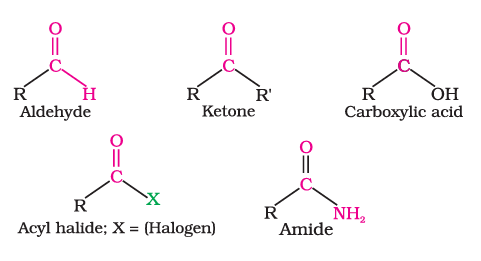
Carbonyl group — The carbonyl group is a carbon–oxygen double bond, written as .
Main carbonyl-containing classes
- Aldehyde: The carbonyl carbon is bonded to at least one hydrogen; general group .
- Ketone: The carbonyl carbon is bonded to two carbon groups; general group .
- Carboxylic acid: The carbonyl carbon is bonded to a hydroxyl group; general group .
- Related derivatives: Acyl halides and amides contain carbonyl carbon bonded to halogen and nitrogen, respectively.
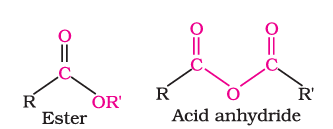
- Esters and anhydrides: Carboxylic-acid derivatives with general structures and .
Occurrence and importance
- Uses: Carbonyl compounds occur in fabrics, flavourings, plastics and drugs, and are involved in biochemical processes.
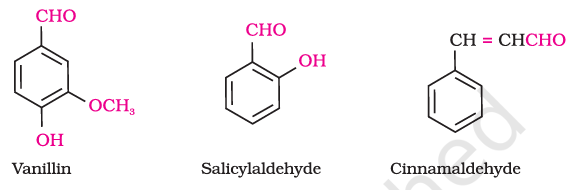
- Natural fragrances: Vanillin occurs in vanilla, salicylaldehyde in meadow sweet, and cinnamaldehyde in cinnamon.
Nomenclature of Aldehydes and Ketones
| Naming rule | Example |
|---|---|
| Aldehyde names often come from the corresponding carboxylic-acid common names; replace the acid ending “-ic” with “aldehyde.” | Acetic acid → acetaldehyde |
| Greek letters locate substituents from the aldehyde group: the adjacent carbon is , followed by , , and so on. | -Bromobutyraldehyde |
| Some ketones have historical names; the simplest ketone, , is acetone. | Acetone |
| Alkyl phenyl ketones are commonly named using the acyl-group name followed by “phenone.” | Acetophenone: ; propiophenone: ; benzophenone: |
| Compound | Rule |
|---|---|
| Aldehyde | Replace the parent alkane ending “-e” with “-al”; number the chain from the aldehyde carbon, which is carbon 1. |
| Ketone | Replace “-e” with “-one”; number from the end nearer the carbonyl group. Include the carbonyl position when needed. |
| Substituents | Give substituents position numbers and list their names alphabetically. |
| Cyclic ketone | The carbonyl carbon is numbered 1; name substituents by their ring positions. |
| Aldehyde attached to a ring | Use “carbaldehyde” after the ring name; ring numbering starts at the carbon bearing . |
| Aromatic aldehyde | Use benzenecarbaldehyde; benzaldehyde is also accepted. Name substituents by position. |
| Multiple aldehyde groups | Use “dicarbaldehyde” or “tricarbaldehyde” to name all aldehyde groups. |
| Structure | Name |
|---|---|
| Methanal (formaldehyde) | |
| Ethanal (acetaldehyde) | |
| 2-Methylpropanal (isobutyraldehyde) | |
| Pentanal (valeraldehyde) | |
| Prop-2-enal (acrolein) | |
| 3-Oxopentanal | |
| Pentan-3-one | |
| 2,4-Dimethylpentan-3-one | |
| 1-Phenylpropan-1-one |
Additional naming examples
- Aldehyde plus ketone: When an aldehyde is the principal group, a ketone carbonyl is named with the prefix “oxo,” as in 3-oxopentanal.
- Ring aldehyde: Cyclohexane bearing is cyclohexanecarbaldehyde.
- Unsaturated aldehyde: is pent-2-enal.
- Aromatic examples: is 4-nitrobenzenecarbaldehyde; is propane-1,2,3-tricarbaldehyde.
Structure and Polarity of the Carbonyl Group
Geometry and bonding
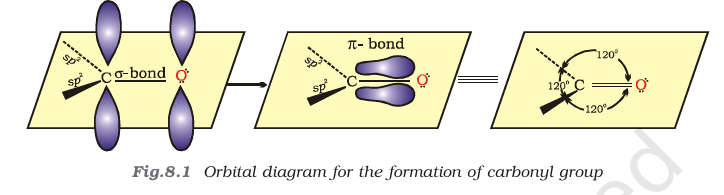
- Hybridisation: The carbonyl carbon is -hybridised and forms three bonds; its unhybridised orbital forms a bond with oxygen.
- Geometry: The carbonyl carbon and its three attached atoms lie in one plane, with bond angles approximately ; the electron cloud lies above and below that plane.
- Oxygen: The carbonyl oxygen has two non-bonding electron pairs.
Polarity and reactivity
- Bond polarity: Oxygen is more electronegative than carbon, so the bond is polar: carbon is partially positive and oxygen partially negative.
- Reactive centres: Carbonyl carbon is electrophilic (Lewis-acidic); carbonyl oxygen is nucleophilic (Lewis-basic).
- Dipole: Carbonyl compounds have substantial dipole moments and are more polar than ethers.
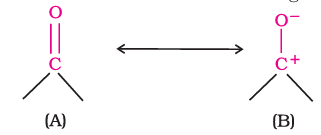
- Resonance: The group is represented by a neutral form and a charge-separated form, .
Preparation of Aldehydes and Ketones
| Starting material or method | Product / key condition |
|---|---|
| Oxidation of alcohols | Primary alcohols give aldehydes; secondary alcohols give ketones. |
| Dehydrogenation of alcohols | Vapours of volatile primary or secondary alcohols pass over heated Ag or Cu catalysts to give aldehydes or ketones, respectively. |
| Ozonolysis of alkenes | Ozonolysis followed by gives aldehydes, ketones or both, depending on alkene substitution. |
| Hydration of alkynes | Ethyne with gives ethanal; other alkynes generally give ketones. |
Specific Preparation of Aldehydes
| Route | Key reaction / name |
|---|---|
| Acyl chloride reduction | Hydrogenate an acyl chloride using over ; this selective reduction is the Rosenmund reaction. |
| Nitrile reduction | Reduce a nitrile to an imine with , then hydrolyse to the aldehyde. |
| Nitrile reduction | DIBAL-H followed by water converts nitriles to aldehydes. |
| Ester reduction | DIBAL-H followed by water converts esters to aldehydes. |
| Toluene oxidation | Chromyl chloride in forms a chromium complex; hydrolysis gives benzaldehyde. This is the Etard reaction. |
| Toluene oxidation | Treat with in acetic anhydride to form benzylidene diacetate; aqueous acid hydrolysis gives benzaldehyde. |
| Side-chain chlorination | Chlorinate toluene to benzal chloride, then hydrolyse; this is a commercial benzaldehyde method. |
| Gattermann–Koch reaction | Treat benzene or a derivative with and using anhydrous or to form an aromatic aldehyde. |
Specific Preparation of Ketones
| Route | Key reaction / name |
|---|---|
| Acyl chloride + dialkylcadmium | Dialkylcadmium, prepared from a Grignard reagent and , reacts with acyl chlorides to give ketones. |
| Nitrile + Grignard reagent | A nitrile reacts with a Grignard reagent; hydrolysis of the imine-type intermediate gives a ketone. |
| Benzene + acyl chloride | Anhydrous catalyses Friedel–Crafts acylation, producing an aromatic ketone. |
How are aldehydes and ketones named in the IUPAC system?
What makes the carbonyl group polar and reactive?
Name two characteristic reactions used to prepare aromatic aldehydes and one used to prepare aromatic ketones.
Quick recap
- Aldehydes, ketones and carboxylic acids contain the carbonyl group, but differ in the groups attached to its carbon.
- Aldehyde IUPAC names end in “-al”; ketone names end in “-one.”
- The carbonyl carbon is -hybridised and trigonal planar, with bond angles near .
- Carbonyl polarity makes carbon electrophilic and oxygen nucleophilic.
- Primary alcohol oxidation gives aldehydes; secondary alcohol oxidation gives ketones.
- Know the named aldehyde preparations: Rosenmund, Etard and Gattermann–Koch; Friedel–Crafts acylation prepares aromatic ketones.
Physical properties
Physical Properties of Aldehydes and Ketones
State, Boiling Point and Solubility
- Physical state: Methanal is a gas at room temperature; ethanal is a volatile liquid. Higher aldehydes and ketones may be liquids or solids.
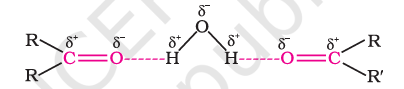
- Boiling points: They are higher than those of hydrocarbons and ethers of similar molecular mass because polar carbonyl groups cause dipole–dipole attraction.
- Comparison with alcohols: Their boiling points are lower than those of similar-mass alcohols because aldehydes and ketones do not form intermolecular hydrogen bonds with each other.
- Solubility in water: Lower members are soluble, but solubility decreases rapidly as the alkyl chain gets longer.
- Organic solvents: Aldehydes and ketones are fairly soluble in benzene, ether, methanol and chloroform.
| Compound | Molecular mass | Boiling point (K) |
|---|---|---|
| n-Butane | 58 | 273 |
| Methoxyethane | 60 | 281 |
| Propanal | 58 | 322 |
| Acetone | 58 | 329 |
| Propan-1-ol | 60 | 370 |
Odour
- Lower members: Have sharp, pungent odours.
- Increasing molecular size: Odours become less pungent and more fragrant; naturally occurring aldehydes and ketones are used in perfumes and flavourings.
| Increasing boiling point | Main intermolecular attraction |
|---|---|
| n-Pentane < diethyl ether < butanal < butan-1-ol | Weak van der Waals < dipole–dipole < stronger dipole–dipole < hydrogen bonding |
Nucleophilic Addition Reactions
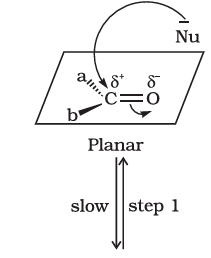
Nucleophilic addition — A nucleophile adds to the electrophilic carbon of a polar carbonyl group, followed by protonation of oxygen.
Mechanism and Intermediate
- Attack: The nucleophile approaches the electrophilic carbonyl carbon approximately perpendicular to its planar orbital plane.
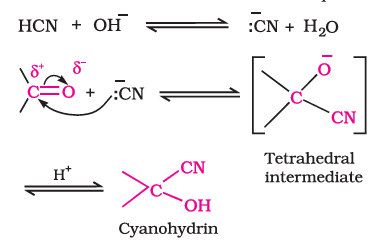
- Intermediate: The carbonyl carbon changes from to , forming a tetrahedral alkoxide intermediate.
- Protonation: The alkoxide accepts to produce a neutral addition product; overall, and add across the carbonyl bond.
Relative Reactivity
- General order: Aldehydes are usually more reactive than ketones toward nucleophilic addition.
- Steric effect: A ketone has two carbon substituents, which obstruct nucleophile approach more than the single carbon substituent of an aldehyde.
- Electronic effect: Alkyl groups donate electron density and reduce the electrophilicity of the carbonyl carbon; ketones have two such groups.
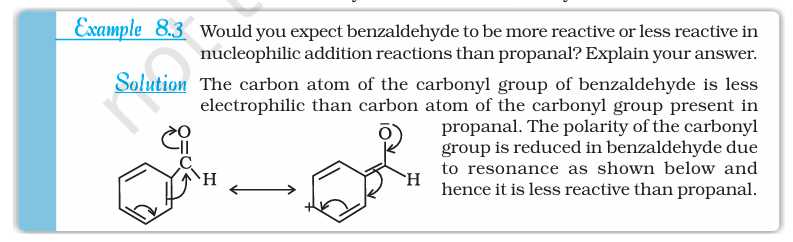
- Aromatic carbonyls: Resonance with an attached benzene ring reduces carbonyl-carbon electrophilicity; benzaldehyde is less reactive than propanal.
Important Nucleophilic Additions
HCN and Sodium Hydrogensulphite
- HCN addition: Aldehydes and ketones form cyanohydrins. The reaction with pure HCN is slow; base generates the stronger nucleophile and catalyses addition.
- Cyanohydrins: Useful synthetic intermediates.
- Hydrogensulphite addition: Sodium hydrogensulphite forms addition compounds; equilibrium lies mainly to the product side for most aldehydes, but to the reactant side for most ketones because of steric effects.
- Purification: The hydrogensulphite adduct is water-soluble and can be decomposed back to the carbonyl compound using dilute mineral acid or alkali; it is useful for separating and purifying aldehydes.
Grignard Reagents
- Addition: Grignard reagents undergo nucleophilic addition to aldehydes and ketones.
Addition of Alcohols
- Aldehyde + one alcohol molecule: In dry HCl, forms a hemiacetal, containing both and on the same carbon.
- Hemiacetal + another alcohol molecule: Forms an acetal, a gem-dialkoxy compound.
- Ketone + ethylene glycol: Forms a cyclic ethylene glycol ketal under acid-catalysed conditions.
- Role of dry HCl: Protonates the carbonyl oxygen, increasing the electrophilicity of the carbonyl carbon.
- Hydrolysis: Acetals and ketals are converted back to the corresponding aldehydes and ketones by aqueous mineral acids.
Ammonia and Its Derivatives
- General reaction: Ammonia or a nucleophile adds to the carbonyl group; the intermediate loses water to form a derivative.
- Conditions: The reaction is reversible and acid-catalysed. Rapid dehydration shifts equilibrium towards the product.
- Possible groups : Alkyl, aryl, , , phenylamino and semicarbazide-related groups.
| Reagent | Derivative group | Product name |
|---|---|---|
| Ammonia | Imine | |
| Amine | Substituted imine (Schiff base) | |
| Hydroxylamine | Oxime | |
| Hydrazine | Hydrazone | |
| Phenylhydrazine | Phenylhydrazone | |
| 2,4-Dinitrophenylhydrazine | 2,4-Dinitrophenylhydrazone | |
| Semicarbazide | Semicarbazone |
Reduction
| Starting compound | Reagents or method | Product |
|---|---|---|
| Aldehyde | , or catalytic hydrogenation | Primary alcohol |
| Ketone | , or catalytic hydrogenation | Secondary alcohol |
| Aldehyde or ketone | Zn(Hg)/concentrated HCl; Clemmensen reduction | Carbonyl becomes |
| Aldehyde or ketone | , then strong base and heat in a high-boiling solvent; Wolff–Kishner reduction | Carbonyl becomes |
Oxidation and Distinguishing Tests
| Point | Aldehydes | Ketones |
|---|---|---|
| Ease of oxidation | Readily oxidised, even by mild oxidising agents | Usually require strong oxidising agents and elevated temperature |
| Main outcome | Carboxylic acid or, in alkaline medium, carboxylate ion | Carbon–carbon bond cleavage gives a mixture of smaller carboxylic acids |
| Common agents | Nitric acid, potassium permanganate, potassium dichromate, Tollens’ reagent and Fehling’s reagent | Vigorous oxidising conditions |
Tollens’ Test
- Reagent: Freshly prepared ammoniacal silver nitrate solution.
- Positive result: On warming, an aldehyde gives a bright silver mirror as silver ions are reduced to silver metal.
- Oxidation product: The aldehyde forms a carboxylate ion in alkaline solution.
Fehling’s Test
- Fehling A: Aqueous copper sulphate; Fehling B: Alkaline sodium potassium tartrate (Rochelle salt). Mix equal amounts before use.
- Positive result: Heating an aldehyde gives a reddish-brown precipitate of as the aldehyde is oxidised to a carboxylate.
- Limitation: Aromatic aldehydes do not respond to Fehling’s test.
Haloform Reaction
- Requirement: Methyl ketones contain the group .
- Reaction: Sodium hypohalite oxidises the methyl ketone to a carboxylate salt with one fewer carbon atom; the methyl group becomes haloform, .
- Detection: The iodoform test detects groups and groups that oxidise to . Iodoform, , is a yellow precipitate.
- Selectivity: A carbon–carbon double bond in the molecule is not affected by this oxidation.
Reactions Due to α-Hydrogens
α-Hydrogen — A hydrogen attached to the carbon atom next to the carbonyl carbon.
Acidity of α-Hydrogens
- Cause: The carbonyl group withdraws electron density, making α-hydrogens acidic.
- Conjugate base: Deprotonation forms an enolate ion, stabilised by resonance.
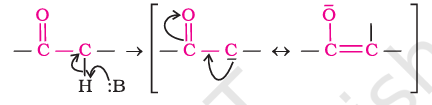
Aldol reaction — Aldehydes or ketones with at least one α-hydrogen react in dilute alkali to form β-hydroxy aldehydes (aldols) or β-hydroxy ketones (ketols).
Aldol Condensation
- First stage: Aldol reaction forms a β-hydroxy carbonyl compound.
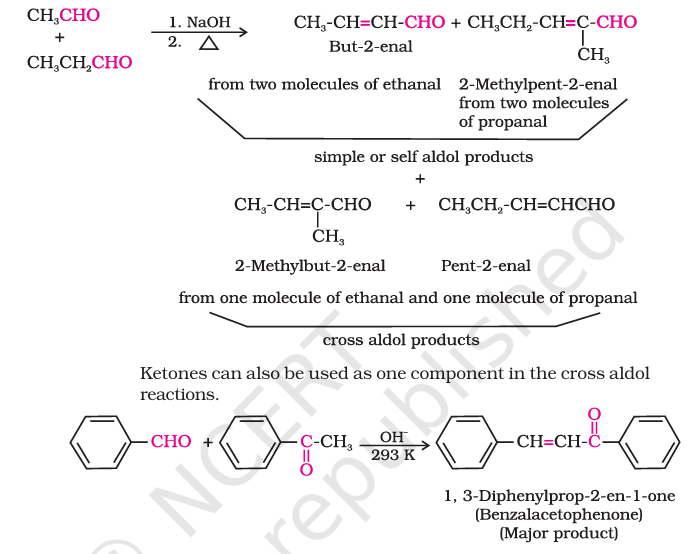
- On heating: The aldol or ketol readily loses water to give an α,β-unsaturated carbonyl compound; this is aldol condensation.
- Name: “Aldol” combines the aldehyde and alcohol functions in the product. The name aldol condensation is also used for the analogous ketone reaction.
Cross aldol condensation — An aldol condensation between two different aldehydes and/or ketones.
Cross Aldol Product Mixtures
- Two different carbonyl compounds with α-hydrogens: Cross-reaction can produce a mixture of four products because either compound can form the nucleophilic partner and either can act as the carbonyl partner.
Other Reactions
Cannizzaro reaction — An aldehyde without an α-hydrogen disproportionates on heating with concentrated alkali: one molecule is reduced to an alcohol while another is oxidised to a carboxylate salt.
Electrophilic Substitution in Aromatic Carbonyl Compounds
- Direction and effect: In aromatic aldehydes and ketones, the carbonyl group deactivates the ring and directs electrophilic substitution to the meta position.
Arrange ethanal, propanal, propanone and butanone in increasing order of reactivity towards nucleophilic addition.
Arrange benzaldehyde, p-tolualdehyde, p-nitrobenzaldehyde and acetophenone in increasing order of reactivity towards nucleophilic addition.
Identify a compound with formula that forms a 2,4-DNP derivative, gives the iodoform test, does not reduce Tollens’ or Fehling’s reagent, and oxidises to benzoic acid.
Quick recap
- Physical properties: Carbonyl dipole–dipole attraction gives aldehydes and ketones higher boiling points than similar hydrocarbons and ethers, but lower than similar alcohols.
- Nucleophilic addition: Nucleophile attack forms a tetrahedral alkoxide, followed by protonation; aldehydes are generally more reactive than ketones.
- Key additions: HCN gives cyanohydrins; alcohols give hemiacetals/acetals or ketals; ammonia derivatives give C=N compounds.
- Reductions and oxidation: Carbonyls reduce to alcohols or to methylene groups; aldehydes oxidise readily, while ketones usually require vigorous conditions and undergo C–C cleavage.
- Diagnostic tests: Tollens’ test gives a silver mirror; Fehling’s test gives red-brown ; methyl ketones give the haloform test.
- α-Hydrogen reactions: Aldol condensation requires an α-hydrogen; Cannizzaro reaction requires an aldehyde without one.
- Aromatic carbonyl compounds: The carbonyl group deactivates the ring and directs electrophilic substitution to the meta position.
Uses of Uses of Aldehydes AldehydesAldehydes and Ketones
Uses of Aldehydes and Ketones
Industrial and Commercial Uses
- General use: Aldehydes and ketones act as solvents, starting materials and reagents in the synthesis of other products.
- Formaldehyde: Formalin is a 40% solution; it preserves biological specimens and is used to make Bakelite, urea-formaldehyde glues and other polymers.
- Acetaldehyde: A starting material for acetic acid, ethyl acetate, vinyl acetate, polymers and drugs.
- Benzaldehyde: Used in perfumery and dye industries.
- Industrial solvents: Acetone and ethyl methyl ketone are common solvents.
- Odours and flavours: Butyraldehyde, vanillin, acetophenone and camphor are known for characteristic odours and flavours.
Carboxylic Acids: Functional Group and Types
Carboxylic acid — An organic compound containing the carboxyl functional group, .
- Structure: The carboxyl group consists of a carbonyl and hydroxyl group attached to the same carbon.
- Types: Aliphatic acids have the form ; aromatic acids have the form .
- Fatty acids: Higher aliphatic acids, usually containing – carbon atoms, occur in natural fats as glycerol esters.
- Importance: Carboxylic acids are starting materials for anhydrides, esters, acid chlorides and amides.
Nomenclature of Carboxylic Acids
IUPAC Naming Rules
- Single group: Replace the final -e of the corresponding alkane name with -oic acid.
- Numbering: The carboxyl carbon is numbered .
- Multiple groups: Use terms such as dicarboxylic acid or tricarboxylic acid; indicate the positions of the groups with numerals before the multiplicative prefix.
- Common names: Many traditional names end in -ic acid and derive from natural sources.
| Formula or structure | Common name | IUPAC name |
|---|---|---|
| Formic acid | Methanoic acid | |
| Acetic acid | Ethanoic acid | |
| Propionic acid | Propanoic acid | |
| Butyric acid | Butanoic acid | |
| Isobutyric acid | 2-Methylpropanoic acid | |
| Oxalic acid | Ethanedioic acid | |
| Malonic acid | Propanedioic acid | |
| Succinic acid | Butanedioic acid | |
| Glutaric acid | Pentanedioic acid | |
| Adipic acid | Hexanedioic acid | |
| Tricarballylic acid | Propane-1,2,3-tricarboxylic acid | |
| Benzoic acid | Benzenecarboxylic acid | |
| Phenylacetic acid | 2-Phenylethanoic acid | |
| Phthalic acid | Benzene-1,2-dicarboxylic acid |
Origins of Three Common Names
- Formic acid: Named from Latin *formica* (ant); it was first obtained from red ants.
- Acetic acid: From Latin *acetum*, meaning vinegar.
- Butyric acid: From Latin *butyrum*, meaning butter; associated with rancid butter.
Structure of the Carboxyl Group
- Geometry: The three bonds around the carboxyl carbon are planar and separated by about .
- Resonance: Delocalisation in the carboxyl group reduces the positive character of its carbonyl carbon.
- Consequence: The carboxyl carbon is less electrophilic than the carbonyl carbon in aldehydes and ketones.

Preparation of Carboxylic Acids
| Starting material | Reagents / conditions | Key outcome |
|---|---|---|
| Primary alcohols | ; or / in acid | Oxidation to carboxylic acids |
| Aldehydes | Mild oxidising agents | Oxidation to carboxylic acids |
| Alkylbenzenes and suitably substituted alkenes | Vigorous oxidation with chromic acid or acidic/alkaline | Oxidative conversion to carboxylic acids; alkylbenzene side chains become |
| Nitriles and amides | Acidic or basic hydrolysis; heat for complete hydrolysis | Nitrile → amide → acid; mild conditions can stop at the amide |
| Grignard reagents | (dry ice), then acidification | Carboxylic acid with one additional carbon atom |
| Acyl halides and anhydrides | Hydrolysis; acidify carboxylates if formed under basic conditions | Carboxylic acids |
| Esters | Acidic hydrolysis, or basic hydrolysis followed by acidification | Carboxylic acid |
1. Oxidation of Primary Alcohols and Aldehydes
- Primary alcohols: Oxidise to carboxylic acids with in neutral, acidic or alkaline medium, or with / in acidic medium.
- Jones reagent: oxidises primary alcohols to acids.
- Aldehydes: Mild oxidising agents convert aldehydes to the corresponding carboxylic acids.
2. Oxidation of Alkylbenzenes and Alkenes
- Conditions: Vigorous oxidation with chromic acid or acidic/alkaline .
- Alkylbenzene rule: The entire side chain is oxidised to the ring-attached group, regardless of side-chain length.
- Scope: Primary and secondary alkyl groups are oxidised in this way; tertiary alkyl groups are not affected.
- Alkenes: Suitably substituted alkenes can also be oxidised to carboxylic acids using these reagents.
3. Hydrolysis of Nitriles and Amides
- Nitrile route: Hydrolysis proceeds through an amide intermediate to a carboxylic acid.
- Control: Mild conditions can stop hydrolysis at the amide stage; stronger conditions and heat complete the conversion.
- Carbon count: The nitrile carbon becomes the carboxyl carbon in the acid.
4. Carboxylation of Grignard Reagents
- Reaction: A Grignard reagent reacts with dry ice () to form a magnesium carboxylate; acidification gives the carboxylic acid.
- Chain extension: The product has one more carbon atom than the alkyl halide used to prepare the Grignard reagent.
- Useful sequence: Alkyl halide → Grignard reagent → carboxylic acid with one additional carbon.
5. Hydrolysis of Acyl Halides and Anhydrides
- Acid chlorides: Hydrolysis gives carboxylic acids; aqueous base forms carboxylate ions, which give the acid on acidification.
- Anhydrides: Hydrolysis with water forms the corresponding carboxylic acid or acids.
6. Hydrolysis of Esters
- Acidic hydrolysis: Produces the carboxylic acid directly.
- Basic hydrolysis: Produces a carboxylate salt; acidification then gives the corresponding acid.
Important Conversion Examples
Physical Properties of Carboxylic Acids
| Property | Key detail / explanation |
|---|---|
| Appearance and odour | Aliphatic acids with up to nine carbon atoms are colourless liquids with unpleasant odours; higher acids are waxy solids and nearly odourless because of low volatility. |
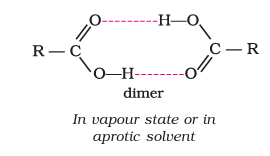
| Boiling points | Higher than those of aldehydes, ketones and alcohols with comparable molecular masses because of extensive intermolecular hydrogen bonding. |
| Association | Carboxylic acids commonly form hydrogen-bonded dimers in the vapour phase and in aprotic solvents; hydrogen bonding is not fully broken in the vapour. |
| Water solubility | Simple acids with up to four carbon atoms are miscible with water; solubility decreases as the hydrocarbon chain grows. |
| Higher acids | Practically insoluble in water because the hydrophobic hydrocarbon part becomes more influential. |
| Benzoic acid | Nearly insoluble in cold water. |
| Organic solvents | Soluble in less-polar solvents such as benzene, ether, alcohol and chloroform. |
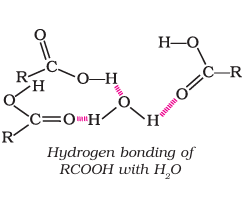
Why do carboxylic acids have higher boiling points than aldehydes and ketones of similar molecular mass?
How can an alkyl halide be converted into a carboxylic acid with one extra carbon atom?
Quick recap
- Aldehydes and ketones are used as solvents, starting materials, reagents and sources of characteristic odours and flavours.
- Carboxylic acids contain and may be aliphatic or aromatic; higher natural members include fatty acids.
- IUPAC acid names use the suffix -oic acid; the carboxyl carbon is numbered .
- Resonance makes the carboxyl carbon less electrophilic than the carbonyl carbon of aldehydes and ketones.
- Carboxylic acids form by oxidation, hydrolysis, Grignard carboxylation, or hydrolysis of acid derivatives and esters.
- Vigorous oxidation converts alkylbenzene side chains to ; suitably substituted alkenes can also form carboxylic acids.
- Hydrogen-bonded dimers explain high boiling points, while increasing chain length lowers water solubility.
Chemical Reaction
Reactions Involving Cleavage of the O–H Bond
Acidity of carboxylic acids — Carboxylic acids donate a proton from the –COOH group, forming resonance-stabilised carboxylate ions.
Reactions and dissociation
- With metals: Electropositive metals form carboxylate salts and release hydrogen gas.
- With alkalis: Bases such as sodium hydroxide form carboxylate salts and water.
- With carbonates/bicarbonates: These weaker bases also react, releasing carbon dioxide; this is a test for the –COOH group.
- In water: Dissociation produces hydronium ions and resonance-stabilised carboxylate ions.
Acid dissociation constant and pKa
- Equilibrium constant: For dissociation in water, .
- Acid dissociation constant: Since liquid water is effectively constant, .
- pKa: Acidity is commonly expressed as ; a smaller pKa means a stronger acid and better proton donor.
- Examples: HCl has pKa ; trifluoroacetic acid, benzoic acid and acetic acid have pKa values , and , respectively.
| Category | pKa range |
|---|---|
| Strong acids | Below 1 |
| Moderately strong acids | 1 to 5 |
| Weak acids | 5 to 15 |
| Extremely weak acids | Above 15 |
| Point | Carboxylic acids | Phenols / alcohols |
|---|---|---|
| Relative acidity | Weaker than mineral acids; stronger than phenols and alcohols | Phenols are more acidic than alcohols |
| Conjugate-base stability | Carboxylate has two equivalent resonance forms; the negative charge is delocalised over two oxygen atoms | Phenoxide has non-equivalent resonance forms; some negative charge is placed on less-electronegative carbon atoms |
| Typical pKa | Acetic acid: 4.76 | Phenol: about 10; ethanol: about 16 |
Effect of substituents on acidity
- Electron-withdrawing groups (EWGs): Stabilise the carboxylate conjugate base by inductive and/or resonance effects, increasing acidity.
- Electron-donating groups (EDGs): Destabilise the conjugate base, decreasing acidity.
- Increasing acidity effect of groups: .
- Directly attached phenyl or vinyl: Can increase acidity because the attached carbon is more electronegative than an carbon.
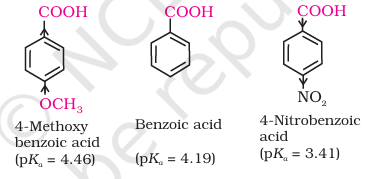
- Substituted benzoic acids: EWGs on the aromatic ring increase acidity; EDGs decrease it.
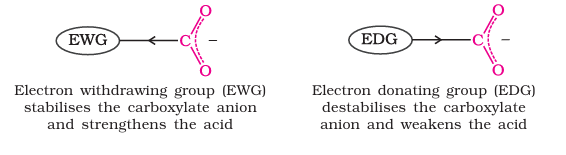
Relative acidity examples
- Decreasing acidity: .
- Reason: Stronger electron-withdrawing effects, especially close to –COOH, generally stabilise the conjugate base more effectively.
Reactions Involving Cleavage of the C–OH Bond
Anhydride formation — On heating with a mineral acid or phosphorus pentoxide, two carboxylic acid molecules combine to form an acid anhydride and water.
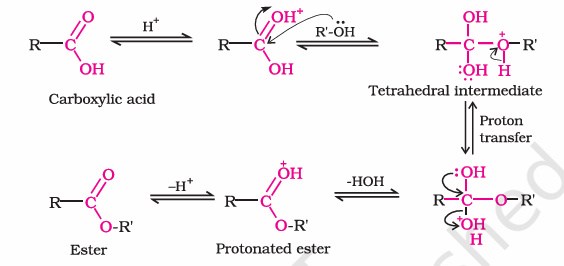
Esterification — A carboxylic acid reacts with an alcohol or phenol in the presence of an acid catalyst to form an ester and water.
Esterification mechanism
- Activation: Protonation of the carbonyl oxygen makes the carbonyl carbon more susceptible to nucleophilic attack.
- Addition: Alcohol attacks, forming a tetrahedral intermediate.
- Leaving-group formation: Proton transfer converts an –OH group into –, which leaves as water.
- Product formation: The protonated ester loses a proton to give the ester.
Acid chloride formation — The –OH group of a carboxylic acid can be replaced by chlorine using , or .
Reaction with ammonia
- Salt formation: Carboxylic acids react with ammonia to form ammonium carboxylates.
- Amide formation: Heating an ammonium carboxylate removes water and forms an amide.
- Examples: Ammonium acetate gives acetamide; ammonium benzoate gives benzamide.
- Phthalic acid sequence: Ammonium phthalate forms phthalamide on heating; strong heating gives cyclic phthalimide with loss of ammonia.
Reactions Involving the –COOH Group
Reduction — Carboxylic acids are reduced to primary alcohols by lithium aluminium hydride or, preferably, diborane.
Decarboxylation — Decarboxylation is the loss of carbon dioxide from a carboxylate salt, producing a hydrocarbon.
Substitution Reactions in the Hydrocarbon Part
Hell–Volhard–Zelinsky reaction — Carboxylic acids containing an α-hydrogen undergo halogenation at the α-carbon with chlorine or bromine in the presence of a small amount of red phosphorus.
Ring substitution of aromatic carboxylic acids
- Directive effect: The –COOH group is deactivating and meta-directing in electrophilic aromatic substitution.
- Friedel–Crafts reaction: These acids do not undergo Friedel–Crafts reactions because –COOH deactivates the ring and binds the Lewis-acid catalyst .
- Examples: Nitration and bromination of benzoic acid give mainly meta-substituted products.
Uses of Carboxylic Acids
| Compound | Uses |
|---|---|
| Methanoic acid | Rubber, textile, dyeing, leather and electroplating industries |
| Ethanoic acid | Solvent and vinegar in the food industry |
| Hexanedioic acid | Manufacture of nylon-6,6 |
| Benzoic acid esters | Perfumery |
| Sodium benzoate | Food preservative |
| Higher fatty acids | Manufacture of soaps and detergents |
Why are carboxylic acids more acidic than phenols?
Why is preferred for preparing acyl chlorides?
What is the Hell–Volhard–Zelinsky reaction?
Quick recap
- Acidity: Carboxylic acids form resonance-stabilised carboxylate ions; lower pKa means a stronger acid.
- Substituents: EWGs increase acidity by stabilising the conjugate base; EDGs decrease it.
- C–OH cleavage: Carboxylic acids form anhydrides, esters, acyl chlorides and amides.
- Reduction and decarboxylation: or, preferably, diborane reduces acids to primary alcohols; soda lime removes the carboxyl carbon.
- Named reaction: The Hell–Volhard–Zelinsky reaction halogenates the α-carbon when an α-hydrogen is present.
- Aromatic substitution: The –COOH group is deactivating and meta-directing; it prevents Friedel–Crafts reactions.
- Uses: Carboxylic acids and their derivatives are used in manufacturing, food preservation, perfumery, soaps and detergents.