Class 12 PCB . Chemistry . Chemistry Part I . The D and F Block Elements
Chapter 4: The D- And F -Block Elements
Ch 4
Chemistry
Class 12 PCB
Position In The Periodic Table
Position and Series of the d- and f-Blocks
Where the blocks are found
- d-block: Groups – occupy the middle of the periodic table, between the - and -blocks. The orbitals are progressively filled.
- d-block series: The four rows are ( to ), ( to ), ( and to ), and ( and to ).
- f-block: The and orbitals are progressively filled; these elements are shown in a separate panel below the main table.
- f-block series: The series, to , are the lanthanoids; the series, to , are the actinoids.
- Names: d-block elements are commonly called transition metals; f-block elements are called inner transition metals.
Transition metal — An IUPAC-defined transition metal has an incomplete subshell in its neutral atom or in at least one of its ions.
Applying the definition
- Why the name: Their properties were originally described as intermediate between those of the - and -block elements.
- Group 12 exception: , , and have configurations in their ground-state atoms and common ions, so they are not regarded as transition metals.
- Series end-members: Although , , and are not transition metals by definition, their chemistry is studied with the transition elements as end-members of their respective series.
- Examples: is a transition element because its ground-state atom has ; is not because its atom and common ion have .
- Silver: Although a ground-state atom has , an ion such as has an incomplete subshell (), so silver meets the definition.
Electronic Configurations of the d-Block
The subshell fills across a series; small energy differences between and orbitals cause exceptions.
Important configurations and exceptions
- Meaning: is the inner subshell, which may contain – electrons; the outer subshell generally contains or .
- Chromium: is , not ; the half-filled subshell is relatively stable.
- Copper: is , not ; a completely filled subshell is relatively stable.
- Palladium: is an exception with configuration .
| Series and elements (in order) | electron counts | electron counts |
|---|---|---|
| : | ||
| : | ||
| : | ||
| : |
Characteristic Features and Similarities
- Orbital influence: d orbitals extend relatively close to an atom’s outer region, so they are influenced by the surroundings and can also affect nearby atoms or molecules.
- Partly filled d subshells: Transition elements commonly show variable oxidation states, coloured ions, complex formation with ligands, catalytic properties, and paramagnetic behaviour.
- Similar configurations: Ions with the same configuration, where –, can have similar magnetic and electronic properties.
- Similarity pattern: Transition elements show stronger similarities across a horizontal series than non-transition elements do, although similarities within groups also occur.
- Examples and uses: , , and are important industrial metals; , , and are precious metals. , , and are important sources of nuclear energy.
Why is scandium a transition element but zinc is not?
Why is silver considered a transition element even though its ground-state atom has a filled d subshell?
Quick recap
- The d-block is in groups –; the f-block sits separately below the main table.
- The four d-block series are , , , and ; the f-block series are lanthanoids and actinoids.
- A transition metal has an incomplete d subshell in its atom or at least one ion.
- , , and are excluded by the definition because their atoms and common ions have configurations.
- The general configuration is , with notable exceptions , , and .
- Partly filled d subshells help explain variable oxidation states, coloured ions, complex formation, catalysis, and paramagnetism.
General Properties Of The Transition Elements (D-Block)
Physical Properties
| Property | Trend or explanation |
|---|---|
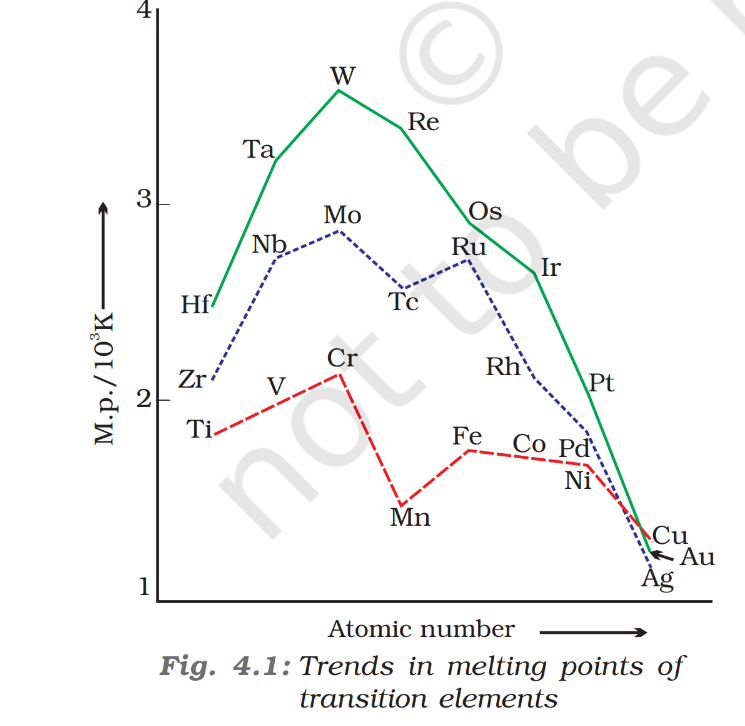
| Melting points | Generally rise to a maximum near , then decrease across a series; and show anomalous values. |
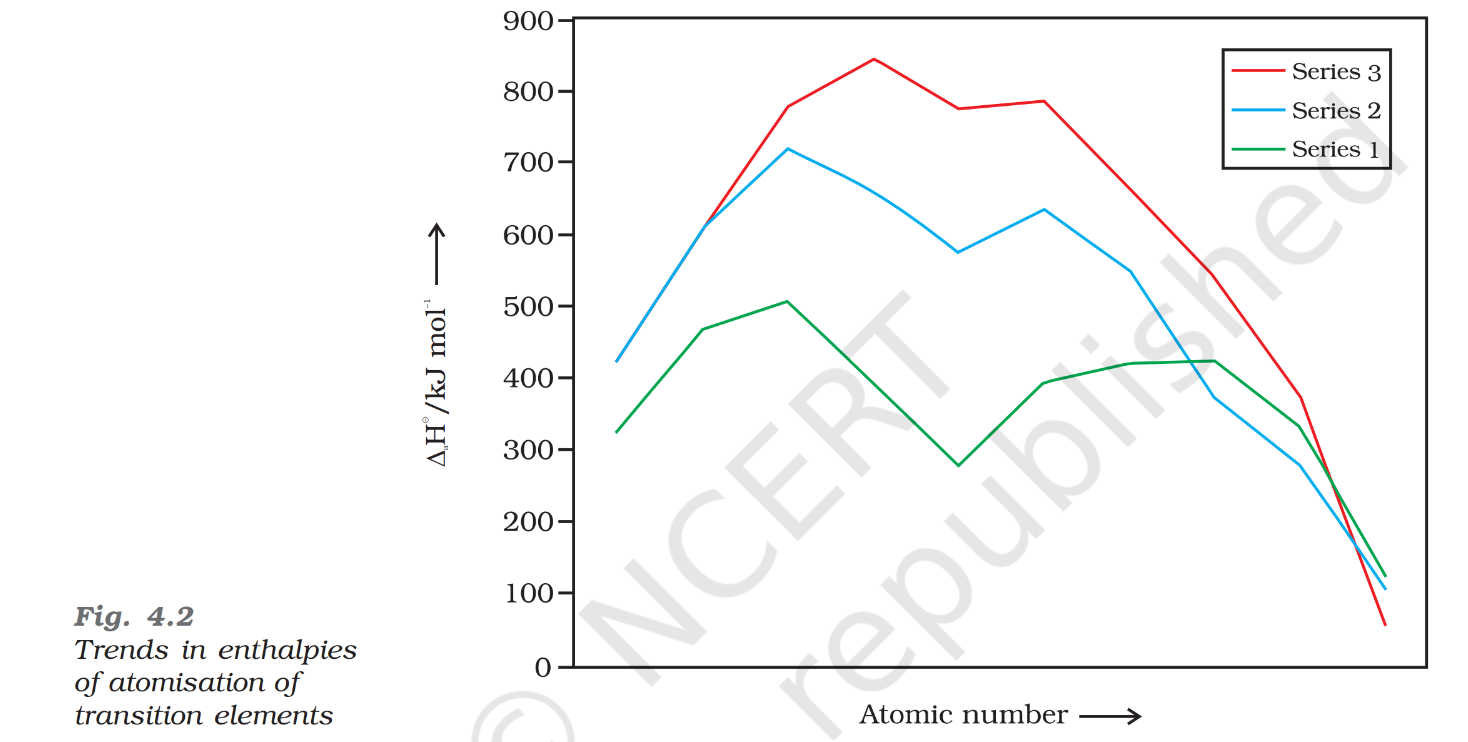
| Zinc atomisation | has the lowest enthalpy of atomisation in the first series: . |
| Zinc bonding | Its configuration has no unpaired electrons, so its interatomic bonding is comparatively weak. |
Atomic and Ionic Sizes
Cause of lanthanoid contraction
- Electrons fill the 4f orbitals before the 5d series begins.
- 4f electrons shield one another imperfectly.
- Increasing nuclear charge pulls the electron cloud inward, reducing atomic radii.
- This contraction offsets the expected increase in size, making corresponding 4d and 5d atoms nearly equal in radius.
Ionisation Enthalpies
Exchange Energy and Ionisation Irregularities
- Exchange energy: In degenerate orbitals, parallel-spin electrons can exchange positions; the stabilising exchange energy increases with the number of possible parallel-spin pairs.
- Stable occupancy: Hund’s rule favours the greatest possible number of singly occupied orbitals with parallel spins; a half-filled subshell is especially stable.
- Ionisation effect: Removing an electron from a stable arrangement disrupts this stabilisation and can require more energy.
- Second ionisation comparison: is and can lose a electron to form with ; is , so its ionisation disrupts . Thus the second ionisation enthalpy of is lower than that of .
- Third ionisation comparison: is , whereas is . Forming gives stable , so the third ionisation enthalpy of is lower than that of .
Formation of Common Oxidation States
Why are corresponding 4d and 5d transition elements similar in size?
Why does the third ionisation enthalpy of Fe fall below that of Mn?
Why are the second ionisation enthalpies of Cr and Cu unusually high?
Quick recap
- Transition metals are generally hard, conductive, low-volatility metals with high melting points and high enthalpies of atomisation; , and are notable exceptions to several trends.
- Melting points generally peak near and then decline; and are anomalous, and has the lowest first-series atomisation enthalpy at .
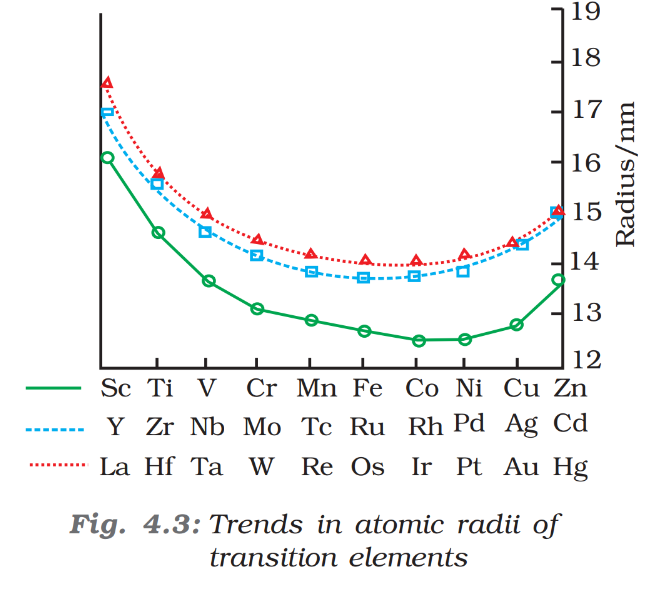
- Atomic and same-charge ionic radii decrease gradually across a series because d-electrons shield the increasing nuclear charge imperfectly.
- Lanthanoid contraction makes corresponding 4d and 5d elements nearly equal in size, such as and .
- First ionisation enthalpies rise only slightly across the 3d series; second and third generally rise more, with exceptions associated with stable configurations.
- Exchange energy stabilises maximum parallel-spin occupancy; the resulting stability of and helps explain ionisation-enthalpy irregularities and common oxidation states.
Oxidation States
Variable Oxidation States
Stability patterns in oxidation states
- Heavier group 6 metals: and are more stable than .
- Oxidising behaviour: Acidic dichromate containing is a strong oxidising agent; and are not.
- Low oxidation states: Ligands with both -donor and -acceptor character can stabilise low states; Ni and Fe are zero-valent in and .
Name a transition element that does not exhibit variable oxidation states.
Standard Electrode Potentials for M²⁺/M
Trends and explanation
- Meaning: is the standard reduction potential for converting aqueous ions to the metal.
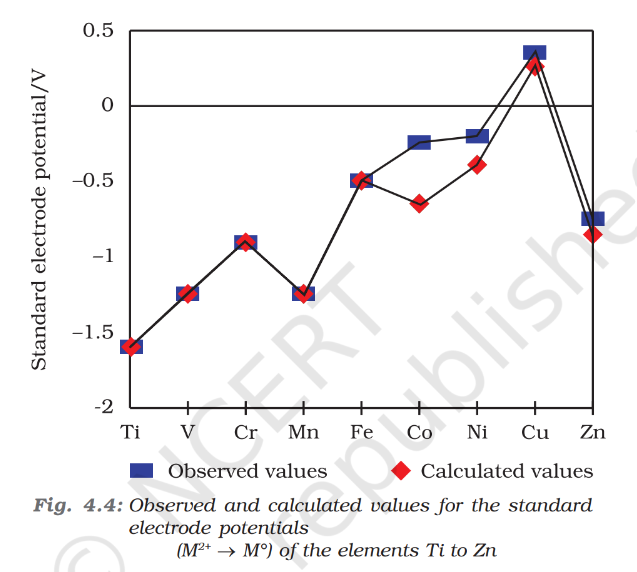
- Across the series: Values generally become less negative as the sum of the first and second ionisation enthalpies increases.
- Irregular values: Mn, Ni and Zn have more negative potentials than the broad trend suggests; sublimation enthalpy and hydration enthalpy also affect the values.
- Copper: Its positive potential, , reflects the high energy needed to form relative to the hydration energy gained.
- Acid reaction: Cu does not liberate from ordinary acids; oxidising acids such as nitric acid and hot concentrated sulphuric acid can react with it.
| M | (V) | ||||
|---|---|---|---|---|---|
| Ti | 469 | 656 | 1309 | −1866 | −1.63 |
| V | 515 | 650 | 1414 | −1895 | −1.18 |
| Cr | 398 | 653 | 1592 | −1925 | −0.90 |
| Mn | 279 | 717 | 1509 | −1862 | −1.18 |
| Fe | 418 | 762 | 1561 | −1998 | −0.44 |
| Co | 427 | 758 | 1644 | −2079 | −0.28 |
| Ni | 431 | 736 | 1752 | −2121 | −0.25 |
| Cu | 339 | 745 | 1958 | −2121 | +0.34 |
| Zn | 130 | 906 | 1734 | −2059 | −0.76 |
Redox behaviour linked to stable configurations
- as a reducing agent: It is readily oxidised from to , giving a half-filled level.
- as an oxidising agent: Reduction to produces the particularly stable half-filled configuration.
Standard Electrode Potentials for M³⁺/M²⁺
Why the potentials vary
- Sc: The low potential reflects the stability of , which has a noble-gas configuration.
- Zn: The high potential is associated with removing an electron from the stable configuration of .
- Mn: The comparatively high value reflects the stability of .
- Fe: The comparatively low value reflects the extra stability of .
- V: Its comparatively low value is associated with the stability of , which has a half-filled level.
Stability of Higher Oxidation States
Halides
- Highest states shown: The 3d series reaches high oxidation states in compounds such as , and .
- Manganese: The state is not found in simple halides, but is represented by .
- Beyond Mn: The only noted trihalides are and .
- Why fluorine stabilises high states: It can provide high lattice energy, as in , or strong covalent bond enthalpies, as in and .
- Hydrolysis: Halides of V(V) other than hydrolyse to oxohalides .
- Low-state fluorides: Fluorides in low oxidation states are unstable; examples include where .
| Oxidation state | Representative halides |
|---|---|
Oxides and oxocations
- Oxides: Oxygen stabilises high oxidation states; the highest oxide states rise to in , broadly matching the group number up to Mn.
- Beyond Group 7: Higher oxides of Fe than are not known; ferrate(VI), , forms in alkaline media but decomposes to and .
- Oxocations: Oxygen stabilises V(V) as , V(IV) as , and Ti(IV) as .
- Oxygen versus fluorine: Oxygen can stabilise higher states than fluorine; for example, manganese reaches in but only in .
- Reason: Oxygen forms multiple bonds to metals. In covalent , each Mn is tetrahedrally surrounded by O atoms, including a Mn–O–Mn bridge.
- Tetrahedral oxoanions: ions occur for V(V), Cr(VI), and Mn(V), Mn(VI) and Mn(VII).
| Oxidation state | Representative oxides |
|---|---|
| Mixed oxides | |
Disproportionation and oxidising power
- Copper(I): Many compounds disproportionate in aqueous solution; is favoured because its hydration enthalpy is much more negative than that of .
- Oxidising strength: in oxidising power because the reduced products become increasingly stable.
Reactivity and Redox Character
Reaction with acids and redox trends
- Reactivity: First-row transition metals, except Cu, are generally oxidised by , though reaction rates can be slow.
- Passivation: Ti and V can be practically passive towards dilute, non-oxidising acids at room temperature.
- Divalent ions: The trend to form generally decreases across the series as the sum of the first two ionisation enthalpies increases.
- Exceptions: Half-filled in and filled in affect their potentials; the Ni value is linked to its very negative hydration enthalpy.
- Strong oxidisers: and are strong oxidising agents in aqueous solution.
- Strong reducers: , and can reduce to hydrogen.
Irregular electrode-potential examples
- versus and : The much more positive Mn potential is mainly due to the large third ionisation enthalpy needed to change Mn from to ; this also makes Mn(III) relatively unimportant.
Magnetic Properties
| Type | Response to magnetic field |
|---|---|
| Diamagnetic | Repelled by the applied field. |
| Paramagnetic | Attracted; arises from unpaired electrons. |
| Ferromagnetic | Very strongly attracted; an extreme form of paramagnetism. |
Spin-only magnetic moment
- Origin: Unpaired electrons have magnetic moments associated with spin and orbital angular momentum.
- First-row ions: Orbital contributions are effectively quenched, so the magnetic moment is estimated using the spin-only formula.
- Trend: More unpaired electrons generally means a larger magnetic moment; a single unpaired electron gives about .
Use for the number of unpaired electrons; is measured in Bohr magnetons (BM).
| Ion | Configuration | Unpaired electrons | Moment (BM) |
|---|---|---|---|
| 0 | 0 | ||
| 1 | 1.73 | ||
| 3 | 3.87 | ||
| 4 | 4.90 | ||
| 5 | 5.92 | ||
| 4 | 4.90 | ||
| 3 | 3.87 | ||
| 2 | 2.84 | ||
| 1 | 1.73 | ||
| 0 | 0 |
Calculate the spin-only magnetic moment of an aqueous divalent ion with atomic number 25.
Colour of Transition-Metal Ions
Origin of colour
- Absorption: An electron can be excited from a lower-energy orbital to a higher-energy orbital by absorbing light.
- Observed colour: The solution appears the complementary colour of the absorbed light.
- Ligand effect: The absorbed frequency depends on the ligand; in aqueous ions, water is the ligand.
- Colourless ions: Ions with or configurations are generally colourless because no relevant – excitation occurs.
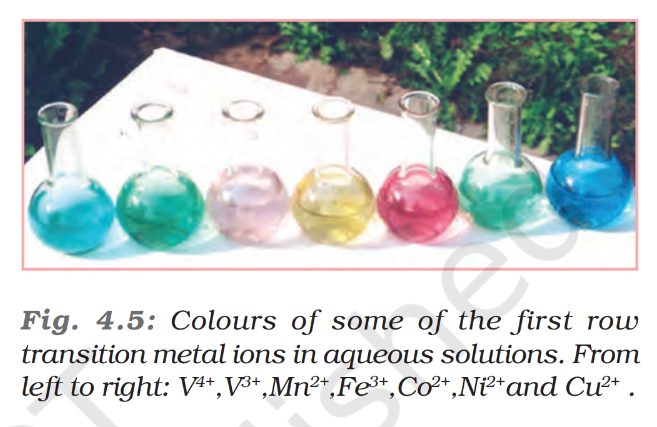
| Configuration | Ion | Colour |
|---|---|---|
| , | Colourless | |
| Purple | ||
| Blue | ||
| Green | ||
| , | Violet | |
| Violet | ||
| Blue | ||
| Pink | ||
| Yellow | ||
| Green | ||
| Blue | ||
| Pink | ||
| Green | ||
| Blue | ||
| Colourless |
Formation of Complex Compounds
Complex compound — A compound in which a metal ion binds several anions or neutral molecules to form a complex species with characteristic properties.
Why transition metals form complexes
- Reasons: Transition-metal ions are comparatively small, have high ionic charges and possess available orbitals for bond formation.
- Examples: , , and .
Catalytic Properties
How transition metals catalyse reactions
- Why active: Transition metals can adopt multiple oxidation states and form complexes.
- Surface catalysis: Reactants bond to the catalyst surface, becoming concentrated there; their bonds weaken and activation energy falls.
- Examples: catalyses the Contact Process; finely divided Fe is used in the Haber Process; Ni is used in catalytic hydrogenation.
- Redox catalysis: Changing oxidation state allows a metal ion to transfer electrons through successive reaction steps.
Interstitial Compounds
Interstitial compound — A compound formed when small atoms such as H, C or N occupy spaces within a metal crystal lattice.
Properties and examples
- Composition: Usually non-stoichiometric and neither typically ionic nor covalent; their formulas do not imply normal metal oxidation states.
- Examples: , , , and .
- Properties: They usually have high melting points, are hard, retain metallic conductivity and are chemically inert.
Alloy Formation
Alloy — A blend of metals; it may form a homogeneous solid solution with atoms of one metal randomly distributed among those of another.
Alloy properties and examples
- Formation condition: Solid-solution alloys commonly form when the component metallic radii differ by about or less.
- Transition-metal alloys: Similar atomic sizes make these metals readily alloy; the alloys are often hard and have high melting points.
- Steel alloys: Cr, V, W, Mo and Mn are used to make steels and stainless steel.
- Other important alloys: Brass is Cu–Zn; bronze is Cu–Sn.
Why is unstable in aqueous solution?
Quick recap
- Transition metals show variable oxidation states because and electron energies are close.
- Electrode potentials depend on ionisation, sublimation and hydration enthalpies, as well as the stability of electronic configurations.
- Fluorides and oxides can stabilise high oxidation states; oxygen often supports higher states through multiple bonding.
- Unpaired electrons determine paramagnetism and the spin-only moment .
- Many transition-metal ions are coloured due to -orbital excitations; and ions are generally colourless.
- Complex formation, variable oxidation states, interstitial compounds and alloy formation are characteristic transition-metal behaviours.
Some Important Compounds Of Transition Elements
Oxides and Oxoanions of Transition Metals
Trends in Oxides
- Formation: Transition-metal oxides generally form when metals react with oxygen at high temperatures.
- Lower oxides: Except scandium, the metals form ionic oxides.
- Maximum oxidation state: In oxides, it generally reaches the group number from scandium to manganese; above group 7, iron has no known oxide higher than .
- Character: Increasing metal oxidation state decreases ionic character. Higher oxides are usually acidic; is a covalent green oil, while and have relatively low melting points.
| Oxide / species | Character or reaction |
|---|---|
| Basic; vanadium oxides become less basic as oxidation state rises. | |
| Less basic; dissolves in acids to give salts. | |
| Mainly acidic but amphoteric; reacts with acids and alkalis, forming and salts, respectively. | |
| / | is basic; is amphoteric. |
| / | Acidic oxides; forms , while forms and . |
| Oxo cations | contains ; contains ; contains . |
Potassium Dichromate
Preparation and Uses
- Uses: Orange is an oxidant, a primary standard in volumetric analysis, and is used in the leather industry and preparation of azo compounds.
- Ore processing: Chromite ore, , is fused with sodium or potassium carbonate in excess air to form chromate.
- Crystallisation: Acidifying yellow sodium chromate solution gives sodium dichromate; adding then crystallises orange potassium dichromate.
- Solubility: Sodium dichromate is more soluble in water than potassium dichromate, enabling separation by crystallisation.
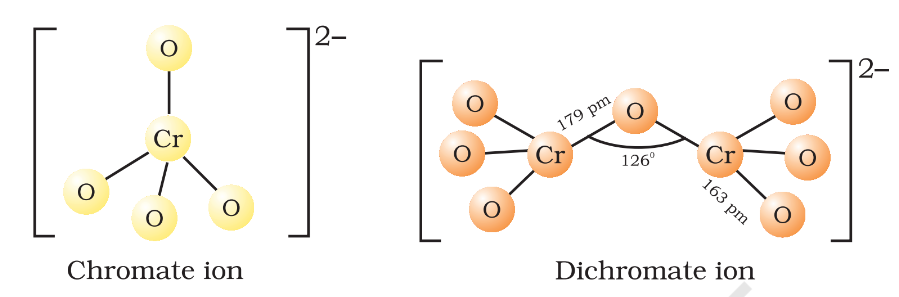
Chromate–Dichromate Equilibrium and Oxidising Action
- Interconversion: pH controls the interconversion: acid favours dichromate, while alkali favours chromate. Chromium has the same oxidation state, , in both ions.
- Oxidant: In acid, dichromate is reduced to ; its standard reduction potential is .
- Oxidations: Acidified dichromate oxidises iodide to iodine, hydrogen sulphide to sulphur, tin(II) to tin(IV), and iron(II) to iron(III).
- Relative use: Sodium dichromate is more soluble and widely used as an organic oxidant; potassium dichromate is useful as a primary standard.
Potassium Permanganate
Preparation and Properties
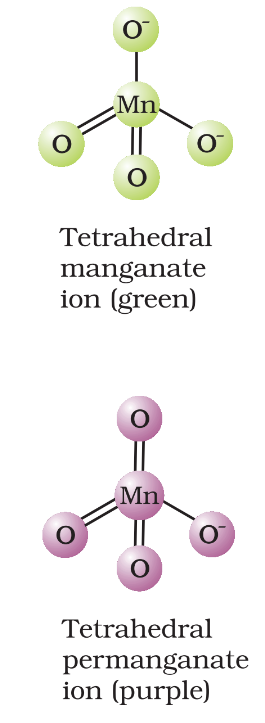
- Preparation: Alkaline oxidative fusion of with and an oxidant such as air or forms green manganate; electrolytic oxidation gives permanganate commercially.
- Disproportionation: Manganate changes to permanganate and manganese dioxide in neutral or acidic solution.
- Appearance and solubility: forms dark-purple, almost-black crystals; it dissolves to a limited extent (6.4 g per 100 g water at 293 K).
- Heating: At 513 K, it decomposes to potassium manganate, manganese dioxide and oxygen.
- Structure and magnetism: Manganate and permanganate ions are tetrahedral. Manganate has one unpaired electron and is paramagnetic; permanganate has none and is diamagnetic. Both have oxygen-to-manganese – bonding.
| Medium / product | Reduction half-reaction | |
|---|---|---|
| Manganate ion | ||
| Manganese dioxide | ||
| Manganese(II) ion |
Oxidising Action and Reaction Conditions
- Medium matters: Hydrogen-ion concentration controls the permanganate reduction product and therefore the oxidation reaction.
- Kinetics: Redox potential alone does not determine the observed rate. Oxidation of water by permanganate is extremely slow unless warmed or catalysed by manganese(II) ions.
- Acidic oxidations: Permanganate oxidises iodide to iodine, iron(II) to iron(III), oxalate to carbon dioxide, hydrogen sulphide to sulphur, sulphite to sulphate, and nitrite to nitrate.
- Neutral or faintly alkaline oxidations: Iodide becomes iodate; thiosulphate becomes sulphate; manganese(II) becomes manganese dioxide. Zinc sulphate or zinc oxide catalyses the last reaction.
- Caution: Permanganate titrations with hydrochloric acid are unsuitable because hydrochloric acid is oxidised to chlorine.
- Uses: It is an important analytical and preparative-organic oxidant, and is used to bleach textile fibres and decolourise oils.
The Inner Transition Elements: f-Block
| Point | Lanthanoids | Actinoids |
|---|---|---|
| Series | Fourteen elements following lanthanum; lanthanum is commonly included in discussion. | Fourteen elements following actinium; actinium is commonly included in discussion. |
| General symbol | Actinoid symbols are used individually. | |
| Chemistry | Closely similar elements; is the most stable oxidation state. | More complex chemistry, with a wider range of oxidation states and radioactivity-related study challenges. |
| Series members | Lanthanum through lutetium. | Thorium through lawrencium; actinium is included in general discussion. |
Lanthanoids
Electronic Configurations and Contraction
- Configuration: Lanthanoid atoms generally have and a progressively occupied subshell. Their most stable tripositive ions have configurations , where to .
- Lanthanoid contraction: Atomic and especially ionic radii decrease overall from lanthanum to lutetium.
- Cause: Increasing nuclear charge is incompletely shielded by added electrons; their shielding of one another is particularly poor.
- Regularity: The decrease is more regular for ions than for atomic radii. Contraction affects the chemistry and sizes of elements in the following transition series.
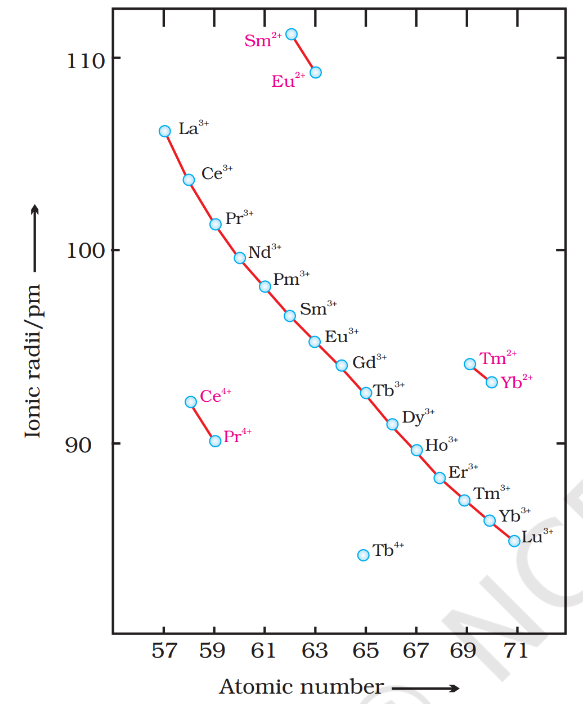
| Ion / element | Configuration or behaviour |
|---|---|
| Common state | predominates across the series. |
| Favoured by a noble-gas configuration; strong oxidant reverting to . ; its reaction with water is slow. | |
| Pr, Nd, Tb, Dy | Show in oxides . |
| configuration; strong reducing agent that tends to become . | |
| configuration; reducing agent. | |
| Has a half-filled subshell and is an oxidant. | |
| Samarium | Commonly shows both and , like europium. |
Physical and Chemical Properties
- Colour: Most tripositive lanthanoid ions are coloured because of -electron transitions; the absorption bands are narrow. and are colourless.
- Magnetism: Ions with partially filled subshells are generally paramagnetic. The and ions, including , , and , are exceptions.
- Ionisation enthalpies: First values are about and second values about . Empty, half-filled and full subshells contribute stability; the third ionisation enthalpies of La, Gd and Lu are unusually low.
- Reactivity: Early members are calcium-like and highly reactive; later members become more aluminium-like. The reduction potentials are usually to (Eu: ).
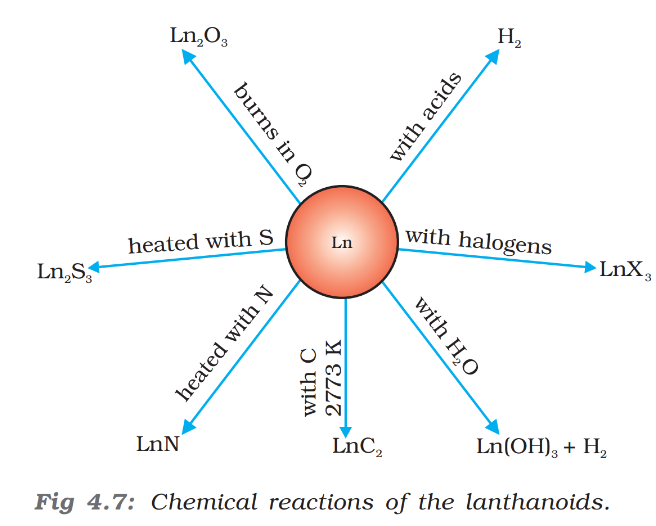
- Reactions: Lanthanoids form hydrides on gentle heating in hydrogen; carbides with carbon; halides with halogens; and oxides and hydroxides . They liberate hydrogen from dilute acids.
- Hydroxides: are definite compounds, not merely hydrated oxides, and are basic like alkaline-earth hydroxides.
Actinoids
Electronic Configurations and Contraction
- Configuration: Actinoid atoms generally contain and variably occupied and subshells. Electrons are formally added to ; filling proceeds from protactinium, reaching at lawrencium.
- Irregularities: Configurations reflect extra stability of , and arrangements. Examples: Am is ; Cm is .
- Bonding: Unlike the more deeply buried orbitals, orbitals can participate substantially in bonding.
- Actinoid contraction: Atomic and ionic sizes generally decrease across the series. The contraction is greater than in lanthanoids because electrons shield nuclear charge poorly.
| Elements | Oxidation states |
|---|---|
| Ac | |
| Th | |
| Pa | |
| U | |
| Np and Pu | |
| Am | |
| Cm | |
| Bk through Lr |
Oxidation States, Reactivity and Comparison
- Range of states: Actinoids generally show , but the early members show more higher oxidation states because , and levels have comparable energies.
- Maximum state: It rises from in Th to in Pa, in U and in Np, then generally declines among later members. The state is more common than overall.
- Hydrolysis: Both and actinoid ions tend to hydrolyse; oxidation-state patterns are too uneven for a single simple series-wide description.
- Reactivity: Finely divided actinoids are highly reactive. Boiling water produces a mixture of oxide and hydride; many non-metals react at moderate temperatures.
- Acids and alkalis: Hydrochloric acid attacks all actinoids. Nitric acid affects most only slightly because protective oxide layers form; alkalis have no action.
- Magnetism: Magnetic behaviour is more complex than in lanthanoids. Susceptibility roughly follows the number of unpaired electrons, but lanthanoids have higher values.
- Bonding tendency: Early actinoid ionisation enthalpies are lower than those of early lanthanoids; less deeply penetrating electrons are more shielded and more available for bonding.
- Series comparison: Lanthanoid-like behaviour becomes clearer in the second half of the actinoid series. Both series show similarities among neighbours and gradual changes where oxidation state stays constant.
Why is actinoid contraction greater than lanthanoid contraction?
Name a lanthanoid well known to exhibit the oxidation state.
Why is hydrochloric acid unsuitable for permanganate titrations?
Quick recap
- Higher transition-metal oxides tend to be more covalent and acidic; oxide character varies with oxidation state.
- Chromate and dichromate interconvert with pH; acidified dichromate is a strong oxidant, and potassium dichromate is a primary standard.
- Permanganate is a powerful oxidant whose reduction product depends on the reaction medium.
- Lanthanoids usually form ions, show -based colour and magnetism, and contract in size from La to Lu.
- Actinoids have variable configurations, a wider range of oxidation states and a greater contraction across the series.
- Poor shielding by and electrons explains the respective lanthanoid and actinoid contractions.
The Lanthanoids, The Actinoids
Applications of d- and f-Block Elements
- Steels: Iron oxides are reduced, impurities removed, and carbon or alloying metals such as , and added to make construction steels.
- Special-purpose compounds: Titanium monoxide () is used as a pigment; manganese dioxide () is used in dry battery cells.
- Batteries: The battery industry uses and nickel–cadmium () systems.
- Coinage: Group metals are known as coinage metals. Modern UK copper coins are copper-coated steel; silver-coloured coins are a alloy. and are largely restricted to collection items.
- Photography: Silver bromide () is used for its light-sensitive properties.
| Catalyst | Use |
|---|---|
| Catalyses oxidation of in sulphuric acid manufacture. | |
| with | Forms Ziegler catalysts used to manufacture polyethylene (polythene). |
| Iron | Catalyses ammonia production from mixtures in the Haber process. |
| Nickel | Catalyses hydrogenation of fats. |
| Catalyses the Wacker oxidation of ethyne to ethanal. | |
| Nickel complexes | Help polymerise alkynes and other organic compounds, including benzene. |
Position and General Features of the d- and f-Blocks
- d-block: Occupies the middle of the periodic table, in Groups –; the inner orbitals are progressively filled.
- f-block: Placed separately at the bottom of the periodic table; the and orbitals are progressively filled.
- Transition series: Three recognised series correspond to progressive filling of the , and orbitals.
- Metallic properties: Transition elements typically have high tensile strength and show ductility, malleability, good thermal and electrical conductivity, and metallic character.
- High melting and boiling points: Strong interatomic bonding involves electrons. Many properties peak near the middle of a series, where one unpaired electron per orbital favours strong interactions.
Characteristic Properties of Transition Elements
- Variable oxidation states: Successive ionisation enthalpies rise less steeply than in main-group elements, so different numbers of electrons can be lost.
- Distinctive behaviour: Participation of electrons contributes to paramagnetism, catalytic activity, coloured ions, complex formation and interstitial compounds.
- Chemical reactivity: Many transition metals dissolve in mineral acids, while a few are noble. In the first transition series, all metals except copper are relatively reactive.
- Binary compounds: Transition metals react with non-metals such as oxygen, nitrogen, sulphur and halogens.
- Oxides: First-series transition-metal oxides commonly form when metals react with oxygen at high temperatures. They can dissolve in acids or bases to form oxometallic salts.
| Compound | Preparation source or note |
|---|---|
| Potassium dichromate () | Prepared from chromite ore by fusion with alkali in air, followed by acidification of the extract. |
| Potassium permanganate () | Prepared using pyrolusite ore (). |
- Strong oxidising agents: Dichromate () and permanganate () ions are strong oxidising agents.
Lanthanoids and Actinoids
- Inner transition elements: Lanthanoids and actinoids are the two -block series, involving progressive filling of inner orbitals.
- Lanthanoid contraction: Atomic and ionic sizes gradually decrease across the lanthanoid series as the orbitals fill; this affects the chemistry of elements that follow.
- Lanthanoid properties: Lanthanum and the lanthanoids are generally soft, white metals. They react readily with water to form solutions containing ions.
- Lanthanoid oxidation states: The principal oxidation state is ; some lanthanoids occasionally show or states.
- Actinoids: Their chemistry is more complex because they can have different oxidation states. Many are radioactive, making them difficult to study.
What is lanthanoid contraction, and why is it important?
What are the main oxidation states of lanthanoids?
Quick recap
- The -block occupies Groups –; the -block is placed separately at the bottom of the periodic table.
- Transition elements have typical metallic properties, including high tensile strength, and show variable oxidation states, paramagnetism, catalytic activity, coloured ions, complex formation and interstitial compounds.
- Dichromate and permanganate ions are strong oxidising agents.
- Lanthanoid contraction is the gradual size decrease across the lanthanoid series as the orbitals fill.
- Lanthanoids mainly form ions; actinoid chemistry is complex and many actinoids are radioactive.
- Applications include steels, batteries, catalysts, pigments and photography.