Class 12 PCB . Chemistry . Chemistry Part I . Chemical Kinetics
Chapter 3: Chemical Kinetics
Ch 3
Chemistry
Class 12 PCB
Rate Of A Chemical Reaction
Chemical Kinetics and Reaction Rate
- Chemical kinetics: Studies reaction rates, the factors that affect them, and reaction mechanisms.
- Reaction rate: Describes how quickly reactants are consumed or products are formed over time.
Reaction Rates: Fast, Moderate and Slow
| Rate category | Example | Note |
|---|---|---|
| Fast | Instant precipitation of silver chloride when aqueous silver nitrate and sodium chloride are mixed | Ionic reactions can be very rapid. |
| Moderate | Inversion of cane sugar; hydrolysis of starch | Proceeds neither instantaneously nor extremely slowly. |
| Slow | Rusting of iron in air and moisture | May take a long time to become evident. |
Meaning and Sign of Reaction Rate
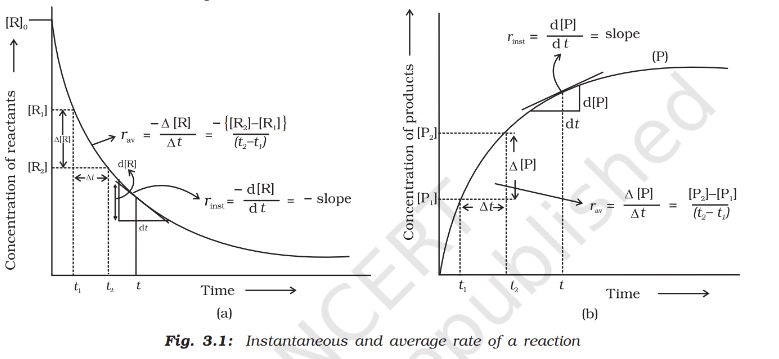
Rate of a reaction — The change in concentration of a reactant or product per unit time.
The negative sign makes the rate positive because reactant concentration decreases; product concentration increases.
Units and Average Rate
Units and changing rates
- Units: Rate has units of concentration divided by time, such as .
- Gas reactions: When gas concentration is expressed as partial pressure, rate units can be .
- Average rate: It is calculated over a finite time interval and depends on the interval selected.
- Changing rate: During butyl chloride hydrolysis, the average rate decreases from to over the listed intervals.
Instantaneous Rate
Instantaneous rate — The reaction rate at a particular moment, found as the average rate when the time interval approaches zero.
As , the average rate becomes the instantaneous rate.
Finding a rate from a graph
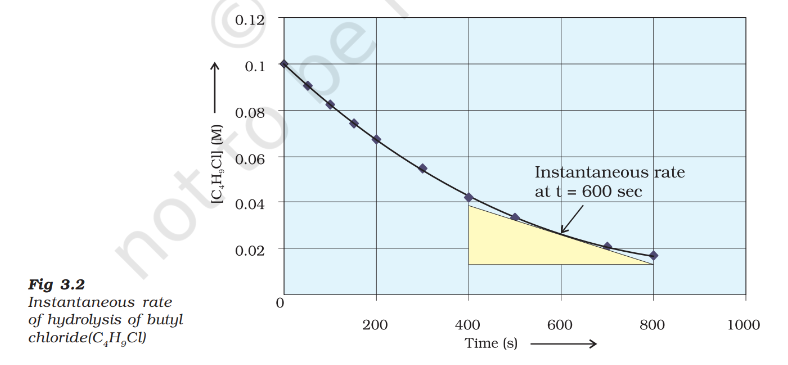
- Method: Draw a tangent to the concentration–time curve at the required time; calculate its slope.
- Reactant curve: The tangent slope is negative, so reverse its sign to give the positive reaction rate.
- Example: For butyl chloride at , .
Rate and Stoichiometric Coefficients
Equal and unequal coefficients
- Equal coefficients: For , reactant disappearance rates equal product appearance rate.
- Unequal coefficients: Divide each species' concentration-change rate by its stoichiometric coefficient to obtain one common reaction rate.
- Signs: Use a negative sign for reactants, which are consumed, and a positive sign for products, which are formed.
For , divide each species' rate of change by its coefficient.
HI is consumed twice as fast as either product forms, so its rate of disappearance is divided by .
Rates in Terms of Partial Pressure
Gaseous reactions
- At constant temperature: Gas concentration is directly proportional to its partial pressure.
- Therefore: A gaseous reaction rate can also be expressed as the rate of change of reactant or product partial pressure.
Worked Rate Example: Nitrogen Pentoxide
The coefficient for must be included when calculating the common reaction rate.
Calculated rates
- Average rate: .
- NO₂ production: Its formation rate is four times the common reaction rate: .
- Reactant disappearance rate carries a minus sign; product appearance rate carries a plus sign.
- For a balanced reaction, divide each species' concentration-change rate by its stoichiometric coefficient to obtain the common rate.
Quick recap
- Chemical kinetics studies reaction rates, reaction mechanisms and factors affecting rates.
- Reaction rate is concentration change per unit time; use a negative sign for reactant disappearance.
- Average rate applies over a finite interval; instantaneous rate is the limit as the interval tends to zero.
- Tangent slope on a concentration–time graph gives the instantaneous rate at that time.
- Stoichiometric rule: Divide each species' rate of change by its balanced-equation coefficient to obtain the common reaction rate.
- Units are concentration per time, commonly ; gas rates may use partial pressure per time.
Factors Influencing Rate Of A Reaction
Factors Influencing Reaction Rate
Reaction rate — Reaction rate depends on experimental conditions, including reactant concentration (or gas pressure), temperature and catalysts.
- Concentration: Increasing reactant concentration generally increases the rate; as reactants are consumed, the rate generally falls.
- Gases: Pressure changes the effective concentration of gaseous reactants.
- Other factors: Temperature and catalysts also influence reaction rate.
Rate Law and Rate Expression
Rate law — A rate law expresses the reaction rate in terms of reactant concentrations at a fixed temperature; it is also called the rate equation or rate expression.
For the reaction , the concentration powers are experimentally determined; is the rate constant.
Finding the Rate Law Experimentally
| Experiment | Initial [NO] (mol L⁻¹) | Initial [O₂] (mol L⁻¹) | Initial rate (mol L⁻¹ s⁻¹) |
|---|---|---|---|
| 1 | 0.30 | 0.30 | 0.096 |
| 2 | 0.60 | 0.30 | 0.384 |
| 3 | 0.30 | 0.60 | 0.192 |
| 4 | 0.60 | 0.60 | 0.768 |
The experimental rate law is second order in and first order in ; here the powers happen to match the reactant coefficients.
- Determine experimentally: A rate law cannot generally be predicted from the balanced chemical equation alone.
- Examples: has ; ester hydrolysis can have .
Order of a Reaction
Order of a reaction — The order is the sum of the powers of reactant concentrations in the experimentally determined rate law.
- Individual order: In , and are the orders with respect to and .
- Overall order: for this rate law.
- Possible values: Order may be zero, an integer or a fraction; a zero-order rate is independent of reactant concentration.
| Rate law | Overall order |
|---|---|
Elementary and Complex Reactions
Elementary reaction — An elementary reaction occurs in a single step.
- Complex reaction: A sequence of elementary steps forms the products; the overall balanced equation does not reveal the mechanism.
- Patterns: Complex reactions can include consecutive, reverse or side reactions.
- Examples: Ethane oxidation proceeds through intermediates such as alcohol, aldehyde and acid; phenol nitration forms ortho- and para-nitrophenol.
Molecularity
Molecularity — Molecularity is the number of atoms, ions or molecules that must collide simultaneously in an elementary reaction.
| Type | Species colliding | Example |
|---|---|---|
| Unimolecular | 1 | |
| Bimolecular | 2 | |
| Trimolecular (termolecular) | 3 |
- Collision limit: Simultaneous collisions among more than three species are very unlikely; termolecular reactions are rare and often slow.
- Complex reactions: Even an equation with many reactant species usually proceeds through several elementary steps, not one simultaneous collision.
| Point | Order | Molecularity |
|---|---|---|
| Meaning | Sum of concentration powers in the rate law | Number of species in an elementary-step collision |
| How obtained | Experimental | From the elementary step |
| Possible values | Zero, integer or fraction | Positive integer only |
| Applies to | Elementary and complex reactions | Elementary reactions only |
Rate Constant and Its Units
Rate constant — The rate constant is the proportionality constant in a rate law; its units depend on the overall reaction order.
For rate units of concentration per time and overall order , concentration is in and time in .
| Order | Units of |
|---|---|
| Zero | |
| First | |
| Second |
Rate-Determining Step and Reaction Mechanism
Rate-determining step — The slowest step in a multistep reaction mechanism controls the overall reaction rate.
Intermediate — An intermediate is formed in one step and consumed in a later step, so it does not appear in the overall reaction equation.
The first elementary step is slow and determines the rate; is the intermediate.
- Order and mechanism: Order is experimental and applies to elementary or complex reactions; molecularity applies only to an elementary step.
- Complex reaction: In the treatment of this chapter, its order is associated with the slow step; the slow step's molecularity corresponds to that order.
Integrated Rate Laws
- Differential rate law: Gives rate as a function of concentration; instantaneous rate is obtained from the slope of a tangent on a concentration–time graph.
- Integrated rate law: Relates concentration at measured times to ; its form depends on reaction order.
Zero-Order Reactions
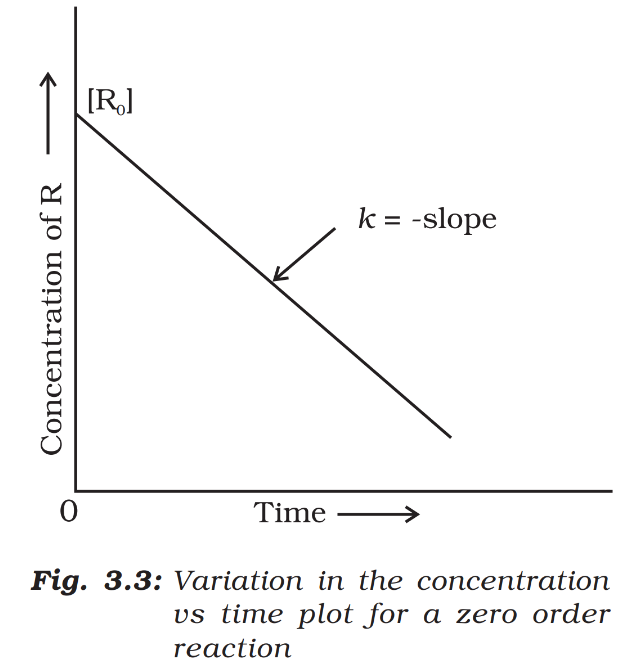
Zero-order reaction — A zero-order reaction has a rate independent of reactant concentration.
For , is the initial concentration and is the concentration after time .
Use when initial and later reactant concentrations are known.
- Linear plot: versus is a straight line with slope and intercept .
- Examples: Some enzyme-catalysed and metal-surface reactions; at high pressure, ammonia decomposes on hot platinum because the catalyst surface becomes saturated.
First-Order Reactions
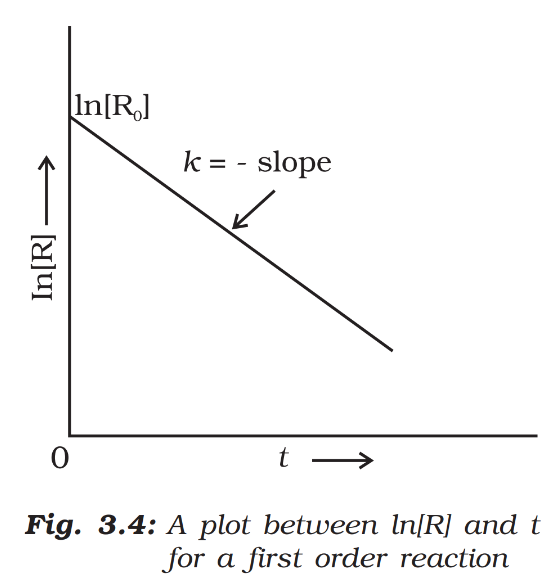
First-order reaction — A first-order reaction has a rate proportional to the first power of reactant concentration.
For , is the initial concentration and is the concentration after time .
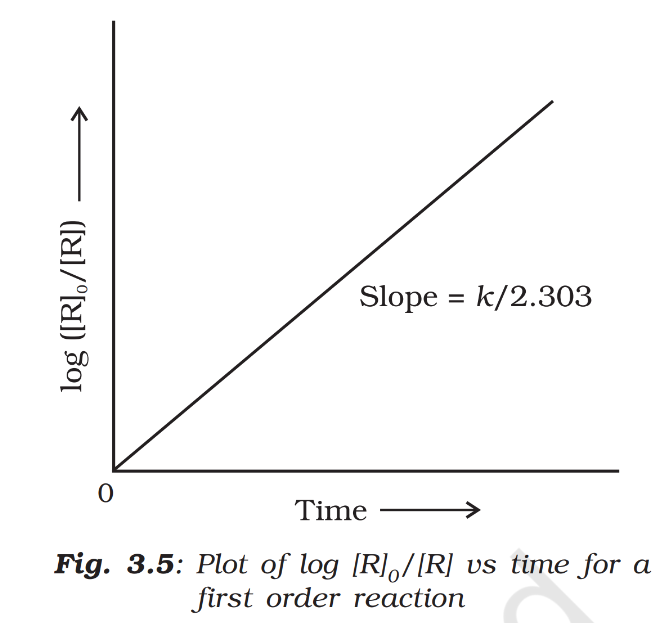
Use this form with common logarithms.
Use concentrations and measured at times and .
- Linear plots: versus has slope ; versus has slope .
- Examples: Radioactive decay, decomposition of and , and the stated hydrogenation of ethene, with .
First-Order Reactions Using Gas Pressure
- Reaction pattern: For , let be the initial pressure of and the total pressure at time .
- Reactant pressure: If pressure decreases by , then and .
Use when one gaseous reactant forms two gaseous products in a stoichiometric pattern.
Example: pressure data for nitrogen pentoxide decomposition
- Data: For , and after .
- Reactant pressure: Stoichiometry gives .
- Result: Applying the first-order pressure equation gives .
Half-Life
Half-life — Half-life, , is the time required for a reactant concentration to fall to half its initial value.
| Order | Half-life | Dependence on initial concentration |
|---|---|---|
| Zero | Directly proportional to | |
| First | Independent of |
- Completion time: In a first-order reaction, completion takes half-lives.
Pseudo-First-Order Reactions
Pseudo-first-order reaction — A higher-order reaction that appears first order because one reactant is present in large excess is called pseudo-first-order.
- Why it appears first order: The excess reactant concentration changes negligibly, so its concentration is effectively included in the observed rate constant.
- Ethyl acetate hydrolysis: The actual reaction is second order, but excess water keeps its concentration nearly constant; the observed rate depends mainly on ethyl acetate.
- Cane-sugar inversion: In excess water, the observed rate is .
For , what is the overall order?
A second-order reaction's reactant concentration is tripled. By what factor does its rate change?
A first-order reaction has . Find .
Quick recap
- Reaction rate depends on concentration or gas pressure, temperature and catalysts.
- Rate-law powers are determined experimentally; reaction order is their sum.
- Order can be zero or fractional, while molecularity is a positive integer for an elementary step only.
- The slowest step controls the rate of a multistep reaction; intermediates are formed and then consumed.
- Zero-order kinetics: and .
- First-order kinetics: and .
- Excess concentration of a reactant can make a higher-order reaction behave as pseudo-first-order.
Temperature Dependence Of The Rate Of A Reaction
Temperature and Reaction Rate
- Temperature: Changing temperature affects the rate of a chemical reaction; most reactions proceed faster at higher temperatures.
- Rate constant: Its temperature dependence helps explain how reaction rates change with temperature.
Arrhenius Equation and Activation Energy
The rate constant depends exponentially on temperature and activation energy.
Activated Complex and Molecular Energy Distribution
Maxwell–Boltzmann Energy Distribution
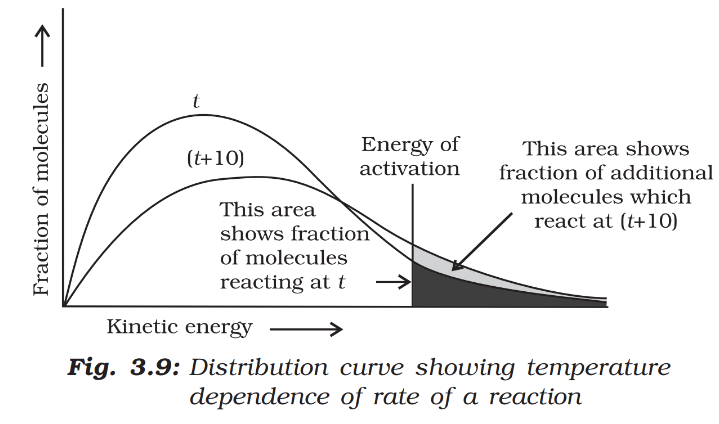
- Distribution: Maxwell and Boltzmann described molecular kinetic energies statistically; is the fraction of molecules with energy .
- Peak: The curve’s peak gives the most probable kinetic energy, possessed by the largest fraction of molecules.
- Temperature increase: The peak shifts to higher energy and the curve broadens, increasing the fraction of high-energy molecules.
- Area: The area under each distribution curve remains constant because the total fraction of molecules is .
- Activation energy: At higher temperature, more molecules have energy at least equal to and can potentially react.
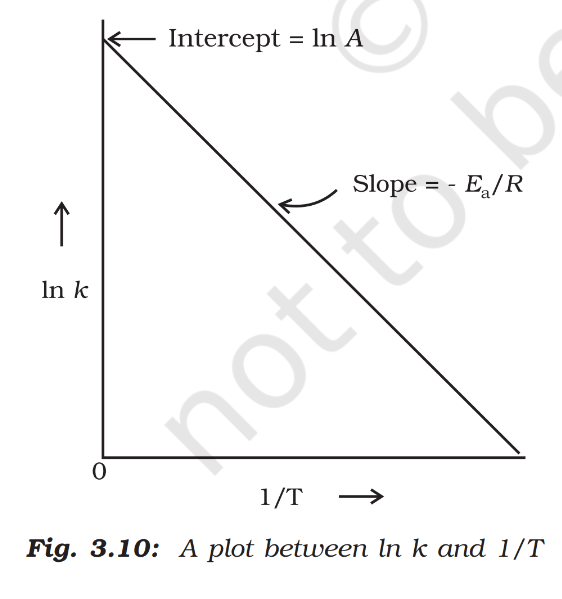
Arrhenius Plots and Two-Temperature Equation
Use this form to determine and from an Arrhenius plot.
Use when rate constants are known at two temperatures; and must be in kelvin.
Using the Two-Temperature Equation
- Match each rate constant to its corresponding temperature, keeping temperatures in kelvin.
- Substitute the known values into the two-temperature equation and solve for the unknown.
- To find another unknown, substitute known values into the Arrhenius equation to calculate or a new .
Illustrative Arrhenius Calculations
- Finding and : For at and at , and .
- Finding a new rate constant: For ethyl iodide decomposition, at and give at .
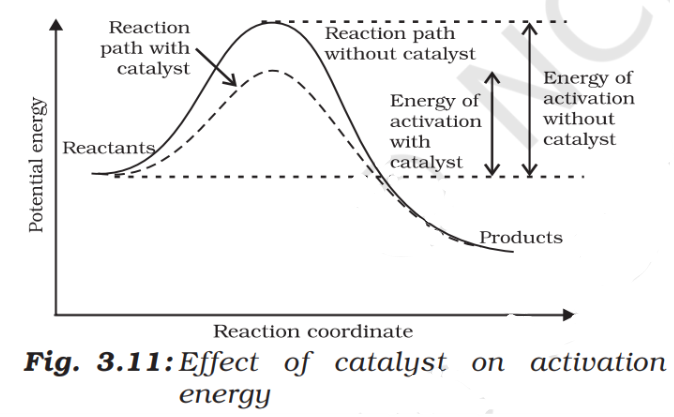
Catalysts and Activation Energy
Collision Theory
For a bimolecular reaction, this expression accounts for collision frequency and the energy needed to react.
The steric factor accounts for the correct orientation required for effective collisions.
| Factor | Arrhenius description | Collision-theory description |
|---|---|---|
| Energy | The exponential term accounts for molecules overcoming . | Collisions need sufficient energy to meet the threshold. |
| Orientation | Not shown explicitly in the basic equation. | accounts for correct orientation. |
| Frequency | is the pre-exponential factor associated with collision frequency. | is the collision frequency for and . |
What happens to the rate constant when temperature increases?
How does a catalyst affect reaction rate and equilibrium?
Quick recap
- The Arrhenius equation is ; increasing temperature or lowering activation energy increases .
- An Arrhenius plot of against has slope and intercept .
- At higher temperature, a greater fraction of molecules has energy at least equal to .
- A catalyst provides an alternate lower-energy pathway and speeds attainment of equilibrium without changing it.
- Effective collisions require sufficient energy and suitable orientation; the steric factor accounts for orientation.
- Collision theory treats molecules as hard spheres and is less reliable for complex molecules.